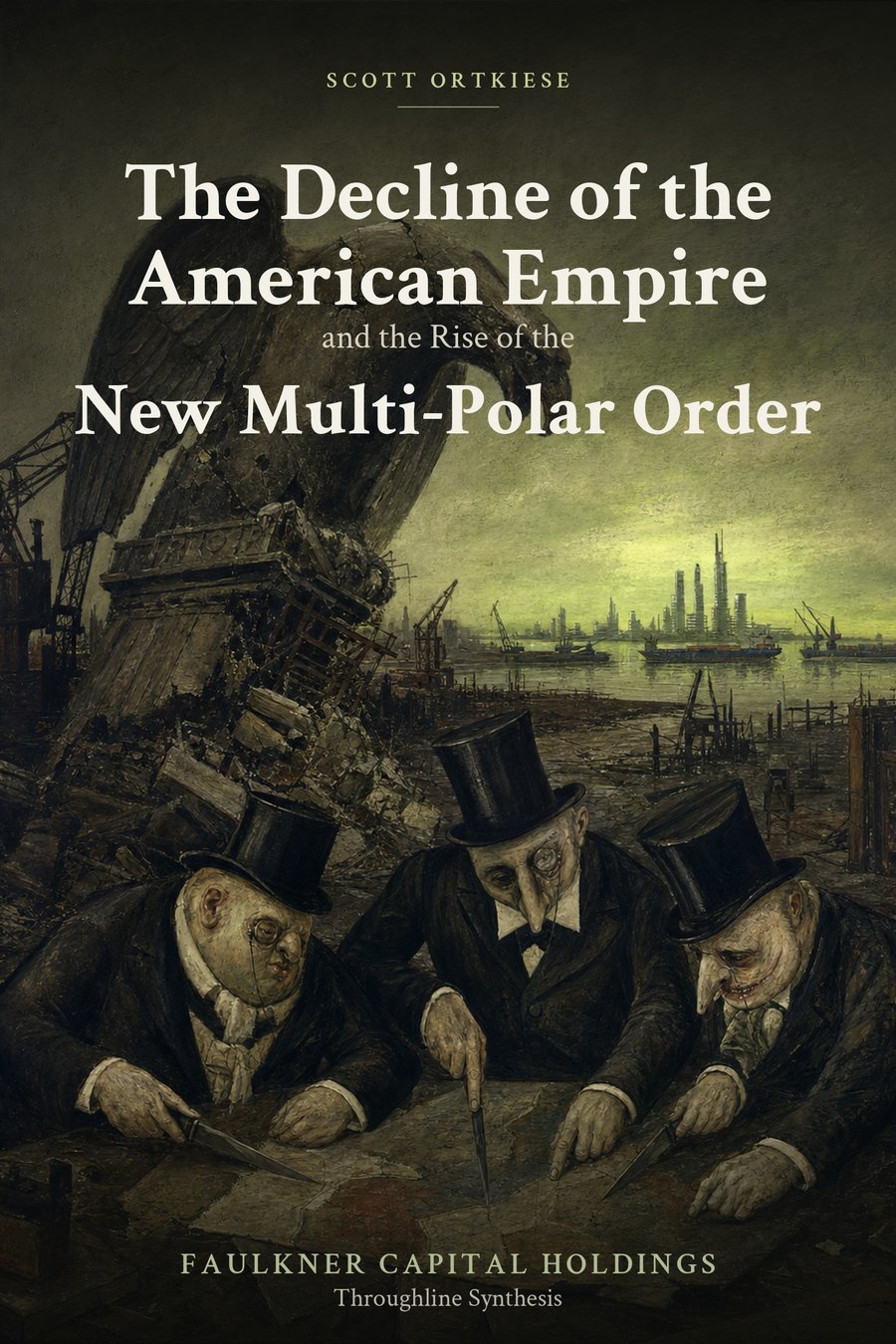
A book by Scott Ortkiese
The Decline of the American Empire and Rise of the New Multi-Polar Order
Manuscript complete October 2026. Three years of work and several thousand pages of research behind it.
Empires do not disappear from the map. They disappear from the mind first, and only then from the map.
From the Introduction
An excerpt. The complete Introduction appears in the finished book.
The American Century ended before most Americans noticed. It did not end on a battlefield, because on the battlefields where it was tested against serious adversaries in this century it lost or drew, and lost or drew again, and the country continued about its business as if losing were a rounding error. It did not end in a treaty room, because the empire never signed the surrender documents that the empires of the twentieth century, at least the ones that were beaten cleanly, had the discipline to sign. It ended by attrition: through repeated demonstrations that the American state could no longer coerce, cajole, or persuade the rest of the world into arrangements it declared to be indispensable, and through the growing willingness of the rest of the world to build the arrangements it needed without American permission. This book is about the years in which that ending became visible.
The book is also about what is coming next, because the interesting question is not whether the American empire has declined, which is now beyond serious dispute, but what is arriving in its place and how the transition is being managed by the parties that stand to lose the most from it. The multi-polar order that is now taking shape, with China, Russia, India, Brazil, the states of the Gulf, and the ten states of ASEAN as its load-bearing structures, is not a Western nightmare. It is the ordinary condition of the international system for most of recorded history. Unipolar moments are rare. American unipolarity lasted roughly a generation, from the collapse of the Soviet Union in 1991 to the joint Russian and Chinese declaration of a strategic partnership without limits in February 2022, and its passage into history is neither a tragedy nor a triumph. It is a fact. The question this book puts to the reader is what the fact requires of us, as citizens of the state that is losing its primacy, and what it will cost, in blood and treasure and moral standing, to pretend the fact is not a fact.
I write this book at the moment of transition. On February 28, 2026, the United States and Israel, acting as two rogue regimes outside the Rule of Law, jointly launched an unprovoked war of aggression against the sovereign nation of Iran that had neither congressional authorization nor United Nations Security Council authorization, that assassinated the head of a sovereign state during active nuclear reduction negotiations, and that has continued through the summer of 2026. The genocide in Gaza continues. The Ukraine war grinds into its fifth year with a negotiated settlement rejected by Washington and its European clients at every serious opportunity. The Pentagon has submitted the largest single-year defense budget request in American history, 1.5 trillion dollars, an increase of 44 percent over the current base. Ten separate war-powers votes have failed in the Congress since February 28, defeated in each case by the same alignment of members whose primary campaigns depend on the same handful of donor networks. These are not disconnected events. They are the same event, viewed from different vantage points. They are the ways an empire in decline reaches for coercion when consent has failed.
The argument of this book is that the decline of the American empire and the rise of the multi-polar order are the same phenomenon, seen from opposite sides of the ledger, and that the transition is being actively resisted by a narrow confederation of financial, technological, and military interests that have captured the American state and that intend to extract every remaining dollar of rent from the imperial arrangement before the arrangement collapses under them. The extraction is not a byproduct of the decline. It is the mechanism by which the decline accelerates, because every dollar extracted for private benefit is a dollar removed from the public capacity that would be required to manage a graceful transition. The war with Iran is not a strategic aberration. It is the extraction machine operating at full throttle, converting American treasure, American law, and American credibility into revenue for a handful of contractors, super PACs, and executive-branch loyalists while the rest of the country pays the fuel bill and buries the dead.
I am not a credentialed academic. I am a citizen who has spent forty years in structured finance and capital markets, who has watched from a professional vantage point the transformation of the American state into an instrument of private extraction, and who has concluded that the transformation is now advanced enough that a public reckoning is required.
One Note on Language
I use the word war to describe a war. I use the word genocide to describe a genocide. I use the word murder to describe the killing of a head of state during ongoing negotiations. I use the phrase rogue regime to describe a government that conducts an unprovoked act of aggression against a sovereign nation, outside the Rule of Law, and that includes both the United States and the State of Israel in their conduct since February 28, 2026. I use the word war criminal to describe a person against whom an International Criminal Court warrant has been issued for war crimes and crimes against humanity, and I use it against the American president whose conduct meets the same threshold.
I do not use the euphemisms that have been developed over the last generation to soften these words. I do not describe the bombing of Iran as an operation or a strike. I do not describe the genocide in Gaza as a war or a conflict or a crisis. I do not describe the assassination of Ali Khamenei as a targeted killing. The euphemisms are how the empire launders its conduct through the language it controls. This book will not participate in the laundering.
Language is where empire begins, and language is where the reckoning must begin. If the reader is uncomfortable with the words, I ask the reader to sit with the discomfort long enough to consider whether the words describe the conduct accurately. If they do, the discomfort is the appropriate response, and the euphemisms that have concealed the conduct are what the reader should have found intolerable long before this book was written.
The book is about a country I love, in the moment of its decline. The love is not incidental to the argument. The argument is only meaningful because the country is worth the reckoning. What comes next is not the end of the country. It is the end of the empire. Those are not the same thing, and the book will spend its final pages insisting that they are not, and that the citizen who understands the difference is the citizen who will have something worth doing when the empire is gone.
—
How the book is built
Four parts, sixteen chapters.
Part One. The Decline. The erosion of American primacy across five dimensions: the military record against serious adversaries since 2001 and the industrial base behind it; the hollowing out of manufacturing, the shipyards, and the machine-tool base; the weaponization of the dollar system and the de-dollarization it provoked; the systematic breach of international law and the collapse of American standing to invoke it; and the record of failed negotiations from Minsk to Istanbul to Vienna.
Part Two. The Rise. The multi-polar order taking shape: the expansion of BRICS and the institutional architecture being built to substitute for the American-led financial order; the Belt and Road Initiative at its current maturity; the emerging Gulf and ASEAN security architectures; and the Russian and Chinese strategic partnership that sanctions accelerated rather than retarded.
Part Three. The Extraction. The machinery by which the American state has been converted into an instrument of private rent: the donor networks that captured the legislature; the war-funding ledger in detail, including the Iran-war supplemental, the reconciliation carve-out, the base defense request, and the classified black line inside it; and the parallel private-sector policy apparatus calling itself Pax Silica.
Part Four. The Reckoning. What a serious response would look like: how a captured country might begin to organize itself out of the arrangements, why the two major parties as currently constituted are incapable of it, what a serious American multi-polar posture would require relinquishing, and what is owed to the people already killed in the wars of the transition.
What the book owes
Paul Kennedy, for the framework of imperial overstretch. Thomas Piketty, for the accounting of what happens when returns on capital outrun growth. Andrew Bacevich, for the diagnosis of the national security state as an autonomous interest that manufactures its own justification.
Hear when the book publishes
The manuscript is complete in October 2026. Leave an email address and you will get one message when the book is available, and nothing else. No newsletter, no forwarding, no third parties.
The research behind it
The argument in this book has been worked out in public. What follows is the archive on this site, arranged by the chapter it feeds.
Part One. The Decline.
Chapter 1. The Military Dimension
The record against serious adversaries since 2001, and the industrial base behind it.
- Patriot Missile Myths, Proxy Wars, and the Capture of Western Foreign Policy by the Tech Oligarchs
- Russia and Ukraine: The Forever War
- Analysis: The Russia-Ukraine Forever War
- The Nuclear Ladder: How America’s Attack on Putin’s Residence Pushed Us to the Brink, And Why You Were Never Told
- Strategic Chaos or Chaotic Strategy? Analyzing Trump’s Approach to NATO Restructuring Through the Greenland Crisis
- Ten Irrefutable Truths: How the West Engineered Ukraine’s War
- The Ukraine-Russia War: No Victory for Anyone
Chapter 2. The Industrial Dimension
The hollowed-out manufacturing base, the shipyards, and the machine tools.
- How France’s Nuclear Commitment Created Industrial Advantage While Its Neighbors Self-Destructed
- The Consulting-Industrial Complex: How McKinsey, BlackRock, and the ESG Cartel Engineered Irreversible Industrial Destruction for Profit
- Drill Baby, Drill: Why Geology and Physics Will Determine the AI Century
- The Climate Hoax, Europe’s Industrial Base Was Dismantled Before the World’s Eyes, While the Press Said Nothing
- Nobody’s Watching: The Physical, Cyber, and Human Failures Hiding Inside Critical Infrastructure
- The Aluminum Pearl Harbor: Trump and Netanyahu Sank America’s Industrial Fleet
- The Data Sovereignty Trap: Why America’s AI Infrastructure Bet May Miss the Point Entirely
Chapter 3. The Financial Dimension
The weaponised dollar, the sanctions that provoked de-dollarisation, and the markets built on the arrangement.
- The Glasshouse Empire War, Debt, and the Petrodollar’s Last Stand
- The Replacement Is Already Here: What the Petrodollar’s Successor Means for Every American
- The Petrodollar Trap: How the Iran War Threatens to Collapse the Financial Architecture of the American Empire
- Five Damned Good Reasons the Loss of the Petrodollar Means the Death of the American Empire
- The Death Warrant for the Petrodollar and America’s AI Future, Signed by Trump and Netanyahu
- Never Is Hope So Pure As In The Certainty Of Loss: UAE’s OPEC Exit and the Structural Dissolution of the Petrodollar
- How the Tehran and Delhi Settlements Expose a Petrodollar Already Gone, Gone, Gone, Taking the Bellicose American Empire With It.
Chapter 4. The Legal Dimension
The systematic breach of international law, and the loss of standing to invoke it.
- Who Authorized This War?
- America, Wake Up: Your Government Ran a Terror Campaign in Iran Last Month
- How to Legalize a War: Just Label Them A “Terrorist Organization”
- The Foundation for War Crimes: A Factual Record of Trump’s Iran War and Where It’s Going
- The Foundation for War Crimes: A Factual Record of Trump’s Iran War and Where It’s Going Part 2
- American Empire in Ruins: The Unprovoked, Unconstitutional, and Catastrophic US-Israeli War on Iran
- Trump Prices, Trump Lies
Chapter 5. The Diplomatic Dimension
Failed negotiations and spurned settlements, from Minsk to Istanbul to Vienna.
- The Strategic Stalemate: Why Negotiation Is the Only Path to Ukrainian Survival
- THE FORTY-DAY MASSACRE: How Boris Johnson Sabotaged Peace and Caused 1.3 Million Casualties for Personal Profit
- Germany’s Reckoning: Jeffrey Sachs Documents Three Decades of Diplomatic Deception on Russia and Ukraine
- The Adults in the Room: How Trump and Putin Conspire for Peace While the Children Throw Tantrums
- The Provocateurs Who Now Obstruct Peace: How the Architects of War Position Themselves Against Its Resolution
- Vassalage Diplomacy: How a US Ambassador Tried to Make Poland Grovel, And Failed Spectacularly
- Europe’s Sleepwalk Toward a Bigger War: Why Real Peace in Ukraine Requires a Pan‑European Settlement With Russia, Not Another Cosmetic Ceasefire
Part Two. The Rise.
Chapter 6. BRICS and the New Financial Architecture
The institutions being built to substitute for the American-led financial order.
Chapter 7. The Belt and Road at Maturity
The industrial corridors and the physical infrastructure now in place.
- The Real US Target in Iran, Is the Railroad, Not the Oil
- America Owns the Seas. So They’re Bombing Iranian and Chinese Railroads.
Chapter 8. Gulf and ASEAN Security Architectures
The realignments in the Persian Gulf and across Southeast Asia.
- Dear South Korea, You Have Been Diagnosed with a Fatal American Dependency Cancer
- The Gulf States Paid Washington to Destroy Them
- The Bahrain Parable: A Cautionary Tale for South Korea, Japan, Singapore, Indonesia, Malaysia, Vietnam, and Thailand
- Abu Dhabi, Not Tehran: The Barrel That Decides the Third Quarter
- South Korea’s Donghak Ants in a Burning House
Chapter 9. The Russia and China Partnership
The integration that sanctions accelerated rather than retarded.
- The Trillion Dollar Bill Is Not Yours: What the Western AI Buildout Means for Russia
- Why Russia’s Future Looks Less Precarious Than Washington’s
- Two Russias, One Reality: There is Only One Truth, and It Isn’t The West’s (or Trump’s)
Part Three. The Extraction.
Chapter 10. Capture of the Legislature
The donor networks, the money, and the arithmetic of the failed war-powers votes.
- Dan Crenshaw’s War on Shawn Ryan Exposed His 1,000% Congressional Wealth Explosion
- THE ADDICTION: Why Neither American Political Party Can Win Elections Without Secret Money
- The Parasite Class: How Neocons Morphed into the Uni-Party, Hijacked Foreign Policy, and Are Now Driving Us Toward Global Extinction
- The Irrelevance of King Trump and His Uniparty Jesters in Congress
- The Phantom Caucus: Why the Ukraine War Lobby is Losing the Midterms Before a Single Vote is Cast
- OBITUARY: U.S. Senator and Foul Little War Criminal, Lindsey Olin Graham, Dead at 71
- The Sound of Silence: Where is the “Established” Press on Crenshaw Threats and Money Making?
Chapter 11. The War-Funding Ledger
The supplemental, the carve-out, the base request, and the classified line inside it.
- The Business of War: How Defense-Funded Think Tanks Choose Which Interventions to Champion
- The Perpetual Market: How Ukraine, Iran, and Taiwan Became Line Items on a Cash‑Flow Statement
- Blood Profits: How the Uni‑Party Turned Ukraine into Its Latest Forever War
- Wagering Without Risk: How Washington and Tel Aviv Insiders Bombed Iran on the American Taxpayer’s Dime
- Where’s the Business Plan for Trump’s $200 Billion Iran “Ask”?
- The $100 Billion Wager: Why Trump Invaded Venezuela When Obama and Biden Wouldn’t
- From Peace Marchers to War Profiteers: How Europe’s Left-Green Establishment Betrayed Everything It Claimed to Stand For, And Why Five Countries Refuse
Chapter 12. The Executive Branch and Pax Silica
Unilateral war-making, and the private policy apparatus assembling itself alongside it.
- The Merger of the National Security State and Predatory Capital
- The Surveillance State Has No Friends, Only Targets
- Altman’s Desperation & The Shakedown Republic: How Trump and the AI Oligarchy Turned a Bubble Into a Protection Racket
- Larry Page Built Google on Public Funds, Then Fled California to Avoid the Wealth Tax He Funded Democrats to Support
- The Three Stooges: CIA, MI6, and Palantir Would Be Funny, If Nuclear War Were
- How the Tech Billionaires’ Cold War on China and Iran Is Consuming the American Empire
- The Architecture of Silence: Why America’s Think Tanks and Media Won’t Name the Forces Driving Us To War with China, Iran, and Russia
Chapter 13. The Household Bill
What the transition costs the people who never voted for it.
- A Illegal & Unnecessary War Turned A Shaky Economy Into A Shipwreck
- The Inflation Reckoning: How an Unlawful War on Iran Is Detonating Every US Price Indicator
- The Price You’re Paying and the People Who Set It
- America and Israel Just Bombed Their Own Gas Stations
- THE BILL COMES DUE: What Every American Will Pay for Washington’s War on Iran
- The Molecules of War: How Washington’s Persian Gulf Gamble Is Coming for Your Grocery Bill, Your Smartphone, and Your Economy
- How to Blow Up the World Order in 30 Days: Washington, Brussels, London and the $200 Oil Suicide Pact
Part Four. The Reckoning.
Chapter 14. The Domestic Political Question
Why the two parties as constituted cannot organise the country out of this.
- Get to the Streets: Shut the Iran War Down and Tell Trump and the Uniparty Imbeciles We Elected in Washington to Negotiate Peace Now
- An Open Letter to Every Incumbent Republican and Democrat: A Call to Arms for Every American Who Is Sick of the War Uniparty; We Want a Third Party!
- Kneecapping the Two-Party Uniparty After Trump’s Versailles Moment
- Blow Up the Uniparty
- A Propaganda Graphic, a LinkedIn Post, and the Two-Party Death Spiral
- The American People Are More Objective About President Trump’s Actions Than Democratic Party Leadership
- America’s Militant Democracy: How the Anti-Trump Establishment Became the Weimar Threat
Chapter 15. The International Question
What a serious American multi-polar posture would require relinquishing.
- The Self-Inflicted Collapse: How Trump Handed the World to Everyone Else
- The Hubris of Hegemony: Why the Neoconservative Approach to China Is Futile Lunacy
- The Last Blunder: How the US-Israel Attack on Iran Killed the American Empire’s Operating System
- America’s Suicidal Empire: The Iran War, the Death Spiral of a Failing Hegemon, and the World We Are Destroying
- Americans, Your World Just Got More Expensive and More Dangerous
- Trump’s Iran War, China Trip and the Vanishing Empire
- The G7’s Relevance Problem: How Russia, China, India, and South Korea See the Club They’re Not In
Chapter 16. The Moral Question
What is owed to the people already killed in the wars of the transition.
- How Yale Sold Its Prestige to Defense Contractors, Misled Congress on the Ukraine‑Russia War, and 800,000 Russians and Ukrainians Have Died, So Far
- The West Engineered 1.5 Million Casualties in Ukraine for Profit, and Your Trusted News Sources Are Lying About It
- The Atlanticists’ Russian-Hate Cult: Ten Truths About How the West Turned Ukraine Into a Graveyard to Weaken Russia
- The Western Press Won’t Report It: Ukraine’s Collapse and the Slaughter Underway
- US-Israeli Attack on Iran Will Trigger Starvation
- Famine Is Not Coming. It Is Here. This Is Not a Food Crisis. It Is a War Crime with a Harvest Date.
- Trump: Genocide on Truth Social