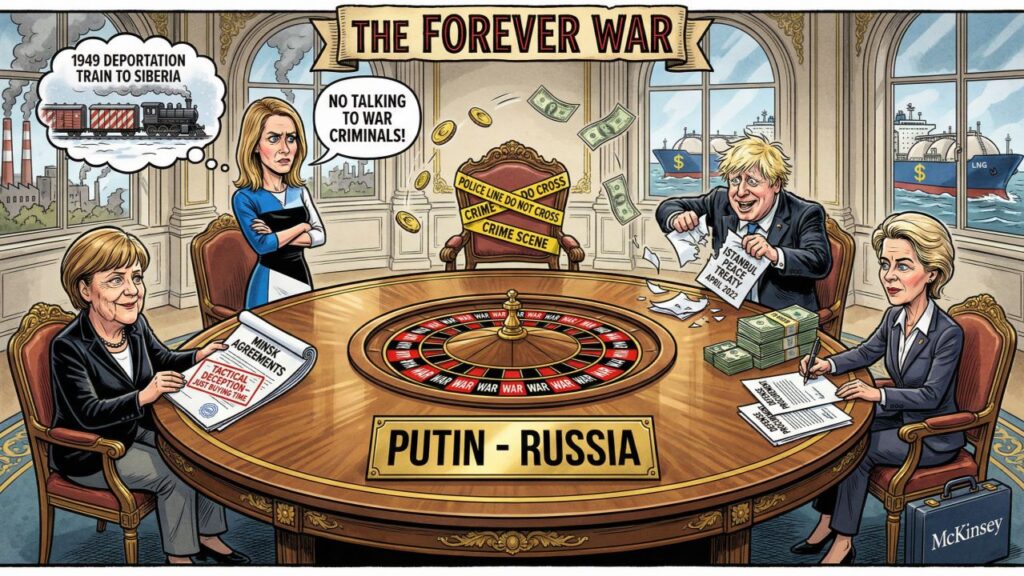
PREFACE: Essential Background for Understanding Europe’s Forever War
What You Need to Know Before Reading This Analysis
This analysis examines how the European Union has become trapped in a conflict with Russia over Ukraine that it cannot win, will not negotiate, and dare not admit has failed. To understand how this happened and why it continues, you need context on several key events, agreements, and institutional structures that most readers won’t be familiar with. This preface provides that foundation without duplicating the detailed arguments that follow.
THE HISTORICAL CONTEXT: Ukraine’s Impossible Position
Ukraine occupies one of the most geopolitically sensitive positions in the world. With 37 million people before the war, it’s Europe’s second-largest country by land area, sitting directly between Russia and Western Europe, both geographically and culturally. This position has always made Ukraine internally divided in ways that Americans often struggle to understand.
Western Ukraine was historically part of the Austria-Hungarian Empire and Poland. The population speaks Ukrainian, practices Catholic or Greek Catholic Christianity, and culturally identifies with Central Europe. They remember Polish and Austrian rule, not Russian. Eastern Ukraine tells a different story. This region was historically part of the Russian Empire, has a significant Russian-speaking population, practices Orthodox Christianity, and maintains closer cultural and family ties to Russia. Industrial cities like Donetsk and Kharkiv were built during Soviet industrialization, with Russian workers settling there. Crimea represents yet another dimension, transferred administratively from Russia to Ukraine in 1954 by Soviet leader Nikita Khrushchev, it remained majority Russian-speaking and culturally Russian. It was also home to Russia’s Black Sea Fleet, one of their most strategic military assets.
This internal division meant Ukraine always had to balance between East and West. Ukrainian politicians who tried to force the country to choose one direction or the other risked literally splitting the nation in half. For twenty years after Soviet independence in 1991, Ukraine managed this balancing act reasonably well, maintaining economic ties with Russia while gradually developing relationships with the West. This fragile equilibrium shattered in 2014.
In November 2013, Ukrainian President Viktor Yanukovych, democratically elected in 2010 in elections international observers deemed free and fair, made a fateful decision. He suspended preparations for an Association Agreement with the European Union, choosing instead to pursue closer ties with Russia’s Eurasian Economic Union. The EU agreement would have required significant economic restructuring and arguably favored Western Ukrainian interests, while the Russian option offered immediate financial assistance and maintained existing trade relationships important to Eastern Ukrainian industry.
What happened next changed everything. Massive protests erupted in Kyiv’s Maidan (Independence Square) demanding European integration. These protests, which became known as “Euromaidan,” grew from thousands to hundreds of thousands of participants. By February 2014, the protests had turned violent, with mysterious snipers killing both protesters and police officers, to this day, it remains unclear who ordered the shootings. On February 21, 2014, Yanukovych signed an agreement with opposition leaders, brokered by European mediators, that called for early elections and a return to the 2004 constitution. The next day, February 22, Yanukovych fled to Russia, and the Ukrainian parliament voted to remove him from office, though the constitutionality of this removal remains disputed.
How you interpret these events fundamentally shapes how you view everything that followed. The Western narrative describes this as a democratic revolution against a corrupt, pro-Russian president who used violence against peaceful protesters. The Russian narrative characterizes it as a U.S.-backed coup that overthrew a democratically elected leader who had merely exercised Ukraine’s sovereign right to choose its own trade policies. A more neutral interpretation might acknowledge genuine popular discontent that was simultaneously supported, encouraged, and perhaps hijacked by external forces with their own agendas.
The timing of these events matters enormously. This crisis erupted during the period when U.S. foreign policy was supposedly “pivoting to Asia” to focus on containing China. Stabilizing Europe should have been an urgent priority to free American attention for the Pacific. Instead, Ukraine became the flashpoint for a new confrontation with Russia that has consumed enormous resources and attention, which is precisely what makes some analysts suspicious about whether the instability was accidental or intentional.
Immediately after Yanukovych’s ouster, Russia moved on Crimea. Within days, armed forces without insignia, later admitted to be Russian special forces, seized the Crimean parliament. On March 16, 2014, a hastily organized referendum showed 95% support for joining Russia, though Western governments dismissed this as illegitimate due to the military occupation. On March 18, Russia formally annexed Crimea. Russia justified this action by citing the Kosovo precedent for self-determination, the need to protect Russian-speaking populations, and Crimea’s historical status as Russian territory (it had only been transferred to Ukraine in 1954 as an internal Soviet administrative decision). The West condemned it as illegal annexation violating Ukraine’s territorial integrity and fundamental principles of international law. Regardless of the legal arguments, the practical reality is that Crimea has been effectively Russian-controlled since March 2014, with Russia having invested billions in infrastructure including a bridge connecting it to mainland Russia.
Why does Crimea’s status matter so much for current peace negotiations? Because Russia views Crimea as non-negotiable Russian territory, with polls showing overwhelming Russian public support for this position. Ukraine and Western governments view it as occupied Ukrainian territory that must eventually be returned. This single issue makes diplomatic compromise extraordinarily difficult, because neither side has political space to yield.
Following Crimea’s annexation, the crisis spread to eastern Ukraine. In April 2014, pro-Russian separatists in the Donetsk and Luhansk regions, collectively called the “Donbas”, declared independence from Ukraine and requested Russian assistance. Armed separatists seized government buildings, and Ukraine launched an “Anti-Terrorist Operation” to retake control. Russia provided weapons, supplies, and what Moscow officially called “volunteers” to the separatists, though evidence suggests regular Russian military units were involved. By August 2014, Ukrainian forces were close to defeating the separatists militarily. Then mysterious Russian “volunteers” and sophisticated military equipment suddenly appeared in large numbers, turning the tide. The conflict froze into a grinding stalemate that killed approximately 14,000 people over eight years. This is the war that the Minsk Agreements were supposed to end, but never did.
THE MINSK AGREEMENTS: Europe’s Admitted Deception
The Minsk Agreements appear repeatedly throughout the main analysis as crucial evidence that Western diplomacy toward Russia was fundamentally deceptive. Understanding what these agreements were, what they required, and why they failed is essential to grasping how diplomatic trust was systematically destroyed.
Minsk I was signed on September 5, 2014, in Minsk, Belarus, after several months of devastating fighting in eastern Ukraine. The signatories included Ukraine (represented by President Petro Poroshenko), Russia (represented by Ambassador Mikhail Zurabov), the self-proclaimed Donetsk People’s Republic (represented by Alexander Zakharchenko), the Luhansk People’s Republic (represented by Igor Plotnitsky), and the Organization for Security and Cooperation in Europe, which was supposed to monitor implementation. The agreement’s key provisions included an immediate ceasefire, withdrawal of heavy weapons, OSCE monitoring of the conflict zone, humanitarian aid corridors, and prisoner exchanges. This agreement failed within weeks as fighting resumed, suggesting neither side was genuinely committed to peace at that point.
Minsk II, signed on February 12, 2015, represented a more comprehensive attempt to end the conflict. This agreement was negotiated by the “Normandy Format” (Germany, France, Russia, and Ukraine) named after a 2014 meeting in Normandy, France where this diplomatic framework was established. Chancellor Angela Merkel and President François Hollande personally invested enormous political capital in brokering this agreement. On February 17, 2015, the UN Security Council unanimously passed Resolution 2202 endorsing Minsk II, which transformed it from a regional agreement into international law binding on all UN members.
The Minsk II agreement contained thirteen specific points, but the sequence of implementation became the critical issue that ultimately made the agreement unworkable. The agreement required Ukraine to first implement constitutional reforms granting “special status” to the Donetsk and Luhansk regions. This meant granting significant autonomy, including their own police forces, courts, and the right to maintain economic and cultural ties with Russia. Only after these constitutional changes would local elections be held in these regions under OSCE observation. Finally, and only after successful elections, Ukraine would regain control of its border with Russia in these areas. This sequence was the poison pill that made implementation politically impossible for Ukraine.
From Ukraine’s perspective, this sequence looked like a Russian diktat designed to legitimize the separatists and give Russia permanent leverage over Ukrainian politics. Ukrainian politicians across the political spectrum argued they were being forced to grant autonomy to territories controlled by Russian-backed armed groups before regaining sovereignty over those territories. They demanded the sequence be reversed, border control first, then elections, then autonomy. From Russia’s perspective, Ukraine’s refusal to implement constitutional changes represented a fundamental violation of the agreement. Russia insisted it was merely a guarantor of the agreement, not a party to the conflict, and that Ukraine must fulfill its obligations. Meanwhile, Russia continued providing military and economic support to the separatists, which Ukraine argued proved Russia was a party to the conflict regardless of Moscow’s official position.
For eight years, from 2014 to 2022, the Minsk Agreements remained frozen. Low-level fighting continued in the Donbas, killing approximately 14,000 people over this period despite the supposed ceasefire. Regular diplomatic meetings in the Normandy Format produced communiqués promising implementation, but no actual progress occurred. Ukraine would not implement constitutional changes without first regaining control of the border. Russia would not pressure the separatists to allow Ukrainian border control without first seeing constitutional changes. The OSCE monitors documented thousands of ceasefire violations but were powerless to enforce compliance. This stalemate persisted until Russia’s February 2022 invasion.
Then came the December 2022 bombshell that transforms how we must understand the entire Minsk process. In an interview with the German newspaper Die Zeit, former Chancellor Angela Merkel made a stunning admission. She stated: “The 2014 Minsk agreement was an attempt to give Ukraine time. Ukraine used this time to become stronger, as you can see today.” She later confirmed this interpretation in another interview, saying explicitly: “The Minsk agreements gave Ukraine more time to develop between 2014 and 2021.”
François Hollande, who had served as France’s president during the Minsk negotiations, confirmed Merkel’s account. He stated: “Yes, Angela Merkel is right on this point. Since 2014, Ukraine has strengthened its military posture. Indeed, the Ukrainian army was completely different in 2014 compared to 2022. It was better trained and equipped. It is the merit of the Minsk agreements to have given the Ukrainian army this opportunity.”
These admissions are devastating to Western diplomatic credibility in ways that cannot be overstated. The German and French leaders who personally negotiated and guaranteed Minsk II have explicitly admitted they never intended it as a genuine path to peace. Instead, it was a tactical delay designed to buy time for Ukraine to militarily strengthen for a future war with Russia. Russia was negotiating in what it believed was good faith with Western partners who were deliberately deceiving them about their true intentions. The Minsk Agreements, endorsed by the UN Security Council and treated as international law, were revealed by their own architects to have been a strategic deception.
This validates every Russian suspicion about Western duplicity and makes future diplomatic engagement vastly more difficult. If peace agreements are merely tactical tools to prepare for future war rather than genuine attempts at conflict resolution, why would Russia ever trust Western-mediated negotiations again? When President Putin was asked about Merkel’s admission, he said he found it “completely unexpected and disappointing,” suggesting Russia genuinely believed the agreements represented a path to peaceful resolution. The destruction of diplomatic trust caused by these admissions cannot be undone. This is why the Minsk deception appears repeatedly throughout the main analysis, it represents proof that Western diplomacy toward Russia has been fundamentally dishonest at the highest levels.
THE ISTANBUL NEGOTIATIONS: The Peace That Was Prevented
While the Minsk Agreements dragged on inconclusively, tensions escalated throughout 2021 and early 2022. Russia massed troops near Ukraine’s borders. The West warned of imminent invasion while providing weapons to Ukraine. On February 24, 2022, Russia launched what it called a “special military operation”, a full-scale invasion of Ukraine from multiple directions. The initial Russian offensive aimed at Kyiv appeared designed to force regime change, but fierce Ukrainian resistance backed by Western intelligence and weapons prevented Russia from taking the capital. By late March 2022, Russian forces withdrew from northern Ukraine and consolidated in the east and south.
During this chaotic period, serious peace negotiations occurred that have since been largely forgotten or deliberately suppressed. These talks began on February 28, 2022, just four days after the invasion, when Ukrainian and Russian delegations met in Belarus. On March 10, the foreign ministers of both countries met in Antalya, Turkey, though this meeting produced no breakthrough. The most significant negotiations occurred on March 29, 2022, in Istanbul, Turkey, when both sides brought large delegations and engaged in substantive discussions of a potential peace agreement.
According to leaked drafts of the treaty being negotiated, as well as detailed accounts from multiple participants and mediators, the Istanbul framework included substantial commitments from both sides. Ukraine would commit to permanent neutrality enshrined in its constitution, meaning no NATO membership. Ukraine would accept limits on military size and equipment types, ensuring it could defend itself but not threaten Russia. Ukraine would agree not to host foreign military bases on its soil. In exchange, Russia would withdraw to the February 23, 2022 positions, meaning before the invasion, though not addressing Crimea’s 2014 annexation. Russia would recognize Ukraine’s sovereignty and territorial integrity. Russia would not interfere in Ukraine’s path toward European Union integration, only NATO membership would be prohibited.
The Crimea question, the most intractable issue, was to be deferred for fifteen years of negotiation, with no immediate resolution required. This represented pragmatic acknowledgment that neither side could politically accept the other’s position immediately, but that time might make compromise possible. Most significantly, multiple countries including the United States, United Kingdom, France, Germany, Turkey, and Poland would provide security guarantees to Ukraine. If Ukraine were attacked, these guarantor states would be obligated to provide military assistance, creating something similar to NATO’s Article 5 collective defense without actual NATO membership.
These weren’t vague peace talks or propaganda exercises. These were substantive negotiations with draft treaty language being refined paragraph by paragraph. Multiple credible sources confirm that both sides were close to agreement. Naftali Bennett, who served as Israel’s Prime Minister at the time and acted as a mediator, later confirmed that both sides “very much wanted a ceasefire.” Bennett stated that Putin was willing to make “huge concessions” if Ukraine accepted neutrality, and that the United States and United Kingdom then “blocked” the agreement because they preferred a long war strategy designed to weaken Russia.
Mevlut Cavusoglu, Turkey’s Foreign Minister who hosted the Istanbul talks, provided even more direct testimony. He stated: “After the talks in Istanbul, we did not think that the war would take this long. But following the NATO foreign ministers’ meeting, I had the impression that there are those within NATO member states that want the war to continue, let the war continue and Russia gets weaker.” Numan Kurtulmus, deputy chairman of Turkish President Erdogan’s party and another participant, confirmed that President Zelensky was ready to sign the agreement before U.S. intervention stopped him.
On April 9, 2022, British Prime Minister Boris Johnson made a surprise visit to Kyiv. According to Ukrainian media reports citing government sources, Johnson delivered two messages to Zelensky. First, “Putin is a war criminal. He should be pressured, not negotiated with.” Second, “Even if Ukraine is ready to sign some agreements on guarantees with Putin, they are not”, meaning the UK and US were not ready for peace. After Johnson’s visit, the Istanbul negotiations collapsed and never resumed at that level of seriousness.
Retired German General Harald Kujat, who served as Chairman of the NATO Military Committee from 2002-2005, confirmed that Johnson’s intervention prevented the signing of a peace agreement. Kujat stated that Johnson’s reasoning was clear: “the West was not ready for an end to the war.” In 2024, Amanda Sloat, who served as the Biden administration’s Senior Director for Europe, admitted in a podcast interview: “At the time in early 2022, we had actually floated out the idea that if Ukraine would not join NATO that we could potentially avoid a war altogether. There is certainly a question almost three years on now, you know, would that have been better to do before the war started, would that have been better to do in Istanbul talks. It certainly would have prevented the destruction and the loss of life.”
Think about what this means. Three years and hundreds of thousands of casualties later, a senior U.S. official admits they could have prevented the war entirely by taking NATO membership off the table, the same concession Ukraine was willing to make in Istanbul. Instead, Western officials actively intervened to prevent Ukraine from signing a peace agreement that would have ended the war in its first six weeks. Ukraine’s own president, in a March 2022 interview with The Economist conducted before the Istanbul talks collapsed, warned: “There are those in the West who don’t mind a long war because it would mean exhausting Russia, even if this means the destruction of Ukraine and comes at the cost of Ukrainian lives.”
Understanding the Istanbul negotiations is crucial to the main analysis because they represent documented proof that peace was possible and was deliberately prevented by Western intervention. This wasn’t a situation where negotiations failed due to irreconcilable differences. Both sides were close to agreement, substantive treaty language was being drafted, and mediators from multiple countries confirm the talks were serious. The negotiations failed because Western officials made a strategic decision that a long war to weaken Russia was preferable to a negotiated settlement that would have left Russia partially intact. The human cost of this decision (hundreds of thousands dead, millions displaced, Ukraine’s cities destroyed) was apparently considered acceptable in pursuit of strategic goals.
THE 2008 BUCHAREST SUMMIT: When NATO Crossed Russia’s Red Line
To understand why Russia views NATO expansion as an existential threat rather than merely an inconvenience, you must understand what happened at the April 2008 NATO Summit in Bucharest, Romania, and what American officials knew about Russian reactions before making their decision.
From April 2-4, 2008, NATO held its annual summit in Bucharest. The major issue on the agenda was whether to grant Ukraine and Georgia Membership Action Plans, the formal pathway to NATO membership. This sparked intense debate within NATO. Germany and France, led by Chancellor Merkel and President Sarkozy, strongly opposed offering MAPs to Ukraine and Georgia. They understood that Russia would view this as a fundamental security threat and that it could destabilize the entire region. The United States, under President George W. Bush, insisted that NATO must remain open to expansion and that Ukraine and Georgia had the right to seek membership.
The compromise reached satisfied no one and achieved the worst of both worlds. NATO’s final communiqué included this declaratory statement: “NATO welcomes Ukraine’s and Georgia’s Euro-Atlantic aspirations for membership in NATO. We agreed today that these countries will become members of NATO.” This wasn’t immediate membership and didn’t include MAPs, but it was an explicit promise that Ukraine and Georgia would eventually join NATO, without specifying when or under what conditions.
This decision was made despite clear, explicit, and detailed warnings from senior American officials about how Russia would react. Just two months before the Bucharest Summit, in February 2008, William Burns, then serving as U.S. Ambassador to Russia and now serving as CIA Director, sent a classified diplomatic cable to Washington. This cable, titled “Nyet Means Nyet: Russia’s NATO Enlargement Red Lines,” has since been declassified and provides devastating evidence that U.S. officials knew exactly what they were doing.
Burns wrote with unusual clarity and force: “Ukraine and Georgia’s NATO aspirations not only touch a raw nerve in Russia, they engender serious concerns about the consequences for stability in the region. Not only does Russia perceive encirclement, and efforts to undermine Russia’s influence in the region, but it also fears unpredictable and uncontrolled consequences which would seriously affect Russian security interests. Experts tell us that Russia is particularly worried that the strong divisions in Ukraine over NATO membership, with much of the ethnic-Russian community against membership, could lead to a major split, involving violence or at worst, civil war. In that eventuality, Russia would have to decide whether to intervene; a decision Russia does not want to have to face.”
Burns continued: “In more than two and a half years of conversations with key Russian players, from knuckle-draggers in the dark recesses of the Kremlin to Putin’s sharpest liberal critics, I have yet to find anyone who views Ukraine in NATO as anything other than a direct challenge to Russian interests.” He emphasized that this wasn’t just Putin’s paranoia but represented a consensus view across Russian society and political elites of all ideological stripes.
The cable explicitly predicted that NATO expansion to Ukraine could trigger civil war in Ukraine and force Russia to intervene militarily, which is precisely what happened six years later in 2014 and again in 2022. This wasn’t vague speculation or diplomatic hedging. It was a clear, specific warning based on extensive conversations with Russian officials, policy experts, and opinion leaders across the political spectrum.
Chancellor Merkel later stated publicly, referencing this period: “If we try to get Ukraine into NATO, this will be interpreted as a declaration of war.” Yet despite these warnings from America’s ambassador to Russia, from Germany’s chancellor, and from France’s president, the decision was made to promise Ukraine NATO membership anyway.
The Bucharest Summit represents a critical inflection point because it proves Western officials knew that NATO expansion to Ukraine could provoke Russian military intervention, possibly including civil war in Ukraine, and they proceeded anyway. This knowledge transforms the nature of Western responsibility for the subsequent conflicts. It’s no longer possible to claim that Russia’s 2014 annexation of Crimea and support for Donbas separatists, or Russia’s 2022 invasion, were unforeseeable Russian aggression. Senior Western officials were explicitly warned these events could occur and chose to pursue NATO expansion anyway.
Understanding Bucharest 2008 is essential because it establishes that Western policy toward Ukraine has involved deliberate choices to cross Russian red lines despite knowing this could trigger military conflict. You don’t have to believe Russia’s invasion was justified or legal to recognize that it was predictable and predicted. The question then becomes why Western officials chose to pursue policies they knew could lead to war, which is the question the main analysis attempts to answer.
NORD STREAM: The Pipelines That Destroyed Europe’s Industrial Future
No single infrastructure project better symbolizes Europe’s economic self-destruction than the Nord Stream pipelines, and no event more clearly illustrates the permanence of that self-destruction than their September 2022 sabotage.
Nord Stream 1 consisted of twin natural gas pipelines running 1,200 kilometers under the Baltic Sea from Vyborg, Russia to Greifswald, Germany. The pipelines became operational in 2011-2012 with a combined capacity of 55 billion cubic meters (bcm) of natural gas per year. This represented approximately 30% of Germany’s natural gas needs and supplied reliable, cheap energy that powered Germany’s chemical, automotive, and manufacturing industries. The pipelines bypassed Ukraine, eliminating transit fees and the risk of supply disruptions during Russian-Ukrainian disputes.
Nord Stream 2, completed in September 2021, consisted of parallel pipelines following the same route. This would have doubled the capacity to 110 bcm per year, essentially allowing Germany and Europe to phase out coal and nuclear power while transitioning to renewable energy, using natural gas as the bridge fuel. The project cost approximately €11 billion and was completed despite fierce opposition from the United States, which had repeatedly sanctioned companies involved in its construction.
For Germany, Nord Stream represented the foundation of its industrial competitiveness. German manufacturing (particularly chemicals, steel, and automotive production) was globally competitive partly because of access to cheap, reliable Russian pipeline gas costing roughly $150-250 per thousand cubic meters. BASF, the world’s largest chemical company, built its entire business model around using natural gas both as energy source and chemical feedstock. ThyssenKrupp’s steel production required massive amounts of energy. Volkswagen, BMW, and Mercedes-Benz depended on supply chains with affordable energy costs. These industries provided millions of high-paying jobs and generated the tax revenue that funded Germany’s generous social programs.
For Russia, Nord Stream represented a direct route to its largest customer, bypassing unreliable transit countries. Ukraine had previously used its position as a transit country for political leverage and had occasionally siphoned gas from pipelines crossing its territory. Belarus had also proven unreliable. A direct underwater pipeline eliminated these vulnerabilities and ensured stable revenue.
For Ukraine, Nord Stream represented both an economic and strategic loss. Ukraine earned approximately $3 billion annually in transit fees for Russian gas crossing its territory. More importantly, Ukraine’s position as a transit country gave it political leverage over Russia, damaging the pipelines or interrupting flow was always an implicit threat. Nord Stream eliminated this leverage entirely.
For the United States, Nord Stream 2 represented a threat to multiple interests. It would increase European energy dependence on Russia, making European sanctions against Russia less credible. It would eliminate Ukrainian leverage over Russia, reducing Ukraine’s strategic importance. It would allow Germany to shut down nuclear and coal plants without needing expensive American liquefied natural gas (LNG). American officials, including Secretary of State Mike Pompeo and Senator Ted Cruz, repeatedly called Nord Stream 2 a threat to European energy security and imposed sanctions attempting to prevent its completion.
On February 22, 2022, two days before Russia’s invasion, Germany suspended certification of Nord Stream 2 in response to Russia’s recognition of Donetsk and Luhansk independence. The pipeline never became operational. Nord Stream 1 continued operating until Russia shut it down in August-September 2022, citing technical issues that Western officials characterized as pretextual.
Then came the event that made Europe’s energy suicide permanent and irreversible. On September 26, 2022, underwater explosions destroyed three of the four Nord Stream pipelines in international waters near Denmark and Sweden. Seismologists detected explosions equivalent to hundreds of kilograms of TNT. Swedish and Danish investigators confirmed deliberate sabotage, with analysis of recovered objects showing traces of explosives. Both countries launched criminal investigations, though Sweden and Denmark closed their investigations in February 2024 without identifying perpetrators or seeking to prosecute anyone.
Germany continues investigating and has reportedly identified several suspects, all with connections to Ukraine. In August 2025, German prosecutors issued an arrest warrant for a Ukrainian man identified as “Volodymyr Z.,” a former Ukrainian special forces soldier. Reporting indicates German investigators have identified at least seven suspects, all connected to a Ukrainian diving school, using real passports with false names, suggesting state-level support for the operation. Dutch military intelligence reportedly intercepted information about potential sabotage months before it occurred.
Russia requested a UN Security Council investigation into the sabotage, but this was rejected with only three votes in favor out of fifteen. The destruction occurred in international waters but within Danish and Swedish exclusive economic zones, giving those countries jurisdiction. The fact that both closed their investigations without pursuing prosecution, despite confirming sabotage, raises obvious questions about what they discovered and why they chose not to reveal it.
The sabotage of Nord Stream represents a critical turning point because it eliminated any possibility of restoring cheap Russian pipeline gas to Europe even if diplomatic relations somehow improved. The pipelines lie in 70-100 meters of water with significant portions destroyed. Repair would require years and billions of euros in investment. More fundamentally, Russia has zero incentive to rebuild pipelines through European waters after they were deliberately destroyed, especially when it can sell the same gas to China and India via other routes.
Europe now depends on liquefied natural gas, primarily from the United States, at prices ranging from $500-1,000+ per thousand cubic meters depending on spot market conditions, roughly three to four times what Russian pipeline gas cost. This price difference is not a temporary market fluctuation but a structural reality. LNG requires liquefaction facilities, specialized ships, and regasification terminals, all of which add enormous costs compared to pipeline transport.
For European industry, this cost increase is catastrophic. Energy-intensive industries like chemicals, steel, aluminum, and glass simply cannot compete globally when paying three to four times more for energy than competitors in America, China, or the Middle East. The result has been systematic deindustrialization of Europe’s industrial heartland, with companies closing facilities that have operated for decades and relocating production to regions with cheaper energy. This isn’t a temporary problem that can be fixed with subsidies or policy adjustments. The physical infrastructure that provided cheap energy to Europe has been destroyed and will not be rebuilt.
Understanding Nord Stream is crucial to evaluating the “forever war” thesis because it demonstrates that Europe’s economic damage is permanent, not temporary. Even if peace broke out tomorrow and relations with Russia normalized, European industry would not regain access to cheap pipeline gas. The destruction was physical, not merely political. This suggests the goal of Western policy may not have been to temporarily pressure Russia but to fundamentally and permanently restructure European energy markets in ways that benefit U.S. LNG exporters while making Europe economically dependent on the United States. The fact that the sabotage investigation was quietly closed without prosecution strengthens this interpretation.
EU INSTITUTIONAL STRUCTURE: Why Certain People Can Block Peace
Understanding the European Union’s decision-making structure is essential to grasping why two women, Kaja Kallas and Ursula von der Leyen, can effectively prevent diplomatic resolution of the Ukraine conflict even if most European citizens and many European leaders might prefer negotiation.
The European Commission serves as the EU’s executive branch, composed of 27 Commissioners with one from each member state. The Commission President, currently Ursula von der Leyen, holds the most powerful position in this structure. She sets the agenda, controls the bureaucracy, proposes legislation, and manages the EU budget. While the Commission cannot pass legislation alone, that requires the European Parliament and Council, it has enormous power through agenda-setting and budget control. The Commission President effectively determines what issues receive attention and resources.
The European Council consists of the heads of state or government of all 27 member states. This body makes major strategic decisions about the EU’s direction and priorities. For foreign policy and security issues, decisions usually require unanimity, meaning every single member state must agree. This gives small countries like Hungary or Estonia veto power over major foreign policy initiatives. While this ensures no member state is forced into policies against its core interests, it also means the most extreme position within the EU often becomes EU policy, since any member can block compromise.
The High Representative for Foreign Affairs and Security Policy, currently Kaja Kallas, serves as the EU’s de facto foreign minister. She chairs the Foreign Affairs Council, which brings together foreign ministers from all member states to coordinate EU foreign policy. She represents the EU in international forums and negotiations. She proposes foreign policy initiatives, though member states must approve them. While Kallas cannot force member states to adopt policies they oppose, she has enormous influence through agenda-setting, determining what issues get discussed, how they’re framed, and what options are presented. She also represents the EU’s position to the outside world, meaning her personal views heavily shape how other countries perceive EU policy.
The structure creates multiple veto points where individuals or small groups can block diplomatic flexibility. Kallas can refuse to put peace initiatives on the Foreign Affairs Council agenda, frame proposals in ways that make them politically unpalatable, or use her role as EU spokesperson to commit the EU to positions that individual member states might not have chosen. Von der Leyen controls the budget, meaning she can channel resources toward military aid and away from diplomatic initiatives, making continuation of the war the path of least resistance. Any member state can block changes to sanctions policy, meaning countries like Estonia or Poland can prevent the EU from offering sanctions relief as part of peace negotiations even if France and Germany support such offers.
This institutional structure explains why European public opinion increasingly skeptical of continuing the war cannot easily translate into policy change. Even if majorities in France, Germany, Italy, and Spain wanted diplomatic engagement with Russia, Estonia, Latvia, Lithuania, and Poland can block such initiatives by threatening to veto any sanctions relief. Even if many European leaders privately recognize the war is unwinnable and economically disastrous, no individual leader wants to be the first to publicly advocate compromise for fear of being labeled a “Putin puppet” by Kallas, von der Leyen, and supporting media. The institutional structure creates collective decision-making paralysis where continuation of current policy becomes the default even when most participants recognize it’s failing.
Understanding these institutional dynamics is crucial because they explain how two individuals, Kallas as High Representative and von der Leyen as Commission President, can effectively prevent peace even without formal dictatorial power. They don’t need to force member states to support war. They merely need to make diplomatic engagement with Russia politically toxic, remove peace options from serious consideration, and ensure that continuing the war remains the path of least resistance bureaucratically and financially. The main analysis examines how their personal backgrounds, financial interests, and psychological profiles make them uniquely suited to maintain this “forever war” dynamic.
FROZEN ASSETS: What Seizing Russia’s Money Really Means
The decision to freeze and potentially seize Russian sovereign assets represents one of the most consequential financial moves in modern history, yet most readers don’t understand what these assets are, why freezing them matters, or why this decision may have been a point of no return.
Central banks hold reserves in foreign currencies and securities for several critical purposes. These reserves allow a country to stabilize its exchange rate during currency crises by selling foreign currency and buying its own currency. They facilitate international trade by providing the foreign currency needed to pay for imports when exports temporarily decline. They provide emergency liquidity if the country faces financial crisis. They signal creditworthiness to international investors, with larger reserves indicating a country can meet its obligations.
Russia’s Central Bank, like most large countries, held substantial reserves in foreign currencies and securities to serve these purposes. When Russia invaded Ukraine in February 2022, Western countries froze approximately €210 billion ($246 billion) of Russian Central Bank reserves held in European financial institutions, with an additional approximately $100 billion frozen by the United States. Most of the European frozen assets, approximately €185-193 billion, sit in Euroclear, a Belgian financial institution that acts as a clearinghouse for securities transactions.
When someone says these assets are “frozen,” this means Russia cannot access them, cannot transfer them, and cannot use them for any purpose, but they technically remain Russian property under international law. The distinction between “freezing” and “seizing” is legally critical. Freezing means temporarily restricting access (a measure that can be reversed if circumstances change, similar to how police might freeze a bank account during an investigation but return it once the investigation concludes. Seizing means permanently taking ownership) confiscating the property so it belongs to the country doing the seizing, not the original owner.
Freezing assets of individuals and companies under sanctions is relatively common in international relations. Freezing sovereign central bank reserves is almost unprecedented in modern history outside of active warfare between countries. What changed in December 2025 represents a fundamental shift from temporary freeze to effective permanent seizure.
Previously, EU member states had to vote every six months on whether to continue the freeze, providing regular opportunities to reconsider and creating an implicit path to unfreezing if diplomatic progress occurred. In December 2025, the EU eliminated this six-month review process and made the freeze indefinite until Russia pays war reparations to Ukraine, meaning the assets will remain frozen until Russia either wins the war on its terms (never going to agree to reparations) or loses so completely that it’s forced to pay reparations. The EU simultaneously structured a €165 billion loan to Ukraine supposedly guaranteed by EU member states, with the implicit understanding that repayment would come from the frozen Russian assets once Russia pays reparations.
This decision matters for several interconnected reasons. First, it’s almost certainly illegal under customary international law, which grants sovereign states immunity from having their assets seized. Even Belgium, which hosts Euroclear and stands to earn fees from managing the assets, initially opposed the move because their own lawyers warned it violates international law and could expose Belgium to enormous legal liability when Russia sues.
Second, it eliminates Russia’s incentive to negotiate. The EU’s position is now “We’ll give your money back only if you lose the war and pay us reparations.” This isn’t a bargaining chip, it’s a demand for unconditional surrender. Russia will never agree to these terms, which means the asset freeze can never be reversed through negotiation. The freeze has transformed from a temporary measure creating pressure for negotiations into a permanent feature that eliminates the possibility of negotiations.
Third, it undermines the global financial system by destroying trust in Western financial institutions. If the United States and Europe can freeze and effectively seize sovereign central bank reserves based on political disagreements, why would China, Saudi Arabia, India, or any other country keep substantial reserves in dollars or euros held in Western banks? The implicit safety of holding reserves in stable Western currencies depended on the assumption that these assets would be protected even during political conflicts. That assumption has been shattered. Countries are already diversifying their reserves away from dollar and euro assets precisely because of what happened to Russian reserves.
Fourth, the decision to make the freeze permanent until Russia pays reparations reveals that the EU leadership has no realistic path to peace in mind. Reparations are only paid after unconditional defeat, think of Germany after World War I or Iraq after 1991. Russia is not going to be defeated unconditionally in Ukraine. It has nuclear weapons, a permanent UN Security Council seat, the world’s largest nuclear arsenal, and a population of 144 million backed by Chinese economic support. The idea that Russia will be militarily defeated so thoroughly that it pays reparations to Ukraine is fantasy. Therefore, making unfreezing contingent on reparations effectively means the assets will never be unfrozen, which is functionally identical to permanent seizure.
The frozen assets decision matters because it represents the EU burning bridges to peace. Even if European leaders wanted to explore diplomatic options tomorrow, they’ve eliminated the main incentive Russia might have to negotiate seriously. Even if a peace agreement were somehow reached, the EU has locked itself into requiring unanimous consent from all 27 members to unfreeze assets, meaning Estonia, Latvia, Lithuania, and Poland can veto any deal. The institutional and legal structure created around frozen assets makes reversing course nearly impossible without admitting catastrophic policy failure.
How to Read the Main Analysis
With this foundation in place, you now understand the critical context needed to follow the arguments in the main analysis. You know what the Minsk Agreements were and why Merkel’s admission that they were tactical deception destroys diplomatic trust. You understand what was being negotiated in Istanbul and why multiple credible sources say peace was close before Western intervention. You recognize why the 2008 Bucharest Summit and William Burns’ warning represent evidence that Western officials knew NATO expansion could provoke war but proceeded anyway.
You grasp what Nord Stream was, why its destruction made Europe’s energy suicide permanent, and how this has destroyed European industrial competitiveness. You understand how EU institutional structures give Kallas and von der Leyen power to block diplomatic initiatives even without dictatorial authority. You know what frozen assets are, why freezing sovereign central bank reserves is unprecedented, and why making the freeze permanent until Russia pays reparations eliminates any path to negotiated settlement.
The main analysis weaves these elements together to construct an argument that the European Union has become trapped in a forever war with Russia over Ukraine, not through accident or incompetence, but through a series of deliberate decisions by leaders whose personal histories, financial interests, and political survival all align with perpetuating conflict. The analysis examines who benefits from this permanent conflict, why the two women running EU foreign policy are structurally incapable of pursuing peace, how institutional mechanisms prevent course correction even when policies obviously fail, and why Europe’s economic self-destruction may serve American strategic interests even as it devastates European prosperity.
This is not comfortable reading. It challenges the prevailing narrative that the West is defending democracy against unprovoked Russian aggression with no alternative to continued military support for Ukraine. The analysis doesn’t require you to believe Russia’s invasion was justified or that Putin is a misunderstood peacemaker. It does require honest examination of Western actions, motivations, and interests that are usually ignored in mainstream media coverage.
Most troublingly, it suggests that hundreds of thousands of deaths and Europe’s economic devastation serve no one’s genuine security interests but do serve specific financial and political interests of individuals and institutions whose wealth and power depend on permanent conflict. Judge the arguments on their merits, evaluate the evidence, and draw your own conclusions. But approach the analysis with the understanding that some of what you’re about to read contradicts what you’ve been told by Western media and governments, and that the documentary evidence cited throughout supports claims those authorities would prefer you not seriously consider.
ANALYSIS
DECEMBER 28, 2025
BY SCOTT ORTKIESE
EUROPE’S FOREVER WAR: HOW THE EU TRAPPED ITSELF IN UKRAINE
Glenn Diesen, a Norwegian professor who studies Russia and European geopolitics, recently gave an interview that exposes a disturbing reality: the European Union isn’t trying to end the war in Ukraine. Through a combination of financial decisions, diplomatic sabotage, institutional interests, and catastrophic energy policy, the EU has locked itself into perpetual conflict with Russia, a strategy that’s destroying Europe’s economy and security while achieving none of its stated objectives.
In 2021, Russia supplied 45% of all EU natural gas imports, 27% of oil imports, and 53% of coal imports. For Germany specifically, the dependence was even more acute: 55% of natural gas came from Russia. The EU’s entire industrial economy was built on cheap Russian energy. Then Europe cut itself off from this energy source through sanctions, watched its pipeline infrastructure get destroyed through sabotage, and replaced Russian gas with American liquefied natural gas costing three to four times more. This analysis examines whether this catastrophic sequence was strategic incompetence or deliberate policy, and why the people making these decisions are structurally incapable of changing course.
The Architecture of Perpetual Conflict
In December 2025, the European Union made a decision that effectively eliminated any possibility of negotiated peace with Russia. The EU had been freezing approximately €210 billion of Russian government assets sitting in European banks since February 2022, with most held in the Belgian clearinghouse Euroclear. Under the original arrangement, EU countries voted every six months on whether to continue the freeze, creating regular opportunities for diplomatic reconsideration and implicit leverage for negotiations.
On December 12, 2025, the EU fundamentally changed these terms. They eliminated the six-month review process and made the freeze permanent until Russia pays war reparations to Ukraine. Simultaneously, they structured a €165 billion loan to Ukraine ostensibly guaranteed by EU member states, with the implicit understanding that repayment would come from frozen Russian assets once Russia is defeated and forced to pay reparations.
This decision transforms the freeze from temporary pressure tactic into permanent confiscation contingent on Russian capitulation. The EU’s position is now: “We’ll return your money only if you lose the war completely and pay us reparations.” This isn’t a negotiating posture, it’s a demand for unconditional surrender that Russia will never accept. Even Belgium, which hosts Euroclear and profits from managing the assets, initially opposed this move because Belgian lawyers warned it violates international law and could expose Belgium to billions in legal liability.
The implications extend far beyond Ukraine. If Western countries can freeze and effectively seize sovereign central bank reserves based on political disagreements, why would China, Saudi Arabia, India, or any other country continue holding substantial reserves in dollars or euros? The assumption that assets held in stable Western currencies would be protected even during political conflicts has been shattered. Countries are already diversifying reserves away from Western assets precisely because of what happened to Russian money.
More fundamentally, making the freeze permanent until reparations are paid reveals that EU leadership operates with no realistic path to peace. Reparations follow unconditional defeat, the treatment of Germany after World War I or Iraq after 1991. Russia possesses nuclear weapons, a permanent UN Security Council seat, a population of 144 million, and backing from China. The notion that Russia will be so thoroughly defeated militarily that it pays reparations to Ukraine represents fantasy, not strategy. Therefore, making unfreezing contingent on reparations functionally equals permanent seizure.
The Leadership Problem: Trauma and Corruption
The two women who control EU foreign policy, Kaja Kallas as High Representative for Foreign Affairs and Ursula von der Leyen as Commission President, cannot be objective about Russia and Ukraine due to personal history and financial interests that make diplomatic compromise psychologically and economically impossible.
Kaja Kallas, 47, was born in Soviet-occupied Estonia in 1977. Her family’s suffering under Soviet rule defines her worldview. In March 1949, her mother, grandmother, and great-grandmother were deported to Siberia during Stalin’s mass deportations of Baltic citizens. Her mother was six months old when loaded into cattle cars for exile in brutal conditions. They spent nearly ten years in Siberian exile before being allowed to return. Her grandfather was imprisoned in Siberian labor camps. Kallas has stated publicly: “Russia hasn’t changed. This evil lives on in Russia.” Every Estonian family, she notes, has a similar story.
Estonia’s geographic nightmare compounds this family trauma. The country has 1.3 million people, smaller than San Diego, shares a border with Russia, and sits within artillery range of St. Petersburg. Estonia was under Soviet occupation from 1940-1991, ending only 34 years ago. The country now spends 5.4% of GDP on defense, higher than any NATO member including the United States. Estonia just approved €3.2 billion in additional defense spending over five years. For a nation of 1.3 million, this extraordinary expenditure reflects what analysts call “perceived existential risk.”
Kallas wasn’t randomly selected as EU’s top diplomat. She was deliberately chosen by Emmanuel Macron, Donald Tusk, Olaf Scholz, and Mark Rutte, the Franco-German-Polish establishment, specifically because of her uncompromising anti-Russia stance. Viktor Orbán opposed and abstained. Giorgia Meloni voted against. Robert Fico criticized her immediately. The selection was intentional: they wanted the most hardline anti-Russian candidate available. They didn’t select a diplomat, they installed a warrior whose family trauma makes compromise psychologically impossible.
In video testimony that went viral, Kallas stated: “I can’t say it publicly here but I have managed to convince some countries to not have meetings with Putin.” She continued: “We really need to reach out to third countries all the time to explain what is at stake. Sometimes they listen, sometimes they have much stronger ties with Russians. I don’t know why because usually we are giving them much more money.” This reveals her diplomatic approach: actively sabotaging engagement with Russia, leveraging EU financial power to pressure third countries against dialogue, and viewing any nation that maintains Russian ties as incomprehensible.
Kallas has repeatedly stated the EU doesn’t negotiate with Russia because Putin is a “war criminal.” This sounds principled until one realizes it means deliberately choosing war over diplomacy. The EU has organized multiple “peace summits” in Denmark, Saudi Arabia, and Switzerland that deliberately exclude Russia. They convene with parties who already agree with them, call it a peace summit, and declare success. Peace cannot be made without engaging the other side.
Ursula von der Leyen represents a different pathology: dynastic privilege combined with serial corruption and financial conflicts that make her incapable of pursuing policies contrary to defense industry profits. She was born in Brussels in 1958 while her father worked for the European Economic Community. Her father, Ernst Albrecht, was a major German CDU politician who served as Minister-President of Lower Saxony from 1976-1990. This isn’t someone who worked her way up through meritocracy, this is European political aristocracy.
Von der Leyen’s career is defined by corruption and evidence destruction. As Germany’s Defense Minister from 2013-2019, she presided over hundreds of millions in illegal contracts to consulting firms, particularly McKinsey & Company, where her son works as an associate. The Defense ministry spent €100 million in 2015 but declared only €2.2 million. It spent €150 million in 2016 but declared only €2.9 million. Contracts were awarded to McKinsey, raising conflict of interest questions given her son’s employment there. Von der Leyen’s State Secretary Katrin Suder was a former McKinsey partner who awarded contracts to her former McKinsey colleague and attended his children’s christening. The German Federal Court of Auditors condemned these practices as inadmissible.
When the Bundestag launched an investigation, von der Leyen’s ministry phones were completely wiped of all data. Text messages that were officially declared as evidence on July 1, 2019, were deleted on August 8, 2019.
As European Commission President, von der Leyen negotiated a €35 billion contract for 1.8 billion additional Pfizer COVID vaccine doses via text message with Pfizer CEO Albert Bourla. When a journalist requested the text messages under EU transparency law in 2021, von der Leyen’s chief of staff decided the texts didn’t need to be archived. The phones were wiped multiple times. When the EU’s top court ordered release, the Commission admitted the texts no longer exist. This was a €35 billion contract, one of the largest pharmaceutical deals in history, negotiated via text message with no documentation, no oversight, and no record.
Von der Leyen has explicitly rebranded the EU’s purpose as “geopolitical Europe”, meaning permanent confrontation with Russia. Her November 22, 2025, statement laid out “non-negotiable” terms for any peace: no border changes, no limitations on Ukraine’s armed forces, “centrality of the European Union” must be “fully reflected,” and Ukraine must join the EU. These aren’t negotiating positions, they’re demands for Russian capitulation.
Together, Kallas and von der Leyen create a pincer movement that makes peace structurally impossible. Kallas blocks any diplomatic engagement with her “we don’t talk to war criminals” stance, while von der Leyen locks in financial commitments that require perpetual conflict. Kallas provides ideological justification by framing this as defending against evil, while von der Leyen provides the institutional mechanism through frozen assets and defense procurement. Neither can back down without destroying their credibility. They’re not capable of being objective, they’re structurally captured by personal history, financial interests, and political survival instincts that all align with perpetual conflict.
The Defense Industry Bonanza
European defense contractors have made unprecedented profits from this war, creating powerful financial interests in its continuation. Germany’s largest defense contractor Rheinmetall provides the clearest example. Its share price rose from €90 in early 2022 to over €600 in 2025. Market value increased from €4 billion to €63 billion, a 1,475% increase in shareholder value in three years. Profit margins increased from 10% to 15%. The order backlog more than doubled from €26 billion to €55 billion.
The EU has committed €1.5 billion specifically to buy weapons from Ukrainian defense manufacturers, making the EU “the largest foreign public investor in Ukraine’s defence industry.” This isn’t humanitarian aid, it’s industrial policy creating permanent dependency and integration. In November 2025, the European Parliament voted 457-148 to deepen defense industry ties with Ukraine through expanded procurement programs. By mid-2025, Europe had allocated €35.1 billion in military aid through defense contracts, €4.4 billion more than the United States. This represents a fundamental shift from donating existing weapons to building new industrial production dependent on continued conflict.
European defense companies now have massive financial interests in continuing this war. Their stock prices, profit margins, order books, and growth projections all depend on sustained conflict. Peace would be catastrophic for their bottom lines. The same consultancies that advise these defense contractors (including McKinsey, where von der Leyen’s son works) collect fees from the contracts she approves. This creates a financial ecosystem where key decision-makers, their families, and their professional networks all profit from war continuation.
The Economic Catastrophe: Energy Colonization
The energy dimension of Europe’s self-destruction represents perhaps the most damning evidence of systematic policy failure. Before the war, 45% of all EU natural gas imports came from Russia. Twenty-seven percent of oil imports came from Russia. Fifty-three percent of coal imports came from Russia. For Germany specifically: 55% of natural gas, 34% of crude oil, and 53% of hard coal came from Russia. This wasn’t a minor trading relationship, Europe’s entire industrial model depended on cheap, reliable Russian pipeline gas.
Russian natural gas arrived via direct pipelines at prices roughly one-third to one-quarter of what liquefied natural gas costs. Germany’s chemical, automotive, and steel industries were globally competitive because of cheap energy. BASF, the world’s largest chemical company, built its entire business model around using natural gas both as energy source and chemical feedstock. ThyssenKrupp’s steel production required massive amounts of energy for blast furnaces. Aluminum smelting is so energy-intensive that energy costs account for approximately 40% of total production costs, a tripling of energy prices makes European aluminum production economically impossible. The German economic miracle of 2000-2020 was built on Russian gas.
As explained in the preface, Nord Stream’s destruction in September 2022 made restoration of cheap pipeline gas permanently impossible. Evidence strongly suggests Ukrainian operatives, likely with Western knowledge or approval, destroyed Germany’s energy infrastructure. Natural gas prices in Europe tripled compared to pre-crisis levels. German industry now pays 40% more for energy than in 2021. BASF announced downsizing operations in Germany and shifting production to China and the United States for cheaper energy, closing facilities that have operated for decades. Volkswagen is experiencing first plant closures in the company’s 87-year history. Mercedes and BMW are reducing German production capacity.
Twenty percent of German industrial value creation is at risk. Manufacturing output has been declining since 2017, accelerating after 2022. Forty percent of industrial companies are considering production cuts or relocation. Unemployment is rising in industrial sectors alongside loss of technical expertise and workforce morale. The EU reduced Russian natural gas from 150 billion cubic meters in 2021 to 54 billion cubic meters in 2024. This was replaced primarily by expensive U.S. LNG. The United States now provides 45% of EU LNG imports at prices three to four times higher than pipeline gas.
The United States became Europe’s largest energy supplier, selling liquefied natural gas at premium prices. American industrial companies are benefiting from European manufacturing relocating to the United States for cheaper domestic energy. This represents energy colonization: Europe is now dependent on expensive American LNG instead of cheap Russian pipeline gas, while its industrial base relocates to America.
Russia reoriented energy exports to Asia, selling to China and India at similar or better margins than European sales. European sanctions hurt Europe more than Russia. China is receiving diverted Russian energy at discount prices while European companies relocate factories to China for cheaper energy. China gains industrial capacity Europe is losing.
European citizens and industry are left with massively higher energy bills, job losses from factory closures, reduced competitiveness, and declining living standards. Europe destroyed its own industrial base to punish Russia. Russia found new customers. The U.S. profits from expensive LNG sales and industrial relocation. Europe is left deindustrializing with no path back to competitiveness.
The Institutional Mission Shift
The European Union was originally created as an economic bloc to promote trade, growth, and shared prosperity among European nations. That mission has been abandoned. Ursula von der Leyen explicitly rebranded the EU’s purpose as “geopolitical Europe”, meaning collective confrontation with Russia. The EU’s reason for existing is no longer economic prosperity but military opposition to Russia.
The EU’s former Foreign Policy Chief Josep Borrell announced that the Ukraine conflict “will be resolved on the battlefield” (explicitly rejecting diplomatic solutions. This became official EU policy: no diplomacy, only military escalation. The EU repurposed something called the European Peace Facility) originally intended for peacekeeping missions, as the primary mechanism for financing Ukraine’s war. It has grown to €12 billion and provided €11.5 billion in military aid. They kept the name “Peace Facility” while using it to fund war, representing Orwellian inversion of language and purpose.
The American Abandonment
In November 2011, President Obama announced the U.S. “pivot to Asia”, a strategic rebalancing toward the Indo-Pacific region to counter China’s rise. This wasn’t an improvisation or Trump’s departure from tradition. It was official U.S. policy for 14 years before Russia invaded Ukraine. The logic is straightforward: China is America’s main competitor. The U.S. cannot be everywhere simultaneously. Therefore, America must prioritize Asia and deprioritize Europe.
In December 2025, the Trump administration released a National Security Strategy that makes this explicit in ways that shocked Europeans. Key excerpts include: “Stark strategic realities prevent the United States from being primarily focused on the security of Europe.” The strategy announced no more NATO expansion, contradicting decades of policy. It demanded Europe must spend 5% of GDP on defense by 2035, double current levels. The U.S. will “reduce its contributions to European conventional deterrence.” The document stated Europe faces “civilizational erasure” due to current EU policies, and the U.S. will “cultivate opposition within the EU” to save European civilization.
The transatlantic alliance that has defined European security since 1945 is ending. America is pulling out of Europe to focus on China. The U.S. is explicitly telling Europe: you’re on your own, your current policies are destroying your civilization, and we’re going to work with individual European countries against the EU itself.
Russia and China are building alternative institutions that exclude the West, BRICS, the Shanghai Cooperation Organization, and other frameworks explicitly designed to create a “multipolar world order” that challenges U.S. dominance. Multipolarity means the U.S. can no longer dictate global rules unilaterally. Regional powers like China in Asia and Russia in Eastern Europe assert spheres of influence. Western economic sanctions lose effectiveness as alternative payment systems and trade networks emerge. Military interventions become prohibitively expensive and risky when regional powers can resist with peer or near-peer capabilities.
For Europe, this is catastrophic. The EU’s entire strategy assumed permanent American security guarantees and continued global Western dominance. Both assumptions are now false. Europe faces a regional conflict with Russia while its primary security guarantor withdraws to focus on a completely different theater, and the global economic architecture that gave Europe outsized influence is fragmenting into competing blocs.
The Military Reality: Attrition Warfare
This conflict isn’t World War II with sweeping tank maneuvers and dramatic territorial conquests. It’s World War I, grinding attrition where both sides try to outlast the other through sustained bloodletting until one side’s military capacity, economic resources, or political will collapses. Russia’s advantages in attrition warfare are substantial and structural. Russia has a larger population of 144 million versus Ukraine’s pre-war 37 million, with millions having fled. Russia has larger industrial capacity and ability to mobilize its economy for war production. Russia receives support from China providing economic backing, Iran providing drones, and North Korea providing artillery shells. Russia can sustain higher casualties longer due to population size and authoritarian control of information.
Ukraine faces severe manpower shortages acknowledged even by Western sources. The average age of Ukrainian soldiers is increasing as young men avoid conscription through emigration or hiding. Desertion rates are rising significantly as the war drags on with no end visible. Units are chronically understaffed and exhausted from continuous rotations with inadequate rest. Equipment losses cannot be replaced quickly, Western production of artillery shells, armored vehicles, and air defense systems remains limited compared to consumption rates. Ukrainian economic damage is severe, with millions of refugees having fled, electricity infrastructure repeatedly attacked, and government finances completely dependent on Western aid that’s becoming increasingly unreliable as American policy shifts and European economies strain.
U.S. intelligence estimates approximately 1 million total Russian casualties including roughly 250,000 killed. Ukrainian losses remain officially undisclosed but are substantial, likely in similar ranges. The fundamental problem is that Russia, with Chinese backing, can sustain attrition warfare longer than Ukraine can. With the U.S. pulling out and Europe lacking the industrial capacity to replace American aid, Ukraine’s position deteriorates.
Europe’s Impossible Trap
Europe is trapped by three mutually reinforcing impossibilities. First, Europe cannot win militarily due to insufficient industrial capacity and manpower to defeat Russia, especially without full U.S. commitment. The fantasy that Ukraine can militarily expel Russia from all occupied territories including Crimea has no basis in military reality given current force ratios and production capacities.
Second, Europe cannot negotiate diplomatically because the indefinite asset freeze contingent on reparations, Kallas and von der Leyen’s anti-diplomacy culture and personal impossibility of compromise, normative framing of the conflict as democracy versus autocracy that makes compromise appear as betrayal, and institutional veto points where Baltic states can block any sanctions relief all combine to make negotiated settlement politically impossible even if it were strategically desirable.
Third, Europe cannot admit defeat because EU leaders have invested enormous political capital in this strategy, and admitting failure would delegitimize their entire tenure. Von der Leyen’s political survival depends on justifying decisions that have destroyed European industrial competitiveness. Kallas’s identity and credibility rest on being the uncompromising voice against Russian evil. The institutional bureaucracy has expanded budgets and authority around the crisis and resists de-escalation.
Europe is stuck in perpetual stalemate, continuing a war it cannot win, will not negotiate, and dare not lose. The irony is profound: EU sanctions hurt Europe more than Russia. Russia reoriented trade to Asia at similar margins. European consumers pay higher prices while competitiveness declines. The United States benefits, selling Europe expensive LNG and attracting European manufacturing investment. The EU destroyed its own economic competitiveness to maintain a policy that’s failing militarily while achieving none of its objectives.
The Forever War Verdict
The evidence overwhelmingly supports the thesis that Europe has trapped itself in a forever war. As documented in the preface, multiple mediators confirm Western intervention killed the Istanbul peace agreement in April 2022. Merkel and Hollande explicitly admitted Minsk was about buying time for military preparation, not peace. Defense industry profits have exploded, with Rheinmetall’s market value increasing 1,475% in three years. EU-Ukraine defense industrial integration creates permanent dependency and lock-in.
Energy colonization has destroyed Europe’s industrial base, making it dependent on expensive U.S. LNG with no path back to competitiveness. Nord Stream sabotage physically destroyed cheap energy infrastructure, ensuring Europe can never restore Russian gas even if relations somehow improve. The leadership is structurally incapable of objectivity, Kallas’s family trauma and von der Leyen’s corruption and son’s McKinsey employment mean neither can pursue peace without destroying their own credibility and income streams.
Institutional anti-diplomacy is embedded, with Kallas blocking engagement, fake peace summits excluding Russia, and permanent asset freezes eliminating negotiation flexibility. Zelensky’s own March 2022 testimony warned that Western countries prefer a long war. No exit mechanism exists, sanctions require unanimous consent to lift, giving hardline Baltic states effective veto power. The U.S. abandonment strategy, evident in the 2025 National Security Strategy, pulls out of Europe while encouraging continued EU-Russia confrontation that weakens both potential rivals.
The “forever war” isn’t a conscious conspiracy where EU officials sit in rooms declaring their intent to perpetuate conflict indefinitely. Instead, it’s an emergent property of distributed interests that collectively produce that outcome. Energy destruction eliminates Europe’s cheap industrial base, making it economically dependent on the U.S. Defense companies profit from continued war and lobby for escalation. Von der Leyen’s son and associates profit from McKinsey defense contracts, so she cannot pursue policies threatening those interests. Kallas’s family trauma makes any compromise with Russia a psychological betrayal, so she blocks diplomacy. EU bureaucrats gain power and budget from crisis and resist de-escalation. Politicians have invested political capital and cannot admit failure. Ideologues believe confronting Russia is a moral imperative and reject compromise as appeasement. Structural decisions including asset freeze architecture, sanctions design, and Nord Stream destruction eliminate flexibility. American withdrawal creates panic driving deeper EU integration around the Russian threat as organizing principle.
Each actor follows local incentives. The system-level behavior resembles intentional perpetuation even without centralized coordination. This is policy capture at the highest level, where the people making decisions profit from or psychologically require continued conflict regardless of consequences for European prosperity or Ukrainian lives.
Strategic Implications and What Happens Next
From a purely strategic perspective, ignoring moral questions, this represents catastrophic policy failure. The West crossed Russian red lines through NATO expansion without military capability to defend Ukraine, creating the worst-case scenario of war without ability to win. EU sanctions and energy cutoff harmed Europe far more than Russia while diverting resources from productive investment. Europe’s destruction of its cheap energy base makes it permanently dependent on expensive U.S. LNG, destroying European industrial competitiveness relative to American and Asian competitors.
As documented in the preface, Minsk deception and Istanbul sabotage eliminated any trust in Western diplomacy. Instead of strengthening Western unity, the conflict exposed deep U.S.-Europe divisions as America pivots to Asia while Europe remains trapped in an unwinnable conflict. Resources devoted to Ukraine prevent addressing climate change, China competition, pandemic preparation, and infrastructure, issues more consequential for long-term prosperity than Ukrainian border configurations.
The most likely scenario is frozen conflict where war continues at lower intensity for years. Ukraine holds some territory but cannot expel Russia. Europe continues expensive military aid with no formal peace agreement. Slow economic deterioration affects both Ukraine and the EU. Europe remains deindustrialized and dependent on expensive U.S. energy with no path to restore competitiveness.
Increasingly likely is Russian victory where Ukrainian military collapses due to manpower exhaustion and the West’s inability to sustain current aid levels. Russia takes additional territory or forces regime change. The EU faces humiliating defeat with potential refugee crisis in Europe. NATO credibility is destroyed. Europe’s energy and economic weakness becomes permanent while America refocuses on Asia.
Negotiated settlement requires leadership change, new European leaders willing to compromise and the U.S. brokering a deal similar to Istanbul 2022 terms. Russia keeps some territorial gains while Ukraine gets security guarantees but not NATO membership. Asset return gets negotiated as part of settlement. But Europe’s industrial base is already destroyed, cheap Russian gas infrastructure has been sabotaged beyond repair, and Russia has no incentive to rebuild pipelines through waters where they were once destroyed.
Long-term risk exists of EU collapse where economic strain, migration, and energy costs overwhelm EU cohesion. Hungary, Poland, Italy, and Austria drift away. The EU fragments into competing blocs, ending the European integration project. Germany and France face industrial decline similar to the UK post-Brexit.
Investment and Policy Implications
For investors, European equities face structural headwinds from permanent energy cost disadvantage, defense spending crowding out productive investment, and demographic decline. Selling European industrials makes strategic sense. U.S. LNG exporters represent long-term buying opportunities, Europe is locked into expensive LNG dependence with Nord Stream destroyed. Companies like Cheniere Energy and EQT Corporation benefit from this structural demand.
Defense contractors have short-term profits but long-term risk if peace breaks out or EU economies collapse, though Rheinmetall, BAE Systems, and Lockheed Martin have benefited enormously. Asian energy and industrial sectors benefit as China and India receive diverted Russian energy at discount prices while their industrial competitiveness increases as Europe’s declines. The euro faces weakness as economic fundamentals deteriorate and political fragmentation increases, while dollar strength continues. Russian energy companies, once sanctions eventually lift in five to ten years, will be positioned to supply Asia, with Europe likely excluded permanently due to infrastructure destruction and trust breakdown.
For policymakers, accepting energy reality is essential. Nord Stream is destroyed. Cheap Russian pipeline gas isn’t coming back. Europe needs a ten-year plan to rebuild industrial competitiveness with expensive energy through massive investment in renewables, nuclear, and energy efficiency, or acceptance of permanent deindustrialization. Creating face-saving exits requires designing diplomatic frameworks allowing EU leaders to pivot without admitting total failure, perhaps through changes in personnel that allow policy shifts without direct repudiation.
Reforming sanctions architecture means building in mechanisms for conditional lifting tied to specific Russian actions rather than unconditional surrender and reparations. Replacing Kallas and von der Leyen is necessary because current leadership is structurally incapable of rational policy due to Kallas’s personal trauma and von der Leyen’s corruption and conflicts of interest. Acknowledging strategic failure regarding Minsk and Istanbul failures and energy suicide requires honesty to rebuild diplomatic credibility.
Final Conclusion
Glenn Diesen is 100% correct. The evidence overwhelmingly supports his claims. Peace was entirely possible in early 2022 and was deliberately prevented by Western intervention, as confirmed by multiple mediators. President Joe Biden, Secretary of State Antony Blinken, National Security Advisor Jake Sullivan, and Under Secretary of State Victoria Nuland coordinated with British Prime Minister Boris Johnson to advise Ukraine against signing the Istanbul peace agreement in April 2022. Nuland explicitly admitted in a 2024 interview that Western officials, “us” and “the Brits”, advised Ukraine to reject the deal, acknowledging that Ukrainian officials “began asking for advice on where this thing was going” and that Western powers intervened to kill negotiations. Amanda Sloat, who served as Biden’s Senior Director for Europe, admitted in 2024: “At the time in early 2022, we had actually floated out the idea that if Ukraine would not join NATO that we could potentially avoid a war altogether. There is certainly a question almost three years on now…would that have been better to do before the war started, would that have been better to do in Istanbul talks. It certainly would have prevented the destruction and the loss of life”.
The Minsk agreements were deceptive, with architects Angela Merkel and François Hollande explicitly admitting they used diplomacy as cover for military preparation rather than genuine conflict resolution. The origins of this catastrophe trace to the April 2008 Bucharest Summit, where President George W. Bush and Secretary of State Condoleezza Rice insisted on promising NATO membership to Ukraine despite explicit warnings from U.S. Ambassador William Burns, now Biden’s CIA Director, that this would be viewed by Russia as crossing their “reddest of red lines” and could trigger civil war in Ukraine followed by Russian intervention. Burns’s February 2008 cable “Nyet Means Nyet” predicted precisely what happened in 2014 and 2022, yet was ignored by American officials who chose to cross Russian red lines without the military capability to defend Ukraine, creating the worst-case scenario of provoking a war they couldn’t win.
Structural incentives favor war continuation through defense profits, bureaucratic expansion, ideological rigidity, and energy colonization of Europe by the United States. The destruction of Nord Stream pipelines in September 2022, with evidence pointing to Ukrainian operatives likely operating with Western knowledge or approval, permanently eliminated Europe’s access to cheap Russian gas and locked Europe into dependence on expensive American LNG at three to four times the cost. American officials who promised Ukraine a path to NATO membership they knew Russia would view as existential threat, then sabotaged peace negotiations when war resulted, bear direct responsibility alongside their European counterparts for hundreds of thousands of deaths and Europe’s economic devastation, outcomes that serve U.S. energy companies and defense contractors while destroying European industrial competitiveness and Ukrainian cities.
The diplomatic architecture systematically prevents resolution through permanent asset seizures contingent on impossible conditions, anti-engagement culture led by Kallas, and leadership structurally incapable of objectivity. Europe committed economic suicide by cutting off Russian energy and allowing or enabling Nord Stream destruction. Europe is trapped in an unwinnable war that’s destroying its economy and security while achieving none of its objectives.
Europe built its industrial economy on cheap Russian gas representing 45% of imports, deliberately provoked a conflict that eliminated that gas, had its infrastructure physically destroyed through Nord Stream sabotage, and is now locked into permanent dependence on expensive U.S. LNG at three to four times the cost while its industrial base relocates to America and Asia. The two women running EU foreign policy (one traumatized by family deportation to Siberia, the other corrupt and financially tied to defense contractors) are structurally incapable of acknowledging this catastrophic failure or changing course.
That’s not just lack of objectivity. That’s policy capture at the highest level. The tragedy is that millions of Ukrainians and Russians die while Europe deindustrializes, all in service of a war that serves neither European security nor prosperity but does serve U.S. energy companies selling expensive LNG, defense contractors booking record profits, McKinsey collecting consulting fees from von der Leyen’s son’s employer, and the political careers of traumatized and corrupt EU leaders.
The sooner this reality is acknowledged, the sooner rational policy can emerge. Until then, Europe will continue down this path toward economic decline, strategic irrelevance, and potential fragmentation. The forever war isn’t conspiracy, it’s system failure where distributed interests align to perpetuate conflict nobody consciously wants but everyone’s local incentives sustain.
Related reading
- Analysis: The Russia-Ukraine Forever War
- Blood Profits: How the Uni‑Party Turned Ukraine into Its Latest Forever War
- Manufacturing War: How the West Built and Sold the Russia-Ukraine War
- Europe’s Sleepwalk Toward a Bigger War: Why Real Peace in Ukraine Requires a Pan‑European Settlement With Russia, Not Another Cosmetic Ceasefire