A Follow-Up Analysis to “A Tale of Three Climate Change Dupes: UK, Germany, and Japan”
EXECUTIVE SUMMARY
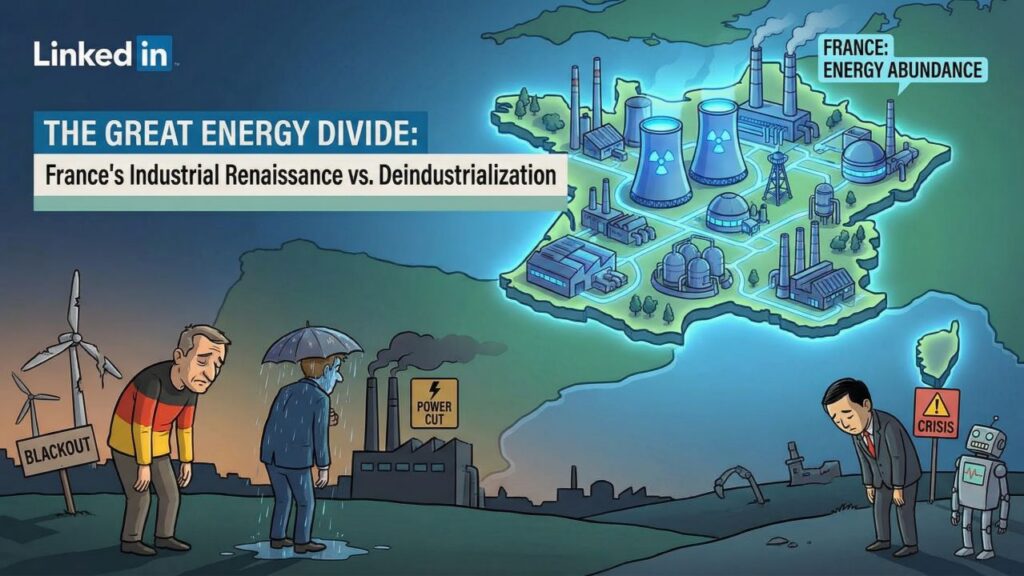
While the United Kingdom, Germany, and Japan have systematically destroyed their industrial bases in pursuit of climate policies that have achieved nothing for global emissions, France has demonstrated an alternative path that delivers both decarbonization and industrial competitiveness. France’s commitment to its nuclear fleet, a decision rooted in the strategic clarity of the 1974 Messmer Plan rather than ideological climate activism, has produced industrial electricity prices approximately 60-70% lower than Germany’s and a staggering 75% lower than the UK’s catastrophic rates. This cost advantage has preserved French manufacturing competitiveness, generated record electricity exports of 89 TWh in 2024, and achieved 95% carbon-free electricity generation, all while the three climate dupes documented in the preceding article have deindustrialized, destroyed hundreds of thousands of jobs, and watched global emissions rise to record highs.
France represents the road not taken: a major European economy that maintained its nuclear infrastructure and achieved both genuine decarbonization and industrial preservation. The French counterfactual demolishes the foundational premise of the “climate leader” narrative embraced by Germany, the UK, and Japan, the claim that aggressive decarbonization requires accepting industrial destruction. France proves that this premise was always false. The three dupes chose the most expensive, least effective pathway to decarbonization not because it was necessary, but because the “green spiral” political lock-in mechanisms documented in the previous article failed in France where they succeeded elsewhere.
PART I: THE PRICE ADVANTAGE THAT PRESERVED INDUSTRIAL COMPETITIVENESS
Industrial Electricity Prices: A Three-to-Four-Times Differential
The most devastating metric separating French success from the self-inflicted wounds of the three climate dupes is industrial electricity pricing. The differential is so stark that it renders the competitive position of German and British manufacturers structurally untenable.
French wholesale electricity prices averaged €58.02/MWh in 2024, compared to Germany’s €78.51/MWh, a 35% differential at the wholesale level that widens dramatically when examining actual industrial rates. UK industrial electricity prices reached 26.63 pence per kilowatt-hour (approximately €266/MWh) in 2024, the highest of any of the 25 countries reporting data to the International Energy Agency and approximately four times French industrial rates.
The magnitude of this differential represents the difference between industrial survival and industrial extinction. ArcelorMittal, the world’s second-largest steel producer, has made this calculation explicit. In June 2025, the company announced it was abandoning plans for green steel facilities in Germany, turning down €1.3 billion in public subsidies, because German energy costs made the projects economically non-viable. The company’s statement was unequivocal: “Electricity prices in Germany are elevated both in comparison to international rates and those of neighboring countries.”
In the same announcement, ArcelorMittal revealed where it would instead invest: nuclear-powered France. The company confirmed its intention to build a €1.2 billion electric arc furnace in Dunkirk, explicitly citing France’s ability to “provide visibility and certainty on low-cost electricity.” This investment decision represents a €2 billion total commitment by ArcelorMittal to French steelmaking operations, a direct vote of confidence in French energy policy and an explicit rejection of German energy policy.
The Post-ARENH Framework: Stable Nuclear Pricing for the Next Decade
France’s competitive position in industrial electricity is secured through a regulatory framework designed to balance consumer protection with sufficient returns for nuclear investment. The ARENH mechanism (Regulated Access to Historic Nuclear Electricity), which required state-owned utility EDF to sell up to 100 TWh per year of nuclear electricity to competitors at a fixed price of €42/MWh, expires at the end of 2025.
The post-ARENH framework, agreed between the French government and EDF in November 2023 after months of negotiation, establishes nuclear electricity pricing at an average of approximately €70/MWh for a period of 15 years beginning in 2026. The French Energy Regulatory Commission (CRE) has estimated the full cost of existing nuclear power at €60.7/MWh for the period 2026-2030, with taxation thresholds set between €65.7 and €85.7/MWh.
This framework incorporates revenue-sharing mechanisms designed to protect both industrial consumers and EDF’s financial viability. If electricity prices exceed approximately €78-80/MWh, the state recaptures 50% of excess revenues for redistribution to end users. Above €110/MWh, the capture rate rises to 90%. The result is a stable pricing environment that shields French industry from the price volatility that has devastated German and British manufacturers while ensuring EDF retains sufficient revenue to fund fleet maintenance and new reactor construction.
Compare this to Germany’s situation: the German government has been forced to commit €11.3 billion through 2030 simply to subsidize electricity prices for energy-intensive industries, a tacit admission that German energy policy has rendered the nation’s industrial base structurally uncompetitive. This €11.3 billion represents crisis management, not strategic advantage. It does not create competitiveness; it merely slows the rate of industrial destruction.
The Household Price Differential
The industrial price advantage extends to households, where French consumers benefit from electricity prices significantly below German levels. In the first half of 2025, household electricity prices in France stood at €26.6 per 100 kWh, compared to €38.4 in Germany, the highest in Europe. French household electricity prices remain below the EU average of €28.7, while German households pay 37% above the European average.
The CRE has proposed reducing regulated electricity sales tariffs in France by 15% beginning February 2025, to €239/MWh including taxes, a decrease of €42/MWh from February 2024 levels. French households subscribing to regulated tariff contracts will see their average annual bills fall from approximately €1,240 to €1,050 per year. While UK and German households face continued upward pressure on energy costs, French consumers are experiencing declining electricity bills driven by the return of nuclear output to historical levels.
PART II: NUCLEAR-POWERED DECARBONIZATION WITHOUT INDUSTRIAL DESTRUCTION
95% Low-Carbon Electricity: The Decarbonization France Achieved by Accident
In 2024, France achieved what Germany and the UK have promised but systematically failed to deliver: genuine, measurable decarbonization of electricity generation. According to transmission network operator RTE, France’s low-carbon electricity output surged to more than 95% of annual power production for the first time in 2024. Nuclear power contributed 67% of total generation, with renewables adding another 28%, including hydropower (14%), wind (13%), and solar (5%).
The carbon intensity of French electricity has fallen to approximately 21-27 gCO₂/kWh, among the lowest in the developed world and approximately seven times lower than the European average of 242 gCO₂/kWh. EDF, which produces 99% of its French electricity from carbon-free sources, reports specific carbon emissions of just 6 gCO₂/kWh for its French operations minus 33 times lower than the European utility sector average.
This achievement was not the result of climate activism or expensive renewable energy subsidies. It was the product of decisions made fifty years ago in response to an entirely different crisis. The Messmer Plan, announced by Prime Minister Pierre Messmer on March 5, 1974, was France’s strategic response to the first oil shock. The plan called for the construction of more than 50 nuclear reactors within the decade, committing France to a nuclear-centered electricity system designed to achieve energy independence rather than decarbonization.
The strategic clarity of the Messmer Plan reflected a fundamental understanding that France lacked indigenous fossil fuel resources: “In France, we do not have oil, but we have ideas.” The decision was not motivated by climate concerns, which were barely part of political discourse in 1974, but by the recognition that dependence on imported oil left France strategically vulnerable.
The irony is devastating for climate activists who have demanded that nations destroy their industrial bases in pursuit of decarbonization: France achieved deeper decarbonization than any of the three climate dupes while maintaining industrial competitiveness, lower electricity prices, and energy sovereignty. The three dupes that explicitly pursued decarbonization as a policy objective achieved less decarbonization at vastly higher cost than France achieved by accident.
Germany’s Carbon-Intensive Alternative
The contrast with Germany could not be more stark. Despite spending €520-696 billion on its Energiewende, the most expensive energy transition experiment in the history of industrialized nations, Germany’s electricity remains significantly more carbon-intensive than France’s.
Germany’s carbon intensity of electricity stood at approximately 381 gCO₂/kWh in 2023 (nearly seven times higher than France’s 55.3 gCO₂/kWh. Throughout 2024, there was not a single hour when Germany had lower carbon emissions per kWh of electricity generated than France. This extraordinary fact) not a single hour in an entire year, demolishes the narrative that Germany’s renewable energy transition represents climate leadership.
Germany achieved a 62.7% renewable share in net public electricity generation in 2024, a record high, yet CO₂ emissions from German electricity generation still stood at approximately 152 million tonnes per year, down only 58% from 1990 levels. The reason is structural: Germany replaced its nuclear fleet not primarily with renewables but with natural gas and maintained substantial coal generation. In 2024, coal contributed approximately 95 TWh to German electricity generation (71 TWh from lignite and 24 TWh from hard coal), while natural gas contributed 48 TWh.
Germany is now structurally dependent on electricity imports to maintain grid stability. In 2024, Germany imported 67 TWh and exported only 35.1 TWh, a net import surplus of 31.9 TWh. France was Germany’s largest source of imported electricity, providing clean nuclear power to compensate for Germany’s intermittent renewable generation and costly conventional backup.
The perverse result: Germany shut down its nuclear plants, destroying its cheapest source of carbon-free baseload power, only to import nuclear electricity from France. German taxpayers funded the decommissioning of German nuclear plants while German electricity consumers now pay France for nuclear electricity that Germany could have produced domestically. The German Federal Environment Agency operates with a budget that allocates €1.4 billion to managing nuclear waste despite the country generating zero electricity from nuclear power.
The Counterfactual: €332 Billion in Savings and Deeper Decarbonization
A 2024 study published in the International Journal of Sustainable Energy calculated exactly what Germany sacrificed through its ideological rejection of nuclear power. According to research led by Professor Jan Emblemsvag of the Norwegian University of Science and Technology, Germany’s Energiewende has cost an estimated €696 billion in total expenditure, €387 billion in direct investments plus €310 billion in subsidies.
Had Germany instead maintained its existing nuclear plants and invested in new reactor capacity, the estimated cost would have been approximately €36 billion. This comparison reveals a potential savings of €332 billion that Germany foregone by choosing the renewable energy transition path rather than a nuclear-based decarbonization strategy.
Professor Emblemsvag’s assessment was direct: “If Germany had maintained its nuclear plants since 2002, it would have significantly reduced expenses and achieved its climate goals more efficiently.” The study further noted that Germany’s reliance on natural gas to back up intermittent renewable generation made the country vulnerable during the 2022 energy crisis, which cost an additional €1.5 trillion in economic damage.
This is the counterfactual that France’s nuclear commitment proves conclusively: the three climate dupes did not need to destroy their industrial bases to achieve decarbonization. They chose to do so because the policy pathway they selected (renewable-dependent, gas-backed electricity systems) was structurally more expensive and less effective than nuclear baseload. France demonstrated that a different choice was available. The three dupes rejected it.
PART III: FROM NET IMPORTER TO RECORD EXPORTER, FRANCE’S ELECTRICITY SOVEREIGNTY
Record Exports: 89 TWh of Nuclear-Powered Electricity
In 2024, France achieved its highest net electricity exports in more than twenty years. According to RTE, France’s gross electricity exports reached 101.3 TWh, an all-time record, while net exports of 89 TWh surpassed the previous historical record of 77 TWh set in 2002.
The export flows reveal the competitive dynamics of European electricity markets. Nearly one-third (32%) of French exports were directed to Italy, 18% to Germany, 15% to Belgium, and 7% to the United Kingdom. France emerged as the largest electricity supplier to both the UK and Germany, nations that have explicitly rejected nuclear power and now depend on French nuclear exports to maintain grid stability.
These exports generate substantial revenue for EDF and the French state. France earns approximately €3 billion annually from selling nuclear electricity to neighboring countries, while Germany sets aside €300 million per year to pay EU emissions fines. The financial flows could not more clearly illustrate the divergent outcomes of divergent energy policies.
The surge in exports was driven by the recovery of French nuclear output to historical levels following the corrosion maintenance issues that had temporarily reduced availability in 2022-2023. Nuclear generation increased from 320 TWh in 2023 to 361 TWh in 2024, a 13% increase, representing the highest nuclear output in six years. EDF’s START 2025 industrial programme, focused on maintenance efficiency, has improved reactor availability and positioned France as Europe’s most reliable clean electricity exporter.
Energy Security: Imports vs. Exports
The contrast between French energy sovereignty and German energy dependence is now structural. Germany became a net electricity importer in 2023 for the first time since 2002 and remained a net importer in 2024, importing 16% more and exporting 8% less electricity year-over-year. German net imports rose to 24.9 TWh in 2024, mainly due to low summer electricity prices in France and Denmark.
The economic logic is straightforward but devastating for Germany: it is now cheaper for Germany to import French nuclear electricity than to generate power domestically. As one economic analysis noted, “From an economic standpoint, it remains logical for Germany to phase out its own nuclear energy in favor of importing it from France. This is largely due to the fact that French nuclear energy tends to be more cost-effective.”
This statement captures the absurdity of German energy policy: Germany dismantled its own nuclear fleet at enormous cost, only to find that French nuclear power is now more economical than German generation. The German taxpayer funded the destruction of German nuclear capacity while the German electricity consumer now pays France for what Germany could have produced itself.
France, by contrast, has achieved what energy strategists call “electricity sovereignty”, the ability to meet domestic demand from domestic sources while generating surplus capacity for profitable export. This sovereignty provides both economic advantage and strategic security. France is not dependent on imported natural gas prices or the geopolitical stability of gas-exporting nations. Its electricity system runs primarily on uranium, a commodity with diversified global supply and minimal storage costs relative to its energy content.
PART IV: WHY THE “GREEN SPIRAL” FAILED IN FRANCE
The Nuclear Constituency That Resisted Dismantlement
The preceding article documented the “green spiral” strategy, the deliberate creation of constituencies dependent on climate policy to make reversal politically impossible regardless of evidence of policy failure. In France, this strategy encountered a countervailing force: the nuclear industrial complex and its associated labor constituencies, which proved powerful enough to resist full dismantlement.
EDF employs tens of thousands of workers directly and supports hundreds of thousands of indirect and induced jobs throughout France’s nuclear supply chain. The CGT (General Confederation of Labour) and other major French unions have historically defended nuclear operations against closure attempts, understanding that nuclear jobs represent some of the best-paid industrial employment available to French workers.
When President François Hollande’s 2012 election pledge included closing France’s oldest nuclear plant at Fessenheim and reducing nuclear’s share of French generation to 50% by 2025, EDF’s board of directors voted against the imminent closure, defying the sitting government. The CGT welcomed the board’s decision, stating: “It would have been heart-breaking to sacrifice, for political reasons, an industrial facility that brings back €1 million a day to the public company and contributes to providing reliable electricity that does not emit greenhouse gases.”
Fessenheim ultimately closed in 2020 after years of political pressure, but the broader nuclear fleet survived the Hollande-era reduction targets. The plan to reduce nuclear to 50% of generation by 2025 was first delayed and then abandoned entirely in 2022, in recognition of the energy transition and security challenges ahead. President Macron’s February 2022 speech at Belfort marked a decisive reversal: instead of continuing nuclear reduction, France would launch a “rebirth” of its nuclear industry with the construction of six new EPR2 reactors and the possibility of eight more.
The Political Economy of Nuclear Preservation
The failure of the “green spiral” in France reflects several structural factors absent in Germany, the UK, and Japan.
First, EDF’s scale and centrality to French electricity supply created institutional resistance to rapid transformation. Unlike Germany’s fragmented utility landscape or the UK’s privatized electricity sector, France maintained a state-owned national champion with the political weight to resist policy changes threatening its core business. The full renationalization of EDF in 2022, from 84% to 100% state ownership, further strengthened the government’s commitment to nuclear as a strategic national asset.
Second, France’s nuclear fleet was not politically associated with catastrophic failure. Germany’s nuclear exit was accelerated by the 2011 Fukushima disaster in Japan, which provided political cover for a decision that had ideological roots predating the accident. France experienced no equivalent catalyzing event. The safety record of French nuclear plants, while subject to ongoing maintenance challenges, did not provide opponents with the political ammunition to force rapid shutdown.
Third, France’s electricity export position created economic incentives for nuclear preservation that did not exist in Germany or the UK. France profits from electricity exports; Germany and the UK pay for electricity imports. The financial argument for maintaining nuclear capacity was self-evidently stronger in France than in nations that lacked comparable export potential.
Fourth, France’s nuclear policy was established before the modern climate policy framework existed. The Messmer Plan preceded the 1992 Rio Earth Summit by nearly two decades. Nuclear power in France was not positioned as a climate solution but as an energy sovereignty solution. This historical framing insulated French nuclear policy from the ideological debates that crippled nuclear development elsewhere.
PART V: THE CBAM PARADOX, FRENCH ADVANTAGE IN A CARBON-PRICED WORLD
Carbon Border Adjustment: The Theory
The EU’s Carbon Border Adjustment Mechanism (CBAM), which entered its definitive phase in 2026, theoretically addresses the carbon leakage documented in the preceding article. By requiring importers to pay for the embedded carbon emissions in goods entering the EU, CBAM aims to level the competitive playing field between EU producers subject to carbon pricing and foreign producers who face no carbon constraints.
CBAM currently covers six sectors: cement, iron and steel, aluminum, fertilizers, electricity, and hydrogen. For steel, the most significant industrial sector affected, CBAM will impose substantial additional costs on carbon-intensive imports. Analysis suggests that steel imports from high-emission producers could face additional costs of approximately €56 per tonne, assuming emissions of 2.1 tonnes CO₂ per tonne of steel and EU ETS prices of €76 per tonne.
The Reality: Chinese Steel Remains Competitive Despite CBAM
The preceding article documented that carbon leakage has offset approximately 13% of domestic emission reductions in sectors like steel and cement, with Chinese import competition strongly increasing global carbon emissions while domestic emissions in wealthy countries fall. CBAM was designed to address this dynamic.
However, detailed analysis reveals that CBAM may not restore EU steel competitiveness, because Chinese production costs are sufficiently lower than EU production costs to absorb the carbon border adjustment. Research published in Nature Communications in 2025 found that Chinese BF-BOF steel production costs are €461 per tonne compared to €508 per tonne for EU BF-BOF steel, a 10% cost advantage before carbon adjustments.
This production cost differential means that Chinese steel producers can initially sustain cost-competitive exports to the EU market even with CBAM charges, because their underlying production cost advantage partially or fully offsets the carbon price penalty. CBAM becomes binding only as free allocation phases out completely and carbon prices rise, a process that will take until 2034 to complete.
France’s Double Advantage
Within this framework, France occupies a uniquely advantaged position. French steel and chemical producers benefit from industrial electricity costs approximately 60-70% lower than German costs and 75% lower than UK costs. This cost advantage partially insulates French producers from the competitive pressures facing German and British industry.
ArcelorMittal’s decision to invest €2 billion in French decarbonization while abandoning German green steel projects illustrates this advantage concretely. The company’s statement explicitly linked its French investment to France’s ability to provide “visibility and certainty on low-cost electricity”, language that implicitly contrasts with German electricity price uncertainty.
French producers face the same CBAM framework as German and British producers when competing with Chinese imports. But French producers start from a lower cost base, meaning the margin squeeze from import competition is less severe. A French steel producer paying €70/MWh for electricity faces different competitive mathematics than a German producer paying €190/MWh or a British producer paying €266/MWh.
This differential is not accidental. It reflects the accumulated consequences of energy policy decisions made over decades. France invested in nuclear baseload that delivers stable, low-cost electricity. Germany and the UK invested in intermittent renewables requiring expensive backup and grid expansion. The cost differentials now embedded in industrial electricity prices are the harvest of those divergent policy choices.
PART VI: THE NEW NUCLEAR RENAISSANCE, FRANCE DOUBLES DOWN
Six New Reactors: The EPR2 Programme
While Germany, the UK, and Japan struggle with the consequences of their anti-nuclear policies, France is preparing to expand its nuclear capacity. President Macron’s 2022 Belfort speech announced plans to build six new EPR2 reactors by 2050, with an option for eight additional units, at a total estimated cost of €50-67 billion.
The Nuclear Policy Council meeting in March 2025 finalized key elements of the financing framework. EDF will receive a subsidized government loan covering at least half of construction costs, alongside a Contract for Difference on nuclear production capped at a maximum price of €100/MWh in 2024 values. This framework ensures both EDF’s financial sustainability and consumer protection from price volatility.
Construction of the first EPR2 pair at Penly is expected to begin in 2027, with commissioning now targeted for 2038, a three-year delay from original timelines reflecting the lessons learned from Flamanville 3’s extended construction period. The delays are frustrating for nuclear advocates but reflect realistic assessment of construction timelines rather than abandonment of the programme.
The EPR2 programme represents a generational commitment. These reactors, with operating lives of 60 years or more, will provide low-carbon baseload electricity well into the twenty-second century. France is making capital investments today that will benefit French industry and consumers for the next three generations.
The Supply Chain Investment
Beyond reactor construction, France is investing heavily in nuclear supply chain security. The Nuclear Policy Council validated action plans for securing the upstream nuclear fuel cycle, including state support for Orano’s uranium supply operations. EDF plans to invest €33 billion over the period 2022-2028 to extend the operating lives of existing reactors beyond 40 years.
France is also investing in next-generation nuclear technologies, including small modular reactors (SMRs) through the NUWARD project, though large reactor development has been prioritized over SMR deployment. The strategic logic is clear: proven EPR technology offers lower risk and faster deployment than experimental SMR designs, making the EPR2 programme the logical vehicle for near-term nuclear expansion.
PART VII: INDUSTRIAL IMPLICATIONS, THE PRESERVATION OF FRENCH MANUFACTURING
Steel: Investment Rather Than Exodus
The contrast between French and German steel industry trajectories illustrates the industrial consequences of divergent energy policies. While Germany’s steel industry faces what the November 2025 study warned could be “€50 billion in annual economic losses” and threats to “democratic stability” from production outsourcing, French steel operations are receiving major capital investments.
ArcelorMittal’s €2 billion French investment programme includes the €1.2 billion Dunkirk electric arc furnace, €254 million in additional Dunkirk investments, €53 million in Fos, and a €500 million electric steels production unit in Mardyck scheduled for completion by year-end 2025. These investments reflect corporate confidence that French energy policy makes green steel production economically viable in France, confidence that the same company explicitly lacks regarding German operations.
ArcelorMittal France employs nearly 15,400 people at 40 production and processing sites, representing 25% of the company’s European workforce. Over the past five years, the company has invested approximately €1.7 billion in France, roughly €350 million annually, representing 25% of the group’s European capital expenditure. This investment intensity reflects France’s energy cost advantage relative to other European locations.
Chemicals: Competitive Positioning Preserved
The French chemical sector (the second-largest contributor to France’s trade balance after aerospace, with a €18 billion trade surplus) maintains competitive positioning despite facing the same European cost pressures affecting German chemicals. With 177,000 direct employees and an estimated 885,000 including indirect and induced jobs, French chemicals represents a substantial industrial constituency.
The sector’s low-carbon strategy relies explicitly on access to competitive low-carbon electricity to cover the 50% increase in electricity consumption required for electrification of chemical processes. The France Chimie industry association identifies securing “access to competitive low carbon electricity” as the most important success factor for achieving the sector’s decarbonization trajectory, a factor that French nuclear policy delivers and German energy policy does not.
Capital expenditure in French chemicals reached a record €8 billion in 2023, with growth investments (capacity expansions and new product introductions) rising to 39% of total expenditure. More than 250 chemical company projects corresponding to over €5 billion in announced investments have received financial support through the France Relance recovery programme. The investment momentum in French chemicals reflects the same cost advantage dynamics driving steel investments: French energy policy makes industrial investment viable in France when it has become non-viable in Germany.
Manufacturing Competitiveness Maintained
France generated $298 billion in manufacturing output in 2024, representing 1.77% of global manufacturing share. While France faces its own industrial challenges, including declining manufacturing PMI and economic strain similar to other European economies, the structural competitive position is fundamentally different from Germany’s.
France maintained its position in 2024 as Europe’s top destination for industrial investments, with 415 projects. According to EY analysis, this attractiveness is “supported by France’s highly developed transport infrastructure, a high-skilled labour force, and a low-carbon energy mix, primarily powered by nuclear energy.” Foreign investors recognize what the three climate dupes have refused to acknowledge: competitive electricity prices are a prerequisite for industrial investment, and France’s nuclear policy delivers competitive electricity prices.
CONCLUSION: THE COUNTERFACTUAL PROVEN
What France Demonstrates
France’s nuclear-centered energy policy proves conclusively that the three climate dupes (the United Kingdom, Germany, and Japan) did not need to destroy their industrial bases to achieve decarbonization. A different pathway was available. It was demonstrated by France.
France achieved 95% low-carbon electricity in 2024 while maintaining industrial electricity prices 60-75% below German and UK levels. France achieved record electricity exports of 89 TWh while Germany became a net importer dependent on French nuclear power. France preserved its steel and chemical industries and attracted major capital investments while German and British manufacturers fled to jurisdictions with lower energy costs. France built a carbon intensity of 21-27 gCO₂/kWh, among the lowest in the developed world, while Germany’s carbon intensity remains seven times higher despite spending €520-696 billion on the Energiewende.
These outcomes were not inevitable. They were the product of different policy choices. France chose nuclear baseload in 1974 and maintained that choice despite decades of anti-nuclear activism. Germany, the UK, and Japan chose to dismantle their nuclear capacity and replace it with expensive, intermittent alternatives backed by fossil fuels. The consequences of those choices are now fully documented.
The Irreversibility of Divergence
The divergence between French success and the self-inflicted destruction of the three climate dupes is now largely irreversible. Nuclear plants that have been decommissioned cannot be recommissioned. Industrial supply chains that have been dismantled cannot be quickly rebuilt. Workers who have been laid off have found other employment or left the workforce. The decisions made over the past two decades have locked Germany, the UK, and Japan into trajectories of industrial decline that cannot be reversed by policy adjustments at the margin.
France, by contrast, has preserved its options. The existing nuclear fleet will operate for decades. The six new EPR2 reactors will provide low-carbon baseload electricity until at least 2100. The industrial base that depends on competitive electricity prices (steel, chemicals, manufacturing broadly) remains viable because energy costs remain competitive.
The Final Verdict
The three climate dupes documented in the preceding article accepted certain economic destruction in pursuit of uncertain climate benefits, achieving nothing for global emissions while destroying their industrial capacity. France demonstrates that this outcome was a policy choice, not a necessity.
France did not implement climate policy as ideology. France implemented energy policy as strategy, energy sovereignty through nuclear baseload, and achieved deeper decarbonization as a byproduct. The three dupes implemented climate policy as ideology, sacrificed energy sovereignty, achieved shallower decarbonization, and destroyed their industrial foundations in the process.
The counterfactual triumph of French nuclear policy is not that France set out to lead on climate and succeeded while others failed. The counterfactual triumph is that France set out to achieve energy sovereignty in 1974 and accidentally achieved climate leadership, while nations that explicitly pursued climate leadership destroyed their economies without reducing global emissions.
This is the ultimate indictment of the climate policy framework embraced by Germany, the UK, and Japan. They chose the most expensive, least effective pathway to decarbonization, and France proved that better alternatives existed. The three climate dupes had fifty years of evidence that nuclear-centered electricity systems deliver both decarbonization and industrial competitiveness. They rejected that evidence for ideological reasons. Their workers and their economies are now paying the price for that rejection.
Related reading
- The Climate Hoax, Europe's Industrial Base Was Dismantled Before the World's Eyes, While the Press Said Nothing
- Misery Loves Company: How a Self-Destroyed UK Led Ukraine to Russian Roulette with All Chambers Loaded
- The Atlanticists: How British Incompetence Brought the World to Nuclear Brink
- The Great Reshoring: How US Industrial Policy Is Capturing Europe's Manufacturing