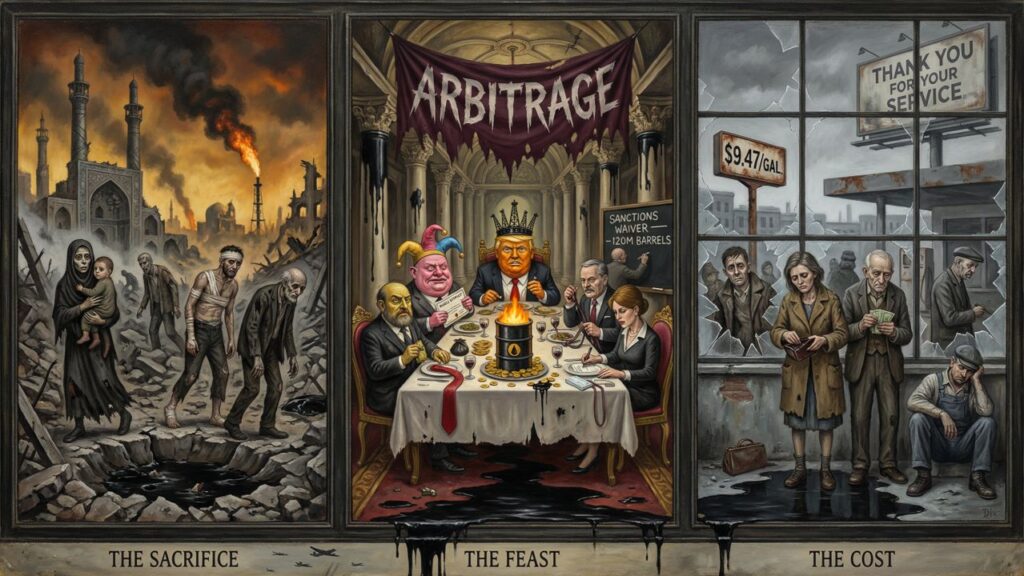
They risked nothing. They made plenty. You paid for it.
A note to my readers: I side with neither the Democratic nor the Republican label, because both report to the MONEY. That is the entire point of nearly everything I write involving politics. My purpose is to expose that arrangement and to encourage the voters who gave the current crop of politicians their seats, and who watched those politicians promptly sell their power to the MONEY, to depose them at the next opportunity. Not because the other party is better. Because anything that breaks the current cycle of narrow majorities and caucus control by the MONEY is better than what we have now. You know where to find the rest of my work.
Scott Ortkiese
This is not a story about Iran. It is not a story about oil. It is not even a story about war, not really. It is a story about a wager, a wager in which one side holds all the upside, the other side absorbs all the downside, and the arrangement is entirely legal. The side that wins is called the MONEY. The mechanism it uses is called Washington. The side that pays is called the American taxpayer.
Royko would have recognized the setup immediately. He covered Chicago’s aldermen for thirty years. His formula never changed: find out who owned the property before the zoning variance, who sat on the committee that approved the variance, and who showed up at the fundraiser the week after. The facts did not require interpretation. They required proximity. The only difference between Royko’s aldermen and what follows is scale. His aldermen were stealing thousands. These people are stealing billions. And the king they perform for does not even know what they are doing, which is precisely how the MONEY likes it.
Let’s find the proximities.
The Trades Were Placed Before the Bombs Fell
On February 2 and February 4, 2026, Representative Josh Gottheimer, Democrat of New Jersey, purchased shares of ExxonMobil. The purchases were modest, between $1,001 and $15,000 each time, the kind of trade that barely registers in a portfolio but registers very clearly in a congressional disclosure file. On February 28, three to four weeks after those purchases, the United States and Israel struck Iran. The Strait of Hormuz effectively closed. Brent crude surged past $100. ExxonMobil shares rallied sharply. By mid-March, Gottheimer was up approximately 17% on his February 2 purchase and 9% on his February 4 buy.
Gottheimer is not alone. On February 10, 2026, Representative Gil Cisneros, Democrat of California, purchased between $50,001 and $100,000 of ExxonMobil. Cisneros had also purchased Raytheon stock on January 9, 2026, roughly seven weeks before the Iran strikes. Raytheon makes the missiles. Exxon makes money when oil spikes. Both stocks went up when the bombs started falling.
Senator Markwayne Mullin, Republican of Oklahoma, bought up to $50,000 in Raytheon on December 29, 2025. He also bought Carpenter Technology on February 4, 2026, less than four weeks before the strikes. Carpenter Technology makes the high-performance alloys that go into missiles and military aircraft. Mullin sits on committees with access to defense and intelligence briefings. On March 5, 2026, the same day Treasury issued its first Russian oil sanctions waiver, Trump nominated Mullin to be Secretary of Homeland Security. His Raytheon, Chevron, and ConocoPhillips positions were up 15 to 30% since purchase.
Representative Scott Franklin, Republican of Florida, made three separate purchases of Lockheed Martin on the same day, including one position of up to $50,000. Lockheed makes the aircraft and missiles deployed against Iran. Its stock jumped nearly 40% since the start of 2026. Senator John Boozman, Republican of Arkansas, owns both Raytheon and Exxon, told reporters there was “no urgency” to pass additional war funding, and watched both positions appreciate when the strikes began.
Notice that this is not a Republican story or a Democratic story. Gottheimer and Cisneros are Democrats. Mullin, Franklin, and Boozman are Republicans. The trades are bipartisan. The profits are bipartisan. The silence is bipartisan. What the two parties share is not an ideology. It is an arrangement. Both report to the MONEY. The MONEY does not vote along party lines. It votes along profit lines, and in the weeks before the Iran strikes, the profit line pointed straight at defense contractors and energy stocks.
These politicians are not the story. They are the price of admission the MONEY pays to use the machinery. The STOCK Act penalty for any of this, if investigators were inclined to investigate, which they are not, is $200.
The Man at the Top of the Retail Layer
All of those congressional positions are retail. The wholesale version is at Treasury, operated by the MONEY’s most fluent instrument.
Scott Bessent, the 79th Secretary of the Treasury, spent his career as a global macro hedge fund manager. Global macro is the discipline of betting on what governments will do before markets price it. He is not in government despite that background. He is there because of it. At Soros Fund Management, Bessent helped engineer the 1992 short against the British pound that made Soros $1 billion in a single day. Returning as Chief Investment Officer from 2011, he generated approximately $10 billion in profits, including a $1 billion windfall shorting the Japanese yen in 2013. In 2015 he founded Key Square Capital Management, raising $4.5 billion including a $2 billion anchor from Soros himself.
Key Square’s investors included Australia’s sovereign wealth fund, the Future Fund, Morgan Stanley Alternative Investment Partners, and the New York City Police and Fire pension funds. Sovereign capital, commingled with private capital, placed with a man whose professional mission was to anticipate sovereign decisions. That arrangement was the entire investment thesis.
In early 2024, Bessent identified what he described in a letter to clients as a market anomaly: political and market analysts were systematically underpricing a Trump election victory. Key Square positioned accordingly. Trump won. The fund booked double-digit returns in 2024, with November being particularly profitable. Trump then nominated Bessent as Treasury Secretary.
The man who bet on Trump’s election and won was now going to run the institution whose decisions his clients had profited from anticipating. In January 2025, he was sworn in. The man who spent thirty years trading sovereign policy decisions became the sovereign policy decision.
This is not a conflict of interest in the legal sense. Bessent announced he would sever formal ties with Key Square upon taking office. What it is, rather, is the structural condition this publication has been describing for months: the line between sovereign decision-making and private financial positioning has been so thoroughly dissolved, through shared personnel, shared networks, and shared professional histories, that the arbitrage is no longer a byproduct of policy. It is the policy.
The MONEY does not merely influence what Washington decides. In the person of Scott Bessent, the MONEY is Washington.
The Official Who Stood in the Way Was Removed
The MONEY does not improvise. It clears the board before making its move.
Two weeks before the Iran strikes, something happened at Treasury that received almost no public attention. John Hurley, the Trump administration’s top sanctions official, the Under Secretary for Terrorism and Financial Intelligence, was pushed out of his post. Bloomberg reported his departure on February 15, citing “months of internal tension over the tactics and targets of US sanctions policy” between Hurley and Bessent. The Financial Times reported Trump was considering Hurley for an ambassadorship to Germany, the standard Washington maneuver for removing a difficult person while maintaining plausible deniability.
Hurley was the official responsible for enforcing the Russian oil sanctions that Bessent would waive two weeks later. He was also the official responsible for the architecture of Iranian sanctions enforcement. He left under pressure from Bessent. Thirteen days after Hurley’s reported departure was made public, the Iran strikes began.
The MONEY removed the man enforcing the sanctions wall. The bombs fell. The wall came down. The MONEY collected the spread. The king signed the order and called it foreign policy. Royko would have called it what it is: the MONEY sent a man to Berlin so it could do business without him watching the till.
The Question That Has Not Been Answered
A bipartisan group of congressional representatives sent a letter to Bessent on March 9, demanding answers to twelve specific questions about the waiver and the pre-war planning process. Most of the questions were technical. One was not.
Question eight asked: Prior to authorizing military action against Iran, did Treasury conduct a sanctions contingency analysis examining the economic consequences of a Strait of Hormuz closure? If not, why not?
That question has two possible answers, and both are damning.
If Treasury conducted no contingency analysis before the strikes, the MONEY’s instrument at Treasury sent bombs into the Persian Gulf without modeling what they would do to oil markets, and without telling allies who had restructured entire national energy economies on the premise that American sanctions were durable commitments.
If Treasury did conduct a contingency analysis, then someone in the building knew Brent would spike above $100, knew the Russian oil waiver would become necessary, and knew what the market impact of that waiver would be before the announcement. That knowledge, flowing through the professional network Bessent spent thirty years building in global macro, is not an abstraction. It is a position.
As of this writing, Bessent has not provided a substantive public response to the letter. The Uniparty does not investigate itself. The letter-writers share a chamber with colleagues who were buying Exxon and Raytheon the same weeks the strikes were being planned. They needed the letter on the record. They did not need the answer. And Bessent knows exactly what that means.
The $20 Billion Backstop the Taxpayer Never Voted For
When the bombs fell and the Strait of Hormuz became a war zone, private insurance markets did what rational private markets always do when the risk becomes real: they left. No private insurer was going to underwrite tanker traffic through an active combat zone at a commercially viable premium.
So the United States government stepped in as insurer of last resort, establishing a $20 billion reinsurance facility to guarantee tanker traffic through the strait. Taxpayer money, backstopping the energy flow that private capital would not touch. The preferred American insurance partners for the facility were specified by CENTCOM, not through a competitive market process, but through a designation. The MONEY exits when the risk is real. The taxpayer absorbs the risk. The MONEY is designated back in at the guaranteed rate, with the government holding the floor and the preferred partners riding the ceiling. No congressional vote. No public tender. A designation, a press release, and a $20 billion commitment made in the name of “market stabilization.”
The little man who voted for a populist to protect him from exactly this kind of arrangement is the little man whose tax dollars are backstopping the profit margin of firms designated by the same military apparatus that dropped the bombs that created the risk in the first place. Royko would have loved this one. The protection racket and the arson are run by the same office.
What Tel Aviv Got Out of the Arrangement
The MONEY does not operate exclusively through American vassals.
Israel struck Iran alongside the United States on February 28, and the Israeli defense industrial base, along with its American counterparts, was the immediate financial beneficiary. Lockheed Martin, Raytheon, and RTX hit all-time highs on March 1, the day after the strikes. The Israeli government achieved its longstanding strategic objective. American taxpayers funded the munitions, the logistics, the carrier group deployments, the reinsurance facility, and will fund the $50 billion war appropriation currently before Congress. The American members of Congress voting on that appropriation own the stocks that appreciate when it passes.
This is the franchise arrangement. Tel Aviv provides the strategic rationale. The MONEY provides the trades. Washington provides the firepower and the financing. The taxpayer provides the check. King Trump stands at the podium, tells the crowd it was his idea, and believes it. Nobody in this chain asked the taxpayer’s permission, and the penalty for the entire arrangement, under current law, is two hundred dollars.
The Royko Closing
Follow the money. Find the alderman. Name the ward.
The MONEY removed Hurley on February 15. The MONEY’s instrument at Treasury drafted the waivers. The king launched the strikes on February 28, unaware and unconcerned that the positions had already been established. The first Russian oil sanctions waiver, covering 120 million barrels of crude, was issued March 5. The second, expanded to all global buyers, March 12. Mullin was nominated for Homeland Security Secretary the same day as the first waiver, with his defense and energy positions up 15 to 30%.
Gottheimer bought Exxon on February 2 and 4. Cisneros bought Raytheon on January 9 and Exxon on February 10. Franklin bought Lockheed Martin three times in a single day. Boozman owns Raytheon and Exxon and sees no urgency in funding the war.
The war cost over $16 billion in its first sixteen days. Congress is being asked to vote on $50 billion more. The members voting on that appropriation own the stocks that appreciate when it passes. The penalty for trading on non-public information while holding a congressional seat is $200.
They risked nothing. They made plenty. You paid for it.
The MONEY designed the wager. The MONEY cleared the obstacle. The MONEY structured the trade. The MONEY collected the spread. The king performed. The jesters applauded. The vassals pocketed their tips. And the American taxpayer, who was never consulted, never informed, and never protected by the populist who promised to protect them, is holding the check.
The question is whether you keep electing the same clowns to perform for the same masters.
Related reading
- THE BILL COMES DUE: What Every American Will Pay for Washington's War on Iran
- The Molecules of War: How Washington's Persian Gulf Gamble Is Coming for Your Grocery Bill, Your Smartphone, and Your Economy
- Where’s the Business Plan for Trump's $200 Billion Iran "Ask"?
- The Inflation Reckoning: How an Unlawful War on Iran Is Detonating Every US Price Indicator