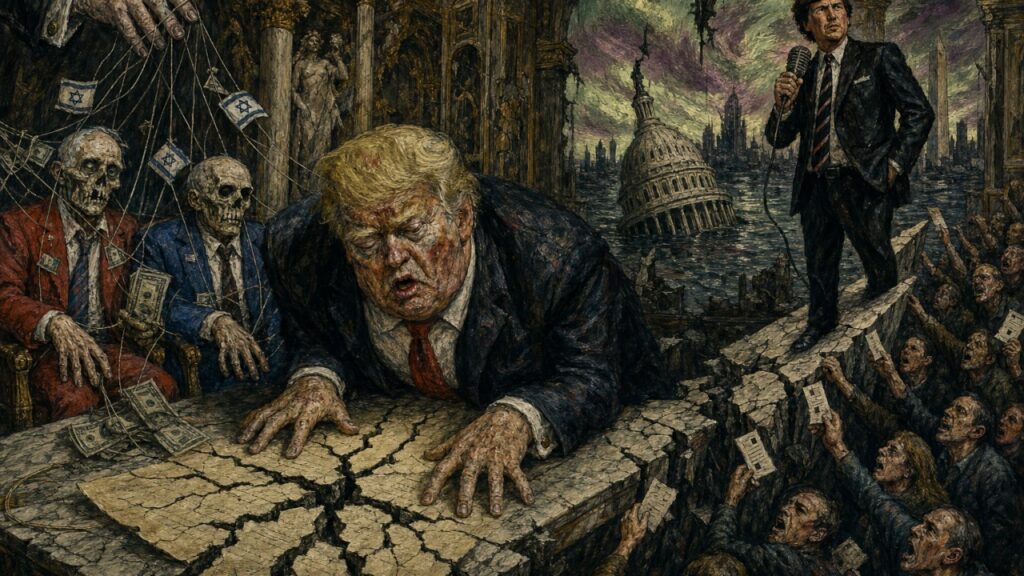
The independents are coming, the independents are coming… Do I hear Tucker’s footsteps?
By Ssott Ortrkiese | June 24, 2026 | so@throughlinesynthesis.com
The only honest way left to discipline a captured, foreign-lobbied American presidency is to kneecap the two-party system with independents who owe nothing to Tel Aviv, K Street, or Versailles-class donors. The Blumenthal-Diesen transcript is useful not because it offers a conventional bipartisan critique, but because it treats Donald Trump as proof that the American presidency can be captured, humiliated, and then repackaged to domestic audiences as strength.] Trump is presented not as a rogue nationalist who lost control of events, but as a weak executive trying to sell a strategic defeat to his own base while the same donor and media networks that helped elevate him begin to turn on him.
The core thesis
Blumenthal’s central argument is blunt: Trump signed what amounts to a surrender-style memorandum and then immediately marketed a different version of it at home. In the transcript, Blumenthal says Trump claimed there would be IAEA inspections and no real American financial burden, even though Iran had rejected the inspection premise and the broader agreement imposed terms Trump could not politically admit to his own supporters. That matters because it shifts the frame from “Trump the dealmaker” to Trump the domestic spin doctor, a president forced to invent a second reality because the first one would expose his weakness.
This is one place where nontraditional sources are revealing. Israeli anger at Trump was not confined to fringe Telegram channels or X accounts; Al Jazeera reported that Israel Hayom, the newspaper owned by Trump megadonor Miriam Adelson, ran a scathing attack describing the agreement as humiliation and surrender. Newsweek and VINnews independently described the same backlash, underscoring that pro-Trump Israeli and pro-Israel circles treated the agreement as betrayal rather than triumph. Blumenthal’s point, therefore, gains external support from an unlikely direction: even some of Trump’s most aligned foreign backers behaved as though he had caved.
Naming the network
One of the transcript’s strengths is that it does not leave the critique at an abstract level. Blumenthal names Jared Kushner, Steve Witkoff, Marco Rubio, Mike Waltz, Ted Cruz, Roger Wicker, and the broader Israel lobby ecosystem as the personnel layer through which Trump’s “America First” brand was hollowed out from within. He also identifies Miriam Adelson’s media apparatus as part of the pressure machinery, useful when Trump is compliant and punitive when he is not.
The Kushner detail is particularly important because it gives this piece a concrete hinge. In the transcript, Blumenthal says Kushner brought an FDD-linked figure, Nick Stewart, into the negotiations in Switzerland, presenting the talks not as a sovereign American diplomatic process but as one permeated by ideologically aligned outside actors. That allegation cannot be fully resolved from mainstream reporting alone, but it is consistent with Blumenthal’s broader public framing that the Trump orbit was saturated with institutional Israel-first influence rather than disciplined US statecraft.
The significance of these names is strategic rather than gossipy. If Trump had merely made a bad decision, the problem would be personal incompetence. If his orbit was structurally filled with actors whose careers were bound up with pro-Israel advocacy, donor networks, and pressure politics, then the failure is systemic. In that case, independents become not a vanity project but a mechanism for punishing the whole supply chain that produces this kind of presidency.
Versailles abroad, algae at home
Blumenthal’s most effective move is symbolic. He juxtaposes the signing of the Treaty of Versailles with the absurd, allegedly $30 million renovation of the reflecting pool on the National Mall, which he describes as a Mar-a-Lago-style no-bid vanity project gone green with algae and guarded by the National Guard. Whether read literally or as political theater, the image is potent: Trump is depicted as a president who cannot maintain appearances at home and cannot impose outcomes abroad, yet still insists on broadcasting strength.
That image matters because this piece is not only about foreign policy. It is about imperial stagecraft collapsing into parody. A president signing what critics in Israel call a surrender agreement while presiding over a decaying, crony-managed civic spectacle in Washington is a useful metaphor for a broader regime problem: institutional legitimacy is being propped up by branding long after performance has failed.
Military reality versus political salesmanship
Blumenthal’s military claim is that the United States emerged from the Iran war without achieving its stated objectives and with serious constraints on escalation.[cite:1] In the transcript, he says the US faced munitions shortages, avoided committing the full airpower needed to break Iran’s deterrent, and could not achieve military outcomes without risks the administration would not accept. The result, in his telling, was not a show of force but a forced political landing.
Here again, corroborating fragments from outside the usual establishment media ecosystem are useful. Senator Tim Kaine publicly described the agreement as one that recognized Iran and Oman as administrators of traffic through the Strait of Hormuz, language that would have been politically unthinkable under a maximalist American victory narrative.[cite:19] Kaine also criticized administration claims about concluded hostilities while US actions in the Strait continued, indicating a gap between official messaging and operational reality. These details do not prove every part of Blumenthal’s military analysis, but they reinforce his broader claim that the White House was managing perception around an outcome much less triumphant than advertised.
This distinction is essential for a hard anti-Trump piece. Trump’s defenders can survive policy disagreements; what is harder to survive is the charge that he was outmaneuvered and then lied to his own public about the result. Blumenthal provides exactly that line of attack: Trump as a salesman for defeat, not a strategist of victory.
The Israeli panic signal
One area where the transcript breaks into something more psychologically revealing is its description of Israeli political and media panic. Blumenthal says Israel’s Channel 14 platformed Uri Geller, who claimed Trump’s brain had been manipulated by Iranian electromagnetic transmissions. That claim is obviously conspiratorial and unsupported, but its value lies elsewhere: it shows the degree to which some pro-Israel media voices preferred occult absurdity to the simpler explanation that Trump had been boxed in by material constraints.
Nontraditional sources here are especially illuminating because they capture narrative behavior in real time. Meaww’s fact check, Mario Nawfal’s repost of the Channel 14 segment, and The Cradle’s video excerpt all point to the same underlying spectacle: a state-adjacent media environment rationalizing Trump’s deviation from maximalist war aims through brain-wave fantasy. That does not automatically validate Blumenthal’s broader worldview. It does, however, support his narrower argument that a segment of Israel’s political-psychological ecosystem is incapable of processing limits except through hysteria, betrayal narratives, or conspiracy.
That matters for a piece centered on political remedy. A system this unstable cannot be corrected by asking one of the two legacy parties to behave better. It has to be disciplined from outside.
Tucker, Khanna, and the disciplinary market
The most politically fertile section of the transcript is the one that steps away from battlefield claims and into party structure. Blumenthal argues that Tucker Carlson could become the nucleus of a third-party force, including Marjorie Taylor Greene, Matt Gaetz, and Thomas Massie, with enough base credibility to kneecap a Republican nominee in 2028 unless that nominee adapts. He also points to Ro Khanna as evidence that dissatisfaction with the bipartisan Israel consensus exists beyond the right and could become a broader anti-establishment current.
This is where the concept of independents as a disciplinary market becomes more than a slogan. A credible independent bloc does not need to win the presidency outright to matter. It needs to create a defections market in which politicians fear losing actual voters more than they value donor protection, media approval, or foreign-policy orthodoxy. In a functioning market, failure is punished; in the American two-party cartel, failure is usually repackaged. An independent flank changes that by making betrayal convertible into a measurable electoral loss.
The transcript also clarifies why this remedy is more realistic than waiting for internal reform. Blumenthal says the Republican base is already drifting away from reflexive pro-Israel support, and he describes the remaining bipartisan consensus as little more than legalized bribery. That is hyperbolic language, but the strategic point is sound: when the voter base moves faster than party institutions, outside vehicles become the only credible enforcement tool.
What new ground Blumenthal actually covers
Blumenthal is not merely repeating a boilerplate antiwar case. He advances several linked claims that push beyond generic dissent. First, he casts the agreement itself as a domestic political problem for Trump because Trump cannot admit the true terms to his own base. Second, he argues that Israeli and pro-Israel backlash is so intense that even aligned outlets like Israel Hayom openly framed Trump as a betrayer. Third, he suggests that Lebanon, not Iran, will be the key pressure point through which Israel attempts to unravel the agreement. Fourth, he interprets the eruption of bizarre media narratives such as the Uri Geller episode as evidence of psychological disarray inside pro-Israel political discourse rather than mere online eccentricity.
Taken together, those points offer a sharper framework for this piece than a generic denunciation of Trump. They let the piece argue that Trump’s real failure was not simply moral, ideological, or even military. It was structural. He embodied the fantasy that a personality cult could outmuscle a donor cartel, a foreign-policy lobby, and an ossified duopoly from inside the same machinery that produced them. Blumenthal’s transcript suggests the opposite: that the machine absorbed him, used him, and then humiliated him.
Why independents are the remedy
If the presidency can be captured this easily, the answer is not to cycle between red and blue managers of the same dependency structure. It is to build an outside electoral force strong enough to punish both parties when they converge around war, donor obedience, and foreign-policy deceit. That is why the remedy in this piece should stay concrete: independents as leverage, independents as a spoiler threat, independents as a market correction against bipartisan impunity.
Trump, in this framing, becomes less an aberration than a warning. He was sold as a sovereign nationalist and emerged, in Blumenthal’s telling, as a frightened sales representative for a humiliating outcome he could not even describe honestly to his own voters. The practical lesson is not merely that Trump failed. It is the two-party system that made his failure easy to survive. Any serious America-first politics now begins with making that survival impossible.
Related reading
- An Open Letter to Every Incumbent Republican and Democrat: A Call to Arms for Every American Who Is Sick of the War Uniparty; We Want a Third Party!
- Get to the Streets: Shut the Iran War Down and Tell Trump and the Uniparty Imbeciles We Elected in Washington to Negotiate Peace Now
- The Irrelevance of King Trump and His Uniparty Jesters in Congress
- The American People Are More Objective About President Trump's Actions Than Democratic Party Leadership