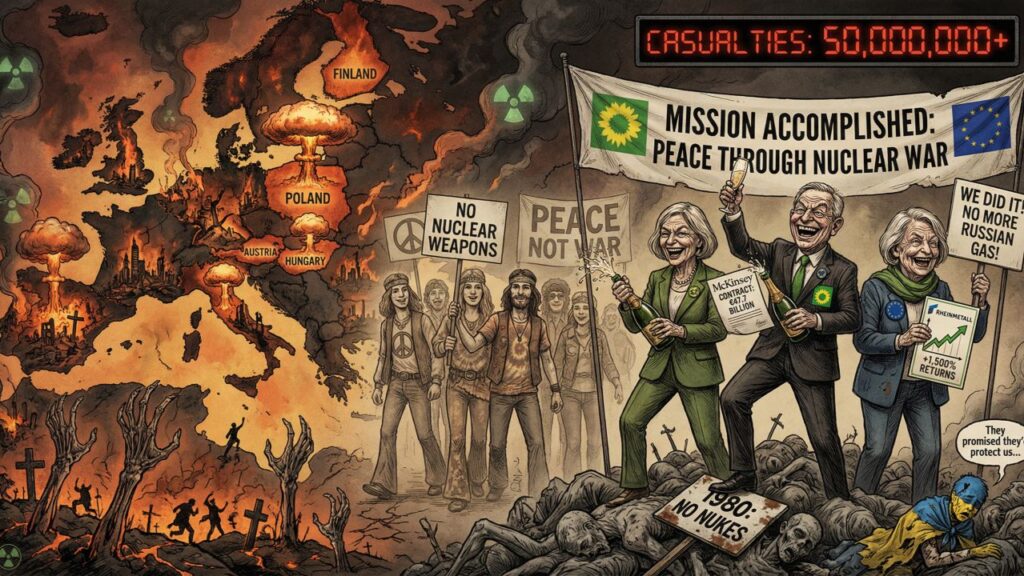
The Green Party’s Nuclear War: Italy, Poland, Hungary, Austria, and Finland Will Not Be Your Corpses
In the early 1980s, hundreds of thousands of young Germans flooded the streets of Bonn and Hannover, blocking roads and occupying public squares in the largest peace demonstrations in European history. They were protesting NATO’s deployment of American nuclear missiles on German soil, Pershing IIs and cruise missiles that turned West Germany into a potential battlefield in any superpower confrontation. The banners read “Keine Atomraketen in Deutschland” (No nuclear missiles in Germany). The chant was “Frieden schaffen ohne Waffen” (Create peace without weapons).
These protests birthed the German Green Party in 1980, founded on an explicitly anti-war manifesto that declared: “Ecological foreign policy is a policy of nonviolence… Nonviolence does not mean surrender, but guaranteeing peace and life by political rather than military means… The development of civilian rule founded on the guiding value of peace must go hand in hand with the immediate commencement of the dissolution of military blocs, especially NATO and the Warsaw Pact.” The founding document called for “the dismantling of the German arms industry and its conversion to peaceful production.”
The Greens were not alone. Social Democrats across Europe championed Willy Brandt’s Ostpolitik“change through rapprochement”, the doctrine that dialogue and economic engagement with the Soviet bloc served peace better than military confrontation. When Ronald Reagan and NATO hardliners pushed for deployment of short-range nuclear missiles in Europe, both Social Democrats and Greens led the opposition, arguing that engagement rather than escalation was the path to security.
For fifty years, Europe’s left-green establishment defined itself as the anti-war faction. They opposed the Vietnam War, the Iraq War, the Libya intervention. They championed nuclear disarmament, NATO skepticism, and diplomatic engagement with adversaries. They positioned themselves as the parties that questioned military spending, challenged defense contractors, and insisted that dialogue, even with hostile powers, was essential to peace.
Then they came to power. And every single principle was reversed.
Today, those same Green parties demand permanent war with Russia while ruling out all negotiation. The same Social Democrats who built careers on Ostpolitik now support a EU foreign policy chief, Kaja Kallas, who boasts that she has “persuaded other countries not to meet with Vladimir Putin” and declares that “the European Union does not negotiate with war criminals.” The same progressives who marched against defense spending in the 1980s now champion policies that quintupled Rheinmetall’s stock price and funnel tens of billions to contractors.
The same parties that opposed nuclear weapons now oversee nuclear shutdowns that destroyed industrial competitiveness, created 95 percent dependency on expensive American LNG, and required a Forever War with Russia to obscure the catastrophic failure of their energy policies.
And when voters across Europe (in Germany, France, Netherlands, Austria, Italy, Poland) reject this betrayal and support parties calling for pragmatic dialogue and affordable energy, the left-green establishment labels them “far-right extremists,” deploys intelligence agencies to surveil them, and uses censorship mechanisms to suppress dissent.
The profound irony is this: The parties that spent fifty years positioning themselves as champions of peace, dialogue, and skepticism of war profiteers have become the primary drivers of permanent confrontation, the eliminators of diplomatic channels, and the direct beneficiaries of a Forever War business model that enriches consulting firms, defense contractors, and the family members of the politicians who created it.
Five countries (Italy, Poland, Hungary, Austria, and Finland) are now saying what millions of European voters are thinking: We’re not dying for this. We’re not sacrificing our economies, our industrial futures, and potentially our young men for a left-green establishment that betrayed every principle it claimed to stand for the moment those principles conflicted with money and power.
This is the story of that betrayal, how it happened, who benefits, and why the conservative nationalist wave sweeping Europe is not irrational populism but a rational rejection of the most comprehensive political fraud in modern European history.
Part I: What They Claimed to Be, The Fifty-Year Peace Narrative
To understand the scale of the betrayal, you must first understand what Europe’s left-green establishment spent half a century telling voters they represented.
The Birth of Green Politics: Fighting the Rich and Powerful
The modern European Green movement emerged from the anti-nuclear protests of the 1970s, and its founding mythology is essential context. In February 1975, when earthworks began for a nuclear power plant in the small southwestern German town of Wyhl, local residents occupied the construction site. Farmers, families, students from nearby Freiburg, clergy, and the local hunting association formed an unlikely alliance against what they saw as decisions imposed by distant elites without local consent.
When police evicted the protesters, “images of farmers and their wives being dragged through the mud captured national attention and sparked support and demonstrations all over the country.” The Wyhl movement succeeded, the developers abandoned the project. And it established a foundational narrative: Green politics meant fighting against decision-making by the rich and powerful, for local community-based decision-making, for the environment and future generations, and for peace against nuclear proliferation and war.
This was not abstract ideology. It was visceral, class-based opposition to a system where corporate interests and government bureaucrats made decisions affecting ordinary people’s lives without their consent or input. The movement spread throughout Germany in the late 1970s, gaining urgency after the Three Mile Island accident in 1979, when 200,000 people marched in Hannover and Bonn against nuclear power.
The German Green Party was founded in 1980 on this foundation. Environmental protection was inseparable from anti-militarism, anti-NATO positions, and opposition to the arms industry. As environmental historian Joachim Radkau observed: “The fact that Germany is home to both the internationally strongest anti-nuclear movement and the strongest Green party is obviously causally related.”
The Greens’ 1980 founding manifesto made this explicit: nuclear power plants were dangerous not only because of accident risk or waste storage problems, but because civilian nuclear technology could be weaponized. Connecting the fight for peace with the fight for a clean environment, the anti-nuclear movement united German progressives. Opposition to nuclear energy meant opposition to nuclear weapons meant opposition to NATO meant opposition to the military-industrial complex that profited from confrontation.
The 1980s: Mass Mobilization Against NATO and Nuclear Weapons
The German Greens entered parliament for the first time in 1983, propelled by the massive protests against U.S. deployment of short-range nuclear missiles in West Germany. These were not fringe demonstrations, they represented hundreds of thousands of Germans who saw their country being turned into a potential nuclear battlefield without their consent.
The movement was explicitly anti-NATO. The Green Party called for NATO’s dissolution and Germany’s withdrawal from the alliance. Their argument was straightforward: Military alliances with nuclear weapons increase rather than decrease the risk of war, and Germany’s security would be better served by neutrality and engagement than by participation in superpower confrontation.
This position resonated across Western Europe. In the UK, the Green Party had “strong crossover membership with the Campaign for Nuclear Disarmament.” Dutch and Swedish Greens held similar anti-militarist positions. The movement represented a generation that had grown up in the shadow of nuclear annihilation and concluded that the path to survival was disarmament and dialogue, not escalation and deterrence.
Even mainstream left parties adjusted to capture this sentiment. “Both the German Social Democrats and the British Labour Party altered their security policies to capture the peace vote,” with Socialist parties across Western Europe (except France) seeing electoral success during the early 1980s by positioning themselves as skeptical of NATO’s nuclear strategy.
The left owned the peace narrative. Opposition to military escalation, skepticism of defense spending, support for disarmament, these were defining characteristics of progressive politics.
Ostpolitik: Dialogue as Security Strategy
While the Greens represented the protest movement, the Social Democrats offered the governing alternative, and their doctrine was Ostpolitik.
West German Chancellor Willy Brandt, a Social Democrat who governed from 1969-1974, built his legacy on the principle of “change through rapprochement” (Wandel durch Annäherung). Brandt’s approach emphasized economic engagement and diplomatic dialogue with the Soviet bloc, laying groundwork that eventually contributed to the fall of the Berlin Wall.
Ostpolitik was controversial, conservatives called it “illegal” and “high treason,” arguing that it legitimized communist regimes and betrayed Germans displaced from Eastern territories after World War II. But Brandt’s vision was that engagement rather than isolation would encourage change in Eastern Europe. The policy was “aiming at ‘change through rapprochement,’ encouraging change through a policy of engagement with the (communist) Eastern Bloc, rather than trying to isolate these countries diplomatically and commercially.”
This approach made Brandt “popular among most of the students and other young West German baby-boomers who dreamed of a country that would be more open and more colorful than the frugal and still somewhat-authoritarian Bundesrepublik.” The 1972 election became a referendum on Ostpolitik, and voters endorsed it decisively, making the SPD the largest party for the first time.
Ostpolitik and the Helsinki Final Act of 1975 “turned freedom and openness into the pivotal principles of Europe’s security. The Final Act’s provisions on human rights and the freer movement of people, information, and ideas turned into the ferment for a transnational network of dissidents, human rights activists, and peace movements that challenged Communism in Eastern Europe and the Soviet Union until its demise.”
The lesson Social Democrats taught for fifty years was clear: Dialogue with adversaries, even hostile authoritarian regimes, serves peace and security better than isolation and military confrontation.
This doctrine survived beyond Brandt. Chancellor Gerhard Schröder (SPD, 1998-2005) “intensified ties with Russia in the early 2000s and in turn, became acknowledged as Russia’s representative in Europe.” The most notable example was Germany, Russia, and France jointly opposing the U.S. war in Iraq in 2003, with Social Democrats arguing that American military intervention would create endless conflict benefiting only defense contractors.
Even Christian Democrat Angela Merkel (2005-2021), though more critical of Russia than Schröder, maintained the general approach because “key positions in the foreign ministry were held by Social Democrats, coupled with Merkel’s tendency to sit on the fence and maintain the status quo.” The Ostpolitik framework, that Germany should maintain economic engagement and diplomatic channels with Russia, remained consensus across the German political spectrum.
The Iraq War: The Left’s Anti-War Validation
The 2003 U.S. invasion of Iraq validated everything the European left had been saying about American militarism and the dangers of regime-change wars. Greens and Social Democrats across Europe overwhelmingly opposed the intervention, arguing it was imperial aggression that would enrich defense contractors while creating chaos and suffering.
When the war produced exactly those outcomes (no weapons of mass destruction, sectarian violence, hundreds of thousands dead, trillions wasted, and massive profits for Halliburton, Blackwater, and other contractors) the left’s anti-war credentials seemed unassailable.
For fifty years, the narrative was consistent:
- Dialogue and engagement serve peace better than military confrontation
- NATO and military alliances increase rather than decrease security risks
- Defense spending enriches contractors at public expense
- Regime-change wars create chaos that populations suffer while elites profit
- Nuclear weapons and nuclear power are interconnected threats to survival
- Opposition to militarism is progressive; support for militarism is conservative
The left-green establishment built entire political identities on this foundation. They were the peace parties. They were the ones who questioned military escalation and insisted on diplomatic solutions. They were the ones who challenged the rich and powerful making decisions that would send ordinary people to die.
Then they came to power. And everything changed.
Part II: The First Betrayals, How Greens Learned to Love War
The transformation did not happen overnight. It occurred through a series of betrayals, each justified as exceptional circumstances, each setting precedent for the next, until the anti-war parties became the most bellicose forces in European politics.
Kosovo 1999: The First Exception That Became the Rule
The first major crack in Green anti-militarism came in spring 1999, when Germany’s SPD-Green coalition under Chancellor Gerhard Schröder (SPD) and Foreign Minister Joschka Fischer (Greens) decided Germany would participate in NATO’s bombing of Serbia.
This violated multiple principles the Greens had championed:
- It was NATO military action without UN Security Council backing, violating the UN charter
- It violated the Two Plus Four agreement that reunified Germany
- It violated the German Constitution, which bans wars of aggression
- It represented exactly the kind of regime-change intervention Greens had opposed
Fischer faced “widespread internal controversy” before managing to secure backing by delegate vote of 444 to 318. The party was split. But the precedent was set: When Greens held power, military intervention could be justified if the cause seemed moral enough.
The Kosovo decision “led on to German Greens supporting the German Army in ‘peacekeeping’ around the world.” Once the exception was established, it metastasized. In 2011, European Green parties backed military intervention in Libya, “even if ‘limited.'”
Critics at the time warned this was a fundamental betrayal. As one longtime Green Party member wrote after the 2023 reversal on NATO: “This decision is a major retrograde, rightwards step. One of the key reasons I joined the Greens to begin with was our thoroughgoing unilateralism.” But by then, the transformation was complete.
The Chernobyl Generation Shuts Down Nuclear, And Creates Energy Catastrophe
Parallel to the military betrayal was the energy betrayal, and it emerged from the same anti-nuclear movement that birthed the Green Party.
The 1986 Chernobyl disaster “gave renewed impetus” to German anti-nuclear activism, “further broadening its support among all main parties.” When Greens entered government alongside Social Democrats in 1998, they secured the 2000 nuclear consensus stipulating closure of all nuclear plants by 2022.
Christian Democrat Angela Merkel initially opposed this, calling it a “destruction of national property” and pledging to reverse it. When her coalition won in 2009, she extended operating times, known as the “phase-out of the nuclear phase-out.” Some 40,000 people protested in Berlin against this decision.
Then came Fukushima in March 2011, a magnitude-nine earthquake and tsunami that killed nearly 20,000 people in Japan, causing meltdowns at a coastal plant vulnerable to Pacific seismic events that don’t exist in Germany. Within seventy-two hours, Merkel reversed course and shut down Germany’s seven oldest reactors immediately, with the remainder to close by 2022.
But here’s the critical detail: Merkel is a trained physicist. She understood perfectly that German reactors faced no tsunami risk. She knew nuclear provided baseload power that renewables couldn’t replace. She had spent years defending nuclear and extending reactor lifetimes.
So why reverse? State elections in Baden-Württemberg were scheduled for March 27, 2011, sixteen days after Fukushima. The Greens were surging on anti-nuclear sentiment. By adopting the Green position instantly, Merkel neutralized their primary campaign advantage. She lost Baden-Württemberg anyway, but limited damage nationally and secured reelection as Chancellor in 2013 by eliminating nuclear as a wedge issue.
From Merkel’s perspective, this was optimal political strategy. The cost, industrial competitiveness destroyed a decade later, would be paid by her successors. By the time Germany’s energy crisis became undeniable in 2024, Merkel would be celebrated as Europe’s most successful leader, not blamed for decisions that caused catastrophe.
The Greens had won the nuclear fight. But what they created was not clean energy independence, it was the preconditions for permanent dependency and forever war.
Part III: The Energy Suicide That Required a Forever War
Germany’s nuclear shutdown intersected catastrophically with Green ideology on coal and gas, creating an energy architecture so incompetent that it required permanent war with Russia to obscure the failure.
The Green Party’s Energy Trilemma
By 2021, Germany faced an impossible trilemma created by Green policies:
- Nuclear: Eliminated. The final three reactors, providing 4.2 gigawatts of baseload capacity, were scheduled for shutdown in April 2023.
- Coal: Being Phased Out. Germany committed to coal elimination by 2038, with accelerated closures starting in 2024. At Easter Weekend 2024, Germany shut down fifteen coal and lignite plants totaling 4.4 gigawatts, precisely when Brandenburg was rejecting 22 gigawatts of data center applications for lack of grid capacity.
- Russian Gas: Politically Toxic. The Ukraine war made Russian energy a moral litmus test. Germany, which had sourced 55% of its gas from Russia at roughly $200 per thousand cubic meters, faced pressure to eliminate those imports entirely.
What remained? Renewables that couldn’t provide baseload, and American LNG at triple the cost.
In November 2022, ChatGPT launched, making clear that AI infrastructure would require gigawatt-scale electrical capacity running continuously. By March 2023, GPT-4 demonstrated this was civilization-level transformation. Brandenburg grid operators were processing applications for 22 gigawatts of data center capacity. Google was planning its Mittenwalde facility. Microsoft was evaluating Frankfurt expansion.
On April 15, 2023, four and a half months after ChatGPT launch, with full knowledge of Brandenburg’s crisis, Chancellor Olaf Scholz shut down Germany’s last three nuclear reactors.
Why would a chancellor execute this decision with perfect information about consequences? Because the coalition agreement with the Greens made it non-negotiable. Scholz needed Green Party seats to form government. Their price was Robert Habeck as Economy and Climate Minister with full control over energy policy, and completion of nuclear phaseout by April 2023 regardless of circumstances.
The Brandenburg Bottleneck: 99.5% Failure Rate
The result was catastrophe. Since 2022, companies filed applications requiring 22 gigawatts of electrical capacity in Brandenburg. By late 2024, grid operators had connected 100 megawatts.
The math: 100 MW ÷ 22,000 MW = 0.45% success rate. Germany achieved a 99.5% failure rate.
Frankfurt, Germany’s primary data center hub, has all capacity spoken for, with new substation capacity promised but not materializing until 2030-2032. German data centers now face 10-15 year grid connection delays. Companies needing AI infrastructure in 2025-2027 to remain competitive simply cannot wait until 2035.
Meanwhile, the United States committed to Stargate (nearly 7 gigawatts) and OpenAI-Nvidia partnerships (at least 10 gigawatts), actually being built with electricity delivered on 2-3 year timeframes. By the time Germany could theoretically deliver the 22 gigawatts requested in Brandenburg (2034-2039 given 10-15 year delays), the AI race will be over and the United States will have trained models requiring years and billions to develop that Germany cannot replicate by buying computers a decade late.
Germany became 95% dependent on American LNG at triple former costs, watched its industrial base relocate to America and China where energy is affordable, and faces permanent exclusion from the AI revolution.
The Business Model: Crisis as Revenue Stream
Germany’s consulting market reached €47.7 billion in March 2025, “driven largely by energy consulting and sustainability initiatives as businesses navigate stringent EU environmental regulations and the shift to renewable energy.”
Read that sentence carefully. The business model is navigating regulatory complexity. The market grows because the regulations are stringent and the transition is chaotic.
McKinsey warned in 2019 that Germany’s Energiewende was “disastrous” and required radical changes. Did this lead to policy reversal? No. It led to more McKinsey contracts advising on how to manage the transition.
This is pure captured-market economics:
- A successful energy transition competently executed would eliminate the need for sustainability consulting
- Prolonged failure creates permanent demand for studies documenting problems, implementation plans for inadequate fixes, change management for perpetual reorganizations, and regulatory compliance guidance for complex rules only experts can interpret
- McKinsey and Boston Consulting Group are hiring hundreds of consultants annually in Germany not despite energy policy failure but because of it
Robert Habeck, Green Party Economy Minister who executed the final nuclear shutdown and accelerated coal closures despite the Brandenburg crisis, has no private sector experience. He was a writer and philosopher before entering politics. His entire political identity is built on climate activism and anti-fossil fuel ideology.
After his minister term ends, he will almost certainly join the Heinrich Böll Foundation (the Green Party’s official think tank receiving €46 million annually from German taxpayers), a climate NGO, or international organization where climate leadership credentials guarantee six-figure salaries.
The cost of his decisions (industrial decline, AI exclusion) is diffuse and delayed. The cost of NOT executing them, career destruction, would have been immediate and personal. Habeck optimized rationally. Just not for German industrial competitiveness.
Why the War Became Necessary
Here’s the trap the Greens created: If Germans focus on energy catastrophe, they demand accountability from politicians who caused it. If Germans focus on Russia as existential threat requiring permanent confrontation, the energy catastrophe becomes “temporary sacrifice for security”, and politicians escape consequences.
The Forever War with Russia is not primarily a foreign policy strategy. It is a domestic political necessity for Green parties that destroyed their countries’ energy foundations and need a villain to blame.
This explains why:
- Kaja Kallas was installed as EU High Representative, her family trauma from Soviet deportations makes her psychologically incapable of negotiation, perfect for a leadership that needs permanent confrontation
- Von der Leyen converted asset freezes into permanent confiscation conditioned on impossible “reparations,” eliminating Russia’s incentive to negotiate
- The EU organizes “peace summits” that deliberately exclude Russia, performing theater rather than diplomacy
- Any party calling for pragmatic dialogue (AfD, FPÖ, RN, Lega) is labeled “pro-Russian” rather than “pro-not-repeating-Iraq-War-mistakes”
The left-green establishment deliberately eliminated every diplomatic off-ramp. Not because dialogue became impossible, but because settlement would expose energy policy catastrophe, shrink defense and consulting bonanzas, and force accountability.
Part IV: The Money, Who Benefits from Forever War
To understand why parties that marched for peace in the 1980s now demand permanent war, follow the money.
Ursula von der Leyen: When Family Business Becomes Policy
As German Defense Minister (2013-2019), von der Leyen’s ministry spent over €150 million on McKinsey consultants. Her son David worked at McKinsey from 2016-2019, precisely during this period. When parliament designated phone records and texts as evidence, the devices were wiped. Messages under evidentiary protection were deleted.
The consequence: promotion to European Commission President in July 2019, less than one month after her records would have revealed how contracts flowed to her son’s employer while she ran the ministry.
As Commission President, she negotiated €35 billion in Pfizer vaccine contracts via text message with CEO Albert Bourla. When journalists sought those messages under transparency law, she claimed they were “short-lived communications” not requiring archival. The European Ombudsman found transparency violations, a finding with zero enforcement power. The consequence: reelection to a second term in 2024.
Her husband Heiko von der Leyen serves as Medical Director at Orgenesis, a biotech company that received EU research funding while his wife led the Commission approving such funding. He resigned from the Orgenesis supervisory board in October 2022 after journalists reported the conflict.
David von der Leyen now works at Google, which announced €5.5 billion in German data center investment by 2029, not for training facilities that German energy policy makes impossible, but for inference and cloud distribution deploying American-trained models, locking Europe into permanent technological dependency.
This isn’t smoking-gun corruption. It’s structural incentive alignment:
- A competent energy policy preventing Germany’s crisis would reduce McKinsey’s €47.7 billion consulting market
- Settlement ending the war would shrink defense budgets, expose failed energy decisions, and eliminate the crisis-management business model
- Sustained crisis ensures McKinsey remains indispensable, the consulting sector keeps growing as German industry shrinks, David’s Google career benefits from European AI dependency, and Heiko’s biotech sector keeps receiving EU funds Ursula oversees
The Defense Contractor Bonanza
Since 2022, European arms manufacturers have enjoyed windfalls usually associated with technology revolutions:
Rheinmetall (Germany): Share price from ~€90 before invasion to over €600 by late 2025fifteen-fold returns in four years. Market cap lifted from single-digit billions to mid-sixties. Profit margins rose from ~10% to mid-teens. Order backlogs doubled. The company committed capital to new munitions plants, including facilities on Ukrainian soil that bind Kyiv’s warfighting to Rheinmetall’s future revenues.
BAE Systems (UK), Thales (France), Saab (Sweden): Record orders, reratings, and government scrambles to refill depots and backfill donated stocks.
By mid-2025, Europe allocated over €35 billion in military aid to Ukraine through various vehicles including the European Peace Facility, quietly repurposed from supporting African peacekeeping to underwriting lethal aid.
Defense firms spend heavily on Brussels lobbying. They hire former officials, sponsor conferences, fund think tanks, and cultivate professional overlap with policymakers. McKinsey and other consultancies advise both ministries on capability gaps AND the companies bidding to fill those gaps.
A genuine peace reducing defense budgets would not merely lower contractor revenues. It would expose the scale of Europe’s energy and industrial self-harm and raise uncomfortable questions about why so many decision-makers, consultants, and lobbyists prospered while societies absorbed costs.
The Heinrich Böll Foundation and the Green Party Ecosystem
The Heinrich Böll Foundation, the Green Party’s official think tank, operates transparently as party infrastructure funded by German taxpayers. Its 2018 budget was €68.6 million total, including €46 million from the German federal government. It funds 1,450 students annually plus 200 doctoral candidates, all selected for commitment to Green ideology.
When foundation co-director Ralf Fücks left to start the Centre for Liberal Modernity, it too was “financed to a large extent by the German state” despite being called “non-governmental.”
This is the institutional ecosystem that rewards officials like Habeck for ideological purity regardless of economic consequences. Failed energy policy doesn’t end careers, it creates demand for experts to manage the failure, positions at think tanks to theorize about the transition, and sinecures at NGOs to advocate for more of the same.
The system naturally selects for people whose personal incentives align with perpetual crisis and managed decline.
Part V: The Diplomatic Catastrophe, When Anti-War Became Anti-Peace
The most profound betrayal is diplomatic. For fifty years, the European left argued that dialogue with adversaries is essential to peace. Ostpolitik, CSCE, détente, all were left-championed frameworks premising engagement over isolation.
Kaja Kallas: Trauma as Foreign Policy
Then Kaja Kallas, whose family trauma from Soviet deportations renders her psychologically incapable of the emotional distance diplomacy requires, was installed as EU High Representative for Foreign Affairs.
Born in Soviet-occupied Estonia in 1977, Kallas grew up in a household marked by deportation and imprisonment. In March 1949, her mother, grandmother, and great-grandmother were loaded into cattle cars and shipped to Siberia, enduring nearly a decade of exile. Her grandfather spent years in labor camps where thousands died.
When Kallas says “Russia hasn’t changed and that same evil still lives there,” she speaks from inherited trauma that makes her fundamentally unsuited to represent a twenty-seven-member union with divergent threat perceptions and historical relationships with Moscow.
Her explicit position: “The European Union does not negotiate with war criminals.” She boasts she has “persuaded other countries not to meet with Vladimir Putin.”
When the EU organizes “peace summits” deliberately excluding Russia and then issues communiqués about what Moscow must do, it performs theater, not diplomacy. The structure is not designed to reach settlement; it is designed to show resolve.
The Asset Freeze That Made Peace Impossible
In December 2025, von der Leyen converted periodic review of ~€210 billion in frozen Russian reserves into permanent confiscation conditioned on Russia paying “reparations.”
Reparations are payments imposed on defeated nations after unconditional surrender, the kind dictated to Germany after WWI or Iraq after 1991. They are not negotiated; they are imposed on states that lost the ability to resist.
Russia has not been defeated. It remains a nuclear power with four times Ukraine’s population, Chinese backing, and a UN Security Council veto. The demand for reparations presupposes total Russian military defeat and regime change, an outcome not occurring under any realistic scenario.
From Moscow’s perspective, this removes any incentive to negotiate. Whether Russia compromises tomorrow or fights for another decade, the financial outcome is identical: permanent loss of reserves. Meanwhile, Russia redirected energy exports to Asia at prices exceeding European margins.
The left-green establishment deliberately eliminated every diplomatic off-ramp. Not because dialogue became impossible, but because settlement would expose energy catastrophe, shrink consulting bonanzas, and force accountability.
The Iraq War Lesson, Forgotten When Inconvenient
Remember: These same parties opposed the Iraq War arguing that regime-change interventions benefit only defense contractors while populations suffer.
Now they support a Forever War with:
- €117 billion spent on American LNG at inflated prices
- €35+ billion in military aid with no end in sight
- Hundreds of thousands of casualties with no diplomatic pathway to settlement
- Defense contractors whose stock quintupled
- Explicit elimination of negotiation channels
What changed? Not principles. Who profits.
Part VI: The Reckoning, Why Conservative Nationalists Are Sweeping Europe
The AfD surge in Germany to 27% nationally, polling at 39-40% in multiple states for September 2026 elections, is not irrational populism. It is voters recognizing betrayal and choosing parties that admit their priorities rather than parties that preach peace while profiting from war.
Germany: The Laggard Finally Catches Up
In Germany, the industrial core that spent seventy years defining national identity around rejection of militarism, the Alternative für Deutschland has become the most popular party.
AfD is the ONLY party that:
- Opposed nuclear shutdowns from the beginning and advocates restarts
- Calls for pragmatic dialogue with Russia on energy
- Labels current policy “eco-dictatorship”
- Was right about everything
Germans can see:
- Energy: Green policies destroyed industrial competitiveness while consulting firms billing €47.7 billion employ children of politicians who created the crisis
- War: Parties that marched for peace in the 1980s now demand permanent confrontation while ruling out negotiation
- Democracy: When voters choose AfD (now largest party), establishment forms grand coalitions of EVERYONE ELSE specifically to exclude them, confirming “democracy” means voting correctly
The establishment response: designate AfD an “extremist party,” grant intelligence agencies surveillance powers, exclude members from public service, maintain coalition “firewall.”
This validates everything AfD claims: The establishment will use any tool (intelligence agencies, coalition boycotts, media campaigns) to prevent voters from choosing accountability.
The Continental Pattern: From Peace Marchers to “Far-Right Extremists”
Netherlands: Geert Wilders’ PVV tied for first in October 2025, campaigning against energy suicide and immigration without consent.
France: Marine Le Pen’s RN topped European Parliament elections, enters 2027 presidential race as frontrunner after Macron adopted RN policies wholesale, which Le Pen called “ideological victory.”
Italy: Giorgia Meloni governs with solid majority, on track to become longest-serving postwar leader, openly calls for EU-Russia dialogue, directly repudiating Kallas doctrine.
Austria: Freedom Party (FPÖ) finished first in 2024 European elections, ahead of both establishment parties.
Poland: Conservative nationalist Karol Nawrocki won June 2025 presidency with 51.9%, campaigning against Brussels overreach.
Czech Republic: Populist ANO secured 35% in October 2025 with highest turnout since 1998.
Hungary: Viktor Orbán governs since 2010, frames 2026 elections as choice between “Brussels’ path to war” vs. Hungary’s path to peace.
Sweden, Finland, Belgium, Croatia, Slovakia: Right-wing populists in government or supporting coalitions.
By late 2027, it is entirely possible that Germany, France, Italy, Poland, Austria, Netherlands, Czech Republic, Hungary will be governed by parties Brussels labels “far-right.” That represents supermajority of EU population and blocking power on any decision.
What Voters Are Actually Rejecting
The establishment frames this as populism or Russian manipulation. The reality: Voters are rejecting parties that betrayed everything they claimed to stand for.
The left-green establishment said:
- “We oppose war” → Demanded permanent confrontation while eliminating diplomatic channels
- “We champion dialogue” → Installed Kallas who boasts about preventing others from meeting Putin
- “We’re skeptical of defense contractors” → Championed policies quintupling Rheinmetall’s stock while their family members work for McKinsey billing defense contracts
- “We stand for working class” → Implemented energy policies destroying industrial jobs while consultants billing €47.7 billion manage the “transition”
- “We believe in democracy” → Used intelligence agencies to surveil largest opposition party and formed grand coalitions to exclude voter preferences
Every single promise reversed when it conflicted with material interests of left-green politicians and the consulting ecosystem they inhabit.
The conservative nationalist wave is voters saying: We see what you did. We see who benefits. We’re not dying for Robert Habeck’s consulting fees or von der Leyen’s family business.
Part VII: We’re Not Ukraine, Five Countries Lead the Rebellion
Italy, Poland, Hungary, Austria, and Finland refusing to be sacrificed is not isolated rebellion. It is the leading edge of a continental majority that will control EU decision-making within two years.
What Ukraine Reveals About the Model
Before February 2022, Ukraine had options. It could have pursued Minsk implementation, accepted neutrality that preserved sovereignty while avoiding NATO membership Moscow treated as existential threat, or negotiated territorial compromises preventing total war.
Brussels and Washington systematically eliminated every off-ramp. NATO expansion was dangled as inevitable. Minsk was treated as tactical delay, Angela Merkel admitted in December 2022 that Minsk was designed to “give Ukraine time” to build military capacity, not achieve peace.
When Russia invaded, Brussels made three catastrophic decisions locking Ukraine into forever war:
First: Helped Ukraine resist initial assault (defensible), then REFUSED to support negotiated settlement during the brief spring 2022 window when terms might have been achievable. Boris Johnson’s April 2022 Kyiv visit, during which he reportedly told Zelensky the West wasn’t ready for war to end, exemplified the strategy: Ukraine must fight until Russia is defeated.
Second: Destroyed physical infrastructure (Nord Stream) and financial architecture (frozen assets conditioned on reparations) that could enable return to status quo ante. This wasn’t about punishing Russia, Moscow redirected exports to Asia at comparable margins. It was about eliminating Europe’s exit option.
Third: Installed leadership (Kallas, von der Leyen) whose personal psychology and financial incentives make them structurally incapable of pursuing settlement.
Result: Ukraine became a sacrifice state, locked into grinding attrition war it cannot win, dependent on Western aid insufficient to achieve victory, with no diplomatic pathway because EU leadership deliberately closed every channel.
Ukrainian casualties exceed several hundred thousand. Millions fled as refugees. Cities destroyed. Economy survives only through external aid. The promised EU membership remains distant conditional aspiration.
Italy, Poland, Hungary, Austria, and Finland are watching and thinking: That’s not happening to us.
Meloni: “We’re Not Letting Green Ideology Close Diplomatic Channels”
Italian PM Giorgia Meloni’s January 2026 call for Europe to “restore direct communication with the Kremlin” is direct repudiation of Kallas doctrine that engagement equals contamination with “war criminals.”
Meloni explicitly endorsed Macron’s view that “time has come for Europe to speak with Russia,” tying this to leverage in end-war negotiations and warning without direct channels “our influence will be limited.”
Her caveat is process, not principle: talks must be coordinated through single European channel, not conducted “piecemeal in disorderly fashion” which would “play into Putin’s hands.”
Meloni accepts same threat narratives about Russian aggression but draws opposite operational conclusion: Power requires channel, not boycott. She’s saying: We’re not Ukraine, we’re not letting Green Party ideology close the diplomatic channels that might be our only exit.
Tusk: “We’re Not Depending on Brussels for Ammunition”
Poland’s Donald Tusk is building “strongest army in Europe”, more tanks than Germany, France, UK, Italy combined by 2030, with 4.8% GDP defense spending. But this isn’t military posture of a country planning to be next Ukraine. It’s posture ensuring Poland never needs to beg Brussels for ammunition while cities are shelled.
Poland’s strategy:
- Independent deterrence: Military capacity imposing catastrophic costs on Russian attack BEFORE NATO reinforcements arrive
- Diversified security guarantees: Bilateral treaties with France and UK, NATO Article 5, defense cooperation with South Korea and US, EU mutual defense
- Energy independence: LNG terminals, interconnectors to Norway, domestic coal, not dependent on Russian gas, won’t become 95% dependent on American LNG like Germany
- Extract resources before committing: Poland will be “lead country on logistics” for Ukraine reconstruction, controlling billions in contracts and having veto power over terms
Poland is systematically eliminating every dependency that would make sacrificepossible.Brussels needs sacrifice states that depend on EU support. Poland refuses.
Orbán: “We’re Not Sacrificing Our Economy So von der Leyen’s Son Gets McKinsey Contracts”
Hungary’s Viktor Orbán refuses to finance Forever War and maintains Russian energy ties, not from sympathy for Putin but refusal to participate in sacrifice system.
Orbán watched Brussels bait Ukraine into confrontation, promise support, deliver insufficient aid, close diplomatic channels, then demand EU members keep funding unwinnable war indefinitely.
His calculation: If Hungary joins Forever War coalition, Brussels extracts maximum Hungarian resources while providing minimum protection if Russia retaliates. When war ends badly, Brussels blames Hungary for not doing enough.
His response: maintain every exit option, energy ties to Russia, economic relationships with China, security entreaties to Trump, EU membership providing market access while resisting deeper integration.
Orbán frames 2026 elections as choice “between Brussels’ path to war” vs. “Hungarian path to peace.” That’s direct accusation: Brussels is trying to sacrifice Hungary the way it sacrificed Ukraine.
Austria & Finland: “We’re Not Abandoning Strategic Postures That Kept Us Safe for Seventy Years”
Austria’s 1955 neutrality and Finland’s Cold War accommodation were survival strategies: accept constraints on alignment in exchange for not becoming battlefield.
Ukraine proves that model is dead. Ukraine’s 1994 Budapest Memorandum was supposed to guarantee sovereignty in exchange for giving up nuclear weapons. The guarantee proved worthless.
Austria and Finland face pressure to choose sides, meaning accept Brussels Forever War architecture and sacrifice obligations.
The potentially fatal mistake would be accepting Brussels logic that deeper EU integration provides security. Ukraine accepted that logic. It’s now a depopulated, destroyed sacrifice state whose “EU membership” remains distant conditional promise.
Optimal strategy is Polish model: maintain NATO guarantees (Finland) or develop armed neutrality with credible deterrence (Austria), while RESISTING EU attempts to subordinate strategic decision-making to Brussels institutions controlled by Kallas and von der Leyen.
Part VIII: The Wave Guarantees Success, From Five to Fifteen
By 2027-2028, Brussels will not be able to maintain Forever War architecture because governments of major member states will refuse to implement it.
You cannot force Germany to stay 95% dependent on American LNG if German voters elect AfD governments demanding nuclear restarts and diversification. You cannot force Poland to keep financing Ukraine if Polish voters elect government demanding reconstruction contracts come to Poland first. You cannot force Italy to accept permanent confrontation if Italian voters elected Meloni to pursue dialogue. You cannot force Hungary to comply if Hungarians keep electing Orbán.
Asset freeze conditioned on reparations, elimination of diplomatic channels, LNG dependency, defense spending, all depend on national governments implementing Brussels decisions. When those governments are controlled by parties that campaigned against those decisions, implementation stops.
Why Suppression Accelerates Collapse
The establishment response (intelligence surveillance of AfD, coalition “firewalls,” censorship of “disinformation”) validates everything insurgents claim.
Domestically: Suppression confirms AfD narrative that establishment will use any tool to prevent voters from choosing accountability. Every exclusion attempt proves: The establishment is oligarchy that tolerates voting only when voters choose correctly.
Internationally: American support breaks establishment legitimacy monopoly. When U.S. Secretary of State says European intelligence surveillance of opposition parties is illegitimate, and world’s richest man says “Only AfD can save Germany,” voters see validation.
Structurally: Firewall accelerates collapse. When AfD wins 39-40% in German states, other parties must form grand coalitions of EVERYONE to govern. Voters see parties that attacked each other in elections suddenly governing together solely to exclude largest party. This confirms: It’s oligarchy with democratic aesthetics.
Within one or two election cycles, firewall becomes unsustainable. Either establishment accepts AfD coalitions, or voters punish anti-democratic exclusion by giving AfD outright majorities.
The 2027 Supermajority
Germany 2026: AfD likely largest party in at least two states, strong second-place finishes elsewhere
France 2027: Le Pen enters presidential race as frontrunner vs. Macron successor
Italy: Meloni on track to become longest-serving postwar leader
Poland 2026: PiS challenges Tusk’s pro-EU government with nationalist president already controlling foreign/military policy
Austria, Netherlands, Czech: Nationalist conservatives in power or positioned to enter government
Hungary: Orbán governs since 2010, frames 2026 as Brussels war vs. Hungarian peace
By late 2027: Germany, France, Italy, Poland, Austria, Netherlands, Czech, Hungary governed by parties Brussels labels “far-right.” That represents supermajority of EU population and blocking minority (or outright majority) on any EU decision.
At that point, question is not whether EU changes course. It’s whether EU survives as meaningful political entity.
Conclusion: The Title They Earned
“We’re Not Ukraine, And We’re Not Dying for the Green Party’s War”
The phrase should become the rallying cry of medium powers refusing to subordinate survival to left-green ideology that betrayed every principle it claimed to champion.
It’s not insult to Ukraine, it’s acknowledgment Ukraine was betrayed by same Brussels establishment now demanding others follow same path. Ukraine trusted Western promises from parties that marched for peace. It committed fully to confrontation Green parties championed as moral necessity. It closed diplomatic channels Social Democrats once would have insisted on preserving. It bet existence on EU membership that remains conditional and distant.
Result: hundreds of thousands dead, millions displaced, economy on life support, cities destroyed, forever war with no diplomatic pathway because left-green establishment deliberately eliminated every off-ramp, not for security, but because settlement would expose energy catastrophe and shrink crisis-management business model.
Italy, Poland, Hungary, Austria, Finland watched. And learned.
When Meloni calls for EU-Russia dialogue, she’s saying: We’re not Ukraine, we’re not letting Green ideology close channels that might be our only exit.
When Tusk builds Europe’s strongest army, he’s saying: We’re not Ukraine, we’re not depending on Brussels for ammunition while our cities are threatened.
When Orbán refuses to finance Forever War, he’s saying: We’re not Ukraine, we’re not sacrificing our economy so von der Leyen’s son keeps McKinsey contracts.
When German voters give AfD 27% nationally and 39-40% in multiple states, they’re saying: We’re not Ukraine, we’re not dying so Robert Habeck can pretend nuclear shutdown was climate leadership instead of industrial suicide.
They’re all saying: We saw what happened to the last country that trusted you. We saw who profited. We saw the betrayal of every principle you claimed to champion. We’re not making that mistake.
The leaked NSS frames this as Washington “pulling countries away from EU.” That misunderstands the dynamic. These countries aren’t being pulled. They’re running, from a left-green establishment that converted anti-war parties into war profiteers, peace activists into confrontation maximalists, and working-class champions into consulting-class oligarchs.
The choice isn’t between Brussels and Washington. It’s between maintaining agency over strategic decisions versus becoming the next sacrifice state in someone else’s forever war, a war the European left claims is about “values” but is actually about money.
Italy, Poland, Hungary, Austria, Finland choose agency. They choose survival. They choose: We’re Not Ukraine. And We’re Not Dying for the Green Party’s War.
The five countries refusing to be Ukraine are about to become fifteen. And when conservative nationalist governments control supermajority of EU population by late 2027, the question is not whether Brussels changes course. It’s whether the left-green establishment that betrayed every principle it claimed to stand for survives the reckoning voters are about to deliver.
From peace marchers to war profiteers. From champions of dialogue to eliminators of diplomatic channels. From skeptics of defense contractors to enablers of contractor windfalls. From fighters against “decision-making by the rich and powerful” to the rich and powerful whose family members profit from the decisions.
That is the betrayal. That is the irony. And that is why they will lose.
Related reading
- Europe’s Sleepwalk Toward a Bigger War: Why Real Peace in Ukraine Requires a Pan‑European Settlement With Russia, Not Another Cosmetic Ceasefire
- Remember the Russian Sacrifice in WWII: The EU Countries Don't
- Europe’s Private Credit Market Is Unsupervised and Untested
- The Climate Hoax, Europe's Industrial Base Was Dismantled Before the World's Eyes, While the Press Said Nothing