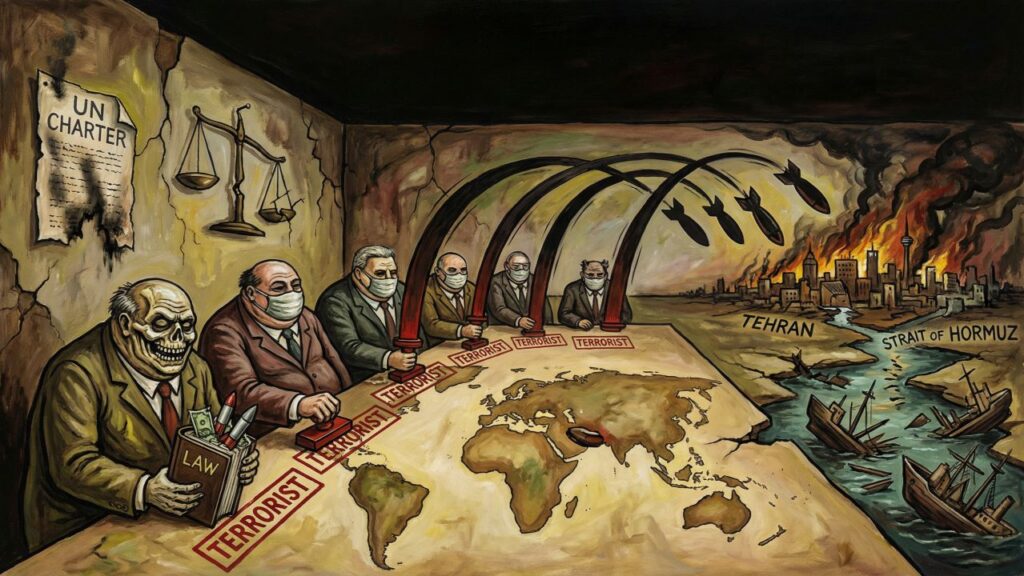
American foreign policy has finally perfected the art of self‑parody. It is now routine for Washington to bomb another sovereign state, talk openly about “taking out” its infrastructure, and then watch the American press repeat, with a straight face, that the target is a “terrorist organization” the US government itself unilaterally designated years earlier. The only thing more ridiculous than this feedback loop is how normal it has become.
Consider Iran. Years of policy groundwork went into branding the Islamic Revolutionary Guard Corps and associated groups as “terrorist organizations,” an unprecedented step against a formal arm of a state rather than a non‑state militia. Once that label is in place, it hard‑wires itself into headlines, chyrons, and ledes. News segments and articles describe US and Israeli strikes as “hitting terrorist targets,” not bombing units of another country’s armed forces inside that country’s territory.
The magic trick works like this. First, the US executive branch decides that some component of a rival state is “terrorist.” Second, that designation is repeated so many times that it becomes part of journalistic boilerplate. Third, when war comes, the same outlets launder acts of aggression as counter‑terrorism, because the actors on the receiving end have already been pre‑branded as beyond the law. The circle is perfectly closed: the state certifies its enemies as criminals, and the media cites the state to explain why it is now punishing them.
Set this against what international law actually says, and the hypocrisy is hard to miss. The UN Charter prohibits the use of force against the territorial integrity or political independence of any state, except in self‑defense against an armed attack or with Security Council authorization. In the current Iran war, there is no Council mandate, and even cautious legal commentators admit that the self‑defense claim is, at best, highly contested. A long list of human rights lawyers, UN special rapporteurs, and international law scholars describe the campaign as an unlawful use of force, verging on the textbook definition of aggression.
Yet if you consume only mainstream US coverage, you would hardly know this debate exists. Questions of legality show up, if at all, in the third or fourth paragraph as “critics say” color, wedged between quotes from Pentagon briefers and terrorism “experts” explaining why the designated organizations are so dangerous. The structure of the story is never about whether the United States has the right to bomb another country. It is about whether the targets deserve it.
That is the funniest and darkest part of the whole spectacle. We have managed to replace the rule of law with the rule of labels. The decisive question is not: Did Congress declare war? Is there Security Council authorization? Has there been an armed attack that meets the bar for self‑defense? The decisive question is: Has Washington stamped these people as “terrorists” on one of its ever‑expanding lists? If the answer is yes, then anything that follows can be described as “counter‑terrorism operations,” no matter how many missiles are in the air or which borders are crossed.
This is why the coverage feels so unhinged. You watch a major power conduct strikes that leading jurists say violate the core post‑1945 restraints on war, and the same outlets that love to sermonize about the “rules‑based order” dutifully repeat that the targets are terrorists. It is like watching an arsonist hold a press conference about fire safety while the building behind him burns, and every reporter writes down his concern about other people playing with matches.
Underneath the absurdity is something more corrosive. Once you accept that the government can make the law disappear by changing the label on whom it is killing, there is no limiting principle. Any enemy can be moved from “state actor” to “terrorist actor” with a press release and a background call. Any war can be rebranded as a “campaign against terrorism,” no matter how nakedly it violates the Charter that is supposed to bind everyone, including the superpower.
It is darkly hilarious to watch the clueless press quote US officials on who is or is not a terrorist while the same officials bomb Iran without even nodding toward legality. The joke, unfortunately, is on us.
Related reading
- A Bill of Indictment for Murder and Genocide Against the American Military and Trump, as its Commander and Chief
- Обвинительное заключение по делу об убийстве и геноциде против американских вооружённых сил и Трампа как их Верховного главнокомандующего
- Stop Calling It News. Gulf State “Reporting” Is Trump’s Bullshit With A Gulf State Palace Seal.
- American Empire in Ruins: The Unprovoked, Unconstitutional, and Catastrophic US-Israeli War on Iran