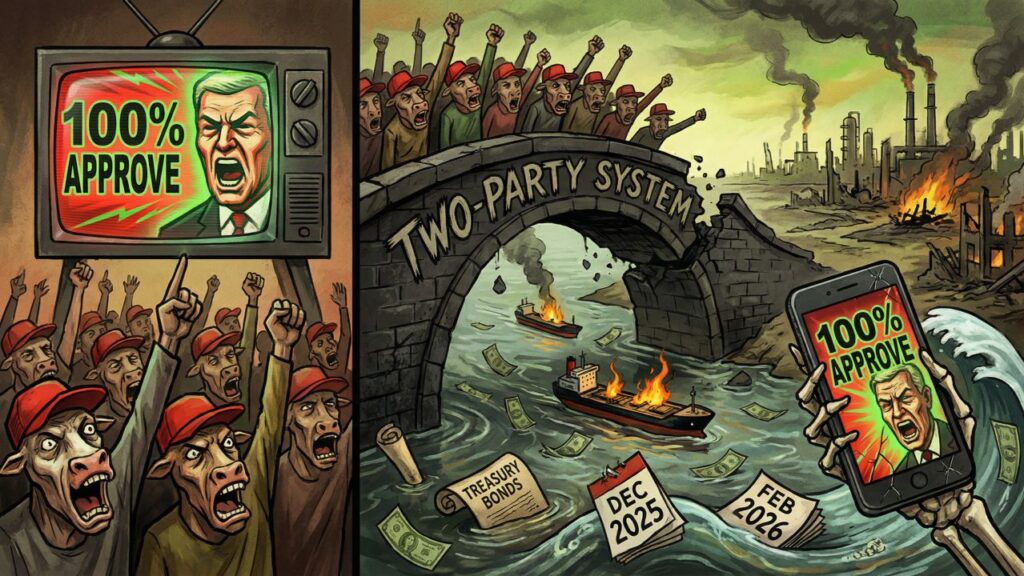
A graphic is circulating on LinkedIn. It shows a CNN broadcast image declaring that MAGA Republicans approve of Donald Trump at 100%, with 0% disapproval. The headline reads: “CNN Admits Stunning 100% Approval for Trump Among MAGA Despite Iran War and Tucker Carlson Criticism.” Someone posted it with the caption: “This must have been difficult for CNN to admit.”
My first reaction was the obvious one: MAGA loyalists cannot be moved. No war, no economic shock, no betrayal of former allies will dislodge them. I have seen this film before. Then I looked more carefully. What I found was not evidence of immovable loyalty. It was a propaganda operation so sloppily constructed that it practically begs to be dismantled, and behind it, a two-party system that has been quietly consuming the country’s capacity for self-governance for a generation.
The Poll That Cannot Prove What It Claims
Start with the fact-check, because the graphic falls apart the moment you read the fine print.
The NBC News poll cited was conducted in December 2025. The US-Israel strikes on Iran did not begin until February 27, 2026. Tucker Carlson’s public break with Trump over the Iran war followed those strikes by days. The graphic’s own headline claims MAGA support holds “despite Iran War and Tucker Carlson criticism,” but the underlying data was collected two to three months before either of those things happened. You cannot measure a reaction to events that had not yet occurred. This is not a subtle methodological quibble. It is a categorical misrepresentation. The image is a pre-war approval snapshot retrofitted with a post-war headline.
The broader polling reality is considerably less flattering. As of mid-March 2026, Trump’s overall approval across reputable pollsters runs between 37 and 44 percent, averaging roughly 40%, not the 41% steady floor sometimes cited, and trending downward. Nate Silver’s aggregate puts his net approval rating at a new second-term low of minus 15.3. A subsequent NBC News poll conducted after the Iran strikes, released March 8, 2026, showed Trump net negative on handling the war and Democrats holding a meaningful midterm edge. That poll does not appear in the circulating graphic.
Pew Research found that only 27 percent of Americans now support “all or most” of Trump’s policies, down from 35 percent when he took office, with the entire decline coming from within his own coalition. Among all Americans, 52 percent disapprove of Trump’s handling of the Iran war specifically. The graphic does not mention any of this. It selects the single most favorable data point available, strips it of context, time-stamps it dishonestly, and sends it into the LinkedIn feed as vindication.
That is not information. That is tribal ammunition.
What the Post Is Actually Saying
When someone shares this graphic with the caption “this must have been difficult for CNN to admit,” they are not making an analytical point. They are making a tribal one. The subtext is: we will not move. We are so ground down by relentless progressive overreach, so repelled by the left’s performative outrage at everything Trump says or does, that we will absorb any policy failure, any strategic catastrophe, any betrayal of former allies within the movement, and we will hold the line regardless.
Consider what “holding the line” now requires. Trump has publicly turned on Tucker Carlson, Marjorie Taylor Greene, Joe Kent, and Elon Musk, each of whom was at various points a defining figure of the MAGA coalition. He has launched a war in Iran with no exit strategy, no credible plan to reopen the Strait of Hormuz, and a daily cost to American taxpayers of roughly $1 billion. He has presided over gas prices rising nearly 80 cents per gallon since the strikes began. He has pushed the national debt past $39 trillion while running a war on a credit card. He has paralyzed the Federal Reserve between inflation and recession. And he has accelerated the very de-dollarization dynamics that threaten the financial architecture of American power.
None of it moves the base. That is not strength. That is the terminal stage of polarization, and to understand how we arrived here, you have to understand what the two-party system has been doing to the American electorate for decades.
The Ratchet That Only Turns One Way
The two-party system under first-past-the-post voting does not produce the best candidates. It produces the most tribal ones. Both parties have an institutional incentive to activate their base rather than persuade the center, because enraged partisans vote reliably and the center has no party home and therefore no leverage. The ratchet turns one direction: toward the extreme. Each cycle, the parties test how far they can push before the center fractures. The answer, it turns out, is very far indeed.
The 2024 election was the ratchet completing a full turn on both sides simultaneously.
Democrats, intoxicated by a decade of progressive identity capture and media validation, ran an incumbent who was visibly, undeniably impaired, propped up by handlers who convinced themselves the country could not see what it plainly saw. When the fiction collapsed in real time during a televised debate, the party did not hold a primary. It anointed. Kamala Harris was installed as the nominee without a single vote cast by a Democratic primary voter, presented to the country as a fait accompli, and dispatched to the campaign trail armed with no discernible platform, no coherent economic message, and a communication style that alternated between impenetrable word salad and the insipid giggling of someone performing confidence they did not feel. She never once articulated a vision for unifying the country. Unity was not the goal. Winning was, and the progressive establishment was so drunk with its own righteousness it genuinely could not see how she landed with the other 60 percent of the electorate.
Republicans, for their part, offered the same Trump the country had already evaluated once and narrowly rejected. His entire first term was the audition tape: bombastic, litigious, constitutionally contemptuous of constraint, openly self-serving, and constitutionally incapable of governing for anyone beyond his base. He made no pretense of national unity. He never stated it as a goal. Like Harris on the other side, the campaign was not about bringing the country together. It was about vanquishing the enemy. The enemy, in both cases, was the other half of the country.
The dumbed-down, propagandized American voter, fed a steady diet of enemy imagery by Fox News on the right and virtually every other major media outlet on the left, walked into the booth and pulled the lever not for a candidate but against a threat. That is what the two-party system has reduced democratic participation to: a binary choice between fears, delivered by media ecosystems whose business model depends on keeping the fear alive.
The Brief Illusion and the Money
We got Trump. In the early weeks of his second term, he grandstanded convincingly as a man of conviction, signing executive orders at a pace that read like genuine ideological momentum and telling the country that this time would be different. It was not different, because it could not be different. The Uniparty Congress, sustained by the same concentrated donor money that has directed American foreign policy for thirty years, absorbed the energy, redirected the agenda, and cut the populist performance down to size. What remained was the ego without the restraint, the bellicosity without the strategy, and eventually, the war in Iran, which no serious person in the energy security community believed had been planned beyond the first strike.
Bob McNally, who served as Senior Director for International Energy on George W. Bush’s National Security Council and who had war-gamed a Hormuz closure scenario with military officers eight months before the first bomb dropped, put it plainly: the central planning failure was “the false belief that the Strait of Hormuz would be left untouched from the conflict.” That belief was not an intelligence failure. It was a choice to ignore what every serious analyst already knew, because the political performance required a quick, clean victory and the strategic reality offered neither.
Where It All Leads
The war Trump launched without provocation and without a plan is now metastasizing into exactly the forever-war scenario his own base was told to fear from the left. The Strait of Hormuz is effectively closed to commercial traffic. Iran is negotiating yuan-denominated oil passage deals with eight countries, directly accelerating the de-dollarization of energy trade. Goldman Sachs commodity analysts model Brent crude scenarios well above $130 under sustained closure. Wood Mackenzie puts $150 oil as its base case, with $200 “not out of the question” by late 2026. The IEA warns this would be the most severe oil supply shock since the 1973 Arab embargo.
Ironically, catastrophically, the war is destroying the very petrodollar system that underwrites the American debt burden and makes the empire financially possible. BRICS governments, Beijing and its Gulf partners, and nervous central banks around the world are building the pipes, platforms, and contracts to cut the dollar out, accelerated by a conflict that every major importer now reads as proof that US-controlled energy routes and payment systems cannot be trusted. The dollar was already down 9 percent in 2025. The bond market is no longer treating Treasuries as a safe haven. The five-year TIPS breakeven is near a one-year high. The foundation of American financial supremacy is cracking, and the man holding the hammer is calling it a victory.
The Real Meaning of the Graphic
The circulating CNN graphic is not evidence that MAGA is immovable. It is evidence that the two-party system has succeeded in its primary function, which is not governance, but containment. It contains the electorate inside two camps so hostile to each other that virtually any behavior by the in-group leader becomes defensible, because the alternative is handing power to the enemy.
That is the logic the graphic exploits. Policy outcomes become irrelevant. A war that costs a billion dollars a day, re-inflates prices, paralyzes the Fed, and quietly auctions the petrodollar to BRICS and Beijing becomes, inside that logic, not a catastrophe but a loyalty test. You either hold the line or you defect to the left. There is no third option, because the two-party system has spent fifty years making sure no third option survives long enough to matter.
Any American who still believes that system is the natural and inevitable expression of democratic self-governance might sit with that image for a moment. A time-displaced poll, stripped of context, headlined with events it cannot actually measure, circulated as proof of eternal tribal fealty while the strategic foundations of American power crack in real time.
That is not democracy functioning. That is democracy consuming itself, one propaganda graphic at a time.
Scott Ortkiese is the founder of Throughline Synthesis Group, a geopolitical and economic analysis firm based in Houston, Texas. He publishes on LinkedIn and Substack on US foreign policy, energy economics, and the structural contradictions of American empire.
Related reading
- A Tale of Two Donalds: What He Said at Davos and What The Press Said He Said
- From Kennedy Campaign Manager to Trump Advocate: Amaryllis Fox Kennedy's Warning About Intelligence Agency Overreach
- The Sound of Silence: Where is the "Established" Press on Crenshaw Threats and Money Making?
- Kneecapping the Two-Party Uniparty After Trump’s Versailles Moment