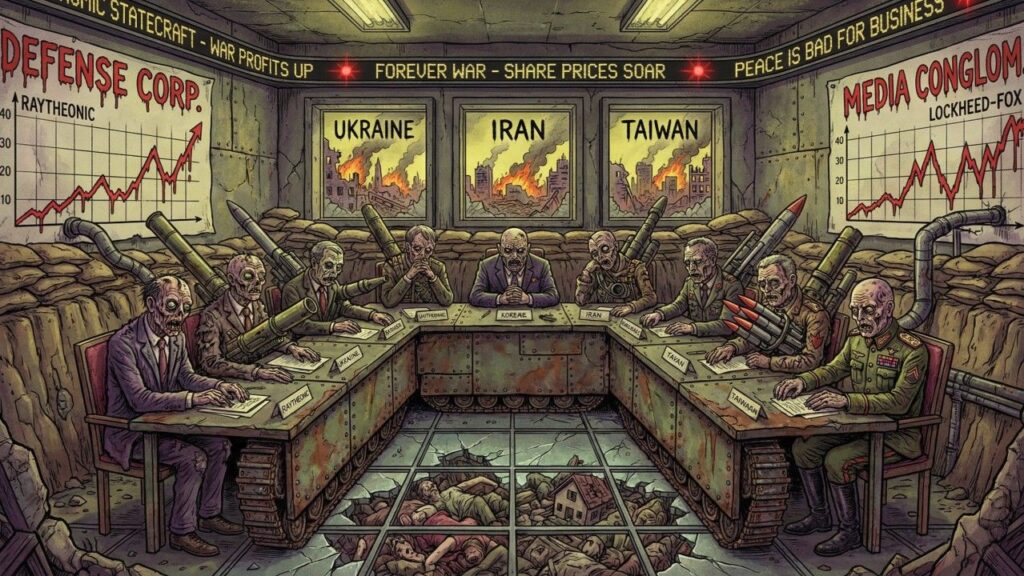
At some point, you have to stop pretending this is about “democracy,” “rules-based order,” or whatever soaring abstraction the comms shop is pushing this week, and admit what’s in front of your face: war has been converted into a revenue model. Ukraine is not just a battlefield, it’s a perpetual market, a recurring‑revenue stream wired straight into the veins of the US and NATO arms industries. Iran is queued up as the next product line extension. Taiwan is the crown jewel on the five‑year plan.
Once you see that, everything else in Western discourse starts to look like what it is: a lot of exquisitely credentialed jabberwocky layered over a simple balance sheet.
The euphemism for all this is “economic statecraft.” That’s the polite term for using finance, sanctions, trade controls, and “friend‑shoring” to kneecap rivals. But economic statecraft is not an alternative to military power. It’s the on‑ramp. It softens the target, concentrates the profits, and builds the domestic constituencies for the next phase, the part we used to call, more honestly, war.
Round and round it goes, and where it lands, everybody knows.
Ukraine: The Proof of Concept for Perpetual War Cash‑Flow
You can start with the obvious: the Ukraine war has been a bonanza for the arms industry. We’re not talking about a marginal bump in orders. We’re talking about a structural, multi‑year ramp in production, pricing power, and political leverage.
- A recent report noted that the Ukraine war has boosted arms manufacturers’ profits and driven sustained share‑price gains, with US and European firms citing Ukraine explicitly in investor materials as a driver of “strong demand.”
- Another analysis concluded the US arms industry is the single biggest beneficiary of the conflict, as Washington’s role as the primary supplier for Kyiv translates into expanded exports and long‑term contracts far beyond Ukraine itself.
This is classic recurring revenue: the plants that were reopened or expanded “to help Ukraine defend itself” are not going to be mothballed once Kyiv signs anything resembling a settlement. They are sunk costs that now require new demand to justify themselves, either endless replenishment for Ukraine, a rotation into other theaters, or both.
Wartime procurement is the cherry on top. Emergency authorities, “streamlined” oversight, multi‑year commitments, and ballooning NATO targets all lock in future cash flows. One Responsible Statecraft analysis warned early on that arms makers were already exploiting Ukraine to weaken oversight and expand their discretion, precisely to ensure that the taps don’t get turned off once the headlines move on.
You don’t have to impute a grand conspiracy. You just have to recognize the structure: an industrial base retooled for conflict, a political system wired to treat defense spending as untouchable stimulus, and a set of corporate actors whose fiduciary duty is to grow that market. In that world, peace is not an objective. It’s a risk factor.
The Media Arm of the Complex: “Expertise” for Hire
All of this would be harder to sustain if there were an honest public debate about costs, tradeoffs, and off‑ramps. That’s where the information layer comes in.
A Quincy Institute study looked at who sets the terms of US debate on Ukraine and defense policy. It found that think tanks funded by major defense contractors dominated media citations, congressional testimony, and policy coverage. FAIR’s write‑up of that research documented case after case where analysts from institutions bankrolled by Lockheed, Raytheon, Northrop, and friends went on television or appeared in print arguing for more weapons, more escalation, and longer war horizons, without a single disclosure that their employers cash checks from the firms supplying the war.
By one count, roughly 85 percent of think‑tank citations in major US outlets on Ukraine came from institutions with financial ties to the arms industry. Voices arguing for ceasefire, compromise, or even serious diplomacy were marginal and typically came from the handful of organizations, Quincy among them, that explicitly refuse defense‑industry money.
The pattern is simple:
- War expands a market.
- The beneficiaries of that market fund think tanks.
- Those think tanks feed “expert” commentary directly into media and congressional hearings.
- The experts explain, at great length, why anything short of maximalist war aims would be “naïve,” “appeasement,” or “helping the aggressor.”
What you hear on cable news or read on the op‑ed page is the marketing copy for a weapons portfolio.
This is why the public conversation about peace in Ukraine feels strangely hollow. You get debates over how to arm Ukraine faster, how to “surge” production, how to move from 155mm shells to longer‑range missiles. You almost never get sustained, prime‑time conversations about what a settlement would look like, how to sequence it, and what we’d have to give up to end the killing.
Because that conversation has no paying client.
Economic Statecraft: Laying the Track for War
But Ukraine is not just a war. It’s also a laboratory for economic statecraftall the non‑kinetic tools used to cripple Russia and discipline the rest of the world: sanctions on central‑bank reserves, SWIFT expulsions, price caps, export controls on critical technologies and minerals.
The theory is simple: you weaponize finance and trade to make the other side hurt so badly that they either capitulate or walk into your preferred negotiation. The practice is more revealing:
- Sanctions and export controls drive Europe deeper into US energy and weapons dependency.
- US and allied firms position themselves as replacement suppliers for everything from LNG to artillery shells.
- “Friend‑shoring” becomes a polite way to say “rewiring global supply chains around US power and preferences,” with new rents for compliant corporations.
Economic statecraft, in other words, is not just about punishing Russia. It’s about re‑concentrating global wealth and leverage in the same Atlanticist networks that run the security order.
And here is the key cycle: once the measures are in place, they create friction and resentment that make genuine accommodation harder. You seize another country’s reserves; you crater their export revenues; you signal that your legal system is an arm of your grand strategy. Don’t act surprised when they don’t trust you at the peace table.
The solution that’s always left on the table? If economic statecraft doesn’t break them, we have other tools. Cue the “no option off the table” chorus, and the inevitable shift to the more familiar form of statecraft, military.
Economic statecraft is not a substitute for war. It’s a preparatory stage and, in many cases, a revenue stream in its own right.
Iran: The Perpetual Sanctions Market
If Ukraine is the live‑fire test, Iran is the proof that forever war need not be formally declared. It can simmer indefinitely as forever siege.
For decades, Iran has been subject to an evolving lattice of sanctions, covert operations, proxy clashes, and occasional overt strikes. Each new “crisis” (a drone incident, a tanker seizure, a nuclear scare) is an opportunity to ratchet up the economic pressure, expand the blacklist, and move more security‑theatre hardware into the region.
The business logic is identical:
- US and allied militaries get a permanent justification for basing, deployments, and missile defenses across the Gulf.
- Contractors get recurring orders for patrols, interceptors, drones, and intelligence platforms.
- Financial and compliance industries build entire product lines around navigating and enforcing sanctions, a professional class whose livelihood depends on the siege never truly lifting.
In practice, the Iranian “file” is managed to stay at a rolling boil: hot enough to warrant constant attention and constant spending, cool enough to avoid an outright regional war that might shock domestic audiences.
If you map the incentive structure, peaceful normalization with Iran (say, a stable regional security arrangement that allows full reintegration into global markets) would destroy several lucrative lines of business at once. You are asking the complex to voluntarily close a profit center.
That’s not how this system behaves.
Taiwan: The Salivating Hawks’ Big Prize
Which brings us to Taiwan. If you think the salivation over Ukraine is bad, watch what happens when the same class of “strategists” and investors stare at a map of the Taiwan Strait.
The logic is already fully visible:
- Ukraine is framed as the rehearsal, “proving ground” for Western resolve and supply chains, while Taiwan is the real show.
- Think tanks heavily funded by US arms makers are rolling out reports on “deterrence by denial,” “porcupine” strategies, and the urgent need to flood Taiwan and the region with missiles, mines, and naval platforms.
- US national‑defense documents explicitly tie the post‑Ukraine industrial ramp to Indo‑Pacific “requirements,” making it plain that the capacity built for one theater is intended to be portable.
From a business perspective, Taiwan is the ultimate recurring‑revenue fantasy: a high‑tech island sitting astride critical sea lanes, opposite a rising peer competitor, in a region whose allies can be convinced to spend two percent of GDP on fear. The scenarios almost write themselves: contested strait, grey‑zone harassment, cyber campaigns, arms races over hypersonics and anti‑ship missiles.
And before you get to the main event, if you ever do, you can book years of cash flow:
- Arming Taiwan to the teeth.
- Arming Japan, Australia, the Philippines, and whoever else can be spooked into “taking the China threat seriously.”
- Building layered missile defenses and naval infrastructure across the region.
The Ukraine model scales beautifully: economic statecraft in the form of tech controls, sanctions threats, and “de‑risking” from China; military statecraft in the form of forward deployments and continuous “freedom of navigation” ops; a media environment saturated with experts whose employers see only upside in a protracted confrontation.
But from the standpoint of the complex, there is an order of operations:
- Lock in Ukraine as a semi‑permanent production baseline, large enough to justify rebuilt factories, normalized enough domestically that questioning it marks you as suspect.
- Keep Iran on simmer as a justification for Middle East posture and sanctions infrastructure, too useful as a training ground for economic statecraft to let go.
- Pivot fully to Taiwan once the public has metabolized the idea that a multi‑front, multi‑theater confrontation is the new normal, not an emergency.
Ukraine and Iran are not distractions from the Pacific “pivot.” They’re the bridge.
The Future of Forever Wars: From Campaigns to Infrastructure
Eisenhower warned about a “military‑industrial complex” that might acquire “unwarranted influence” and distort the republic beyond recognition. He did not live to see the full elaboration of the system: a military‑industrial‑media‑financial complex whose normal mode of operation is a permanent low‑grade war against somebody, somewhere.
It’s no longer helpful to think in terms of discrete wars that begin and end. The business model is infrastructural: a permanent archipelago of bases, contracts, sanctions regimes, surveillance networks, and narrative operations that require only occasional spikes of overt violence to justify their own existence.
Under this model:
- Economic statecraft is the scaffolding, sanctions, export controls, financial policing, “de‑risking,” all of which create new dependency relationships and fee streams.
- Military statecraft is the enforcement layer, deployments, arms sales, covert operations, occasional bombing campaigns.
- Media statecraft is the story generator, manufacturing consent for each new ratchet, stigmatizing dissent as reckless, and laundering interested positions as objective expertise.
The wars themselves become interchangeable episodes. Today it’s Ukraine; yesterday it was Afghanistan and Iraq; tomorrow it’s Taiwan or something we haven’t thought of yet. The point is not victory. The point is continuity.
Victory, properly understood, is dangerous: it implies the possibility of demobilization, of returning powers, budgets, and attention to civilian priorities. The complex has learned that such moments are to be avoided. Better to define objectives so expansively, and threats so metaphysical, that victory can never be declared, only “managed.”
So we get forever counterterrorism, forever “competition” with China, forever sanctions on Iran, forever “support” for Ukraine. Each campaign justifies the last and seeds the next.
Where It Lands, Everybody Knows
The Mearsheimer-Beebe debate at Quincy was about whether peace in Ukraine is possible. That’s a useful academic question. But it’s not the operative one. The real question is whether peace is compatible with the consolidated interests that currently run the show.
Look at who owns the factories, the patents, the debt, the media properties, the think tanks, the campaign coffers. Look at how Ukraine, Iran, and Taiwan are described in investor calls and strategic roadmaps. Then ask yourself: what does “peace” look like to those people? A human achievement, or a threat to quarterly guidance?
You already know the answer. Everybody does. That’s why the jabberwocky feels so hollow. Underneath the rhetoric, the system is doing exactly what it was built to do: turn conflict into cash‑flow.
Economic statecraft lays the rails. Military statecraft runs the trains. Media statecraft makes sure the passengers cheer.
Round and round it goes. And where it lands, if we don’t break the machine, is obvious: a world where every serious geopolitical disagreement is pre‑monetized, securitized, and endlessly prolonged, not because it cannot be solved, but because solving it would mean closing a line of business.
If you want peace, you’re not arguing with a policy anymore. You’re arguing with a business model.