NOTE FROM THE AUTHOR:
March 15, 2026
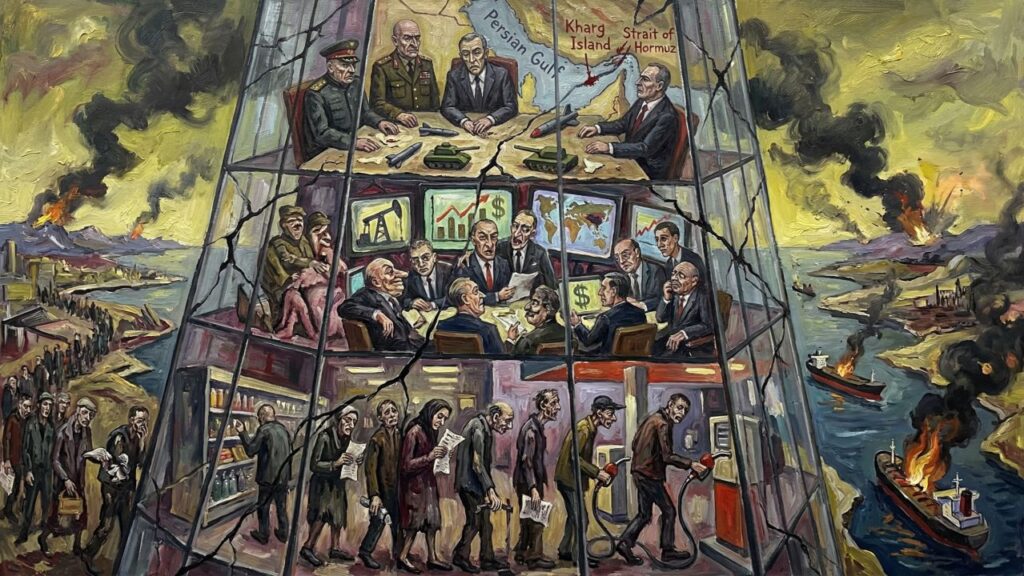
The scene you should picture is not just an American family at the pump, but a conference table in a locked room in Washington, Brussels, Beijing, Riyadh, and Delhi. Around it sit finance ministers and central bankers staring at the same charts: oil above one hundred, shipping lanes frozen, bond markets twitching, currencies under pressure. On one screen is the Strait of Hormuz. On another is the US debt clock. On a third are the approval ratings of governments that cannot tell their own people what this crisis is really about without admitting how much of their sovereignty has already been sold.
This article is written for that room and for the public that has been deliberately excluded from it. The ministers know that a forty trillion dollar debtor that no longer makes what the world needs cannot bomb its way back to credibility. They know that the petrodollar order is being stress‑tested in real time and that every misstep accelerates the search for alternatives. What they will not say out loud is that the system they serve has become a glasshouse held together by financial privilege and military force, and that every strike on Iran, every closure of Hormuz, brings the shards closer to their own feet.
If you are reading this in Houston or Hamburg, Mumbai or Manila, you deserve to be in that summit room, at least in your mind. You need to know that the price at your pump and the food on your table are hostage to a rentier order that treats your future as a line item on its balance sheet. And you need to know that the real question in this crisis is not whether “our side” wins another news cycle, but whether any of us can rebuild a system where law, production, and human needs matter more than the panic of an empire of paper that chose to live off other people’s work and is now running out of road.
Scott Ortkiese
By Scott Ortkiese | so@throughlinesynthesis.com | www.throughlinesynthesis.com
Introduction
On a Friday in March, you pulled into the gas station and the number on the pump felt wrong. Not a typo wrong, but something‑is‑breaking wrong. Gasoline was up almost a dollar in a week. Diesel, which prices every truck that moves every product you buy, was up even more. You did the math in your head and felt the quiet panic that comes when there is no slack left in the household budget.
Nothing about that spike was an accident. You were not “hit by global events” in the abstract. You were handed the bill for a choice. American warplanes struck Kharg Island in Iran. Iran closed the Strait of Hormuz. The world’s most important energy chokepoint seized up. The price you paid at the pump is the visible symptom of something most people are never taught to see: a glasshouse empire of debt and financial privilege that chose to start a war to defend the money system it lives on.
This is the story of that glasshouse, the people who built it, why they chose to bomb Iran when they did, and what happens when a rentier empire that builds almost nothing runs out of other people’s work to live off.
I. Naming the Glasshouse
Modern America still talks like an industrial nation. We remember the arsenals of democracy, the factories that won World War II, the union wages that bought homes and filled Main Street diners. On paper, we still call ourselves the world’s largest economy. In reality, the foundation has changed.
The United States now carries almost forty trillion dollars in public debt. The annual interest bill on that debt already exceeds the official defense budget, and both numbers are still rising. The dollar’s global dominance is not what it was. Central banks have been quietly diversifying away from US Treasuries. The dollar’s share of global reserves and cross‑border payments is drifting down. None of this has produced a crisis yet, but it has changed the terms of American power. Cheap borrowing is no longer a birthright. It is a privilege that has to be defended.
At the same time, the productive base that once anchored that privilege has been hollowed out. Since the 1980s, American elites made a set of deliberate choices. They treated factories and unions as costs to be shed, not assets to be nurtured. They embraced a doctrine that says the sole purpose of a corporation is to maximize shareholder value in the next quarter. Between 2003 and 2012, the largest companies in the country paid out more than ninety percent of their earnings to shareholders in dividends and stock buybacks. That left almost nothing for new plants, new equipment, or better wages.
The result is an economy where the labor share of income is at its lowest level since World War II, where tens of millions of people live paycheck to paycheck, and where entire regions have been stripped of the industries that once gave them both jobs and a sense of purpose. What expanded instead was the financial sector, the tech platforms, the legal and consulting machinery that sits on top of that real economy and extracts fees, rents, and interest from it.
That is the glasshouse. A debt‑bloated, financialized, information‑heavy superstructure built on top of a shrinking productive base, protected by a currency that other countries are increasingly unwilling to underwrite on the old terms, and maintained by a military that has quietly become its core collateral.
II. The Military as Collateral
For fifty years, the dollar’s status as the world’s reserve currency gave Washington what a French president once called an “exorbitant privilege.” Because you needed dollars to buy oil and settle trade, you had to hold dollars. Because you held dollars, you bought US bonds. Because you bought US bonds, the United States could borrow more, at cheaper rates, than any normal country.
That status did not just fall from the sky. It was built in large part on a specific bargain with Saudi Arabia and other oil producers after the collapse of Bretton Woods in the 1970s. They would price oil in dollars and invest their surplus in American assets. In return, the United States would guarantee their security and, crucially, the security of the energy routes their exports depended on.
Over time, that energy guarantee expanded into a broader promise. The US Navy would keep the sea lanes open. US forces would police the Gulf. Anyone who threatened that arrangement would face American power. Energy markets, global trade, and, indirectly, the value of the dollar itself were all tied to the assumption that Washington could and would enforce order in the key chokepoints.
In that architecture, the US military is not just a national defense instrument. It is the visible guarantor of an invisible balance sheet. It is the hard asset that gives confidence to a system of paper claims. When bond markets and foreign central banks look at forty trillion dollars of US debt, they are not just looking at tax receipts. They are looking at aircraft carrier groups, air bases, special forces, intelligence networks, and the demonstrated willingness to use them.
This is not how Americans are taught to think about war. We are told stories about defending freedom, fighting terrorism, protecting allies. But when you look at where the wars happen, when they happen, and who benefits, you find a consistent pattern. The strikes that matter most are the ones that protect energy flows, shipping routes, and financial leverage. They are monetary events as much as military ones.
The attack on Kharg Island fits that pattern. On the surface, it was sold as a response to Iranian aggression and a defense of “freedom of navigation.” In substance, it was a move by a system that feels its monetary privilege slipping to punish and intimidate a state that has been working, with Russia and China, to build energy and trade routes that bypass the dollar.
III. The Rentier Protection Racket
That underlying pattern matters because it reveals what America has become in the eyes of many of its own creditors and partners. Not a neutral broker of global order, but something closer to a protection racket.
In a classic protection racket, you do not produce much yourself. You offer “security” to those who do, on terms you dictate, and you extract a share of their output in exchange. The threat is that if they refuse, they will face disorder, sanctions, or worse.
Look at the division of labor in the current system. China, Japan, South Korea, and the Gulf producers make things and energy. They run the factories, ship the goods, and keep the pipelines and tankers flowing. The United States and its core allies sit in the middle, running the currency, the payment systems, the sanctions regimes, the tech platforms, the IP and legal codes, and the weapons networks that underwrite it all.
When Japanese or Korean companies sell cars, chips, or steel, a significant slice of the value they generate is captured by dollar settlement, Western‑owned logistics and insurance, platform fees, patent royalties, and the financing structure around those transactions. When Gulf states sell oil and gas, much of the surplus ends up recycled into US Treasuries, Western asset managers, London and New York real estate, and defense contracts.
For decades, this worked well enough for the players involved. Asia got access to US markets and technology. The Gulf got security guarantees and elite lifestyles. The United States got cheap imports, financial flows to support its deficits, and a global role.
But the terms of that bargain have been shifting. The more Washington uses sanctions, asset seizures, and unilateral military action to enforce its preferences, the more Russia, China, Iran, and many in the Global South see the system less as a stable order and more as a trap. When they watch US officials freeze central bank reserves, weaponize SWIFT, and cut countries off from trade, they see a protection racket in action. Obey and pay, or be cut off.
The attack on Iran was received through that lens. Here is a state that has already been under crushing sanctions for years, now being bombed, not because it poses an imminent existential threat to the United States, but because its existence as an independent energy exporter outside the dollar system is unacceptable to a rentier order. For countries that have no desire to live forever under someone else’s financial veto, the message was clear and intolerable.
IV. Government as Inefficiency
If this is what the system looks like from thirty thousand feet, the next question is who actually pilots it. Most Americans are told that the decisive choices about war, sanctions, and grand strategy are made by the president, the Congress, and the formal national security bureaucracy. That picture is badly out of date.
Over the past three decades, a dense web of private power has wrapped itself around the institutions of government. Think tanks funded by defense contractors and foreign governments generate the white papers and talking points that define the “serious” policy debate. Lobbyists and lobby‑style organizations channel campaign money and threats of primary challenges to members of Congress. Revolving‑door careers tie the personal fortunes of senior officials to the industries and foreign governments their decisions affect.
None of this happens in the shadows. The founding documents of the current Iran policy are public if you know where to look. In the mid‑1990s, a group of American neoconservative strategists wrote a memo for an incoming Israeli prime minister that called for regime change across the region, with Iran as the ultimate prize. After September 11, many of the same people and their allies used fear and anger to push the United States into Iraq and to place Iran and Syria on the target list.
When those wars went badly, the network did not disappear. It changed names, created new organizations, and moved into new administrations. By the time Donald Trump returned to office, a new generation of hawkish institutions and personnel was ready with fresh manifestos calling for confrontation with Iran, and with deep links into the incoming national security team.
Around them sat a much larger machine. The major think tanks that provided intellectual cover were funded heavily by defense firms and foreign‑aligned donors. The largest asset managers in the world were major shareholders across those defense firms, tech companies, and media conglomerates. The Israel lobby and other well financed policy shops were spending record sums reshaping congressional primaries and punishing dissenters.
In that environment, formal democracy became something closer to a user interface. Voters could swap out the face at the top, but the basic script rarely changed. The language of “rules based order,” “credibility,” and “national security” recycled from one administration to the next, even as the underlying reality shifted toward private ownership of strategic decisions. To the people directing capital and contracts, Congress was no longer an independent branch of government. It was a cost center, an inefficiency to be managed.
V. Pax Silica and Pax West
For most of the postwar era, we called the global system “Pax Americana.” The idea was that American military presence, American economic leadership, and American institutions provided peace and stability. Whatever you think of that story, it no longer fits the current arrangement.
Today, the old Pax Americana has fused with something new: a private, tech driven order that treats sovereignty itself as an asset class. Call it Pax Silica or Pax West. Its core institutions are not the New Deal state, but the platforms, cloud providers, data brokers, and asset managers that sit at the center of 21st century commerce and warfighting.
Companies that began life handling search results or social networks now provide cloud infrastructure for intelligence agencies and militaries. Firms that started by analyzing consumer data now build predictive targeting systems and kill chains. Private launch companies carry military payloads into orbit. AI companies lean on governments to adopt their models as critical infrastructure and justify it in the language of national security.
Behind them stand the giant asset managers and private equity funds whose portfolios span defense, tech, energy, and media. When you own large stakes in all the major players in a sector, you do not just passively ride the market. You coordinate strategy, shape governance, and align policy to your interests. When those interests depend on growth in defense and surveillance spending, perpetual tension and periodic war are not bugs. They are features.
This fusion of Silicon Valley, Wall Street, and the Pentagon has created a new kind of private empire. It relies on state power when useful, especially for war, regulation, and legal enforcement. But it has also learned how to bypass parliaments and courts when they get in the way. It does business directly with foreign sovereigns, buys influence within parties before elections, and uses a mix of lobbying, investment, and narrative management to steer policy without the public ever seeing a formal debate.
VI. Kharg and Hormuz as Stress Test
The strike on Kharg Island and the closure of the Strait of Hormuz did two things at once. They jolted ordinary people awake to the vulnerability of the system they live in, and they provided the rest of the world with a live‑fire stress test of American power.
Most Americans had never heard of Kharg Island. They had no reason to. It is a small outcrop in the northern Gulf with a runway, some storage tanks, and a terminal. But that terminal handles the overwhelming majority of Iran’s crude exports. It sits at the threshold of a narrow passageway through which about a fifth of the world’s daily oil supply and a significant share of global liquefied natural gas flows. It also carries a large share of the world’s urea fertilizer just as farmers across the northern hemisphere are planting crops.
When American aircraft destroyed the island’s military installations and Iran responded by closing the strait, the consequences rippled faster than most people could follow. Oil prices spiked past one hundred dollars per barrel and kept climbing. Diesel shot up by more than a dollar and a half. The International Energy Agency announced the largest release of strategic reserves in its history. Analysts projected that even a partial and temporary disruption could knock hundreds of billions off global output. A prolonged closure pointed toward something closer to a global depression than a recession.
This was not unforeseeable. Military planners have war‑gamed a conflict with Iran for decades. Almost all of them warned that air power alone cannot defeat a country of ninety million people with prepared coastal defenses, a large missile arsenal, and decades of practice in asymmetric warfare. Intelligence assessments reportedly told the president that no feasible campaign would produce regime change. Senior officers warned that ground forces were insufficient and exposed.
Those warnings were brushed aside. The bombs fell anyway. From a purely military standpoint, it looks like madness. From the standpoint of a rentier system that feels time running out on its monetary advantage, it looks like a desperate gamble: hit now, before alternative energy and financial corridors fully mature, and hope that a shock will cow rivals into backing down.
What the world actually saw was an empire that could not secure the chokepoint it had promised to police, attacking a state it could not defeat, and triggering a crisis that hurt its own allies and citizens while enriching its official adversaries.
VII. Sovereign Anarchy
For years, Western leaders have repeated a phrase that is now starting to ring hollow: the “rules based international order.” The promise was that the post‑1945 system would restrain raw power with law, institutions, and shared norms. There was always a gap between those words and reality, but in recent years the gap has become a chasm.
We now inhabit something closer to sovereign anarchy. There is no credible global peacekeeping force. The United Nations is paralyzed whenever the veto powers’ interests are involved. There is no real enforcement mechanism for international law against the strongest states, and international financial institutions are routinely used as instruments of policy rather than impartial guardians of stability.
Within this vacuum, competing oligarchic blocs operate with growing freedom. On one side sit the US led networks of finance, tech, and security states. On the other sit the coalitions clustered around China, Russia, Iran, and the broader BRICS group. Each bloc has its own media ecosystems, financial rails, and strategic narratives. Each accuses the other of lawlessness. Both are willing to use force and economic coercion to shape outcomes.
In that setting, the language of rules has become a tool of sentimentality and distraction. Western publics are encouraged to see their own side as defending democracy, even when their governments are arming autocracies and ignoring their own laws. Adversaries are painted as uniquely evil, even when they are responding to very real grievances about past interventions, sanctions, and unequal treaties.
Fear plays a central role. Fear of losing monetary privilege. Fear of rising competitors. Fear of domestic political backlash if any leader admits that the era of unchallenged Western dominance is over. That fear drove the decisions to sabotage peace efforts in Ukraine, to pursue regime change doctrines that left countries in ruins, and now to launch a war against Iran that accelerates the shift toward the very multipolar order Washington fears.
VIII. Seeing the “Enemies” Clearly
None of this requires turning Russia, China, Iran, or any other power into heroes. Their governments have their own abuses, corruptions, and ambitions. But if you want to understand the world we are moving into, you have to strip away the cartoon villains and look at the rational core of their behavior.
Russia watched NATO expand to its borders, saw US backed coups and interventions in its near abroad, and then experienced the freezing of hundreds of billions of its reserves after invading Ukraine. It has concluded that any dependence on Western financial channels is a strategic risk. It is therefore pushing to settle trade in national currencies, deepen energy ties to Asia, and weaken the dollar’s grip wherever possible.
China has spent the past two decades building infrastructure and trade connections across Eurasia, Africa, and Latin America. It watched the United States use sanctions and export controls to try to cripple its tech sector and cut it off from key inputs. It is now accelerating work on alternative payment systems, expanding cross border use of the yuan, and building overland energy corridors that reduce its exposure to US controlled sea lanes.
Iran has been on the receiving end of sanctions, covert action, and military threats for most of the Islamic Republic’s existence. It knows it cannot match US conventional power. Instead, it has invested in asymmetric capabilities, regional networks, and non‑dollar trade. Its interest in accepting payment in yuan or other currencies for transit through Hormuz is not a stunt. It is part of a long term effort to escape a system that can choke off its economy at will.
Across the Global South, decades of structural adjustment, debt crises, resource extraction, and selective Western outrage have left deep scars. Many governments and populations have no illusions about the motives of any great power. They are not saints and many of their own elites are predatory. But they are asking a simple question: why should we keep accepting a system that leaves us vulnerable to someone else’s financial and military decisions when alternatives are finally emerging?
IX. The Spider System
When you put all of these strands together, you see something like a spider web. A structure that does not have a single center or mastermind, but that traps and channels the movements of everyone inside it.
One set of strands is the money itself: the global pools of capital that sit in sovereign wealth funds, insurance companies, university endowments, and above all in the giant asset managers. These institutions do not just buy and sell stocks. They sit on the boards, vote the shares, and influence strategy across industries.
Another strand consists of the non‑producing rentiers: the owners of fee streams, interest payments, IP portfolios, and platform monopolies. They profit not by building new productive capacity, but by owning the legal rights to other people’s productivity. As more of national income flows to them, less is left for wages, public investment, or genuinely innovative projects.
Wrapped around them is the traditional military industrial complex and the uniformed forces themselves. The contractors design and manufacture ever more expensive platforms and systems. The officers plan around those capabilities. Retirees cross the street to join the companies whose contracts they once helped award. War and permanent readiness are their business model.
Interlinked with all this are the tech, resource, and infrastructure oligarchs. They control the clouds where data lives, the algorithms that sort and predict, the mines and refining capacity for critical minerals, and the logistics networks that move goods. Their systems are now indispensable not just for commerce, but for modern war.
Then come the sovereign partners: the governments that align themselves with this web for protection, money, or ideological reasons. Israel, Gulf monarchies, NATO states, and key Asian allies all play roles, providing bases, legitimacy, and regional reach.
Feeding the web its stories is the owned press and managerial class. Major media outlets, consultancies, and corporate boards overlap with the same capital structure. They decide what counts as “moderate,” which experts are amplified, and which perspectives are dismissed as fringe or disloyal.
Finally, at the bottom of the web, is the exhausted public. Citizens juggling multiple jobs, rising costs, and collapsing trust in institutions. A population that has seen enough broken promises to be cynical, but that is also too stretched to mount sustained resistance. People for whom politics becomes either a grim spectator sport or a culture war, not a serious debate over empire, money, and war.
X. The Pax Lie and the Missing Peace Movement
The story this web tells about itself is simple and flattering. It insists that Pax Americana, now fused with Pax Silica and a wider Pax West, delivers peace and prosperity. That the alternatives would be chaos, dictatorship, and poverty. That any price paid at the pump or in foreign blood is a necessary sacrifice to keep the world safe.
Look at the record instead of the slogans. The sequence of major interventions and wars over the past quarter century has given us Iraq in ruins, Libya shattered, Syria devastated, Afghanistan abandoned, Ukraine bleeding, and now a Persian Gulf crisis that threatens global recession or worse. None of these outcomes resembles peace. None of them has strengthened the security or prosperity of ordinary Americans or Europeans in any lasting way.
At home, the same period has seen the erosion of stable middle class life, the rise of precarious work, the housing crisis, the opioid epidemic, and a slow collapse of trust in every major institution. The winners have been a narrow sliver at the top whose wealth and political leverage have grown astonishingly, and whose businesses are deeply entangled with the machinery of war and surveillance.
Under those conditions, you might expect a powerful peace movement to emerge. Instead, it is almost entirely absent. That is not an accident. Both the mainstream left and right are financed, staffed, and narrated by institutions that are themselves tied into the war and money system. Politicians who question the basic premises of US military and financial hegemony face primary challenges, media smears, and donor flight. Activists are encouraged to fight one another over domestic culture battles, not to organize across class and party lines against permanent war and debt peonage.
XI. BRICS and the Post Bretton Woods Rebellion
While the West talks about defending a “rules based order,” a different conversation has been unfolding elsewhere. For many in the Global South, BRICS and related coalitions are not vehicles for a new empire. They are a rolling audit of what the post‑Bretton Woods order has actually meant.
That audit asks hard questions. What has fifty years of petrodollar supremacy delivered to countries that do not issue the dollar. How often have sanctions and structural adjustment programs served as tools of discipline rather than justice. How many governments have been overthrown, isolated, or punished because they tried to assert control over their own resources or financial policies.
The answers are driving practical work. States are setting up alternative payment systems, from China’s CIPS to Russia’s SPFS and the planned BRICS Pay platform. They are signing bilateral currency swap agreements, agreeing to settle trade in their own currencies, and experimenting with gold and commodity linked instruments. They are exploring ways to price energy in non‑dollar units and to hold reserves in a more diversified basket.
None of this will abolish the dollar overnight. The United States still has deep capital markets, a powerful military, and a huge economy. But each new link in this alternative network makes it easier for countries to reduce their exposure to US financial coercion. Each crisis triggered by Western intervention makes it more urgent for them to do so. The Iran war, coming on top of the reserve seizures and sanctions of recent years, has given their central bankers and finance ministers a concrete answer to the question: “what happens if we stay all in on the old system.”
XII. Futures for a Rentier Empire
All of this brings us back to the central question. What happens to a deindustrialized, forty trillion dollar in debt, rentier empire when the petrodollar cracks and the information economy can no longer pay for the guns that keep the system together.
One possibility is managed retreat and reconstruction. In this scenario, American elites accept that the era of unipolar monetary and military dominance is over. The country begins to re‑industrialize, not just with slogans, but with real capital spending, worker power, and regional rebuilding. It undertakes painful but controlled fiscal adjustments, renegotiates its role in a multipolar financial system, and tries to re‑anchor its legitimacy in domestic prosperity rather than global dominance.
Another possibility is fortress oligarchy. The core rentier class doubles down on financial extraction at home and coercion abroad, even as dollar privilege erodes. The country becomes more internally unequal and more reliant on surveillance and militarized policing to manage its own population. Abroad, it fights a series of limited wars and proxy conflicts, not to win, but to keep the military economy humming and to slow the advance of alternative systems.
A third is chaotic unraveling. Monetary and energy shocks hit in close succession. Allies lose faith faster than Washington can adjust. Domestic politics, already polarized and brittle, fractures under the strain of rising prices, falling real wages, and visible strategic failures. Regional powers and even US states begin to chart their own courses as the federal government oscillates between paralysis and overreach.
The last path is the least likely but the most necessary to consider. It begins with a simple admission: that no republic can survive if the money that runs it is allowed to capture or bypass every check and balance that was meant to constrain power. It would require reasserting genuine democratic control over the institutions of finance and war. Breaking up concentrations of private power that can veto policy. Rebuilding an economy that makes things people need instead of just trading claims on those things. And re‑learning how to live in a world where other countries are no longer subordinate clients, but peers.
None of these futures is preordained. The spider system that delivered you higher gas prices and a new war is powerful, but it is not invincible. It relies on your consent, your confusion, and your belief that there is no alternative. It relies on the idea that the only question left is which elite faction will lead the “rules based order,” not whether any meaningful rule of law can be rebuilt over those elites.
The first step toward any different outcome is to see the glasshouse for what it is. To understand that the bombs falling on distant coasts and the numbers blinking on the pump in front of you are parts of the same story. A story about a rentier empire that chose, again and again, to live off other people’s work, resources, and wars rather than off its own effort and discipline.
The question now is whether the citizens of that republic will accept that choice as their fate, or whether they will insist on something harder and better before the glasshouse finally shatters.
Related reading
- How the Tehran and Delhi Settlements Expose a Petrodollar Already Gone, Gone, Gone, Taking the Bellicose American Empire With It.
- Five Damned Good Reasons the Loss of the Petrodollar Means the Death of the American Empire
- The Petrodollar Trap: How the Iran War Threatens to Collapse the Financial Architecture of the American Empire
- Never Is Hope So Pure As In The Certainty Of Loss: UAE's OPEC Exit and the Structural Dissolution of the Petrodollar