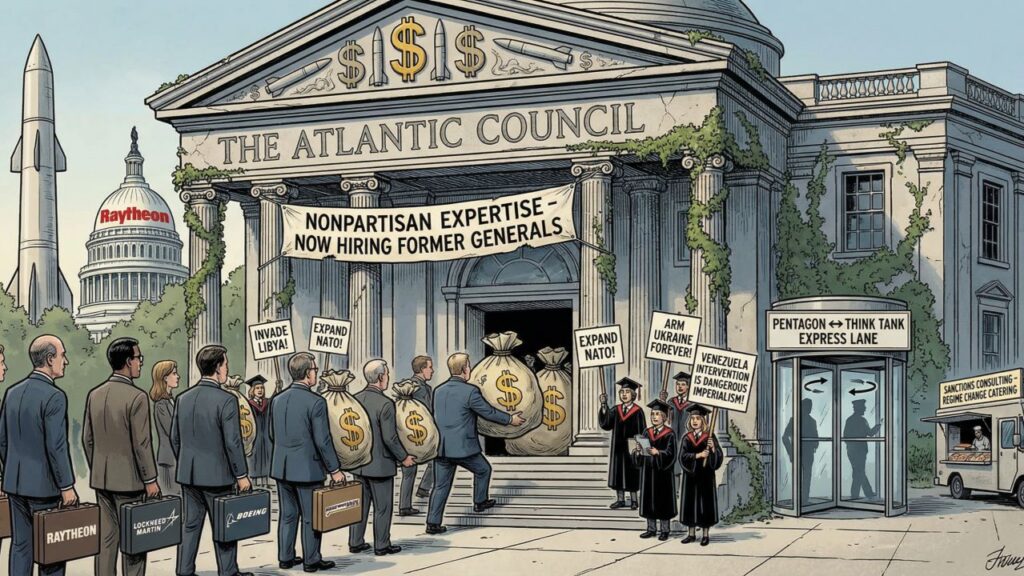
The Selective Outrage Circus
When Trump ordered strikes on Venezuela and captured Nicolás Maduro on January 3, 2026, Washington’s foreign policy establishment erupted in coordinated moral panic. But their selective outrage revealed far more about their business model than their principles.
Jeffrey Sachs stated the obvious: “The United States has been trying to overthrow the Venezuelan government for more than 20 years”. He’s right. But Sachs and the chorus now condemning Venezuela were conspicuously silent, or actively supportive, when those same intervention playbooks destroyed Libya, prolonged Ukraine’s war by sabotaging peace talks, and locked Europe into permanent energy dependency through policies their own leaders celebrated.
Bernie Sanders thundered that Trump’s operation “gives a green light to any nation on earth that may wish to attack another country to seize their resources or change their governments. This is the horrific logic of force that Putin used to justify his brutal attack on Ukraine”. Sanders called it “rank imperialism” recalling “the darkest chapters of U.S. interventions in Latin America”.
The irony is staggering. Sanders spent years voting for defense budgets funding weapons shipments to Ukraine, weapons that prolonged a war Western officials deliberately prevented from ending in April 2022. He supported NATO expansion despite explicit warnings it would provoke Russian invasion. Now he discovers principles about sovereignty when Trump acts in America’s hemisphere against a narco-trafficking regime.
EU foreign policy chief Kaja Kallas, whose personal trauma from Soviet occupation makes her temperamentally unsuited for diplomacy requiring nuance, called for “restraint” while emphasizing “international law and the UN Charter must be respected”. German Chancellor Friedrich Merz said the operation’s legality was “complex” and required “careful consideration”.
These are the same European leaders who celebrated Nord Stream’s destruction, cheered Ukraine’s rejection of peace negotiations, and imposed sanctions guaranteeing their own industrial collapse, then blamed Russia for consequences their decisions created.
The pattern is unmistakable: these voices don’t oppose war. They oppose wars that don’t serve their interests. They don’t support peace. They support conflicts generating sustained revenue for the defense contractors, consulting firms, and energy companies funding their operations.
Venezuela doesn’t generate ongoing Raytheon contracts. It won’t require decades of European LNG dependency. Trump’s operation might succeed quickly, and quick success doesn’t pay.
So they oppose it. Not on principle, but on profit.
What Is The Atlantic Council? Meet Washington’s Most Influential War Lobby You’ve Never Heard Of
Most Americans have never heard of the Atlantic Council. That’s by design. Think tanks operate in the shadows of power, unelected, largely unaccountable, but extraordinarily influential in shaping the foreign policy decisions that send Americans to war and determine which dictators we support and which we overthrow.
The Atlantic Council, founded in 1961, presents itself as a “nonpartisan organization that galvanizes US leadership and engagement in the world.” In reality, it’s a lobbying operation for defense contractors, energy companies, and foreign governments, dressed up as academic expertise.
Here’s how the game works: The Atlantic Council employs former government officials, retired generals, and credentialed academics who write policy papers, testify before Congress, appear on cable news as “experts,” and brief Pentagon officials on what policies to pursue. When these experts recommend more defense spending, weapons shipments to Ukraine, or NATO expansion, media outlets present them as disinterested analysts rather than paid advocates for the companies funding the organization.
The Atlantic Council’s influence is enormous. Its board and staff include multiple former NATO Supreme Allied Commanders, CIA directors, National Security Advisors, Secretaries of State and Defense, and ambassadors. When the Atlantic Council publishes a report calling for increased military spending or intervention in a particular region, that report gets briefed to Pentagon officials, cited in Congressional testimony, and amplified across media outlets.
Former Atlantic Council fellows rotate into senior government positions, and then rotate back out to the think tank after their government service, creating a revolving door where the same people alternate between making policy and advocating for policy that enriches their corporate benefactors.
But the Atlantic Council is just the most prominent example. Washington is full of these organizations: the Center for Strategic and International Studies (CSIS), the Center for a New American Security (CNAS), the Hudson Institute, the American Enterprise Institute. Collectively, they form an ecosystem that manufactures consensus around foreign policy positions that serve defense contractors, energy companies, and consulting firms.
These aren’t obscure academic institutions debating theory. They’re multi-million dollar operations with corporate funding, professional communications teams, and direct pipelines to policymakers. When you see a “foreign policy expert” on CNN advocating for weapons shipments or warning about threats requiring military responses, there’s a high probability that expert works for, or is funded by, organizations receiving millions from defense contractors.
The Atlantic Council alone has received at least $10 million from major Pentagon contractors since 2019. That money isn’t donated out of civic virtue. It’s an investment that generates returns when the “experts” those millions fund advocate for policies requiring weapons purchases, military deployments, and defense budgets that enrich the donors.
This is the machine Trump confronted when he acted decisively in Venezuela. Not principled opponents of military intervention, but a profit-driven lobby that supports wars generating sustained revenue and opposes interventions that might succeed quickly without ongoing contracts.
The Think Tank Racket: Purchasing Policy Recommendations
The numbers tell the story the Atlantic Council’s mission statement obscures.
A 2023 investigation by Responsible Statecraft revealed the organization receives at least $2.69 million annually from 22 weapons manufacturers: Raytheon, Boeing, Lockheed Martin, Northrop Grumman, General Dynamics, and SAIC. The Center for Strategic and International Studies (CSIS) takes $2.46 million from defense contractors annually. The top 50 foreign policy think tanks in the United States accepted at least $35 million from Pentagon contractors in the past five years, and that’s only what’s publicly disclosed, since there’s no legal requirement for think tanks to disclose funding sources.
But defense contractors aren’t the only paymasters. The UAE has donated millions to the Atlantic Council, and received glowing op-eds in return. The organization refused to disclose exactly how much UAE money it accepts, but investigative reporting revealed the Gulf state has been among the Council’s largest foreign government donors.
Foreign government funding of U.S. think tanks has exploded, with over $110 million flowing to the top 50 foreign policy think tanks in recent years. These governments aren’t funding academic research, they’re purchasing influence over U.S. policy. When think tank fellows testify before Congress, they rarely disclose which foreign governments fund their organizations.
According to a 2024 investigation, some 80% of think tank “experts” testifying before the House Foreign Affairs Committee (HFAC) received money from either defense contractors or foreign governments, yet disclosure of these conflicts is entirely voluntary. The investigation found that witnesses routinely appeared before Congress advocating policies that would directly benefit their funders, without any requirement to reveal those financial ties.
This is the business model: Defense contractors and foreign governments fund think tanks. Think tanks hire “experts” who advocate for policies benefiting those funders. Congress hears testimony from those experts without knowing who pays them. Policies get enacted. Funders profit. The cycle continues.
Representative Lance Gooden (R-TX) introduced the Think Tank and Nonprofit Foreign Influence Disclosure Act in 2025, which would require tax-exempt organizations to publicly disclose contributions over $10,000 from foreign governments. The bill has gone nowhere, because too many members of Congress rely on think tank “expertise” to justify their own positions, and transparency would expose the corruption underlying the entire system.
The Revolving Door: From Pentagon to Paycheck
The think tank racket is only part of the story. The real money is in the revolving door between the Pentagon and defense contractors.
Over 80% of four-star generals and admirals who retired between June 2018 and July 2023 went to work for the arms industry as board members, advisers, executives, consultants, lobbyists, or members of financial institutions investing in defense. That’s 26 of 32 four-star officers.
The biggest category of post-retirement employment was as board members or advisors for small and medium-sized arms contractors, with 15 choosing that option. Five became board members or executives for one of the top 10 arms contractors including Lockheed Martin, Boeing, General Dynamics, and BAE Systems.
Among the most prominent examples: General Joseph Dunford, former Chairman of the Joint Chiefs of Staff, joined the board of Lockheed Martin just five months after retiring in September 2019. Lloyd Austin, Biden’s Defense Secretary, sat on the board of Raytheon Technologies and was set to receive $1.7 million in stock and compensation when he left to join the administration.
But the most insidious revolving door involves consulting firms that operate in complete secrecy because they technically don’t “lobby”, meaning they have zero disclosure requirements.
WestExec Advisors, founded in 2017 by Antony Blinken (now Secretary of State) and Michèle Flournoy, became Biden’s Cabinet-in-waiting. The firm placed numerous alumni in senior positions: Blinken as Secretary of State, Avril Haines as Director of National Intelligence, and Jen Psaki as White House Press Secretary.
WestExec’s entire business model is selling access and influence to former colleagues now in government, without ever disclosing which corporations are paying for that access. Because WestExec doesn’t directly lobby Congress, it’s not required to register as a lobbying firm or disclose its client list.
Investigative reporting revealed some former WestExec clients: Palantir Technologies, SoftBank Group, GlobalFoundries, and Samsung, all of which terminated their contracts after Trump’s election because they wanted firms with “direct lines to the Trump administration” instead. WestExec’s disclosed revenue sources included JP Morgan Chase, Microsoft, and Facebook, but the full client list remains secret.
Financial disclosures show Avril Haines earned $68,706 from WestExec for consulting work averaging “less than a day a month”, while the firm’s co-founders made millions arranging introductions and providing “strategic advice” that’s really just monetized Rolodexes.
When Blinken and Haines were nominated for Cabinet positions, the House Oversight Committee demanded WestExec disclose its full client list. The firm refused, calling the request inappropriate. Both were confirmed anyway, meaning senior U.S. foreign policy and intelligence officials took office while concealing which corporations paid them immediately before joining government.
This isn’t a conspiracy theory. It’s documented, legal corruption operating in broad daylight because the regulatory framework exempts “strategic advisors” from disclosure requirements applying to registered lobbyists.
The Atlantic Council’s Venezuela Reaction: Revealing the Script
The Atlantic Council’s own response to Trump’s Venezuela operation exposed their entire game.
On January 2, 2026, the Council published “Experts react: The US just captured Maduro. What’s next for Venezuela and the region?”. The framing is extraordinary: not whether the operation was legal or wise, but “what’s next”, assuming U.S. control as fait accompli while expressing concern about “implications.”
Alexander B. Gray, Atlantic Council fellow, wrote: “Going forward, the administration has a unique opportunity to build upon the success of its pressure campaign against Maduro to reestablish overwhelming US strategic predominance in the hemisphere, including by tacitly shaping a post-Maduro settlement that ensures extra-hemispheric powers like China and Russia are excluded from meaningful influence in Caracas”.
Translation: We support regime change when it advances U.S. corporate interests and excludes competitors.
Celeste Kmiotek, another Council expert, noted: “The US strikes most likely fall afoul of international law” because “The United Nations (UN) Charter forbids use of force against a state’s ‘territorial integrity or political independence,’ with exceptions permitted for self-defense and Security Council authorizations. Self-defense requires that the force used be necessary and proportional, and that the threat be imminent. None of these conditions appear to have been met”.
Yet nowhere does Kmiotek recommend Congress act to stop an illegal war. She simply observes that it’s probably illegal, then moves on to discussing “implications.”
David Goldwyn wrote about “Opening up Venezuela’s energy industry” with analysis of how U.S. oil companies can profit from access to Venezuela’s reserves. The piece reads like a prospectus for Exxon and Chevron, not analysis from a “nonpartisan” institution.
This is the Atlantic Council’s function: Provide legal cover (“concerns about international law”), geopolitical justification (“strategic predominance”), and profit projections (“opening energy industry”), all framed as disinterested expertise rather than advocacy for policies enriching their defense contractor and energy company funders.
Compare this to the Council’s Ukraine advocacy. They never expressed “concerns” about international law when Boris Johnson sabotaged Istanbul peace talks. They didn’t worry about “implications” when Merkel admitted Minsk Agreements were tactical deceptions to buy time for war. They celebrated NATO expansion despite explicit warnings it would provoke Russian invasion.
The difference? Ukraine generates sustained weapons demand. Venezuela might not. So Venezuela gets “concerns about international law” while Ukraine gets “stand with democracy.”
Anne Applebaum, Atlantic Council senior fellow, appeared on podcasts worrying about Trump’s Venezuela “imperialism”. This is the same Applebaum who spent years advocating for NATO expansion, celebrating weapons shipments prolonging Ukraine’s agony, and framing European industrial destruction as “standing with Ukraine.”
When asked about Venezuela, Applebaum expressed concern about “precedent” and “unilateral action”, principles she’s never applied to policies she supports. Her selective application of international law principles reveals they’re rhetorical tools deployed when convenient, not genuine commitments.
Congressional Fury: Bipartisan Revolt Against Illegal War
Trump’s Venezuela operation triggered something rare: bipartisan congressional fury over war powers violations.
Senator Tim Kaine (D-VA) filed a War Powers Resolution to block use of U.S. armed forces in Venezuela unless authorized by Congress. “We should not be risking the lives of our nation’s servicemembers to engage in military action within Venezuela without a robust debate in Congress,” Kaine stated. “A US invasion of Venezuela to depose its president and arrest him is illegal”.
Senator Rand Paul (R-KY) co-sponsored the resolution, stating: “The American people do not want to be dragged into endless war with Venezuela without public debate or a vote. We ought to defend what the Constitution demands: deliberation before war”.
The Congressional Black Caucus issued a blistering statement calling Trump’s operation “a grave and illegal abuse of power”. Representative Yvette Clarke stated: “President Trump thinks he is above the law. He steals from taxpayers. He thumbs his nose at the law. And now, he is starting an illegal war”.
Senator Andy Kim (D-NJ), a former Obama national security adviser, accused Secretaries Rubio and Hegseth of lying to Congress: “Secretaries Rubio and Hegseth looked every Senator in the eye a few weeks ago and said this wasn’t about regime change. I didn’t trust them then and we see now that they blatantly lied to Congress”.
Senator Ruben Gallego (D-AZ), a Marine Corps veteran who served in Iraq, declared: “This war is illegal. There is no justification for the United States to be at war with Venezuela. I lived through the consequences of an illegal war sold to the American people with lies. We swore we would never repeat those mistakes. Yet here we are again”.
Representative Alexandria Ocasio-Cortez cut through the propaganda: “It’s not about drugs. If it was, Trump wouldn’t have pardoned one of the largest narco traffickers in the world [former Honduran President Juan Orlando Hernández] last month. It’s about oil and regime change”.
Even some Republicans expressed concern. Senator Mike Lee (R-UT) initially questioned what might “constitutionally justify this action in the absence of a declaration of war”, though he later made “feeble excuses” after receiving a call from Secretary Rubio.
The Senate had already voted down a War Powers Resolution in December 2025 that would have blocked Trump from using military force against Venezuela. Another vote occurred December 17, when the House rejected Democrat-backed resolutions to rein in Trump’s military campaign. After Maduro’s capture, both chambers prepared new votes.
Kaine told reporters: “Republicans ‘cannot pretend anymore’ that Trump’s rhetoric was just a ‘bluff’ or a ‘negotiating tactic.’ That makes me hope we’ll get more votes on the resolution. It’s time for Congress to ‘get its ass off the couch’ on its own warmaking authority”.
This bipartisan revolt exposes something the Atlantic Council never mentions: actual constitutional experts and lawmakers across the political spectrum recognize Trump’s Venezuela operation as flagrantly illegal. Yet think tank “experts” funded by defense contractors frame it as a debate about “implications” rather than a constitutional crisis.
Europe’s Hypocrisy: Discovering International Law When Convenient
European reactions to Venezuela revealed breathtaking hypocrisy from leaders who spent years demolishing their own economies while celebrating policies guaranteeing permanent U.S. dependency.
Kaja Kallas, the EU’s chief diplomat, told Secretary Rubio the EU was “closely monitoring” Venezuela and called for “restraint” because “the principles of international law and the UN Charter must be respected”. She emphasized that while “Mr Maduro lacks legitimacy,” any action must respect international law.
This is the same Kaja Kallas whose personal trauma from Soviet occupation has made her the most militantly anti-Russian voice in Europe, advocating for indefinite weapons shipments, celebrating Nord Stream’s destruction, and supporting every policy that destroyed European industry while enriching American corporations.
German Chancellor Friedrich Merz said the legality of the U.S. operation was “complex” and Germany would “take our time” to evaluate it, while noting that Maduro “led his country into ruin”. Merz emphasized “political instability in Venezuela must be avoided” and called for “an orderly transition to an elected government.”
The irony: Merz is criticizing Trump for creating political instability while Germany’s own leaders (Merkel, Scholz, Habeck) deliberately created political instability in Europe by shutting down nuclear plants, accelerating coal closures, and celebrating Nord Stream’s destruction. Germany now faces 10-15 year data center grid connection delays, a 99.5% failure rate on AI infrastructure applications, and permanent industrial decline.
French Foreign Minister Jean-Noël Barrot criticized the U.S. for “contravening international law” and asserted that “no enduring political resolution can be imposed from outside”. Emmanuel Macron called for a transition that is “peaceful, and respectful of the will of the Venezuelan” people.
These are the same French leaders who supported NATO expansion knowing it would provoke Russia, celebrated weapons shipments prolonging Ukraine’s war, and never expressed concern about “international law” when Boris Johnson sabotaged Istanbul peace talks that could have ended the conflict in April 2022.
Spanish Prime Minister Pedro Sánchez called for “de-escalation” after spending years supporting policies that escalated Ukraine into Europe’s bloodiest conflict since World War II.
UN High Commissioner for Human Rights Volker Turk said he was “alarmed by U.S. intervention in Venezuela” and urged “all parties to exercise restraint”. European Council President Antonio Costa said the EU was following Venezuela “with great concern” and called for resolution “in full respect of international law”.
Where was this concern for international law when:
- Merkel admitted Minsk Agreements were tactical deceptions?
- Johnson sabotaged Istanbul peace talks?
- NATO expanded despite explicit warnings from William Burns that it would trigger civil war and Russian intervention?
- Nord Stream was destroyed and European leaders celebrated?
European leaders apply “international law” selectively: as a constraint on actions threatening their interests, and irrelevant when policies serve their ideological commitments, even when those policies destroy their own economies.
The Renew Europe group in the European Parliament captured this perfectly: “Nicolás Maduro is a ruthless, illegitimate dictator…However, the military intervention of the Trump administration in Venezuela contravenes the foundations of international law”. They want Maduro gone, but oppose the method that might actually accomplish it, preferring virtue-signaling about international law to confronting the reality that their preferred methods (sanctions, pressure, diplomatic isolation) accomplished nothing for years.
The Real Sachs Position: Right About NATO, Wrong About Solutions
Jeffrey Sachs deserves credit for stating obvious truths the establishment refuses to acknowledge. He’s right that NATO expansion deliberately provoked Russia. He’s right that Minsk was deception and Istanbul was sabotaged. He’s right that U.S. policy serves corporate interests rather than genuine security.
On Venezuela, Sachs stated: “The United States has been trying to overthrow the Venezuelan government for more than 20 years. They’ve put a bounty on Maduro’s head. It’s all flagrantly [illegal]”. He argued the operation has “nothing to do with drug cartel. This is pure total unequivocal” pursuit of regime change to control oil.
Sachs is right about the pattern. Since Trump’s first term, when he told Latin American leaders at a dinner “Why don’t I just invade Venezuela?” the U.S. has pursued regime change through sanctions, coup attempts, and “drug war” pretexts that helped implode Venezuela’s economy and drive millions to flee.
But where Sachs fails is thinking these are mistakes. They’re not. They’re features of a system working exactly as designed to enrich the people running it.
The same establishment now condemning Venezuela supported NATO expansion knowing it would cause war. They sabotaged peace negotiations because extended conflict generates revenue. They celebrated Europe’s industrial self-destruction because it locked in American corporate profits. They admitted diplomatic agreements were tactical deceptions, then faced no consequences.
Sachs treats this as policy failure requiring reform. It’s actually policy success requiring exposure. The system isn’t broken, it’s functioning perfectly to transfer wealth from taxpayers to defense contractors, from European workers to American LNG exporters, from dead Ukrainian soldiers to Raytheon shareholders.
Libya and Syria: When Humanitarian Rhetoric Meets Business Reality
The Atlantic Council’s selective support for interventions reveals that “humanitarian” justifications are marketing copy, not genuine principles.
In March 2011, citing Responsibility to Protect, NATO intervened in Libya’s civil war with enthusiastic Atlantic Council support. A 2013 Belfer Center assessment found NATO’s intervention “magnified the conflict’s duration about sixfold and its death toll at least sevenfold, while also exacerbating human rights abuses, humanitarian suffering, Islamic radicalism, and weapons proliferation”.
The intervention prolonged conflict from six weeks to seven months, increasing casualties from roughly 1,000 to at least 7,000 during the war, with tens of thousands more killed in subsequent civil war and state failure. Libya now has open slave markets. In September 2023, dam collapses in Derna killed over 11,000 due to infrastructure collapse from the failed state the intervention created.
The Atlantic Council has never acknowledged this catastrophe. They moved on to advocate for intervention in Syria, NATO expansion, and endless Ukraine weapons.
Syria’s civil war killed over 500,000 and displaced 13 million, objectively worse than Libya’s humanitarian crisis. Yet the international community took no comparable military action because Russia and China blocked Security Council authorization.
This reveals Responsibility to Protect as selective geopolitics. The “responsibility” applies when:
- Target has no major power patron
- Action serves Western geopolitical interests
- Defense contractors can sell weapons
- Intervention advances “democracy promotion” narratives
The “responsibility” disappears when:
- Russia or China have strategic interests
- Intervention challenges great power interests
- Quick success eliminates ongoing revenue opportunities
- Regional allies oppose action
They destroyed Libya (no Russian veto, weapons opportunities), ignored Syria (Russian veto blocked action), champion endless Ukraine war (maximum sustained weapons sales), and now oppose Venezuela (quick success, no ongoing contracts).
The Truth They’ll Never Admit
Whether it’s the Atlantic Council supporting some wars and opposing others, or Bernie Sanders voting for Ukraine funding while condemning Venezuela, or European leaders celebrating Nord Stream’s destruction while invoking international law, or think tank experts testifying before Congress without disclosing who pays them, they’re all playing the same game.
They don’t have principles. They have clients. They don’t seek peace. They seek profit. They don’t care about casualties. They care about quarterly earnings.
The Atlantic Council receives $2.69 million annually from weapons manufacturers. Think tank experts testifying before Congress take money from defense contractors 80% of the time without disclosure. Over 80% of retiring four-star generals go to work for arms makers. WestExec Advisors places alumni throughout government while refusing to disclose which corporations paid them.
This isn’t conspiracy. It’s documented business operating in broad daylight because disclosure requirements exempt the most lucrative corruption.
They supported NATO expansion knowing it would provoke war, because war generates weapons sales. They sabotaged Istanbul peace talks knowing it would prolong conflict, because extended wars require ongoing contracts. They celebrated Nord Stream’s destruction knowing it would destroy European industry, because American corporations profit from the dependency created. They admitted Minsk was tactical deception, because fake diplomacy bought time to prepare for more profitable war.
And now they oppose Venezuela not because it violates principles they’ve never held, but because Trump’s operation might actually succeed quickly without generating the sustained revenue streams their business model requires.
Venezuela, Ukraine, Libya, Syria, Iraq, Afghanistan, the names change but the game stays the same. Elite wonks manufacture crises, profit from chaos, and never face consequences when their policies produce corpses and refugees. The only question is which crisis pays better this quarter.
Jeffrey Sachs is right that the system serves corporate interests. Where he fails is thinking reform is possible. The system is working exactly as designed. It doesn’t need fixing. It needs exposing.
The Reckoning
The profiteers have been fully exposed. The Atlantic Council taking millions from weapons makers while posing as disinterested experts. Think tank witnesses testifying before Congress without disclosing their funders. Generals rotating from Pentagon to defense contractor boards. WestExec alumni running U.S. foreign policy while refusing to reveal which corporations paid them.
Anne Applebaum discovering principles about military intervention when it’s Trump in Venezuela, having spent years cheerleading NATO expansion that provoked the Ukraine war she now profits from advocating. Kaja Kallas invoking international law after celebrating every policy that destroyed European industry. Bernie Sanders condemning Venezuela after voting for every defense budget funding the Ukraine war Western officials deliberately prevented from ending.
Angela Merkel, Olaf Scholz, Robert Habeck, and Ursula von der Leyen destroying Europe through ideological zealotry and corruption, not American conspiracy, but European suicide that American corporations merely capitalized on. Friedrich Merz calling Venezuela’s legality “complex” while his own country faces permanent AI exclusion from energy decisions his predecessors made.
Every Congressional witness with undisclosed defense contractor funding. Every four-star general joining arms maker boards. Every think tank fellow advocating for policies enriching their hidden paymasters. Every diplomat rotating through WestExec Advisors between government positions.
They’re all running the same con, just choosing different marks depending on which crisis is more profitable this quarter.
The emperor has no clothes. The Atlantic Council has no principles. The foreign policy establishment serves only itself. And the American public deserves to understand that when these voices claim to speak for human rights, democracy, and international law, they’re actually speaking for Raytheon’s quarterly earnings, Cheniere Energy’s LNG contracts, and McKinsey’s consulting fees.
Whether they support or oppose any particular military action is irrelevant. What matters is understanding they’re all profiteers choosing positions based purely on which generates more revenue, more influence, and more opportunities for the next lucrative position.
The profiteers have been exposed. Every single one of them. The only question is whether anyone will finally see them for what they are.
About the Author: Scott Ortkiese is an investigative writer and business strategist specializing in geopolitical analysis, corporate fraud, and the intersection of foreign policy and financial interests.
Related reading
- The Arsonist’s Lament: Robert Kagan, Victoria Nuland, and the Neocon Family Business of Perpetual War
- The Architecture of Silence: Why America's Think Tanks and Media Won't Name the Forces Driving Us To War with China, Iran, and Russia
- Does He Really Think They Don't Have Options? How Trump’s Lack of Strategy Is Driving Nations Away
- Does He Really Think Nobody Has Options? Trump’s Imperial Arrogance and the Countries He Screwed