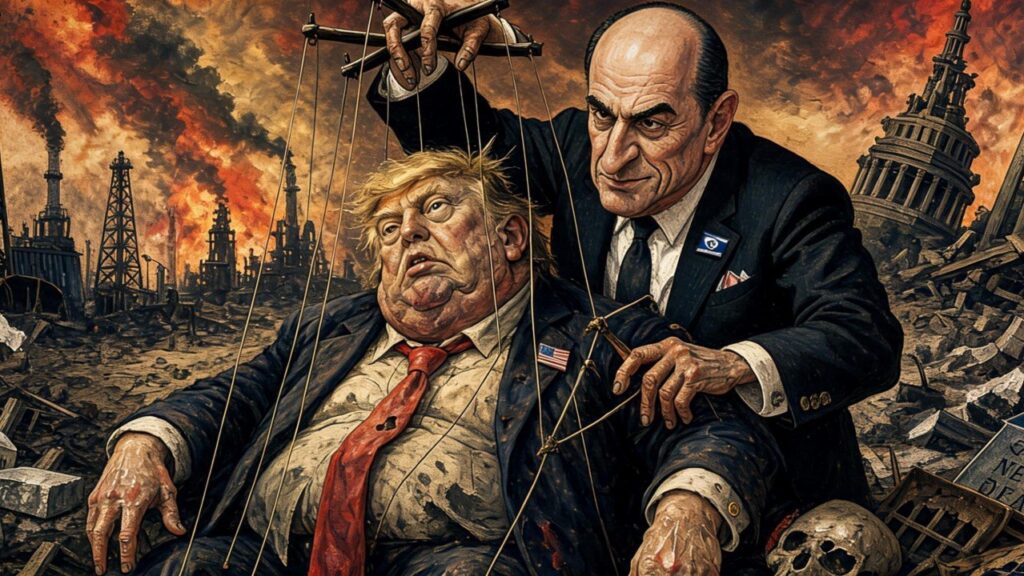
Bibi to Trump: ‘Get that ballroom ready, Donald. I told you blowing up the U.S. economy and taking the world with it would work. You are the greatest,
June 1, 2026
By Scott Ortkiese | Throughline Synthesis | June 1, 2026
so@throughlinesynthesis.com | www.throughlinesynthesis.com
“In the councils of government, we must guard against the acquisition of unwarranted influence, whether sought or unsought, by the military-industrial complex. The potential for the disastrous rise of misplaced power exists and will persist.”
Dwight D. Eisenhower, Farewell Address, January 17, 1961
“For every complex problem there is an answer that is clear, simple, and wrong.”
H.L. Mencken
A Note to the Reader
Eisenhower named it. Mencken diagnosed it. Together, they described with precision what happened on February 28, 2026, when the United States and Israel launched Operation Epic Fury against Iran: the military-industrial complex, whose unwarranted influence Eisenhower spent his presidency trying to contain, found in Trump and Netanyahu two men willing to sell the clear, simple, wrong answer, regime change by air power, to a public that had no vote on the matter and will pay for it for a generation.
There is an event already in motion that the press has not reported, that your government has not acknowledged, and that your grocery store, your car manufacturer, your electric utility, your defense contractor, and your solar installer have not yet fully priced. It is not a risk. It is not a projection. It is a calendar event, already scheduled by physics, logistics, and the irreversible destruction of industrial infrastructure, unfolding in slow motion while the American public argues about immigration and pronouns.
The event is a structural aluminum shortage, the first of its kind in the modern industrial era, manufactured not by fate, not by market forces, and not by the adversary. Manufactured by two men, one in Washington and one in Tel Aviv, who chose personal political survival over their nations’ economic integrity on February 28, 2026. The damage is done. The supply pipeline is broken. And the arithmetic of what comes next is not a matter of opinion. It is a matter of mathematics. And mathematics does not negotiate.
This is not a story about aluminum. It is a story about what happens when the misplaced power Eisenhower warned about finds, in a single month, the clear, simple, wrong answer Mencken described, and detonates it against the industrial spine of the country it claims to govern.
Part I: The Metal That Holds the Modern World Together
Before the consequences, the physics. Aluminum is not a commodity in the conventional sense. It is the skeletal system of industrial civilization, present in every structure, vehicle, aircraft, grid, appliance, beverage container, pharmaceutical blister pack, solar panel, data center cooling system, and weapons platform that defines modern life. No other element comes close to combining its properties: one-third the weight of steel, corrosion-resistant, infinitely recyclable, and an extraordinary conductor of electricity. Where oil energizes civilization, aluminum is the civilization, the physical substrate on which everything else rests.
Consider the scope. Every F-35 fighter requires approximately 3,000 pounds of aluminum alloy. Every commercial aircraft is 80% aluminum by volume. Every Ford F-150, America’s best-selling vehicle, is built on an aluminum-intensive body that saves 700 pounds of weight per truck. The grid transmission wires connecting every solar farm, every wind turbine, every data center to the homes and factories they power are aluminum conductors; copper simply cannot scale to meet the demand. A single utility-scale solar installation requires aluminum racking, clamps, rails, and brackets as its structural foundation; the 43.4 gigawatts of utility solar planned for 2026 alone carried an aluminum cost exposure exceeding $5 billion before the war. The beverage cans holding 78% of all packaged craft beer in America are aluminum. The packaging protecting nearly every pharmaceutical, every processed food item, every sterile medical device is aluminum foil and sheet.
The United States, in its infinite economic wisdom, long ago decided not to make much of this itself. In 2025, the United States was dependent on imports to meet 60% of its internal aluminum consumption. Domestic production collapsed to 1,950,000 metric tons in 2025, a 29% decrease since tariffs were supposedly designed to revive it. As of this writing, the country operates exactly five primary smelters. Five. For the world’s largest economy.
The structural dependency this created was not a secret. It was documented, published, and formally studied. What no serious analyst anticipated is that the administration tasked with protecting American industrial security would deliberately detonate the supply chain it claimed to be rebuilding, through a combination of self-defeating tariffs and an unprovoked war that closed the one maritime corridor through which the remediation of those tariffs was flowing. Mencken would have recognized the pattern immediately: a clear, simple answer, TARIFFS, that was wrong, followed by a clearer, simpler answer, BOMBS, that was more wrong still.
Part II: Qatar, Qatalum, and the 51-Day Clock Nobody Is Watching
Every catastrophe has its inciting mechanism, its specific industrial moment when the abstract becomes irreversible. In the aluminum story, that moment has a name: Qatalum.
Qatalum is the joint venture between QatarEnergy and Norsk Hydro operating in the Mesaieed Industrial City of Qatar. Its nameplate capacity is 648,000 metric tons of primary aluminum per year, roughly equivalent to the combined output of three of the five remaining American smelters. On March 3, 2026, four days after the United States and Israel launched Operation Epic Fury, Qatalum’s gas supplier informed it that gas supply was suspended. Iranian strikes on Qatar’s LNG infrastructure had damaged the Ras Laffan complex, a facility three times the size of Paris, built over thirty years at a cost of hundreds of billions of dollars. Hydro issued Force Majeure notices to all Qatalum customers that same week.
A full restart, if the plant fully cools, takes six to twelve months. Hydro has stated explicitly that it is “not known when the plant can potentially restart” if it goes to a complete cold state. As of late March, Qatalum stabilized at approximately 60% of nameplate capacity, not because the situation improved, but to protect the potlines from catastrophic and permanent damage. The Force Majeure notices remain in force as of this writing. QatarEnergy extended force majeure on LNG shipments to European clients through mid-August. The industrial ecosystem around Ras Laffan, the gas supply, the processing infrastructure, the logistics corridors, sustained damage estimated at three to five years of repair time.
Qatar to the United States by ship is 51 days. That is not an estimate. That is a physical constant determined by distance and vessel speed. It means this: even if the Strait of Hormuz reopened today, which it has not, even if Qatalum returned immediately to full capacity, which it cannot, the United States would not see a single kilogram of new Qatari aluminum until late July at the earliest. And that assumes no backlog, no priority queuing for other customers, and no logistical damage to the loading and terminal infrastructure around Ras Laffan.
The Strait has not reopened. Traffic through Hormuz fell from approximately 130 ships per day before the crisis to single digits in early March, a decline of more than 95%. The UN has confirmed the disruption is “spreading across regional shipping routes and affecting critical supply lines.” The war is not ending. As John Mearsheimer stated without equivocation: “we are now in a long war, a war of attrition the Iranians prepared for and are in an excellent position to prevail in.”
The 51-day clock is not a metaphor. It is the minimum physical lag between any improvement in Gulf conditions and any relief in American aluminum markets. That clock has been running since February 28, 2026, now 93 days. The pipeline is empty. The damage has been done.
Part III: The Destruction of Middle Eastern Production Capacity
Qatar’s Qatalum is not the only casualty. It is not even the largest one.
The Middle East produces approximately 6.5 to 6.8 million metric tons of aluminum annually, roughly 10% of global production and, critically, 23% of all non-Chinese output. In the ex-China market, the one that Western manufacturers and American consumers actually compete in, Gulf aluminum is the structural supply backstop. When it moves, global prices move. When it disappears, consuming industries face choices that have no good options.
The destruction extends well beyond Qatar. A May 2026 Mysteel Global analysis documented the specific industrial damage:
· Emirates Global Aluminium’s Al Taweelah facility (Abu Dhabi): A 400,000-metric-ton-per-year rolling slab operation, one of the largest in the world, was halted after missile and drone strikes. Restoration is estimated at a minimum of twelve months.
· Aluminium Bahrain (Alba): One of the world’s largest single-site smelters at 1.6 million metric tons per year, Alba has idled approximately 19% of its capacity, cutting rolling ingot output by an estimated 14%.
· Qatalum (Qatar): Operating at roughly 60% of nameplate capacity under force majeure, with full restart timeline unknown (invoking force majeure is the contractual equivalent of “not our fault, not our problem, we owe you nothing).
Combining the impacts: approximately 560,000 metric tons of annual Gulf aluminum capacity is currently affected, close to 8-9% of regional supply and roughly 3% of global output. Markets have already processed this number. By late March 2026, aluminum on the London Metal Exchange had risen approximately 15% since the war began, approaching $3,500 per metric ton, levels not seen since 2022. COMEX aluminum futures surged more than 30%. Citi analysts raised their LME price projection to $3,600 per metric ton, with a $4,000 bull case if Middle East supply disruptions deepen, a price level that would translate to approximately $7,000 per metric ton all-in for a US buyer, including the Trump administration’s 50% tariff and the regional premium.
UBS revised its aluminum supply growth forecast for 2026 to 0.3%, down from a prior estimate of 2.4%. Wood Mackenzie estimates a global aluminum deficit of approximately 365,000 metric tons for the year. The structural deficit is not a forecast. It is an accounting identity: production capacity that has been physically destroyed cannot supply metal that does not exist.
What no one is saying clearly enough is that the market has not yet priced the second-order consequences, the destroyed port infrastructure, the insurance market collapse, the routing detours that extend transit times and costs, and the simple fact that the world’s largest non-Chinese aluminum export corridor is running through a war zone that Lloyd’s of London will not insure at economically viable premiums. The spot price is the first tremor. The supply chain re-engineering, the contract cancellations, the production allocation decisions, and the downstream consumer impacts are the earthquake.
Part IV: The American Double Exposure
There is a particular bitter irony embedded in the American position. The Trump administration imposed 50% tariffs on Canadian aluminum imports in June 2025, a policy explicitly designed to “revive” American industrial capacity. The immediate market effect was to collapse Canadian aluminum flows to the United States and compel American buyers to substitute Gulf supply to fill the gap. The GCC, particularly UAE and Bahrain, had become the primary remediation channel for the Canadian supply that Trump’s tariffs had restricted.
Trump then bombed the Gulf.
Wood Mackenzie’s senior research manager for global aluminum markets, Uday Patel, described the resulting American predicament with striking directness: “The U.S. is absolutely in a bind at the moment.” S&P Global CERA’s Karen Norton added: “We struggle to see where the US would find alternative units as Canada continues to eye Europe as a destination for shipments beyond the current quarter.”
The arithmetic is punishing. US primary aluminum demand ran at approximately 1,950,000 metric tons of domestic production in 2025 against an import-dependent consumption base requiring 60% import coverage. Gulf supply accounted for approximately 22% of US primary and alloyed aluminum imports, roughly 607,000 metric tons annually per US Department of Commerce data. That supply is now largely cut off. Canadian supply, the natural remediation channel, continues flowing toward Europe, which is equally desperate for non-Gulf metal and carries no tariff penalty for Canadian producers.
The alternatives are, by any analytical standard, unavailable. Russian aluminum is subject to a 200% tariff and practically inaccessible due to banking restrictions. Indonesian new capacity will not be meaningful until 2027 at earliest. Restart of European smelters is being considered but faces the compounding problem that Hormuz closure has spiked European natural gas prices; the Dutch TTF month-ahead gas index jumped 60% from its pre-war level, making aluminum smelting in Europe structurally more expensive precisely when it is most needed. Iceland and Norway have some restart capacity, but scale matters; 190,000 tons from Metlen and 320,000 from Hydro’s Iceland facility together don’t approach the Gulf gap.
The US aluminum industry association has offered the public-facing reassurance that “there is metal coming in from other smelters and other countries” and that the industry is “showing resilience.” What this translates to in commercial reality is: buyers are paying dramatically more for smaller quantities from more expensive sources through longer routes. That is not resilience. That is managed contraction, and it has not yet fully arrived at the consumer.
Part V: The Cascade, What Every American Will Feel
The political class has not told the American public what is coming. So let the dots be connected plainly.
Automobiles
Ford’s CFO told analysts in late April that commodity-related challenges from the conflict could exceed $2 billion, approximately twice the prior forecast, primarily due to escalating aluminum prices. Ford’s stock has fallen 17% since the onset of the conflict. The F-150, America’s best-selling vehicle for 44 consecutive years, built on an aluminum-intensive body structure, is the most exposed vehicle in the fleet. Toyota has reportedly cut approximately 40,000 units of production due to aluminum supply constraints. Every American who plans to buy a new truck, SUV, or electric vehicle in 2026 or 2027 will pay the price of this war in the sticker price. That is not a forecast. Ford’s CFO has already disclosed it.
Beverages, The Can That Cannot Be Replaced
Aluminum cans hold 78% of all packaged craft beer in America. They hold Coca-Cola, every energy drink, every sparkling water that Americans carry in their hands every day. Molson Coors’ finance chief reported that rising aluminum prices added approximately 30 mills per can to their cost structure. Coca-Cola faces the prospect of reformulating toward plastic packaging, a regression not only for consumer preference but for the sustainability commitments the company has spent billions cultivating. Craft brewers have their own canning lines and face “high switching costs” to move to glass or other formats; they will absorb costs or pass them directly to the consumer at the register. There is no good outcome here. The only variables are who pays and when.
The Grid, Solar, and the Energy Transition
This is where the consequences become existential rather than merely expensive.
Aluminum conductors are the physical medium of the American electrical grid. Every overhead transmission line, every distribution wire, every connection between a solar farm and the homes it powers runs through aluminum. The United States is in the midst of an historic grid expansion, driven simultaneously by AI data center demand, EV adoption, and the renewable energy buildout, that requires aluminum at a scale the country has not attempted since the postwar industrial era.
The solar industry is already screaming. Reuters reported in May 2026 that aluminum price spikes are adding $5 billion in costs to the 43.4 gigawatts of utility-scale solar planned for 2026. Jim Wood, CEO of SEG Solar Inc., told Reuters he is seeing approximately a 20% rise in racking prices: “I anticipate that some marginally profitable projects, especially those with slim returns, may be abandoned.” As Wood Mackenzie’s Uday Patel noted: “for the U.S. and for the electricity, distribution, and transmission sector, it’s going to be expensive.”
The compound effect is this: the Trump administration simultaneously promised an AI infrastructure boom requiring massive grid expansion, imposed tariffs that cut Canadian aluminum supply, and bombed the Gulf supply that was compensating for those tariffs. The result is that the physical material required to build the very future Trump announced in January 2025 is now scarce, expensive, and increasingly unavailable, and will remain so for years. Gartner had projected, before the war, that power shortages would restrict 40% of AI data centers by 2027. The war has added an aluminum supply constraint on top of an already broken energy constraint. The physical infrastructure of the American future is now doubly impaired.
Defense, The Sword That Cannot Be Forged
Consider the following convergence. The United States is simultaneously conducting a war in the Persian Gulf that is consuming munitions at rates that cannot be replenished under current production contracts. It is promising NATO allies that it will accelerate deliveries of defense platforms including the F-35. And it has just destroyed the supply chain for the aluminum that every one of those platforms requires. This is the military-industrial complex Eisenhower warned about, eating its own supply chain.
F-35 production was at 191 aircraft delivered in 2025, a record. European NATO allies had already been warned about delivery delays due to the Iran war exhausting US weapons stockpiles. The Pentagon plans to buy 85 F-35s in FY2027, but 53 of them depend on supplemental legislation that has not been passed. The average F-35 availability rate was approximately 50% in 2024 against a target of 65%. The Air Force needs over 1,500 fighters; it has approximately 1,100. Every one of those aircraft, whether building new or maintaining existing, runs on aluminum alloys that are now more expensive, less available, and sourced from a disrupted global market.
There is a particular savagery in this: an administration that signed the largest defense budget in American history is conducting a war that is simultaneously consuming defense capacity and degrading the industrial inputs required to rebuild it. The generals told Trump this before the first bomb fell. He launched it anyway.
Packaging, Pharmaceuticals, and the Quiet Shortages
Aluminum foil and sheet are the protective medium for an enormous share of the pharmaceutical supply chain: blister packs, sterile packaging, medical device containers. India’s pharmaceutical sector, which supplies approximately 40% of global generic medicines by volume, is absorbing simultaneous shocks to API costs, excipient costs, and transport costs as supply chains fracture. American consumers who rely on generic medications, the majority of prescription drug users in the country, will feel this in availability and price.
Aluminum packaging for food, pie plates, roasting pans, foil containers, every convenience food item in every supermarket, was already facing industry-wide price increases of 10% to 25% effective January 1, 2026, before the war. D&W Fine Pack implemented a 25% increase; Durable Packaging a 22% increase; Handi-Foil an 18% increase. Those increases preceded the war. They are now compounded by the Gulf supply disruption, the LME price spike, and the logistics cost increases from Hormuz rerouting. Manufacturers are implementing purchase caps and reporting material shortages. The word “rationing” has not yet entered the mainstream conversation. It should.
Part VI: The Broader Commodity Catastrophe Being Politely Ignored
To frame aluminum in isolation is to misrepresent the nature of the wound. The Strait of Hormuz is not a petroleum pipeline. It is the physical artery of the global industrial economy, and its closure, even partial, has severed flows of commodities whose downstream consequences are only beginning to be calculated. Each of the following represents its own clear, simple, wrong answer: that closing Hormuz would be a contained, surgical disruption affecting only Iranian exports. It is not. It is a systemic rupture.
The World Economic Forum identified nine commodities materially impacted by the Hormuz crisis beyond oil. Forbes documented specific shocks to fertilizers, metals, and plastics. The full catalog reads like the contents of American civilization’s industrial pantry:
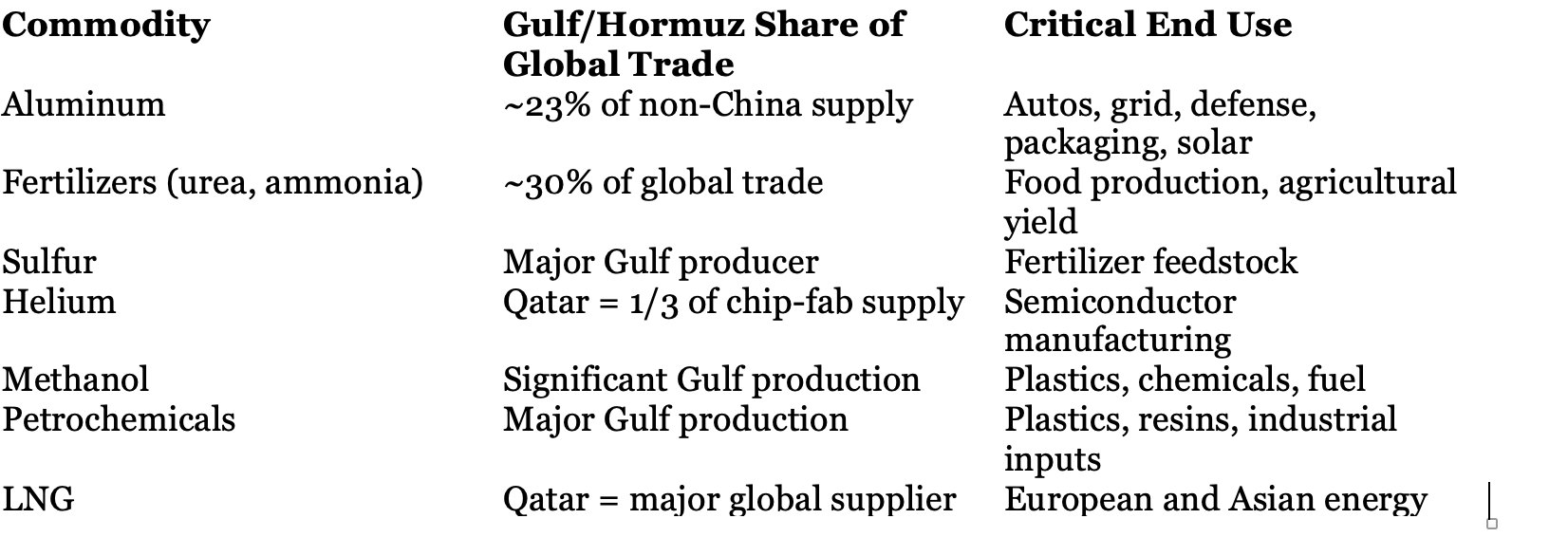
The fertilizer disruption alone is an act of agricultural mass casualty. Approximately 30% of globally traded fertilizers transit Hormuz, including ammonia and urea that are the inputs for the spring planting cycle that was already underway when the Strait closed. UNCTAD has formally warned that the “timing is critical” and that failure to secure supply during the planting window will translate directly to reduced crop yields and food price inflation that the world’s poorest countries cannot absorb. The UN projects 45 million additional people facing acute hunger because the fertilizer did not ship during the planting window. That is not a risk estimate. That is a calendar event, already scheduled, already too late to prevent.
The helium supply from Qatar’s Ras Laffan complex, which supplies approximately one-third of the world’s chip-making helium, was severed in the opening days of the conflict and will not be restored for three to five years. South Korea’s Samsung and SK Hynix, which together produce approximately two-thirds of the world’s DRAM and NAND memory, the memory that powers every AI system, every defense platform, every modern economy, sourced 64.7% of their helium from Qatar. They are now running on emergency reserves with a calculable depletion date. When those reserves are exhausted, memory chip production contracts. When memory chip production contracts, every digital economy on earth feels it. The semiconductor countdown clock has been running since March 2026, and it is not being reported.
Part VII: The Architecture of Accountability
The American media is not covering this story with the depth it demands because the story is not politically convenient. It requires connecting a presidential policy decision, the February 28 launch of Operation Epic Fury, to specific, traceable, irreversible industrial damage that will be felt by American consumers, manufacturers, soldiers, farmers, and power ratepayers for years. This is precisely the “unwarranted influence” Eisenhower described: a decision architecture so thoroughly captured by donor interests and ideological certainty that the public interest becomes structurally irrelevant to the outcome. 78% of Americans opposed the initial strikes. They were not consulted.
The accountability architecture is clear and requires no speculation:
On Geneva: The Omani foreign minister personally briefed the American Vice President that the parties were “this close to a deal.” Iranian Foreign Minister Araghchi was in Geneva with “real ideas to achieve a fair and equitable deal.” Iran had already agreed to zero uranium enrichment, even for civilian purposes. The IAEA director was in the room. Tulsi Gabbard, as Director of National Intelligence, had testified under oath that all sixteen US intelligence agencies had unanimously concluded with high confidence since 2007 that Iran had not resumed nuclear weapons-related activity. The bombs fell anyway.
On the chokepoint: Bob McNally, Senior Director for International Energy on the NSC under George W. Bush, war-gamed a Hormuz closure scenario with military officers eight months before the first bomb dropped. He identified the central planning failure afterward: “the false belief that the Strait of Hormuz would be left untouched by the conflict.” That was not an intelligence failure. It was a choice to ignore what every serious analyst already knew. It was the Mencken problem: the clear, simple, wrong answer demanded that Hormuz be left out of the calculation, because including it made the answer less simple and the war less clean.
On donor architecture: Miriam Adelson pledged $250 million toward Trump-aligned political operations. Saudi Arabia invested $2 billion in Jared Kushner’s private equity fund. AIPAC spent over $126 million in the 2024 election cycle. Speaker Mike Johnson said it on the record. Lindsey Graham bragged publicly that he worked with Netanyahu to advise him on how to convince Trump to attack Iran. The principal-agent divergence is documented: the agents who launched this war bear none of its costs and captured private benefits from its continuation. The principals, American taxpayers, servicemembers, manufacturers, and consumers, bear all of the costs. This is the misplaced power Eisenhower named. It has now fully arrived.
The Chairman of the Joint Chiefs told Trump in January there was no viable strategy. Trump launched it anyway.
Part VIII: What Cannot Be Undone
This is the section that matters most, and the section that political rhetoric is structurally unable to address. Because the question is not whether Trump or Netanyahu made a mistake. The question is whether the consequences of that mistake can be reversed by any decision available to any actor in the system.
The answer, for the near term, is no.
The production capacity damage is multi-year, not monthly. Qatalum’s gas supply infrastructure connects to the Ras Laffan complex, which sustained damage estimated at three to five years of repair. EGA’s Al Taweelah smelter requires at minimum twelve months. A cold smelter restart, even under optimal conditions, takes six to twelve months. These are physical timelines determined by industrial metallurgy, not political will.
The 51-day shipping lag cannot be compressed. Even if Hormuz reopened tomorrow, the physical pipeline of metal in transit, which has been empty since early March, cannot be refilled instantaneously. Vessels must be chartered, loaded, routed, and delivered. Industry analysts expect container-shipped primary metal and value-added products to normalize “more slowly than tanker-based flows, even if partial transit resumes,” due to shipping and insurance dynamics.
Domestic American capacity cannot rescue the market. Five smelters. 1,950,000 metric tons of annual production against an import-dependent consumption base. The proposed new American smelter, a Bechtel-studied facility targeting 750,000 tons per year, is awaiting a power supply agreement, and even if construction begins by year-end, first metal production is expected no earlier than 2030. Century Aluminum’s Mount Holly restart is targeting 220,000 tons annually by mid-2026, a remediation that covers less than 1% of total US import needs. These are the industrial physics of a country that spent forty years offshoring its smelting capacity.
The insurance market has not been repaired. Lloyd’s of London war-risk premiums for Gulf transit remain prohibitive. Greek shipowners, who control the largest tanker fleet in the world and are theoretically positioned to carry Gulf metal, will not transit a war zone that the insurance market will not cover at economically viable rates. No ceasefire announcement changes this overnight; insurers re-enter markets slowly and with elevated caution after conflict.
The LME price signal is now embedded in forward contracts. Every buyer who repriced contracts in March, April, and May of 2026 locked in elevated aluminum costs for months or years. That pricing does not reset when the war ends. It unwinds gradually as contracts roll. The inflationary impact is not a spike. It is a multi-year floor embedded in the cost structure of every downstream industry.
Part IX: The Things That Are Coming, A Practical Inventory
The American people are not being told what is coming. Here is what is coming.
Within the next 60 to 90 days:
· Further automotive price increases and production allocation decisions affecting truck and SUV lines
· Aluminum beverage can cost increases flowing through to retail: beer prices, soft drink prices, energy drink prices
· Solar project cancellations at the margin, with 20%+ racking cost increases eliminating thin-margin installations
· Grid expansion project delays and cost overruns as aluminum conductor pricing rises
· Pharmaceutical packaging cost increases flowing through to generic drug prices
Within the next six to twelve months:
· Domestic aluminum rationing for certain industrial segments as distributors manage allocation across competing end-use priorities
· Defense procurement cost escalation as aluminum alloy pricing rises for aircraft and naval platforms
· Stagflationary pressure, aluminum embedded in the CPI through packaging, construction, transportation, and durables, resistant to monetary policy because it is a supply shock, not a demand stimulus
· Industrial project deferrals and cancellations in construction, particularly commercial structures dependent on aluminum curtain wall, framing, and HVAC systems
Within the next one to three years:
· Structural deindustrialization pressure on downstream aluminum-intensive manufacturing segments that cannot hedge the sustained price environment
· Grid expansion delays measured in gigawatts, directly constraining the AI data center buildout Trump announced as the centerpiece of his economic legacy
· Persistent above-market aluminum premiums in the US Midwest, potentially reaching the $7,000 per metric ton all-in levels Citi modeled, pricing some manufacturing uses out of the market entirely
The Aluminum Association’s characterization of industry “resilience” is the polite vocabulary of managed decline. “Resilience” means your supply chain is adjusting in real time to a permanent reduction in availability at permanently higher prices. That is not resilience. It is rationing by price, which means the Americans with the least margin absorb the most pain. This is the clear, simple, wrong answer arriving at your doorstep in the form of a grocery receipt.
Conclusion: The Economic Pearl Harbor Already Underway
On December 7, 1941, the United States was attacked without warning by an adversary it had not taken seriously enough. The country mobilized, suffered, rebuilt, and ultimately prevailed.
On February 28, 2026, the United States attacked itself. Eisenhower’s warning was fulfilled in full: the military-industrial complex, through its acquisition of unwarranted influence over two governments simultaneously, launched a war whose costs will be borne by the public that had no vote on it and no stake in it. Mencken’s diagnosis was confirmed in real time: the clear, simple, wrong answer, regime change by air power over a negotiating table where the deal was already done, was chosen over the complex, difficult, correct answer, because complex, difficult, and correct answers do not generate campaign contributions or satisfy donor architecture.
The damage is structural. The pipeline is broken. The arithmetic is set. The architects of the attack, the men who launched a war over a negotiating table where Iran had already agreed to zero enrichment, who gave away the Hormuz chokepoint that every serious strategist had identified as Western civilization’s most critical vulnerability, who destroyed the Gulf aluminum supply that was compensating for their own tariff-induced Canadian shortfall, are still in office, still signing defense budgets, still calling it a victory.
Pearl Harbor was a surprise. This was not. Every consequence described in this analysis was foreseeable, documented, and modeled in advance by people who were ignored. The 51-day shipping clock was always there. The Qatalum force majeure was always a possibility once gas infrastructure was targeted. The LME price spike was always the mechanical result of removing 3% of global supply from a structurally tight market. The grid expansion cost overruns were always the downstream consequence of aluminum price inflation in a country that imports 60% of what it consumes.
The press is not covering this because it is boring and technical and the men responsible for it have large public relations operations and very loud megaphones. The American people are sleeping because no one in authority has told them to wake up.
Aluminum is one commodity. Fertilizer is another. Helium is a third. LNG is a fourth. Petrochemicals are a fifth. Every one of them transits the same 21-mile strait. Every one of them has been disrupted since February 28. Every one of them has a downstream consequence that will arrive in American wallets, factories, farms, hospitals, and military platforms on a schedule determined by physics, not politics.
The economic Pearl Harbor has already been conducted. It was conducted by the Trump administration, at the urging of the Netanyahu government, in service of donor obligations and personal political survival. No amount of flag-waving changes the aluminum price. No amount of presidential bravado refills the empty supply pipeline. No tweet accelerates a cold smelter restart.
The mathematics does not negotiate.
Eisenhower named the mechanism. Mencken diagnosed the reasoning. History is now writing the invoice. It will be paid, not by the men who made the decision, but by the Americans who never had a vote on it, in aluminum prices, fertilizer shortages, canceled solar projects, delayed fighter jets, rationed pharmaceuticals, and a future that costs more and delivers less than the one that was within reach on February 27, 2026.
*
Scott Ortkiese is an independent geopolitical analyst and journalist. He is President and CEO of Faulkner Capital Holdings
and publishes through Throughline Synthesis Group.
so@throughlinesynthesis.com | www.throughlinesynthesis.com
Related reading
- Where’s the Business Plan for Trump's $200 Billion Iran "Ask"?
- Trump Is Gambling America’s Power on a Losing Hand
- The Death Warrant for the Petrodollar and America's AI Future, Signed by Trump and Netanyahu
- The Molecules of War: How Washington's Persian Gulf Gamble Is Coming for Your Grocery Bill, Your Smartphone, and Your Economy