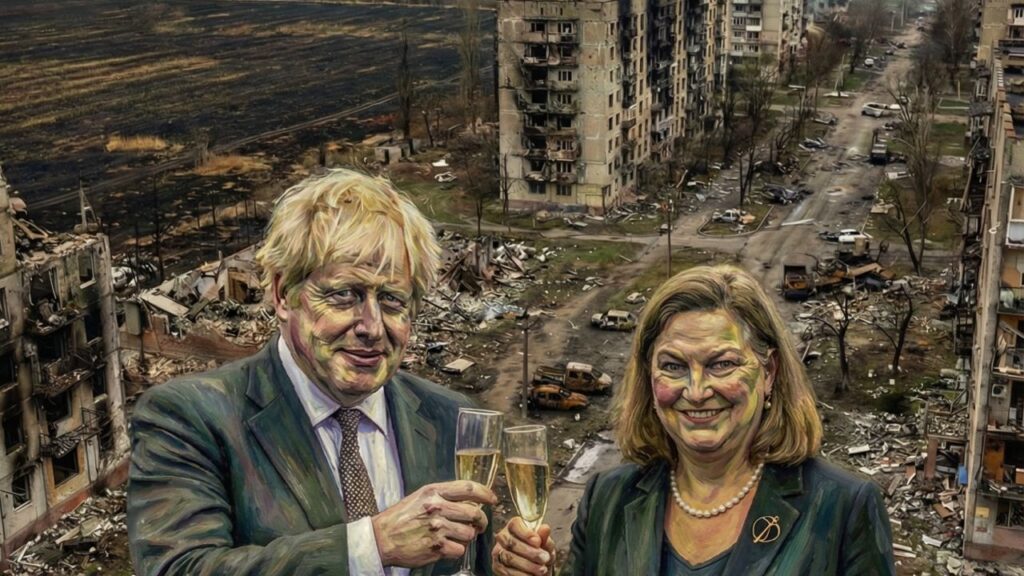
As the fourth year of Russia’s special military operation in Ukraine unfolds, the conflict has reached what may prove to be its most consequential phase. The February 3, 2026, interview between Glenn Diesen and Stanislav Krapivnik, a former U.S. Army officer and military analyst born in Donbas, provides a striking window into the Russian strategic calculus at this pivotal moment. Comparing Krapivnik’s analysis with the latest battlefield reporting reveals a war at an inflection point where the tactical, operational, and diplomatic threads are converging toward a potentially decisive outcome.
The Strategic Architecture of Russian Operations
Krapivnik’s central thesis is that Russia has finally abandoned political constraints on its military operations and is now prosecuting the war with full operational logic. The infrastructure campaign, he argues, was deliberately restrained for over two years in hopes of either a negotiated settlement or internal political change in Kyiv. That restraint has ended. “The pressure on the government in Moscow has gotten to the point where we need to end this… correctly,” Krapivnik explains, framing the current phase as one where military professionals are finally being allowed to fight the war they know how to win.
This assessment aligns precisely with developments on the ground. On the night of February 2-3, 2026, Russia launched what DTEK, Ukraine’s largest private energy company, called “the most formidable strike against Ukraine’s energy infrastructure this year.” The barrage comprised 71 missiles and 450 drones targeting electricity generation and distribution facilities across eight oblasts, leaving over 1,100 apartment buildings in Kyiv without heat during temperatures plunging to -20°C. This was Russia’s ninth large-scale attack on Ukraine’s energy sector since October 2025, deliberately timed to coincide with the expiration of a brief “energy truce” that Putin had granted through February 1 at Trump’s request.
The timing is significant. The truce (which Russian forces observed while Ukraine reportedly conducted 47 attacks on Russian energy infrastructure during the same period, according to Krapivnik) ended precisely as trilateral peace talks were being postponed. The message is unambiguous: Moscow will negotiate from a position of escalating pressure, not restraint.
The Donbas Endgame: Konstantynivka and the Slovyansk-Kramatorsk Agglomeration
The geographical focus of Russian operations has crystallized around what Krapivnik identifies as “the last big fortified area” of the Donetsk People’s Republic, the Slavyansk-Kramatorsk-Konstantynivka triangle. According to his assessment, Konstantynivka is already “60% surrounded,” with Russian forces investing the city from multiple directions while Ukrainian commanders pour reserves into its defense.
Current ISW reporting substantiates this assessment with striking precision. Ukrainian military analyst Kostyantyn Mashovets reported on February 2 that “the primary goal of the Russian Grouping Forces in the Lyman area is to advance toward the Slovyansk-Kramatorsk agglomeration from the northeast, with plans to initiate this offensive by May or June 2026.” Russian forces (including elements from the 20th Combined Arms Army, 25th Combined Arms Army, and the 2nd Motorized Rifle Division) must first secure Lyman and drive Ukrainian troops from the northern bank of the Siversky Donets, with current operations described as positioning maneuvers for a future encirclement.
The battlefield picture confirms active fighting in this sector. Russian sources claim control of Berestok, the nearest suburb of Konstantynivka, with fighting continuing in Ilyinovka and inside the city itself. Ukrainian commander Yevhen Dykyi, formerly of the Aidar Battalion, frames the defense of this agglomeration in existential terms: “If they manage to break through there, then it will be Druzhkivka, and after that Kramatorsk and Sloviansk.” He believes that with competent defensive organization, this battle “could become not only the central event but also tie down the Russian army for virtually all of 2026.”
The divergence between Russian and Ukrainian assessments lies not in the facts on the ground but in their interpretation of the correlation of forces. Krapivnik sees a defensive position being systematically reduced; Ukrainian commanders see potential Pyrrhic victories that could exhaust Russian offensive capacity. Both may be partially correct, the question is whether Ukraine can sustain the defense long enough for Russian culmination to occur.
The Zaporizhzhia Axis: The Emerging Strategic Center of Gravity
Perhaps the most consequential element of Krapivnik’s analysis concerns Zaporizhzhia Oblast, which he identifies as the theater where “the big moves” will occur. His operational assessment is remarkably detailed:
- Russian forces have reached the estuary south of Zaporizhzhia city, positioning them approximately 11 kilometers from the city’s outskirts
- A strong push is underway to cut the N-08 highway feeding the last Ukrainian stronghold in central Zaporizhzhia Oblast
- Multiple axes of advance are converging on Orikhiv from the southeast and west
- Russian forces have moved west of Huliaipole despite Ukrainian claims of continued fighting for the city itself
Current reporting validates every element of this assessment. RBC-Ukraine’s analysis confirms that “the overall Russian plan for the Zaporizhzhia region” involves advancing from Prymorsk along the Konka River toward Komyshuvakha to cut logistics roads to Orikhiv, while simultaneously moving toward the Orikhiv defense area from the northeast out of the Huliaipole area. ISW reports that fighting in Huliaipole continues though “the city has effectively become a large gray zone.”
The strategic implications are profound. Krapivnik argues that capturing Zaporizhzhia city, most of which sits on the left (eastern) bank of the Dnipro River, would present Ukraine with a catastrophic dilemma: defend too heavily and risk mass encirclement when bridges are destroyed, or cede a major regional capital. Once Zaporizhzhia falls, he envisions three immediate directions opening: north up the left bank toward Dnipropetrovsk, directly west across the Dnipro, and south to Nikopol and Kryvyi Rih. From there, the path to Mykolaiv, Odessa, and even Kyiv becomes geometrically simpler.
Military analyst Denys Popovych has warned that Russian forces are attempting to capture footholds near Zaporizhzhia “to conduct mass artillery shelling of the city”, a particularly dangerous development because “artillery strikes are especially dangerous because there is no prior air raid warning.” The city endured an eight-hour continuous air raid alert in mid-January, a “new record” that underscores its centrality to 2026 operations.
The Northern Pressure: Kharkiv and Sumy Oblasts
Krapivnik’s assessment of the northern front emphasizes its function within Russia’s overall strategy of placing Ukraine “on the horns of a dilemma”, presenting multiple simultaneous threats that paralyze defensive decision-making. He notes Russian movements toward Sumy city (approximately 19 kilometers away) and the intensification of operations around Kupyansk, but frames these as shaping operations designed to draw Ukrainian reserves away from the decisive Zaporizhzhia and Konstantynivka axes.
ISW reporting confirms this picture. Russian forces conducted offensive operations in Kursk and Sumy oblasts through January 31 and February 1, attacking northwest, north, and northeast of Sumy City. In Kharkiv Oblast, Russian forces have made gains in northern Nesterne, northeast of Kharkiv City, with ISW revising its assessment of operations there “previously regarded as infiltration missions, to now categorize them as advances.”
The Kupyansk situation remains contested. Krapivnik describes it as “Schrödinger’s cat of the battlefield”, both sides claiming liberation while fighting continues. Ukrainian Joint Forces Task Force spokesperson Colonel Viktor Trehubov confirmed on January 29 that “Russian forces continue efforts against Kupyansk, periodically increasing and decreasing the intensity of their offensive operations,” while noting that Russian forces “do not have a sufficient manpower advantage to intensify attacks without frequently rotating troops.” Approximately 50 Russian servicemembers reportedly remain in Kupyansk itself, attempting infiltration from the north.
The language shift Krapivnik highlights is significant: Russian media and government sources now describe these territories as being “liberated,” suggesting annexation intentions beyond the originally claimed four oblasts. “There may be a People’s Republic of Kharkiv very soon,” he predicts, “the way things are built.”
The Diplomatic Theater: Negotiations as War by Other Means
The diplomatic track has evolved considerably since the transcript was recorded on February 3, 2026. Trilateral talks between Ukraine, Russia, and the United States that were scheduled for February 1 in Abu Dhabi were postponed after a surprise bilateral meeting between Russian representatives and U.S. officials in Florida without Ukrainian participation. President Zelensky announced rescheduled dates of February 4-5.
The negotiating positions remain irreconcilable. Russian Foreign Minister Sergei Lavrov dismissed the idea of a ceasefire prior to a comprehensive peace agreement as “not serious.” Russia demands Ukrainian withdrawal from the roughly 20% of Donetsk region it does not control, while Kyiv has stated it will not cede any territory Russia has not secured through military engagement.
Political analyst Pavel Dubravsky frames the timeline starkly: Trump must resolve the conflict by November 2026 or “lose interest” as midterm elections reshape his political capital. According to Dubravsky, Trump proceeds from the assumption that “in the long run, Ukraine will be defeated by Russia on the battlefield.”
The brief energy truce illustrated the fundamental asymmetry in negotiating dynamics. Putin agreed to halt strikes on Kyiv and “various towns” during extreme cold at Trump’s request, but the Kremlin explicitly limited this to February 1. The massive February 2-3 attack immediately following its expiration demonstrated that such gestures are tactical concessions designed to showcase goodwill while maintaining strategic pressure.
The Probable Trajectory
Synthesizing the transcript analysis with current battlefield reporting, several assessments emerge with reasonable confidence:
The Donbas fight will intensify through spring 2026. Both Russian and Ukrainian analysts agree that the Konstantynivka-Slovyansk-Kramatorsk agglomeration will be the central battleground of the first half of the year. Russian forces are positioning for an encirclement operation projected to begin in May-June, while Ukraine is preparing a defense-in-depth that commanders hope can exhaust Russian offensive capacity.
Zaporizhzhia represents the war’s potential strategic turning point. If Russian forces achieve their operational objectives in this oblast (cutting logistics routes to Orikhiv, reducing the city itself, and crossing the Dnipro) the geometric possibilities for subsequent operations multiply dramatically. Krapivnik’s assessment that “a lot of opportunities open up” with Zaporizhzhia’s fall is sound military analysis.
Infrastructure warfare will continue to escalate. Russia has demonstrated it possesses both the inventory and targeting precision to conduct sustained campaigns against Ukrainian energy generation and distribution. With Ukraine’s power system operating “under severe restrictions” following the February 2-3 strikes, the question is not whether Russia can degrade Ukrainian infrastructure but whether Ukraine can absorb enough damage to reach a political settlement before economic collapse.
The negotiating track will remain subordinate to battlefield developments. Despite Trump administration efforts to broker a settlement, neither party has incentives to make the concessions required for peace absent fundamental changes in the military correlation of forces. Russia is advancing; Ukraine is defending. Until that dynamic shifts (through Ukrainian counteroffensive capacity, Russian culmination, or Western intervention) diplomacy will function as theater management rather than conflict resolution.
The war’s geographic scope may expand significantly. Both Krapivnik and Ukrainian analysts like Colonel Pavlo Palisa describe Russian ambitions extending far beyond the currently claimed territories. Palisa’s assessment that Russia “intends to occupy all Ukrainian territory on the east bank of the Dnipro River and seize Odesa and Mykolaiv regions by the end of 2026” aligns with Krapivnik’s operational analysis of how Zaporizhzhia’s fall would enable subsequent advances toward the Black Sea coast.
The former head of the German armed forces, Harald Kujat, who held NATO’s highest military position, has reportedly warned that continued reluctance to negotiate “could well completely dissolve Ukraine as a nation,” with a suspicion that failure to reach a deal by March would trigger “a massive offensive not seen since the beginning of the special military operation but aimed primarily towards Odessa,” as Krapivnik relayed in the interview.
The Information Environment
One element of Krapivnik’s analysis deserves careful consideration: his observation that Russian forces have moved west of Huliaipole while Ukrainian maps show fighting still ongoing for the city. This disconnect between official Ukrainian mapping and geolocated battlefield developments has been noted by multiple analysts. ISW itself has repeatedly refined its assessments of Russian advances after initially categorizing penetrations as “infiltration missions” rather than territorial gains.
This mapping disparity matters because it shapes both Western understanding of the war and Ukrainian domestic perceptions. If the gap between official positions and ground truth continues to widen, the eventual correction could prove politically destabilizing.
Conclusion: A War of Culmination Points
The Ukraine-Russia war has entered its most dynamic phase since the initial 2022 offensives. Russia is conducting coordinated multi-axis operations designed to force Ukrainian commanders into impossible choices, prosecuting an infrastructure campaign calculated to degrade Ukrainian society’s capacity to sustain the war, and negotiating from a position of perceived strength.
Ukraine’s position is not hopeless, the Konstantynivka-Kramatorsk agglomeration could indeed absorb Russian forces for much of 2026 at enormous cost, as Ukrainian commanders hope. But the trajectory is unfavorable, and the Western support required to reverse it shows no signs of materializing at the scale necessary.
Krapivnik’s fundamental assessment (that this is now “a war to the end” from Russia’s perspective, requiring Ukrainian capitulation rather than compromise) may prove the most consequential judgment in the transcript. If accurate, the question is not whether a settlement can be negotiated but when Ukraine’s capacity to resist will be exhausted, and what territorial reality will exist when that moment arrives.
The Diesen-Krapivnik interview provides an invaluable window into how the war appears from within the Russian analytical framework. That framework may be morally objectionable to Western observers, but it appears to be operationally coherent, and coherent strategies, however ruthless, tend to defeat incoherent ones. The next several months will determine whether Ukraine and its supporters can develop a strategic response equal to the challenge.
Related reading
- The Sabotage of the Istanbul Peace Negotiations: Evidence, Architecture, and Complicity
- Manufacturing War: How the West Built and Sold the Russia-Ukraine War
- Europe’s Sleepwalk Toward a Bigger War: Why Real Peace in Ukraine Requires a Pan‑European Settlement With Russia, Not Another Cosmetic Ceasefire
- Germany's Reckoning: Jeffrey Sachs Documents Three Decades of Diplomatic Deception on Russia and Ukraine