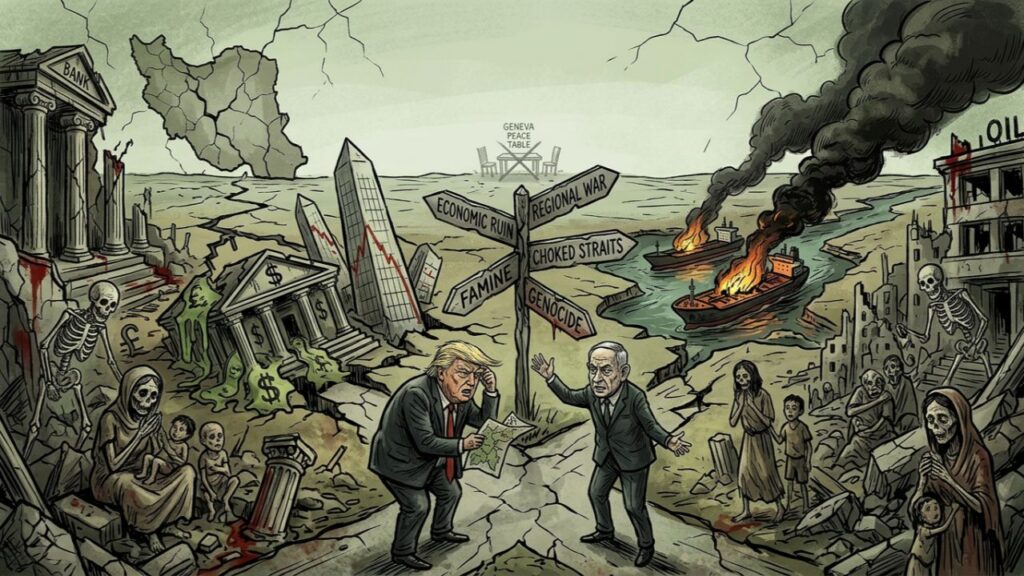
A Note on This Document
This is the second of two connected pieces. The first, The Foundation for War Crimes: A Factual Record of Trump’s Iran War, established the evidentiary record: what happened, who said what, what the military and economic data show, and where the official narrative diverges from the facts. That document does not speculate about the future. This one does.
The United States government has been telling a story about this war. In that story, Operation Epic Fury was necessary and brilliant. The Iranian government is in chaos. Negotiations are progressing. The war is going well. The evidentiary record in Part One contradicts all of it. This document picks up where Part One ends and asks the harder question: given what we know, where does this end?
The analysts whose frameworks drive this document are the same nineteen voices assembled in Part One, extended by three additional figures whose work is indispensable to forward-looking analysis: Adam Tooze (Columbia University historian, Foreign Policy, the single most data-rigorous economist covering the war’s financial consequences), Yanis Varoufakis (former Greek Finance Minister, author of Technofeudalism, the most prominent voice connecting this war to a global financial crisis trajectory), and Gary Sick (former NSC Director for Iran under Carter, Ford, and Reagan, the single most authoritative living American former official on fifty years of U.S.-Iran institutional history).
Before the five scenarios, this document also addresses the question that should be the dominant frame of every news broadcast and every congressional hearing, and is not: the constitutional crime at the foundation of this war. Trump himself answered that question at a fundraising dinner on March 25. Everything that follows begins there.
The Constitutional Crime: A War That Was Never Called a War
On March 25, 2026, at a National Republican Congressional Committee fundraising dinner, Trump said the quiet part out loud: “I won’t use the word ‘war.’ They don’t like the word ‘war’ because you are supposed to get approval. So I will use the word ‘military operation.’”
That is not a slip. That is a confession. The President of the United States publicly acknowledged, at a fundraiser, that he deliberately chose words to evade the constitutional requirement to obtain congressional authorization. The constitutional scholars at Dorf on Law noted there was “more than adequate time to go to Congress” before a single bomb was dropped, and that the administration’s own timeline of pre-war planning made any claim of urgency factually untenable.
Article I, Section 8 of the Constitution is unambiguous: only Congress holds the power to declare war. The War Powers Resolution of 1973, passed over Nixon’s veto after Vietnam, reinforced this by limiting presidential use of military force to three specific circumstances: a formal declaration of war, specific statutory authorization, or a national emergency created by a direct attack on the United States, its territories, or its armed forces. Not one of those three conditions existed on February 28, 2026. Iran had not attacked the United States. There was no imminent threat. There was, by every account including Trump’s own, an active negotiation underway.
The Brennan Center for Justice published within 48 hours: “President Trump’s massive and ongoing operation against Iran violates the Constitution and our nation’s founding principles. The president acted unilaterally and lawlessly, without congressional authorization and absent any imminent threat to the United States.” The ACLU stated without qualification: “Trump has breached the Constitution by invading Iran, as it is unequivocal that Congress alone holds the power to declare war.” Senator Bernie Sanders declared it “illegal, premeditated and unconstitutional.”
Congress was not asleep. It tried, twice, to invoke the War Powers Resolution. The Senate vote on March 4 failed 47 to 53, with every Republican except Rand Paul voting to give Trump a free hand. The House vote the next day failed 212 to 219, seven votes. A second Senate attempt on March 18 failed again with the same alignment. Speaker Mike Johnson’s response to the constitutional challenge: “We are not at war,” directly contradicting Trump himself, who had already described it as a war in his announcement speech. The Council on Foreign Relations assessed the practical result: even if a War Powers resolution passed, Trump would veto it, and a two-thirds override majority does not exist in either chamber.
The deeper reason this is not the dominant frame of every broadcast is structural. Presidents of both parties have been ordering military force without congressional authorization for more than seventy years. Korea was not declared. Vietnam was not declared. Kosovo, Libya, Syria: none declared. Each unconstitutional precedent made the next one easier, until a president could bomb a country into a war, close the world’s most important shipping lane, kill a head of state, and call it a “military operation” to a laughing crowd, and Congress would respond by failing to stop it by seven votes in the House.
This is the constitutional foundation upon which every scenario in this document rests. The war is not only a strategic catastrophe. It is a lawless act, acknowledged as such by its own architect. That fact must be carried through everything that follows.
Prefatory Note: Why Forecasting Is Necessary and Dangerous
Every serious analyst consulted for this companion piece opened with the same caveat. Richard Wolff was bluntest: “I hesitate in the middle of the war to speak as though I know what it’s going to do. Everything at this point depends on how much bombing and destruction the Iranian people can tolerate, and I can’t speak to that.” John Mearsheimerframed the same uncertainty through the lens of military history: “Countries go to war because they’re optimistic about their chances. It makes perfect sense. You don’t go to war if you think you’re going to lose. President Trump didn’t go to war thinking he was going to end up in the situation he is in now.” George Beebe, former CIA Director for Russia Analysis and now at the Quincy Institute, added the sobering systemic dimension: “The window of opportunity is still there but I do think it is closing. I don’t think it’s going to extend much beyond this summer, quite honestly.”
What follows is not prediction but scenario analysis, the disciplined identification of structurally possible outcomes, weighted by the convergence of expert frameworks and the observable facts on the ground as of March 31, 2026. No scenario is offered as destiny. All of them are in play simultaneously.
The State of Play: The Variables That Determine Every Scenario
These are not rhetorical abstractions. They are measurable, tracked in real time, and they represent the actual hinge points of this war.
Variable One: Iranian Missile and Drone Inventory
This is the decisive military variable. Trump claimed first that 90 percent of Iran’s missile capabilities had been destroyed, then walked it back to 82 percent. Reuters reported on March 27 that US intelligence can only confirm about one third of Iran’s arsenal destroyed, with the status of another third described as “less clear.” Mercouris assessed that figure as itself almost certainly wrong.
Iran reported more than 80 missile volleys launched since February 28. Israeli sources, via Haaretz, confirmed on March 28 that 80 percent of Iranian missiles launched against Israel are reaching their targets, with success rates continuing to improve as air defenses become increasingly strained. A key structural advantage for Iran: it fires cheap Shahid-class drones costing tens of thousands of dollars against US interceptors costing one million dollars or more each. Mearsheimer quantified the asymmetry precisely: “Iran can continue to just pump out these very cheap drones. You know, you can it is easy to manufacture. They’re cheap. The industrial potential can remain. And these 5,000 drones are sent and the US has to use this million-dollar interceptive missile, so they continue to pump them drones while the US diminishes its potential.”
Alexander Mercouris reported on March 27, from a source with access to Russian intelligence, that Iran has approximately one million drones available, many concealed in central and eastern Iran beyond the reach of American and Israeli strikes, and that Russia and China have been systematically re-equipping Iran with advanced drone technology since the June 2025 war. On March 30, Mercouris added a finding that reframes the entire military picture: Iran has never yet used its most advanced missiles. The current exchange is being conducted with Iran’s second-tier arsenal.
Variable Two: The Strait of Hormuz
This is the decisive economic variable. Before February 28, approximately 20 percent of global oil transited the Strait. Mearsheimer, drawing on shipping data, estimated that as of late March 2026, only 5 percent of pre-war Strait traffic is now flowing. Iran has not only maintained the Strait closure but, as of March 29, appears to be tightening control rather than loosening it, the opposite of Trump’s repeated public claims. Seyed Mohammad Marandi confirmed from inside Tehran: “if there’s a deal, let’s say at some point the Americans meet Iran’s demands and it comes to an end, and they open the Strait, energy can gradually be exported and it will take some time but a lot of the problems will decrease over a year or so. But if the fighting intensifies, obviously these installations will be destroyed and opening the Strait at some point would be meaningless.”
Iran controls an irreversible lever. It can open the Strait when it chooses. The longer the war continues, the more Gulf infrastructure is destroyed, and the less the opening means. The window for a clean settlement is narrowing every week.
Variable Three: Iranian Political Cohesion
The decapitation strategy was premised on the assumption that killing Khamenei and the senior leadership would produce collapse, power struggle, or popular uprising. None of these occurred. The constitution functioned, Mujtaba Khamenei was appointed as the new Supreme Leader, and, as Marandi reported from Tehran on March 29, millions of Iranians are in the streets nightly, in cities under active bombardment. “People are resilient. They understand that this is a war for survival. This is an existential war.”
Mercouris described the new leadership as “younger, more militant, more hardline than the one it is succeeding, and more firmly anchored in the IRGC.” Marandi assessed the Iranian political system as having essentially run itself during the week between Khamenei’s assassination and the appointment of his successor: “The country was being run in accordance with the constitution. During that week it was basically the people holding the country together.”
Variable Four: Great Power Support for Iran
This variable has been transformative and is still accelerating. Mercouris reported on March 27 and March 29 that Russia has been providing Iran with satellite intelligence, fiber optic drone technology, drone stockpiles, and man-portable air defense missiles since the June 2025 war. The AWACS aircraft destroyed at the Saudi base was struck with what Mercouris assessed, from the precision of the strike, as Russian-assisted targeting. Russia’s own public position, via Lavrov, is that this is the beginning of World War Three.
Richard Wolff placed this in the broadest context: “Iran has two incredible allies and if they think this might be the beginning of a global war, then they are going to line up behind Iran. They’re not going to sell Iran down the river. And the joke that must pass among them is how ironic that what you, America, did to us in Ukraine, we can now do to you in Iran. How could they resist?”
On March 30, the Chinese Global Times published an editorial with a cartoon of Uncle Sam hovering over a burning Middle East, calling for an immediate ceasefire and making unambiguous who China holds responsible. The structural alignment of Russia and China behind Iran means Iran has unlimited resupply, real-time intelligence on US forces, and diplomatic cover in every international forum.
Variable Five: The American Domestic and Financial Situation
Wolff called this “the fiscal cliff variable.” Trump inherited deficits exceeding one trillion dollars per year, a credit rating downgraded by all three major agencies, and a defense budget already at $900 billion. He then requested a $600 billion increase in the defense budget, plus an additional $200 billion for the Iran war, for a total new military outlay of $800 billion. The tariffs intended to fund this were ruled unconstitutional by the Supreme Court, requiring refunds to importers. The result: an $800 billion increase in military spending with zero new revenue.
Bond market consequences were immediate. The probability of Federal Reserve interest rate increases moved from zero to 26-27 percent within days, reversing rate-cut expectations markets had priced in for six months. Mearsheimer flagged the 10-year Treasury yield as a live danger zone. Lawrence Wilkerson, Colin Powell’s former Chief of Staff, was blunt: “There is a really good chance we’ll go into depression.”
Jeffrey Sachs identified three possible Trump motivations for the “negotiations that never happened” episode: genuine confabulation from dementia combined with narcissism, impulsive incompetence, or market manipulation by insiders front-running the price swings. All three are consistent with the observed behavior. None suggests a commander in chief capable of managing a protracted war.
Variable Six: Trump’s Escalation Options and Their Limits
The ground operation planning, confirmed by the Washington Post, involves at most 10,000 troops, predominantly special forces, Marines, and the 82nd Airborne, all light infantry without the heavy armored divisions used in both Gulf Wars. Mearsheimer’s Desert Storm comparison was devastating: that operation used 540,000 troops against Iraq, a country with a third of Iran’s population, flat terrain, and a far less deeply rooted regime.
Iran is mountainous, has a population of over 90 million, has been preparing for a ground invasion for 25 years, and, as Marandi described, has missile and drone stockpiles in underground bases “that the Americans know nothing about” and that “haven’t even started operation” yet. Wilkerson identified the nuclear threshold: “Do I think Donald Trump would even consider that Iran was a target he shouldn’t use a nuclear weapon on? Not for a minute. Do I consider that Netanyahu would feel that way? Not for a minute.” But he also identified the constraint: “We’re talking about the three predominant nuclear powers in the world facing one another.” The nuclear option is off the table for any rational actor, which still leaves open the question of whether rational actors are in charge.
The Five Scenarios
Scenario One: Prolonged Attrition War (Probability: 40%)
The Structure of This Outcome
This is the base case, the outcome requiring no additional decisions by either side beyond continuation of current trajectories. It is not a scenario anyone wants. It is the scenario produced by inertia.
Iran continues missile and drone attacks on US bases, Gulf infrastructure, and Israel. The US continues airstrikes on Iranian military and industrial targets. The Strait of Hormuz remains closed or partially open under Iranian terms. Negotiations are announced and abandoned repeatedly. Ground operations are prepared, leaked, and either postponed indefinitely or attempted and quickly scaled back after taking casualties.
This is what both Mearsheimer’s “no exit strategy” and Mercouris’s “Paris talks, Vietnam style” analyses describe. Mearsheimer quoted Medvedev noting it took the US ten years to exit Vietnam. Wolff compared it directly to Europe’s current situation: “You have an ‘if I were Mr. Trump I would be extraordinarily worried’ situation because this time may be his last time. And the reason for that is to quote a leading business communication: ‘this war may take us over a fiscal cliff.’”
Why This Scenario Dominates
Iran has every incentive to string the war out. As Mearsheimer explained: “The longer the war goes on, the more leverage you have. The longer the war goes on, the more desperate President Trump is going to get. If you’re playing Iran’s hand, you have no interest in cutting a deal now. You have huge leverage now.”
Iran cannot win a total military victory against the United States. But Iran does not need to. It needs only to make the cost of continuation higher than the cost of concession. Every week of Strait closure inflicts economic damage that no military victory could compensate. Every interceptor missile fired costs ten to one hundred times what the Iranian drone that prompted it cost to build.
The attrition scenario shades toward other scenarios based on three indicators: the rate of US interceptor depletion, the rate at which Gulf states begin directly approaching Iran for separate arrangements, and Trump’s poll numbers going into the November midterms.
Scenario Two: Negotiated Settlement Under Great Power Brokerage (Probability: 25%)
The Structure of This Outcome
This is the scenario that most analysts believe is the only rational exit, and that most analysts also believe is currently beyond Trump’s political reach. It requires Russia and/or China to broker a framework that gives Iran most of what it demands, gives Trump a face-saving narrative, and restructures the US military and economic position in the Persian Gulf.
Mercouris identified the leverage architecture precisely: Russia is the party with the most direct military relevance to Iran’s capabilities, and therefore the party whose intervention in pushing Iran toward talks would be most effective. But Russia’s price for exercising that leverage is steep, nothing less than a fundamental renegotiation of European security architecture and concessions on Ukraine. “If the United States is indeed going to turn to the only party that is really in a position to exercise leverage on Iran, which is Russia, they’re going to have to pay the very steep price the Russians are going to demand.”
China’s Global Times editorial of March 30 represents the public face of what is likely a more active private diplomacy. Trump’s planned mid-May visit to China is now understood by analysts as a leverage moment: the Chinese will likely use it to pressure the US toward a ceasefire framework that requires major concessions to Tehran.
Iran’s stated conditions, as summarized by Marandi, are: full withdrawal of US forces from the region, lifting of all sanctions, reparations for the war, and a security guarantee preventing future attacks. Mearsheimer described them bluntly: “He really has no choice in the final analysis but to cave in to most of Iran’s demands and accept a humiliating defeat.”
Why This Scenario Is Possible But Constrained
Richard Wolff traced the domestic pressure mechanism: Trump’s internal coalition is fracturing. The Florida state legislature election showed a Democrat winning in Trump’s own Mar-a-Lago district for the first time in years. New York City elected a Muslim socialist mayor who campaigned on the promise to arrest Netanyahu if he visited. Midterm polling is catastrophic. If the fiscal cliff arrives before November, the political constituency for continuing the war collapses.
The constraint is Netanyahu. Mearsheimer articulated the trap: “The Israelis will not want us to make any concessions. The Israelis will want us to continue the war. But I think this will be a case where we will be so desperate to avoid a global catastrophe that Trump will ignore the Israelis and do what he has to do.” His qualifier: “He may not do that. He may feel that he just can’t make the necessary concessions that the Iranian demands are just too outrageous.” At that point the Titanic hits the iceberg.
The Pakistan-Turkey-Egypt Channel and Its Limits
The active mediation track as of March 31 runs through Pakistan, with Turkey and Egypt as supporting parties and China publicly endorsing the effort. But as Mercouris noted, Iran’s speaker of parliament, Ghalibaf, has publicly stated Iran believes the talk of negotiations is a deliberate distraction while the US prepares a ground operation, and Iran will not be deceived again.
The Iranian position has been consistent: “We can’t do a deal with Trump. He’ll say one thing today, do something else tomorrow. Just like the JCPOA, just like the 12-day war, just like this war, he was negotiating while secretly plotting.” This structural trust deficit must be overcome before any negotiated scenario can materialize, and Russia and China, not Pakistan, are the only parties with the credibility to do it.
Scenario Three: Escalation to Regional Catastrophe (Probability: 20%)
The Structure of This Outcome
This scenario is produced by Trump’s described pattern of behavior, doubling down when losing rather than retreating, combined with the pro-escalation pressure from Lindsey Graham, Fox News, General Keane, and the Wall Street Journal editorial board, whom Mearsheimer identified as the people who “helped produce this disaster” and “don’t want to retreat now.”
The proximate trigger is a failed or costly ground operation. If US forces land on Kharg Island or the Strait islands and take significant casualties, the political pressure to retaliate overwhelmingly becomes enormous. Marandi described the Iranian counter-plan directly: “What if Iraqi forces, while the Americans are trying to invade Iranian territory, enter Kuwait and northern Saudi Arabia? What if Yemen enters Saudi Arabia from the southwest? Then what do the Americans do?” The desalination plants are the existential vulnerability. Saudi Arabia, Qatar, Kuwait, and Bahrain depend on them for fresh water. Their oil export infrastructure is equally vulnerable.
Wilkerson confirmed from a military planning standpoint: “Iran has a target list. They’ve already pretty much listed every main truly decisive point in the region for all these countries. An interim step for them. And if they execute that target list, all of the states in the region would be brought to their knees.”
The Nuclear Threshold and the Israeli Variable
The most alarming specific in this scenario came from Professor Theodore Postol of MIT, who called Wilkerson directly on March 28 and stated there is a 75-80 percent probability that Iran has sufficient enriched uranium, in a facility deep enough underground to survive bombardment, to build and deliver nuclear weapons on Khorramshahr or similar Mach 3 and Mach 4 missiles. Wilkerson’s analysis: “We would be looking at the three predominant nuclear powers in the world facing one another.”
Wilkerson assessed Netanyahu’s position directly: “I’m beginning to think about the last Israeli. It’s getting really dire for Israel. Israel is going to disappear as a Jewish state in the Levant. Netanyahu is going to be the presider over that disappearance.” A cornered Netanyahu, facing war crimes trials, with an IDF chief of staff warning the IDF will collapse on itself from manpower shortage, is precisely the kind of actor who might reach for a nuclear option. As Wilkerson said: “Do I think Netanyahu would use nuclear weapons? Not for a minute would I think he wouldn’t.”
This is the scenario Lavrov described as World War Three.
Scenario Four: American Domestic Political Collapse Forces Exit (Probability: 10%)
The Structure of This Outcome
This scenario does not require military defeat or successful negotiations. It requires the American domestic political system to perform the function it was designed to perform: removing a president whose policies are catastrophically damaging the country.
Wolff traced the mechanism with precision. The MAGA coalition is fracturing visibly. Polls show Trump losing every election currently contested. The business community, Trump’s core elite constituency, has gone through a year of agonizing adjustments to tariffs, only to have those tariffs struck down by the Supreme Court and the refund demands arrive simultaneously with an $800 billion war bill. A leading business communications newsletter warned the war “may take us over a fiscal cliff.”
Wilkerson placed the endpoint clearly: “Even if we get through this by some miracle, he’s still got to win the midterms. All the polls show he’s going to lose. His party’s going to lose disastrously. And he knows impeachment is around the corner from that.” He then drew the Nixon parallel explicitly: Republican senators going to the White House with impeachment documents, making clear the votes are there. “That’s what needs to happen to Trump.”
Beebe identified the European calculation: European leaders are “hoping they can just hold on through the next several months” and then “Trump will not have the ability politically to drive this peace process.” The same logic applies to Iran: if Trump is politically incapacitated by the midterms, the conditions for a rapid settlement under JD Vance or any successor improve dramatically, because Iran’s stated objection to negotiations includes the specific refusal to deal with Witkoff and Kushner.
The Constitutional Question, Revisited
Here the constitutional crime documented at the opening of this document returns as a structural variable. Trump’s open admission that he called this a “military operation” to avoid congressional approval means that the legal foundation of the war is actively contested. If the midterms produce a Democratic majority or a Republican revolt, the first legislative act of the new Congress is likely to be a War Powers resolution that, unlike the March attempts, has the votes to override. The war’s legal foundation collapses before the military one does.
The ICE and Military Governance Risk
Wolff identified the structural risk that could prevent this scenario from running its normal democratic course: the expansion of ICE into a parallel enforcement apparatus now deployed at every airport, combined with Trump’s active purging of military officers and replacement with loyalists. “The question becomes whether he will go or not. And then that’s where we are, the issue becomes the American military establishment, where will they go? Because you will have reached a point in which the country is split 60/40 and the only conceivable control mechanism becomes the military.” Wolff’s assessment: “He will probably leave in a straight jacket.”
Scenario Five: Financial System Collapse Forces Rapid End (Probability: 5%)
The Structure of This Outcome
This is the most catastrophic non-nuclear scenario, and the one that Adam Tooze’sfinancial analysis places in a non-trivial probability range. It requires no military event. It requires only the continuation of current economic trajectories.
The chain: the Strait of Hormuz remains closed. Oil approaches $200 per barrel (Bloomberg reported discussions of this possibility as of March 30). The fertilizer and petrochemical supply chain collapses, triggering food shortages across Asia and Africa within 90 to 120 days. US Treasury yields spike as the US attempts to borrow $800 billion additional dollars with a downgraded credit rating in a market where Gulf states are now liquidating US Treasury holdings to repair Iranian-strike damage to their infrastructure. The Federal Reserve is caught between raising rates to attract borrowing and cutting rates to prevent recession. Stagflation returns with 2020s speed.
Wolff predicted the stock market would go from pricing in rate cuts to pricing in rate hikes almost overnight, which it did. He also identified the structural irreversibility: “When you’re faced with a sudden spike in the price of oil and there are adjustments, those do not get readjusted back to the position before when the prices come down again. There are people who are going to be switching to solar energy or hydro energy that are never going to go back to buying oil.”
Wilkerson, drawing on shipping data, noted approximately 4,000 ships are standing off the Strait with nowhere to go. Sachs described the helium crisis: large quantities of helium, required for semiconductor manufacturing, flow through the Strait, and no one in the US government knew this.
Yanis Varoufakis identified the deeper systemic mechanism. His framework, drawn from Technofeudalism, holds that the war represents the terminal crisis of the dollar-denominated global financial architecture. The IRGC’s Hormuz tollbooth, requiring yuan-denominated payment and cargo vetting, is not merely a military tactic. It is the moment a structural challenge to the petrodollar becomes irreversible. Once major Asian buyers have paid in yuan for thirty days, the habit calcifies, the infrastructure for dollar-based transactions atrophies, and the mechanism of American financial dominance over the Middle East is permanently damaged regardless of how the war ends.
The scenario ends the war because there is literally no government left with the institutional capacity to continue it. This is not an analysis anyone wants to be correct about. It is an analysis whose preconditions are advancing in real time.
The Cross-Cutting Analytical Frameworks
Framework One: Mearsheimer’s Escalation Ladder
Every rung of the escalation ladder makes the US position worse. Mearsheimer’s systematic analysis showed that the US cannot attack Iranian energy infrastructure (because Iranian oil is needed in global markets), take and hold Kharg Island (too expensive to supply and defend), conduct a meaningful ground invasion (insufficient forces, no air superiority, Russian real-time intelligence feeding to Iran), or use nuclear weapons (Russia and China would respond). The only remaining option on the ladder that changes the military calculus is the one option that ends civilization.
Framework Two: Mercouris’s Intelligence Assessment
Mercouris’s March 27 program noted that US forces had been evacuated from many, maybe most, Persian Gulf bases; 10 radar stations have been destroyed; the Gerald Ford is returning to the US for at least 14 months of repairs; the Lincoln’s crew is exhausted; and Iran continues over 80 missile volleys since the start of the war. His assessment: “the president is stuck. He is not able to force open the Strait of Hormuz. He’s not able to take action that can change the strategic calculus. Iran has most of its missiles. It probably has huge numbers of drones.”
Framework Three: Beebe’s Trust Deficit and the Ukraine Linkage
Beebe made explicit what other analysts left implicit: Trump’s negotiating behavior with Iran is being watched in Moscow and is poisoning the Ukraine talks simultaneously. “The same envoys that the Russians are dealing with on the Ukraine settlement process” are the ones Iran has refused to meet. Witkoff has not seen a single Iranian; he has been talking to Pakistani and Omani intermediaries. The trust deficit is now global, structural, and visible to every US adversary simultaneously.
Beebe’s most important contribution to scenario analysis: the window for any negotiated outcome closes in summer 2026. “I don’t think the patience in Moscow and Washington will be infinite. And I don’t think that window is going to be open much beyond early fall of this year.”
Framework Four: Wilkerson’s No Mission, No Strategy Military Assessment
Wilkerson’s judgment from three decades in the US military: “This is the worst performance I’ve ever seen by a leadership cell from the United States. It’s terrible. It’s utterly terrible.” The specific military-doctrine failure: US forces have been conducting “objectives,” destroying a percentage of missile sites, seizing islands, without any coherent “mission,” which is the end state that makes those objectives meaningful. “What is your mission? You would have been categorically unable to tell me.”
His diagnosis of the command structure: “Trump has no idea how he’s going to get out of this. He’s finally come to the realization that he’s in it and in it deeply and he has not the tools to extricate himself. And the main person who got him in it to this depth is Netanyahu, who has absolutely no sympathy for him whatsoever.”
Framework Five: Wolff’s Fiscal Cliff Political Economy
Wolff’s framework synthesizes the military and economic analyses into a single political prediction: the war ends not when either side wins militarily but when domestic US economic pressure becomes greater than the political cost of concession. He identified the inflection point: “What’s really going to cause President Trump to cave in a major way is when he comes to understand that if he doesn’t shift course, the Titanic is going to hit the iceberg.”
His timeline: the fiscal cliff arrives before or during the November midterms. The midterms produce a Democratic majority or a Republican revolt. Either outcome removes Trump’s governing authority. The question, the genuinely open question, is whether he accepts the constitutional result or moves to prevent it using ICE, military appointments, and the Save Act’s voter suppression mechanisms.
The Irony of History: Gary Sick’s 50-Year Lens
Gary Sick, who managed the 1979 hostage crisis directly as the NSC director for Iran under three presidents, has consistently described US-Iran relations through a single concept: the inability of any US administration to develop a Plan B for Iran. The assumption, never tested and never abandoned despite repeated failures, is that sufficient pressure, sanctions, military strikes, regime decapitation, will eventually produce Iranian capitulation.
The historical record, which Sick knows better than any other living American official, is exactly the opposite. The Islamic Republic has survived the 1979 revolution; the 1980-88 war with Iraq, in which the US covertly supported Saddam; the assassination of scores of scientists and military officials; three decades of crippling sanctions; the June 2025 bombing of nuclear facilities; and the February 28 decapitation strike that killed the Supreme Leader himself.
At every point, external pressure strengthened the regime’s internal legitimacy by confirming the narrative that Iran faces an existential enemy that will never accept Iranian sovereignty. Mearsheimer put it with the bluntness of a structural realist: “Iran is dealing with an existential threat here. The Israelis especially, but also the Americans, want to wreck their state. They want to do to Iran what happened to Syria. They want to break it into pieces. When you face an existential threat, you have to fight to the death. That’s the way this works.”
Sick’s framework demands confronting a question that official Washington has never honestly answered: what does the United States actually want from Iran? Not the stated objective, denuclearization, no ballistic missiles, no regional alliances, but the real objective. Mearsheimer’s answer: they want to “destroy Iran,” to “do to Iran what happened to Syria,” to “break it into pieces.” If that is the objective, no negotiated settlement is possible at any price, and the war ends only in Scenario Three or Scenario Five.
If the actual objective is something less than that, manageable coexistence, removal of nuclear capacity, US military dominance of the Persian Gulf, then the framework for a settlement exists. But as Mearsheimer observed, even articulating that framework requires Trump to betray the constituency, domestic and Israeli, that produced this war. “He may feel that he just can’t make the necessary concessions.” And then we hit the iceberg.
The Food Crisis Accelerant
One variable cuts across all five scenarios and makes the timeline of every one of them faster: the global food crisis. The Strait closure has disrupted not only oil but fertilizer supply chains already under stress from the Ukraine war disruption of potash and nitrogen exports. Mearsheimer quantified the fertilizer dimension: “When you think about the consequences for the world’s food supply of all these fertilizers not making it through the Strait, and then you think about the consequences of only 5 percent of pre-war flow of tankers through the Strait now taking place, you see that the potential for disaster is huge.”
Food prices, which rose sharply in the first week of the Strait closure, are now being monitored by the IEA, the World Food Programme, and the IMF as a leading indicator for state fragility in import-dependent countries across South Asia, Southeast Asia, East Africa, and the Sahel. The Philippines has already begun gasoline rationing. The billions of people who are going hungry are not going hungry because they chose this war, or because they have a position on the Strait of Hormuz, but because the price of bread doubled while a president told a fundraising crowd he called it a “military operation” to avoid asking Congress.
What the Record Demands
This document has attempted to do what Part One deliberately did not: look forward rather than backward. Part One established the factual record of how this war was launched, during negotiations, without authorization, on the basis of a decapitation strategy every serious analyst predicted would fail, by leaders who “relied on Steve Witkoff and Jared Kushner and Lindsey Graham” rather than the deep-state expertise they had systematically destroyed.
The fundamentals, as of March 31, 2026, are these:
The war was launched without constitutional authority, a fact the president admitted out loud at a fundraiser. The US cannot win this war by military means. Iran has no incentive to stop fighting until it has extracted the concessions it needs to prevent this from happening again. The economic consequences of the Strait closure are now severe enough that time pressure operates on both sides, but more severely on the US. Russia and China will not broker a settlement without extracting their own price from the US. The domestic political clock in the US is running, and it favors resolution before November 2026 or chaos after it.
No path out of this war is clean. Every path requires the United States to acknowledge, in substance if not in words, that it started and lost a war it should never have started, a war its own president privately knew required no approval precisely because no approval would have been given.
The abyss is staring back. The question is whether we blink.
This document is Part Two of a two-part series. Part One is “The Foundation for War Crimes: A Factual Record of Trump’s Iran War.” All transcript citations draw from primary source recordings of Glenn Diesen’s interviews with Alexander Mercouris (March 27, 29, 30, 2026), John Mearsheimer (March 27, 2026), Jeffrey Sachs (March 25, 2026), Richard Wolff (March 25, 2026), Lawrence Wilkerson (March 28, 2026), George Beebe (March 27, 2026), and Seyed M. Marandi (March 29, 2026). By Scott Ortkiese, Throughline Synthesis Group.sothroughlinesynthesis.com |www.throughlinesynthesis.com. March 31, 2026.
Related reading
- The Foundation for War Crimes: A Factual Record of Trump’s Iran War and Where It’s Going
- Trump’s Iran War, China Trip and the Vanishing Empire
- American Empire in Ruins: The Unprovoked, Unconstitutional, and Catastrophic US-Israeli War on Iran
- What American Media Won’t Tell You About the Iran War and the End of the American Century in Asia