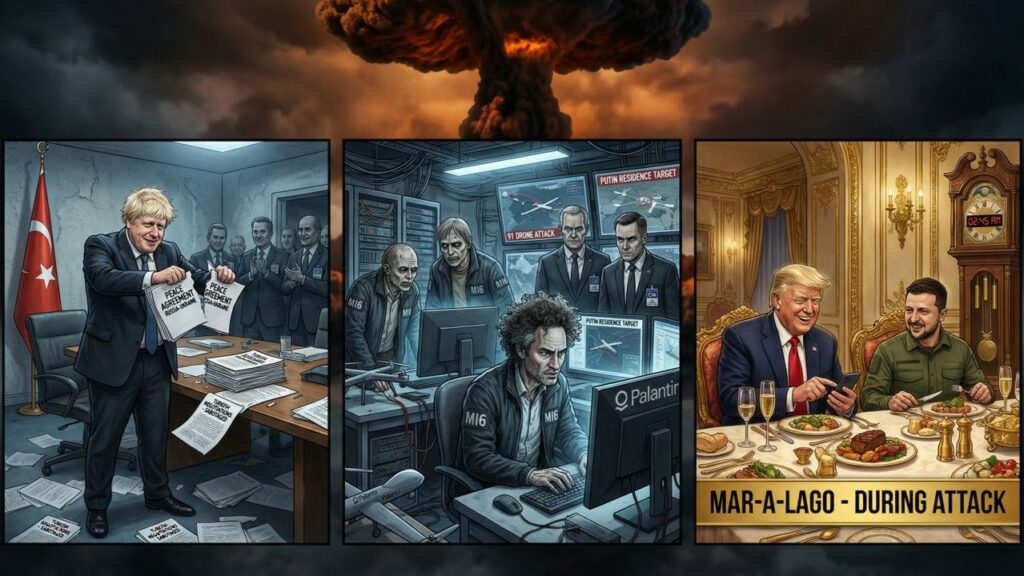
When bumbling and scheming intelligence agencies and Silicon Valley contractors play with nuclear fire, Russians and Ukrainians continue to die, and the whole world is at risk.
A recent conversation between Dr. Glenn Diesen, a professor of political science specializing in Russia-NATO relations, and Scott Ritter, a former UN weapons inspector and US Marine intelligence officer, captures one of the most brutally candid assessments of Western policy toward Russia to emerge from informed sources in recent memory. Ritter delivers a systematic dismantling of British and American strategic incompetence that reads less like conventional geopolitical analysis and more like a coroner’s report on the death of transatlantic credibility.
The Theater of British Absurdity
Ritter opens with a devastating technical analysis of Britain’s recently announced “Nightfall” ballistic missile system, intended to strike Moscow with 200-kilogram warheads from 500 kilometers away. His arithmetic is simple and damning: the UK Ministry of Defense allocated £9 million to develop a missile they claim will cost £800,000 per unit to produce at a rate of ten per month. That production cost alone would consume £8 million monthly, nearly the entire development budget.
“They don’t even have a production facility yet. They have not built a prototype. They haven’t tested a prototype,” Ritter notes, characterizing the announcement as scientists “with chalk drawing pictures on a board, taking snapshots of it with their iPhone and send it to the defense minister saying, ‘We have a plan.'” The missile isn’t a weapon; it’s what he calls “an idea that’s been totally underfinanced” and “just another stupid idea from a nation of stupid people.”
This harsh judgment extends beyond hardware to Britain’s broader military capacity. The entire British military numbers 76,000 personnel, and when London discusses deploying 7,600 troops to Ukraine minus 10% of total force structure, Ritter dismisses this as physically impossible. “They literally don’t have them. They can’t deploy them. They’re incapable of physically moving these troops out of the United Kingdom into Ukraine and then sustaining them.”
The logistics problem is compounded by rotation requirements: a six-month deployment cycle would require 22,800 troops total (7,600 deployed, 7,600 preparing for deployment, 7,600 in training for the next cycle). “The British can’t do it,” Ritter states flatly. When British General Richard Sherriff himself warned that the UK lacks “the manpower, they don’t have the money, they don’t have the military equipment and also not the political will,” he confirmed what Ritter characterizes as Britain’s status as a power that “can’t perform.”
MI6 Russia House: A Study in Spectacular Incompetence
Perhaps the conversation’s most devastating section concerns British intelligence operations against Russia. Ritter, drawing on his intelligence background, offers an insider’s assessment of MI6’s Russia operations that amounts to a professional obituary for what was once considered a premier intelligence service.
The Christopher Steele dossier serves as Ritter’s Exhibit A, evidence of what he calls “extraordinary incompetence” within MI6’s Russia portfolio. Following the Soviet collapse, British intelligence “spent a whole bunch of effort and not so much money recruiting anybody they could… taxi drivers, hookers, politicians, former politicians, everybody.” When Russian counterintelligence cracked down, Ritter references the famous “spy rock” scandal, the networks unraveled.
More fundamentally, Ritter argues that MI6’s Russia operations are structurally compromised by their dependence on anti-Putin émigré sources in London. “Their Russia house is appended to their London station and their London station is home of a bunch of anti-Putin immigrants.” He specifically names Mikhail Khodorkovsky, the former oil oligarch imprisoned for corruption, who now “using his billions to work with MI6 to create this anti-Putin propaganda machine.”
This creates what Ritter describes as an echo chamber of wishful thinking: “They believe that Vladimir Putin is a unpopular dictator who rules through fear and intimidation. And that if they can expose him as weak and frail that they will create the opportunity for these disaffected enraged aspects of Russian society to remove him from power.” Every operation flows from this fundamentally flawed assumption, that striking symbolic targets will undermine Putin’s domestic standing rather than, as actually occurs, strengthening Russian resolve.
The practical implications are profound. When MI6 operates from such distorted intelligence pictures, every tactical success (a drone reaches its target) becomes a strategic failure (Russian retaliation intensifies, Western credibility erodes, escalation risks multiply). A failed intelligence service isn’t merely incompetent, it’s actively dangerous, generating plans divorced from ground truth.
Ukraine: The Propaganda War After Military Defeat
On the central question of Ukraine’s viability, Ritter offers an unsparing assessment: “Any rational leadership having assessed the totality of the picture, understanding that there was no pathway to victory would be looking for a pathway to avoid an even more decisive defeat. But that’s not what’s happening in Ukraine.”
Instead, Ukrainian operations have become purely performative. Drone strikes against Lukoil drilling rigs in the Caspian Sea “didn’t destroy the rigs, but you know, they got their video that they were able to put out there.” Zelensky meets with intelligence chiefs to announce deep strikes into Russia, apparently oblivious that “the retaliation that Russia will inflict on them is going to be extreme.”
British strategy, which Ritter identifies as “Keep Ukraine in the Fight,” centers on “psychological preparation of Ukraine for sustaining a conflict that by any measure it’s being decisively defeated in.” This isn’t war-fighting in any conventional sense, it’s theater designed to maintain the illusion of Ukrainian viability while reality systematically contradicts that narrative. “Good chunks of Kiev don’t have power, don’t have water and not going to get power and water restored,” yet Ukrainian forces continue “throwing away reserves and fruitless attacks for propaganda purposes.”
Diesen notes the darkness of this approach: “If there was British troops being slaughtered in this way, they would not have put this as an objective to keep the war going at any cost. They would have made a deal or pulled out by now. But again, they’re fighting with Ukrainians. So I don’t think they’re counting their losses.”
The coalition assembled in Paris represents what Ritter calls “the willing but unable”, a collection of European states that “may be willing, but they’re unable” to actually deploy meaningful military force. “This is Europe. This is the UK today. They can’t perform. They’re literally pathetic.”
The Alaska Setup: Trump’s Betrayal Thesis
The conversation’s most explosive claim concerns Trump’s negotiations with Putin. Ritter argues that the January 2025 Alaska summit was never genuine, it was an elaborate deception operation designed to create internal divisions within Russia.
The mechanism worked through economic expectations. Trump, through figures like Kirill Dmitriev (who handles Russia’s sovereign wealth fund), created anticipation of sanctions relief and economic renaissance. Russian regions began planning for lifted restrictions (“we want to revitalize oil production in the north. Oh, let’s call the mayor and the governor… let’s tell us what we need to do”) spending money “before they have it.” This created what Ritter calls “a fifth column inside Russia of people who are now anticipating the lifting of sanctions which are never going to be lifted.”
Then Trump pivots, blaming Putin for the failure: “I’m not happy with Putin. I think Putin’s the problem.” The goal, Ritter argues, was “to create a wedge between Putin and the political and economic elites who are now enthralled about the potential of the lifting of sanctions.”
Evidence for this interpretation includes Julia Ganis, the former National Intelligence Officer for Russia who “honchoed the 2017 intelligence community assessment that said Donald Trump was colluding with the Russians.” Despite her documented statement “I hate Donald Trump and I want to bring Donald Trump down,” CIA Director John Ratcliffe “whitewashed her and she’s on the airplane briefing Donald Trump on his way to meet Putin.” Ritter’s conclusion: “Donald Trump knew that this was a lady who hates Russia and that he Donald Trump has won the CIA over by telling them, ‘No, no, no. I’m not a Russian asset. I’m Russia’s worst enemy.'”
The January drone attack on Putin’s residence, involving 91 drones, provides what Ritter considers proof. When Russian technicians reverse-engineered the navigation chips, they discovered intelligence “both extremely detailed and also extremely timely” that could only come from specific US collection platforms and processing facilities, “literally only one place in Europe that can do this and that’s a Department of Defense organization or entity in Europe that supports the targeting of the Tomahawk missile.”
When Russia presented this evidence to Trump, they were signaling “we know everything”, which intelligence assets collected the data, who processed it, and who packaged it into the drone guidance systems. Trump, who had publicly denied any attack occurred, was “exposed as a liar, an absolute liar, a fraud, a man who literally used negotiations to try and target the president of Russia.”
Palantir: Who Programs the Nuclear Apocalypse, A Pentagon Contractor?
(see the generated image above)
In his conversation with Glenn Diesen, a professor of political science who has emerged as one of the more penetrating analysts of NATO-Russia dynamics, former UN weapons inspector and US Marine intelligence officer Scott Ritter moves from describing the technical forensics of the January drone attack on Putin’s residence to identifying a specific culprit. Buried within Ritter’s explanation of how navigation chips must be programmed with “extremely detailed and also extremely timely” intelligence is a detail so disturbing it demands its own analysis: Palantir Technologies, the Silicon Valley data analytics firm co-founded by Peter Thiel, is “running this operation on behalf of the CIA and the British to program these chips.”
Read that again slowly. A private company, answerable to shareholders and quarterly earnings expectations, is programming the navigation systems for drone strikes against the nuclear command infrastructure of the world’s largest nuclear power. Not advising. Not analyzing. Not providing software tools. Running the operation. Integrating classified intelligence. Packaging targeting data. Programming the chips that guide weapons to Russian presidential compounds and nuclear command centers.
Subcontracting works fine for cafeteria services and IT support. It’s acceptable for logistics and facilities management. There’s a reason the military expression goes “close only counts in horseshoes and hand grenades”, because for everything else, precision and accountability matter. Yet somehow, the United States has decided that operations risking nuclear escalation can be outsourced to a private contractor operating outside the constitutional chain of command, beyond effective congressional oversight, and immune from the accountability mechanisms that theoretically constrain government action.
The Revolving Door to Armageddon
Ex-generals and admirals must go somewhere when they retire. The defense contractor ecosystem exists, in large part, to provide lucrative sinecures for flag officers who’ve spent careers building relationships with the procurement officers who will become their clients. Palantir’s advisory boards and executive suites feature the usual collection of former intelligence officials, retired military brass, and ex-national security advisers.
This revolving door has always been problematic, it creates conflicts of interest, enables corruption, and ensures that defense policy serves contractor profits as much as national security. But when the contracts involve programming navigation systems for strikes that could trigger nuclear war, the revolving door becomes a firing mechanism.
These aren’t people analyzing satellite imagery or building databases. According to Ritter, Palantir personnel are the operational nexus between intelligence collection and kinetic strikes on strategic targets. They receive classified data streams. They integrate information from multiple sources that Ritter identifies as traceable to specific collection platforms. They package this into guidance systems. They are, in the most literal sense, selecting targets and enabling strikes.
Who authorized this? Under what legal framework does a private company gain authority to make targeting decisions that could start World War III? The answer appears to be: nobody specifically authorized it, and there is no framework, which is precisely why it’s structured this way.
No Checks, No Balances, No Accountability
The genius of using contractors for strategic operations is that it circumvents every accountability mechanism simultaneously:
Congressional oversight? Classified contracts with private companies don’t trigger the same reporting requirements as direct covert operations. Intelligence committees receive briefings on “capabilities development” and “data integration services,” not “we’re using Palantir to program strikes on Putin’s nuclear command center.”
Judicial review? Private contractors aren’t state actors for purposes of constitutional limitations. When Palantir programs a navigation system, it’s business operations, not government action subject to judicial scrutiny.
International law? Is Palantir’s involvement an act of war by the United States, or merely a private company selling services to Ukrainian clients with American government encouragement? The ambiguity is the point.
Public accountability? Everything is classified. Palantir’s actual work is hidden behind multiple layers of secrecy. Shareholders don’t know what contracts the company holds. Employees are compartmentalized. The public has no visibility whatsoever into operations that could end civilization.
Military chain of command? Palantir isn’t subject to the Uniform Code of Military Justice. Its personnel aren’t soldiers bound by orders and military law. They’re employees, operating under corporate policies designed to maximize profit and minimize liability.
This isn’t an oversight, it’s the design. When you want to conduct operations that wouldn’t survive scrutiny, you launder them through contractors. When you want deniability, you insert a corporate cutout. When you want to avoid constitutional constraints, you privatize.
Peter Thiel’s Private War
Palantir was co-founded by Peter Thiel, the billionaire tech investor and political kingmaker who was an early Trump supporter in 2016. Thiel has built an empire on the thesis that technology should disrupt and replace failing institutions, banks, universities, governments. His companies (PayPal, Palantir, Founders Fund investments) consistently push boundaries, challenge regulations, and operate in legal gray areas until forced to stop.
Now his company finds itself, according to Ritter, executing operations that the Trump administration used to deceive Putin during what Ritter characterizes as the Alaska setup. Did Thiel know his company was supporting what Ritter calls an assassination attempt under cover of diplomatic negotiations? Or was Palantir itself compartmentalized, told they were supporting defensive operations while actually enabling strategic deception?
More fundamentally: what does it mean that one billionaire’s private company can make operational decisions that risk nuclear war? There are no voters who can remove Thiel from power. No elections that determine Palantir’s board composition. No mechanism by which the public endangered by these operations can exercise any control whatsoever over the private actors conducting them.
Thiel has long argued that democracy and freedom are incompatible, that “the fate of our world may depend on the effort of a single person who builds or propagates the machinery of freedom that makes the world safe for capitalism.” If Palantir is indeed programming strikes on Russian nuclear infrastructure, we’re witnessing his philosophy in action: a private company, led by someone skeptical of democratic governance, conducting operations that could kill billions, accountable to no electorate and constrained by no constitution beyond the minimal boundaries of contract law.
The Intelligence-Corporate Fusion
Ritter’s technical description reveals something even more disturbing than Palantir’s operational role, it reveals the degree to which classified intelligence infrastructure has been privatized. The company isn’t just receiving finished intelligence; it’s integrated into the collection-to-strike pipeline at the deepest levels.
The navigation systems required intelligence that was “both extremely detailed and also extremely timely,” with collection timing that when reverse-engineered by Russian technicians revealed specific satellites and processing that “literally only one place in Europe that can do this and that’s a Department of Defense organization or entity in Europe that supports the targeting of the Tomahawk missile.”
Yet Palantir possesses equivalent capability. This means either:
- DoD has given a private contractor direct access to its most sensitive targeting infrastructure
- Palantir has independently developed capabilities that match classified military systems
- Palantir personnel operate inside DoD facilities with full access to national technical means
Any answer is alarming. In scenario one, the crown jewels of American intelligence have been handed to a private company. In scenario two, export controls and classification systems have failed so completely that private actors can replicate our most sensitive capabilities. In scenario three, we’ve dissolved the boundary between government intelligence and private contractors so thoroughly that Palantir employees function as intelligence officers without the training, oversight, or legal constraints that bind actual intelligence professionals.
“Commercially Available Information”
Palantir’s public posture, that it relies on “commercially available information”, becomes, in this context, an Orwellian euphemism. Yes, technically, when DoD provides classified satellite imagery to a contractor under a classified contract, that information is “available” to the contractor “commercially” in the sense that they’re being paid for a commercial service.
This fiction serves multiple purposes. It allows Palantir to maintain plausible deniability about working with classified intelligence. It lets government officials claim they’re not providing targeting information, merely contracting for “data integration services.” It creates legal distance between intelligence collection and operational strikes.
But when Russian technicians reverse-engineer the navigation chips and trace the intelligence back to specific collection platforms and processing centers, the fiction collapses. Russia knows exactly what Palantir did, using precisely which classified sources. The only people deceived by the “commercially available” story are the American public and congressional overseers, which, again, is the point.
Corporate Liability Meets Nuclear Deterrence
If Ritter’s account is accurate, that Russia reverse-engineered the chips and identified Palantir’s specific role, then a private American company has been exposed conducting operations against Russian strategic targets. The implications cascade:
For Palantir itself: Every Palantir office, data center, and facility globally becomes a legitimate military target under Russian military doctrine. Palantir employees working in Europe, Asia, or anywhere within Russian strike range could find themselves reclassified from civilians to combatants. The company’s personnel have no military training, no combat status under laws of war, and no protections afforded to actual soldiers, yet they’re conducting military operations against a nuclear power.
For employees: Does the software engineer in Palantir’s London office programming navigation algorithms understand she might be targeted by Russian intelligence or military forces? Does the data analyst in Munich know his work on “data integration” makes him a party to strikes on nuclear command centers? Have these employees accepted combat risk, or do they believe they’re civilian tech workers?
For the tech sector broadly: If Palantir can be credibly identified as conducting military operations disguised as commercial services, what prevents Russia from treating all major defense-adjacent tech companies as legitimate targets? Amazon Web Services hosts classified intelligence clouds. Microsoft provides infrastructure for military operations. Google’s AI work has defense applications. Where’s the line between civilian technology company and military combatant?
For escalation theory: Traditional deterrence assumes rational state actors with clear command structures making calculated decisions. But when strategic strikes are executed through corporate contractors with fragmented decision-making, compartmentalized information, and profit motives, escalation becomes unpredictable. Does Palantir CEO Alex Karp understand he’s risking nuclear war, or does he see this as a lucrative contract? Do Palantir engineers know their work could trigger Russian retaliation against American cities, or are they compartmentalized into thinking they’re building “navigation solutions”?
The Precedent of Privatized Apocalypse
The most chilling aspect isn’t what Palantir has allegedly done, it’s what this represents as precedent. If a private contractor can program strikes on Russian nuclear command infrastructure, what operational boundaries remain?
Can Palantir target Russian leadership for elimination? Can it conduct signals intelligence operations that would be illegal for NSA? Can it engage in offensive cyber operations that constitute acts of war? The answer appears to be: if there’s a contract for it, and if the work can be classified, then there are no boundaries except those the company imposes on itself.
The Cold War operated under clear rules, however imperfectly enforced. State intelligence services conducted operations under political control. Military forces operated under command authority. There were mechanisms (again, imperfect but real) for authorization, oversight, and accountability. Leaders who ordered nuclear-risk operations bore political responsibility. Intelligence officers who conducted strategic operations did so under legal authorities that could be reviewed and revoked.
The Palantir model destroys all of this. Intelligence operations become commercial services. Military targeting becomes data analytics. Acts of war become software deployment. And the decision to risk nuclear escalation becomes a question of which contracts to accept and how to price them.
Government by Subcontractor
Ritter’s assertion that “the CIA is at war with Russia today. At war with Russia. The CIA is killing Russians” must now be extended: and they’re doing it through corporate contractors whose involvement creates legal ambiguity about whether these are acts of the US government or merely private entities pursuing contracted objectives.
This connects to the broader question of institutional failure. If the UK is a failed power whose MI6 Russia House has been compromised into worthlessness, what does it say about American power that we conduct existential-risk operations through private contractors?
A confident superpower operates through accountable institutions under clear legal authority. Its intelligence services answer to elected officials. Its military operates under constitutional command. Its strategic decisions undergo review by separate branches of government designed to check executive power.
A declining hegemon outsources the dirtiest work to contractors, creating just enough legal distance to deny responsibility while lacking the capability or political will to achieve objectives through legitimate means. It privatizes warfare because privatization provides deniability. It uses corporate cutouts because corporate cutouts can’t be impeached, can’t be called before Congress (except under narrow circumstances), and can’t be held accountable by voters.
Subcontracting works fine for horseshoes and hand grenades, for logistics, support services, non-critical functions where “close enough” is acceptable. But nuclear war is not a horseshoe. Strategic escalation is not a hand grenade. These are existential decisions that demand the highest levels of accountability, the clearest chains of authority, and the most rigorous oversight.
Instead, we’ve outsourced them to a private company founded by a billionaire who believes democracy is overrated, staffed by ex-intelligence officials seeking post-retirement income, executing operations that could end civilization, accountable to no electorate and constrained by no constitution beyond the minimal boundaries of contract law.
If this is how American power now operates, if Palantir truly represents the operational model for strategic escalation, then the question isn’t whether the UK is a failed power. The question is whether the United States has already failed, replacing constitutional government with a corporate-intelligence fusion that risks human extinction for quarterly earnings and shareholder value.
The Nuclear Dimension: Attacks on Russian Deterrence
Diesen raises a chilling pattern: repeated Ukrainian strikes against Russia’s nuclear command and control infrastructure. In May 2024, Russia’s early warning radars for nuclear attack were hit. In June 2025, Russian nuclear-capable bombers were attacked. The Engels nuclear air base has been repeatedly targeted. And the January drone attack on Putin’s residence targeted, according to former Zelensky adviser Alexei Arestovich, “a nuclear command center” beneath the complex.
“If any of these things had happened once during the Cold War, there would have been panic, red flags going up, possible nuclear exchange,” Diesen notes. “But now this is becoming almost a common occurrence.”
Ritter attributes this to MI6 psychological operations aimed at creating the “impression that Putin is weak and that he is subordinated to Trump, that Trump is daddy to him and Trump gets to dictate and Putin’s the misbehaving little boy.” But this reflects profound misunderstanding: “Vladimir Putin isn’t weak.”
Russia’s response, the deployment of the Oreshnik intermediate-range ballistic missile, represents a strategic shift of enormous consequence. Putin announced that Oreshnik is now “a permanent part of Russia’s strategic nuclear deterrent posture,” meaning intermediate-range nuclear forces “are now here to stay in Europe.” The system provides Russia with “the ability to do strategic escalation in a non-nuclear fashion, which means Russia’s more likely to use this weapon in the future.”
The arms control implications are terminal. New START expires next month with no prospect of extension. Ritter was scheduled to participate in a simulation exercise in St. Petersburg involving American and Russian graduate students negotiating arms control frameworks. “That’s dead. They just canceled. The Russians are like no we’re not doing arms control anymore. It’s just not going to happen.”
We are entering “an arms race where Russia holds all of the advantages already. They have deployed intermediate forces that are unmatched. They have the best strategic nuclear forces in the world, most modern.” Meanwhile, American nuclear infrastructure is geriatric: “our bombers don’t work, our missiles are old, and our submarines are aging out quickly and it’s going to cost us trillions of dollars to fix this problem. Money we don’t have.”
Trump’s simultaneous increase of the defense budget to $1.5 trillion, after promising cuts, focuses heavily on “Golden Dome,” a missile defense system that Ritter dismisses: “None of the technology in Golden Dome is proven and we can’t afford it and it won’t work.”
CIA at War: The New York Times Article
A New York Times piece confirming CIA support for Ukrainian strikes on Russian oil refining infrastructure becomes, in Ritter’s analysis, evidence of institutional warfare. “This is highly classified information. The CIA had to openly collaborate with the New York Times for this article… The CIA is doing this at a time when the president is talking about the spirit of Alaska. It means it’s a setup. It’s a lie.”
Ritter concludes: “The CIA is at war with Russia today. At war with Russia. The CIA is killing Russians. Scott Bessent, Secretary Department of the Treasury, is at war with Russia to try to destroy the Russian economy. Marco Rubio is at war with Russia, seeking the isolation.”
Rubio’s dual role as Secretary of State and National Security Adviser creates what Ritter calls “ultimate nefariousness”, he can “be the Secretary of State and say, ‘Hey, we’re all for diplomacy'” while simultaneously, as National Security Adviser, greenlighting CIA operations through channels that don’t require Congressional oversight. “Rubio is running this anti-Russian campaign as the national security adviser. So, Donald Trump’s been a liar from day one.”
The Tanker Incident: Misreading Restraint as Weakness
When Russian naval forces failed to intervene after NATO allies boarded and detained a tanker Russia claimed as reflagged under Russian registry, Western analysts interpreted this as Russian weakness. Ritter offers a different explanation: Russia “messed up” legally. The reflagging process they used “only has legitimacy in Russian territorial waters. It’s sort of a domestic law kind of thing. It doesn’t really apply to ships on the open sea.” Under maritime law, “you can’t have a dual flagged ship. The flag that the ship set out on is sort of the flag it has to be.”
Russia’s restraint wasn’t weakness but legal recognition that “the Russian Navy had no legal authority to intervene on behalf of this alleged Russian reflag because there was no legitimacy to that ship.” However, European powers are now “picking up on Russia’s non-reaction as a sign of weakness. And now they’re talking about going against actual flagged Russian ships.”
Ritter’s warning is stark: “That would be a fatal mistake because the Russian Navy will intervene.” The British, Danes, and Norwegians all now discuss boarding Russian vessels. “Russians are going to kill you. Kill you. How stupid can you be?”
The Death of NATO and Rise of Bilateral American Control
Ritter predicts NATO’s imminent collapse, triggered ironically by American actions against a NATO member: “The United States is going to make a move very soon on Greenland.” If Denmark resists, “Trump is tasking the Joint Special Operations Command to come to Greenland. Okay, they just kill… They just rolled in. They killed everybody.”
A US military occupation of Danish territory would end NATO: “We are close to having the United States militarily occupy Greenland a NATO ally. And that’ll be the end of NATO.”
But this won’t lead to European strategic autonomy. Europe “has no plan B none whatsoever zero no capacity.” Instead, Trump will “divide and conquer. As NATO dissolves, as Europe collapses, there’s going to be countries desperate and Trump is going to reach out and go, ‘We’ll have a bilateral relationship.'” The result: “The United States will build a European security architecture that Europe has no vote in. It’s all going to be based upon a bilateral relationship between baby boy and daddy.”
Pathways to Peace: None Visible
On the central question of whether peace remains achievable, Ritter is bleak. Compromise “requires trust. Russia can’t trust anybody. None of the actors on the other side of the table are trustworthy.” Russia will continue talking “just to keep lines of communication open” and “to avoid avoidable conflict,” but substantive negotiations are impossible “as long as Donald Trump is the president of the United States.”
Russia has stated terms and conditions that “must be met for this conflict to end. And I don’t see him making any compromises on that.” The Alaska deception, the assassination attempt, the ongoing CIA operations, all have destroyed whatever limited trust existed. “You can’t trust the United States. You can’t trust Donald Trump.”
The practical implication for Ukraine is grim. If Ukraine is indeed a lost cause militarily, and if Western strategy has devolved into “Keep Ukraine in the Fight” for purely psychological purposes, then the best course of action depends on whose interests we’re considering:
For Ukraine: Immediate negotiations accepting territorial losses to halt the destruction of remaining infrastructure and population. Every additional month of conflict trades lives and cities for propaganda value that accrues to London and Washington, not Kiev.
For Russia: Continue military operations until strategic objectives are achieved, having concluded that negotiated settlements with untrustworthy adversaries merely create breathing space for the next deception.
For Europe: Prepare for NATO’s dissolution and resist bilateral subordination to Washington by developing genuine strategic autonomy, precisely what decades of dependency have made impossible.
For the United States: Ritter offers a devastating assessment of American democracy itself. Trump “doesn’t care about international law” or “constitutional law” or “anything but his own ego-driven narcissism.” The constitutional republic with three co-equal branches of government has been replaced by “a de facto dictator” who has “killed” the republic. ICE functions as “stormtroopers who operate above the law,” cities are under “invasion and occupation,” and Trump may be preparing to “manipulate how America votes” to “steal a midterm election.”
Under these circumstances, the best course of action for Americans would be invoking the 25th Amendment, but Ritter expresses doubt that constitutional mechanisms remain functional.
Implications If True
If Ritter’s analysis is substantially correct, the implications cascade across multiple domains:
Military-Strategic: The West is engaged in escalatory actions (attacking nuclear command infrastructure, developing Moscow-strike weapons, attempting leadership decapitation) without the military capacity to prevail in the resulting conflict. Britain cannot deploy meaningful forces. Europe cannot defend itself. America’s nuclear infrastructure is aging while Russia achieves overmatch.
Intelligence: MI6’s Russia operations have been so thoroughly compromised by reliance on émigré sources that they generate plans based on fantasy rather than reality, making tactical actions (drone strikes) counterproductive to strategic goals (undermining Putin).
Diplomatic: Trust between nuclear powers has collapsed to levels potentially more dangerous than the Cold War, because Cold War adversaries at least believed each other’s stated positions. Current dynamics involve deliberate deception at the highest levels.
Constitutional: The American republic has been replaced by authoritarian rule operating outside constitutional constraints, international law, and democratic accountability, meaning no pathway exists to redirect policy through normal political means.
Nuclear: The arms control architecture that prevented nuclear war for six decades is dead, replaced by an arms race America cannot afford featuring weapons systems (Oreshnik, Poseidon) that fundamentally alter strategic calculations.
Implications If False
Alternatively, if Ritter’s analysis represents motivated reasoning, conspiracy thinking, or disinformation, the implications are also significant:
Information Environment: Experienced intelligence professionals with established credentials are either willing to fabricate complex narratives or have become so captured by particular worldviews that their analytical frameworks have collapsed.
Geopolitical Discourse: The distance between establishment and heterodox analysis has grown so vast that figures like Ritter operate in completely different factual universes from mainstream policymakers.
Strategic Debate: If even highly specific, technically detailed critiques of Western policy cannot be trusted, then genuine strategic assessment becomes impossible, every view represents tribal affiliation rather than analysis.
The View from Everywhere Else: Hostages to Anglo-American Failure
Imagine watching this unfold from Beijing, Seoul, Helsinki, Moscow, Singapore, Nuuk, Canberra, or anywhere outside the Washington-London axis. Imagine being a Finnish diplomat tracking Russian responses to provocation, knowing your border proximity makes you an early casualty if miscalculation leads to war. Imagine being a Korean military planner watching American intelligence agencies program drone strikes on nuclear command centers while simultaneously maintaining security commitments on the peninsula. Imagine being a Singaporean analyst watching the maritime rules your trade depends on being casually violated in the name of “boarding Russian vessels.”
The rest of humanity is being held hostage to institutional failures they didn’t cause, can’t control, and might die from.
From any external vantage point, the spectacle is staggering. British intelligence, once considered a premier service, has been so thoroughly compromised by émigré sources that it generates operations based on fantasy. MI6’s Russia House believes striking Putin’s residence will trigger regime change because anti-Putin oligarchs in London told them so, despite every previous operation strengthening rather than weakening Putin domestically. This isn’t intelligence work; it’s wishful thinking with Tomahawk guidance systems.
American intelligence services coordinate with the New York Times to publicize classified operations targeting Russian oil infrastructure at the precise moment the President claims to be negotiating in good faith. The CIA is “at war with Russia,” in Ritter’s phrase, conducting operations that risk nuclear escalation while apparently unconstrained by constitutional oversight, congressional authority, or basic strategic coherence.
A Silicon Valley contractor programs navigation systems for strikes on nuclear command infrastructure, answerable to shareholders pursuing quarterly earnings rather than voters who might prefer not to be incinerated. Palantir operates in legal gray zones that provide plausible deniability to government officials while potentially making the company’s global workforce legitimate military targets, including employees in neutral countries who thought they were doing data analytics, not risking nuclear war.
The British Prime Minister’s predecessor flew to Turkey specifically to sabotage peace negotiations that might have ended the conflict in 2022, preserving Ukrainian territorial integrity and tens of thousands of lives. Instead, Boris Johnson delivered the message: keep fighting. The State Department concurred. Hundreds of thousands have died since. Infrastructure that will take decades to rebuild has been destroyed. And now the same governments that wrecked peace talks have attempted what Ritter characterizes as an assassination strike against a nuclear-armed state’s leadership.
While this assassination attempt unfolded minus 91 drones targeting presidential compounds and nuclear command centers, Trump and Zelensky dined at Mar-a-Lago, apparently awaiting Putin’s response like spectators checking scores. The optics alone are obscene: gold-plated luxury dining while operations risk nuclear war. The reality is worse: this reflects genuine disconnect between decision-makers and consequences. Trump can check his phone for updates on whether Putin survived while eating gourmet food because Mar-a-Lago won’t be in the first strike’s target list. Neither will London’s political class. The consequences will fall on everyone else.
From outside the Anglo-American bubble, the competence question becomes unavoidable: Just how catastrophically dysfunctional can these institutions be?
Britain can’t deploy a meaningful military force but programs strikes on Moscow. The United States can’t maintain its nuclear infrastructure but diverts resources to “Golden Dome” missile defense that won’t work. Both countries’ intelligence services appear captured, Britain by émigré fantasists, America by what Ritter suggests is a CIA that has simply decided it’s “at war with Russia” regardless of presidential policy. And when government proves insufficient for the task, they outsource existential-risk operations to private contractors operating outside constitutional frameworks entirely.
For Chinese strategists, this is studied carefully. If Anglo-American institutions are this compromised, this captured by special interests, this disconnected from reality, then the “rules-based international order” they claim to defend is already dead, killed not by revisionist powers but by the institutional decay of its supposed defenders. China watches British intelligence fail repeatedly yet continue operating on the same flawed assumptions. China watches American intelligence coordinate openly with media outlets to publicize classified operations. This is not strength requiring deterrence; this is weakness creating opportunity.
For Russian analysts, the picture is even darker. They’ve reverse-engineered the navigation chips. They know which satellites collected the intelligence. They know which DoD facilities processed the targeting data. They know Palantir packaged it. They know Trump lied about the attack. They know the CIA coordinated with the New York Times. They know Boris Johnson wrecked the Turkish negotiations. They have concluded, not through propaganda but through evidence, that the United States is fundamentally untrustworthy, that negotiations are deception opportunities, and that the only language Washington understands is force.
This is why arms control is dead. This is why Russia deployed Oreshnik permanently. This is why Putin announced intermediate-range nuclear forces are “here to stay.” Not because Russia seeks confrontation, but because Russian leadership has concluded that American institutional decay makes negotiated outcomes impossible. You can’t do arms control with a government that uses diplomacy as cover for assassination attempts. You can’t trust commitments from institutions that outsource strategic operations to private contractors. You can’t negotiate with a system that has replaced constitutional governance with what Ritter characterizes as authoritarian rule by “a de facto dictator.”
For Europeans, the calculation is more desperate. They’ve built entire security architectures on American guarantees that are now revealed as worthless, not because America lacks capability, but because American institutions have collapsed to the point where capability can’t be coherently deployed. NATO is dying, Ritter predicts, killed ironically by American military occupation of Greenland, a NATO member’s territory. When NATO ends, Europe has “no plan B none whatsoever zero no capacity.” What follows is bilateral subordination to Washington on whatever terms Trump dictates, with European security architecture built “that Europe has no vote in.”
The Finns, who spent decades maintaining neutrality precisely to avoid being crushed between great powers, joined NATO seeking security only to discover they’ve chained themselves to institutions in advanced decay conducting operations that maximize rather than minimize nuclear risk. The same applies to Swedes, Balts, Poles, everyone who made security commitments based on assumptions of American institutional competence that no longer obtain.
For the rest of the world (Latin America, Africa, South Asia, Southeast Asia, the Pacific) the lesson is clear: Anglo-American institutional failure can kill you even if you have no stake in their conflicts. Nuclear war doesn’t respect neutrality. Escalation spirals don’t check passports. When incompetent intelligence services and unaccountable contractors risk human extinction, “not our fight” provides no protection.
Perhaps most galling is the utter absence of accountability. If Chinese intelligence conducted an operation this compromised, heads would roll. If Russian intelligence failed this spectacularly, careers would end. But MI6’s Russia House continues operating despite being demonstrably worthless. The CIA openly collaborates with media to publicize classified operations with no apparent consequences. Palantir programs strikes on nuclear infrastructure and remains a darling of defense investors. Trump attempts to assassinate Putin during peace talks and faces no investigation, no congressional inquiry, no invocation of the 25th Amendment.
The rest of the world watches this and reaches the obvious conclusion: the institutions claiming to defend global order are incapable of governing themselves, let alone anyone else. They risk nuclear war through incompetence, conduct assassination attempts through corporate contractors, wreck peace negotiations as policy, and dine in luxury while thousands die and millions more are displaced.
This is not hegemony in decline, that would imply controlled descent. This is institutional collapse in real-time, with nuclear weapons. And everyone else on Earth is forced to watch, unable to intervene, hoping these failing powers don’t take civilization with them on the way down.
The question isn’t whether Anglo-American credibility has died, Ritter’s conversation with Diesen makes clear it’s already being autopsied. The question is whether the rest of humanity survives the death throes.
The Extraordinary Nature of This Conversation
The reader must judge which interpretation fits the available evidence. What cannot be disputed is that this conversation represents an extraordinary artifact of contemporary geopolitical discourse, a former UN weapons inspector and Marine intelligence officer stating on the record that the President of the United States attempted to assassinate the President of Russia while conducting ostensibly good-faith negotiations, that British intelligence has been effectively neutralized by its own incompetence, that constitutional government in America has ended, and that we are entering a nuclear arms race without functioning arms control at a moment when trust between nuclear powers has reached historic lows.
What makes this transcript remarkable isn’t merely its conclusions but its sourcing and specificity. Ritter speaks from direct intelligence experience, offering technical details (navigation chip reverse-engineering, Tomahawk targeting center locations, missile production economics) that either reflect genuine insider knowledge or represent extraordinarily detailed fabrication.
His assessment of MI6 operations includes walking the listener through British intelligence headquarters: “I’ve actually done it with them in the past targeting Iraq. I know the office. I could take you into the headquarters and walk you up and take you to the office.” This is either authentic professional knowledge or an elaborate performance.
The Julia Ganis detail, that the intelligence officer who produced the 2017 assessment claiming Trump-Russia collusion is now briefing Trump on Russia policy after Ratcliffe’s “whitewashing”, is specific enough to be verified or disproven, yet explosive enough to reshape understanding of current policy if accurate.
Most fundamentally, Ritter’s central thesis, that Trump deliberately used diplomatic engagement as cover for an assassination attempt against Putin, represents a claim of such gravity that it demands either rigorous evidence or categorical dismissal. The circumstantial case Ritter builds (the timing, the navigation chip intelligence, the CIA-New York Times coordination, Trump’s denial followed by evidence presentation) is coherent but remains circumstantial.
Whether these claims represent devastating truth-telling or dangerous delusion may be the most important analytical question of our time. The stakes (nuclear war, democratic collapse, European subjugation, Ukrainian annihilation) could hardly be higher.
Related reading
- Russophobia and The West’s Forgery That Launched Two Centuries of War
- Two Russias, One Reality: There is Only One Truth, and It Isn’t The West’s (or Trump’s)
- Six Billion People Can See What CNN Won't Tell You: Ukraine Is Losing, and the West Wants the Killing to Continue
- If Brad Pitt Were Harald Kujat, Ukraine Would Have Peace, Where's the Press?