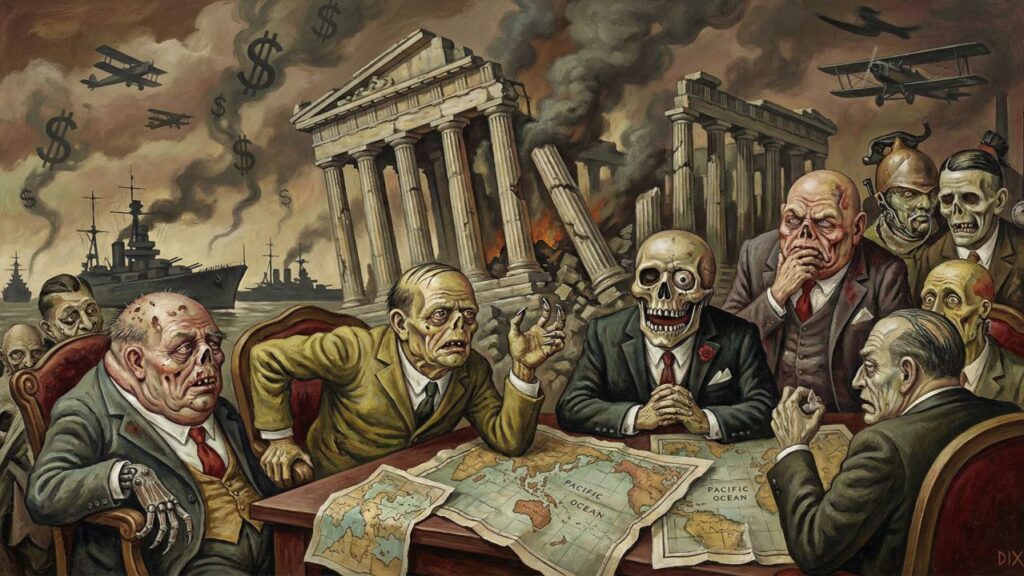
Introduction: The Classicists Who Forgot Their Classics
There is a bitter irony at the heart of America’s neoconservative China policy. The intellectual tradition that gave us this obsession with permanent primacy, uncontested dominance, and the quasi-religious duty to reshape the world in democracy’s image traces its roots to classical scholarship, to men like Donald Kagan, the eminent Yale historian of ancient Greece whose sons Robert and Frederick became architects of American foreign policy hawkishness. Victor Davis Hanson, the classicist who married ancient history to contemporary justifications for military activism, supplied further intellectual ammunition.
Yet if these scholars had actually absorbed the lessons of the civilizations they studied rather than cherry-picking quotations to legitimize present-minded ambitions, they would have recoiled from the very policies they championed. The Peloponnesian War did not end well for Athens. Rome’s expansion ultimately consumed the Republic. The pursuit of hegemony, treated as an end in itself, has a historical track record that should give any serious student of antiquity pause.
Instead, neoconservatism uses classical language as “window dressing”, legitimizing symbols rather than binding constraints, while quietly abandoning the ancients’ tragic sensibility about the limits of power and the cyclical nature of rise and fall. The result is a foreign policy doctrine that treats China as an existential threat requiring permanent confrontation, despite overwhelming evidence that this approach has already failed, is economically ruinous, and risks catastrophe.
Just once, one might ask: why don’t we give peace a chance instead of premeditated strife?
The Neoconservative Alchemy of “Hegemony”
The word itself betrays the intellectual sleight of hand. Hegemony derives from the Greek hēgemoniathe leadership of one city-state over an alliance, the position Athens held over the Delian League before hubris transformed leadership into empire and empire into catastrophe. For Thucydides and the historians who followed, hegemony was a descriptive category freighted with tragic potential: the hegemon’s position invited overreach, bred resentment among subordinates, and contained the seeds of its own destruction.
Yet neoconservatives performed a curious alchemy on the term. In their usage, American hegemony becomes not a historically contingent and inherently unstable condition to be managed with prudence, but a permanent entitlement to be defended at all costs, a natural order rather than a precarious achievement. When Robert Kagan speaks of “benevolent hegemony” or argues that American primacy is uniquely legitimate, he is not describing the world as the ancients understood it; he is performing an ideological transformation that strips the word of its cautionary content and replaces it with missionary certainty.
The classicists who supplied this tradition’s intellectual foundations knew, or should have known, that the Greeks had a word for this kind of self-delusion too: hubris, the arrogance that precedes divine punishment. That they chose hegemony’s promise while ignoring its warnings tells us everything about the project’s intellectual seriousness.
The Construction of an “Existential” Enemy
From Economic Competitor to Civilizational Foe
The framing of China as an existential threat to the United States did not emerge organically from objective strategic analysis. It was constructed (piece by piece, across administrations, through think tanks, congressional committees, and media narratives) until it hardened into what one study calls an “anti-Chinese consensus” among U.S. foreign policy institutions.
This consensus treats China as “10 feet tall, undeterred from wanting to destroy the United States except by a massive U.S. counterforce.” In such an environment, historical disputes over Taiwan or maritime boundaries in the South China Sea become “fundamental zero-sum strategic struggles requiring ever-more forceful pushback.” Any accommodation is branded appeasement. Any cooperation is naïve weakness.
Yet the core question, whether China actually poses an existential threat to American survival, receives remarkably little rigorous examination. Numerous scholars and even officials acknowledge that it does not. Andrew Nathan of Columbia University states plainly that “the China threat is not existential, but it is significant.” Air Force-affiliated analysis concludes that China represents a “persistent but manageable strategic challenge” rather than an unstoppable existential danger, one constrained by demographic headwinds, slowing growth, and domestic burdens.
The distinction matters enormously. An economic competitor, even a formidable one, calls for economic countermeasures, investment in domestic innovation, supply chain diversification, trade negotiations. An existential enemy requires something altogether different: permanent mobilization, ever-expanding military budgets, the subordination of all other priorities to the imperative of confrontation.
The Institutional Incentives Behind Threat Inflation
Why does the “existential” framing persist despite its analytical weaknesses? Because powerful institutional incentives sustain it.
The military-industrial complex that Eisenhower warned about has obvious interests in identifying and countering threats on a worst-case basis. Defense spending approaching $1 trillion annually creates political incentives for every state to obtain its share of the defense dollar, “locking in a continuous effort to preserve local defense industries and jobs through sustained, high defense budgets, linked to both real and imagined threats.”
Think tanks dependent on defense-contractor funding produce studies that emphasize danger. Politicians who appear “weak on China” face electoral punishment. The bipartisan consensus has become so entrenched that the debate swung 180 degrees, from compulsory support for free trade to compulsory support for confrontation, “with almost no critical discussion.”
The result is what the Quincy Institute calls “threat inflation”: the systematic exaggeration of an adversary’s capabilities and hostile intentions to justify policies that might otherwise face scrutiny. This threat inflation “undermines those voices within China that favor moderation, significantly raises the danger of Sino-American crises and military conflict, and diverts huge amounts of U.S. resources away from desperately needed nonmilitary uses at home and abroad.”
The Record of Failure
The Biden Gamble That Crashed
The Biden administration inherited and intensified the confrontational approach, believing that containing China, “organizing U.S. allies against it, cutting off its development in high-value sectors, discrediting it in the eyes of rising powers in the Global South, casting it as the antagonist in a worldwide struggle between democracy and authoritarianism”, would revive American economic dynamism and unite a fractured nation.
The gamble failed spectacularly.
Far from rallying the world to containment, even allies “dragged their feet” while developing countries “overwhelmingly rejected a coerced choice between Beijing and Washington.” Military formations built to surround China “exacerbated Beijing’s own fears and set off a menacing arms race in the region.”
The technology blockade (supposedly a “small yard, high fence” approach targeting narrow national security concerns) predictably became “an inexorably expanding roster of blocked goods, blacklisted firms, and new restrictions.” Yet China continued recording “stunning technological breakthroughs” while American companies “lost billions of dollars.” The result: “a stronger, more independent, and more aggrieved China.”
China did not merely circumvent American restrictions. It “carefully studied American export controls, sanctions, and tariffs” and “slowly but systematically erected its own mirror-image system capable of doing serious damage to the U.S. economy.” When the trade war escalated, China throttled rare earth supplies, essential for everything from cell phones to fighter jets, forcing American companies to “idle production” until the U.S. agreed to “step back from the brink.”
The Catastrophic Economics of Decoupling
The U.S. Chamber of Commerce estimates that the costs of hard decoupling “could amount to hundreds of billions of dollars annually.” A comprehensive Rhodium Group analysis found that if 25% tariffs were expanded to cover all bilateral trade, the U.S. would forgo $190 billion in GDP annually. Lost market access creates revenue and job losses, lost economies of scale, smaller R&D budgets, and diminished competitiveness.
SectorEstimated Annual Cost of DecouplingSemiconductors$54 to 124 billion in lost output; 100,000+ jobs at riskAviation$38 to 51 billion in lost output annually; $875 billion cumulative by 2038Chemicals$10 to 30 billion in output losses; 26,000 to 100,000 jobsMedical Devices$23.6 billion in annual revenue; $479 billion over a decadeServices (students/tourism)$15 to 30 billion annually if flows halve
The semiconductor industry alone faces existential disruption. Boston Consulting Group estimates that U.S. companies would lose 18 percent of their global market share and 37 percent of their revenues under hard decoupling, leading to the loss of 15,000 to 40,000 high-skilled domestic jobs. “Reshoring” the entire semiconductor value chain would require at least $1 trillion in upfront investment, incur $45 to $125 billion in recurrent annual costs, and result in a 35 to 65 percent overall increase in chip prices.
These are not abstractions. They represent American workers, American companies, and American consumers bearing the costs of a policy premised on the fantasy that economic warfare can somehow “defeat” a deeply integrated trading partner without self-inflicted wounds.
The Military Dimension: A War Neither Side Would Win
The Taiwan Flashpoint
If the economic costs of confrontation are severe, the military risks are potentially catastrophic. A recent war-game report concluded that the U.S. could “hit a breaking point in 30 days” in a conflict with China over Taiwan. The report found that “existing Pentagon programs and congressional funding are too slow, too fragmented and too modest to address the scale of the challenge.”
The consequences extend far beyond the battlefield. Disruption of shipping lanes, destruction of critical infrastructure, and the collapse of Taiwan’s semiconductor production would trigger “a global economic shock estimated at roughly $10 trillion, with enduring ripple effects across financial markets, manufacturing and global trade.”
A war over Taiwan could also “open the door to follow-on aggression by adversaries such as Russia, Iran or North Korea, fundamentally destabilizing the global security order.”
The Council on Foreign Relations warns that “the risk of a cross-strait conflict that triggers a larger U.S.-China confrontation is higher today than at any time since the 1950s.” The deterrent advantages that the United States once enjoyed “have eroded. China is now able to hold at risk U.S. forces and bases in the region that would be vital to the defense of Taiwan.” This creates dangerous escalation dynamics where each side’s defensive preparations look like preparations for offense, raising “the specter of China opting for preemptive strikes on U.S. bases and forces in the region even before the United States decides to directly intervene.”
The Thucydides Trap Reconsidered
Graham Allison’s “Thucydides Trap” thesis, that rising powers and ruling powers tend toward war, has dominated discourse about U.S.-China relations. In 12 of 16 historical cases Allison examined, war broke out between rising and ruling powers.
But the lesson most frequently drawn from this thesis, that the United States must therefore prepare for war, inverts Thucydides’ actual teaching. The Peloponnesian War was, as scholars note, “a war of choice rather than necessity, sparked by imperial hubris on the one hand and chance, a sequence of events unintentionally brought about by hapless humans, on the other.”
Thucydides’ history teaches that “great power wars often are not won by one decisive battle but rather by long and drawn out attrition warfare” in which “victory comes at enormous cost to both sides, often blurring the binary distinction between victor and loser.” Athens’ Sicilian Expedition, the disastrous attempt to conquer Syracuse, stands as history’s greatest cautionary tale against hegemonic overreach. Driven by “imperial hubris” and promises that allies would welcome them with open arms, Athens committed its finest forces to a campaign that ended in utter annihilation.
The parallels to contemporary U.S. adventures are uncomfortable. The assumption that allies will fall in line. The belief that superior resources guarantee victory. The escalating commitment of forces to salvage failing campaigns. The refusal to accept that the situation is “far worse than foreseen.”
The Intellectual Bankruptcy of Liberal Hegemony
Mearsheimer’s Critique
John Mearsheimer, the University of Chicago political scientist, has offered the most systematic critique of the foreign policy consensus that neoconservatives share with liberal interventionists. Both camps, he argues, embrace “liberal hegemony”, “a super ambitious and heavily militarized foreign policy” predicated on the belief that the United States has a special responsibility to spread democracy and reshape the international order.
“The United States has fought seven separate wars since the Cold War ended,” Mearsheimer observes. “It is a country that is addicted to war.” Liberal hegemony led to NATO expansion, the Bush Doctrine, and interventions across the Middle East, all of which “crashed and burned.” “I can think of no case in the history of the United States where we pursued a foreign policy as ambitious and foolish as this.”
The fundamental problem is that “social engineering in foreign countries is an impossible exercise.” Nationalism, “such a powerful force”, “causes target states to resist such foreign interventions.” Applied to China, this critique is devastating. The neoconservative fantasy that the United States can somehow compel China to abandon its political system, accept permanent subordination, or fragment into manageable pieces runs headlong into a civilization of 1.4 billion people with the world’s oldest continuous literary tradition and a nationalism forged in what Chinese call the “Century of Humiliation.”
Walt’s Parallel Indictment
Stephen Walt of Harvard has offered a parallel critique, arguing that liberal hegemony “rested on a distorted understanding of international politics, which led its proponents to exaggerate its expected benefits and underestimate the resistance the United States would generate while pursuing it.”
The policy “overestimated the effectiveness of interventionism and ability of U.S. power to reshape other states, while it also unintentionally intensified security anxieties and balancing in Russia and China.”
What the Classics Actually Teach
The Athenian Tragedy
Donald Kagan dedicated his career to studying the Peloponnesian War, yet the policy tradition that bears his intellectual imprint has learned exactly the wrong lessons from it.
The war between Athens and Sparta lasted 27 years and ended with Athens’ total defeat, its walls torn down, its fleet surrendered, its empire dissolved. Sparta’s victory, however, was pyrrhic. The conflict so weakened the Greek world that within a generation, Macedonia under Philip II would subordinate all the Greek city-states, and his son Alexander would build an empire that made the Athenian and Spartan spheres look provincial.
The “struggle for hegemony in fourth-century Greece” that Kagan himself lectured about demonstrated that no Greek power could establish lasting dominance. Sparta’s overreach after defeating Athens “led to tensions with former allies, as its harsh governance alienated other city-states.” Thebes rose. Sparta fell. The cycle continued until external conquest rendered it moot.
Roman Overstretch
Paul Kennedy’s thesis of “imperial overstretch”, “the situation in which an empire extends itself beyond its military-economic capabilities and often collapses as a result”, applies with uncomfortable precision to contemporary America.
Rome was “strong and effective in the first and early second centuries CE” but “lost territories after that and could not keep the Saxons, Huns and other ‘barbarians’ out in the 4th and 5th centuries.” The increasing size of Rome’s “bureaucracy and army likely also contributed to its decline. The cost of maintaining them stifled” economic vitality.
Jack Snyder’s extension of Kennedy’s thesis identifies the specific mechanism: imperial overstretch happens when “notions that security can best be achieved through imperial expansion guide policymakers.” These ideas are “myths of empire”, they “tend to be counterproductive.”
The neoconservative belief that American security requires permanent global primacy, uncontested dominance in every region, and the suppression of any peer competitor is precisely such a myth.
The Alternative: Competitive Coexistence
A Framework for Peace
If confrontation has failed and hegemony is unsustainable, what alternative exists?
Scholars across the ideological spectrum have articulated frameworks for “competitive coexistence”, accepting that the United States and China will compete, sometimes intensely, while avoiding the catastrophic costs of conflict.
Andrew Erickson of the Naval War College proposes four pillars:
- Don’t suppress China wholesale; oppose its harmful behaviorsDistinguish between legitimate security concerns and blanket hostility.
- Accept risk and friction to recalibrate Chinese actions threatening American interestsCompete where necessary, but recognize that friction is not the same as war.
- Hold ground in contested areas to thwart Chinese dominanceMaintain credible deterrence without seeking offensive superiority.
- Reduce tensions and pursue shared interests as much as Beijing is willingClimate change, pandemic preparedness, financial stability, and nuclear nonproliferation require cooperation.
This framework accepts competition as inevitable but refuses to inflate it into an existential struggle. It maintains deterrence while creating space for diplomacy. It protects American interests without demanding Chinese capitulation.
The Costs of Coexistence vs. Confrontation
DimensionConfrontationCompetitive CoexistenceEconomicHundreds of billions in annual GDP lossesContinued trade, investment, technology exchangeMilitary RiskTaiwan war scenario: $10 trillion global shockReduced escalation risk, stable deterrenceAllies”Dragged feet,” rejected forced choicesFlexible coalitions, issue-based cooperationInnovationSupply chain disruption, R&D cutsContinued access to global talent and marketsGlobal StandingPerceived as destabilizing hegemonRespected competitor within rules-based system
Why Don’t We Give Peace a Chance?
The Question No One Asks
The most striking feature of American China discourse is what goes unexamined: the assumption that confrontation is necessary, that competition must be zero-sum, that accommodation equals weakness.
Polls consistently show that Americans, by margins of 2-to-1 or more across party lines, prefer “working to avoid military conflict with China over preparing for it.” The popular instinct for peace has proven wiser than elite consensus for confrontation.
Economic interdependence between the United States and China remains substantial. In 2020, China was America’s largest goods trading partner, third largest export market, and largest source of imports. Exports to China supported an estimated 1.2 million American jobs. Most U.S. companies operating in China report being committed to the market for the long term.
This interdependence is not weakness, it is leverage. As Joe Nye has observed, “America can decouple security risks like Huawei from its 5G telecommunications network, but trying to curtail all trade with China would be too costly. And even if breaking apart economic interdependence were possible, we cannot decouple the ecological interdependence that obeys the laws of biology and physics, not politics.”
Climate change, pandemics, financial stability, nuclear proliferation, these challenges cannot be addressed without Chinese cooperation. Treating China as an existential enemy makes such cooperation virtually impossible, “closing off opportunities for mutual accommodation or policy moderation, which become labeled as appeasement or worse.”
The Tragedy of Premeditated Strife
There is something deeply tragic about the current trajectory. Two nuclear-armed powers, deeply economically intertwined, facing shared challenges from climate change to pandemic disease, are instead mobilizing for a conflict that neither wants and that would devastate both.
The “margin for accidental escalation has narrowed dangerously.” Supply chain redundancy now substitutes efficiency, “lowering escalation thresholds.” Xi’s “China Dream” and Trump’s industrial nationalism “interact with militarised technologies and resources, the ‘Silicon Trap’, where crises could emerge from unforeseen cyber, space, or maritime incidents.”
“War is not inevitable, but the margin for accidental escalation has narrowed dangerously.”
Conclusion: The Futility of Hegemony
The neoconservative approach to China is not merely misguided, it is historically illiterate, economically ruinous, and strategically self-defeating.
The classicists who built this intellectual tradition should have known better. Athens’ pursuit of hegemony ended at Syracuse. Rome’s expansion consumed the Republic. The Thucydides Trap is not a prophecy of inevitable war but a warning about the choices that make war likely.
The United States cannot “build its way out” of competition with China, nor develop a successful long-term strategy “based on inflated threats.” It will need to “accept the logic of balance over dominance in many areas, fashion credible strategies designed both to deter and reassure Beijing, and strengthen its capacities at home.”
This will require a fundamental reassessment of current policies “in the light of realistic assessments of both threats and opportunities, real capacities, and reasonable aspirations.” It will involve some risks. “But the alternatives would generate far worse risks.”
The Washington consensus on China is beginning to crack. The recognition that “China’s growth cannot be halted” and that the United States “can only do so much to slow China’s technological progress” is forcing a rethink among observers, including current and former senior officials.
The Greeks understood that hubris invites nemesisthat arrogance calls down destruction. The neoconservatives who borrowed their vocabulary while ignoring their wisdom have led American foreign policy into a cul-de-sac of escalating confrontation with no plausible victory condition.
The opportunity for a different path exists. Competitive coexistence is neither capitulation nor naïveté, it is the recognition that a $28 trillion economy and a $18 trillion economy, bound together by trade, investment, and shared planetary challenges, have more to gain from managed rivalry than from manufactured enmity.
Whether American leaders will seize that opportunity, whether they will finally give peace a chance instead of premeditated strife, remains the defining question of our time.
Related reading
- Neocons, China, and the New Bipartisan Lunacy
- The G7’s Relevance Problem: How Russia, China, India, and South Korea See the Club They’re Not In
- The Bahrain Parable: A Cautionary Tale for South Korea, Japan, Singapore, Indonesia, Malaysia, Vietnam, and Thailand
- Dear South Korea, You Have Been Diagnosed with a Fatal American Dependency Cancer