Before we start, a note to Korean readers: This article is not a criticism of the Korean people. However, it is most certainly a criticism of the structural trap that Washington consciously built and that Seoul was forced to adopt under IMF conditionality after 1997, and the clueless Trump administration is now replicating and accelerating it at home, making conditions worse for every U.S. ally that depends on a stable American economic order. The Donghak Ants are not the problem. They are only the most visible symptoms of a disease made in Washington. Scott Ortkiese | June 17, 2026
There is a particular cruelty to spectacles of financial euphoria built on hollow ground. South Korea is currently producing one of the great market spectacles of this century, and the hollow ground beneath it is measurable, documented, and accelerating.
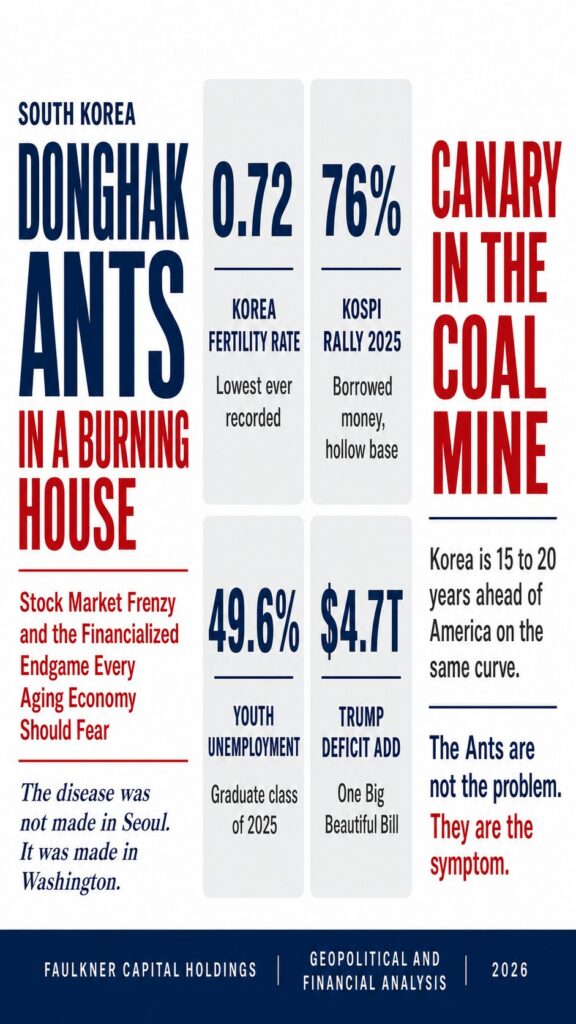
The KOSPI, Seoul’s benchmark equity index, surged approximately 76% in 2025 alone, the best performance of any major economy’s index anywhere on earth. By February 2026, the index had crossed 6,000 for the first time in history, making Seoul the hottest equity market on the planet. The rally minted $2.2 trillion in market capitalization gains in roughly eighteen months. South Korean retail investors, the so-called “Donghak Ants,” a name borrowed deliberately from the 19th-century peasant uprising against feudal exploitation and foreign predation, rushed in with borrowed money. Cash piles of 111 trillion won sat in retail brokerage accounts primed for deployment. Margin debt climbed from 16.4 trillion won in early 2025 to a record 34.3 trillion won by April 2026, eventually surging past 60 trillion won ($39 billion) by May 2026. That 72.5% jump in leveraged equity investment over a single year eclipsed the United States (36.3%), China (36%), and Japan (21%) simultaneously.
The breathless headlines wrote themselves. Korea is back. The Tiger roars again.
It is not roaring. It is cornered. And the corners of this trap were built far from Seoul.
The Population That Isn’t There
Here is what is structurally, arithmetically, and irreversibly true about the economy that supposedly produced this wealth. South Korea has the lowest birth rate ever recorded by any sovereign nation in the history of modern demographic science. Its total fertility rate (TFR) hit 0.72 in 2023, less than a third of the 2.1 replacement level. Even the uptick to roughly 0.80 by 2025, celebrated by some as a turning point, changes the terminal trajectory only at the margins. A TFR of 0.80 means that for every 100 Koreans alive today, the next generation produces roughly 38. The generation after that, roughly 14. This is not a declining birth rate. It is a civilizational subtraction function running in real time.
The OECD made the arithmetic explicit in March 2025: if the fertility rate remains near its current level, South Korea’s population will halve within 60 years, with those aged 65 and over accounting for approximately 58% of the total population by 2082. The elderly dependency ratio is projected to surge from 28% to 155%, meaning one working-age Korean will be expected to support one-and-a-half elderly people. Korea crossed into “super-aged society” territory, with more than 20% of the population over 65, by end of 2024. The Bank of Korea projects potential GDP growth near zero by the 2040s, with outright economic contraction possible as early as 2041.
Five consecutive years of population decline. Only 1.25 million births across the entire 2020-2024 period, the lowest five-year total ever recorded. Schools closing. Military recruitment pools evaporating. Entire rural communities hollowing out faster than Japan’s, and Japan took three lost decades to reach this point.
Against this backdrop, a nation physiologically running out of future economic participants, the stock market is at an all-time high. Something structural is being substituted for something real. That substitution was not a Korean invention. It was a policy prescription imported from Washington and enforced at Seoul’s most vulnerable moment.
The Job Market That Priced Youth Out
The fertility collapse does not arrive in a vacuum. It is downstream of a labor market that systematically priced an entire generation out of the economic conditions that historically produce family formation.
Employment among South Koreans aged 25 to 29 fell by 98,000 in Q1 2025, the sharpest quarterly decline in more than a decade and the ninth consecutive quarter of year-over-year job losses for this cohort. Not a pandemic recession. Not a financial crisis. A structural deterioration accelerating in full economic recovery conditions. New hires of workers under 30 fell to 1.37 million in Q2 2025, the lowest since records began in 2018. The average young Korean university graduate now waits 11.5 months to land a first job, the longest gap ever measured. Graduate unemployment reached 49.6% in 2025.
The structural root is the labor market duality that the post-1997 IMF bailout imposed on Seoul. That bailout required mass layoff legalization, labor market liberalization, and the systematic dismantling of employment protections for a large share of the workforce. The result was a Korean labor market permanently split in two. The inner tier: regular workers at chaebols and large firms, protected by firing regulations so stringent that employers will do almost anything to avoid hiring them permanently. The outer tier: non-regular, irregular, precarious workers who now constitute 27.3% of the Korean workforce against an OECD average of 11.3%, earning on average 54.6% of what regular workers make, stripped of pension coverage, job security, and meaningful benefits. The OECD explicitly identified this duality as a root cause of ultra-low fertility: the “weak financial position of youth holds back family formation.”
The causal chain is exact and cruel. The post-1997 restructuring, imposed by Washington under conditions of near-zero Korean negotiating leverage, created a permanent class of economically marginal young adults for whom marriage and children represent unaffordable financial commitments, not life milestones. Those young adults did not have children. The children never born never entered the workforce. The workforce that does not exist cannot produce the tax revenues to fund the pensions of the generation that came before. And so those pensionless elderly, carrying an elderly poverty rate of 39.8% as of 2023, the highest in the entire OECD and nearly four times the OECD average, are left with one remaining option for financial survival: the stock market.
The Retirement Gamble of a Pensionless Nation
South Korea’s National Pension Scheme was not launched until 1988 and matured slowly. Only about 40% of South Koreans aged 60 and over receive an old-age pension at all, and the benefit levels for most recipients fall below any reasonable definition of a living wage. The OECD’s 2022 review found the system “generates low pension levels, leading to significant income vulnerability in old age,” and that even these anemic benefit levels “cannot be financed in a sustainable way without further important reforms.” Research published in 2025 found that aligning Korean pension benefits with OECD peers would reduce elderly poverty rates by between 24 and 50 percentage points. The National Pension Scheme is not a safety net. It is a suggestion.
What fills the void? The stock market. A Chosun editorial in May 2026 documented what the data confirms: investors aged 60 and older drove a 33% surge in margin-financed equity transactions through April 2026, with the 60-plus cohort carrying more margin debt than those in their 50s or 40s. Retired Koreans, people on fixed incomes without adequate pensions, are borrowing at 8-10% annual interest to participate in a bull market they cannot afford to lose. A nine-day period of KOSPI turbulence in early 2026 produced an average return of negative 19.8% for investors in their 60s using credit loans. The KOSPI itself posted its largest single-day decline in history, a 12% collapse, before rebounding 10% the next session.
The Korea Capital Market Institute projected that capital market asset holdings decline sharply after age 60 as Korean retirees liquidate to fund consumption. The Bank of Korea warned explicitly: “if the market fails to absorb the massive sales of financial assets, their price might take a nosedive.” The retirement cohort driving demand today is the liquidation pressure of tomorrow. And the generation that would absorb those liquidated assets, the young buyers who historically absorb equities from retiring hands, is precisely the cohort being destroyed by structural unemployment, irregular work, and a Seoul housing market where the average apartment now exceeds 1.3 billion won, more than 13 times median annual household income.
This is not a market cycle. It is a demographic Ponzi in equity form. The Korean people did not architect this Ponzi. It was designed around them.
Not a Korean Disease: The Universal Financialized Aging Script
It would be convenient, particularly for American readers, to assign South Korea’s predicament to something distinctly Korean: the brutality of its education arms race, Confucian rigidities around gender roles and marriage, the dominance of chaebol industrial structure. Some of those factors are real at the margins. None of them is the core story.
The core story is universal. The IMF documented it precisely in a 2017 paper: “Korea’s demographic trends seem to track Japan’s with a lag of about 20 years.” Japan’s original crisis was a burst asset bubble, a frozen banking system, and three decades of wage stagnation. Japan’s wages have not risen in real terms since 1995. Japan’s equity market took 35 years to recover from its 1989 peak. Japan created the template: aging population, suppressed wages, asset-price management substituting for structural reform, and a social contract in which the state presides over the hollowing out of its own productive base while calling it stability. Korea is following that template 20 years behind, now close enough to Japan’s 1990 position that the Bank of Korea is warning about debt levels “last seen in Japan on the eve of its 1990s asset bubble collapse.”
Stopping at Japan and Korea and calling it an Asian problem, however, would be the most consequential intellectual error an American reader could make. The United States is running the same playbook, with the same structural drivers, roughly 15 to 20 years behind the Korean position.
American financialization produced a nearly identical dynamic. As William Lazonick documented, “trillions of dollars that could have been spent on innovation and job creation in the US economy over the past three decades have instead been used to manipulate the prices of corporate stock.” The Demos Institute found the financial sector’s expansion has “shrunk the economic pie” while “channeling nearly all remaining growth exclusively to the most affluent,” producing household debt growth, shrinking labor incomes, diminishing job security, and weak employment growth for the majority of Americans. In 2025, the U.S. economy deepened its K-shape: wealthy households gaining steadily from asset appreciation, lower-income Americans facing slower wage growth and compounding costs. The top 10% of Americans own roughly 87% of the stock market. The bottom 50% own 1.1%. Rising share prices are not broadly shared wealth. They are a simulation of broadly shared wealth, a performance standing in for the structural conditions that actually produce middle-class economic security.
Social Security’s retirement trust fund is projected to reach insolvency by 2032, seven years away, triggering automatic benefit cuts of 23-24%. Medicare’s Hospital Insurance trust faces insolvency by 2033. The 75-year unfunded obligation of the combined Social Security trust funds stands at $25.1 trillion. American baby boomers have already turned the pension system from a net buyer of financial assets to a net seller, with private pension funds recording negative net flows for most quarters since 2021. The San Francisco Fed documented years ago what Morningstar reiterated in April 2026: the boomer liquidation wave “could be a factor holding down equity valuations over the next two decades.”
The population that would absorb those liquidated assets, American workers in their 20s and 30s, carries the highest student debt load in history, cannot afford housing in most major metros, and faces an AI-accelerated labor displacement that has barely begun registering in official statistics.
Remind you of anyone?
The Emulation Problem: When the Student Copies the Teacher’s Mistakes
South Korea did not arrive at this moment through independent mismanagement. It got here by following instructions from Washington.
The post-1997 IMF bailout required Seoul to implement fiscal austerity, trade liberalization, financial deregulation, and most consequentially the restructuring of labor laws to allow mass layoffs and legalize temporary work. Washington consensus prescriptions, applied under duress, with exactitude. The result was a Korean economy that had been “once praised for achieving rapid growth with relative equality” and had “now turned into the second most unequal economy among OECD countries.” Financialization deepened “the weakening engine of growth and the intensification of social inequality.” The working class became “increasingly stratified and fragmented, as the middle class dwindles.”
South Korea built what America recommended. A shareholder-value economy. A dual labor market. A financialized system where ordinary households were invited to participate in equity markets as a substitute for the wages and social infrastructure that a mature welfare state would otherwise provide. The Donghak Ants, Korean retail investors who poured their savings and borrowed money into the KOSPI, were not irrational. They were responding rationally to a structural offer: the wage ladder has been pulled up; here is a stock market ladder instead. That offer originated not in Korean culture but in the ideology exported from Wall Street and credentialed in Washington.
America made the same offer to its own working and middle class beginning in the 1980s. The 401(k) revolution transformed retirement security from a defined social contract into a personal equity speculation exercise, concentrating retirement risk on individual households while liberating corporations from pension obligations. The result has been the redirection of capital away from investment, wages, and innovation and toward stock buybacks and financial engineering. That is the same dynamic driving Korea’s chaebol-dominated economy, same structural DNA, different packaging.
The difference between the United States and South Korea is timing and demographic velocity. Korea has run the experiment further and faster because its demographics are more extreme. Korea is what the American model produces at full demographic maturation and terminal velocity. The Donghak Ants are not failing. They are being failed, by a structure they did not build and were never fully empowered to dismantle.
Washington Accelerates the Slide: The Trump Policy Analog
If South Korea’s predicament were simply a cautionary tale about demographic arithmetic and financialization outrunning policy response, the analogy to the United States would be uncomfortable but still manageable. The United States still had time. The Trump administration’s second term has chosen to spend that time systematically accelerating every structural vulnerability while dismantling the adaptive capacity that could otherwise allow a course correction.
The most powerful demographic intervention available to an aging economy with a below-replacement birth rate is immigration. The United States, unlike South Korea, has always had this structural offset: an immigrant labor supply that Korea, culturally and institutionally, has never had access to at scale. That offset is being deliberately demolished. A Paris School of Economics analysis estimated that mass deportations reducing the labor force by 0.8% by 2028 would cut American GDP by 1.2%, reduce employment by 1.1%, and raise inflation by 0.6%. The Penn Wharton Budget Model found that deporting 10% of unauthorized immigrants annually would add $350 billion to federal deficits, cut GDP by 1%, and reduce average worker wages. Sustained over a decade, the GDP contraction reaches 3.3% and wage decline 1.7%. The Center for American Progress noted in March 2026 that with American deaths expected to exceed births by 2030, immigration represents a critical remaining source of labor supply growth, yet the crackdown is “sharply reducing migration without delivering the promised gains for native-born workers.” In California alone, private sector employment fell 2.9% between May and September 2025 as enforcement drained the labor pool. America is destroying the one demographic buffer that separates its aging crisis from Korea’s closed demographic trap, and doing so by deliberate political choice.
Now layer in the fiscal structure. The CBO projected in February 2026 that U.S. debt held by the public will reach 101% of GDP in 2026 and 120% by 2036, exceeding the post-World War II record, with the federal deficit running at $1.9 trillion, 5.8% of GDP, in 2026. The Trump administration’s “One Big Beautiful Bill” added $4.7 trillion in additional deficits through extended and expanded tax cuts overwhelmingly benefiting upper-income households and corporations, while immigration enforcement actions contributed another $0.5 trillion in deficit through reduced tax-paying workers and diminished economic activity. Franklin Templeton’s head of global macro strategy said bluntly in July 2025 that “the US fiscal fundamentals are probably actually the worst among developed nations,” with soaring debt, low tax revenues, and rising entitlement spending combining into an “unsustainable medium fiscal term trajectory.” The bill “effectively locks in very large deficits for the next five-plus years at a time where the government debt level is already very high and you’re paying more and more interest.”
Then there are the social programs that aging populations need to survive without turning retirement savings into leveraged equity speculation, which is precisely what South Korean elderly are already doing. The Trump administration’s FY2026 budget proposed eliminating the Administration for Community Living, abolishing the Senior Community Service Employment Program (the only federal job training program for low-income older workers), gutting Adult Protective Services, cutting the National Institute on Aging budget from $4.4 billion to $2.8 billion, and slashing the Department of Labor’s overall budget by 65%. DOGE fired every staff member running the Low-Income Home Energy Assistance Program and eliminated the Medicare-Medicaid Coordination Office, leaving seniors and people with disabilities stranded without assistance. The Big Beautiful Bill cut Medicaid by more than $1 trillion over ten years, with CBO estimating 11.8 million people losing coverage by 2034. Over 60% of American nursing home residents depend on Medicaid. These cuts will push retirement-age Americans toward the same leveraged equity dependence already devastating Korea’s elderly, at the precise moment the market is most vulnerable to the boomer liquidation wave.
Then there are the tariffs, which bring into view what economists have been calling, with increasing frequency and decreasing restraint, the makings of stagflation. The OECD reduced its U.S. growth forecast to 1.6% in 2025 and 1.5% in 2026, down from 2.8% the prior year, attributing the deterioration directly to tariff-driven cost increases and policy uncertainty. ABN AMRO estimated the complete tariff package would reduce U.S. GDP by roughly 3 percentage points over two years while raising inflation 1.5 to 2 percentage points. Morningstar placed recession risk at approximately 40%. Ernst and Young described the tariff regime as “a stagflationary shock, a negative economic hit combined with an inflationary impulse.” South Korea’s own central bank flagged inflation rebounding and stagflation concerns rising precisely in response to the knock-on effects of American trade disruption. Trump’s tariffs are not just damaging the American economy. They are striking a U.S. ally already under structural siege, compressing the export revenues and growth margins Korea needs to fund pension reform and social investment from the outside while its demographic base collapses from within.
The structural picture is not a collection of unrelated policy errors. It is a coherent acceleration. Strip out immigrant labor, the one demographic offset that distinguishes the U.S. from Korea’s closed trap. Cut the social programs that allow the elderly to survive without equity speculation. Lock in a decade of deficits through tax cuts for asset holders. Impose trade barriers that generate stagflation and market volatility. Do all of this against a backdrop where Social Security faces insolvency by 2032, debt-to-GDP reaches 120% by 2036, and the boomer liquidation wave has already begun.
South Korea stumbled into its predicament through accumulated structural forces, many of them imposed from outside. The current U.S. administration is not stumbling. It is sprinting, in full view of the arithmetic, toward the same wall. And it is kicking its Korean ally toward that wall at the same time.
The Canary Has Already Stopped Singing
Korea has served as the world’s economic canary in the coal mine for decades, traditionally signaling global demand through export data. Its new function is far darker. Korea is previewing what happens when aging, financialized economies exhaust the demographic fuel that has always been the hidden subsidy behind every equity bull market and every pension system that ever appeared to work.
The structural verdict is not complicated. A market requiring its retirement-age population to borrow against fixed incomes to participate, while depending on a youth cohort contracting at 98,000 jobs per quarter and generating one of the world’s lowest birth rates, has no credible mechanism for sustaining price discovery. The sellers of tomorrow are the buyers of today. The buyers of tomorrow do not exist in sufficient numbers to absorb the selling pressure. When the Donghak Ants who are 60 today are 70 tomorrow and the KOSPI needs a new generation of buyers to hold the equities they must liquidate to live, the market will face what no interest rate policy can fix: a buyer shortage with demographic causes.
For Washington, the implications are neither abstract nor distant. A U.S. ally of strategic importance, hosting American troops and deeply integrated into the semiconductor supply chain underpinning American technological competitiveness, is running an experiment whose outcome the Bank of Korea itself describes as potentially terminal. A permanent recession by the 2040s. Economic contraction by 2041. For a 30-year-old Korean entering the labor market in 2026, that is their retirement horizon. The Trump administration’s tariffs, deficit expansion, and social program dismantlement are not helping Korea avoid that horizon. They are compressing it.
The uncomfortable realization for American readers is not merely that Korea is vulnerable. It is that Korea emulated America, was structurally shaped by American prescriptions, and America is 15 to 20 years behind on the same curve. The difference between South Korea’s position today and America’s position in the 2030s and 2040s is not a difference of kind. It is a difference of time.
The Donghak Ants are not the problem. They are the symptom. And the disease was made in Washington.
Sources: Statistics Korea, Bank of Korea, OECD Pension Reviews 2022-2025, Korea Financial Investment Association (KOFIA), Korea Capital Market Institute, Korea Development Institute, IMF Working Papers, Federal Reserve Bank of San Francisco, Committee for a Responsible Federal Budget, Social Security Administration, Congressional Budget Office, Paris School of Economics, Penn Wharton Budget Model, Center for American Progress, Bloomberg, Reuters, CNBC, The Diplomat, Chosun Ilbo, Korea JoongAng Daily, Korea Herald, Korea Times, Hankyoreh.
Related reading
- The G7’s Relevance Problem: How Russia, China, India, and South Korea See the Club They’re Not In
- The Bahrain Parable: A Cautionary Tale for South Korea, Japan, Singapore, Indonesia, Malaysia, Vietnam, and Thailand
- Dear South Korea, You Have Been Diagnosed with a Fatal American Dependency Cancer
- American AI Domination? Not So Fast.