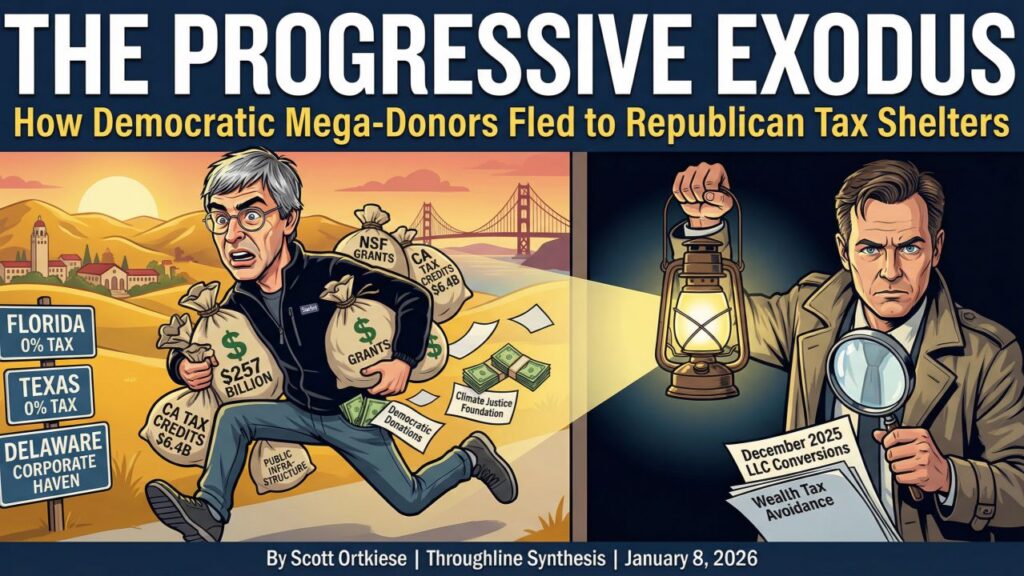
In the final week of December 2025, as most Americans prepared for New Year’s celebrations, a quiet stampede occurred in the law offices and corporate registries of Silicon Valley. Google co-founder Larry Page, owner of a $257 billion fortune, was methodically converting his family office and business entities from California (the progressive Democratic state that had nurtured his company with taxpayer-funded research grants, world-class public universities, and innovation infrastructure) to Delaware, Nevada, Florida, and Texas.
The restructuring was completed with surgical precision, days before January 1, 2026, the trigger date for California’s proposed Billionaire Tax Act. The measure, if approved by voters in November, would impose a one-time 5% levy on residents worth over $1 billion, designed to raise $100 billion for healthcare and education over five years. Page’s potential bill: $12.8 billion out of a fortune that had grown 65% in a single year.
This would be unremarkable corporate tax planning, wealthy people restructure to minimize tax liability all the time, except for one inconvenient fact: Larry Page is a progressive Democrat who has donated over $1 million to liberal causes and whose company has funneled tens of millions of dollars to Democratic candidates who explicitly support wealth taxes. He personally funded California’s clean energy initiative and opposed the state’s gay marriage ban. He built his empire in a state shaped by progressive taxation, union-negotiated benefits, and decades of Democratic governance.
Now he is restructuring his wealth to avoid the consequences of the very policies his political donations helped enact, relocating to states run by the Republicans he opposed, because those states offer what progressive California does not: zero income tax and maximum anonymity.
This is not an isolated incident. It is a pattern across Silicon Valley’s Democratic donor class, revealing a central truth about billionaire progressivism: it extends exactly as far as their tax liability and not one dollar further.
Building a Fortune on Progressive Policies
Larry Page did not build Google in a garage through pure entrepreneurial grit, despite the mythology. His fortune rests on a foundation of public investment that took decades to construct and required progressive taxation to fund. In 1994, the National Science Foundation awarded Stanford University a $4.5 million grant as part of the Digital Library Initiative. Page and his fellow graduate student Sergey Brin used that taxpayer-funded project to develop BackRub, the search engine that would become Google. Brin himself was supported by an NSF Graduate Research Fellowship, and their prototype equipment was purchased with public grant money.
The internet infrastructure Google would eventually dominate? Built by the Defense Advanced Research Projects Agency with taxpayer funds. The university where Page conducted his research? Constructed on massive federal land grants and sustained by hundreds of millions in federal and state funding. Stanford has produced over 250,000 alumni in tech and venture capital, maintains more than 300 active startups, and sits walking distance from Sand Hill Road’s venture capital corridor, all built on the back of public subsidy.
The University of California system, which educated countless Google engineers, returns $14.32 in Gross State Product for every dollar California taxpayers invest. One out of every 45 jobs in California is tied to the UC system. When Page recruited engineers trained at UC Berkeley, he was hiring talent educated at taxpayer-subsidized tuition rates. California residents pay roughly $15,000 annually for UC tuition; out-of-state students pay $48,000. The taxpayer subsidy is approximately $33,000 per student per year, multiplied across thousands of employees over two decades.
Google’s headquarters sit on infrastructure paid for by California’s progressive tax base: Highway 101 and local transportation networks, an electricity grid upgraded to handle massive data center loads, water systems essential for cooling servers, and a legal system that enforces the intellectual property rights, contracts, and corporate governance that made Google valuable. Even the famous Google buses that shuttle employees from San Francisco use public roads maintained by state and local governments.
California Democrats also designed Research and Development tax credits to incentivize innovation and job creation. Alphabet, Google’s parent company, has banked $6.4 billion in unused California R&D tax credits available to offset future state taxes. These credits were intended to keep companies in-state. Alphabet took the credits, built the empire, and then restructured the founders’ entities to avoid contributing back.
U.S. taxpayers invested $4.5 million in the Stanford research that created PageRank. Larry Page’s personal return on that investment: $257 billion. Google’s current market capitalization exceeds $2 trillion. The taxes Page has paid back to fund the next generation of researchers? Systematically minimized through offshore structures, and now, through jurisdictional flight.
A Progressive Democrat in Good Standing
Page’s political identity is not ambiguous. In 2006, he donated $1 million to support California Proposition 87, a ballot initiative to tax oil companies and fund clean alternative energy research. It was his largest political donation at the time, and it aligned him squarely with progressive environmental groups against the oil industry. Two years later, he donated $40,000 to oppose Proposition 8, the gay marriage ban that Democrats fought to defeat. In 2019, he donated $5,000 to Google’s Political Action Committee, which overwhelmingly funds Democratic candidates.
Under Page’s leadership as CEO from 2011 to 2015, and continuing as controlling shareholder, Google became one of the largest corporate funders of the Democratic Party. In the 2020 election cycle, 88% of Google and Alphabet employee donations went to Democrats. The company PAC and employees donated $3.66 million to Joe Biden, $1 million to Bernie Sanders, and $700,000 to Elizabeth Warren. In the 2024 cycle, the pattern held: 88.84% of Alphabet donations flowed to Democrats, with only 11.16% going to Republicans.
Eric Schmidt, who served as CEO under Page’s chairmanship, personally endorsed Barack Obama and donated $25,000 to his inauguration committee. Google executives routinely attend Democratic fundraisers, and the company advocates for progressive immigration reform, climate action, and social policies that align with the Democratic platform.
The evidence is unambiguous: Larry Page is a progressive Democrat who has donated over $1 million to liberal causes and whose company functions as a major Democratic Party funding mechanism, directing tens of millions of dollars to progressive candidates and causes over two decades.
The contrast with Elon Musk is immediate and clarifying. Musk’s political evolution from Obama voter to Trump supporter has been public, documented, and subjected to relentless media scrutiny. When Musk began criticizing California’s regulatory environment and progressive policies in 2020 and 2021, he did so openly on social media. His reasoning was transparent: he disagreed with California’s approach to COVID restrictions, environmental regulations, and taxation. When he moved Tesla’s headquarters from Palo Alto to Austin, Texas in 2021, he announced it publicly and explained why. Whether one agrees with Musk’s positions or not, his behavior has been consistent with his stated beliefs.
Page, by contrast, has maintained the public persona of a progressive philanthropist, quietly funding Democratic causes through his foundation and his company’s PAC, all while executing a covert restructuring to avoid the exact policies his donations helped legitimize. Musk faces daily media attacks for his transparency. Page receives philanthropy awards for his opacity. The double standard is instructive.
The December Escape to Republican Tax Havens
Between December 20 and December 31, 2025, Page converted virtually every California-based entity in his portfolio. Koop, his family office, was converted from California to Delaware. Flu Lab LLC, which funds influenza research, moved to Delaware with its principal office relocated to Nevada. One Aero, his flying car venture, became a Delaware entity with a principal office in Florida. Dynatomics LLC, an AI aircraft manufacturing company, shifted to Delaware with a principal office in Texas. Even the limited liability companies Page uses to purchase islands in Puerto Rico, the Virgin Islands, and Fiji were converted to Delaware entities with new Florida addresses. His wife Lucinda Southworth’s marine conservation charity, Oceankind, also left California for Delaware in the same week.
The timing was not coincidental. California’s proposed wealth tax would apply to anyone who was a resident on January 1, 2026, regardless of when voters actually approved the measure in November. By converting his entities and establishing alternative residency before the trigger date, Page positioned himself to argue he was no longer a California resident, even if he continued spending significant time in the state.
Page’s destinations are revealing. He did not relocate to other progressive states with comparable universities and innovation infrastructure, not to Massachusetts, home of MIT and Harvard; not to New York, with Columbia and Cornell; not to Illinois, with Northwestern and the University of Chicago. He relocated to states run by Republican governors specifically because they offer tax advantages that progressive governance does not provide.
Florida, where One Aero now maintains its principal office and where Page’s island-purchasing entities claim residence, is governed by Republican Ron DeSantis. The state imposes zero income tax, zero estate tax, and zero inheritance tax. It offers Domestic Asset Protection Trusts that shield wealth from creditors and an unlimited homestead exemption that protects primary residences from seizure. Republicans have controlled the governor’s mansion since 1999.
Texas, where Dynatomics now claims its principal office, is governed by Republican Greg Abbott. The state has zero income tax and has been under Republican governance since 1995. Tech figures fleeing California routinely promote Texas as an alternative to what they derisively call “socialist California.”
Nevada, where Flu Lab now maintains its principal office, is governed by Republican Joe Lombardo. The state offers zero income tax, anonymous LLC registration with no beneficial owner disclosure requirements, and no information-sharing agreements with the IRS. Academic researchers rank Nevada second only to Delaware for ease of forming untraceable shell companies.
Musk moved Tesla to Texas in 2021 and announced it publicly, explaining his disagreements with California’s regulatory approach. He paid the costs of relocating thousands of employees, building new facilities, and establishing operations in a state whose Republican governance aligned with his stated preference for lower regulation and taxation. He did not maintain a progressive donor profile while secretly restructuring. He did not continue funding Democratic candidates who support wealth taxes while simultaneously fleeing those taxes. He changed his public position and changed his residence accordingly. The behavior was transparent.
Page executed a covert December 2025 restructuring to the exact same Republican-run states (Texas, Florida, Nevada) while maintaining his Carl Victor Page Memorial Foundation’s progressive branding, his company’s Democratic donation patterns, and his public silence on the wealth tax he is avoiding. He wants the cultural and reputational benefits of California progressivism combined with the tax benefits of Republican governance. Musk chose one or the other and accepted the consequences. Page is attempting to have both, and the media that savages Musk daily for his political transparency has been conspicuously silent about Page’s tax flight.
Delaware, where Page converted Koop and virtually every other entity, is technically governed by a Democratic governor but functions as a bipartisan corporate tax haven. Its anonymity laws are stronger than those of any foreign jurisdiction. The “Delaware Loophole” exempts income from intangible assets (patents, trademarks, royalties) from state taxation if the entity maintains no physical presence in the state. Seventy percent of Fortune 500 companies are domiciled in Delaware specifically for tax advantages, and the state’s Court of Chancery offers business-friendly rulings that protect corporate interests. Delaware functions as a domestic Cayman Islands, offering anonymity and tax optimization regardless of which party holds the governorship.
The pattern is unmistakable: Larry Page funded progressive Democratic policies in California, then relocated his wealth to jurisdictions that Republicans govern specifically because they reject progressive taxation. He wants to live under California’s culture, benefit from its innovation ecosystem and Democratic social policies, but pay taxes under Republican fiscal policies. It is the ultimate act of having your cake and eating it too, except the cake was baked with taxpayer funds, and he is now refusing to pay for the ingredients.
A History of Aggressive Tax Avoidance
This is not Page’s first exercise in minimizing tax obligations. Google pioneered one of the most aggressive corporate tax avoidance schemes in modern history, a structure so brazen it acquired a nickname: the Double Irish Dutch Sandwich. The mechanism worked as follows: Google licensed its intellectual property to an Irish subsidiary that was officially tax-resident in Bermuda, where corporate taxes are zero. A second Irish subsidiary sublicensed the IP for use outside the United States and paid royalties to a Dutch subsidiary, which immediately paid those royalties back to the first Irish company in Bermuda.
The result: billions in profits taxed at zero percent. In 2011, Google shifted $9 billion to Bermuda and avoided $2 billion in taxes, fully 80% of the company’s pre-tax profits that year. Between 2015 and 2018, Google shifted $34 billion to Bermuda. In 2017 alone, the company moved $23 billion. In 2019, after Ireland began closing loopholes under pressure from the European Union, Google shifted $75.4 billion from Ireland to Bermuda in a single year.
Under Page’s leadership, Google achieved a global effective tax rate of 19.3% in 2016, compared to the statutory U.S. corporate rate of 35%. Its foreign tax rate was even lower: 2.4%, the lowest of the top five U.S. tech companies by market capitalization. These were not accounting errors or good-faith differences in tax interpretation. They were deliberate strategies, executed by armies of lawyers and accountants, designed to extract maximum wealth from the countries where Google conducted business while contributing the legal minimum back to the public institutions that made that business possible.
Europe eventually fought back. The European Union’s Court of Justice ordered Google to pay €2.4 billion in antitrust fines, and France forced the company to pay over $1 billion in a 2019 tax settlement after determining Google had systematically underreported its French income. But the strategy had worked for years, allowing Google to accumulate wealth on a scale that would have been impossible if the company had paid taxes at the rates ordinary businesses face.
Both Google and Tesla have minimized corporate tax liability through legal means, this is standard practice for multinational corporations. But the difference in how their founders approach the issue is stark. Musk has been transparent about his view that government wastes tax revenue and that private innovation often achieves better outcomes than public programs. He has stated this position repeatedly and publicly, accepting the media firestorm that follows. He does not fund progressive candidates who advocate for higher corporate taxes while simultaneously using offshore structures to avoid those taxes.
Page, by contrast, funded Democrats who explicitly support wealth taxes and corporate tax reform (Biden, Sanders, Warren) while Google was shifting tens of billions to Bermuda to avoid paying the taxes those same candidates sought to impose. He maintained his progressive credentials through foundation giving while his company executed one of the most aggressive tax avoidance schemes in corporate history. The hypocrisy is not in minimizing taxes, most corporations do that, but in funding the politicians who campaign against tax avoidance while personally engaging in it at a massive scale, then fleeing when those politicians’ policies threaten his personal fortune.
The hypocrisy is staggering: Google built its business on taxpayer-funded research, DARPA-funded internet infrastructure, and publicly subsidized universities, then spent billions on sophisticated legal structures to avoid paying taxes that would support the next generation of researchers, infrastructure, and students. Now, Larry Page is executing the same strategy personally, accepting public subsidy during wealth accumulation, then fleeing democratic taxation during wealth preservation.
The Philanthropy Shell Game
Page attempts to maintain his progressive credentials through the Carl Victor Page Memorial Foundation, which holds $6.7 billion in assets and publicly funds “climate justice,” “equity,” and causes aligned with Democratic priorities. The foundation’s public communications emphasize its commitment to addressing inequality and protecting the planet. The structure reveals something quite different.
Between 2015 and 2021, the foundation disbursed $836 million, substantial by any measure. But 99% of those grants did not go to actual charities. Instead, they flowed to donor-advised funds held at institutions like National Philanthropic Trust, Schwab Charitable, and Vanguard Charitable. This distinction matters because donor-advised funds have zero payout requirements. Money deposited in a DAF can sit indefinitely, compounding tax-free, with no legal obligation that it ever reach an actual charitable cause.
The mechanics are elegant from a tax optimization perspective. Page donates appreciated stock to his foundation and receives an immediate tax deduction worth 50 to 74 cents per dollar, depending on the asset and his tax bracket. The foundation satisfies the legal requirement to disburse 5% of its assets annually by granting to donor-advised funds. Once in the DAF, the Page family retains perpetual advisory control over disbursements, the capital grows tax-free, and there is no public disclosure of ultimate recipients. The arrangement allows Page to claim the tax benefit, generate progressive credentials, and maintain dynastic control, all while the money never has to leave the family’s sphere of influence.
Page’s family office, Koop, operates with such opacity that when federal investigators attempted to subpoena Page in connection with the Epstein matter, they could not locate an address for the entity. His family office CEO, Wayne Osborne, has constructed financial structures so opaque they defeat even federal legal process.
When legislators proposed reforming donor-advised funds to require minimum payout rates and transparency about recipients, the foundation industry mobilized against the effort. Fidelity Charitable, Schwab Charitable, and Silicon Valley Community Foundation, the exact institutions that hold billions for wealthy donors like Page, spent $11 million lobbying to block reform. The system protects itself: progressive billionaires use philanthropy to avoid democratic taxation, then fund lobbying campaigns to prevent reforms that would require actual charitable giving.
The contrast with Musk’s approach to philanthropy is telling. Musk faces constant criticism for not signing the Giving Pledge and for his foundation’s relatively modest public giving. Yet when Ukraine needed internet connectivity during the Russian invasion, Musk deployed thousands of Starlink terminals at a cost of tens of millions of dollars, actual hardware, delivered immediately, solving an urgent problem. When Flint, Michigan needed clean water, Musk’s foundation funded filtration systems for schools. The amounts are smaller than what flows through Page’s foundation, and the causes are less fashionable among progressive elites, but the money reaches actual beneficiaries rather than sitting in perpetuity in donor-advised funds controlled by the donor’s heirs.
Page gets foundation awards and progressive credibility for moving billions into DAFs with zero payout requirements and perpetual family control. Musk gets attacked for not doing enough philanthropy despite deploying resources directly to solve problems. The media’s treatment of these two approaches reveals its priorities: progressive branding matters more than actual charitable impact, and maintaining donor-advised fund opacity matters more than transparency about where wealth goes.
The Broader Pattern Among Democratic Donors
Larry Page is not alone. Across Silicon Valley’s Democratic donor class, a similar pattern is emerging: fund progressive politics, profit from blue-state infrastructure and policies, then flee to red-state tax shelters when those same progressive policies threaten personal wealth.
Reid Hoffman, LinkedIn co-founder and owner of a $3 billion fortune, has spent $64 million funding progressive causes since 2015. He donated $7 million to Biden super PACs, $10 million to Future Forward PAC supporting Kamala Harris, and $6 million to anti-Trump Republican groups. He called Trump a fascist threat to democracy and publicly stated he wished the former president had become “an actual martyr” just days before an assassination attempt. Yet when California’s billionaire wealth tax, supported by Senator Bernie Sanders and designed to fund healthcare for the uninsured, threatened his portfolio, Hoffman’s tone shifted dramatically. The tax is now “badly designed” with “massive flaws,” according to Hoffman. Representative Ro Khanna, a progressive Democrat, is scrambling to arrange private meetings with Hoffman to “work out the specifics” and avoid losing a major donor.
Ron Conway, the venture capitalist and close ally of Governor Gavin Newsom, has elevated tax position-taking to performance art. In 2018, Conway personally funded and supported Proposition C, a corporate tax on San Francisco’s largest companies to fund homeless services. He was celebrated as a civic leader willing to tax his own portfolio firms. In early 2022, Conway donated $50,000 to support Proposition 30, a 1.75% income tax increase on earnings over $2 million to fund wildfire prevention and electric vehicle subsidies. His spokesperson explained that Ron “believes strongly we can combat climate crisis.”
Then, months later in 2022, Conway donated $1 million to oppose Proposition 30. His spokesperson clarified that while Conway remained committed to addressing climate change, he had determined this could be accomplished “without raising income taxes.” The pivot was stunning: Conway had discovered, in the span of a single fiscal quarter, that climate salvation could be achieved through some mechanism that did not involve his money. Now, in 2026, Conway is leading the confidential effort among Silicon Valley donors to defeat the billionaire wealth tax, personally contributing $100,000 to the “Stop the Squeeze” PAC. He remains, according to all public statements, deeply progressive. He signed the “VCs for Kamala” pledge and hosts Democratic fundraisers. He simply opposes any tax that applies to him personally.
Other major Democratic donors have gone silent. Vinod Khosla, Sun Microsystems co-founder worth $7.8 billion, hosted fundraisers for Biden and Harris at his Portola Valley estate and signed the “VCs for Kamala” pledge. He sits on the board of Breakthrough Energy Ventures, Bill Gates’s climate investment fund, and publicly selects political candidates based on their environmental positions. On California’s billionaire wealth tax minus 90% designated for healthcare, 10% for education, Khosla has no public position whatsoever.
Dustin Moskovitz, Facebook co-founder worth $15 billion, donated $20 million to defeat Trump in 2016 and channels billions through Open Philanthropy and Good Ventures to support “effective altruism” causes. He lives in San Francisco, ground zero for the wealth tax debate. His position on the tax: unavailable for comment. Reed Hastings, Netflix founder worth $4.8 billion, donated $7 million to a Harris super PAC in 2024, his largest political contribution ever. Yet in 2022, he donated $1 million to oppose Proposition 30, the climate tax. On the 2026 billionaire wealth tax: complete silence.
The pattern is consistent: Democratic mega-donors who fund progressive candidates either oppose progressive policies when those policies threaten personal wealth, or they go silent and hope the issue resolves without their public involvement.
The One Who Stayed
The moral clarity in this story comes from an unexpected source. Jensen Huang, Nvidia CEO worth $142 billion, faces an $8 billion tax bill under California’s proposed wealth tax, proportionally more than what Page would pay. His response, delivered publicly and without equivocation: “We chose to live in Silicon Valley, and whatever taxes they would like to apply, so be it. I’m perfectly fine with it.”
When reporters pressed him about concerns that the tax would scatter California’s talent pool, Huang was direct: “It never crossed my mind once.” His reasoning was straightforward: California’s universities trained his engineers, the state’s infrastructure enabled Nvidia’s growth, and Silicon Valley’s concentrated talent pool is irreplaceable. Eight billion dollars is an affordable contribution from a $142 billion fortune built on California’s public investments.
Huang’s position exposes what Page’s flight attempts to obscure: the wealth tax is survivable, talent will not flee en masse, and a billionaire can remain extraordinarily wealthy while contributing a modest fraction to the state that made that wealth possible. The difference between Huang and Page is not financial capacity, both are among the richest people on Earth. The difference is moral character. Huang recognizes the tax as a reasonable civic obligation. Page recognizes it as a threat to dynastic wealth accumulation and responds accordingly.
What the Numbers Reveal
The mathematics of Page’s behavior are worth examining. U.S. taxpayers invested $4.5 million in the NSF grant that enabled PageRank. California taxpayers subsidized Stanford’s operations, the UC system that trained Google’s engineers, and the infrastructure that enabled the company’s growth. Alphabet has banked $6.4 billion in unused California R&D tax credits. Google shifted over $100 billion to Bermuda between 2011 and 2019 to avoid U.S. and state taxes.
Page’s net worth grew from $156 billion to $257 billion in 2025 alone, a single-year increase of $101 billion driven largely by AI developments enabled by decades of taxpayer-funded computing research. California’s proposed wealth tax would collect $12.8 billion once. That represents 5% of Page’s current fortune and 12.6% of his single-year gain. Put differently: Page’s wealth increased by more than eight times the proposed tax bill in a single year, and he restructured his entire corporate footprint to avoid contributing anything.
Compare this to Page’s political donations. He gave $1 million to tax oil companies for clean energy research in 2006. The California wealth tax would collect $12.8 billion from him for healthcare and education. He supported taxing ExxonMobil, but he restructured his empire to avoid a tax 12,800 times larger on himself. The contradiction is stark: Page endorses progressive taxation when it applies to others; he executes sophisticated avoidance strategies when it applies to him.
He votes for Democrats, funds progressive policies, and built his company under Democratic governance, then moves his money to states run by Republicans who reject everything he claims to support. He wants California’s culture, universities, and innovation. He wants to signal progressive values and fund Democratic candidates. But he wants to pay taxes like a Republican in Florida or Texas.
Conclusion: The Double Standard
On January 8, 2026, Larry Page’s restructuring is complete. His family office, research entities, business ventures, and even his wife’s charity are now domiciled in Delaware, Nevada, Florida, and Texas, jurisdictions chosen specifically because they offer tax advantages and anonymity that progressive California does not provide. If California voters approve the Billionaire Tax Act in November, Page will argue he was not a resident on the trigger date and therefore owes nothing.
The California Franchise Tax Board may challenge that claim. Establishing non-residency requires more than filing paperwork; it requires demonstrating that California is no longer the place Page intends to return to, that his closest connections are elsewhere, and that his move was genuine rather than a temporary tax dodge. If Page kept his California home, if his family remained in the state, if he continues spending substantial time in Silicon Valley, the FTB may determine he owes the $12.8 billion regardless of where his LLCs are domiciled.
But even if Page successfully avoids the tax, the broader truth remains: he is a progressive Democrat who donated over $1 million to liberal causes, whose company funneled tens of millions to Democratic candidates, who built his fortune on taxpayer-funded research and California’s progressive infrastructure, and who fled to Republican-run tax shelters the moment Democratic voters proposed he contribute a fraction of that wealth back to fund healthcare and education.
He is not alone. Reid Hoffman, Ron Conway, Vinod Khosla, Dustin Moskovitz, Reed Hastings, and other Democratic mega-donors are either fleeing, opposing, or maintaining strategic silence on a tax measure that their own political contributions helped legitimize. They spent decades funding progressives, profiting from progressive governance, and lecturing about inequality, then discovered that progressive taxation becomes “badly designed” when it threatens personal fortunes.
Jensen Huang is staying in California and paying the tax because he recognizes it as affordable and just. Larry Page is fleeing because he recognizes it as a threat to wealth preservation. The difference reveals everything.
But the media’s treatment of Page versus Musk reveals perhaps the deepest hypocrisy of all.Elon Musk faces relentless daily criticism from progressive journalists, Democratic politicians, and activist groups for his political positions, his management of X, and his role in the Trump administration. His move from California to Texas is cited as evidence of disloyalty, selfishness, and disregard for the common good. Yet Musk was transparent: he openly disagreed with California’s policies, announced his move publicly, and accepted the reputational consequences.
Larry Page executed a covert December restructuring to avoid $12.8 billion in taxes while maintaining his progressive donor profile, his foundation’s climate justice branding, and his company’s Democratic funding apparatus. He donated $1 million to tax oil companies for clean energy, then avoided a tax 12,800 times larger on himself for healthcare. He funded Democrats who support wealth taxes, then fled to Republican-run states that reject wealth taxes. He built his fortune on $4.5 million in taxpayer-funded research, then shifted over $100 billion through offshore structures to minimize contributions back.
And the response from progressive media? Silence. No investigations into Page’s December restructuring. No op-eds about billionaire hypocrisy. No demands that he pay his fair share. He continues to receive philanthropy awards for moving money into donor-advised funds with no payout requirements while his companies donate to the Democratic candidates who will continue not to investigate him.
The message is clear: you can be a progressive billionaire and avoid any amount of taxation, engage in any degree of hypocrisy, and execute any level of jurisdictional arbitrage, as long as you maintain the correct political donations, the correct foundation branding, and the correct public silence. What matters is not your behavior but your allegiance. Musk is vilified for his transparency and heterodoxy. Page is protected for his opacity and orthodoxy.
This is not about progressive values. It is about protecting a class of Democratic mega-donors whose continued financial support depends on never facing accountability for the gap between their rhetoric and their actions. The California wealth tax threatens to expose that gap by forcing progressive billionaires to choose: pay the tax you funded, or admit you never actually supported it. Page chose, and the media is choosing to let him get away with it.
Page will continue funding climate initiatives through donor-advised funds with no payout requirements. He will continue receiving awards for progressive philanthropy. Google will continue donating to Democratic candidates. And Page’s wealth will continue compounding tax-free in Republican-run states that offer him what progressive California does not: the freedom to keep his money.
The pattern is now undeniable: Silicon Valley’s progressive billionaires support Democratic taxation policies as long as those policies apply to corporations, the middle class, or other wealthy people. When those same policies threaten their personal fortunes (even modestly, even once, even for healthcare) they flee to jurisdictions that reject progressive governance entirely.
They are progressives in rhetoric. They are Republicans in tax planning. And anyone who criticizes Elon Musk for his political transparency while giving Larry Page a pass for his covert tax flight is not interested in accountability. They are interested in maintaining the fiction that billionaire progressivism is anything more than reputation management funded by the very tax avoidance it pretends to oppose.
Larry Page has made his choice. The evidence is irrefutable. The question now is whether progressive voters and journalists will hold him accountable, or whether they will continue reserving their outrage exclusively for those who are honest about their politics.
Related reading
- Altman's Desperation & The Shakedown Republic: How Trump and the AI Oligarchy Turned a Bubble Into a Protection Racket
- The AI Oligarchs Delivered a “Useful Idiot” as the American President
- The Humans Elected a “Useful Idiot” for AI; They Will Be Repaid with Everything But Kindness
- Diogenes Found His Honest Man, Elon Musk, And the Uni-Party Promptly Destroyed Him