By Scott Ortkiese | March 19, 2026
so@throughlinesynthesis.com | www.throughlinesynthesis.com
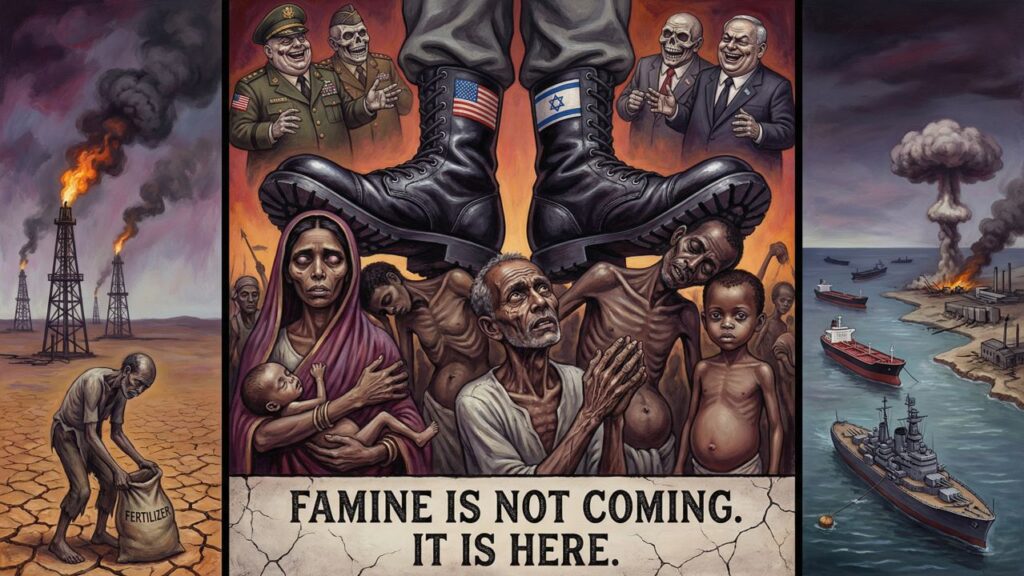
The United States and Israel bombed the gas fields that grow the world’s food. Iran struck back at Qatar’s. This is not collateral damage. This is the direct, foreseeable consequence of a war of choice, and the people paying for it grow no crops, fly no jets, and cast no votes in Washington or Tel Aviv.
Done. Irreversible. Delivered.
The strikes on South Pars yesterday did not escalate a crisis. They closed it, in the worst possible way. The United States and Israel destroyed the gas infrastructure that feeds the Haber-Bosch process that produces the nitrogen that grows approximately half the world’s food. Iran’s retaliation finished Ras Laffan. No subsequent diplomacy, no ceasefire, no emergency fund, no rerouted tanker fleet recovers the productive capacity that no longer exists. 319 million people are already in acute hunger this morning. The harvest that will compound that number is already lost. The only question that remains is how many people will die as a consequence of what was decided in Washington and Tel Aviv, not in the fields where the food was supposed to grow.
Pakistan’s urea plants are shutting down one by one. India’s largest fertilizer cooperatives have curtailed output. Bangladesh’s fertilizer producers have gone dark. Egypt’s plants are offline. Iran’s ammonia and urea capacity has halted entirely. Qatar’s QAFCO facility (a 5.6 million tonne per year urea operation, one of the largest on earth) went dark on March 4 when QatarEnergy declared force majeure on all LNG exports and “associated products.” The world’s planting season begins now. The fertilizer is not coming. The crops will not be grown. The food will not exist.
This is the news. It is not being reported as the news.
How You Destroy a Food System Without Touching a Single Farm
To understand why bombing a gas field in the Persian Gulf starves a child in Lahore or Dhaka or Nairobi, you need to understand one industrial process: Haber-Bosch.
Fritz Haber and Carl Bosch solved the nitrogen problem in 1909. Before their process, the amount of food the earth could grow was hard-capped by the amount of naturally occurring nitrogen in the soil. After it, natural gas became the molecular feedstock for synthetic ammonia, which became urea, which became the fertilizer that enabled the Green Revolution, which enabled the global population to grow to 8 billion people. Today, roughly half of all the nitrogen in human bodies passed through an industrial ammonia plant before it entered the food chain. Remove the gas. Remove the ammonia. Remove the urea. Remove the food.
The Persian Gulf sits on the world’s cheapest and most accessible natural gas. It therefore became the world’s dominant nitrogen export corridor. Five Gulf exporters (Iran, Qatar, Saudi Arabia, the UAE, and Bahrain) together account for 34 percent of global urea trade, representing 18.5 million tonnes per year flowing through a single chokepoint. The International Fertilizer Association estimates that the wider Middle East supplies nearly 50 percent of globally traded urea. IFPRI calculates that 20 to 30 percent of all global fertilizer exports (nitrogen, ammonia, phosphates, sulfur) pass through Hormuz every month. UNCTAD puts that at approximately one million tonnes per month.
The Strait of Hormuz is not primarily an oil chokepoint. It is a calorie chokepoint. And since February 28, when the United States and Israel launched their opening strikes on Iran, it has been closed.
Vessel traffic dropped approximately 70 percent within hours of those strikes. The number of daily tankers transiting has fallen toward zero, down from 37 the day before the war started. More than 150 vessels are anchored in open Gulf waters, waiting for war-risk insurance that is not available and naval escorts that have not materialized. The Iranian Revolutionary Guard has threatened to set ablaze any vessel attempting to pass. As of this writing, only 21 tankers have navigated the route since the war began. The pre-war daily average was more than 100.
Now add yesterday. Israeli strikes hit facilities at South Pars, the world’s largest natural gas field, the source of approximately 70 to 80 percent of Iran’s total gas output. Analysts estimate the damage affected roughly 12 percent of Iran’s total gas production, halting two refineries and triggering fires visible from neighboring countries. South Pars contains an estimated 1,800 trillion cubic feet of natural gas (enough, by Reuters’ calculation, to supply the world’s needs for 13 years. Iran retaliated immediately, striking Qatar’s Ras Laffan Industrial City) home to 14 LNG trains and 77 million metric tonnes of annual production capacity, as well as the UAE’s Habshan gas plant, Saudi Arabia’s Samref refinery, and the Jubail petrochemical complex. QatarEnergy confirmed “extensive damage” at Ras Laffan.
Then President Trump threatened to finish what Israel started. On Truth Social, he warned: “If that happens, the United States… will massively blow up the entirety of the South Pars Gas Field at an amount of strength and power that Iran has never seen or witnessed before.” He did not appear to register, or to care, that South Pars is also the molecule that feeds Bangladesh. That it feeds Pakistan. That it feeds the 45 countries that depend on Gulf urea exports for the nitrogen that determines whether their harvests happen at all.
Analyst Shanaka Anslem Perera captured the structural result in a sentence: “The molecule cannot ship because the strait is blocked. The molecule cannot be produced because the factory is burning. Two chokepoints on the same supply chain. Both compromised on the same day of the same war.”
The Price of a Decision Nobody Asked the Hungry
The market is never slow to price what politicians refuse to acknowledge.
Before the conflict, urea at the U.S. Gulf was already at a multi-year high, around $450-475 per ton, elevated by China’s pre-war export restrictions and tight global supply. Josh Linville, Vice President of Fertilizer at StoneX, described the pre-war condition: “We were already dealing with a world market where nitrogen and phosphate markets were already incredibly tightly supplied.” China, the world’s largest potential emergency supplier, had already signaled it would not export urea until at least August 2026, removing the last safety valve before the first missile was fired.
Within days of the initial strikes, urea at New Orleans surged to $520-550 per ton. Within a week, dealers were quoting $700 as spring planting panic bids arrived. S&P Global’s granular urea benchmark was up 38.8 percent by March 13. Argus Media analyst Marina Simonova documents Middle East export benchmarks approximately 60 percent above year-ago levels. Sulfur, with 44 to 50 percent of global seaborne sulfur also moving through Hormuz, rose $200 per metric tonne in the same period, compounding the crisis for phosphate producers like Morocco’s OCP, which imports 3.7 million metric tonnes of Gulf sulfur annually.
Fitch Ratings formally raised its 2026 fertilizer price assumptions on March 13. Seth Goldstein of Morningstar warned that nitrogen prices could roughly double if the disruption extends beyond a few weeks, reaching or exceeding the crisis peaks of 2022. Chris Lawson of CRU Group stated plainly: “While there are many parallels to 2022, the supply and demand implications of the conflict in the Middle East have the potential to be much more severe and wide ranging.”
The 2022 Russia-Ukraine fertilizer crisis, the previous benchmark for input supply disruption, pushed 27.2 million more people into poverty and 22.3 million more into hunger. That crisis involved Russian and Belarusian product that could, in theory, be rerouted to new markets through different logistics. The Hormuz closure is categorically different: the product is physically trapped, not commercially redirected. North Dakota State University’s Agricultural Trade Monitor is unambiguous, “Unlike the Russia-Ukraine conflict where Russian and Belarusian fertilizer could be redirected, fertilizer trapped behind the Hormuz closure cannot be rerouted.” If 2022 was the floor, 2026 is the ceiling collapsing.
Yara CEO Svein Tore Holsether told The Guardian: “If the Strait of Hormuz were to be closed for a year, it would be catastrophic. We are talking about the nutrition that plants need, and without it, large crop yield declines would be inevitable”, with some crops facing reductions of up to 50 percent. The American Farm Bureau Federation wrote to President Trump on March 9 warning of a threat to national food security, asking the U.S. Navy to protect fertilizer shipping, from a war the United States had started. The International Fertilizer Association declared a global fertilizer crisis in an open letter to governments on March 17.
These are not the statements of anti-war activists. They are the statements of the institutions that run the global food system. They are being ignored by the governments whose military decisions created the crisis they are describing.
The Innocent Parties
The people least responsible for this war are paying the highest price for it. That is not rhetoric. It is the documented distribution of consequences across populations that cast no votes in Washington or Jerusalem, sign no executive orders, and sit on no national security councils.
Pakistan entered this crisis with wheat production already failing, 28.42 million tonnes in 2024-25 against a 33.58 million-tonne target, a 15 percent shortfall and the second consecutive year of missed targets, with sown area down 6 percent. USDA projects a further production decline in 2026 before the fertilizer shock is even factored in. FAO’s GIEWS data show wheat flour prices rose 50 to 90 percent between July 2025 and January 2026, approaching record highs. Then the war began. On March 4, Sui Northern Gas Pipelines formally notified Agritech Limited of a force majeure on LNG supply, effective immediately, and the plant closed. Pakistan is now considering emergency shutdowns of up to six more fertilizer facilities. LNG terminals have been cut from 500 mmcfd of regasification to 100 mmcfd, with the fertilizer sector’s supply fully suspended in favor of households. Qatar and the UAE supply 99 percent of Pakistan’s LNG imports. When Ras Laffan went dark, Pakistan’s nitrogen supply did not become expensive. It ceased.
Bangladesh has shut down fertilizer production and is now reported to be seeking U.S. sanctions waivers simply to access Russian oil, a measure of how completely its supply options have collapsed. Foreign reserves under IMF BPM-6 accounting sit at approximately $29.5 billion, with economists warning the oil and LNG cost spike could strip $10 to 11 billion from reserves by year-end, threatening emergency import capacity.
Sri Lanka, still four years out of a sovereign default partly triggered by the removal of chemical fertilizer subsidies, holds $7.1 billion in reserves, 3.7 months of import cover, and is back on IMF emergency financing after Cyclone Ditwah. It has no fiscal runway for a multi-year fertilizer and food shock.
India sources over 40 percent of its urea and phosphatic fertilizers from the Middle East, with approximately 86 percent of the LNG used by domestic fertilizer plants coming from West Asia. Three urea plants have curtailed output, with IFFCO, Chambal, Kribhco, and GNFC all receiving force majeure notices or taking production offline. India’s Kharif season (rice, cotton, pulses, maize across hundreds of millions of hectares) opens in June-July and depends on fertilizer applications beginning in late April.
Sub-Saharan Africa imports more than 90 percent of its fertilizers. Sudan, already carrying two active famines, sources 54 percent of its fertilizer via Gulf seaborne routes. Somalia sits at 30 percent, Kenya at 26 percent. For these populations, a 40 to 60 percent price spike in nitrogen inputs is not a budget line item. It is the decision between planting and not planting, between a harvest and a famine, between children who survive and children who do not.
Brazil covers 100 percent of its urea needs through imports, with approximately 41 percent transiting Hormuz-linked routes. Iran was also Brazil’s largest corn buyer in 2025 to 9 million tonnes, 20 percent of total exports. Brazilian farmers have simultaneously lost their primary input supply and a major revenue market in the same war.
None of these countries chose this war. None were consulted. All are paying for it with food security they cannot recover on a planting-season timeline.
The Biological Deadline That Has No Diplomatic Exception
The full weight of this crisis rests on a fact that is agronomic, not political, and that does not yield to negotiation: the planting window closes whether or not a ceasefire is signed.
The northern hemisphere spring planting season, the window during which urea must reach fields to be biologically useful, runs from late March through May. This is a physiological constraint, not a logistics preference. Nitrogen enables cell division and protein synthesis during the rapid vegetative growth phase of grain crops. If nitrogen is not present at the growth stages that require it, the yield potential of that plant is gone. Not reduced. Gone. For the entire current season. No amount of fertilizer applied in July recovers the yield that the May application would have produced.
Analyst Maciej Jankowski has stated the constraint precisely: “Nitrogen fertilizer is not like oil. You cannot store it for later. If it does not reach fields by mid-May, crop yields drop 30 to 50 percent… Miss the window, and no amount of later fertilizer application recovers the lost yield.” University of Illinois farmdoc crop scientists quantify the corn yield penalty at up to 1.75 bushels per acre for each day of planting delay past the end of April.
Day 45 of this conflict (the agronomic threshold identified by NDSU, IFPRI, and independent analysts as the point at which planting decisions become irreversible) is mid-April 2026. Day 60 is late April. The strait is still closed. The gas fields are still burning. The fertilizer is still not moving.
IFPRI’s Joseph Glauber describes the farmer-level consequence: “In poorer countries, farmers may simply reduce fertilizer use altogether, significantly cutting agricultural output.” This is the mechanism by which a supply chain disruption becomes a famine. Grain not planted in May does not exist in November. It cannot be flown in. It cannot be manufactured retroactively. It can only be diverted from someone else’s plate, which means someone else goes hungry first.
The WFP warned on March 16, before the South Pars escalation, that an additional 45 million people would be pushed into acute hunger if the war runs through June. That projection did not model the destruction of South Pars. It did not model the damage to Ras Laffan. It did not model a multi-year reconstruction timeline for Gulf LNG infrastructure. It described the pre-escalation scenario. The 45 million figure is a floor, not a ceiling.
From Disruption to Structural Famine: The Multi-Year Horizon
The most dangerous analytical error in current commentary is treating this as a temporary supply shock that resolves when the shooting stops. It does not. The South Pars and Ras Laffan attacks have converted a shipping disruption into the structural, multi-year destruction of production capacity. That distinction determines whether we are talking about a bad agricultural year or a permanent reconfiguration of global food security.
Energy infrastructure analysts are clear about reconstruction timelines. The 2019 Abqaiq attack damaged seventeen pieces of equipment at a single Saudi facility. Full restoration under peacetime conditions (with global insurance, free contractor access, and functioning logistics) took approximately six months. LNG trains are far more complex and capital-intensive than oil stabilization plants. QatarEnergy’s own documentation for its North Field Expansion projected a five-to-seven-year construction timeline for new capacity. QatarEnergy has stated publicly that production cannot restart until the conflict ends, and even after it ends, full restoration is measured in years. The North Field East expansion that would have brought 32 million tonnes per year of new LNG capacity to market has already been pushed to at least 2027.
The system does not snap back to status quo ante. It settles into a permanently higher-cost, lower-volume equilibrium in which the countries with the least fiscal space to absorb higher fertilizer prices (Pakistan, Bangladesh, Sri Lanka, Sudan, Kenya, Nigeria) lose first and worst. The redistribution of food security that a multi-year Gulf gas shock produces is not random. It follows the existing geography of global inequality and deepens it, permanently.
The Geopolitical Consequence: Who Benefits from American Destruction
The humanitarian catastrophe is not the only consequence that Washington’s strategists appear not to have war-gamed. There is a geopolitical one unfolding in parallel, reordering the global system in ways that will outlast this war by decades.
Every country in the Global South that is now watching its fertilizer supply collapse, its food import bills spike, and its foreign reserves drain, because of a war started by the United States and Israel against a country that none of them consider their enemy, is drawing conclusions about American power that will not be revised when a ceasefire is announced. Those conclusions are: the United States is willing to impose catastrophic costs on innocent third parties in pursuit of its strategic objectives; the American security umbrella that was supposed to guarantee the stability of global trade routes is actively destabilizing them; and the alternative (alignment with a China and Russia-anchored order, operating outside dollar-denominated trade and U.S.-managed logistics) is no longer an ideological preference. It is a survival strategy.
China is already moving. Beijing’s decision to restrict fertilizer exports through August 2026 is publicly framed as domestic supply protection. The geopolitical signal is unmistakable: China is conserving strategic commodity leverage in a world where the United States has just demonstrated its willingness to bomb the global food supply chain in pursuit of regional military objectives. Russia, whose fertilizer exports were the subject of Western sanctions after 2022 and which has quietly resumed supplying countries that chose to keep buying regardless of Western pressure, is now the most reliable nitrogen supplier for a growing list of countries locked out of Gulf product.
The alignment emerging from this crisis is not primarily ideological. It is hunger-driven. Countries that cannot feed their people because a U.S.-backed war destroyed their fertilizer supply chain do not deliberate about democratic norms or liberal international order. They deliberate about who will sell them ammonia. The answer, increasingly, is Moscow and Beijing, and the price they charge is not measured in dollars. It is measured in UN votes, in military basing rights, in currency swap agreements, and in the slow unwinding of the dollar’s role as the reference currency for commodity trade.
This is how empires lose their grip, not in single dramatic defeats, but in the accumulation of moments when the costs they impose on the world exceed the benefits they provide. The United States spent decades building its global credibility on the proposition that it guaranteed the stability of international trade, protected shipping lanes, and underwrote the food security of the developing world. It is now the country whose military actions have physically closed the world’s most important fertilizer export corridor and destroyed the gas fields that feed it. The contradiction between those two identities cannot be resolved by press releases. It is being resolved, right now, in the foreign ministries of Islamabad, Dhaka, Nairobi, and Brasília, one alignment shift at a time.
The Reckoning
Every institution that has looked at this crisis is saying the same thing. The WFP Deputy Executive Director called it “a terrible, terrible prospect” and noted that “hunger has never been as severe as now.” Yara’s CEO used the word “catastrophic.” CRU Group invoked 2022 and said this could be worse. The IFA declared a global fertilizer crisis. Morningstar projected nitrogen prices potentially doubling. CSIS concluded the war had “effectively closed a critical chokepoint in global oil, natural gas, and fertilizer trade simultaneously, with long-term risks to food security.” UNCTAD warned that developing economies with high debt and limited fiscal space faced the most severe exposure. NDSU concluded the 2026 shock was structurally more severe than 2022.
None of these statements made the front page of the newspapers that are covering this war.
The planting window is closing. The gas fields are burning. The LNG trains at Ras Laffan are under battle damage and force majeure. South Pars, which contains enough gas to supply the world for 13 years, may yet be, as the President of the United States has publicly threatened, “massively blown up” in its entirety. China has locked its fertilizer export door through August. Pakistan’s fertilizer plants are dark. India’s cooperatives are cutting production. Bangladesh is seeking sanctions waivers for Russian oil. The WFP is cutting rations because it has run out of funding to maintain them.
Food not grown in June 2026 does not exist in November 2026.
The people dying from this decision will not die in uniform. They will not die on a battlefield. They will die in the quiet catastrophe that follows a missed planting season, in villages where the shelves go empty, where the price of flour doubles and then doubles again, where children begin to show the signs that pediatric malnutrition researchers recognize immediately and governments acknowledge too late. They will die with no official connection to the strikes on South Pars or the closure of Hormuz or the force majeure declarations that cascaded from Ras Laffan to Karachi to Dhaka to Nairobi. The causal chain is long enough that responsibility can be diffused, denied, and forgotten.
This article is a refusal of that diffusion. The chain runs directly from the decision to bomb Iran to the gas fields that are now burning to the fertilizer that is not being produced to the crops that will not be planted to the food that will not exist to the people who will not survive the autumn.
The decision was made in Washington and Tel Aviv. The harvest date is June. The body count follows in November.
Tick, tick, tick.
Scott Ortkiese is the founder of Throughline Synthesis Group.
Related reading
- The Molecules of War: How Washington's Persian Gulf Gamble Is Coming for Your Grocery Bill, Your Smartphone, and Your Economy
- A Bill of Indictment for Murder and Genocide Against the American Military and Trump, as its Commander and Chief
- Обвинительное заключение по делу об убийстве и геноциде против американских вооружённых сил и Трампа как их Верховного главнокомандующего
- Stop Calling It News. Gulf State “Reporting” Is Trump’s Bullshit With A Gulf State Palace Seal.