There is a particular kind of stupidity that is only visible in retrospect to those who committed it. Everyone else saw it coming.
On February 28, 2026, the United States and Israel launched coordinated strikes against Iran, Operation Epic Fury and Operation Roaring Lion, assassinating Supreme Leader Khamenei, devastating the Kharg Island export terminal, and striking military infrastructure across the country. Within 48 hours, Iran had closed the Strait of Hormuz, US bases across the Gulf were under sustained missile attack, Israeli air defenses were being systematically depleted, and oil had crossed $80 a barrel. Within three weeks, it was approaching $120 and still climbing, but that’s only the beginning of the economic horror story that is unfolding.
The Omani foreign minister, hours before the first bomb fell, had announced on CBS News that Iran had already agreed to zero uranium enrichment, even for civilian purposes. There was a deal on the table. Trump bombed it.
This is the story of what that decision broke, and why it will not be repaired.
What They Actually Destroyed
The nuclear program was the stated rationale. It was not the target.
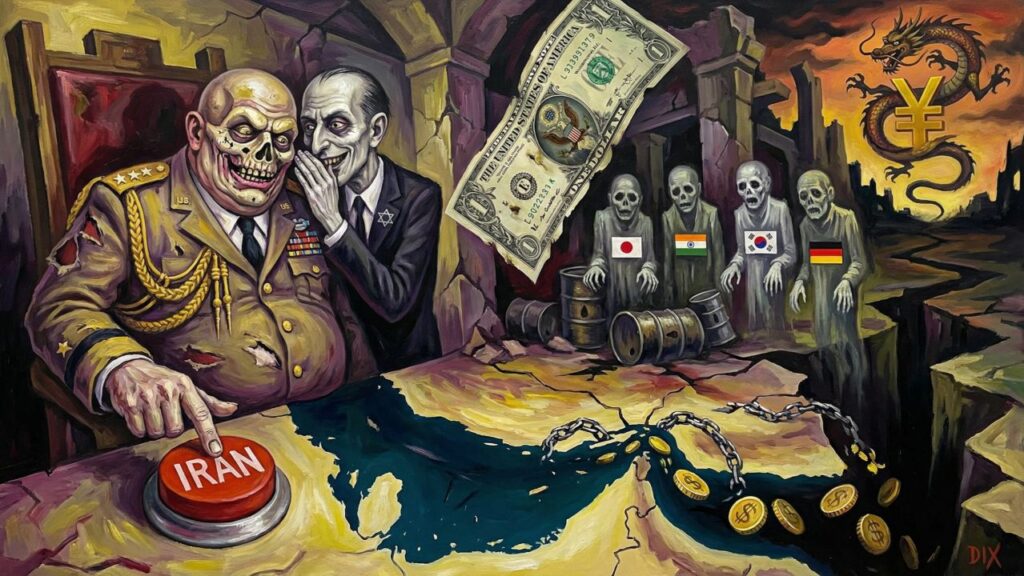
What the US-Israel attack bumblingly destroyed was the physical infrastructure of the petrodollar system, the 52-year-old arrangement through which the world’s most vital commodity was priced in US dollars, those dollars were recycled into US Treasury bonds and American equity markets, and the United States got to run a $40 trillion debt, finance 800 military bases, and consume the world’s output without producing an equivalent amount of anything in return. The Strait of Hormuz is not just a shipping lane. It is the physical chokepoint through which 20% of global oil and 20% of global LNG moves. Close it, and you do not just raise the price of oil. You sever the recycling loop that has quietly underwritten American financial hegemony since 1974.
Professor Jiang, applying game theory to the architecture of American power, described the mechanism with precision: “The Gulf States sell oil, get petrodollars, and then they recycle it back into the American economy, mainly by investing into AI, into data centers, which is now the main engine of growth for the American economy.” An Amazon data center in the UAE was struck by an Iranian drone in the opening hours of the war. The symbolism was not subtle. Neither was the math.
GCC sovereign wealth funds collectively manage nearly $6 trillion, over 40% of the global total. In 2025 alone, Gulf funds invested $70 billion into US AI and technology companies. With the Strait closed and GCC oil exports halted, those funds are no longer generating petrodollars. They are liquidating foreign assets to fund survival. The capital that has been the marginal price-setter in American equity markets is leaving. The AI bubble Jiang identified as America’s last engine of growth is losing its fuel.
Trump was “not concerned.” Neither was the British Chancellor, fourteen days before the pound lost 30.5% of its value overnight.
The Countries Washington Left to Burn
The propaganda framing treats this as a bilateral conflict between the United States and Iran. It is nothing of the sort. What Washington actually did was blow up the energy security of every major Asian economy without a phone call.
Japan imports over 90% of its crude from the Middle East, with roughly 75% transiting through Hormuz. Japan is not a spectator to this war. It is its largest unintended casualty. Prime Minister Takaichi has told her cabinet Japan will exhaust its oil reserves in eight to nine months. The country that holds $1.23 trillion in US Treasury bonds (purchased, in significant part, because the petrodollar system required it to hold dollar reserves to buy the oil Washington just bombed) received no warning, no consultation, and no offer of compensation. Iran’s IRGC commander told NHK explicitly: Japanese tankers could pass freely if Japan stopped supporting America’s war. That is not a diplomatic overture. That is a public extortion offer that demonstrates, in real time, that Japan’s energy security now depends on Iranian goodwill, not American protection.
The former US Ambassador Rahm Emanuel put the damage plainly: “The president made a decision on Iran without consulting allies, and they’re bearing the brunt of it.” That is a diplomatic understatement of historic proportions.
South Korea sources 60-70% of its crude through Hormuz. It has seven months of strategic reserves. Its petrochemical industry, one of the most energy-intensive manufacturing sectors in the world, is already curtailing production. Seoul, like Tokyo, was given no notice and no off-ramp. It is now watching its energy supply held hostage by a war it did not vote for, cannot influence, and cannot escape.
India is in the most acute immediate danger of any major economy. It depends on Hormuz for 60% of its oil imports and had only 25 days of reserves on hand when the Strait closed. An Indian business contact told Colonel Wilkerson: “This will be a tragedy of the first order for us.” India has approximately $15 billion to raise immediately just to cover oil at current prices before they go higher. Modi’s careful balancing act (maintaining US partnership while expanding ties with Russia, Iran, and the BRICS bloc) has been brutally simplified by American unilateralism.
China depends on the Strait for approximately 50% of its oil imports. Beijing, unlike Tokyo and New Delhi, had been building for this moment, diversifying through Belt and Road, expanding domestic renewable capacity, deepening its Russian energy relationship, and building mBridge and CIPS as parallel financial infrastructure that does not touch the dollar. China is not a victim of this war. It is its principal strategic beneficiary. Every day the Strait stays closed, every economy that pivots away from dollar-denominated oil trade advances Xi Jinping’s patient, decade-long project to position the yuan as the world’s next reserve currency.
Indonesia imports 75% of its sulfur from the Gulf for nickel HPAL processing. Its critical minerals export ambitions, the foundation of its EV battery supply chain position, are being strangled by a war it had no part in starting.
Germany completes the portrait of Western self-destruction. Michael Hudson described Germany’s pre-war model with characteristic clarity: buy cheap Russian energy, manufacture excellent goods, subcontract labor to Poland, sell expensive cars to China. The United States destroyed that model in stages, first severing Germany from Russian energy through the Ukraine escalation, then attacking Germany’s access to Gulf energy. Germany has lost its two cheapest energy sources in four years, both times at Washington’s instigation. Chancellor Merz has not called Putin. He is spending 500 billion euros on defense instead of rebuilding an industrial base that has no cheap feedstock to run on.
“Russian Sanctions” The Parasitic Fiction
The phrase “Russia is sanctioned” needs to be retired from serious analytical discourse. Sanctioned by whom? Sanctioned to what effect?
Russia is not sanctioned by China, India, Brazil, South Africa, Indonesia, Turkey, Vietnam, Saudi Arabia, the UAE, Kazakhstan, or any other country that collectively represents the majority of the world’s population and a growing share of its economic output. Russia is sanctioned by the United States, the European Union, and their immediate vassals, a coalition that has spent two years discovering that economic warfare works best when the target cannot simply route around it through alternative partners.
India never sanctioned Russia. It is now Russia’s largest oil customer. China never sanctioned Russia. Bilateral trade hit a record $244.8 billion in 2024, nearly all of it settled in yuan and rubles, bypassing the dollar entirely. Brazil and China eliminated the dollar from their bilateral trade in 2023. Indian refiners, including Reliance Industries and Bharat Petroleum, routinely purchase Russian crude in UAE dirhams.
The sanctions architecture was always a Western projection of Western institutional centrality. It assumed that because the United States controls SWIFT, controls correspondent banking networks, and controls dollar-clearing systems, it controls global trade. That assumption has been quietly dismantled, transaction by transaction, for a decade. The Iran war has not reversed that process. It has accelerated it past any point of comfortable denial.
Iran was “sanctioned” for 40 years while Asian buyers purchased its crude through workarounds Washington tacitly permitted, because genuinely enforcing the sanctions would have meant strangling the Asian growth engines whose dollar recycling financed American deficits. The sanctions were a political performance, not an economic reality. Everyone in Asia understood this. Washington pretended otherwise until it didn’t.
The Replacement Is Already Operational
While Washington’s foreign policy establishment was debating whether the petrodollar was “really” in danger, the rest of the world stopped debating and started building.
Project mBridge (a cross-border digital currency platform that settles international payments in central bank digital currencies without touching SWIFT, without routing through correspondent banks, and without using US dollars) has now processed over $55.5 billion in cumulative transactions across more than 4,000 settlements. That represents a 2,500-fold increase since its 2022 pilot phase. Participating central banks include China, Hong Kong, Thailand, the UAE, and Saudi Arabia. Saudi Arabia, the nation whose 1974 agreement with Nixon and Kissinger created the petrodollar system, is an active participant in the platform designed to make that arrangement obsolete.
The Bank for International Settlements exited mBridge in October 2024. BIS General Manager Agustin Carstens explained why: “We cannot directly support any project for the BRICS because we cannot operate with countries that are subject to sanctions.” The BIS departure did not slow the project. It clarified the geopolitical alignment: the West is on one side, and the nations building the replacement are on the other.
China’s CIPS payment system now connects participants across 119 countries. Russia’s SPFS links 160 foreign banks in over 20 countries. Vladimir Putin confirmed at the 2025 BRICS summit that 90% of all transactions between Russia and other BRICS member states are now settled in national currencies, up from 26% just two years earlier. BRICS Pay launches at the 2026 summit in India.
Central banks are communicating the same conclusion through their reserve decisions. In 2025, central banks purchased 863 tonnes of gold, the fourth-largest annual expansion on record. Gold overtook US Treasuries as the largest reserve asset held by central banks on a mark-to-market basis, for the first time since 1996. China’s Treasury holdings ended 2025 at $683.5 billion, the lowest since 2008, after offloading $208.6 billion in long-term US financial assets during the year. Brazil’s holdings fell from $229 billion to $168 billion. India’s dropped from $234 billion to $186.5 billion.
This is not a panic. It is a rotation. Thirty central banks, in thirty countries, making the same quiet decision: the asset that has backed the world’s monetary reserves for 50 years is no longer the safest place to hold value.
Why the War Was Launched Anyway
Professor Mearsheimer offered the most direct answer: “Virtually every country on the planet except for Israel is opposed to this war. We’re doing this because of pressure from Israel and the lobby inside the United States.” He drew the explicit parallel to Iraq. Netanyahu visited the White House seven times in the preceding year. Each visit produced a new confrontation with Israel’s enemies.
Colonel Wilkerson described Netanyahu’s objective with unsettling precision: “The objective of BB Netanyahu, for whom we’re fighting this war, is chaos. Not putting in Tehran a regime that would run a reasonably quisling state. He wants chaos, total chaos in the region.” The Greater Israel project requires the elimination of every coherent state power capable of organizing resistance. Iran was the last one standing.
Trump’s personal calculus converged with Netanyahu’s agenda through a structure of private financial incentives that game theory would call a principal-agent problem. The American public, 75-78% of whom opposed the war, are the principals. The agents who launched it bear none of its costs. Saudi Arabia invested $2 billion in Kushner’s private equity fund. Miriam Adelson pledged $250 million toward a potential third Trump term. The agents optimized their own payoff functions. The principals are paying for it in oil prices, reserve depletion, and broken alliances.
Jeffrey Sachs was succinct: “Strategy is a big word when it comes to Donald Trump. I don’t think there is a strategy.”
The military assessment was equally damning before the first bomb fell. General Kaine, Chairman of the Joint Chiefs, told Trump in January there was no viable strategy. Mearsheimer confirmed it three days before the strikes. The Chairman of the Joint Chiefs said it. The President launched it anyway.
The Architecture of Failure
Lt. Col. Daniel Davis identified the central asymmetry before the first strike: “For us to succeed we have to accomplish all of our primary tasks and that means regime destruction. Iran has merely to survive.” Davis estimated the US had “maybe four or five days of high-intensity flight. Maybe we could stretch that out to a couple of weeks if you’re judicious in the use.” General Jack Keane, on the morning of the attack, boasted the US “could do this for two or three weeks”, effectively broadcasting to Tehran the window it needed to outlast.
Macgregor’s pre-war inventory was clinical: only two carrier battle groups available, the USS Gerald Ford nine to ten months at sea, aircraft requiring double aerial refueling at 700-800 miles, escort ships whose defensive missiles “could be exhausted very quickly.” He invoked Kosovo, a campaign planned for two weeks that lasted 78 days, against a country of 8 million. Iran has 93 million people, a professionalized military, and a Shia eschatological framework in which martyrdom is not a political liability but a theological consummation.
Killing Khamenei was not a decapitation. It was a galvanizing atrocity. Former British diplomat Alastair Crooke, who spent decades negotiating in the region, called it “an incredible error of judgment” demonstrating “complete cognitive dissonance” about who Khamenei was and what he represented to the Shia world. The airstrike on a girls’ school in southern Tehran that killed approximately 150 children on the same morning eliminated whatever internal Iranian ambivalence “regime change” theory had counted on exploiting.
The Petrodollar Bargain, and Its Breach
The petrodollar system rested on a specific exchange. The United States would guarantee the security of Gulf energy flows. Gulf states would price oil in dollars. The world would hold dollar reserves. America would get to borrow without limit, finance its military without taxation, and consume beyond its productive capacity.
The rest of the world tolerated this arrangement as long as Washington delivered on its end: stable Gulf energy flows. That was the price of the exorbitant privilege.
On February 28, 2026, Washington did not protect Gulf energy flows. It destroyed them. It bombed its own system’s physical infrastructure in service of a foreign government’s regional ambitions, without consulting the allies who depended on that infrastructure, without a strategy for restoring it, and without a plan for managing the consequences.
Iran built the alternative pricing mechanism in the wreckage. It told every tanker seeking passage: bring yuan. The Strait of Hormuz is now the toll gate, and Tehran owns it. Eight countries are in active negotiations with Iran on yuan-passage arrangements. Saudi Arabia has signed a $7 billion yuan-riyal swap with China and is actively using mBridge. The country that created the petrodollar is hedging against its own creation.
The Last War of the Oil Age
There is a final irony, and it is the most devastating of all.
The United States is fighting a war to control the world’s oil supply at the precise historical moment when the world is beginning to not need that oil. Over 90% of all new power generation capacity added in 2024 came from renewable sources. Global EV sales climbed 25% to over 17 million units. The IEA projects oil demand will plateau near 105 million barrels per day before 2030.
China has been building what amounts to a structural exit from petrodollar dependency, solar, wind, nuclear, and domestic alternatives that reduce its dollar-denominated energy exposure with each installation. Every solar panel is a panel that requires no petrodollar transaction. Every electric vehicle generates no GCC recycling flow. China is not de-dollarizing out of ideology. It is de-dollarizing out of rational self-interest, eliminating the structural dependency that the petrodollar system was designed to make permanent.
The petrodollar may not die because of a financial crisis or a military defeat. It may die because the commodity it depends upon is being made obsolete. The war to preserve the petrodollar may be the last war of the oil age, fought by an empire that did not notice the age had ended.
Ron Paul, at 90 years old, offered the longest historical view: “This is what empires do. They overextend. They destroy their currency. They consume their wealth in foreign wars. The only question is what survives the transition.”
The British went through this. Their Chancellor denied it was happening. Fourteen days later, the pound lost 30.5% of its value overnight. The empire did not end in a single catastrophic moment. It ended in a long, grinding series of quiet losses, each one explicable, each one manageable in isolation, and together, irreversible.
The United States attacked Iran. Every independent military analyst said it was unwinnable. The Chairman of the Joint Chiefs said there was no strategy. A deal was in Geneva. 75% of Americans opposed it. The Omani foreign minister was announcing Iranian concessions on live television the night before the bombs fell.
They bombed it anyway.
As Alex Krainer put it: “Staggeringly dumb. I still sometimes think, am I dreaming, or did they really do this?”
They did. The consequences are only beginning.
Scott Ortkiese is Principal of Throughline Synthesis Group. He writes atthroughlinesynthesis.com and on LinkedIn and Substack. This article draws on the author’s prior series on the petrodollar and the Iran war, incorporating analysis from Professors John Mearsheimer and Jeffrey Sachs, Lt. Col. Daniel Davis (Ret.), Col. Douglas Macgregor (Ret.), Commodore Steve Jermy (Ret.), former diplomat Alastair Crooke, economist Michael Hudson, market analyst Peter Schiff, economist Richard Wolff, and investigative journalist Glenn Greenwald.
Related reading
- American Empire in Ruins: The Unprovoked, Unconstitutional, and Catastrophic US-Israeli War on Iran
- What American Media Won’t Tell You About the Iran War and the End of the American Century in Asia
- Trump’s Iran War, China Trip and the Vanishing Empire
- America’s Suicidal Empire: The Iran War, the Death Spiral of a Failing Hegemon, and the World We Are Destroying