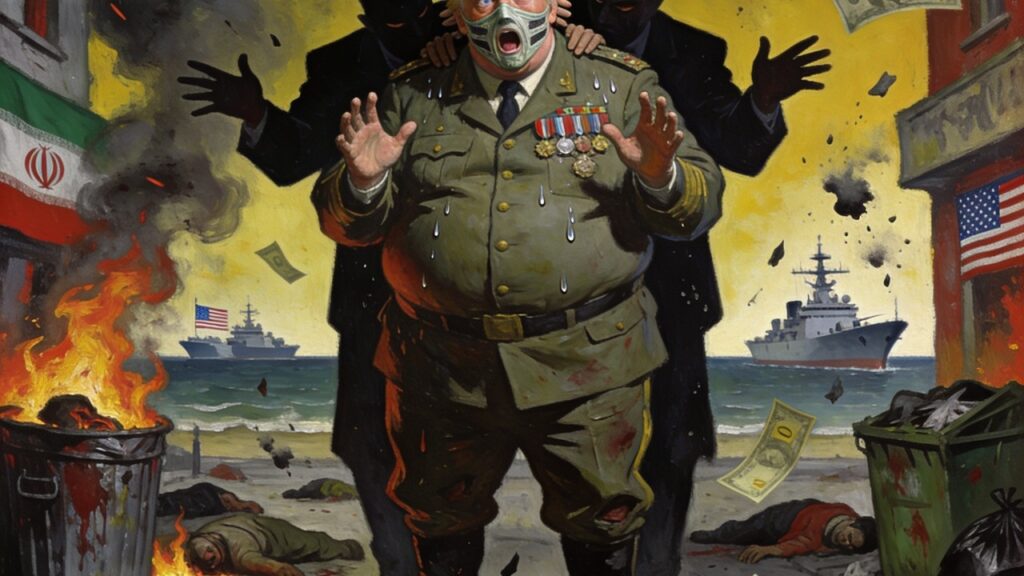
The legacy media reported Iran’s massacre of 36,000 protesters. They didn’t report that Trump promised “help is on the way,” that Pompeo celebrated Mossad agents in the crowds, or that American think tanks openly called for CIA covert operations inside Iran. Here’s the story they won’t tell, and why they won’t tell it. Trump signed it. The CIA executed it. The corpses are Iranian civilians.
The Accusation
When the President of the United States publicly promises “help is on the way” to protesters seeking to overthrow a foreign government, and then a massacre ensues, serious people ask what that help looked like.
When a former CIA Director publicly celebrates Mossad agents “walking alongside” those protesters, the question sharpens.
When American think tanks openly call for “covert operations and close collaboration between the CIA and Israel’s Mossad” inside that country, the question becomes unavoidable.
Did the United States sponsor terrorism in Iran last month?
The evidence is circumstantial but damning. The pattern is documented across sixty years. And the Western press (which covered the Iranian regime’s massacre in exhaustive, horrified detail) has refused to investigate the American role in creating the conditions for that bloodshed.
This is the story they won’t tell. Here is why they won’t tell it, and what it reveals about the permanent machinery of American foreign policy.
The Massacre They Reported
Let us be clear about what happened in Iran last month: the Islamic Republic committed mass murder against its own people.
Between January 8 and 10, 2026, Iranian security forces (the IRGC, the Basij militia, and reportedly foreign Shia militias imported from Iraq) killed somewhere between 12,000 and 36,500 civilians in what Human Rights Watch called “countrywide massacres.” Supreme Leader Khamenei personally ordered forces to “crush the protests by any means necessary.” Security forces used DShK heavy machine guns against crowds. Snipers targeted heads and hearts. Hospitals were raided, wounded protesters executed in their beds. Bodies were dumped in mass graves. Families were charged for the bullets that killed their children.
This was state terrorism on a scale that dwarfs Tiananmen Square. The Western press reported it, CNN, the New York Times, the Guardian, all covered the death toll, the internet blackout, the horror.
What they did not report, what they will not investigate, is the other half of the story.
The Questions They Won’t Ask
On January 12, 2026, President Donald Trump told Iranian protesters: “Help is on the way.”
What did that mean?
This is not a rhetorical question. When the President of the United States publicly promises “help” to protesters seeking to overthrow a foreign government, serious journalists should ask: What kind of help? Delivered how? Through what channels? With what operational footprint already in place?
The Western press treated Trump’s statement as mere rhetoric, bluster from a president prone to hyperbole. But others took it quite seriously.
The Foundation for Defense of Democracies, the neoconservative think tank that has driven Iran hawkishness for two decades, published a piece in The Atlantic calling explicitly for “precise intelligence, covert operations, and close collaboration between the CIA and Israel’s Mossad, skills already demonstrated within Iran.” They suggested “kinetic strikes” on Iranian security convoys. They framed this not as speculation but as recommendation.
When American think tanks with direct pipelines to the national security establishment openly advocate CIA-Mossad operations inside Iran in mainstream publications, and the President publicly promises that “help is on the way,” the responsible journalistic question is obvious: Is it already there?
CNN did not ask. The New York Times did not ask. The Washington Post did not ask.
What Iran Claims, And Why It Matters
The Iranian government claims it has answers to those questions.
According to Iranian state media and official statements, security forces arrested operatives who confessed to being recruited via social media by handlers based in Germany, receiving dollar payments, purchasing equipment on instruction, attending gatherings to chant specific slogans, and sending footage abroad. Police chief Brigadier General Ahmadreza Radan stated that security forces had targeted ringleaders “receiving dollar payments from outside the country in exchange for provoking the public.”
Raids on safe houses in Tehran allegedly uncovered “weapons, ammunition, and bomb-making materials.”
Iran’s intelligence ministry announced the arrest of “terrorist ringleaders” with “the people’s effective cooperation.”
Now, and this is crucialIranian state media is not a reliable source. Press TV is a propaganda organ. Confessions extracted by the Islamic Republic are worth less than nothing. The regime has every incentive to blame foreign actors for domestic discontent, and a long history of fabricating evidence to support that narrative.
But here is the problem: the Western press used Iran’s unreliability as an excuse not to investigate at all.
The regime’s claims about foreign involvement were dismissed as propaganda, which they may well be, but the American government’s own statements suggesting foreign involvement received no equivalent scrutiny. Trump’s “help is on the way” was reported as a quote, not investigated as a policy. The FDD’s open advocacy for CIA-Mossad operations was published in The Atlantic without anyone asking whether such operations were already underway.
The Iranian government’s credibility is zero. But the American government’s credibility on covert operations in Iran is not much higher, and the press refuses to examine it.
The 1953 Precedent No One Mentions
When Trump promised “help” to Iranian protesters, Al Jazeera’s Belen Fernandez offered the context that American outlets refused to provide:
“As Trump now asserts that the US is ‘ready to help!!!’ Iran, it is prudent to reflect on previous instances of American ‘help!!!’ in the nation, such as the 1953 CIA-backed coup against democratically elected Prime Minister Mossadegh, which paved the way for the oppressive reign of the shah, ultimately overthrown during the Iranian Revolution in 1979.”
This is not ancient history. This is pattern.
The CIA’s Operation Ajax, planned jointly with British intelligence, overthrew Iran’s elected government to protect Western oil interests. The agency bribed journalists, funded mobs, created the chaos it then cited as justification for intervention. The operation succeeded. Twenty-six years of the Shah’s brutal SAVAK secret police followed. Then came the revolution, the hostage crisis, and four decades of enmity.
When American officials promise “help” to Iranian protesters, Iranians remember what that help looked like last time.
The American press does not remind them. It does not remind American readers either.
Mike Pompeo Says the Quiet Part Loud
On January 11, 2026, former Secretary of State Mike Pompeo posted a message that should have generated headlines:
He wished “Happy New Year to every Mossad agent” walking alongside Iranian protesters.
Read that again. A former Secretary of State, former CIA Director, and current Republican power broker publicly acknowledged, celebrated, the presence of Israeli intelligence operatives embedded within Iranian protest crowds.
This was not Iranian propaganda. This was not regime disinformation. This was Mike Pompeo, on the record, confirming foreign intelligence presence in the protests.
The Western press did not follow up. No outlet asked Pompeo what he meant. No outlet asked the State Department whether Mossad agents were indeed operating inside Iran. No outlet asked the CIA whether American operatives were alongside them.
The statement simply vanished into the news cycle, noted by Iranian media and ignored by everyone else.
When “Covert Operations” Means Terrorism
The Foundation for Defense of Democracies recommended “kinetic strikes” on Iranian security convoys and “covert operations” targeting the Basij militia. Strip away the think-tank euphemisms and translate: they advocated bombing vehicles and assassinating paramilitary personnel inside a sovereign nation with which the United States is not at war.
If Iran funded operations to bomb American National Guard convoys and assassinate DHS personnel on American soil, we would call it terrorism. We would be right to call it terrorism.
The only difference is the flag on the drone.
The semantic game is transparent. When adversaries fund violence against state security forces, it is terrorism. When America funds violence against state security forces, it is “democracy promotion” or “covert operations” or “kinetic action.” The bodies are equally dead. The buildings are equally destroyed. The families are equally shattered.
But one version gets you on a terrorist watchlist, and the other gets you published in The Atlantic.
The FDD’s recommendations were not hypothetical musings from marginal figures. This is the think tank that shaped Trump’s first-term Iran policy, that pushed for the assassination of Qasem Soleimani, that has direct pipelines into the National Security Council. When they call for CIA-Mossad operations, they are not speculating about what might be possible. They are signaling what is already underway, or advocating for its acceleration.
And the American press publishes their recommendations without asking the obvious follow-up: Is this already happening?
The Asymmetry of Scrutiny
Here is how Western media covered the Iran story:
Iranian regime claims protesters were “terrorists” backed by foreign powers: Press coverage: “Iran blames US and Israel for unrest” (framed as regime propaganda, dismissed without investigation)
Trump promises protesters “help is on the way”: Press coverage: Quoted without scrutiny, treated as rhetorical support
Iranian government claims arrests of foreign operatives: Press coverage: Ignored or dismissed as fabrication
American think tanks call for CIA-Mossad operations inside Iran: Press coverage: Published in The Atlantic, no follow-up on whether operations are underway
Former CIA Director celebrates Mossad agents in protest crowds: Press coverage: Ignored entirely
Iranian security forces massacre 12,000-36,000 civilians: Press coverage: Extensive, horrified, demanding international action
The asymmetry is not subtle. When Iran commits atrocities, Western media investigates, documents, and condemns. When American officials signal covert involvement, Western media quotes and moves on. When American think tanks openly advocate intelligence operations, Western media publishes and asks no questions. When a former CIA Director confirms foreign intelligence presence in the protests, Western media pretends it didn’t happen.
This is not journalism. It is stenography for one side and scrutiny for the other.
The 2022 Blueprint
Iranian officials explicitly connect the 2026 protests to the 2022 unrest following Mahsa Amini’s death. According to Brigadier General Mohammad Kazemi, head of IRGC intelligence, investigation of the 2022 protests revealed that “as many as 20 foreign intelligence agencies played an ‘active’ role”, including the United States, United Kingdom, France, Germany, several Arab states, and Israel.
The claimed activities included: European diplomats gathering real-time intelligence on security responses; CIA and Mossad collaboration on cyberspace platforms; and coordination between Israeli and UAE intelligence services.
Againthis is Iranian government claims, which deserve skepticism. But the pattern they describe matches documented U.S. behavior in other contexts: the 2014 Ukraine coup that Victoria Nuland helped orchestrate; the “color revolutions” across the former Soviet space; the long history of CIA involvement in regime change operations worldwide.
The template is consistent: identify genuine grievances, amplify them through social media and funded NGOs, provide organizational support and training to protest leaders, escalate confrontation with the regime, and when the regime responds with violence, use that violence to justify further intervention.
The Iranian regime’s brutality is real and indigenous. But the question of whether foreign intelligence services helped manufacture the confrontation that provoked that brutality is legitimate, and the press refuses to ask it.
What “Help” Looks Like
The Foundation for Defense of Democracies laid out exactly what American “help” might entail:
- Cyberattacks targeting IRGC facilities
- Covert operations against the Basij paramilitary
- Targeting of Iranian cyber police and morality police
- “Kinetic strikes” on security convoys
- “Close collaboration between the CIA and Israel’s Mossad”
This was published openly, in a mainstream American magazine, as policy recommendation.
The authors assured readers that “none of this necessitates occupation or nation-building.” Just precise intelligence. Just covert operations. Just enough violence to destabilize without accountability.
This is the same logic that produced the Iraq catastrophe, the Libya catastrophe, the Syria catastrophe. Surgical intervention. Limited footprint. No nation-building required. The formula has failed everywhere it has been applied, and the neoconservative establishment keeps proposing it because they never face consequences for failure.
Iraq was supposed to be a cakewalk. Libya was supposed to be a humanitarian intervention. Syria was supposed to be moderate rebels versus a dictator. Each became a charnel house. Each produced exactly the opposite of its stated objectives. And the architects of each disaster are still writing op-eds, still advising presidents, still calling for the next intervention.
Iran is next on the list. It has been next on the list since 2003, when a senior Bush official reportedly said, “Anyone can go to Baghdad. Real men go to Tehran.”
Twenty-three years later, the real men are still trying.
Why the Press Won’t Investigate
The Western press will not investigate American covert involvement in Iran for the same reasons it did not investigate the Iraq WMD claims until years after the invasion:
Access journalism: Reporters depend on government sources for information. Asking uncomfortable questions about CIA operations means losing access to officials who provide scoops on other stories. The trade-off is made unconsciously, but it is made.
Ownership structure: The media conglomerates whose coverage shapes public perception are owned by investors with stakes in defense contractors. BlackRock, the world’s largest asset manager, holds significant positions in both Lockheed Martin and the parent companies of major news networks. Editorial independence is structurally compromised.
Narrative alignment: The frame “brutal regime massacres freedom-seeking protesters” is simple, morally satisfying, and aligned with U.S. foreign policy objectives. The frame “brutal regime massacres protesters, some of whom may have been organized or funded by foreign intelligence services pursuing regime change” is complicated, morally ambiguous, and threatens to implicate American policy in the bloodshed. Journalists choose the simple frame.
The “both sides” escape: When pressed, editors invoke the difficulty of verification. “We can’t confirm Iranian claims,” they say, as if the alternative, taking American claims at face value, were journalistically superior. The same outlets that published Hamas casualty figures from Gaza for years suddenly discover rigorous evidentiary standards when Iranian claims implicate American intelligence.
Career incentives: No journalist ever lost a job for being too hawkish on Iran. Plenty have lost jobs, or never gotten them, for questioning the consensus. The incentive structure is clear, and journalists respond to incentives like everyone else.
The Same Playbook, Different Theater
This is not an aberration. This is method.
The same think tanks that advocated the Iraq invasion now advocate Iran destabilization. The same pattern that produced Boris Johnson’s sabotage of the Istanbul peace deal (arm the proxy, promise support, let the bloodshed unfold, blame the adversary) is being applied to Tehran. The neoconservative project requires enemies; when one war winds down, another must be manufactured.
Victoria Nuland orchestrated Ukraine. Kurt Campbell is positioning the pieces for Taiwan. And the Foundation for Defense of Democracies is openly calling for regime change in Iran, using the same language, the same logic, and the same indifference to consequences that has produced nothing but corpses for thirty years.
The Kagans write the policy papers. The think tanks launder them into respectability. The journalists publish them without scrutiny. The officials execute them without accountability. And when the bodies pile up (in Baghdad, in Tripoli, in Mariupol, in Tehran) the same voices that created the catastrophe pivot to explaining why the next intervention will be different.
It is never different. It is only more of the same, with different flags on the coffins.
The Massacre Was Real. The Questions Remain.
Let there be no ambiguity: the Iranian regime committed crimes against humanity last month. The evidence is overwhelming, videos of mass graves, testimony from doctors forced to treat the dying under threat, reports of heavy weapons deployed against crowds, accounts of wounded protesters executed in hospital beds.
Khamenei, Larijani, the IRGC commanders who gave the orders, all should face prosecution at the International Criminal Court. The Iranian people deserve justice for what was done to them.
But acknowledging the regime’s atrocities does not require ignoring the other questions:
- What did Trump mean by “help is on the way”?
- Were CIA and Mossad operatives present during the protests, as Pompeo implied?
- Were Iranian opposition figures receiving funding, training, or direction from foreign intelligence services?
- Did American policy contribute to creating the conditions for the massacre?
- Are the “kinetic strikes” and “covert operations” the FDD recommended already underway?
These questions are not regime apologetics. They are journalism. They are the questions any serious press would ask about any other country.
The American press will not ask them about Iran because the answers might implicate American policy, and American policy is not subject to scrutiny in the same way foreign governments are.
The Story They Won’t Tell
Thirty-six thousand Iranians are dead. The regime that killed them is monstrous. That much the Western press will tell you.
What they will not tell you is that the President of the United States promised “help” to the protesters before the massacre began. They will not tell you that American think tanks openly advocated CIA-Mossad operations inside Iran. They will not tell you that a former CIA Director publicly celebrated Mossad agents walking among the crowds. They will not tell you that the pattern of American “help” in Iran began in 1953 and has produced nothing but suffering ever since.
They will not tell you because telling you would require them to investigate their own government with the same rigor they apply to foreign adversaries. And that is something the American press has never been willing to do.
The Iranians who died last month deserved better than the regime that killed them. They also deserved better than a superpower that promised “help” without explaining what that help would cost, or who would pay the price.
When the President of the United States signals covert support for regime change, when his former CIA Director celebrates foreign intelligence operatives in the streets, when American think tanks openly call for bombings and assassinations, and then tens of thousands die in the crackdown that follows, Americans have a right to ask whether their government sponsored the terrorism that provoked the massacre.
The press won’t ask. So I am asking.
America, wake up. Do you realize what was done in your name?
Scott Ortkiese writes on geopolitics, institutional corruption, and the permanent failures of America’s foreign-policy establishment.
Related reading
- America’s Suicidal Empire: The Iran War, the Death Spiral of a Failing Hegemon, and the World We Are Destroying
- The Last Blunder: How the US-Israel Attack on Iran Killed the American Empire's Operating System
- The Enemy We Made: Three Times Iran Extended Its Hand, Three Times America and Israel Answered with a Fist
- The Economic Hitman at Davos: Jeffrey Sachs and Glenn Diesen on America's Hybrid War Against Iran