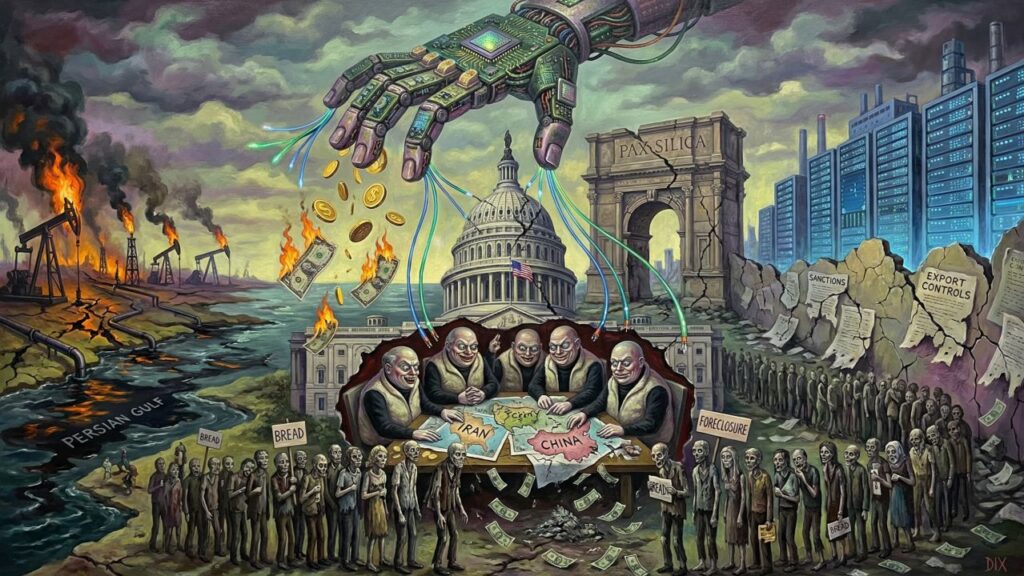
Tech Oligarchs Have Bought Control of the U.S. Government, Launched a Cold War on China and Iran Only to Protect Their Monopolies, and Accelerated the American Collapse They Swore to Prevent
The United States is no longer just “competing” with China. It is waging a full spectrum cold war that runs through tariffs, chip bans, critical minerals, energy chokepoints, and financial sanctions. That campaign is not being designed by neutral strategists acting in the public interest. It is being driven by a tight Silicon Valley network now embedded in the state: Peter Thiel’s Palantir protégé Jacob Helberg running Pax Silica at the State Department, David Sacks shaping AI and crypto policy while betting heavily on the same sector, and the PayPal Mafia’s money putting JD Vance a heartbeat from the presidency.
Their project is straightforward: use U.S. power to break the only country, China, that has built a parallel tech stack capable of challenging their global monopoly, and to throttle China’s energy lifeline through Iranian oil. In the process, they accelerate the internal decay of an American empire already hollowed out by financialization, de‑industrialization, and permanent war, while selling this scorched earth strategy as “national security” and, with a Latin flourish, “Silicon Peace.”
The Financialized Empire
How America Traded Factories for Futures
The foundation of everything that follows is a single structural fact: the United States de‑industrialized. American manufacturing fell from roughly 21 to 25 percent of GDP in the 1950s to about 10 percent today, well below peer economies like Germany, South Korea, and Japan that kept strong industrial bases. Between 1998 and 2010, the U.S. lost 6.1 million manufacturing jobs, with 4 million vanishing before the Great Recession even began. The manufacturing sector spent most of 2025 in contraction, with the ISM Purchasing Managers’ Index at 47.9 in December, below the 50 line, and the gap between production and orders at levels not seen since the 2008 financial crisis.
This was not an accident. It followed a deliberate policy architecture that put finance over industry. Starting in the 1980s and accelerating under Clinton, Bush, Obama, and Trump, the United States replaced industrial policy with monetary policy. The Federal Reserve became what one prominent economist called “the implementer of the Ponzi scheme into which the United States economy has degenerated,” not managing the real economy, but inflating asset prices for the benefit of the financial sector’s most important clients.
The numbers show this clearly. Between December 2005 and December 2025, the Fed’s balance sheet grew from about 800 billion dollars to around 6.5 trillion, from roughly 6 percent of GDP to about 21 percent. This expansion did not go into productive investment. It went into stocks, bonds, and real estate. The top 1 percent now hold about a third of the nation’s wealth, the highest share since records began in 1989, while the bottom half holds only a few percent. The top 10 percent hold the vast majority of corporate equities and mutual fund shares. Almost all the wealth growth of the last two decades went to that top slice, while 90 percent of households hold the corresponding debt.
Fiscal policy looks similar. For decades, it has been a one way ratchet. Republican administrations cut corporate taxes. Democratic administrations leave the cuts in place and trim social spending. The next Republican administration cuts taxes again. The result is a debt pile above 37 trillion dollars and interest payments that now rival the defense budget. That creates a perverse incentive to privatize Social Security into the stock market just to keep the scheme going.
The Everything Bubble
Today’s financial system sits on what analysts call the “everything bubble.” Equity prices have been driven to extreme levels, mainly by the big tech names and AI hype. Amazon, Alphabet, Meta, and Microsoft together spent close to 300 billion dollars on capital expenditures in 2025. It is increasingly clear that these huge AI investments are not generating returns that match the hype. One major research house projects that when the AI bubble finally breaks, U.S. stocks will deliver only low single digit average returns over the next decade, well under the long term norm, and warns that “American exceptionalism may end in the coming years.”
The Federal Reserve’s 2026 stress tests now model a scenario with a stock market fall of more than 50 percent triggered by an AI bust and global stagflation. A major bank’s bubble indicator has already flagged rare earth metals and several other asset classes at extreme risk levels. The Fed is boxed in. If it raises interest rates to fight inflation, it risks triggering an asset price crash like 2008. If it keeps rates elevated or cuts too slowly, it strangles a leveraged, debt dependent economy. In 2025, the Fed started cutting rates, moving the funds rate down from just under 5 percent to the mid 3s. The dollar index dropped by double digits in the first half of 2025, the sharpest fall since the early 1970s, and hit a four year low in early 2026. Major banks expect more weakness through this year.
Congress then pushed cryptocurrency into this already fragile system through the GENIUS Act, adding yet another volatile speculative asset class that insiders can pump while ordinary investors take the risk.
The Supply Chain Battlefield
China’s Critical Mineral Dominance
Against that backdrop of financial fragility and industrial hollowing, the United States faces a stark strategic reality. The country that de‑industrialized now depends on its main rival for the raw materials that feed both its remaining tech sector and its military industrial complex.
China dominates the global supply chain for critical minerals. It produces a majority of mined rare earths and controls over 90 percent of refining and processing capacity for key elements. Its grip is even tighter in heavy rare earths, which are the most sensitive for defense applications. The U.S. produces only a small fraction of what China does, and still ships much of its own output to Chinese refiners.
That dominance was built through decades of deliberate industrial policy. China made a plan and stuck to it. The United States, by contrast, treated industrial policy as a dirty word. Beijing has also shown it is willing to weaponize this advantage. In 2025 it rolled out export controls on a widening list of heavy rare earths used in magnets and military systems, and extended those controls to related products and technologies. By the end of the year, exports of less processed rare earths were well below average.
Hawks in Washington keep publishing reports calling China’s mineral control a national security threat, because U.S. weapons systems depend on those elements. The irony is impossible to miss. The United States is preparing for a potential war with China but cannot actually fight such a war without Chinese processed minerals.
Pax Silica: Imperial Peace in the Language of Commerce
The program that ties these elements together is called Pax Silica. The name is a tell. It is Latin for “Silicon Peace” and deliberately echoes “Pax Romana” and “Pax Americana,” the labels historians use for eras when one empire enforced its order on the known world through overwhelming military and economic dominance. In political history, “Pax” is never neutral. It means an imperial peace enforced from above: Rome in antiquity, Britain in the 19th century, the United States after 1945. By choosing that label, the State Department openly claims continuity with that imperial lineage. As one analyst put it, Pax Silica “may not embody peace in the conventional sense” but instead aims at “collective autonomy and dominance.” The department’s own slogan is even plainer: “If the 20th century ran on oil and steel, the 21st century runs on compute and the minerals that feed it.” Swap oil and steel for silicon and rare earths, keep the same extractive structure, and call it peace.
Pax Silica was launched in December 2025 as the State Department’s “flagship effort on AI and supply chain security.” It is run by Under Secretary Jacob Helberg, who describes it as a “coalition of capabilities” that will secure the “full technology stack” from mines and refineries through chip foundries, data centers, and AI platforms. In congressional hearings, Helberg outlined plans to build something that looks a lot like an Amazon style global logistics system for the U.S. tech supply chain. He was blunt about the purpose: to turn American diplomats into sales reps for U.S. AI companies and make it easier for allied governments to buy American systems instead of Chinese ones. The foreign service as a tech sales force is not a metaphor. It is the operating model.
Helberg calls this framework “Silicon Statecraft.” It replaces the oil centered order of the 20th century with a silicon centered order still run from Washington and still enforced through access and denial. The “peace” offered is closer to a protection racket. Countries that sign up get access to chips, models, and mineral finance. Countries that do not risk being cut out of the American technology stack and related aid programs, including the “secure, low cost devices running on American software” that Washington is using as bait. When Helberg insists that “Pax Silica is really not about China,” the denial speaks for itself. The architecture is built around excluding one country.
The membership list shows both the ambition and the limits. Core signatories include close U.S. partners in the Pacific and Europe, plus a handful of Gulf monarchies. Canada, the EU, and Taiwan hover in observer status. In early 2026, the State Department hosted a “Critical Minerals Ministerial” in Washington, inviting 54 governments to discuss supply chain security. The administration pitched a critical minerals trade bloc, “trusted” trading zones, and price coordination meant to “restore competitiveness,” a polite way of saying “break China’s dominance.” It announced eleven new bilateral frameworks and unveiled a new forum with a name straight out of a video game, the Forum on Resource Geostrategic Engagement.
At the same time, it launched Project Vault, a 12 billion dollar stockpile of critical minerals, backed by a record 10 billion dollar loan from the Export Import Bank and 2 billion from private investors. It also rolled out a 36 billion dollar package of oil, gas, and minerals deals with Japan. On paper, State and Ex‑Im boasted of more than 30 billion dollars in combined investments, loans, and guarantees for mineral projects.
The reality is less impressive. Of the 54 governments that showed up in Washington, only around a dozen signed binding commitments. Brazil, Mexico, Pakistan, and Saudi Arabia all attended but did not enlist in an anti China minerals bloc. Even friendly think tanks admit that problems like volatile prices, uncertain long term offtake contracts, and weak demand are structural, not something a single forum can fix. The first heavy rare earth processing plant owned by a U.S. firm and operating on U.S. soil only came partly online in 2025. China has been building capacity for three decades. By the admission of industry experts and U.S. officials, “China’s control of rare earths will be difficult to break” and Chinese firms hold “almost 100 percent competitive edge in medium and heavy rare earth refining due to cost factors.”
Strip away the Latin branding and diplomatic language and Pax Silica looks like this: a rushed attempt to recreate the industrial supply chains the United States dismantled over thirty years, without upsetting the oligarchs who profited from their destruction. Instead of rebuilding domestic industry through public investment and regulation, Washington is leaning on diplomatic pressure, aid packages, and the conversion of embassies into sales offices for the tech billionaires who now occupy government posts. The State Department is running business development for Palantir, OpenAI, and Nvidia and calling it “peace.” The Romans at least built aqueducts and roads.
And Pax Silica is not just about minerals and chips. It also has an energy arm. That arm is the maximum pressure campaign against Iran.
The Energy Chokepoint Strategy
Iran, Oil, and the Real Target
One of the least understood parts of Cold War II is how U.S. policy toward Iran, Venezuela, and Russia links back to the broader strategy against China. The connecting tissue is oil.
China is the largest crude oil importer in the world. It buys most of Iran’s exports, a similar share of Venezuela’s, and is also the top buyer of Russian oil. A significant slice of the oil China receives by sea comes from Iran. In early 2026, Trump and Israeli prime minister Benjamin Netanyahu announced that they had agreed to intensify economic pressure on Iran “particularly targeting its oil exports to China.” Senior U.S. officials said bluntly that Washington and Tel Aviv had agreed to pursue “maximum pressure against Iran, particularly concerning oil sales to China.”
Helberg has been just as direct in public. On social media he wrote that “the goal of max pressure is to drive Iran’s oil exports to zero, especially oil exports to China.” This is not a side project. U.S. sanctions and pressure now target Iranian capacity, Venezuelan production, and Russian energy exports at the same time that the Pentagon deploys naval forces near the two vital sea lanes through which most of China’s seaborne oil flows.
The first is the Strait of Hormuz, off Iran’s coast, where close to a fifth of global oil and product shipments pass every day. U.S. warships now operate just outside those waters. The second is the Strait of Malacca between Malaysia and Indonesia, through which much of that oil then passes to reach the South China Sea. In a crisis, the U.S. Navy could shut either chokepoint and strangle Chinese energy supplies.
Beijing’s response has been to buy as much crude as it can and stuff both commercial and strategic reserves, taking advantage of discounts on sanctioned oil. That stockpiling reduces short term vulnerability. It does not change the geography. The U.S. still holds the naval leverage. The energy offensive is simply another wing of the same encirclement strategy that runs through minerals and chips.
The Tech War and the AI Arms Race
The confrontation over supply chains extends up the technology stack. Washington has rolled out wave after wave of export controls meant to deny China access to cutting edge semiconductors. The idea was simple. If China cannot buy the most advanced chips, it cannot compete in AI, and U.S. firms keep their lead by default.
That is not what happened. Cut off from the newest processors, Chinese firms went sideways. They clustered large numbers of slightly older chips into massive parallel systems and trained competitive models anyway. DeepSeek, a Chinese AI lab, put out a large language model that has been downloaded more than 75 million times. Developers access it through Hugging Face, a public website and platform where AI models are shared and reused. DeepSeek reportedly trained its newest model on Nvidia’s top tier Blackwell chip, which would imply a hole in the export control regime, and then refused to give early access to U.S. chipmakers while offering it to domestic firms such as Huawei. Analysts read this as part of a wider Chinese strategy to impose a disadvantage on U.S. hardware and models inside China.
At the same time, Washington is trying to pull the entire AI supply chain back under its control. Both the Biden and Trump administrations leaned on TSMC, the Taiwanese foundry that makes most of the world’s leading edge chips, to build plants in the United States. The critical triangle of the AI chip world is ASML in the Netherlands (which makes the lithography equipment), Nvidia in the United States (which designs the chips), and TSMC in Taiwan (which manufactures them). U.S. strategy is to ensure that all three points in that triangle are either on U.S. soil or in the hands of governments that will follow Washington’s lead in a crisis.
The Oligarchs Behind the Curtain
Silicon Valley’s Capture of the State
The most revealing feature of Cold War II is not the technology or the trade disputes. It is the question of who is driving this agenda and why. Official rhetoric says this is about national security and defending democracy. The evidence points to something narrower: the capture of U.S. foreign policy by a small group of tech oligarchs whose fortunes depend on shutting down Chinese competition.
Trump’s current administration is the wealthiest in U.S. history. At least a dozen cabinet level or senior officials are billionaires. Treasury Secretary Scott Bessent is a billionaire hedge fund manager. Commerce Secretary Howard Lutnick is a billionaire financier. The crucial intersection of AI, tech regulation, and China policy is dominated by what the business press once cheerfully called the “PayPal Mafia”: the group of PayPal founders and early executives who used their initial success to build a network of venture funds, platforms, and political operations.
Peter Thiel is at the center. He co‑founded Palantir, a data analytics company that builds surveillance and intelligence software for the Pentagon, the CIA, and allied militaries, and he runs one of Silicon Valley’s most aggressive venture funds. He poured 15 million dollars into JD Vance’s Senate campaign and helped push Vance onto Trump’s ticket. Elon Musk, the world’s richest man, returned to Washington as a senior adviser and head of the Department of Government Efficiency. David Sacks, a billionaire investor and podcast host, was put in charge of AI and crypto policy and has said openly that a more “hawkish position with respect to China” helps “American companies win the AI race.” These people are not lobbying from the outside. They are sitting at the table making policy.
The conflicts of interest are obvious. Sacks still owns stakes in startups and platforms that stand to gain from the rules and contracts he designs. Palantir and other Thiel backed firms have picked up billions of dollars in government work from an administration his network helped install. In the fall of 2025, Trump invited a who’s who of Silicon Valley to the White House. Many of them were billionaires. Mark Zuckerberg alone pledged hundreds of billions of dollars in U.S. investments over the next few years.
No appointment captures this merger of state and tech oligarchy better than Jacob Helberg, the under secretary running Pax Silica. Before he took that job, Helberg was a senior adviser at Palantir, Thiel’s flagship intelligence contractor. Palantir lives on defense and intelligence contracts. Helberg is married to Keith Rabois, a member of the original PayPal Mafia who served as an executive vice president at PayPal with Thiel, Musk, and Sacks. Their wedding was officiated by Sam Altman, the chief executive of OpenAI. The man now in charge of U.S. AI supply chain policy was literally married by the CEO of the most powerful AI company in the world to a key member of the same tech clique that installed the politicians who hired him.
Draw the line: Palantir trained Helberg. The PayPal Mafia integrated him into their private network. Thiel’s money helped put the current vice president in office. The same network then placed Helberg in a State Department role where he sets policy on mineral supply chains, AI infrastructure, and sanctions. Helberg now uses that position to push “maximum pressure” on Iranian oil exports “especially oil exports to China” and to build Pax Silica so that, in Sacks’s words, “the world runs on the American technology stack rather than China’s.” That is not a conspiracy narrative. It is a straightforward description of overlapping professional, financial, and personal ties.
Once you see that line, China’s central role makes sense. Russia is a military rival. The European Union is an economic peer. Japan and South Korea are advanced tech producers. But only China has built a full parallel digital ecosystem that can replace U.S. platforms almost anywhere in the world. It has its own search engines, social networks, payment systems, e‑commerce giants, cloud platforms, chip designers, AI labs, and even its own satellite navigation system. No other country has done this. No other country has the scale to do it. China is not just another competitor. It is the one actor that can break Silicon Valley’s global monopoly outright.
Without China, U.S. firms would dominate digital life almost everywhere: search, payments, messaging, cloud, AI, and more. The present cold war is not being fought to protect Midwestern factory workers who lost their jobs to offshoring and automation. It is being fought to protect the billionaire class that offshored those jobs, cashed the gains, and now faces a rival they cannot simply buy or bankrupt.
Two Visions of World Order
The Rubio Doctrine: Empire Restored
The ideological frame for this confrontation was laid out in unusually clear terms at the Munich Security Conference in February 2026, when Secretary of State Marco Rubio gave a speech that sounded like it had been ghostwritten in the 1890s.
Rubio praised five centuries of Western expansion, “its missionaries, its pilgrims, its soldiers, its explorers pouring out from its shores to cross oceans, settle new continents, build vast empires extending out across the globe,” and he blamed the “terminal decline” of “the great western empires” on decolonization, “godless communist revolutions,” and “anti‑colonial uprisings.” His answer was simple: “We in America have no interest in being polite and orderly caretakers of the West’s managed decline. Armies fight for a way of life. And that is what we are defending.”
There was no subtext. The message was that the United States intends to reverse the global shift away from Western colonial domination. Unions and civil society groups in Africa called the speech “an insult and a direct and dangerous threat” to former colonies still living with the scars of empire. Scholars at major universities described it as “civilizational panic.” Trump’s deputy chief of staff Stephen Miller spelled out the operational logic on cable news: “The United States is using its military to secure our interests unapologetically in our hemisphere. We’re a superpower and under President Trump, we are going to conduct ourselves as a superpower.” The Monroe Doctrine, updated for the 21st century, now extends beyond Latin America to the world’s supply chains.
Beijing’s Counter Proposal: Sovereign Equality
At the same conference, Chinese foreign minister Wang Yi delivered a mirror image talk. Where Rubio invoked colonial glory, Wang cited the UN Charter. Where Rubio framed the issue as Western leadership versus decline, Wang said that “the monopolization of global power by a small number of countries is unpopular” and that “all countries should be equal in terms of rights, opportunities, and rules.”
Wang outlined five principles of Xi Jinping’s Global Governance Initiative: sovereign equality, rule of law in international affairs, multilateralism, a people centered development focus, and concrete follow through rather than slogans. He warned about a return of “the law of the jungle and unilateralism” and argued for “greater democracy in international relations.” He emphasized that “the Global South is rising collectively” and that international institutions must “update” to reflect that rise.
This is not just rhetoric. China has not fought a war since 1979. The United States has been in near constant conflict for decades and currently maintains active operations or deployments in multiple regions. China supports the UN system, with all its flaws, because it gives each member state one vote in the General Assembly and some protection through collective procedures. Washington routinely sidelines or withdraws from multilateral institutions it cannot bend to its will, uses its veto on the Security Council, holds unique veto power in the IMF and World Bank, and has effectively disabled the dispute settlement system at the World Trade Organization.
The contrast is stark. On one side, a power that openly mourns the end of formal empire and promises to use hard power to restore Western primacy. On the other, a power that calls for “greater democracy” in global institutions and leans on the language of sovereign equality. It is not hard to understand why most of the world’s population, the roughly 86 percent who live outside the Western bloc, show growing interest in the latter.
The Trade War’s Legal Reckoning
Supreme Court and the Limits of Executive Power
The legal scaffolding of the economic front in Cold War II took a hit on 20 February 2026. The Supreme Court struck down Trump’s broad tariffs in a 6 to 3 decision. Chief Justice John Roberts wrote that Trump did not have peacetime authority under the International Emergency Economic Powers Act to impose tariffs so sweeping and long lasting. He noted that the administration was using two words in the law, “regulate” and “importation,” separated by 16 others, to claim “independent power to impose tariffs on imports from any country, of any product, at any rate, for any amount of time,” a power Congress had never granted.
Trump responded almost immediately with a new proposal for a 10 percent across the board tariff on all imports under a different legal pretext and vowed to “keep fighting for years.” Trade lawyers pointed out that some tariffs targeted specifically at China might still survive under other statutes. A one year truce on tariffs that Trump negotiated with Beijing in October 2025 remains in place, but the White House has already signaled plans to reimpose new measures in 2027 after the midterms.
The key point is that this is not a partisan project. When Biden was in office, he did not unwind Trump’s tariffs. He kept them and then raised some of them further. The cold war on China is not a Republican or a Democratic idea. It is baked into a system that relies on debt and asset bubbles instead of industrial strength, but whose ruling class refuses to accept the loss of global dominance that follows from that choice.
India: The Swing State
Opportunism Disguised as Alignment
The biggest geopolitical addition to the Pax Silica framework so far is India’s decision to formally join in early 2026. New Delhi signed the declaration on the margins of the “India AI Impact Summit.” External Affairs Minister S. Jaishankar called for more structured cooperation to “de‑risk” supply chains and reduce “excessive concentration.” Helberg pitched the move as “securing the full stack of the future, from minerals deep in the earth to the intelligence that will unleash human potential.”
India’s calculus is straightforward. It wants the investment the U.S. is trying to steer away from China. It wants Apple to move more assembly to Gujarat and Tamil Nadu. It wants foundries, data centers, and AI labs. In short, it wants to repeat, in some form, the Chinese playbook of using foreign capital, tech transfer, and domestic champions to industrialize.
That does not mean India has become a loyal foot soldier in a U.S. led anti China bloc. The country still draws on its old Non Aligned Movement habits. In 2025, Modi attended a high profile summit with Xi and Putin on Chinese soil. India remains an active member of both BRICS and the Shanghai Cooperation Organization. When it suits India’s interests, it works with the U.S. When it does not, it deepens ties with China and Russia. This is not bandwagoning. It is hedging.
That pattern generalizes. Even the countries that have joined Pax Silica have done so for opportunistic reasons. They want money, technology, and access. They are not pledging loyalty in a new ideological struggle. The U.S. is not building a moral “coalition of the willing.” It is buying a coalition of the interested. Everyone else, from Brazil and Mexico to Pakistan and Saudi Arabia, is keeping options open.
The Structural Impossibility of Victory
Why the U.S. Cannot Win This Cold War on Current Terms
The deepest irony of the emerging cold war is that, on current terms, the United States cannot win it. Washington is trying to wage a trade war, a minerals war, a tech war, and an energy war without fixing the underlying weaknesses that made those wars seem necessary in the first place.
The trade war requires factories. The U.S. spent three decades closing them. The mineral war requires refineries and processing plants. China built those over thirty years. The first U.S. owned heavy rare earth processing facility on U.S. soil just started partial operations. The tech war requires large scale public investment in research and manufacturing that goes against the low tax, light regulation ideology of the billionaire class that funds U.S. politics.
Meanwhile, the dollar is losing altitude. After a long bull run from 2010 onward, it dropped meaningfully against other major currencies in 2025. Analysts at major banks expect more slippage this year. Central banks are quietly diversifying away from dollar assets. The U.S. fiscal deficit is widening again, driven by tax cuts and rising interest costs.
The Fed is out of easy moves. Quantitative easing is a political lightning rod after it became clear how much it enriched the top 10 percent. Rate cuts risk feeding the very bubbles that make the system fragile. Higher rates risk popping those bubbles. Scott Bessent described recent Fed policy as a “gain of function” experiment on the U.S. economy, borrowing a phrase from virus research, and the metaphor stuck for a reason.
To compete with China on industry, the U.S. would have to do what it did in the 19th and early 20th centuries: pour public money into infrastructure, break up or regulate finance, and rebuild manufacturing capacity. That would mean confronting the same oligarchs who currently shape both monetary policy and foreign policy. The billionaires who sat in special sections at Trump’s inauguration as symbols of national “success” effectively are the government. They are not going to vote to shrink their own power.
How the War Accelerates the Collapse
The cruel twist in all this is that every tool Washington uses against China makes the underlying American problems worse. The subtitle of this article is not hyperbole. You can measure the boomerang.
The Tariff Boomerang
Tariffs were sold as a weapon against Beijing. In practice, they hit American consumers and firms. Research by the New York Fed found that, for most of 2025, almost all the cost of U.S. import duties was borne by U.S. companies and households rather than foreign exporters. Average tariff rates on goods entering the U.S. jumped from low single digits into the teens in a single year. Independent tax analysts calculated that the tariff shock was the largest single tax increase since the early 1990s, costing typical households roughly a thousand dollars in 2025 and more the following year. Economists at the St. Louis Fed estimated that tariffs accounted for a notable share of headline inflation in 2025. Major banks warned that even after the Supreme Court ruling, most of the price damage would not unwind quickly.
Tariffs did not inspire a factory boom. They just charged Americans more for goods the U.S. no longer makes.
The Chip War Backfire
Export controls on chips were meant to slow China’s AI advance. Instead, they motivated Beijing to sprint toward self reliance. DeepSeek and other firms built competitive models anyway. Reports that DeepSeek trained on chips that were supposed to be blocked by U.S. policy suggest that enforcement is porous. DeepSeek’s decision to give preferential model access to Chinese companies over U.S. partners turned an attempted hardware chokehold into a software disadvantage for American firms. The net effect of the chip war so far has been to accelerate China’s push to build what it once would have been happy to buy.
The Sanctions Spiral and De‑Dollarization
Each new round of sanctions, whether on Russia, Iran, Venezuela, or third countries that keep trading with them, gives the rest of the world another reason to find non dollar ways to do business. The dollar’s share of global reserves has fallen from roughly three quarters at the start of the century to a bit over half today. China and Russia now settle most bilateral trade in their own currencies. Brazil and China have created a yuan real settlement channel. India pays for Russian oil in rupees. The BRICS bloc, which on a purchasing power basis now accounts for a large part of global output, is building a common payments system that uses central bank digital currencies instead of the dollar.
Weaponizing the dollar was supposed to force compliance. Instead, it convinced much of the world that relying on a single national currency for global trade is too dangerous. When Washington slapped high tariffs on Brazil over a political spat and threatened India over its Russian oil purchases, BRICS governments treated the moves as sanctions and responded by deepening intra bloc cooperation. Trump’s threat to slap 100 percent tariffs on countries that “de dollarize” did not scare them back into line. It proved the point that they needed an exit ramp.
The Fiscal Hemorrhage
Pax Silica, Project Vault, and the Japan energy minerals package all cost real money. Combined, they amount to tens of billions of dollars in commitments at a time when the U.S. runs annual deficits above 2 trillion dollars and pays more in interest on existing debt than it spends on the military. The Export Import Bank’s 10 billion dollar loan behind Project Vault is the biggest in its history. These are subsidies for offshore leverage, not for domestic schools, hospitals, or bridges. Every billion that goes into trying to outbid China for a mine in Africa is a billion that does not fix crumbling infrastructure in Ohio or Mississippi.
The Oil Gambit’s Double Edge
The maximum pressure strategy on Iran aims to drive its oil exports toward zero and squeeze China. But oil is traded on a global market. Removing more than a million barrels a day of Iranian crude from circulation risks sending prices higher for everyone, including U.S. drivers. China, which has been filling its tanks with discounted sanctioned crude, can ride out a spike far better than many poorer importers. The U.S. is trying to manufacture an energy crisis for Beijing and hoping it can avoid the fallout at home. That is wishful thinking.
Taken together, these measures are not random. They are the expected behavior of a financialized empire that is trying to fight economic, technological, energy, and monetary wars all at once without an industrial base, without insulation from global markets, and with a reserve currency whose dominance is slipping. The cold war with China is not slowing the American decline. It is speeding it up.
The Central Contradiction
The architecture of American decline is not mainly a story of bad leaders or bad plans. It is what you get when you optimize a system for financial extraction instead of productive investment. The new cold war with China is not a cure for that disease. It is a symptom of how advanced it has become. Every initiative, from Pax Silica and Project Vault to the Iran oil squeeze, tries to make up for lost competitiveness with brute force.
The unipolar moment is already over. The dollar is weaker. Chinese AI models are good enough for much of the world. The Global South is hedging against Western volatility. The Supreme Court has started to push back on unilateral trade powers. U.S. manufacturing is still shrinking. The “everything bubble” hangs over the economy, looking for a pin.
The open question is how the transition to a multipolar order will unfold. One option is some version of the multilateral sovereign equality that Beijing and much of the Global South say they want. The other is a chaotic descent driven by an empire whose chief diplomat romanticizes colonial rule and whose senior aides talk openly about using military power to enforce U.S. economic interests.
Most of humanity lives outside the Western alliance. They have listened to both pitches. Their choices are visible in the pattern of countries that attend American led summits, decline to sign on to containment schemes, and go home to keep trading with China.
The architects of American decline are not sitting in Zhongnanhai. They are on Wall Street, in Silicon Valley, and in Washington, enriching themselves while the imperial machinery they control rusts and breaks. The second cold war is not a clash of civilizations. It is the end stage of a system that chose extraction over renewal and is now consuming itself in real time.
Related reading
- American Empire in Ruins: The Unprovoked, Unconstitutional, and Catastrophic US-Israeli War on Iran
- Trump’s Iran War, China Trip and the Vanishing Empire
- The Last Blunder: How the US-Israel Attack on Iran Killed the American Empire's Operating System
- The Petrodollar Trap: How the Iran War Threatens to Collapse the Financial Architecture of the American Empire