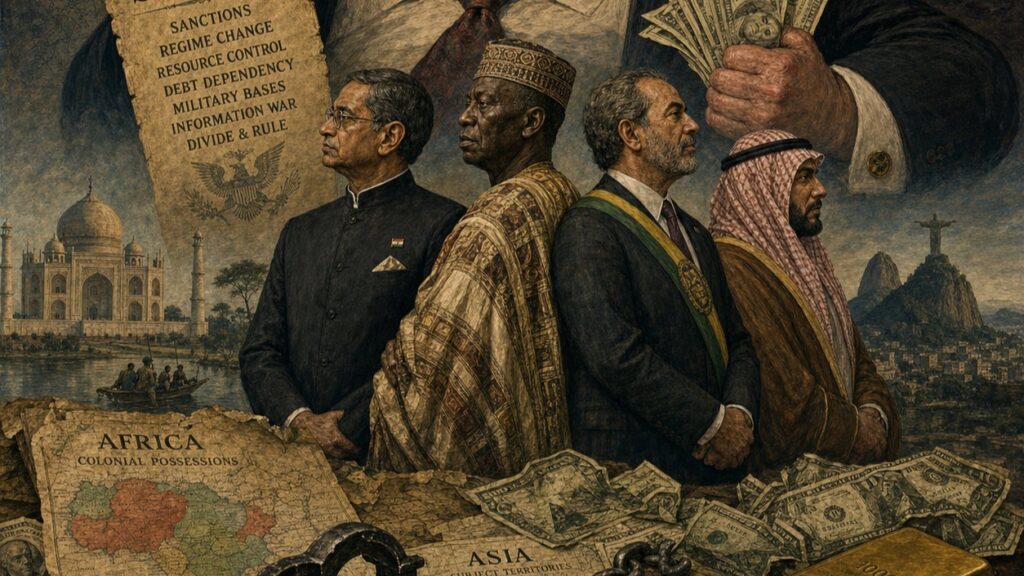
The Western Script Works for Nobody, Not Even Them
By Scott Ortkiese | July 5, 2026 | so@throughlinesynthesis.com
Introduction: The Dog That Did Not Bark
When Russia launched its military operation in Ukraine in February 2022, the Western foreign policy establishment expected the world to follow. Sanctions would be universal. Condemnation would be unanimous. The rules-based international order, as its custodians prefer to call it, would close ranks. What happened instead was one of the most consequential acts of collective geopolitical defection in the post-war era. India, China, Brazil, South Africa, the Gulf states, most of Africa, and much of Southeast Asia refused to follow the script. They declined to sanction Russia. They declined to condemn it in terms the West found satisfactory. They continued buying Russian oil, Russian grain, and Russian fertilizer. They abstained at the United Nations. And when Washington passed the 2022 “Countering Malign Russian Activities in Africa Act,” threatening punishment for any African government that refused to condemn Moscow, the response was not compliance. It was contempt.
The Western explanation for this defection has been consistent and self-serving: these countries are economically dependent on Russia, corrupted by Kremlin propaganda, or simply not yet mature enough to understand that rules-based order is in everyone’s interest. That explanation is not only wrong. It is precisely the kind of condescension that explains why the defection happened in the first place. The Global South did not refuse the script because it failed to understand it. It refused the script because it understood it perfectly. The countries that declined to join the Western coalition against Russia are, with very few exceptions, the same countries that spent the 19th and 20th centuries on the receiving end of the mechanisms now being deployed against Moscow: sanctions, isolation, enforced dependency, and the application of universal moral principles that apply to everyone except the party doing the enforcing.
This article argues three things. First, the Global South’s refusal is not a temporary diplomatic inconvenience. It is a structural signal about the durability of the post-1945 Western-led order. Second, the monetary consequences of that refusal, specifically the acceleration of de-dollarization and the systematic diversification of central bank reserves away from U.S. Treasuries and toward gold, are already visible in the data and will compound over the next decade in ways that Western financial institutions are structurally reluctant to model. Third, the most concise explanation for why this happened was delivered not by a Russian official or an academic theorist but by India’s Foreign Minister S. Jaishankar at the Globsec forum in Slovakia in June 2022: “Europe has to grow out of the mindset that Europe’s problems are the world’s problems, but the world’s problems are not Europe’s problems.”
Part I: The Memory That Europe Forgot It Had Created
The Bandung Reflex
To understand why India, South Africa, and Brazil behaved as they did in 2022, one must go back to Bandung, Indonesia, in April 1955, when 29 newly independent nations gathered for what became the founding conference of the Non-Aligned Movement. The delegates at Bandung were not naive. They understood the Cold War perfectly well. What they rejected was the premise that they were obligated to choose a side in a conflict between two imperial powers neither of which had ever treated them as equals. They adopted what became the Bandung Principles: opposition to colonialism, support for national sovereignty, and rejection of the idea that any bloc of nations had the right to define universal norms and enforce them on others.
The institutional memory of Bandung is not abstract in New Delhi, Pretoria, or Brasilia. It is the foundational operating principle of the foreign policy establishments of three of the world’s ten largest economies. When Western capitals expressed shock and frustration at India’s refusal to condemn Russia in 2022, they were encountering the direct descendant of the political architecture India built at Bandung seventy years earlier. India had not changed. The West had simply forgotten that India had never agreed to the rules it was now being asked to enforce.
The Colonial Pattern Recognition Problem
Pascal Lottaz, writing from the Pskov conference in June 2026, makes the essential observation that the Global South’s clarity about this conflict derives in part from direct experience with the mechanisms being deployed. The othering, the dehumanization, the construction of a hollow stereotype combining weakness and menace, the justification of punitive action against a people reduced to a caricature: this is not an unfamiliar template in Lagos, Mumbai, Jakarta, or Johannesburg. It is the mechanism of colonialism, applied to a new target.
Alexander Mercouris, also at Pskov, documented 250 years of Western literary, theatrical, and cinematic output constructing the same caricature of the Russian: simultaneously ridiculous and threatening, too stupid to govern themselves yet somehow dangerous enough to require containment, or destruction. The Global South recognized that template because it had been applied to them. The construction of the “imbecile savage,” as Lottaz terms it, is not specific to Russia. It is the general-purpose ideological infrastructure of Western expansionism, repainted for each new target.
This recognition produced what analysts, groping for a neutral term, have called “pragmatic indifference.” The phrase understates the phenomenon. India’s position on the Ukraine conflict is not indifference. It is a principled refusal to participate in a moral framework whose universal pretensions are falsified by the selective application of its own rules. As Jaishankar made clear in Slovakia, the Global South watched the West treat the destruction of Libya, Iraq, Afghanistan, and Gaza as regrettable but necessary, and then demand that the same world community treat the Ukraine conflict as an unprecedented crime against civilization. The inconsistency is not subtle. It is structural.
Part II: The Weaponization of the Dollar and Its Consequences
The $300 Billion Lesson
In February 2022, the United States and its allies froze approximately $300 billion in Russian sovereign foreign exchange reserves held in Western financial institutions. The decision was legally controversial, strategically significant, and, from the perspective of every central bank outside the Western alliance, existentially clarifying. The message was unambiguous: dollar assets held in the Western financial system are not assets. They are hostages. Any sovereign government that maintains reserves in the form of U.S. Treasuries, euro-denominated bonds, or assets accessible through SWIFT is not holding money. It is holding a potential instrument of coercion in the hands of Washington.
The response was immediate, measurable, and has continued to accelerate. Central bank gold purchases, which had averaged approximately 500 tonnes annually before 2022, surged to over 1,000 tonnes in each of the three years following the freeze of Russian reserves. In 2025 alone, central banks acquired a net 1,237 tonnes of gold. By end-2025, according to ECB data, gold had surpassed U.S. Treasuries as a share of total global official reserves for the first time in nearly three decades, accounting for 27% of global reserve assets against 22% for Treasuries. The dollar’s share of global foreign exchange reserves fell to approximately 57% by end-2025, its lowest level since 1994, down from 71% in 1999.
The BRICS+ bloc, which expanded in 2024 to include Egypt, Ethiopia, Iran, Saudi Arabia, and the United Arab Emirates, now collectively holds approximately 6,000 tonnes of gold, representing 17.4% of total global central bank gold reserves. Russia holds 2,336 tonnes. China holds 2,298 tonnes. India holds 880 tonnes. These are not portfolio decisions. They are sovereign insurance policies against a financial architecture that has demonstrated, publicly and unambiguously, that it will seize the assets of any government that crosses Washington’s red lines.
The Payment Architecture Under Construction
The de-dollarization process is, contrary to Western commentary, not primarily about replacing the dollar with an alternative reserve currency. It is about building parallel plumbing. The BRICS mBridge initiative, the bilateral currency settlement agreements between India and Russia, between China and the Gulf states, and between Russia and Iran, are not designed to make the yuan the world’s reserve currency. They are designed to make it possible for major economies to trade energy, grain, fertilizer, and manufactured goods without touching the dollar system at all.
The practical consequences for Western financial institutions are already visible. India has settled substantial crude oil purchases from Russia in rupees and dirhams. China and Russia have expanded yuan-ruble settlement to cover a majority of their bilateral trade. Saudi Arabia has completed test transactions in yuan for oil sales to China. None of these transactions, individually, constitutes a systemic shift. Collectively, they represent the construction of a parallel financial architecture whose capacity and coverage is expanding quarter by quarter.
A 2025 World Gold Council survey found that 73% of central bankers anticipate further declines in the dollar’s reserve share over the next five years, and 43% intend to increase their gold allocations. As of June 2026, the inclination among surveyed central banks to reduce dollar holdings over the next decade has, for the first time, surpassed the inclination to increase them. The dollar will not be displaced as the dominant reserve currency in any near-term horizon. But the margin of its dominance is compressing, and the catalyst for that compression is not Chinese economic power or yuan internalization. It is the demonstration, in February 2022, that the dollar system is a weapon.
Part III: The Sanctions That Backfired Structurally
What the Sanctions Were Supposed to Do
The Western sanctions regime imposed on Russia following February 2022 was the most comprehensive ever assembled against a major economy. It was designed to collapse the ruble, crash Russian GDP, starve the military-industrial base of components, and produce the kind of domestic economic crisis that would force a political change in Moscow. None of these objectives were achieved. The ruble recovered. Russian GDP contracted modestly in 2022 and then grew in 2023 and 2024. The military-industrial base adapted, sourcing components through Turkey, the UAE, China, and India. Russian oil found new buyers at slightly discounted prices in Asia within months of the Western embargo.
The sanctions failed for a reason that Glenn Diesen, Larry Johnson, and the Russian economic establishment understood before they were imposed: Russia had spent the previous decade making its economy structurally resilient to exactly this scenario. The pivot to Asia was not improvised after 2022. It was prepared. When Russian oil stopped flowing to Germany, it did not disappear. It flowed to China, India, and Turkey instead, at prices that remained profitable for Russia and attractive for buyers. The European energy crisis that followed was not an unintended consequence. It was the predictable result of severing a supply relationship that had been built over decades, with no viable alternative supplier, while the displaced Russian supply simply rerouted.
The Demonstration Effect
The more consequential failure of the sanctions regime is not what they failed to do to Russia. It is what they taught everyone else. The 2022 “Countering Malign Russian Activities in Africa Act” passed by the U.S. House of Representatives, threatening punitive measures against African governments that refused to condemn Russia, produced the opposite of its intended effect. Rather than coercing African states into alignment, it confirmed for them that the dollar system and the Western institutional framework were instruments of coercion, not neutral infrastructure. It validated, in legislative form, exactly the Kremlin narrative that Western sanctions were neo-colonialism with a financial mechanism.
India’s Jaishankar has articulated the fundamental objection precisely: the West weaponized interdependence. Having built a global financial architecture premised on the benefits of participation, it then demonstrated that participation was conditional on political compliance. For countries that had spent decades integrating into that architecture in good faith, the demonstration was not abstract. It was a direct threat to their sovereign financial autonomy. The response, de-dollarization, gold accumulation, bilateral currency settlements, and BRICS+ payment architecture, is not anti-Western sentiment. It is rational risk management.
Part IV: The Multipolar World the West Accidentally Built
What Multipolarity Actually Means
Western commentary treats “multipolarity” as a Russian propaganda term, a Kremlin talking point designed to legitimize aggression by dressing it in the language of international equity. That framing cannot survive contact with the actual positions of the countries involved. The demand for a multipolar order did not originate in Moscow. It has been the consistent foreign policy position of India, China, Brazil, South Africa, and the Non-Aligned Movement for seven decades. It predates Putin. It predates the Soviet Union as a geopolitical competitor. It is the political expression of the same impulse that gathered at Bandung in 1955: the refusal to accept that any single power center has the right to define universal rules and enforce them selectively.
What the Ukraine war has done is accelerate the construction of the institutional infrastructure of that multipolar order. BRICS expanded from five to ten members in 2024. The New Development Bank, the BRICS alternative to the World Bank, has continued to expand its lending portfolio. The payment architecture bypassing SWIFT is being piloted in real transactions. Central banks are systematically reducing their exposure to the dollar system. The African Continental Free Trade Area is developing settlement mechanisms that reduce dependence on dollar intermediation. None of these developments was caused by the Ukraine war. All of them were accelerated by it, and specifically by the decision to weaponize the dollar system against Russia.
The Jeffrey Sachs Warning
Jeffrey Sachs, in a February 2025 address to the European Parliament at an event titled “The Geopolitics of Peace,” made the essential argument in terms that the European political class has proven constitutionally unable to absorb: the EU must stop its Russophobia, engage in direct dialogue with Moscow, and recognize that a security architecture for Europe must accommodate Russian interests or it will have no durability. Sachs, who has called European leaders “warmongers” and described their position as profoundly self-defeating, represents the most credentialed American voice making the argument that the Global South has been making in its foreign policy conduct since 2022.
His specific warning about Baltic Russophobia, delivered at the same forum, is particularly relevant for this analysis. The Baltic states, whose Russophobia is the most acute in the European theater, are also the states most exposed to the consequence of a direct military confrontation between Russia and NATO. Their eagerness for escalation is inversely proportional to their capacity to survive its consequences. The Global South watches this dynamic and draws the rational conclusion: the parties most enthusiastically prosecuting the conflict against Russia are the parties who will bear the least of its cost. Europe will pay with deindustrialization and energy poverty. Ukraine will pay with its population. The United States will pay with dollar hegemony erosion and depleted munitions stockpiles. The defense contractors will bank the proceeds.
Part V: The Reckoning for Western Financial Architecture
What the Asset-Backed Investment Community Must Price
For the economists and investment bankers for whom this analysis is written, the Global South’s refusal of the script translates into three concrete risk factors that are systematically underpriced in Western institutional frameworks.
The first is dollar reserve erosion. The dollar’s share of global reserves is declining at an accelerating rate. It fell from 71% in 1999 to 57% in 2025, and the survey data suggests the trend will continue. This does not mean the dollar collapses. It means the margin of seigniorage privilege and the political leverage that flows from reserve currency status are both compressing. Any long-duration instrument denominated in dollars or indexed to dollar-system dynamics carries an embedded risk that was not priced before February 2022.
The second is sanctions ineffectiveness as a policy tool. The demonstrated failure of the most comprehensive sanctions regime in history to achieve its stated objectives, combined with the acceleration of de-dollarization it produced, has permanently degraded the credibility of sanctions as coercive instruments against major or mid-tier economies with access to alternative markets. Any strategic framework that prices in the availability of sanctions as a reliable lever against Russia, China, Iran, or any BRICS-aligned economy needs to be rebuilt from the ground up.
The third is reconstruction finance risk. The assumption that Ukraine’s post-war reconstruction will be financed through Western institutional frameworks, with recoverable returns collateralized against Ukrainian sovereign assets, must be evaluated against the realistic military and political endgame documented in the companion analysis,The Managed War. A settlement imposed by Russia rather than negotiated with Western participation produces a reconstruction geography and institutional framework radically different from what Western reconstruction bond issuers are currently marketing. The guarantor class is the same class that produced the conditions requiring reconstruction.
Conclusion: The Script Was Always Theirs to Refuse
The Global South did not refuse the script out of ignorance, dependency, or corruption. It refused the script because the script asked it to endorse, once again, the premise that Western institutional power is the neutral arbiter of universal rules. That premise was false in 1884 at the Berlin Conference, when European powers divided Africa among themselves. It was false in 1953 when the CIA overthrew the elected Iranian government. It was false in 2003 when Iraq was invaded on the basis of fabricated intelligence. And it is false now.
The countries that declined to sanction Russia in 2022 are not pro-Russian. India is not pro-Russian. Brazil is not pro-Russian. South Africa is not pro-Russian. They are pro-themselves, in the tradition of Bandung, in the tradition of non-alignment, and in the entirely rational recognition that a world organized around Western institutional hegemony has historically served Western interests at their expense.
The most important strategic fact about the Ukraine conflict is not what it has done to Russia or Ukraine. It is what it has done to the architecture of Western power. The dollar system has been revealed as a weapon. The sanctions regime has been revealed as ineffective against non-compliant economies. The moral authority of Western institutions has been revealed, to anyone outside the Western epistemic bubble, as a selective application of principles that evaporate whenever Western interests require it. The Global South drew the rational conclusions from each of these revelations and acted accordingly.
The script is in the hands of the same people who wrote it. The rest of the world decided it was not obligated to perform it.
This article is the second in a series examining the Ukraine conflict and its global consequences. The first, “The Managed War,” addressed the military and political architecture of the conflict. Subsequent analysis will address the Russophobia framework as a political technology and its implications for European institutional credibility.
Related reading
- Why Russia’s Future Looks Less Precarious Than Washington’s
- The G7’s Relevance Problem: How Russia, China, India, and South Korea See the Club They’re Not In
- Hey World: Give Peace a Chance
- The Trillion Dollar Bill Is Not Yours: What the Western AI Buildout Means for Russia