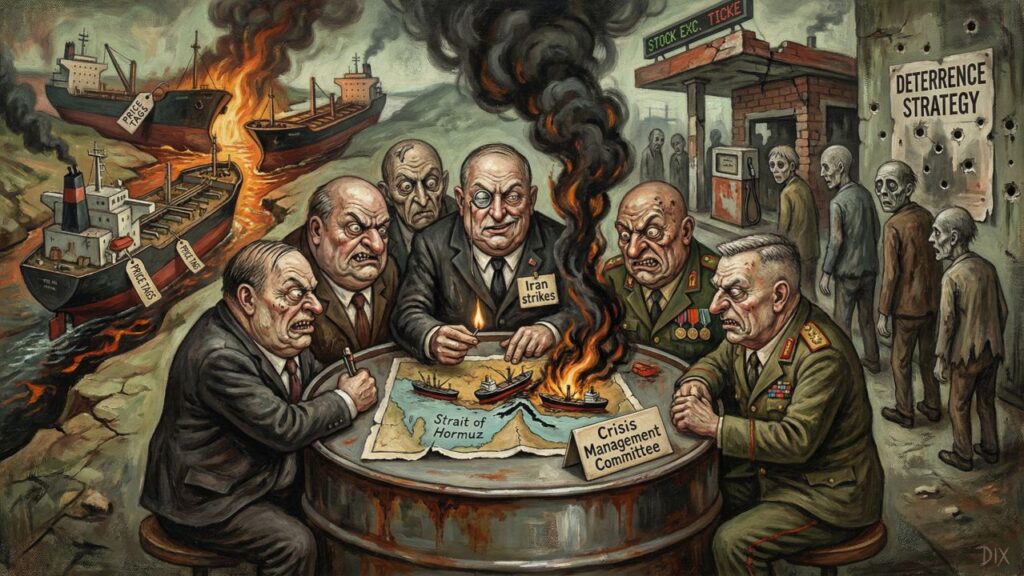
The United States has finally done it. It bombed Iran, helped trigger the effective closure of the Strait of Hormuz, and is now scrambling to fix the energy shock it created. This is not a strategy. This is a country lighting the gas station on fire, then insisting it is the fire department.
We are told the strikes were about “deterrence” and “credibility.” In practice, the message to the rest of the world is simpler: Washington will gamble with a fifth of global oil flows and then act surprised when markets price in risk. Iran did the one thing every basic war game has highlighted for decades: it weaponized Hormuz, and the administration looks offended that gravity still exists.
The follow‑up has been a case study in amateur crisis management. First, bomb Iran and turn the world’s key oil chokepoint into a live‑fire zone. Second, watch prices spike and shipping grind to a halt. Third, scramble to waive sanctions on Russian and possibly Iranian barrels at sea, plus suspend the Jones Act, as if paperwork changes on tankers can magically replace physical supply.
The sanctions pivot is particularly revealing. Days ago, Russian and Iranian oil were framed as strategic threats that had to stay in the ground. Today, the same barrels are “temporarily” indispensable to contain an energy shock triggered by Washington’s own decision to widen the war. The result is obvious: higher revenues for Moscow, a de facto bailout for sanctioned producers, and a visible crack in the sanctions regime’s credibility.
The Jones Act waiver is even more cosmetic. Allowing foreign‑flagged vessels to move fuel between US ports for 60 days might help with some short‑term routing issues, but it does nothing to reopen Hormuz or create new barrels globally. You do not solve a structural supply shock originating in the Persian Gulf by tinkering with cabotage rules in the Gulf of Mexico.
None of this was unforeseeable. The vulnerability of Hormuz, the role of Iran’s asymmetric tools, and the sensitivity of oil and LNG markets, all of this has been exhaustively discussed in energy and security circles for decades. If you bomb Iran, you run a serious risk that Hormuz turns into a battlefield. If Hormuz closes, you get a global price spike and a scramble for barrels. This is page one of any honest risk memo.
Yet here we are, watching policymakers pretend the crisis is a “surprise” rather than the predictable consequence of their own choices. They are improvising waivers and exemptions on the fly, hoping to keep prices down long enough to declare victory, while ordinary people absorb the hit in fuel, food, and macro uncertainty.
It is tempting to call this a miscalculation. It is closer to malpractice. When a government walks straight into the most obvious trap in modern geopolitics and then reaches for short‑term gimmicks to hide the damage, the problem is not intelligence. The problem is that no one in charge feels accountable for connecting cause and effect.
If this is what passes for grand strategy in Washington, allies and markets will draw the obvious conclusion. The “indispensable nation” is behaving like an arsonist who wants credit for holding the hose.
Related reading
- The Enemy We Made: Three Times Iran Extended Its Hand, Three Times America and Israel Answered with a Fist
- The Gulf States Paid Washington to Destroy Them
- The Last Pretense: Kharg Island and the Architecture of Trump's Imperial Theft
- US-Israeli Attack on Iran Will Trigger Global Starvation