April 28, 2026
By Scott Ortkiese | so@throughlinesynthesis.com | www.throughlinesynthesis.com
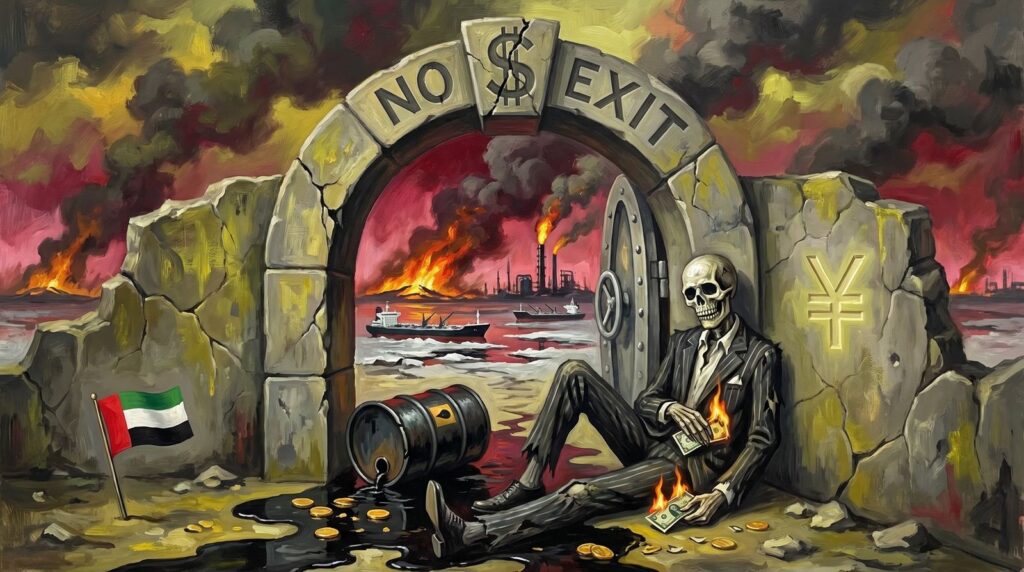
Today, the United Arab Emirates announced its withdrawal from OPEC and the wider OPEC+ alliance, effective May 1. The official statement cited strategic flexibility, domestic capacity ambitions, and dissatisfaction with the Gulf Cooperation Council’s collective security response to the Iran war. Every word of that statement is technically accurate and almost entirely beside the point. This is not an energy market event dressed in geopolitical clothing. It is a geopolitical event dressed in energy market clothing, and what it presages for the petrodollar system is not erosion. It is rupture.
Wall Street did not see it coming because Wall Street chose not to look.
The Opening Exhibit: OPEC’s Institutional Suicide
Before analyzing what the UAE’s exit means, it is necessary to establish what the institution it is leaving had already become.
In April 2026, the OPEC secretariat published its Monthly Oil Market Report maintaining its pre-war economic projections in the face of a 10.1 million barrel per day supply deficit, the largest sudden supply disruption in recorded history, dwarfing the 1973 Arab oil embargo, the 1991 Gulf War, and the 2020 pandemic shock combined. OPEC+ production alone suffered a catastrophic 27% decline, dropping 9.4 million barrels per day month-over-month to 20.79 million barrels per day. The Strait of Hormuz, through which roughly 20% of the world’s seaborne crude oil and liquefied natural gas normally transits, had been functionally closed for nearly sixty days. And the secretariat noted only that geopolitical developments “warranted monitoring.”
This is the wine-from-water dynamic at its purest institutional expression. An organization constitutionally incapable of acknowledging a 10.1 million barrel per day deficit in its own official data is not a cartel managing a market. It is a bureaucratic fiction maintaining the appearance of governance while the physical reality it purports to govern has already moved beyond its reach. The UAE’s exit is, among other things, a public declaration that Abu Dhabi will no longer associate its sovereign credibility with that fiction.
The Willful Blindness
There is a particular species of institutional negligence that masquerades as sophistication. It is not ignorance. It is the deliberate suppression of a threatening signal in favor of a reassuring framework, repeated so consistently and by so many credentialed voices that it eventually becomes indistinguishable from consensus analysis.
The petrodollar’s structural vulnerability was not a secret. Deutsche Bank circulated a note in late March warning explicitly that the Iran war “may expose further fault lines” in the dollar’s security umbrella, that “damage to Gulf economies could encourage an unwind in their foreign asset savings,” and that the conflict “could be remembered as a key catalyst for erosion in petrodollar dominance, and the beginnings of the petroyuan.” That note circulated on trading desks across Wall Street. The response from the institutional community was not engagement. It was active counter-narrative.
The Wall Street Journal published an op-ed on April 12 titled “The Iran War Is a Boon for the Petrodollar,” arguing that U.S. military presence in the Gulf reinforced dollar primacy and that the petroyuan threat was structurally overstated. State Street Global Advisors, in its April currency commentary, declared flatly that “crisis conditions favor USD,” citing the dollar’s status as a net energy exporter currency and its AI-driven growth tailwinds as structural supports. Morningstar’s fixed-income analysts argued that once the war was “in the rearview mirror,” markets would refocus on underlying macro conditions that would put downward pressure on the dollar only modestly, predicting a “V-shaped year” for the currency.
Meanwhile, the UAE Crown Prince was in Beijing. The UAE central bank was calling the Federal Reserve to ask for an emergency dollar swap line. And Abu Dhabi was embedding a yuan warning in that very request.
The irony is not merely that the market was wrong. Markets are often wrong. The irony is that the market was wrong in precisely the direction that required the most active effort to maintain. The signals pointing toward dollar stress were not ambiguous. They were Deutsche Bank-grade explicit, sovereign-wealth-fund-grade operational, and Fed-swap-request-grade urgent. Choosing to read them as confirmation of dollar strength required a motivated interpretive framework, one that institutional clients, quarterly earnings cycles, and the structurally comforting myth of American monetary exceptionalism were perfectly calibrated to supply.
What the 1974 Architecture Actually Was
To understand what is breaking, you have to understand precisely what was built.
In June 1974, in the aftermath of the Nixon Shock and the 1973 oil embargo, the United States and Saudi Arabia concluded an arrangement so sensitive its terms remained classified until 2016. The agreement was structurally elegant: Gulf producers would price oil exclusively in U.S. dollars and recycle those surpluses into U.S. Treasuries, and in exchange, the United States would provide an unconditional security guarantee to the Gulf monarchies. The arrangement was not a formal treaty. It was an operational architecture. Oil became the mechanism by which every nation on earth was compelled to hold dollars, because every nation on earth needed to buy energy. The “exorbitant privilege” its critics have invoked for decades was not rhetorical. It was structural: the United States was the only country whose debt was self-financing because the entire global economy was involuntarily capitalized into demand for that debt.
That architecture rested on two load-bearing pillars. First, producers had to need the security guarantee enough to accept the currency constraint. Second, the security guarantee had to credibly deliver. Both pillars are now compromised simultaneously, and the UAE exit is the public confirmation of what Gulf capitals have been signaling in operational terms since February 28.
The UAE Was Already Preparing to Leave
The OPEC exit did not happen because of the Iran war. It was prepared before it, accelerated by it, and announced through it.
ADNOC committed $150 billion in capital expenditure for 2026 through 2030 in November 2025, targeting 5 million barrels per day of production capacity by 2027, a 25% increase from 2020 levels. That plan was structurally incompatible with continued OPEC+ quota compliance. Under the OPEC+ agreement, the UAE’s assigned quota held between 3.0 million and 3.2 million barrels per day through 2023 and early 2024, creating a gap of 1.5 to 1.85 million barrels per day of idle, unmonetized spare capacity. For a nation aggressively investing to maximize production ahead of the global energy transition, that gap represented tens of billions of dollars in foregone revenue annually. The Iran war provided the political justification for a departure that the production arithmetic had already made inevitable.
The fiscal arithmetic makes the escalation dominance explicit. The UAE requires a mere $50 per barrel to balance its national budget, fortified by a highly diversified economy where non-oil sectors contribute approximately 75% of GDP. Saudi Arabia requires an estimated $80 to $90 per barrel to prevent fiscal contraction, relying far more heavily on crude revenues to fund Crown Prince Mohammed bin Salman’s Vision 2030 megaprojects. This asymmetry is the single most important structural fact in the exit calculus. With Brent above $107 and WTI crossing $100 on the day of the announcement, the UAE can pump at maximum capacity and remain fiscally comfortable even if its unilateral production softens prices materially. Saudi Arabia cannot. This is not a negotiation between equals. It is escalation dominance exercised by the party with the lower breakeven, the bypass pipeline, and the larger undeployed capacity.
The UAE also spent $4.2 billion building the Habshan-Fujairah pipeline to reduce its physical dependence on the Strait of Hormuz. The 360-kilometer Abu Dhabi Crude Oil Pipeline connects inland Abu Dhabi fields directly to Fujairah on the Gulf of Oman, with a nameplate capacity of 1.5 million barrels per day and a design ceiling near 1.8 million bpd. During the current Hormuz crisis, ADNOC has been operating that pipeline at 71% capacity with 440,000 barrels per day of spare capacity still available, while Saudi Arabia, Kuwait, and Iraq were forced to shut in crude output due to blocked maritime routes and filling domestic storage. The competitor who can export when no one else can does not need the cartel.
A country that has spent $4.2 billion to bypass the Strait of Hormuz, locked in $150 billion to grow production by 25%, and explicitly warned Washington it may price oil in yuan if dollar liquidity tightens is not a country that will subordinate its production sovereignty to OPEC quota discipline. The exit was written into the strategic logic years before the Reuters headline ran this morning.
The Security Guarantee Has Failed Its First Real Test
UAE Diplomatic Adviser Anwar Gargash said on the record that the Gulf and Arab partners’ political and military response to Iranian attacks had been “the weakest historically.” That statement demands precise reading. Gargash did not say the United States had failed to act. He said the collective security architecture failed to produce the political and military coherence the UAE expected from an alliance it had paid for in fifty years of dollar-denominated oil sales and Treasury recycling.
That distinction matters because the petrodollar’s security pillar was not simply about U.S. military presence. It was about the credibility of a coordinated response. The 1974 arrangement assumed that when a Gulf producer was threatened, the combined weight of the alliance would mobilize behind it. What the UAE observed from February 28 onward was a U.S. military operation conducted unilaterally, an Israeli partner pursuing objectives that periodically contradicted American ceasefire announcements, a Saudi Arabia absorbed in its own Hormuz exposure, and a GCC that provided logistical support while delivering the weakest political and military posture in its history.
When the security guarantee underperforms, the currency constraint loses its rational basis. This is not ideology. It is contract law applied to geopolitical architecture. Wall Street’s institutional analysts spent April arguing the opposite, that American military engagement in the Gulf reinforced dollar credibility. They confused military presence with alliance coherence. The UAE, whose territory had absorbed Iranian missile and drone strikes, knew the difference.
The Monetary Signal Sequence Markets Chose to Ignore
The sequence of events over the past ten days is a case study in available information discarded in favor of preferred narrative.
On April 15, UAE Crown Prince Sheikh Khaled bin Mohamed bin Zayed traveled to Beijing. The Foundation for Defense of Democracies published an analysis warning that Washington “mustn’t take dollar dominance for granted” and that the visit represented concrete Chinese progress on petroyuan infrastructure. On April 19, UAE officials approached the U.S. Treasury and the Federal Reserve requesting a dollar swap line and embedded in that request a warning: if dollar liquidity tightened further, the UAE might be forced to settle oil transactions in yuan. That warning received coverage in Fortune. It was not absorbed by equity markets, which recorded a near-record session the same week.
On April 24, Treasury Secretary Scott Bessent publicly confirmed that swap line discussions were ongoing with Gulf and Asian partners. The confirmation that Washington was scrambling to offer dollar liquidity to prevent currency defection was reported as reassuring evidence of U.S. dollar management capacity. The underlying signal, that the dollar system required active emergency intervention to prevent a Gulf sovereign defection, was not the headline any institutional desk chose to run. On April 28, before that swap line was finalized, the UAE announced the OPEC exit anyway.
The market had every piece of this sequence in hand. It chose, institution by institution, desk by desk, to read each piece as evidence of dollar resilience rather than dollar distress. That is not analytical failure. It is structural motivated reasoning at industrial scale, the same wine-from-water dynamic that has characterized the entire composite since February 28.
The Compounding Architecture of Dollar Stress
The dollar’s structural stress was not created by the Iran war. The war accelerated a deterioration already underway and made the Gulf’s exit calculations explicit rather than theoretical.
The dollar’s share of global foreign exchange reserves had already fallen to approximately 57% before the first shot was fired, a 25-year low, down from 70% at the start of the century. The dollar depreciated 10% through most of 2025, its weakest year in more than a decade, against the euro by 13.5%, against the Swiss franc by 13.9%, and against a basket of major emerging-market currencies by 5.6%. J.P. Morgan’s own FX team declared a net bearish dollar view for 2026 in December, citing the Fed’s labor-market anxiety, persistent fiscal deficits, and the structural erosion of U.S. growth premium. In early April, total gold holdings in global central bank reserves surpassed the total value of U.S. Treasury holdings for the first time in 30 years, a direct measurement of reserve managers voting with their allocation.
None of these data points are obscure. They were available to every institutional analyst who spent April arguing that crisis conditions favor the dollar. The crisis-favor-dollar argument relies on the dollar’s safe-haven bid during acute risk events, which is historically real but temporally narrow. The structural deterioration runs in the opposite direction and on a longer timeline, and the Iran war has compressed that timeline materially.
What OPEC’s Fracture Does to Global Oil Pricing
The UAE’s exit does three things to global oil markets that interact with the dollar architecture in compounding ways.
It removes production discipline. ADNOC will now produce toward its 5 million barrel per day target without quota constraint. At current Brent prices above $107, every unconstrained barrel ADNOC produces flows into either dollar-denominated revenues or, increasingly, yuan-denominated settlements with Chinese buyers. China is the world’s largest oil importer, and producers who want guaranteed demand access in a supply-disrupted market have structural incentives to settle in the buyer’s currency regardless of ideological preference for dollars.
It fractures the Saudi-led price coordination mechanism. Saudi Arabia did not consult any other country before the UAE exit was announced. Saudi Arabia now presides over an OPEC without its most technically sophisticated Gulf member, at the precise moment Iranian supply disruption has already eliminated Iran’s production from the market. OPEC’s production coordination function was already operating with roughly half its historical leverage; the UAE’s exit reduces it further and signals to other producers that quota compliance carries costs that independence does not.
It accelerates the bifurcation of the oil market into dollar and non-dollar settlement channels. China’s Cross-Border Interbank Payment System processed approximately 1.22 trillion yuan in a single day in March 2026, largely driven by yuan-denominated energy settlements. Iran has moved to 100% yuan settlement for Chinese oil purchases, collecting even Hormuz transit tolls in yuan. Saudi Arabia has joined the mBridge platform, a central bank digital currency initiative led by China that enables financial institutions to move digital currencies internationally outside Swift entirely. An ADNOC producing 5 million barrels per day unconstrained by OPEC will be selling into a market where Chinese buyers represent the dominant marginal demand. The currency of settlement follows the currency of the buyer.
The Sovereign Credit Verdict
The rating agencies have been navigating this crisis with precisely the institutional caution that the situation does not warrant, and their differentiated verdicts reveal more about the system’s structural stress than any individual rating action.
S&P Global’s lead sovereign analyst stated in March that the firm was “not inclined to overreact,” acknowledging the situation had moved from low to moderate risk, while simultaneously warning that a new downgrade cycle for emerging market sovereigns may be beginning as energy-price inflation tightens financial conditions globally. The contradiction between those two positions is not resolved in the public record. Fitch has been more decisive: it placed Qatar (AA) and Ras Al Khaimah (A+) on Rating Watch Negative, warning that even if the war ended soon, the security environment may have “permanently deteriorated” and that QatarEnergy’s force majeure declaration, following damage to approximately 17% of Ras Laffan’s LNG capacity with restoration potentially requiring five years, represents a structural impairment rather than a temporary disruption. Moody’s, in a notably divergent read, affirmed QatarEnergy’s Aa2 rating, citing vast gas reserves and strong cash generation. Two agencies applying fundamentally different time horizons to the same structural damage is not analytical disagreement. It is institutional disorientation.
The UAE’s pre-war ratings, S&P AA, Moody’s Aa2, and Fitch AA-, were built on Abu Dhabi’s net asset position of approximately 336% of GDP, representing one of the most heavily cushioned sovereign balance sheets in the world. In the narrow lens of fiscal fundamentals, the OPEC exit improves the UAE’s credit profile by unlocking 1.5 million barrels per day of constrained production at prices above $107. The revenue line gets stronger, not weaker.
But the rating agencies are applying that narrow lens to a situation whose primary risks are monetary and systemic rather than fiscal and idiosyncratic. The risk to the UAE’s long-term credit quality is not that Abu Dhabi runs short of money. It is that the dollar peg underpinning the UAE dirham’s stability comes under structural pressure as the petrodollar architecture it was designed to mirror begins to dissolve. UBS warned explicitly in April that using Gulf reserve assets for fiscal support would “rapidly call into question the stability of the Gulf’s dollar pegs,” flagging the peg architecture itself as a subject of potential sovereign review. A sovereign credit rating assigned in dollars to a sovereign whose dollar peg is contingent on an architecture being publicly dismantled is rating the wrong risk.
The cascading picture across the credit spectrum is unambiguous in its direction. Emerging market sovereign index spreads have widened 35 basis points year-to-date to 289 basis points, with the Middle East widening 71 basis points to 336 basis points. Net oil-importing high-yield sovereigns, including Egypt, Bahrain, Pakistan, and Sri Lanka, have underperformed sharply. The UNDP has warned that the total cost of the war to Arab economies could reach $200 billion, with GDP contraction ranging between 3.7% and 6%. The agencies are, in their institutional way, doing exactly what Wall Street’s equity desks have done since February 28: treating a structural break as a cyclical shock, monitoring conditions that have already crossed the threshold of reversibility, and offering balance sheet buffers as substitutes for architectural integrity that those buffers were never designed to replace.
The Reserve Architecture Is Already Moving
Gulf sovereign wealth funds hold in excess of $2 trillion in U.S. assets, skewed toward dollar-denominated holdings and representing over 35% of their total portfolios. More than 25% of those Gulf investments are in U.S. equities, approximately 17% in U.S. Treasuries. Forbes warned in March that if Gulf sovereign wealth fund managers were to collectively liquidate U.S. assets, it could lead to a significant market downturn, “especially given the current climate of investor anxiety,” with private equity exposure in critical infrastructure and technology sectors representing an even more concentrated and consequential exposure.
That warning was published in March. By April, the UAE was already redirecting capital flows toward Asian development assets and yuan-denominated instruments. UBS noted in late April that using Gulf reserve assets for fiscal support amid the Hormuz disruption would “rapidly call into question the stability of the Gulf’s dollar pegs,” flagging the possibility that the peg architecture itself, not merely the investment allocation, could become a subject of sovereign review.
The Treasury recycling mechanism that made the petrodollar self-financing for fifty years does not unwind in a single announcement. It unwinds in a sequence of portfolio decisions, swap line negotiations, currency warnings, and production strategy revisions. That sequence is now running in public, in real time, and the institutional community that spent April calling it a dollar tailwind is the same community that will call it a surprise when the repricing arrives.
Why This Is Structural, Not Cyclical
The analytical temptation is to frame the UAE OPEC exit as another episode in a decades-long pattern of Gulf producers threatening to defect from dollar pricing before ultimately staying in the system. That temptation should be resisted for three reasons.
First, the physical infrastructure of Hormuz dependence that historically kept Gulf producers tethered to the U.S. security guarantee has been materially changed. The UAE’s Habshan-Fujairah pipeline is operational. ADNOC’s production expansion plan is funded and underway. The supply disruption since February 28 has cost the global economy more than $50 billion in lost oil revenues and an estimated $58 billion in damaged energy infrastructure. Gulf producers are not facing a temporary shock to a functioning system. They are operating inside a system whose physical architecture has been permanently altered.
Second, the alternative settlement infrastructure that previous de-dollarization attempts lacked now exists at operational scale. CIPS can process over a trillion yuan in a single day. The Shanghai Petroleum and Natural Gas Exchange provides yuan settlement mechanisms for energy trades. The mBridge platform enables cross-border digital currency settlement outside Swift. The friction cost of switching to yuan settlement has fallen to near zero for large producers with established Chinese buyer relationships, and the UAE is one of China’s largest Gulf trading partners.
Third, the security guarantee that gave producers a rational basis for accepting the currency constraint is no longer being delivered at the level the arrangement requires. As Gargash said, the response was the weakest historically. A guarantee that fails its first real test at scale does not command a currency premium. The dollar doomsayers who were consistently proven wrong in prior decades were wrong because the conditions that would make them right had not yet arrived. Those conditions have now arrived. The difference between being early and being wrong is a function of timing and catalyst. The UAE’s OPEC exit is the catalyst that closes that gap.
The Practical Horizon
None of this means the dollar collapses tomorrow. The dollar’s dominance rests on more than oil pricing: the depth and liquidity of U.S. capital markets, the absence of a fully convertible alternative, the institutional inertia of fifty years of dollar-denominated contracts and trade finance. Bessent’s swap line offers are a rational short-term instrument to slow the monetary bleeding, and if dollar liquidity reaches Gulf central banks on acceptable terms, some of the defection pressure abates in the immediate term.
But the petrodollar system was not a formal treaty that could be renegotiated. It was an emergent architecture maintained by the continuous alignment of incentives: producers needed the security, the security required dollar pricing, dollar pricing required Treasury recycling, Treasury recycling financed American power projection, American power projection secured the Gulf. That chain does not require every link to break simultaneously. It requires enough links to weaken the self-reinforcing logic so that it no longer holds. Those links are now broken, visible, and public.
A OPEC secretariat that cannot acknowledge a 10.1 million barrel per day deficit in its own official reporting, a security alliance that delivers the weakest collective response in its history, a Wall Street consensus that reads an emergency swap line request as a sign of dollar strength: these are not individual failures. They are systemic expressions of an architecture that has lost the will to maintain itself.
Wall Street spent the entire duration of this crisis calling each broken link a sign of dollar strength. The UAE exit, effective May 1, is the market’s answer. The system does not announce its death. It simply stops being worth defending. That is what the exit means, and the fact that markets chose not to see it coming does not make it any less the most consequential single event in the dollar’s reserve currency architecture since Nixon closed the gold window in 1971.
Never is hope so pure as in the certainty of loss.
Throughline Synthesis Group | April 28, 2026
Related reading
- Five Damned Good Reasons the Loss of the Petrodollar Means the Death of the American Empire
- How the Tehran and Delhi Settlements Expose a Petrodollar Already Gone, Gone, Gone, Taking the Bellicose American Empire With It.
- The Petrodollar Trap: How the Iran War Threatens to Collapse the Financial Architecture of the American Empire
- The Replacement Is Already Here: What the Petrodollar's Successor Means for Every American