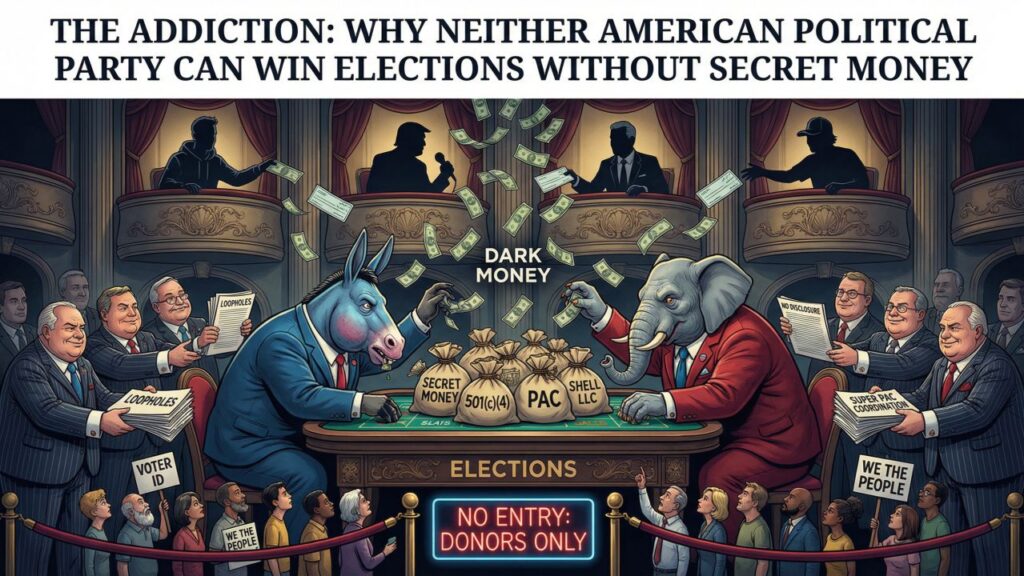
A comprehensive investigation into the structural mechanisms enabling unprecedented concealment of campaign funding in American elections is currently in development. Titled “The Architecture of Obscurity: Dark Money, Regulatory Collapse, and the Crisis of American Democracy,” this investigation documents how $1.9 billion in hidden political spending shaped the 2024 presidential election while remaining systematically invisible to voters during the period when electoral decisions were made.
The investigation emerges from a fundamental observation: the 2024 election marked an inflection point in American campaign finance. For the first time, a major party’s presidential nominee relied on hidden mega-donor funding for 73 percent of her mega-donor base, approximately $686 million flowing through dark money structures specifically designed to obscure donor identities. This represented not merely an increase in dark money’s scale but a threshold transition from dark money as a supplementary funding mechanism to dark money as the dominant architecture through which elite political influence operates.
The investigation documents this transformation through analysis of Federal Election Commission filings, Internal Revenue Service tax records, campaign finance watchdog databases, and comprehensive media coverage pattern analysis. What emerges is not a scandal rooted in individual corruption but a systematic failure of regulatory institutions, media structures, and democratic accountability mechanisms. Both major parties possess equivalent dark money infrastructure. In 2024, Democratic strategists deployed it more aggressively than Republicans, revealing strategic calculations about whether transparent mega-donor funding was preferable to hidden funding despite stated opposition to dark money.
Central to this investigation is detailed documentation of Future Forward USA Action, the largest dark money operation in American presidential history. This 501(c)(4) nonprofit organization raised and spent approximately $950 million during the election cycle, more than half of all pro-Harris dark money spending. The organization functioned through a dual-entity structure where the nonprofit accepted hidden donations, passed funds to an affiliated super PAC, and the super PAC reported receiving money “from Future Forward USA Action” rather than from original donors. The chain connecting funding sources to political spending was deliberately broken. Of the $304 million spent directly through the nonprofit, approximately 93 percent came from identified mega-donors including Bill Gates ($50 million), Laurene Powell Jobs ($30 million), Michael Bloomberg ($20 million), and George Soros ($20 million). Yet approximately $21 million came from donors who chose complete anonymity, mega-donors exercising enormous political influence while remaining unknown even to watchdog organizations.
Equally significant is the investigation’s analysis of the Arabella Advisors network, the sophisticated consulting and funding infrastructure that designs and manages concealment mechanisms for progressive dark money operations. The Sixteen Thirty Fund, raising $282 million in 2024, operates as part of this network under unified strategic direction. Approximately 60 percent of Sixteen Thirty Fund’s revenue came from just five wealthy donors, with at least three contributing $50 million or more while remaining completely unidentified in public filings. This represents hierarchical mega-donor influence operating entirely outside voter knowledge or accountability mechanisms.
The investigation details four distinct pathways through which dark money concealment operates. The nonprofit pass-through mechanism allows donors to contribute to 501(c)(4) organizations exempt from disclosing their funding sources, which then pass money to super PACs that report receiving funds “from the nonprofit” rather than from original donors. Shell company structures exploit state-level corporate secrecy, allowing donors to create limited liability corporations in Delaware, Nevada, or Wyoming where beneficial ownership remains unrecorded and untraceable. Daisy chain arrangements layer multiple nonprofit entities sequentially, with each transfer further obscuring original sources. Advertisement loopholes permit unlimited “issue advocacy” spending without disclosure requirements when advertisements avoid explicitly stating “vote for” or “vote against.”
These mechanisms persist because regulatory institutions have abandoned enforcement capacity. The Federal Election Commission operates with a 3-3 partisan deadlock that requires four votes for any enforcement action, making punishment of violations practically impossible. The Internal Revenue Service has revoked zero 501(c)(4) tax exemptions for illegal political spending since Citizens United in 2010, despite multiple documented cases of organizations spending 80-90 percent of their budgets on political activity, spending that violates their legal tax classification. This regulatory vacuum means that dark money organizations operate with certainty that concealment mechanisms will not trigger investigation or penalty.
The investigation also examines the systemic trap that ensnares both major parties. Candidates explicitly opposed to dark money in principle became its primary beneficiaries in practice not due to hypocrisy but due to competitive dynamics making unilateral restraint electorally suicidal. Once dark money becomes competitively decisive, any candidate refusing it faces asymmetrical disadvantage relative to opponents who deploy it. Campaign finance reform would require bipartisan legislative agreement on restrictions affecting both parties equally, a theoretically possible but practically unstable coalition because parties have incentive to defect once agreements are established. The consequence is an escalating arms race where each election cycle increases dark money deployment regardless of candidates’ stated principles.
Critical to this investigation is documentation of the information asymmetry between campaign leadership and voters. Harris’s campaign possessed real-time knowledge of Future Forward USA Action’s spending, Sixteen Thirty Fund’s activities, and the scale of hidden mega-donor funding supporting her candidacy. The median voter encountered minimal pre-election mainstream coverage of this funding reality. Post-election analysis eventually revealed the scale, but by then electoral outcomes had already been determined. This timing asymmetry meant that the primary funding sources supporting a major candidate remained invisible during the period when voters were making electoral decisions.
The investigation also documents structural media failures that prevented adequate pre-election reporting of dark money’s scale. Television networks derive substantial revenue from political advertising including dark money advertising, creating financial incentive against transparency. News organizations dependent on campaign access face pressure that discourages aggressive dark money reporting. The complexity of dark money mechanisms overwhelmed newsrooms’ willingness to explain them clearly. Social media platforms amplified misleading comparisons through algorithmic systems prioritizing engagement over accuracy. The result was systematic failure to inform voters during the critical pre-election period.
Finally, the investigation explores what the 73 percent concealment figure means in practical terms for democratic accountability. Hidden mega-donors create policy obligations that voters cannot evaluate because they cannot identify the donors. They obtain information advantages regarding campaign strategy, polling data, and policy development. They establish hierarchical influence structures where hidden mega-donors possess greater access than disclosed mega-donors operating outside dark money networks. The accountability mechanism fundamental to democratic governance is severed when voters lack knowledge of major funding sources supporting major candidates.
“The Architecture of Obscurity” documents not a scandal but a system, a system that operates as designed, serves rational strategic purposes for participants, and undermines democratic accountability as a structural consequence rather than an unintended side effect. The investigation’s purpose is to make that system visible, comprehensible, and unavoidable in discussions about American democracy’s future. The full investigation, including comprehensive documentation, detailed analysis, and implications for future electoral cycles, is currently in development and will be released in full in the coming weeks.
Related reading
- An Open Letter to Every Incumbent Republican and Democrat: A Call to Arms for Every American Who Is Sick of the War Uniparty; We Want a Third Party!
- The American People Are More Objective About President Trump's Actions Than Democratic Party Leadership
- A Bill of Indictment for Murder and Genocide Against the American Military and Trump, as its Commander and Chief
- Holy Trump or Evangelical Scholar? Neither. Just a Nincompoop Babbling to Morons on the 4th of July