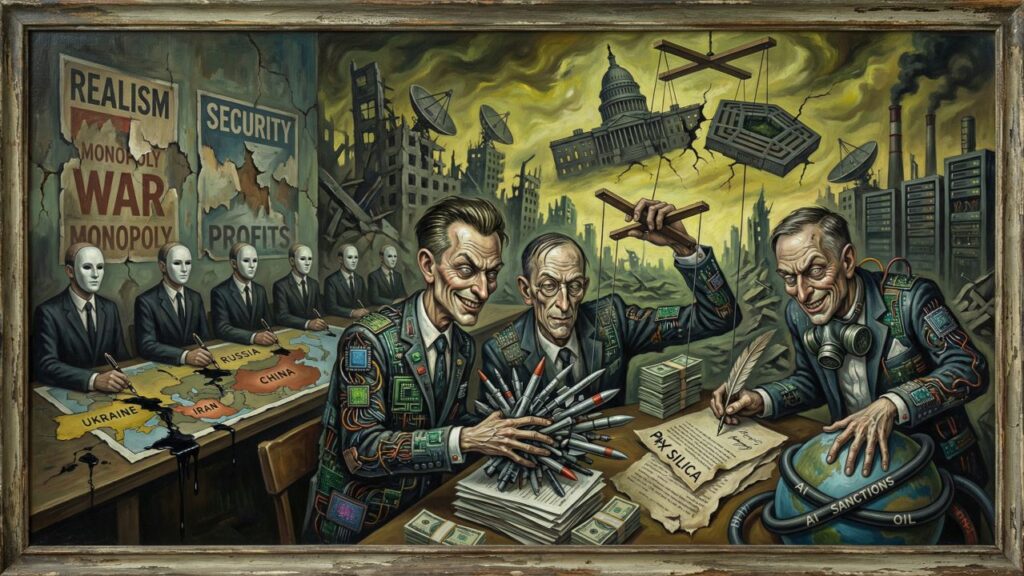
Note to my readers:
I wrote this piece because the war with Iran is not a “policy debate.” It is a business model rammed down our throats by the Uniparty, despite 78% of Americans being against this crime-in-progress, and the bill will be paid in human lives. My article lays out, in detail, how a small, tightly connected network of tech oligarchs, defense firms, donors, and think tanks captured U.S. foreign policy and is now using your government as an instrument for private enrichment and legacy protection dressed up as “national security,” “Western democracy,” and “regime change.” Give me a break.
I show how the same people who profit from AI, surveillance, and sanctions are now profiting from the bombs falling on innocent Iranians, just as they profited from the destruction of Iraq and the slow-motion demolition of Ukraine and will benefit from reheating Cold War II against Russia and China. It names the institutions that launder this agenda into “serious” analysis and the incentives that keep them from telling you who actually benefits. WTF, happened to giving peace a chance?
This ain’t no party, this ain’t no disco, there ain’t no peace marchers or hippies to be found.
What I hope you will do is simple and hard at once: refuse to forget. Lock the names, networks, and mechanisms in your mind. Share them. Confront your representatives with them. Use them to puncture every pious speech and op-ed that sells this carnage as a moral necessity. If enough people see the architecture clearly, it becomes much harder to hide behind it, even if the media has been bought and sold and the Democrats and Republicans are fused into one blob-like Uniparty, marching to bipartisan war.
Scott Ortkiese
Executive Summary
On January 27, 2026, George Beebe, former CIA Director for Russia Analysis and Chief Global Strategist at the Quincy Institute for Responsible Statecraft, sat down with Glenn Diesen to discuss the prospects for peace in Ukraine. One month later, an independent analysis titled “How the Tech Billionaires’ Cold War on China and Iran Is Consuming the American Empire” laid out, in granular detail, the network of Silicon Valley oligarchs who have bought and now exert vast influence within the legislative, executive, and military networks of the U.S. government, using its State Department mandates and military apparatus to protect their monopolies and fiefdoms, driving the country toward cold and active war with Iran, China, and Russia against the wishes of the vast majority of American citizens.
That network has a name: Pax Silica. It is the State Department’s flagship initiative on AI and supply chain security, launched in December 2025 under Jacob Helberg, the Under Secretary of State for Economic Growth, Energy, and the Environment. But Pax Silica is more than a government program. It is the institutional expression of the “Pax Silica Clan,” centered on the old PayPal network of Peter Thiel, David Sacks, and their protégés, who have leveraged personal wealth, political donations, and interlocking corporate relationships to install themselves at the commanding heights of American foreign and economic policy.
Their motives span every dimension. Geopolitically, Pax Silica ensures the global technology stack, from rare-earth mines to chip foundries to AI platforms, runs on American architecture rather than Chinese alternatives. Economically, the clan’s fortunes are tied to the dominance of American AI, cloud computing, surveillance technology, and cryptocurrency, as Palantir’s government contracts, OpenAI’s market position, and the venture portfolios of Thiel and Sacks all depend on keeping Chinese competitors locked out. Politically, the network operates through the bipartisan Uniparty, funding both sides: Thiel poured 15 million dollars into JD Vance’s Senate campaign; Sacks co-hosted a fundraiser that raised over 12 million dollars for Trump in a single evening. Corporately, the network functions as an interlocking directorate: Helberg was trained at Palantir, married into the PayPal network (his husband, Keith Rabois, is a PayPal alumnus), and had his wedding officiated by Sam Altman. Globally, Pax Silica seeks to lock in American dominance of the AI supply chain from Australian lithium mines to Taiwanese foundries, squeezing out Chinese access at every node. Financially, the entire architecture protects its architects’ wealth: Palantir’s stock has surged on government contracts from an administration the Thiel network helped install; the maximum pressure campaign on Iran, which Helberg has said is intended “to drive Iran’s oil exports to zero, especially oil exports to China,” serves both the China containment strategy and the energy-sector investments of the broader donor class.
Both the think tank and the independent analysis examine the same geopolitical crisis. Both see a foreign policy establishment blocking peace. Both understand that Ukraine, China, and Iran are interconnected pieces of a single imperial architecture in decline. Yet the think tank analyst speaks in the careful, coded language of a career intelligence officer who still needs to be in the room, while the independent writer names names, traces money flows, and identifies specific acts without restraint. The gap between them is not intellectual disagreement. It is a structural feature of how American foreign policy discourse is policed, and that policing is itself an obstacle to the peace that responsible analysts claim to seek.
This is not a story about two writers. It is a story about the institutional architecture that determines what can and cannot be said about American power, and who pays the price when the truth remains unspoken.
What Beebe Is Willing to Say
George Beebe’s analysis is coherent, informed, and carefully bounded. His core argument proceeds along five lines.
The Realist Vindication
A small circle of realists correctly predicted Russia would invade Ukraine because they understood Moscow viewed NATO expansion as an existential threat. The foreign policy mainstream dismissed the warnings. Events proved the realists right.
The “Trump Pivot” and Its False Premises
Beebe argues that the Biden administration was committed to NATO hegemony and that the Trump administration has adopted “a more realist approach to the world,” recognizing that great powers must be balanced through engagement rather than primacy.
This framing deserves scrutiny. The label “realist shift” is itself a product of the very network it purports to describe neutrally. David Sacks has cultivated this language precisely, describing himself as aligned with “the anti-empire realism of John Mearsheimer” while simultaneously arguing that “a more hawkish position with respect to China” helps “American companies win the AI race.” That is not realism. That is corporate protectionism wearing a realist mask. The Pax Silica Clan coined the “realist” label for Trump’s foreign policy because it provided intellectual cover for an agenda driven by the preservation of private monopolies.
Trump operates within a system dominated by the bipartisan Uniparty Congress that has sold itself to the tech oligarchy, which cannot afford to be at odds with the Israel lobby and its billionaire donors. Just 150 billionaire families spent nearly 2 billion dollars on the 2024 elections, with the top ten contributing over 953 million dollars. Miriam Adelson gave 100 million dollars to Trump’s campaign committee. Haim Saban has openly stated the transactional logic: “Those who give more have more access, and those who give less have less access. It is simple math.” Trump does not operate as a free agent making realist calculations. He operates at the mercy of a donor class whose interests converge around tech monopoly preservation, Israel’s regional agenda, and the containment of China. To call this “realism” is to launder oligarchic self-interest through the vocabulary of international relations theory.
The Istanbul Sabotage
Beebe correctly notes that in early 2022, Russia and Ukraine were close to a deal on neutrality and military caps, and that the West, via Boris Johnson, torpedoed the talks. What he omits is the specific institutional architecture behind it.
The sabotage was the predictable outcome of a thirty-year project driven by two overlapping factions. The Neoconservatives, whose lineage runs from the Project for the New American Century through the Iraq War, view American military primacy as both moral imperative and strategic necessity. Victoria Nuland, married to PNAC co-founder Robert Kagan, engineered Ukraine’s 2014 regime change, caught on a leaked call handpicking the post-coup prime minister (“Yats is the guy”) and dismissing Europe (“Fuck the EU”). Carl Gershman, president of the National Endowment for Democracy, had laid out the plan in a 2013 op-ed, calling Ukraine “the biggest prize” and a step toward toppling Putin.
The Atlanticists overlap but are distinct. Where neoconservatism is an ideology of American exceptionalism, Atlanticism is a structural project: the maintenance of NATO, EU security dependencies, and intelligence-sharing arrangements that keep Europe subordinate to American strategic direction. NATO enlargement was driven not by the security needs of Poland or the Baltics but by the need to prevent Europe from developing an independent architecture that might accommodate Russia.
Together, both factions killed Istanbul because a neutral, non-aligned Ukraine would have been a mortal blow to their projects. Jeffrey Sachs has called this “the end stage of the 30-year U.S. neocon debacle in Ukraine,” noting that “the U.S. political system has not yet held the neocons to account.”
The Blob as Obstacle
Beebe identifies the primary impediment to peace as “the old foreign policy establishment, the Blob, if you want to call them that.” What he will not say is why it persists: the financial architecture that sustains it.
The link runs through three interlocking systems. First, defense contractors and asset managers: the top 100 military contractors contributed more than 34.7 million dollars to the top 50 think tanks between 2019 and 2023, with the Atlantic Council alone receiving 10.2 million dollars from weapons manufacturers. The RAND Corporation received 1.4 billion dollars from the U.S. government in the same period. Second, the Israel lobby: AIPAC functions as the single most effective mechanism for converting billionaire donor money into congressional votes. Miriam Adelson, the Saban family, and Paul Singer fund both AIPAC’s lobbying and its super PAC operations, which have targeted even Republican critics like Thomas Massie. Third, the fifteen to twenty billionaires who dominate Uniparty fundraising: political donations of the top 100 wealthiest Americans to federal elections surged nearly 140-fold between 2000 and 2024. By 2024, roughly one in every thirteen dollars spent on national elections came from this small group.
Beebe could easily identify this architecture. He chooses not to, because doing so would implicate his employer’s donor networks, including the Koch and Soros foundations, that fund the Quincy Institute itself.
European Complicity
Beebe frames the Europeans as reluctant players clinging to a dead post-Cold War project. This is far too generous. European leadership, not European publics, who have consistently shown skepticism, has been among the most enthusiastic participants in a proxy war it helped provoke, driven by the need to protect political fiefdoms and institutional sinecures. They lack the intelligence, satellite, and industrial capacity to sustain a Ukrainian regime they helped install and duped into fighting a catastrophic war on its own soil.
Ukraine was the instrument of this strategy, not its beneficiary. Its young men were fed into a meat grinder to bleed Russia, on the promise of NATO membership and EU integration that was never going to materialize. Now, with hundreds of thousands of casualties, millions of refugees, and its industrial base destroyed, Ukraine faces the reality of being a destroyed former nation without a clear path to recovery, whose “allies” are already calculating how to move on.
Beebe never identifies who comprises “the Blob.” He never names a single individual, company, or financial interest. He does not mention Israel, Iran, Pax Silica, Helberg, Sacks, Thiel, or the tech oligarchy’s capture of the State Department. He treats the Trump administration’s “realist shift” at face value, without examining who is shaping its priorities.
What Non-Legacy Media Is Willing to Say
The independent analysis inhabits a different universe of discourse. Where Beebe speaks of “the Blob,” a term he could easily unpack but does not, because doing so would defeat the purposes of the Soros and Koch foundations that funded Quincy with their respective thirty pieces of silver, independent media draws a map of specific individuals, financial flows, and institutional capture.
Peter Thiel did not merely “co-found Palantir” and “donate to Vance’s campaign.” He built a private intelligence empire that the CIA bankrolled from its inception because the agency could not legally conduct the surveillance it wanted. Palantir is now, by its own CEO’s admission, “responsible for most of the targeting in Ukraine.” Thiel told an interviewer, “I defer to Israel” on Middle Eastern policy, and Palantir signed a multi-hundred-million-dollar “strategic partnership” with Israel’s Ministry of Defense in January 2024 to provide AI technology for “war-related missions” in Gaza, technology that human rights organizations say has been used to generate “kill lists” targeting homes, schools, and mosques. Thiel poured 15 million dollars into Vance’s Senate super PAC, the largest individual donation to a single Senate race in American history, and arranged the Mar-a-Lago meeting that brought Vance into Trump’s orbit. This is not political participation. It is the purchase of a future president.
Jacob Helberg was trained at Palantir, integrated into the clan through his marriage to Keith Rabois (officiated by Sam Altman), and now runs the State Department’s economic and energy portfolio. He has publicly stated the goal of maximum pressure is “to drive Iran’s oil exports to zero, especially oil exports to China” and outlined plans in congressional testimony to turn American diplomats into sales representatives for U.S. AI companies. This is not a diplomat. This is a corporate operative with a government title.
David Sacks, installed as Trump’s AI and crypto czar, has said openly that “a more hawkish position with respect to China” helps “American companies win the AI race.” He owns stakes in startups that directly benefit from the regulatory framework he designs, a conflict of interest so brazen it would disqualify a municipal zoning commissioner yet passes without comment.
Elon Musk stands apart from the Pax Silica Clan. Musk entered Washington to lead the Department of Government Efficiency with a mandate supported by virtually every working American: to identify and eliminate fraud, waste, and abuse. DOGE achieved the largest peacetime reduction in the federal workforce on record and identified billions in questionable contracts. Musk was driven out not because he failed but because he succeeded in threatening the sinecures, graft, and institutional self-dealing that sustain the entire political class. That a man who has revolutionized payments, automobiles, rockets, and communications could be ground down by the federal bureaucracy tells you everything about the system’s capacity for self-preservation.
The Vance-Rubio Competition
Thiel identified Vance early, hiring him at his venture capital firm in 2017 and nurturing his political rise. The 15 million dollars flowed through direct donations and dark money channels, including the Thiel-controlled Per Aspera Policy group. Thiel then arranged the Mar-a-Lago meeting that rehabilitated Vance with Trump, a man Vance had once called “Hitler,” and cleared the path to the vice presidency.
Vance has repaid the investment by serving as a “MAGA enforcer,” but he is not a free agent. He is, as Politico reported, “handcuffed” on the issues that matter most to his tech backers. His 2028 ambitions depend entirely on maintaining support from Trump, the Pax Silica Clan, the Israel lobby, and the Uniparty’s donor class.
Marco Rubio operates as Vance’s mirror image and rival. Trump has turned the competition into a parlor game, asking advisers, “JD or Marco?” Rubio, who called Trump a “fraud” in 2016 before executing a complete reversal, has positioned himself as the “problem solver”: traveling to Panama, designing the Venezuela operation, earning a standing ovation at Munich. Both men compete not over policy substance but over who can more effectively serve the donor class while maintaining the appearance of populist authenticity. It is a race to the bottom conducted at the commanding heights of American power.
Seven Things Think Tanks Will Not Say
The divergence between institutional and independent analysis maps across seven categories of omission, each reflecting a structural boundary enforced by the economics and politics of the think tank model.
1. The Oligarchic Capture of the State. Think tanks do not acknowledge that the Trump administration is the wealthiest in U.S. history, with at least a dozen billionaire cabinet-level officials. They do not mention that Treasury Secretary Scott Bessent made his fortune as George Soros’s protégé, helping Soros “break the Bank of England” in 1992, then serving as his chief investment officer before launching his own fund with 2 billion dollars in Soros seed money. Bessent’s presence in a supposedly anti-establishment Republican cabinet is the single clearest proof that the Uniparty is alive at the highest levels. His Soros pedigree should be headlining the news. Instead, the legacy media treats it as a biographical footnote.
2. Israel’s Role in Pushing War with Iran. This may be the most consequential omission. In Beebe’s interview, Israel and Iran are never mentioned, yet at that very moment, Trump had amassed the largest military buildup in the Middle East since 2003. Senior advisers were reportedly exploring how to have Israel strike Iran first so that Iranian retaliation against U.S. forces would provide political cover for a broader war. Quincy’s own Responsible Statecraft published an article titled “The White House wants Iran to attack Americans.” Independent analysts connect this directly to the tech oligarchy’s China strategy: maximum pressure on Iran is the energy arm of Pax Silica, designed to choke off Chinese oil imports. The Helberg-Sacks-Thiel network shares Israel’s interest in keeping Iran isolated and Chinese energy supplies vulnerable. The silence on the Israel-Iran-China-tech oligarchy axis is the most telling absence in institutional analysis.
3. Pax Silica and Silicon Statecraft. Think tank discourse almost never mentions Pax Silica, despite it being the operational framework connecting the China cold war, the Iran maximum pressure campaign, the critical minerals competition, and the AI arms race into a single integrated strategy. Even Quincy’s own Responsible Statecraft acknowledged that the Trump defense strategy, while “rhetorically quite compatible with realism and restraint,” retains “a rather status quo Republican view of the Middle East” with “a muscular approach” that “may lend itself to the very interventionism that the report ostensibly opposes.” A grand strategy analyst who omits Pax Silica is analyzing a war while ignoring the battlefield.
4. De-Industrialization and Financialization. Independent analysis grounds the crisis structurally: the United States de-industrialized, replacing factories with financial instruments, and now cannot fight the wars it has started. Manufacturing fell from roughly 25 percent of GDP in the 1950s to about 10 percent today. The U.S. lost 6.1 million manufacturing jobs between 1998 and 2010. The Fed’s balance sheet ballooned from 800 billion to 6.5 trillion dollars, enriching the top 1 percent while 90 percent of households absorbed the debt. Think tank strategists almost never touch this because diagnosing the structural disease risks alienating donors who benefit from the financialized system.
5. The Structural Impossibility of Victory. Every weapon the U.S. deploys boomerangs. Tariffs hit American consumers. Chip controls accelerated China’s push for self-reliance. Sanctions drove de-dollarization. The energy squeeze risks higher oil prices at home. The United States is preparing for a potential war with China but cannot fight it without Chinese-processed minerals. Think tank analysts imply the right diplomatic formula can thread the needle. They do not confront the possibility that structural contradictions make threading impossible without confronting the oligarchs who have captured the policy apparatus.
6. The Specific Identity of “The Blob.” Independent analysis tells you who the Blob actually is: not only the traditional neoconservative establishment but its successor class, the tech billionaires who have replaced the old guard, motivated by private monopoly preservation rather than ideological conviction. The old Blob wanted NATO hegemony. The new Blob wants to ensure “the world runs on the American technology stack rather than China’s,” in Sacks’s words.
7. Conflicts of Interest as Policy Driver. Sacks owns stakes in startups that benefit from the rules he designs. Palantir picks up billions from an administration the Thiel network installed. Helberg sets AI supply chain policy while embedded in the same personal network as OpenAI and Palantir executives. Think tank analysts never mention conflicts of interest. Their analyses treat policy as the product of strategic reasoning, not financial self-interest, a framing that protects the very actors independent analysis indicts.
Why Think Tanks Will Not Say It
The gap between institutional and independent analysis is not a gap between knowledge and ignorance. It is a gap between what can be said inside the system and what can only be said outside it.
Donor Architecture
The Quincy Institute’s donor list maps the contradictions constraining its discourse:
- $500,000+: John D. and Catherine T. MacArthur Foundation, Lorien Fund at Fidelity Charitable, Peaceshares Fund, Stand Together Trust (Koch network), Michael J. Zak
- $250,000, $499,000: Carnegie Corporation of New York, Ford Foundation, Pivotal Foundation, Giustra International Foundation
- $100,000, $249,000: Ken Fong, Rockefeller Brothers Fund, Lee Zehrer
- $50,000, $99,000: Open Society Foundations (Soros), Ploughshares Fund, East West Bank Foundation, and others
George Soros and Charles Koch each provided $500,000 in seed funding for what the Boston Globe called “one of the most remarkable partnerships in modern American political history.” The conventional explanation is that both share an interest in ending “endless wars.” The deeper explanation is that both share an interest in managing the terms of debate without that debate threatening their own positions. Koch’s network benefits from reduced military expenditure (freeing resources for tax cuts and deregulation) without challenging tech monopolies. Soros’s network benefits from diplomacy and multilateral institutions without questioning the financial architecture that generated his fortune. They are unlikely bedfellows united by a shared interest in ensuring that the critique of American foreign policy never extends to the economic system both have exploited.
A landmark academic study on think tank conflicts of interest, published by Sage and reviewed in Quincy’s own Responsible Statecraft, found that “nearly all of the analysts interviewed said they engaged in self-censorship.” One analyst stated: “Self-censorship is the greatest threat to our democracies in the West. A lot of think tank experts posture as experts with complete academic freedom; this is absolutely not the case.” The study’s most damning finding: funders’ greatest influence is exercised not by censoring specific products but by “affecting which questions are asked” and “determining who gets funded to write or say something in the first place.”
The Israel Taboo
Within weeks of Quincy’s founding, Senator Tom Cotton accused the institute of “fostering anti-Semitism,” targeting Mearsheimer and Walt, co-authors of The Israel Lobby and U.S. Foreign Policy. This attack, launched before Quincy had produced significant work, established the parameters of permissible discourse. Any analyst who connects Israel’s lobbying for the Iran war to the broader architecture risks triggering the same accusation, weaponized by senators, media organizations, and the formidable network of pro-Israel institutions. AIPAC’s super PAC operations have demonstrated the capacity to target and defeat even sitting members of Congress.
Trita Parsi, Quincy’s co-founder, has been a primary target, the Wall Street Journal characterizing him as an advocate for “a more amicable U.S. stance towards the regime in Tehran,” Fox News amplifying accusations of lobbying on behalf of Iran. For any think tank analyst, engaging the Israel-Iran axis is doubly dangerous. The moment a figure names Israel as a driver of Iran war pressure, that person crosses from analysis into what the establishment treats as toxic advocacy.
The Revolving Door
Beebe spent more than two decades in government, including as director of CIA Russia analysis and special adviser on Russia to Vice President Cheney. His career follows the classic “revolving door” pattern Richard Haass described as “unique to the United States”: officials rotate to think tanks, maintaining insider credibility and networks. That credibility is Beebe’s value to Quincy, and his constraint. Naming names would permanently close those doors. Calling the Trump administration a vehicle for oligarchic capture would destroy access to policymakers.
The revolving door creates what one scholar called “perspective filtering”: think tanks do not need to censor analysts because they only hire people whose instincts align with acceptable discourse. “Censorship becomes largely unnecessary when you only hire people who agree with the views of the censor. This helps to produce an artificial consensus: experts all seem to agree with one another only because most dissenting experts are excluded from the conversation.”
The Professional Grammar of Implication
Intelligence professionals are trained to convey the maximum possible meaning while maintaining plausible deniability. Beebe’s use of “the Blob” is a textbook example. Every informed listener understands what it encompasses, the neoconservative establishment, the defense industry, think tanks funded by foreign governments and weapons manufacturers. But the euphemism avoids the legal, reputational, and political risks of pointing fingers. This is not cowardice; it is a professional grammar that permits the audience to nod knowingly without ever being compelled to confront the specific individuals and interests driving policy. “The Blob” is a safety valve that allows dissent without consequence, for the dissenter or the powerful.
The Overton Window and Legal Risk
Quincy occupies a unique position at the edge of the think tank Overton window. Its “restraint” orientation already marks it as an outlier. But there is a difference between challenging the consensus and naming the individuals who enforce it. A think tank already attacked as “isolationist” and “anti-Semitic” cannot afford to add “conspiracy theorist” to the charges. The irony is that independent analysis of the Pax Silica network is not conspiratorial, it documents publicly available financial relationships, confirmed appointments, and on-the-record statements. But in Washington, connecting those dots in a single narrative is treated as inherently suspect, regardless of the evidence.
Accusing specific living individuals of corruption and conflicts of interest carries legal and reputational risks think tanks cannot absorb. An independent writer can document Helberg’s use of his position to advance the network that placed him there because that writer’s livelihood does not depend on institutional relationships in Washington. A statement from the Chief Global Strategist at a major think tank would be treated as an institutional position and would expose Quincy to coordinated retaliation.
The Cost of Silence
The forces constraining think tank analysts are real and understandable. But understanding them is not the same as accepting their consequences.
While Beebe discusses the abstract prospect of peace in Ukraine, the specific policies driving toward war with Iran proceed unimpeded by think tank critique. Trump has amassed the largest military buildup in the Middle East since 2003. CENTCOM’s commander has briefed Trump on possible Iran strikes. Administration officials have explored scenarios in which Israel strikes first and Iranian retaliation provides political cover. Helberg uses Pax Silica to advance the economic dimensions of the same confrontation. None of this appears in think tank analysis. An institutional analyst who discusses Ukraine without mentioning the simultaneous march toward war with Iran provides an incomplete picture that serves the interests of those who want to compartmentalize these crises.
By refusing to name who constitutes “the Blob,” think tank analysis paradoxically protects them. An unnamed adversary cannot be held accountable. An unnamed conflict of interest cannot be investigated. “The Blob” is a useful analytical concept. It is a useless political weapon. And in the current moment, analytical usefulness without political force is a luxury the world cannot afford.
The YouTube comments on the Beebe-Diesen conversation illustrate how far ahead of institutional analysts the public has moved. One commenter captures it: “The ‘Blob’ is the US Government, not some unrelated shadowy organization… The names of the US Government officials directly involved with (at least) the Ukraine regime change and the subsequent violence it fomented, funded and openly supported… now that it is failing and backfiring wants to proclaim ‘it wasn’t US!'” The audience does not need to be told that the Blob has names. They want to hear those names spoken by people with the credibility to make the charge stick.
The Iran Test Case
As of late February 2026, the United States stands on the brink of a war with Iran that would reshape the Middle East, devastate global energy markets, accelerate de-dollarization, and potentially draw in Russia and China. This war is being pushed by a convergence of Israeli strategic interests, tech-oligarch commercial interests, and neoconservative ideological interests that have survived every presidential transition since Iraq.
Quincy’s reporting stops short of the connection independent analysts draw: that the Iran maximum pressure campaign is not a standalone policy but an integral component of Pax Silica’s energy-chokepoint strategy against China, driven by the same network that controls AI and crypto policy. Without that connection, the public sees disconnected crises: Ukraine, Iran, China, and AI regulation. With it, they see a single architecture of oligarchic war and can begin to organize opposition. The think tank model is structurally incapable of providing that unifying framework because the framework indicts the very donor class on which it depends.
The Mearsheimer Exception
John Mearsheimer, who debated Beebe at Quincy on February 19, 2026, has historically been willing to go where most analysts will not. His The Israel Lobby and U.S. Foreign Policy, co-authored with Stephen Walt, named the mechanisms by which the lobby shapes American policy. It generated accusations of anti-Semitism and coordinated backlash, but permanently shifted the terms of debate. Mearsheimer paid a professional price, but the work endured. The question is whether the constraints preventing analogous work on the tech oligarchy’s capture of the state are producing a comparable cost, not to any individual analyst, but to the prospect of informed democratic resistance.
The Paradox of Truth-Telling
The independent writer’s position offers freedoms think tank analysts cannot claim: the freedom to name names, trace financial relationships, and connect crises that institutional analysts are incentivized to compartmentalize. The Pax Silica analysis provides a unified field theory linking de-industrialization, financialization, the everything bubble, the Iran oil squeeze, the chip war, de-dollarization, and the tech oligarchy’s capture of the state.
But that freedom comes with vulnerabilities. An independent writer lacks the institutional imprimatur that grants automatic credibility. Such analysis will not be cited in congressional testimony or briefed to the National Security Council. The very specificity that makes it powerful makes it easy for gatekeepers to dismiss as “conspiratorial,” not because the facts are wrong, but because connecting them violates the norms of compartmentalized discourse.
This is the paradox. The people with the credibility to be heard cannot say what needs to be said. The people who say what needs to be said lack the credibility to be heard. The system is designed to produce this result. It is the architecture of managed discourse in a declining empire, and dismantling it may be a prerequisite for the peace that analysts across the spectrum claim to seek.
Consider what would happen if a figure with Beebe’s credentials were to say publicly: “The Trump administration’s foreign policy is being shaped by a network of tech billionaires, Thiel, Sacks, and Helberg, who have personal financial stakes in the policies they are designing. The maximum pressure campaign against Iran is about choking off Chinese oil imports to protect Silicon Valley’s global monopoly. Pax Silica is a subsidy program for Palantir, OpenAI, and Nvidia run out of the State Department. And Israel’s lobbying for war with Iran serves the same network’s interest in keeping Chinese energy supplies vulnerable.”
Such a statement would be an earthquake. It would trigger donor flight, media attacks, congressional denunciation. But it would also make it impossible for the American public to pretend that the policies driving them toward multiple wars are the product of dispassionate strategic reasoning rather than oligarchic self-interest.
The Architecture of Managed Decline
George Beebe deserves respect. He operates at the edge of what the system permits, and his willingness to criticize NATO expansion and challenge establishment orthodoxy puts him in an admirable minority. But “admirable minority” is a lower bar than the moment demands.
The United States is simultaneously escalating toward war with Iran, waging a cold war against China its industrial base cannot sustain, failing to secure peace in Ukraine, and watching its reserve currency status erode. The architects of these policies are not anonymous. They have names, stock portfolios, and government titles. They have been placed in their positions by a specific network of wealthy individuals who stand to profit from the confrontations those positions enable.
Speaking in the coded language of “the Blob” is no longer sufficient. Analysts who care about peace must confront the choice between institutional survival and the transparency the moment requires. The history of consequential dissent, from Daniel Ellsberg to the intelligence officers who challenged the Iraq War intelligence, suggests that the most important truths are almost always spoken by individuals who decided that the cost of silence exceeded the cost of speaking. Independent writers have already made that choice. The question is whether anyone with the credentials and platform of the institutional world will follow.
The gap between think tank discourse and independent analysis is about the architecture of American foreign policy discourse itself, a system designed to produce a permanent gap between what is known and what is said. That architecture permits limited dissent, enough to maintain the appearance of intellectual freedom, not enough to threaten the interests that drive policy. Think tanks like Quincy play a vital role, but the system ensures that the most consequential questions, Who profits from war? Whose money buys whose policy? Why is this administration really confronting China, Iran, and Russia simultaneously?, remain officially unasked.
The war in Ukraine will not end because a think tank analyst found the right formula. It will end, if it ends, when the public understands who profits from its continuation and demands accountability from the specific individuals who have made war their business model. That understanding requires the transparency independent media provides and the institutional courage the think tank world has not yet shown. The clock is ticking on both.
Related reading
- UPDATE: What Western Media Is Not Telling You About the Iran War
- The Business of War: How Defense-Funded Think Tanks Choose Which Interventions to Champion
- What Day Three of the Iran Conflict Tells Us That Cable News Won't
- How Yale Sold Its Prestige to Defense Contractors, Misled Congress on the Ukraine‑Russia War, and 800,000 Russians and Ukrainians Have Died, So Far