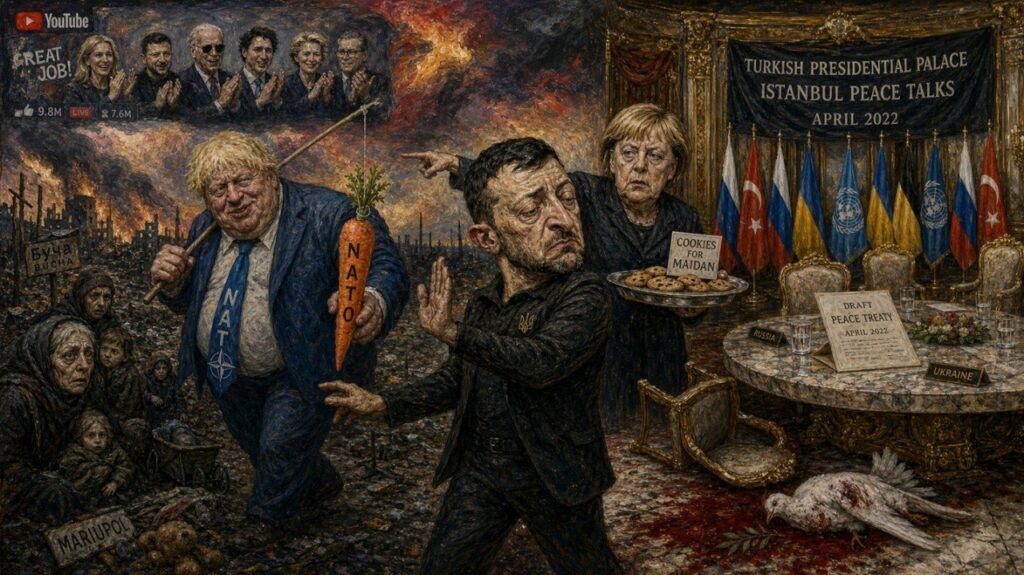
U.S, Germany and UK to Zelensky: “Anything but peace. We will provoke the Russians on your soil. Be President Z. Loot at will. Get rich”
June 2, 2026
By Scott Ortkiese June 2, 2026
Herding Lemmings
Open YouTube. Type “Ukraine war.” Watch what happens.
You will not see a debate. You will not see Russian generals or Donetsk civilians or Kyiv dissidents who think this war should have ended at Istanbul in April 2022. You will see an avalanche of pro-Kyiv, pro-NATO content packaged as neutral coverage, with a uniform vocabulary (”unprovoked,” “brutal aggression,” “Putin’s war”) and a uniform conclusion (escalate, arm, sanction, repeat). RT and Sputnik were banned worldwide on YouTube in March 2022 within two weeks of the Russian invasion, and the European Union banned them across all 27 member states by EU regulation, formally invalidating their broadcasting licenses. The Atlantic Council called that “a model intervention.” The world’s largest video platform, the dominant repository of human attention, executed a one-sided information purge in real time and called it journalism.
This is not a conspiracy theory. It is a measured finding by Western academics themselves. A peer-reviewed content analysis of BBC and CNN coverage concluded that “Western media coverage disproportionately represents the Ukrainian perspective, with the Russian standpoint largely marginalized or stereotypically characterized,” that Western outlets “normalize or trivialize the role of neo-Nazi organizations in the conflict while downplaying potential war crimes committed by the Ukrainian side,” and that a quantitative review of 99 articles found “a discernible dominance of war journalism over peace journalism” with the BBC running an even more aggressive war-journalism modality than CNN (Södertörn University, 2023). A separate framing study of the New York Times found that even when ostensibly covering Russian operational capability, TNYT portrayed Ukraine as “disciplined and capable” while Russia was rendered through aggressor frames (University of Arkansas thesis). A simulation study of the YouTube algorithm published this year showed that “minimal behavioral cues yield strong personalization, reducing content diversity” on geopolitical themes, with the system locking users into ever narrower topical channels the longer they watched (arXiv 2507.04534).
There is nothing organic about this. It is the largest, always-on narrative machine in human history, and almost all of it tilts one way. Even Western strategists admit the architecture. NATO’s own doctrine treats “Strategic Communications” as a peer discipline to public diplomacy and psychological warfare, packaged into “the same domain,” with declassified intelligence drops and curated leaks deployed to “shape the information environment of their rivals and amplify NATO narratives” (Jerusalem Strategic Tribune, 2023). What the Kremlin calls information confrontation and what NATO calls strategic communication are the same trade. Only one side has hundreds of millions of English-speaking viewers and a platform monopoly delivering its message.
The borderland racket
This is what the West does. It runs experiments on other people’s countries, talks loftily about values, and walks away from the wreckage. Ukraine is not the first chapter. It is the latest.
Vietnam
Direct military spending in 2008 dollars: roughly $870 billion. Total present-value cost including veterans benefits: $1.4 trillion. American military dead: 58,200. Vietnamese dead: in the millions. (Hall, Journal of Public Economics, 2014).
Panama
The 1989 invasion killed at least 314 Panamanian soldiers and somewhere between 202 and 3,000 civilians by various estimates, displaced 20,000 people, and burned the El Chorrillo neighborhood to the ground. The “surgical operation” produced civilian deaths “at least four-and-a-half times higher” than enemy military deaths, per Human Rights Watch (Britannica; HRW, in Wikipedia summary). The “national day of reflection” became an annual black march.
Iraq
Stiglitz and Bilmes put the all-in cost at $3 trillion. The Joint Economic Committee said $3.5 trillion. Up to 4.6 million Iraqis displaced. (Harvard Kennedy School; DePaul Law Review summary).
Afghanistan
Brown University’s Costs of War project pegs the full bill for the post-9/11 wars at roughly $8 trillion and more than 900,000 direct deaths, with another 3.6 to 3.8 million indirect deaths from disease, displacement, and lost access to food and water (Brown University; Costs of War summary). After the August 2021 withdrawal, Afghan GDP collapsed by roughly 28 percent in a single year by World Bank reckoning, with the U.S. freezing the Afghan central bank’s foreign reserves and aid flows that had supplied 45 percent of GDP and 75 percent of the government budget (PLOS ONE / Afghan economic collapse study, 2024). Roughly half of Afghans now live in poverty.
Libya
A peer-reviewed assessment from the Belfer Center concluded NATO’s 2011 intervention “increased the duration of Libya’s civil war by about six times and its death toll by at least seven times, while also exacerbating human rights abuses, humanitarian suffering, Islamic radicalism, and weapons proliferation in Libya and its neighbors” (Belfer Center, Harvard Kennedy School). The Carnegie Endowment later catalogued how Europe’s failure to rebuild Libya and its rush to outsource migrant suppression to local militias produced a humanitarian and security catastrophe across the Mediterranean (Carnegie, 2018).
Venezuela
U.S. sanctions imposed in 2017 collapsed an oil-dependent economy and drove the largest displacement crisis in modern Latin American history: 5.4 million Venezuelans had fled by 2021 and 7.7 million by 2024, with murder rates among the highest on earth (SUNY Albany honors thesis; Crisis in Venezuela overview). The Washington Office on Latin America documented how those sanctions “directly worsened” the humanitarian collapse (WOLA, 2020).
These are not unconnected episodes. They are episodes of the same series. Wash, rinse, ruin, repeat. The defining feature of American borderland intervention since 1965 is not strategic victory. It is the production of failed or hollowed-out states whose populations pay the bill in lives, in displacement, and in generations of lost capital, while Washington walks away with a fresh set of contractors and a fresh set of slogans. Ukraine is being processed through the same machine.
What Ukraine has paid
Look at the numbers, not the slogans.
The World Bank’s RDNA5 assessment, released February 2026, puts the cost of reconstruction and recovery in Ukraine at $588 billion over the next decade, with $195 billion in direct physical damage already recorded as of December 2025, and total economic losses of $667 billion. Fourteen percent of Ukrainian housing has been damaged or destroyed, hitting more than three million households (World Bank, RDNA5, Feb. 2026; Reuters, Feb. 23, 2026). The reconstruction estimate is nearly three times Ukraine’s projected 2025 nominal GDP.
Ukraine’s population has collapsed. The UN Human Rights Monitoring Mission verified that 2025 was the deadliest year for civilians since 2022, with 2,514 killed and 12,142 injured, a 31 percent increase over 2024 (OHCHR, January 2026). The death rate now outpaces the birth rate nearly three to one. Refugees abroad number 5.3 million, and only 43 percent of them plan to return per a 2025 Center for Economic Strategy study; just 98,000 returned in 2025, down from 660,000 in 2022 (Think Global Health, Feb. 2026). Military casualties on the Ukrainian side, depending on the source, run between several hundred thousand and well over a million dead and wounded, with leaked Ukrainian Armed Forces databases suggesting roughly 621,000 KIA or missing in 2025 alone, though independent verification remains impossible (casualties roundup).
The European Union and its 27 member states have provided $223 billion in financial, military, humanitarian, and refugee assistance to Ukraine, including $82.9 billion in direct military support, the training of 86,800 Ukrainian soldiers, and an EU loan of roughly $106 billion agreed in late 2025 (EEAS / EU Assistance to Ukraine; Council on Foreign Relations). The total Western pledge, U.S. plus Europe, runs in excess of $380 billion. By early 2025, Western strategists estimated only 20 percent of Ukrainian equipment came from the United States, 25 percent from Europe, and 55 percent from Ukraine’s own industrial mobilization (Malcolm Chalmers via Wikipedia compilation). The United States, after 2025, made no new aid commitments. Europe is now the lead financier of a war it cannot militarily decide.
This is what the brochure calls “supporting Ukraine’s right to self-determination.” On the ground it means a country with a per-capita GDP below most of Latin America, a shattered grid, three million destroyed or damaged homes, a missing generation of working-age men, and a fertility collapse that will define its demographics for half a century. The realist case is not contested by anyone serious. Mearsheimer has argued for over a decade that NATO’s eastward expansion, the West’s role in the 2014 Maidan turnover, the gutting of the Minsk agreements, and the spurning of Russia’s December 2021 security demarche made this war predictable, avoidable, and ultimately catastrophic for the Ukrainians the West claims to defend (Mearsheimer, Foreign Affairs, 2014). The borderland was used as a buffer, then as a battering ram, then as a write-off.
The Sachs indictment: Germany’s six failures and the road to a war Berlin could have stopped
If any one document deserves to sit on the desk of every honest European reader of this war, it is Jeffrey Sachs’s open letter to Chancellor Friedrich Merz, published 28 May 2026 in the Berliner Zeitung and on Substack. It is his second such letter. The first, six months earlier, urged diplomacy. The second arrives after Lavrov has formally notified Washington on 25 May 2026 that Russia is now launching “systematic and sustained strikes” on facilities and decision-making centers in Kyiv, and the Russian Foreign Ministry has asked the United States and others to evacuate their diplomatic personnel. That is the prologue, in Sachs’s words, to a major escalation. Diplomacy, he writes, is more urgent than ever. Berlin sleeps.
Sachs’s central claim is geographic, not ideological. No European leader in Paris, Warsaw, or Rome holds the position Merz holds. Germany was the principal beneficiary of the assurances that made German reunification possible. Germany is now the principal accelerant of a war that diplomacy could end. Merz, with Meloni and Macron, called in January 2026 for Europe to restart relations with Russia and described Russia as “a European country.” In the months since, neither Merz nor his foreign minister has attempted a single substantive dialogue with Putin or Lavrov. Not one. The drift to general war is therefore not a Russian project. It is a German abdication. Before any reset toward peace is possible, Sachs writes, Germany’s record must be confronted honestly. He sets out six failures.
First. The 2+4 Treaty and NATO’s eastward expansion. On 12 September 1990 in Moscow, Germany signed the Treaty on the Final Settlement with Respect to Germany, completing reunification. That treaty was secured because Mikhail Gorbachev was given solemn assurances by Hans-Dietrich Genscher, Helmut Kohl, James Baker, and other Western leaders that NATO would not move eastward. The declassified record, including the now-public memoranda assembled by the National Security Archive at George Washington University, is unambiguous: those assurances were given and were clearly meant at the time to apply beyond the territory of the former GDR to Eastern Europe. They were reaffirmed through 1990 and 1991. The 2+4 Treaty itself restricts NATO troops on the former GDR and recalls the Helsinki Final Act principle that no nation’s security should come at the expense of another’s. Does any serious person believe, Sachs asks, that the Soviet Union cared about Western troops in the former GDR but was indifferent to NATO armies in Warsaw, Vilnius, or Kyiv? Of course not. As early as 1993, German leaders began promoting the violation of the very assurances that had been the quid pro quo for German reunification. Berlin broke the seal first.
Second. Merkel’s own testimony. In her memoirs, Angela Merkel writes with striking candor that she understood at the 2008 Bucharest Summit that inviting Ukraine and Georgia into NATO would be tantamount to a declaration of war on Russia. She knew Russia’s red line. She gave in to American pressure and accepted the compromise communiqué that Ukraine and Georgia “will become” NATO members. That single sentence, Sachs writes, set in motion the catastrophes of 2014 and 2022. Merkel’s later candor is a gift to her successors. She has told them, plainly, in her own words, what was understood at the time. Germany should not now pretend otherwise.
Third. The betrayal of the 21 February 2014 agreement. That day in Kyiv, German Foreign Minister Frank-Walter Steinmeier, with his Polish and French counterparts, brokered an agreement between President Yanukovych and the Maidan opposition. It provided for a return to the 2004 constitution, a national-unity government, and early presidential elections. Putin was consulted; the agreement was confirmed. It was a serious diplomatic achievement under conditions of extreme violence. Within twenty-four hours Yanukovych was forcibly overthrown by a violent coup. Germany did not insist on the agreement it had just guaranteed. Following the U.S. lead, it backed the new government as if no agreement had been in place. That choice, Sachs writes, persuaded Moscow that Western signatures could not be trusted. The lesson would be administered again.
Fourth. Minsk II as stratagem, not guarantee. In February 2015, Chancellor Merkel personally negotiated Minsk II in the Normandy Format and pledged Germany’s political backing through the Declaration of Support adopted in Minsk on 12 February 2015. For seven years, the key political provision, autonomy for the Donbas regions within a sovereign Ukraine, was never implemented by Kyiv. Germany did not press Kyiv to implement it. Merkel later acknowledged that the agreement had been used as a holding action to allow Ukraine to rearm. François Hollande said the same. The guarantee was not a guarantee. It was a stratagem at Washington’s behest. Once more, the message to Moscow was that Western signatures cannot be trusted.
Fifth. Nord Stream. On 7 February 2022 in the East Room of the White House, President Biden announced, with then-Chancellor Olaf Scholz standing beside him, that “if Russia invades, then there will be no longer a Nord Stream 2. We will bring an end to it.” Asked how, he replied, “I promise you, we will be able to do that.” The pipelines were destroyed seven months later in an act of sabotage in the Baltic Sea. The available evidence, including Seymour Hersh’s investigative reporting, the trail followed by the German federal prosecutor, and public statements of former officials, points overwhelmingly to a joint Ukrainian-American operation. The German government has long known this. Berlin has nonetheless permitted public blame to fall on Russia, against the direct evidence, while the largest single act of industrial sabotage against the German economy in modern history has gone unprosecuted and unanswered. Germany was attacked, by allies, and Germany said nothing.
Sixth. The April 2022 Istanbul deal that was within reach. Weeks after Russia’s February 2022 invasion, Russian and Ukrainian negotiators converged in Istanbul on the terms of a peace: Ukrainian neutrality outside NATO, multilateral security guarantees, agreed troop limits, and political resolution of the Donbas and Crimea questions over time. The agreement was within days of signature. Former Israeli Prime Minister Naftali Bennett, one of the mediators, has publicly confirmed that the deal was close and that the West, the United States and the United Kingdom in particular, moved to block it. Boris Johnson’s mission to Kyiv in April 2022 to instruct Ukraine not to sign is a matter of public record. Hundreds of thousands of Ukrainian and Russian lives, and the wider European order, have paid the price for that Anglo-American intervention. Germany has not raised its voice on this, though Germany, more than any other European state, has borne the economic consequences.
That is the indictment. Six failures, all admitted in the public record by the German officials who committed them or their successors, none of them ever forced into a serious German political reckoning. Berlin broke the post-1990 architecture, then backed the breaking of every Western signature that followed, then watched its own economic lifeline be blown up by its protector and pretended not to know who lit the fuse. That is the substrate of European policy now driving Germany to talk seriously, in 2026, about a war with Russia.
Germany’s second catastrophe: economic suicide as foreign policy
Sachs’s second charge is that Berlin is committing a slow economic suicide and calling it solidarity. Germany’s industrial economy was built on trade with Russia. The destruction of Nord Stream and the severance of trade relations have left Germany buying U.S. liquefied natural gas at prices several times higher than the Russian pipeline gas it replaced. Sachs’s verdict: “industrial suicide.” The German chemical sector, the steel sector, the glass industry, the energy-intensive Mittelstand manufacturers that are the foundation of the German export model, are losing international competitiveness day by day. Skilled jobs are draining out of the German economy. The German taxpayer and the German consumer are making a transfer of national wealth from Germany to American gas producers at a scale unprecedented in postwar Europe.
On top of this, the German government is now pledging an enormous defense build-up, hundreds of billions of euros over the coming decade, to arm for a war that diplomacy could prevent at a fraction of the cost. Sachs calls it “a profound misallocation of national resources.” The fundamental challenge facing Germany in this decade, he argues, is competitiveness in the digital age. Every euro spent on tanks, missiles, and artillery shells is a euro not spent on Germany’s AI capacity, its chip-design and chip-fabrication capability, its energy infrastructure, and the high-speed digital networks Germany needs to remain a top global economy. The hard reality, in Sachs’s words: “there is no security to be bought with these arms that diplomacy cannot buy at a tiny fraction of the cost, and there is no prosperity to be had without the digital and energy investments that this arms buildup will crowd out.”
Note what is happening. The same Germany that abandoned its own brokered 2014 agreement, the same Germany that let Minsk II rot, the same Germany that swallowed the destruction of its own pipelines without a public word, is now choosing to deindustrialize itself in the name of resisting the very Russia that Merkel knew in 2008 had a non-negotiable red line at Kyiv. The bagholder thesis from the prior section is not an outsider’s slur. It is the diagnosis of Columbia University’s most decorated development economist.
Sachs’s terms: what an honest German chancellor would propose
Sachs does not stop at indictment. He puts a peace architecture on the table. An honest German chancellor, in his framing, would do six concrete things. Open dialogue with Putin. Send the foreign minister to Moscow or invite Lavrov to Berlin. Reopen the OSCE channels Germany has allowed to atrophy. Tell Kyiv to cease strikes on civilian targets. Tell the German public the truth, that a negotiated peace based on Ukrainian neutrality is the realistic path out of catastrophe and that restoring a normal economic relationship with Russia is the realistic path out of Germany’s industrial decline. And then propose terms.
The terms are not mysterious. Sachs sets them out in four lines. The fighting stops on an armistice line. All sides renounce any future resort to violence on the question of borders. Ukraine restores its neutrality, and NATO permanently renounces further eastward enlargement. Europe and Russia restore economic relations and stop the warmongering. The OSCE returns as the central forum for European security, on the Helsinki principle that European security is indivisible, not based on military blocs dividing Europe. Alongside the peace, Germany redirects national resources toward the digital, AI, semiconductor, and energy investments its economic future demands.
Nothing in that list is Kremlin propaganda. Every item was already on the table in Istanbul in April 2022. Every item is consistent with the 2+4 Treaty’s recall of the Helsinki Final Act. Every item is a position to which Germany’s own Chancellor Merkel and Germany’s own Foreign Minister Steinmeier signed their names within the last fifteen years. The only thing standing between this architecture and a Europe that survives the decade is the political courage of Friedrich Merz, and through him, the willingness of the German political class to confront the six-step record of its own complicity.
The odds of Merz reading the letter, much less heeding it, are precisely those of any other vassal reading a notice of foreclosure on a property he no longer believes he owns. But it is now on the public record. So is the bill.
The glasshouse: U.S. debt per person and the structural rot
Now flip the camera. While Ukraine bleeds and Europe rearms, what is happening to the empire writing the checks?
The Peterson Foundation, hardly a Kremlin outlet, reports the U.S. national debt now stands at more than $39 trillion (Peterson Foundation, March 2026). USAFacts puts the per-person federal debt at $112,700 as of 2025 (USAFacts). The Congressional Budget Office’s February 2026 outlook projects the 2026 deficit at $1.9 trillion, or 5.8 percent of GDP, rising to 6.7 percent by 2036, with debt held by the public climbing from 101 percent of GDP to 120 percent over the same decade. Net interest payments will hit 6.9 percent of GDP by 2056 and the public debt will reach 175 percent of GDP. Make the 2025 One Big Beautiful Bill Act’s tax provisions permanent and the trajectory is 211 percent by 2056 (CBO, Budget and Economic Outlook 2026 to 2036; Brookings update, March 2026).
The on-balance-sheet number is the polite version. The off-balance-sheet number is the obscene one. The Cato Institute, citing the 2023 trustees reports, found that Medicare and Social Security alone carry $78 trillion in long-term unfunded obligations, or roughly $600,000 per U.S. household, three times annual U.S. GDP (Cato Institute, 2023). The 2025 trustees’ update widened the actuarial deficit for both programs (SSA 2025 Trustees Summary). The current-policy projection from the most recent trustees’ financial report puts U.S. debt-to-GDP at 200 percent by 2046 and 566 percent by 2097. Their language, not anyone else’s: “the continuous rise of the debt-to-GDP ratio indicates that current fiscal policy is unsustainable.”
Translate this into per-capita reality. The average American citizen now sits beneath roughly $113,000 in explicit federal debt and, through their household, beneath roughly $600,000 in unfunded entitlement promises. The interest on the explicit debt alone is on course to consume more of federal revenue than defense and Medicaid combined. That is the financial position from which Washington is underwriting an endless Ukrainian proxy war, conducting strikes on Iran, maintaining roughly 750 bases abroad, and threatening sanctions on every economy that resists dollar discipline.
The Russian position, soberly
Now run the same exercise on Russia. Set aside the boilerplate. Read the IMF.
Russia’s general government gross debt-to-GDP ratio stood at 20.3 percent in 2024, ticked up to 21.4 percent in 2025, and the IMF projects 22.5 percent in 2026 (FRED, IMF series GGGDTARUA188N; IMF Datamapper, April 2026; Wikipedia compilation of IMF data). For comparison: France 113 percent, United States 124 percent, Italy 135 percent, Japan 240 percent. Russia’s debt-to-GDP is roughly one-sixth the United States’.
Per-capita GDP at purchasing-power parity in 2026 is roughly $52,479 in Russia, ranking 43rd in the world and ahead of Romania, Hungary, and Portugal (IMF/Wikipedia GDP PPP table). Russia is now ranked the fourth-largest economy in the world by PPP, according to the IMF and World Bank (Atlantic Council, December 2025). Its National Wealth Fund held $165 billion as of April 2026, up from $144.6 billion the year before, with liquid assets shifting steadily into yuan and gold (Russian NWF data; Trading Economics NWF series). External debt has fallen to a 20-year low (Moscow Times, Feb. 2026; the headline is misleading: the underlying figure dropped to a record low in Q3 2025 measured against GDP and external-asset position, per Qatar News Agency).
None of this is a Russian boast. It is the price of being severed from Western capital markets in 2014 and again in 2022. Russia was forced to live within its means, while the West was free to live within its credit cards. Sanctions hardened a structural prudence that an empire still drunk on petrodollar privilege never had to develop.
The Russian economy has rot. Real after-tax growth slowed to roughly 1 percent in 2025 from above 4 percent in 2023 and 2024. Inflation ran near 10 percent. The central bank’s headline rate sat at 21 percent in 2024 and 16 percent in early 2026. Defense and security consume 40 percent of federal expenditure, dwarfing health, education, and civilian investment (GIS Reports, February 2026; Atlantic Council report, December 2025). Russia is entering what its own analysts call “managed stagnation,” with 1 to 2 percent annual growth as the medium-term baseline.
This is the part the Western press loves. What they will not say out loud is that 1 percent real growth on a balance sheet at 22 percent debt-to-GDP and 4th-largest PPP economic mass is a much less perilous position than the United States’ nominal 2 percent growth on a balance sheet at 124 percent debt-to-GDP, $1.9 trillion in annual deficits, and entitlement obligations that have already lost their accounting fiction. Russia’s structural rot is visible. America’s structural rot is hidden inside the unfunded liabilities the Treasury refuses to mark to market.
The economic center of gravity has moved
Here is the part most relevant to a serious geopolitical reader, and the part the Western algorithm is least eager to surface.
Russia is now anchored inside a bloc that has already overtaken the G7 in real economic mass. The Carnegie Endowment, in its 2025 study of BRICS expansion, conceded that BRICS members’ collective economic power “now exceed[s] the G7’s GDP when measured in terms of purchasing power parity” (Carnegie Endowment, March 2025). The expanded BRICS now accounts for roughly 44 percent of global GDP and 56 percent of world population (Geopolitical Economy Report; BRICS Brazil official). China alone is 19.6 percent of the global economy, India 8.5 percent, Russia 3.4 percent, Indonesia 2.4 percent, Brazil 2.3 percent. Intra-BRICS merchandise trade has expanded more than 13-fold since 2003 and reached $1.17 trillion in exports in 2024 (UNCTAD, March 2026).
The Russia-China axis is no longer a sentiment. It is a number. Bilateral trade reached $244.8 billion in 2024 and $227.9 billion in 2025, marking the third consecutive year above $200 billion, with Q1 2026 running up 14.7 percent year-on-year. The yuan share of Russia-China bilateral trade settlement rose from under 2 percent before 2022 to roughly 30 percent today, with national-currency settlement now covering an estimated 99 percent of the relationship (Beyond the Horizon ISSG, November 2025; Politics Today, November 2025; CIIE / Facebook summary). China is now Russia’s main trading partner for both exports and imports; roughly a third of Russia’s exports go to China; only 8 percent now go to the EU, down from prewar levels of roughly 40 percent (GIS Reports breakdown). Russian oil flowed to India at 1.36 million barrels per day in July 2025; to China at 0.92 million (market data summary).
The trade is happening at a discount, the logistics chain is longer, the financial plumbing is worse, none of this is contested. But the direction of travel is unmistakable. Russia is rotating into a bloc whose share of world output rises every year, while the West is doubling down on a debt-financed model whose share of world output falls every year. Strip out the moralism and look at the per-capita arithmetic. A Russian citizen lives inside a sovereign holding 22 percent debt-to-GDP, integrated into the demographic and consumption growth of Asia, with a National Wealth Fund still cushioning the budget. An American citizen lives inside a sovereign holding 124 percent debt-to-GDP, structurally dependent on continued global dollar demand to finance $1.9 trillion in annual deficits, with $600,000 of unfunded household liabilities hanging from entitlement programs the political class refuses to touch. Which one of those balance sheets is “ruined”?
Europe’s permanent dependency
The other piece of the trade nobody on the YouTube front page wants to discuss. Europe was the bagholder.
In 2014, all of three NATO members met the 2 percent of GDP defense target. By 2025, every single NATO ally met or exceeded it, European allies and Canada having reached $574 billion in collective defense spending, a 20 percent year-on-year increase (NATO Defence Expenditures 2014 to 2025; NATO 5% commitment page). Germany has committed a one-off €100 billion special fund for the Bundeswehr and pledged to maintain spending at and above 2 percent of GDP indefinitely, with the incoming chancellor adding additional layers (BMVg; CNN, March 2025). The summit target is now 5 percent (NATO commitment page).
This is not security. This is a tribute system. Europe’s industrial base, hollowed by losing access to Russian gas and forced to buy U.S. LNG at multiples of pre-war prices, now also pays for U.S.-designed weapons in increasing volume. The “most lethal and important” 20 percent of Ukrainian equipment was American (Malcolm Chalmers cited via Wikipedia), and the U.S. defense-industrial base captured the largest single share of the spending Congress nominally directed to “Ukraine.” The strategic outcome is a Europe that has lost its energy autonomy, lost its trade balance, lost demographic confidence, and tied its security to a transatlantic ally whose own debt position now wobbles in plain sight. Permanent dependency was the product, not the side effect.
The sanctimony that is killing the empire
Look at the picture honestly. A president who has, in the span of roughly twelve months, bombed Iranian nuclear facilities at Fordow, Natanz, and Isfahan in Operation Midnight Hammer without a congressional authorization, escalated into a full Iran war in February 2026 with the same nuclear program as justification, parked naval assets off Venezuela, threatened Cuba, kept the boot on the necks of Syria, Yemen, and half a dozen smaller economies via sanctions, openly demanded Greenland and the Panama Canal, and absorbed wholesale the neoconservative foreign policy he ran against, now stands at a podium and calls Vladimir Putin a monster for refusing NATO infrastructure on the Russian border. The hypocrisy is not subtle. It is industrial-grade. It is the entire purpose of the show.
Run the geography. The Monroe Doctrine, declared in 1823 and operationalized through every corollary since (Roosevelt 1904, Kennan 1950, Reagan 1980, and now the explicit “Trump Corollary” of 2025), asserts that the entire Western Hemisphere is an American sphere of influence in which no outside power may meddle without inviting U.S. military response. Washington has invoked or operationalized that doctrine for two hundred and three years. Cuba in 1898 and again in 1961. Guatemala in 1954. The Dominican Republic in 1965. Chile in 1973. Grenada in 1983. Nicaragua through the Contras in the 1980s. Panama in 1989. Haiti repeatedly. Venezuela under sanctions since 2017 and now under direct naval intimidation. The 1962 Cuban Missile Crisis is enshrined in U.S. archives as the textbook case: the moment the Soviets placed missile launchers ninety miles from Florida, John F. Kennedy threw a naval and air quarantine around the island and brought the world to within hours of nuclear war (National Archives). That precedent is taught in every American high school as a justified act of national self-defense. The same act of national self-defense, attempted by Moscow against NATO infrastructure twelve hundred kilometers from its capital, is rebranded as the act of a monster.
The standard American position is that even a Chinese port-services contract in the Bahamas or a Russian listening post in Cuba is an existential provocation that justifies the full machinery of force. The United States maintains roughly 750 to 800 military base sites in 80 foreign countries, accounting for between 70 and 85 percent of all foreign military bases on earth (Overseas Base Realignment and Closure Coalition, 2025; Al Jazeera, 2021). China, Russia, the United Kingdom, France, India, Türkiye, and every other military on earth combined run 150 to 300. Over the past seventy years U.S. forces have been deployed in over 200 countries and territories. Russia has fewer than ten foreign installations outside the former Soviet Union. China has sixteen. The asymmetry is not a footnote. It is the architecture of the postwar order.
Then this same political class turns east, looks at a country whose capital is twelve hundred kilometers from the Russian frontier, watches NATO move its launchers and command structures progressively closer to that frontier for a quarter century, watches a U.S.-backed street operation install a hostile government in Kyiv in 2014, watches an eight-year shelling campaign in the Donbas, watches the Istanbul deal in April 2022 get killed by Boris Johnson on Washington’s instruction, and then declares with a straight face that Russia’s response is “unprovoked aggression by a monster.” The intellectual content of that position is zero. It is pure projection laundered through a captured press.
The Iran strikes are the cleanest tell. There was no plausible legal architecture, no UN authorization, no congressional declaration, no claim of imminent threat that survives ten seconds of scrutiny. The Arms Control Association, the Cambridge American Journal of International Law, and even the leaked Defense Intelligence Agency assessment all concluded that the Midnight Hammer strikes were not justified on nonproliferation grounds, were of sharply contested international legality, and delayed Iran’s program by months rather than years. Senator Tim Kaine’s war powers resolution to require congressional authorization was defeated 47 to 53 (Wikipedia summary, 2025 strikes). The United States, with Israeli coordination, attacked a sovereign nation that had not attacked it, in defiance of the Non-Proliferation Treaty framework the United States itself wrote, because that nation refused to dismantle a civilian nuclear program it is legally entitled to maintain. The same president who ordered that strike then goes on television and calls Putin a war criminal for defending a buffer zone the Russians have explicitly told every American administration since Yeltsin they would defend by force.
Venezuela is the same scam in tropical packaging. Maduro is a thug. Granted. So was Noriega. So were Pinochet, Mobutu, the Shah, and the Saudi royal family, and every other client Washington propped up for decades. The actual offense of Caracas is not domestic governance. It is oil reserves and currency policy. Venezuela sits on the largest proven crude reserves on earth, has flirted with selling that crude in non-dollar currencies, has welcomed Russian and Chinese investment, and has refused to recognize Washington’s chosen successor. For that, roughly 7.7 million Venezuelans have been displaced by sanctions-driven economic collapse (Crisis in Venezuela), the economy has been broken, and warships are now massing in the southern Caribbean while the orange-headed POTUS muses about “options on the table.” Cuba gets the same treatment because Cuba has refused for sixty-six years to accept that the empire owns its surrounding water.
The image of an American president, sitting in a country with $39 trillion in debt, 750-plus military installations on foreign soil, and active or recent kinetic operations against Iran, Yemen, Syria, Iraq, Somalia, Libya, Venezuela’s maritime approaches, Mexican cartel infrastructure, and god knows what else under classified authorities, lecturing Vladimir Putin about respecting borders, is one of the more grotesque pieces of political theater of the twenty-first century. It is a Roman emperor calling a Visigoth a barbarian for raising fortifications on the Danube. The Romans built the empire on the same logic. The Visigoths simply learned faster than the Romans expected.
And here is the part that should make every honest American furious. The audience is supposed to swallow it. They do. Not because they cannot see the contradiction. Because the narrative machine documented in the opening pages of this essay has spent four years training them not to. The same YouTube avalanche, the same BBC framing, the same captured think-tank class, the same hereditary punditocracy moving from the State Department to MSNBC to the Atlantic Council to the boardrooms of Raytheon and Lockheed and back again. The performance is not designed to convince anyone overseas. It is designed to maintain domestic consent for a project of permanent imperial overreach that the American public would never knowingly fund if it were named honestly.
This is the sanctimony that is killing the empire. Not the debt alone. Not the deindustrialization alone. The sanctimony itself, the brand of moral exceptionalism that allows a hegemon to bomb a country at breakfast and lecture a rival about international law at lunch, is the asset whose value collapses fastest in a multipolar world. The Global South watched Iraq. It watched Libya. It is watching Ukraine and Venezuela in real time. The Indians, the Brazilians, the Saudis, the Indonesians, the Turks, the Emiratis, and the Africans have stopped clapping. They are quietly running the dollar reserves down, settling oil in yuan and rupees, joining BRICS, and waiting for the inevitable balance-sheet failure to do the geopolitical work that no rival military ever could. The orange-headed POTUS attacking Iran, blockading Venezuela, menacing Cuba, and absorbing the entire neoconservative foreign policy he ran against, while denouncing Putin for doing on a tenth of the scale what every American president since Polk has done on the American periphery, is not a hypocrite by accident. He is the empire’s most useful idiot. The hypocrisy is the product. The sanctimony is the brand. The cognitive dissonance is the moat. And the bill, denominated in dollars the world is quietly walking away from, is going to come due whether the American voter ever notices the contradiction or not.
That is the picture. Tony Soprano in a flag pin, calling the Russians barbarians from the front porch of a house built on conquest, financed by debt, defended by a military so overextended it cannot recruit, and decorated with banners that read “values.”
What the algorithm hides
This is what is not on the YouTube front page when you search “Ukraine war.”
You are not shown that Russia’s debt-to-GDP is one-sixth of the United States’. You are not shown that BRICS PPP exceeds G7 PPP. You are not shown that Ukrainian reconstruction will cost three times Ukrainian GDP and that nobody has any plan or any money to pay for it. You are not shown that the World Bank’s own assessment puts physical damage at $195 billion and rising. You are not shown that 5.3 million Ukrainians have left and over half do not plan to return. You are not shown that the 2014 Maidan turnover was orchestrated with intimate American involvement and that the early Istanbul peace track in April 2022 was killed by Western pressure on Kyiv. You are not shown Mearsheimer, Sachs, Hudson, Diesen, or any sober realist with a microphone the size of Anderson Cooper’s. You are shown drone-strike compilations, Zelensky in olive drab, and recycled MI6 lines about Russian collapse that have not survived a single quarter intact since the spring of 2022.
The narrative machine is doing exactly what it was built to do. It is buying time for a political and financial elite that cannot afford for its captured citizens to do the per-capita math on debt, trade, and the direction of history. The moment that math gets done, the entire Atlanticist justification for this war evaporates, and with it the social license for the rentier-imperial system the war exists to defend.
The brutal arithmetic: Two columns, no euphemism.
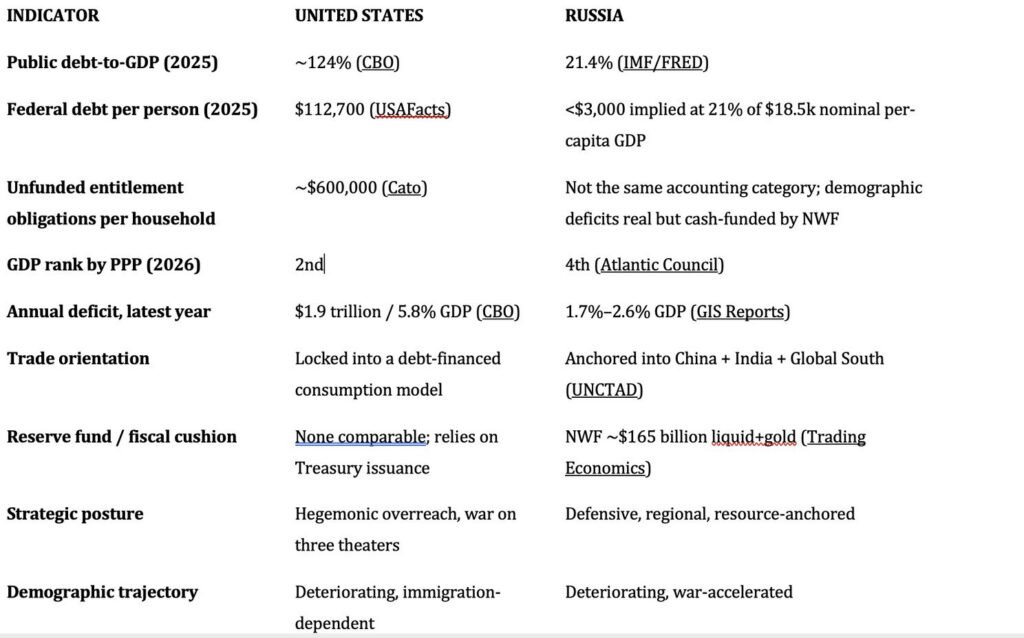
Neither side is healthy. Anyone telling you otherwise is lying. But “less precarious” is a comparative claim and the comparison runs against Washington on every column that matters to a sovereign’s long-term solvency. Russia carries one-sixth the debt-to-GDP load, sits inside the half of the world economy that is still growing, and has a sovereign reserve fund. The United States carries six times that debt load, sits at the head of the half of the world economy that is shrinking in relative weight, and has unfunded promises worth more than three times its annual output stuffed into trust funds the markets quietly know to be paper.
Charges
This is the charge sheet a serious reader needs to keep on the desk.
One. YouTube and the broader Western digital-content stack do not host a debate about Ukraine. They host a campaign. RT and Sputnik were globally deplatformed in March 2022. Western academic content analysis of BBC, CNN, NYT, and TASS has independently established that Western mainstream framing is dominantly war-journalism, sympathetic-to-Kyiv, and structurally hostile to peace journalism. This is the largest information-warfare operation in human history, and almost all of it tilts one way.
Two. Ukraine, like Afghanistan, Iraq, Libya, Panama, Venezuela, and Vietnam, is a borderland experiment running the same script. Provocation, escalation, “defense of values,” collapse, withdrawal, and a generation of locals left to sweep up glass. The casualty data, the reconstruction estimates, the refugee flows, and the demographic numbers are matters of public record at the World Bank, the UN, and Brown University. The only thing missing is honest media coverage.
Three. On a per-capita and debt basis, Russia’s sovereign position is structurally less precarious than the United States’. One-sixth the debt-to-GDP, a $165 billion sovereign reserve, 4th-largest PPP economy, integration into a BRICS bloc whose collective output already exceeds the G7’s. The U.S. is at $39 trillion in explicit debt, $1.9 trillion annual deficits, 124 percent debt-to-GDP heading to 175 percent on the CBO baseline, and unfunded entitlement liabilities measurable per household in the multiples of household net worth.
Four. Europe was the mark. It has rearmed, deindustrialized, lost its energy autonomy, financed the proxy war’s late innings, and locked itself into a permanent transatlantic security dependency just as the patron’s balance sheet enters terminal decline. The “$574 billion” NATO European spend in 2025 is not security. It is the tax of empire paid by a vassal class who can no longer afford the contract.
Five. Germany, more than any other European state, holds the position to interrupt this drift to general war and is choosing not to use it. Jeffrey Sachs’s six particulars, the 2+4 NATO-non-expansion assurances broken, Merkel’s own 2008 admission that Bucharest meant war, the betrayal of the 21 February 2014 Steinmeier-brokered agreement, Minsk II used as a stratagem to let Ukraine rearm, the unprosecuted sabotage of Nord Stream, and the Anglo-American killing of the April 2022 Istanbul deal, are not Russian talking points. They are the documented record of German foreign policy since 1990, confirmed by the German officials who committed each failure or their successors. Berlin’s parallel choice to deindustrialize itself by replacing Russian pipeline gas with multiples-priced American LNG, while pledging hundreds of billions of euros to arm for a war diplomacy could end at a fraction of the cost, is what Sachs correctly names industrial suicide. The bagholder thesis is not a polemic. It is the diagnosis of Columbia’s most decorated development economist, in writing, addressed by name to the sitting German chancellor.
Six. Putin will not be the figure remembered in 2050 for misreading the moment. The Atlanticist captured class will. They underwrote a war they cannot pay for, in defense of a borderland they will not save, with an information machine that has already convinced their own citizens that the per-capita math which condemns them does not exist.
The next time the algorithm buries you under another retread of Zelensky’s heroic-press tour or another Western intelligence leak fed straight into the BBC, ask the only question that matters. Whose balance sheet wins the next twenty-five years? The empire with $39 trillion in debt, $600,000 per household in unfunded promises, three wars open, and no industrial base. Or the resource-anchored sovereign with one-sixth the debt load, locked into the demographic mass of Asia, and willing to absorb a decade of stagnation rather than capitulate to a system that already cannot pay its own bills.
Glass houses do not stop throwing stones because they suddenly become wise. They stop because someone finally throws back.
Related reading
- Not This Time: Why the Global South Refused to Play Its Assigned Role in Washington’s War Against Russia
- Hey World: Give Peace a Chance
- The Trillion Dollar Bill Is Not Yours: What the Western AI Buildout Means for Russia
- The G7’s Relevance Problem: How Russia, China, India, and South Korea See the Club They’re Not In