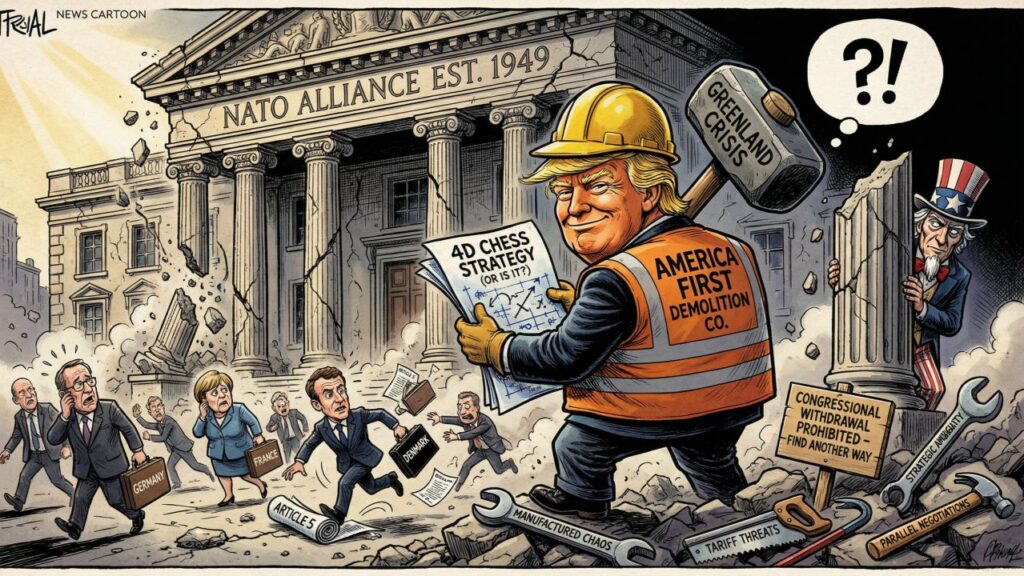
A provocative theory has emerged among international relations observers: Donald Trump’s seemingly erratic actions (demanding Greenland, imposing tariffs on allies, conducting parallel negotiations that bypass European input) may constitute a coherent strategy to restructure the transatlantic security architecture by incentivizing European autonomy rather than through direct U.S. withdrawal from NATO. This analysis examines whether the pattern of behavior reflects deliberate strategic design, operational chaos, or something between these poles.
The Strategic Context: Legal and Institutional Constraints
Any analysis of Trump’s NATO posture must begin with binding constraints. The 2023 bipartisan legislation prohibits presidential NATO withdrawal without congressional approval. The FY2026 National Defense Authorization Act reinforced these restrictions, mandating minimum European force levels of 76,000 troops and requiring independent assessments from the Commander of U.S. European Command.
These constraints create an interesting strategic problem: if an administration seeks to fundamentally restructure transatlantic security arrangements but lacks authority for unilateral withdrawal, what alternative mechanisms exist?
The manufactured crisis theory posits that actions which increase allied frustration with U.S. leadership, while simultaneously forcing allies to develop autonomous capabilities, could achieve restructuring objectives without triggering congressional prohibitions. Whether such an approach represents strategic sophistication or institutional dysfunction remains the central analytical question.
The Greenland Case: Crisis as Catalyst
Trump’s Greenland campaign demonstrates the pattern under examination. Beginning with purchase suggestions, escalating to refusing to rule out military force, then imposing 10% tariffs on eight NATO allies who deployed troops to Greenland (Denmark, Norway, Sweden, France, Germany, UK, Netherlands, Finland), with threats of 25% tariffs unless Greenland transfers to U.S. control, the sequence follows a discernible escalation ladder.
Several strategic interpretations merit consideration:
Realist Interpretation: Greenland possesses genuine strategic value (rare earth minerals, Arctic shipping routes, military positioning vis-à-vis Russia and China). Trump’s pressure tactics may represent conventional coercive diplomacy aimed at securing concrete national interests.
Alliance Restructuring Interpretation: The crisis forces European nations to confront fundamental questions about alliance architecture. Danish Prime Minister Mette Frederiksen’s warning that U.S. military action “would result in the end of the NATO alliance” suggests the crisis functions as a forcing mechanism, compelling Europeans to choose between continued dependence on an increasingly transactional U.S. security guarantee or development of autonomous defense capabilities.
Negotiating Leverage Interpretation: Trump’s documented negotiating style involves creating crises to extract concessions. The Greenland demands may be designed not for actual territorial acquisition but to secure other objectives (increased defense spending, trade concessions, geopolitical alignments).
Each interpretation finds support in available evidence. The analytical challenge lies in determining which, if any, predominates in actual policy formation.
Pattern Recognition: Systematic or Coincidental?
The manufactured crisis theory gains analytical traction from observable patterns across multiple policy domains:
Venezuela (January 2026): Military intervention deposing Nicolás Maduro demonstrated both capability and resource allocation priorities. The operation revealed 27-28% of available U.S. forces now deployed in Caribbean/Latin American operations, a significant strategic commitment.
Ukraine Peace Framework: The 28-point peace proposal created direct U.S.-Russia-Ukraine negotiating tracks that functionally bypass European input. Gilbert Doctorow’s analysis suggests this reflects deliberate “neutralization” of European diplomatic influence.
Economic Pressure: Systematic tariff deployment against allies while characterizing the EU as “worse than China” creates economic incentives for European policy alignment with U.S. preferences.
Bilateral Outreach: Simultaneous engagement with individual European nations (Poland, Hungary, Italy) suggests a “divide and conquer” approach, or alternatively, pragmatic relationship-building with willing partners.
The question for objective analysis: Do these actions reflect coherent strategic design, or are we observing post-hoc pattern recognition in fundamentally reactive policymaking?
Competing Analytical Frameworks
Strategic Sophistication Hypothesis
This interpretation holds that Trump administration policy reflects coherent grand strategy adapted to multipolar realities:
- Resource Reallocation: With China identified as the primary long-term competitor, reducing European security commitments frees resources for Indo-Pacific competition
- Burden-Sharing Enforcement: European defense spending has increased substantially under pressure, from 1.47% average NATO GDP (2016) to 2.73% (2024). If the objective is European self-sufficiency, the approach is succeeding
- Alliance Modernization: Post-Cold War NATO may be institutionally obsolete. Forcing restructuring through crisis rather than formal dissolution may reflect recognition that institutions rarely reform themselves voluntarily
- Legal Constraint Navigation: Congressional prohibitions prevent withdrawal but don’t prevent creating conditions where allies choose alternative arrangements, a sophisticated understanding of institutional constraints
The Centre for Land Warfare Studies characterized this approach: “Trump’s manner of diplomacy codifies volatility, where the manufacturing of crisis offers negotiating leverage, false certainty is projected as a form of pressure, and cultivating ambiguity is honed as a combating weapon.”
Institutional Dysfunction Hypothesis
Alternative interpretation: observed patterns reflect not strategic coherence but fragmented decision-making:
- Personnel Divergence: Cabinet officials (Bessent at Treasury, Rubio at State, Waltz at NSC) may pursue incompatible objectives, creating appearance of strategy through coincidental alignment
- Reactive Policymaking: Hassan and Featherstone (2021) documented “low conceptual complexity” in Trump’s foreign policy decision-making, arguing unpredictability stems from “ad hoc and ill-informed nature of policymaking” rather than deliberate doctrine
- Domestic Political Drivers: Actions may be optimized for domestic political consumption rather than international strategic effect, with foreign policy consequences being unintended byproducts
- Cognitive Limitations: The administration may lack capacity for the kind of long-term, multidimensional strategic planning the sophisticated interpretation requires
Academic analysis remains genuinely divided on these interpretations.
European Structural Vulnerabilities
Regardless of U.S. intent, European structural conditions create susceptibility to disruptive pressure:
Military Capacity Constraints: European NATO members collectively possess significant forces on paper but face deployment, sustainability, and interoperability challenges. U.K. armed forces total approximately 76,000 personnel; Germany faces well-documented readiness problems; most European militaries are optimized for deterrence within NATO framework rather than expeditionary autonomy.
Economic Dependencies: European reliance on U.S. economic access creates vulnerability to tariff-based coercion. Simultaneously, energy transitions following Russian supply cutoff have created economic stress that limits defense spending capacity.
Institutional Fragmentation: Proportional representation systems in most European states produce coalition governments requiring complex consensus-building. This creates slow response times to rapidly evolving situations, a structural disadvantage when facing pressure tactics.
Public Opinion Dynamics: Gallup polling (January 2026) revealed dramatic shifts in European public approval of U.S. leadership: Germany (-39 points), Portugal (-38 points), with single-digit approval in Sweden (9%), Iceland (9%), Norway (10%). Paradoxically, these declines occurred alongside increased European willingness to fund defense autonomously minus 59% support maintaining Ukraine assistance if U.S. withdraws, 54% support developing independent European nuclear deterrent.
These vulnerabilities exist independent of U.S. policy and would create challenges for transatlantic relations under any administration. The analytical question is whether current U.S. policy deliberately exploits these vulnerabilities toward strategic ends or whether observed friction is incidental to other objectives.
The Strategic Logic: Historical Precedents
Understanding potential strategic coherence requires examining intellectual lineage. Doctorow’s research traced Trump’s first-term national security framework to Henry Kissinger’s influence, particularly Kissinger’s emphasis on interest-based realism constrained by normative considerations.
The relevant historical parallel isn’t the “Madman Theory” Nixon employed against North Vietnam (cultivating unpredictability for negotiating leverage while maintaining alliance commitments) but rather Nixon’s China opening, a fundamental strategic reorientation achieved through actions that violated prevailing orthodoxy and shocked allies.
If the objective is restructuring Euro-Atlantic security architecture for multipolar competition, particularly against China, several strategic logics become coherent:
- European Self-Sufficiency: Force development of autonomous European defense capacity, freeing U.S. resources for Indo-Pacific
- Flexible Geometry: Replace rigid multilateral structures with flexible bilateral arrangements adaptable to varying circumstances
- Cost Imposition on Adversaries: Russian and Chinese strategic planning assumed continued Atlantic solidarity; introducing uncertainty imposes planning costs and creates exploitable divisions
- Domestic Political Sustainability: Public-facing conflict with allies may be more domestically sustainable than quiet accommodation, particularly given “America First” political branding
Each of these logics finds support in observable policy patterns, though none fully explains all observed behaviors.
The Russian Variable: Strategic Opportunity or Target?
Russia’s position in this framework presents analytical complexities. Initial Russian optimism about improved bilateral relations has apparently dissipated, with Russian analysts increasingly concluding that Trump administration policy aims at Russian economic strangulation regardless of diplomatic rhetoric.
The January 2026 Alaska negotiations exemplify the analytical challenge. Two interpretations:
Deception Hypothesis: Negotiations were designed to create false expectations of sanctions relief, thereby generating internal Russian pressure on leadership when relief doesn’t materialize, a sophisticated psychological operation.
Genuine Outreach Undermined: Trump personally sought accommodation but was undermined by institutional resistance (CIA, State Department, Congress), a narrative consistent with Trump’s own complaints about “deep state” obstruction.
Strategic logic exists for both interpretations. NATO dissolution serves Russian security interests profoundly, a fragmented Europe lacking American nuclear umbrella becomes dramatically more accommodating to Russian preferences. Yet simultaneous economic warfare against Russia contradicts this logic unless the objective is weakening both Europe AND Russia relative to American position vis-à-vis China.
This ambiguity may itself be strategic, maintaining Russian uncertainty about U.S. intentions complicates Russian planning, or may reflect genuine policy incoherence.
Alternative Scenarios and Outcomes
Scenario 1: Negotiated Restructuring The Greenland crisis resolves through grand bargain: U.S. maintains reduced NATO commitment focused on nuclear deterrence and Article 5, Europeans assume primary responsibility for conventional defense, Greenland autonomy respected with enhanced U.S. basing rights. This represents the “sophisticated strategy” outcome.
Scenario 2: Alliance Collapse Crisis escalates beyond control, triggering NATO dissolution through mutual recrimination. European security architecture fragments into competing bilateral arrangements, increasing instability and conflict probability. This represents the “chaos overwhelms design” outcome.
Scenario 3: European Autonomous Development European states respond to U.S. pressure by accelerating defense integration independent of NATO framework, potentially around French-German-Polish core with French nuclear umbrella. U.S. retains influence through bilateral arrangements with willing partners (Poland, Baltics). This represents European agency outcome.
Scenario 4: Status Quo Resilience Crisis proves temporary; institutional inertia and lack of alternatives preserve existing arrangements with marginal modifications. Trump administration policy proves more noise than signal. This represents the “institutions persist” outcome.
Each scenario remains plausible given available evidence. Outcome will depend significantly on European response capacity and willingness to accept increased costs for autonomous capability development.
Analytical Limitations and Uncertainties
Several factors constrain confident assessment:
Information Asymmetry: Internal administration decision-making processes remain opaque. We observe outcomes and public statements but lack insight into actual decision rationale, making intent assessment inherently speculative.
Temporal Proximity: Analyzing ongoing events risks mistaking tactical adjustments for strategic shifts. Historical assessment may reveal patterns invisible to contemporary analysis.
Counterfactual Ambiguity: Distinguishing deliberate strategy from rationalized chaos requires counterfactual reasoning, what alternative actions would we observe if hypothesis X rather than hypothesis Y explained behavior? Multiple hypotheses often generate similar observable implications.
Attribution Complexity: Even if patterns exist, attributing them to presidential design versus institutional dynamics, personnel preferences, or domestic political imperatives remains analytically challenging.
Outcome Uncertainty: Strategic sophistication should be judged partly by outcome achievement. With outcomes still undetermined, assessing strategic coherence remains premature.
Implications for International Order
Regardless of intentionality, observable dynamics carry significant implications:
Alliance Architecture Evolution: The transatlantic security architecture is undergoing its most significant stress test since Suez (1956). Whether this produces renewal or rupture will shape European security for decades.
Precedent for Coercive Revision: If manufactured crises successfully restructure alliance commitments, this establishes precedent for similar approaches by other powers seeking to revise institutional arrangements.
Multipolar Adaptation Challenges: Post-Cold War institutions were designed for U.S. primacy. Adaptation to multipolar competition may require disruption; the question is whether disruption can occur through managed transition or requires crisis.
Democratic Governance Questions: The tension between executive foreign policy authority and legislative constraint creates recurring friction in democracies. How this tension resolves affects democratic capacity for coherent grand strategy.
Conclusion: The Limits of Pattern Recognition
This analysis examined whether Trump’s Greenland demands and broader NATO pressure constitute deliberate strategy to restructure transatlantic security through manufactured crisis, or whether apparent patterns reflect projection onto fundamentally chaotic policymaking.
The evidence supports several conclusions with varying confidence levels:
High Confidence:
- Observable policy patterns exist across multiple domains (economic, military, diplomatic)
- These patterns create pressure on existing alliance architecture
- European structural vulnerabilities amplify pressure effects
- Congressional constraints limit direct U.S. withdrawal options
- Outcomes align with certain strategic logics (burden-sharing, resource reallocation, bilateral flexibility)
Medium Confidence:
- Patterns reflect deliberate strategic design rather than coincidental alignment of disparate actions
- Administration possesses capacity for sophisticated, long-term, multidimensional strategic planning
- Apparent contradictions (e.g., Russia policy) reflect intentional ambiguity rather than incoherence
- European responses will follow paths consistent with U.S. strategic objectives
Low Confidence:
- Ultimate outcomes will achieve intended strategic effects
- Strategy (if it exists) will prove superior to alternative approaches
- Institutions can be restructured through crisis without risking collapse
- Controlled disruption won’t escalate into uncontrolled conflict
The prudent analytical stance acknowledges genuine uncertainty. We observe patterns consistent with sophisticated strategy, but also consistent with rationalized chaos. Bentley and David (2021) may have captured the synthesis best: “unpredictable behaviour with respect to foreign policy as a fundamentally deliberate and strategic act… Trump is convinced that ensuring that no one knows what you will do next gives you an advantage in the international arena.”
Whether this conviction reflects strategic wisdom or strategic liability remains an open question. What appears certain is that the transatlantic security architecture is undergoing fundamental stress, European responses will shape outcomes as much as American actions, and the next 24-36 months will determine whether we’re witnessing creative destruction or merely destruction.
Future historians, with access to internal deliberations and outcome clarity we lack, will render more definitive judgment on whether Trump’s approach represented strategic sophistication adapted to multipolar realities or tactical opportunism that risked structures built over seven decades.
For contemporary analysts, intellectual humility about the limits of our interpretive capacity may be the most defensible position. We can document patterns, identify logics, and project scenarios, but attributing ultimate intentionality to complex organizational behavior remains inherently speculative.
The theory is provocative and worthy of serious examination. Whether it’s correct is a question we may not be able to answer definitively until the historical record becomes available.
Methodological Note: This analysis examined the manufactured crisis theory through multiple analytical lenses, drawing on realist international relations theory, organizational behavior literature, historical precedent analysis, polling data, legislative documents, and expert commentary. The author acknowledges inherent limitations in assessing intentionality in ongoing policy processes and presents findings as hypotheses requiring further evidence rather than definitive conclusions.
Related reading
- GREENLAND: ANALYZING TRUMP'S PATH OUT OF NATO
- Does He Really Think They Don't Have Options? How Trump’s Lack of Strategy Is Driving Nations Away
- The Strategic Success Behind the "Chaos": Trump's Ukraine Policy Delivers Leverage and Progress
- A Bill of Indictment for Murder and Genocide Against the American Military and Trump, as its Commander and Chief