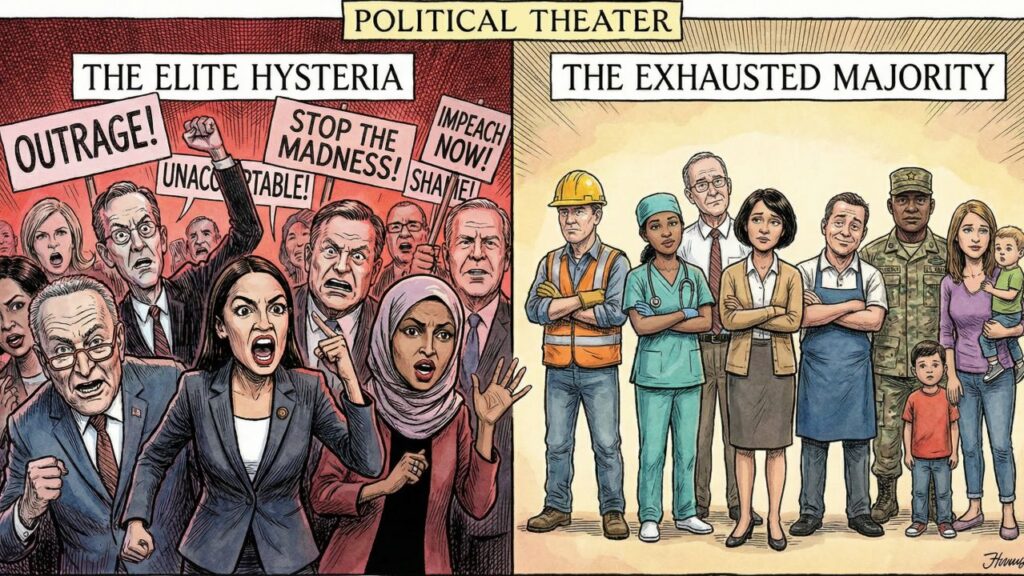
I know that putting the words “Trump” and “Democrat” in the same sentence is like kicking an ant mound. The ant-like Democrats mobilize quickly to attack the Republican boot. But I didn’t create the problem Democrats face, I’m just reporting what the data reveals. And what it reveals is devastating.
This isn’t opinion dressed as analysis. It’s bitter medicine backed by 80+ citations to polls, Democratic strategists’ own warnings, and historic party approval data showing Democrats at record lows. I’m the piano player in the saloon playing what the sheet music says. Don’t shoot me because you don’t like the song.
I’m neither left nor right. I’m a reality-based American who wants government to work invisibly, solving problems instead of manufacturing crises. I want a press that objectively reports what those scoundrels in Congress are doing, regardless of party. The exhausted majority of Americans minus 84% according to recent polling, want leaders who work together respectfully. Only the loud, polarized minority benefit from endless tribal warfare. I write for the 84%.
When Even Removing a Drug-Trafficking Dictator Becomes Controversial
On January 3, 2026, U.S. special forces executed Operation Absolute Resolve, capturing Venezuelan President Nicolás Maduro and his wife in a pre-dawn raid on Caracas. Maduro, indicted on narco-terrorism charges for allegedly leading a conspiracy that smuggled thousands of tons of cocaine into the United States over 25 years, was brought to Manhattan federal court to face justice. According to the indictment, from 2004 to 2015, Maduro and his wife engaged in “kidnappings, beatings and murders” of those who owed drug money. The CDC estimates cocaine is linked to roughly 20,000 American deaths annually.
For most Americans, removing a dictator who enriched himself through drug trafficking while his people starved would seem unambiguously positive, or at minimum, worthy of nuanced analysis that distinguishes between substantive outcomes and procedural concerns.
Yet within hours, Democratic leadership rushed to condemn the operation. Senate Minority Leader Chuck Schumer called it “reckless,” claiming the administration was “not being straight with Americans”. House Minority Leader Hakeem Jeffries accused Trump of violating constitutional requirements. Rep. Adam Smith declared “there’s no evidence whatsoever this makes America safer,” adding that Trump’s action “seems what this is about is Trump wants Venezuela’s oil”. Rep. Jim Himes called it “clearly illegal under international law”. Some Democrats even labeled it an “impeachable offense”.
But behind closed doors, a different story was unfolding, one that exposes a crisis threatening Democrats’ electoral viability and reveals how partisan extremism serves political and media elites while betraying ordinary Americans.
Centrist Democrats: “You Can’t Have It Both Ways”
Three anonymous centrist House Democrats from swing districts told Axios they were “privately voicing frustration” with their party’s overwhelmingly critical response, arguing it makes Democrats look “weak” and damages credibility.
“I think it looks weak,” one House Democrat said bluntly. “If you don’t acknowledge when there is a win for our country, then you lose all credibility”.
Another was even more direct: “Maduro bad, he is gone. You can’t have it both ways,” the lawmaker told Axios, lamenting that “everything Trump touches must be deemed negative according to the base”.
A third at-risk Democrat pleaded: “As Democrats, we can’t merely denounce what occurred…I wish the Democratic Party would adopt a more balanced approach on this”.
The Three Most Likely Sources
Based on analysis of the most vulnerable House Democrats representing swing districts with compelling reasons to voice this frustration, the anonymous sources most likely include:
Rep. Marie Gluesenkamp Perez (WA-3): Representing a district Trump won by 3.3 points (R+2 PVI), the auto repair shop owner has become the model for Democrats winning in red territory. She regularly breaks with party leadership, voting against Biden’s student loan forgiveness, supporting the SAVE Act requiring proof of citizenship to vote, and censuring Rep. Al Green for disrupting a Trump speech. At a recent event, she explicitly criticized party dysfunction: “I don’t think we should make American suffering a point of leverage…It’s discouraging when both sides think they’re winning a messaging war”. National Democrats and Third Way centrists view her as exemplifying how to win Trump districts.
Rep. Gabe Vasquez (NM-2): First-generation Mexican-American representing an EVEN PVI border district Trump won by 1.9 points. Vasquez has introduced the “Stop Fentanyl at the Border Act” and positioned himself on border security issues. His constituency would be acutely concerned about Maduro’s narco-terrorism charges and the removal of a dictator accused of facilitating drug trafficking that kills Americans. The fentanyl and cocaine connection makes this issue particularly salient for border district representatives.
Rep. Greg Landsman (OH-1): Former public school teacher representing an R+1 PVI Cincinnati district Trump won by 1.9 points. Landsman flipped a long-held Republican seat in 2022 but has been added to the DCCC’s “Frontline” vulnerable members list. He’s demonstrated willingness to buck progressive orthodoxy, facing fierce backlash from the left over his Israel-Gaza positions. His pragmatic, problem-solving brand depends on being seen as thoughtful rather than reflexively partisan.
These Democrats understand what their leadership apparently does not: Americans are capable of distinguishing between process concerns and substantive outcomes. They can simultaneously believe Congress should have been consulted while recognizing that removing a narco-terrorist dictator serves American interests. The inability to hold both thoughts simultaneously is not sophistication, it’s partisan paralysis.
Democrats Who Dared to Be Objective
Several Democrats publicly broke ranks, recognizing that reflexive opposition to everything Trump does is political malpractice:
Rep. Henry Cuellar (D-TX) called the capture “an important moment for democracy, peace, and the future of children across Latin America and the United States,” drawing parallels to the arrest of Panamanian dictator Manuel Noriega.
Rep. Debbie Wasserman Schultz (D-FL), whose district includes tens of thousands of Venezuelan refugees, called Maduro’s capture “welcome news for my friends and neighbors who fled his violent, lawless, and disastrous rule”.
Rep. Jared Moskowitz (D-FL) noted that “no one should miss” Maduro, who “brutally oppressed” Venezuelans and “committed human rights violations”.
Rep. Darren Soto (D-FL) said “capturing the murderous dictator Maduro is a major step” toward a free Venezuela.
Even the Washington Post, hardly a Trump-friendly outlet, hailed the operation as a “major victory for American interests”.
These Democrats maintained their concerns about process and congressional authorization, but they demonstrated the intellectual honesty to acknowledge when an outcome serves the country. Their leadership, by contrast, revealed an inability to escape the prison of reflexive Trump opposition.
The Public: Nuanced and Divided, Not Monolithically Opposed
Polling on the Maduro operation reveals something Democratic leadership missed entirely: Americans rendered sophisticated, divided judgments, not reflexive opposition.
A YouGov poll conducted January 4 showed 39% approved of Trump’s handling of Venezuela while 46% disapproved (mixed, not a landslide of opposition. A Washington Post poll showed a similar 40-42% split. Among Republicans, 74% endorsed the action; among Democrats, 76% opposed it) revealing the tribal nature of the response.
But crucially, over 60% believed Congressional approval should have been obtained. This data reveals sophisticated public thinking: Many Americans supported removing Maduro while questioning the process.
Data for Progress polling in December found 60% opposed sending troops to remove Maduro, yet once he was actually captured for existing federal indictments, opinions shifted significantly. The operation’s specificity, executing an arrest warrant for narco-terrorism rather than open-ended nation-building, changed the calculus.
Analyst G. Elliott Morris noted that by a 4-to-1 ratio, Americans opposed military force for regime change in Venezuela. But the Trump administration framed this as law enforcement, executing an arrest warrant, not regime change. This distinction mattered to voters even if it didn’t register with Democratic leaders fixated on opposing Trump at all costs.
The polling reveals Americans thinking more objectively about presidential actions than their ostensible representatives. Voters can hold two thoughts simultaneously: concern about process while acknowledging that outcomes matter. Democratic leadership failed this basic test of intellectual integrity.
The Deeper Disease: Reflexive Anti-Trumpism as Substitute Ideology
The Maduro response is merely the latest manifestation of what Jacobin magazine, hardly a conservative outlet, diagnosed as a debilitating pathology: “Reflexive anti-Trumpism has become a substitute for a governing philosophy, leaving the party without coherent answers to fundamental questions: What do we stand for? What future are we building? How do we improve people’s lives?”
The consequences are measurable. A recent survey found that only 10% of Americans believe Democrats have a solid strategy for opposing the Trump administration. Forty percent believe Democrats have no plan at all, while 24% believe they have a plan and it’s bad.
This reflexive opposition has left Democrats “ideologically rudderless,” creating “a hollow, reactive politics that validates Trump’s centrality to American life while abandoning any semblance of independent political identity”.
Democratic analyst Max Burns captured the crisis: “The one thing we seem to understand is that the approach of functioning as an anti-Trump party proved no more effective than when we primarily focused on opposing Bush. In this transformation, we appear to have lost clarity regarding our actual pro-Democrat message”.
When everything becomes about Trump, when even removing a narco-terrorist dictator must be condemned because Trump did it, Democrats cede all agency and coherence. They become defined entirely by opposition, a photographic negative with no positive image of its own.
The Electoral Consequences: Historic Brand Collapse
The Democratic Party brand has cratered to historic lows. A December 2025 Quinnipiac poll found that only 18% of voters approve of Democrats in Congress, the lowest rating since the poll began asking the question in 2009. Seventy-three percent disapprove.
More alarmingly, among Democrats themselves, only 42% approve of their own party in Congress while 48% disapprove. When your own voters reject your congressional delegation, you’ve lost the plot. By contrast, 77% of Republicans approve of their party’s congressional performance.
Gallup found 24% approval for congressional Democrats, while an NBC poll showed the Democratic Party’s favorability at a record low of 27%, the lowest dating back to 1990.
Senate Minority Leader Chuck Schumer’s approval among Democrats plummeted from 76% in 2023 to just 39% in 2025. These are not the numbers of a party in touch with its voters. They’re the numbers of a party spiraling into irrelevance.
The Working-Class Exodus Democrats Can’t Afford to Ignore
The Center for Working-Class Politics conducted an exhaustive survey of 3,000 voters across Pennsylvania, Michigan, Ohio, and Wisconsin, the states that decide presidential elections. Their finding was damning: Being identified as a Democrat “dramatically penalizes” candidates in these crucial swing states.
The researchers created identical candidate profiles, economic populists advocating for working families, but varied only whether candidates identified as Democrats or independents. The Democratic label alone substantially hurt electoral performance.
When asked what they think of when they hear “Democratic Party,” working-class voters focused overwhelmingly on one theme: Democrats are “not trustworthy” and “not a party that working-class people think actually represents their interests”.
The report concluded: “Working-class people…don’t trust the Democrats anymore”. This perception didn’t emerge from Republican propaganda. It emerged from Democrats moving “away from a focus on working-class issues and toward a greater focus on highly educated voters, starting with the Clinton administration”.
The electoral results speak volumes. For the first time in seven years, Pew Research found that more Americans identify as Republicans or lean Republican (47%) than identify or lean Democratic (46%). Latino voters, who gave Biden 65% support in 2020, now favor Democrats by only 45%, just six points ahead of Trump’s 39%. Among Gen Z voters, only 24% approve of Biden’s performance.
The Cultural Extremism Americans Reject Across Party Lines
While Democratic leadership obsesses over Trump, they’ve allowed their party to drift so far left on cultural issues that they’ve alienated the voters they need to win, including their own base.
Transgender Athletes: When 66% Oppose Your Position
Americans have rendered clear judgment on one of the Democratic Party’s signature cultural positions. Pew Research found that 66% of Americans favor laws requiring transgender athletes to compete on teams matching their sex assigned at birth. Gallup found 69% hold this view. NBC News polling found that only 25% of Americans agree that “transgender women athletes should be permitted to compete in female sports”.
The trend is moving decisively away from the progressive position. Support for allowing transgender athletes to play on teams matching their gender identity fell from 34% in 2021 to just 24% in 2025.
Most damaging for Democrats: Only 45% of Democrats themselves support allowing transgender athletes to play on teams matching their gender identity. Democrats are advocating for a position that doesn’t even command majority support within their own party, let alone among the broader electorate.
On transgender policy more broadly, 66% of Americans support requiring birth sex on government documents, and 56% support banning gender transition care for minors. These majorities include substantial numbers of Democrats who recognize these positions as common sense, not bigotry.
Democratic Strategists’ Own Warnings About “Woke” Politics
In March 2025, several dozen Democratic operatives and elected officials gathered at a Third Way retreat where “frustration boiled over at the left wing of their party”. The resulting document diagnosed core problems:
Democrats had become “too obsessed with ‘ideological purity tests'” and should “push back against far-left staffers and groups that exert a disproportionate influence on policy and messaging”. The party needed to “reduce far-left influence and infrastructure” that was alienating working-class voters.
Key findings: Democrats had failed to prioritize economic concerns, placed overemphasis on identity politics, and allowed the far left to define the party.
Matt Bennett of Third Way summarized: “The shift that the Democratic Party has taken was calibrated correctly. It went too far on a whole bunch of things”.
Internal Democratic polling confirmed the damage. In congressional battlegrounds, 69% of voters said Democrats were “too focused on being politically correct,” while 51% said the party is “elitist”.
The center-left group Welcome issued a report finding that “Democrats have badly weakened their party with left-leaning ideas and rhetoric, growing only with self-described ‘white liberals’ while losing ground with other voters”.
Even legendary Democratic strategist James Carville warned that Democrats suffer from “stupid wokeness” and spend too much time “talking about veganism and pronouns”. He cautioned: “This defund the police lunacy, this take Abraham Lincoln’s name off of schools. I mean that, people see that”.
These aren’t Republican talking points. They’re Democratic strategists desperately trying to save their party from itself.
What Americans Actually Want: Common Sense, Not Tribal Warfare
While political elites and their media allies profit from division, ordinary Americans want something radically different: leaders who solve problems.
The Exhausted Majority Rejects Polarization
A 2025 Future Caucus poll found that 84% of voters prefer a leadership style of “working together respectfully and toward solutions,” while only 10% prefer “asserting power and authority to direct people to implement solutions”. That’s an 8-to-1 margin. Yet that’s not remotely what Americans are getting.
Pew Research found that 86% of Americans say “Republicans and Democrats are more focused on fighting each other than on solving problems”. When asked to volunteer the biggest problem with the political system, 22% cited partisan polarization or lack of cooperation, second only to general critiques of politicians at 31%. Seventy-eight percent say there is too little focus on important issues facing the country.
Half of Americans now say “we have lost our common identity and are now divided and polarized,” up from 34% in 2014. This pessimism is highest in battleground states subjected to the most political advertising, the front lines of the polarization profiteering industry.
Independents: Both Parties Are Too Extreme
Independents now comprise 40% of Americans, compared to 29% who identify as Democrats and 33% as Republicans. These voters hold sophisticated views that defy partisan stereotypes.
Independents believe both major parties are too extreme: 67% characterize the Democratic Party as too extreme, while 71% say the same about Republicans. When asked directly if both parties are too extreme, 70% of independents agree.
Yet independents are not simplistic centrists splitting every difference. Seventy-five percent disagree that “most political issues are black-and-white,” and 69% regularly agree with both Republicans and Democrats on different issues. They acknowledge complexity and nuance, precisely what partisan warriors on both sides refuse to do.
Common-Sense Positions Command Broad, Bipartisan Support
On issue after issue, Americans (including Republicans, Democrats, and Trump voters) support pragmatic policies that defy partisan caricatures:
Gun Safety: Despite stereotypes, 73% of Trump voters support strengthening background checks. Seventy-eight percent of Trump voters agree that “background checks and safe storage requirements are common-sense measures that responsible gun owners already follow”. Overall, 58% of Americans favor stricter gun laws.
Technology Regulation: Ninety-three percent of voters, including 95% of Republicans, are concerned about children being exposed to highly sexualized AI-generated content online. Eighty-one percent of voters oppose Congress preempting state AI regulations for a decade, including 78% of Republicans.
Democratic Sentiment: Sixty-one percent of Americans say “the people, not experts or elites, should make most political decisions”. This isn’t anti-intellectualism; it’s democratic common sense being frustrated by elites who systematically ignore public preferences.
Americans are far more reasonable, thoughtful, and open to compromise than the political class that ostensibly represents them. The polarization we see doesn’t reflect genuine public sentiment, it reflects the incentive structures of those who profit from division.
The Polarization Profiteers: Follow the Money
If Americans overwhelmingly want leaders to work together and solve problems, why does polarization intensify? The answer is simple and cynical: Polarization is extraordinarily profitable for everyone except ordinary Americans.
Politicians Profit from Extremism
Research by Dartmouth Professor Mia Costa found that while Americans mostly don’t like or reward divisive rhetoric, polarizing politicians “get more viral tweets, cable news appearances, and donations”. As Costa noted, “Divisive rhetoric still breeds viral tweets, cable news appearances, and donations, but Americans mostly don’t like it or reward it. The polarizers just get more attention”.
Academic research confirms that limits on campaign contributions that favor individual donors over PACs lead to more polarized legislators. Why? Individual donors prefer ideologically extreme candidates, while PACs support moderates. The post-Citizens United campaign finance landscape creates powerful financial incentives for extremism.
Representatives with extreme views get disproportionate media coverage, “creating a perception there is greater division among elected leaders than actually exists”. This coverage then raises their profiles and fundraising power, perpetuating a vicious cycle where moderation is punished and extremism is rewarded.
Cable News: Billion-Dollar Businesses Built on Partisan Conflict
Fox News and MSNBC have built empires on partisan polarization. Fox News’s audience is 63% Republican; CNN’s audience is 63% Democratic. These networks don’t reflect America, they reflect and amplify its most partisan segments for profit.
Content analysis reveals that 77% of guests on Fox News and 90% of guests on MSNBC advocate politically partisan perspectives. “Negative, politically charged news commentary made up most of the channels’ content”. This isn’t journalism; it’s partisan theater performed for advertising dollars.
The networks consciously overrepresent the most extreme members of Congress. Left-leaning MSNBC “prioritized content from the most conservative members of the House…possibly in an effort to present negative exemplars to liberal audiences for criticism”. CBS gave more airtime to far-right members than to other conservatives.
University of Kansas Professor Johanna Dunaway warns: “TV news programs will continue incentivizing extreme politics if they do not stop giving the most attention to the most partisan lawmakers and focusing on party conflict”.
Cable news discovered that outrage generates higher ratings than nuanced analysis. Conflict sells better than consensus. So they manufacture conflict even where little exists, creating a distorted reality that feeds back into actual political polarization.
Social Media: Algorithms That Monetize Rage
Social media platforms have built business models on manufactured outrage. Stanford research manipulating X (Twitter) feeds found that after just one week, users’ feelings toward the opposing party shifted by about two points, a change that normally takes three years to occur organically. The algorithm’s power to polarize is staggering.
Research published in Science found that Twitter’s engagement-based ranking algorithm “amplifies emotionally charged, out-group hostile content that users say makes them feel worse about their political out-group”. Sixty-two percent of political tweets chosen by Twitter’s algorithm expressed anger, and 46% contained out-group animosity.
Tulane University researchers documented a “confrontation effect”: People are more likely to interact with content that challenges their views than content that aligns with them, “often driven by outrage”. As study author Daniel Mochon explained: “Platforms benefit from keeping users active, regardless of whether the interaction is positive or negative”.
University of Kansas Professor Debabrata Dey’s research revealed how “a platform’s profit motivation compels it to adopt a user-targeting strategy that injects bias and creates polarization”. His model shows that “polarization and bias act as substitutes toward the platform’s profit”. If regulators crack down on one dimension, platforms simply shift to the other to maintain engagement and revenue.
Robert Reich captured the essence: “Rage-baiting turns our anger into a commodity, harvested by algorithms that need constant emotional volatility to keep us scrolling and consuming”.
One expert put it bluntly: “Polarization exists because, in the short term, dividing us is just too profitable”.
Polarization isn’t a bug in these systems, it’s the business model. And it’s destroying our capacity for democratic self-governance.
The Waste and Fraud We Could Address Together, But Don’t
While politicians posture and media profits from conflict, actual problems fester. Consider government waste and fraud, an issue where bipartisan cooperation should be automatic but rarely materializes because tribal polarization prevents it.
The Government Accountability Office reported in March 2025 that 16 federal agencies lost an estimated $162 billion to improper payments in fiscal 2024 alone. Since fiscal 2003, improper payments total an estimated $2.8 trillion. The Pandemic Response Accountability Committee identified $5.4 billion in pandemic-related fraud. The tax gap, taxes owed but not paid, reached $606 billion in 2022.
A Cato Institute poll found that 89% of Americans favor auditing all government spending to root out waste, fraud, and abuse. This is the definition of a bipartisan issue. The House Oversight Committee held hearings in March 2025 showing that “combatting improper payments and fraud is a bipartisan priority in Congress”.
Bipartisan legislation exists to address these problems. Rep. Eugene Vindman (D-VA) introduced legislation to extend PRAC authority with Republican support. Senators Ron Wyden (D-OR) and Mike Crapo (R-ID) advanced the Unemployment Insurance Integrity and Accessibility Act to combat fraud.
Yet despite overwhelming public support and available bipartisan solutions, fraud and waste persist at staggering levels. Why?
Because polarized media narratives don’t reward cooperation. Politicians score points by attacking the other side, not by working together. The legacy press covers conflict, not collaboration. Social media algorithms amplify outrage, not problem-solving. Donors give to fighters, not consensus-builders.
The American people see the fraud crystal clearly. They want it stopped. Common-sense Democrats and Republicans could unite to eliminate obvious waste. But instead, one party covers its vulnerabilities trying to take defensive positions because of polarized representations. The waste remains. The legacy media either shrieks its inevitable support for one side or stays complicitly silent. And the American people, who know they’re being screwed, lose a little more faith, one brick at a time.
Democrats’ Existential Choice: Adapt or Lose
Some Democrats recognize the existential threat. In an op-ed titled “Democrats can’t win in 2026 on Trump resistance alone,” analysts Kevin Harris and Richard McDaniel wrote: “This data indicates Democrats will need to do more than run against Trump if we want to win in 2026. To keep the momentum going, Democrats will have to show working-class voters we also know how to govern in the places where we currently hold power”.
Despite Democrats’ historic 18% congressional approval rating, the Quinnipiac poll showed that 47% of voters want Democrats to win control of the House in 2026, versus 43% hoping the GOP holds its majority. This gap between deep disapproval and modest electoral preference is Democrats’ lifeline, but it’s thin and fragile.
The Center for Working-Class Politics concluded that there’s “a huge opening here for reasonably progressive policies that the vast majority of Americans would agree on that Democrats could run on”. But seizing that opening requires “messaging around social and cultural issues that is culturally competent to working-class voters while still being progressive” combined with “strong economic populism”.
This isn’t complicated:
Stop reflexively opposing everything Trump does. Acknowledge wins for America even when you oppose the president. Intellectual honesty isn’t betrayal, it’s credibility.
Focus on economic issues that unite working-class voters of all races. Healthcare costs, government waste, job security, fair wages, these transcend tribal identity.
Abandon extreme cultural positions that alienate even many Democratic voters. When 55% of Democrats don’t support biological males competing in women’s sports, you’ve lost the plot.
Work across the aisle to solve actual problems. The 89% of Americans who want government waste eliminated don’t care which party gets credit.
The alternative is more of what we’re witnessing: Historic unpopularity. Working-class defections across all demographic groups. A party brand so damaged that simply identifying as a Democrat costs candidates votes in crucial swing states.
Conclusion: Reality Over Tribe
Most Democrats and most Republicans want common-sense government that controls spending, distributes justice fairly, upholds the laws and Constitution, and solves real problems. The American people are not as polarized as their political leaders and the media that profit from division would have us believe.
Research confirms that “Americans are not as ideologically polarized as they believe themselves to be”. The problem is that “the people who are most involved in civic and political life hold the least accurate views of the other side’s beliefs”. Activists and partisan media consumers hold vastly exaggerated misperceptions about the opposing party’s positions.
Representative democracy depends on elected officials reflecting voters’ policy preferences, yet “U.S. elected officials are more ideologically extreme than even the voters from their own party”. This disparity doesn’t exist despite voters’ preferences, it exists because campaign finance, media incentives, and social media algorithms all systematically reward extremism over moderation.
What we don’t want, what Americans across the spectrum clearly reject, is two totally separate camps of Democrats and Republicans polarized for their own benefit and working against us. Polarization only works for seated politicians who use it for fundraising and attention, legacy press that profits from conflict, and social media platforms that monetize rage. It doesn’t work for Americans who comprise the exhausted majority.
The Maduro capture crystallized this dynamic with painful clarity. Democratic leadership rushed to condemn an operation that removed a narco-terrorist dictator responsible for smuggling thousands of tons of cocaine into America and engaging in kidnappings, beatings, and murders. They revealed their inability to escape reflexive Trump opposition even when American interests are clearly served.
Centrist Democrats like Marie Gluesenkamp Perez, Gabe Vasquez, and Greg Landsman, representing districts Trump won, pleaded privately for a more balanced approach, recognizing the electoral suicide of appearing reflexively negative about everything Trump does. They understand what Schumer and Jeffries apparently don’t: Americans can distinguish between process concerns and substantive outcomes.
The American people rendered nuanced judgments that acknowledged both the value of removing Maduro and concerns about congressional authorization. They thought more objectively about presidential actions than their ostensible representatives.
The anonymous House Democrat who warned colleagues put it perfectly: “If you don’t acknowledge when there is a win for our country, then you lose all credibility”.
Another captured the madness succinctly: “Maduro bad, he is gone. You can’t have it both ways”.
Democrats face a choice. They can continue down the path of reflexive Trump opposition, extreme cultural positions that alienate even their own voters, and tribal point-scoring that serves media and political consultant profits while driving away working-class Americans of all races. That path leads to continued historic unpopularity, further defections, and electoral losses in 2026 and beyond.
Or Democrats can rediscover what most Americans already know: Politics shouldn’t be about hating the other side. It should be about solving problems, improving lives, and governing in the broad national interest. That requires intellectual honesty to acknowledge when opponents do something right, political courage to resist extreme voices in your own coalition, and moral seriousness to recognize that ordinary Americans deserve better than endless tribal warfare that serves everyone’s interests except theirs.
The American people are more objective about President Trump’s actions than Democratic Party leadership. They’re more objective about most things than our polarized political class. They’re tired of politicians, media outlets, and social media platforms that profit from keeping them divided and angry.
The 84% who want collaborative, problem-solving leadership aren’t naive moderates with no principles. They’re Americans who understand that most issues are complex, that both parties occasionally get things right, and that the real enemy isn’t the other tribe, it’s the elites of both parties who profit from manufacturing tribal hatred.
This article will trigger reflexive attacks from both sides. Democrats will call me a Republican. Republicans will say I’m not conservative enough. That’s how I know I’m over the target. When both tribes attack you for refusing to pick a side, you’re threatening the profitable polarization business that serves them and exploits everyone else.
I write for the exhausted majority who want their government to work, their press to be honest, and their politics to be about something more noble than manufacturing hatred for profit. If you’re one of the 84%, you understand. If you’re part of the loud, polarized 16%, no amount of data will convince you, and that’s precisely the problem this article exposes.
I’m just the piano player. The sheet music says what it says. Shooting me won’t change the tune. The medicine tastes bitter. But the disease is killing us. Take the medicine.
Related reading
- A Bill of Indictment for Murder and Genocide Against the American Military and Trump, as its Commander and Chief
- Kneecapping the Two-Party Uniparty After Trump’s Versailles Moment
- An Open Letter to Every Incumbent Republican and Democrat: A Call to Arms for Every American Who Is Sick of the War Uniparty; We Want a Third Party!
- Trump’s Truth Social: The Unfiltered Record, An Objective Analysis