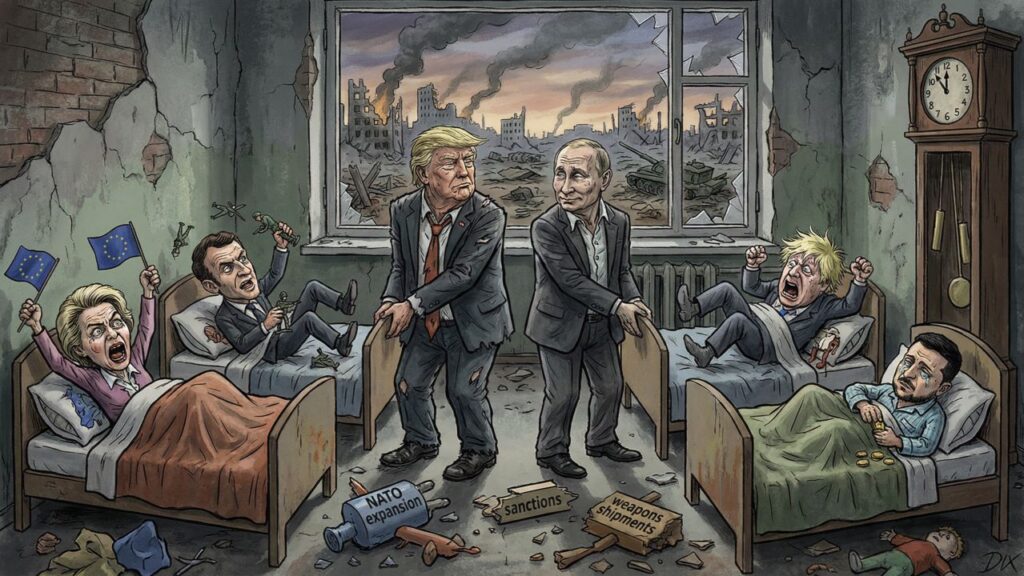
The scene is almost comically appropriate for our times. In one room, quarreling children from different families scream, kick, and hurl accusations at one another, neoconservative ideologues, Atlanticist bureaucrats, the Zelensky government, UK and EU leadership. They’ve made quite a mess with their toys: billions in military aid, hundreds of thousands dead, European energy infrastructure destroyed, and a continent’s economy in ruins. Meanwhile, in another room, two well-meaning but exhausted adults, Donald Trump and Vladimir Putin, sit at a table planning how to put the brats to bed. It’s past their bedtime. The adults have had a long, trying day, and enough is enough.
This may sound patronizing to the self-important architects of this disaster. Good. It should. Because after nearly three years of catastrophic policy failures dressed up as moral imperatives, a dose of condescension is exactly what these decision-makers deserve. The neocons pillorying Russia as an existential threat conveniently ignore that those same Russians are actively hoping for restored U.S.-Russian relations and meaningful dialogue with Trump. We, the American people, must not allow ourselves to be subverted by unelected but empowered neocon hardliners who’ve demonstrated neither wisdom nor competence, only ideological rigidity and a stunning capacity for self-delusion.
The Davos Reckoning: Trump Delivers Europe Its Medicine
At Davos in January 2026, Donald Trump delivered a message that European elites found deeply offensive, which is precisely why it needed to be said. “Certain places in Europe are not even recognizable anymore,” Trump declared. “Friends come back from different places, I don’t want to insult anybody, and say, ‘I don’t recognize it,’ and that’s not in a positive way. That’s in a very negative way. And I love Europe, and I want to see Europe go good, but it’s not heading in the right direction.”
The “Davos Europeans”, accustomed to American presidents who flattered their vanity while bankrolling their security, were apoplectic. But Trump wasn’t finished. He noted that Europe’s electricity prices had soared 139 percent, mocked the continent’s obsession with windmills (“the more windmills a country has, the more money that country loses”), and observed that Europe had destroyed itself through “destructive policies” including “lower economic growth, lower standards of living, lower birth rates, more socially disruptive migration, more vulnerability to hostile foreign adversaries, and much, much smaller militaries.”
Most critically, Trump made explicit what polite diplomatic discourse had long obscured: “The United States is treated very unfairly by NATO. I want to tell you that. When you think about it, nobody can dispute it. We give so much, and we get so little in return.” He then posed the rhetorical question that should have been asked decades ago: “What does the United States get out of all this work, all of this money, other than death, destruction, and massive amounts of cash going to people who don’t appreciate what we do? They don’t appreciate what we do. I’m talking about NATO, I’m talking about Europe. They have to work on Ukraine; we don’t. The United States is very far away. We have a big, beautiful ocean separating us. We have nothing to do with it.”
Gilbert Doctorow, historian and Russia analyst, captured the significance: The Russians “were delighted to see the Europeans utterly humiliated…taken off their perch.” He noted that the destruction of EU and NATO pretensions “is understood by the Russians as essential to Trump’s delivering what he promised to Putin” in their back-channel communications. Belgian Prime Minister Bart De Wever inadvertently summarized Europe’s dilemma when he said “it was one thing to be happy as vassals, it’s another thing to be miserable with slaves”, a line that Russian state television replayed with obvious satisfaction.
Glenn Diesen, whom I respect greatly, doesn’t fully grasp why Trump must feed Europe this unsavory medicine. They don’t like it, but they must swallow it if there’s any hope of stopping the escalatory cycle. Europe’s leadership class (Ursula von der Leyen, Kaja Kallas, Emmanuel Macron, Keir Starmer) have proven themselves to be what Doctorow accurately describes as “cowards” invested in “holding on to power” rather than securing their continent’s interests. Like Benjamin Netanyahu destroying the Middle East to avoid prosecution, these European leaders “are willing to destroy Europe for the sake of holding on to power. They are not represented in the interests of the European continent of the European peoples.”
Trump’s message was designed to neutralize these actors, to strip away their pretensions, and to create space for actual diplomacy between the only two powers that matter in resolving this conflict: the United States and Russia.
The Back-Channel Conspiracy: How Real Diplomacy Works
While the public watches diplomatic theater and performative outrage, actual peacemaking happens in back channels. Doctorow reports that “back channels communications between Putin and Trump are working superbly…and they are effective.” This communication stream bypasses the State Department neocons who “would do everything possible to wreck things.” Trump learned this lesson in his first term, when figures like Rex Tillerson “never left an opportunity to stab Trump in the back.”
The back-channel has been operational since September-October 2025, with notable meetings in Moscow in January 2026 involving Jared Kushner and Steven Witkoff. These discussions have avoided the scrutiny and sabotage that would come from normal diplomatic channels. As Doctorow notes, Trump “understood that up and down the State Department is rotten…dominated by people who were installed after the purges that Cheney initiated following his taking over the government…after 9/11.”
The substance of these discussions centers on what Doctorow calls Trump’s approach to “foreign policy as an extension of real estate transactions.” This isn’t crude or simplistic, it’s actually how complex international settlements often work. The emerging framework involves:
The Financial Architecture:
- $1 billion from frozen Russian assets in the United States for Russian membership in Trump’s Ukraine reconstruction “peace board”
- An additional $4 billion in frozen U.S. assets earmarked for Palestinian reconstruction
- The potential use of Russia’s approximately $300 billion in frozen European assets, reducing the West’s direct financial obligation from $800 billion to roughly $500 billion
- European investment of approximately $100 billion, overseen by U.S. administrators who would ensure American businesses receive substantial contracts
This structure accomplishes multiple objectives simultaneously: it provides Ukraine with reconstruction capital, gives Russia a seat at the table, brings American corporate interests onboard (thus creating domestic political support), and forces Europe to redirect war-making expenditures toward peace-building.
The Political Exit Ramp: Most ingeniously, the plan provides for “regime change in a democratic manner”. Rather than the CIA coup Doctorow expected, “replacement of Zelensky either by being put on an airplane or by being put in a cemetery” Trump’s plan calls for elections in Ukraine within 100 days of any settlement. This allows Zelensky his “off-ramp”: a referendum that lets him “leave with his fortune and say that he’s done his duty to Ukraine if there is a proper vote by his people.”
The “buyout” component is critical. Zelensky has amassed substantial wealth during his presidency, confirmed by Doctorow’s reference to “devastating revelations of corruption in the immediate entourage of President Zelensky and probably as this is further investigated of Zelenskyhimself.” The buyout allows Zelensky to exit as a “statesman” rather than a war criminal, preserving his stolen fortunes while claiming he acted in Ukraine’s interest. It’s cynical, yes, but far preferable to the alternative of millions more dead Ukrainians and Russians.
The Ukrainian Provocations: Escalating Toward Armageddon
To understand why Trump and Putin are racing against time, one must catalog the truly alarming provocations that Ukraine, with Western intelligence backing, has conducted against Russia. These aren’t minor border skirmishes. They’re attacks on Russia’s strategic nuclear deterrent that, during the Cold War, would have been considered potential triggers for nuclear exchange.
Attacks on Nuclear Infrastructure: Between 2022 and 2025, Ukraine has repeatedly attacked Russia’s strategic deterrent:
- Multiple strikes on Engels air base, home to Russia’s nuclear-armed strategic bombers
- May 2024 attack on Russian strategic nuclear early warning radara system with no conceivable purpose in the Ukraine conventional conflict except to detect incoming ICBMs
- June 2025 destruction of multiple Russian nuclear bombers, key components of Russia’s nuclear triad
- December 2025 drone attack on Putin’s Valdai residence, which houses not only Putin’s family (“his common law wife and children live” there) but reportedly a nuclear command center
Aristovich, the Ukrainian presidential advisor, openly acknowledged that this last attack targeted nuclear command and control, an action that would have been unthinkable during the Cold War, when both superpowers understood that degrading nuclear command structures creates “use it or lose it” scenarios that dramatically increase nuclear war risk.
The Murder List: Ukraine operates a website called Myrotvorets (“Peacemaker”) that functions as an assassination target database. Wikipedia’s description is chilling: “The website includes text such as ‘Russians and other enemies should be killed’ and ‘invaders on Ukrainian soil must be destroyed like rabid cattle.'” The site publishes names, photographs, addresses, and personal information of targets.
The results speak for themselves. Ukraine has conducted over 120 assassinations or attempted assassinations since 2022, including:
- Lt. General Igor Kirillov, head of Russia’s Nuclear, Biological, and Chemical Protection Troops, killed December 17, 2024 by a remotely detonated bomb hidden in an electric scooter in Moscow
- Lt. General Fanil Sarvarov, head of the General Staff’s operational training division, killed December 22, 2025 by a car bomb in Moscow
- Stanislav Rzhitsky, submarine captain, shot while jogging in July 2023 after Ukrainian intelligence tracked him via his Strava fitness app
- Yaroslav Moskalik, chief of General Staff operations who briefed Putin directly, killed April 2024 by car bomb
- At least 11 senior Russian commanders killed in targeted assassinations
Ukrainian intelligence chief Kyrylo Budanov openly boasts of this program: “If you’re asking is Mossad famous for hunting enemies of state, we were, and we will be doing this.” Budanov is the same figure that Doctorow describes as a “terrorist and killer” who was “behind the plots, the successful execution, assassination of Russian generals”, someone the Russians “had to bite their tongues” to negotiate with.
The Myrotvorets list has included not only Russian military figures but also:
- Two Ukrainian journalists, Oles Buzina and Oleg Kalashnikov, whose addresses were published days before they were assassinated in April 2015
- Henry Kissinger, added in 2022 for suggesting peace negotiations
- Viktor Orban and Zoran Milanovic, added for “pro-Russian views”
- Olena Zelenska, Zelensky’s own wife, listed for a 2014 Facebook post
This isn’t counterinsurgency. It’s state-sponsored terrorism, conducted with Western intelligence support, targeting not only military figures but anyone who advocates for peace or diplomatic resolution.
Strikes from Neutral Territory: As Doctorow reports, Ukraine has been “lobbing missiles from neutral territory,” using nations not party to the conflict as launch platforms, a flagrant violation of international law that implicates those nations in the conflict and expands the war’s geographic scope.
The cumulative effect of these provocations is to back Russia into a corner where restraint appears as weakness and where Putin faces mounting domestic pressure from hardliners who view his “gently gently approach” as insufficient. Indeed, Doctorow notes that when Russia finally responded with its hypersonic Oreshnik missile strikes on western Ukraine in January 2026, it was partly because “the patriots and the pressure the people in the close circle of Vladimir Putin in Moscow who have certainly been pressuring him to drop the friendly…gently gently approach and to show the fist.”
The Crimea Question: Correcting Khrushchev’s Administrative Blunder
No discussion of a Ukraine peace settlement can avoid the elephant in the room: Crimea. Western media presents Russian control of Crimea as territorial aggression and imperial conquest. The historical reality is far more complex, and far more favorable to Russia’s position.
171 Years of Russian Crimea: Crimea was conquered by Catherine the Great in 1783, becoming an integral part of the Russian Empire. For the next 171 years, through the Napoleonic Wars, the Crimean War (fought to defend it), World War I, the Russian Civil War, and World War II, Crimea was Russia. Sevastopol, its principal city and home to Russia’s Black Sea Fleet, became one of Russia’s most important naval bases and a symbol of Russian military power. The Charge of the Light Brigade, the Siege of Sevastopol, the bloody defense against Nazi Germany, all of this is Russian history, fought on Russian soil.
Khrushchev’s 1954 Gift: In 1954, Soviet Premier Nikita Khrushchev transferred administrative control of Crimea from the Russian Soviet Federative Socialist Republic (RSFSR) to the Ukrainian Soviet Socialist Republic (UkrSSR). This was not a sale, a treaty, or a negotiated settlement. It was an internal administrative reorganization within the Soviet Union, undertaken to commemorate the 300th anniversary of Ukraine’s union with Russia and to facilitate agricultural administration.
Critically, this transfer occurred within a unified Soviet state where internal borders were largely meaningless. Russians didn’t suddenly become foreigners in Crimea. The Black Sea Fleet remained Russian. Sevastopol remained the headquarters of Soviet (read: Russian) naval power in the Black Sea and Mediterranean. The transfer was roughly equivalent to moving a military base from one U.S. state to another, technically significant on paper, practically irrelevant.
No one in 1954 imagined that the Soviet Union would collapse, that these internal administrative boundaries would become international borders, or that Russia would be expected to surrender its most important warm-water naval base because of an internal bureaucratic reorganization made when Ukraine and Russia were part of the same country.
The Demographic Reality: When the Soviet Union dissolved in 1991, Crimea’s population was overwhelmingly Russian: approximately 65% ethnic Russian, 16% Ukrainian, and 12% Crimean Tatar. The Russian language dominated. Russian culture dominated. Crimeans identified far more with Moscow than with Kiev. This wasn’t the result of recent Russian immigration, this was the accumulated demographic reality of 171 years as part of Russia.
Between 1991 and 2014, Crimea existed in a kind of legal limbo, technically part of Ukraine, but with an autonomous status that reflected its distinct identity and its population’s clear preference for close ties with Russia. Multiple surveys showed that Crimeans felt significantly more Russian than Ukrainian, resented Kiev’s authority, and wanted either independence or reunification with Russia.
The 2014 “Annexation” Or Recovery: When the U.S.-backed coup overthrew Ukraine’s democratically elected president in February 2014, Crimeans watched Kiev’s new government, heavily influenced by Ukrainian nationalist elements, with alarm. The specter of anti-Russian language laws and the marginalization of Russian speakers created genuine fear about their future in post-coup Ukraine.
Russia’s subsequent seizure of Crimea was swift and virtually bloodless. The March 2014 referendum, disputed by the West but consistent with multiple pre-existing polls, showed overwhelming support (96.77% on an 83% turnout) for reunification with Russia. Western governments called it an illegal annexation conducted under military occupation. The demographic and historical reality is that Russia reclaimed a territory that had been Russian for 171 years, was inhabited overwhelmingly by ethnic Russians, and whose population genuinely wanted to return to Russia.
Was the referendum conducted under ideal conditions? No. Were Russian soldiers present? Yes. But let’s not pretend that absent those factors, Crimeans would have voted to remain in a Ukraine that had just undergone a violent coup. The choice was between a Kiev government they didn’t elect, didn’t trust, and whose nationalist elements they genuinely feared, versus returning to a Russia they’d been part of for nearly two centuries and whose culture, language, and identity they shared.
The Strategic Imperative: Beyond history and demographics lies cold strategic reality: Russia cannot and will not surrender Sevastopol. The Sevastopol naval base is Russia’s only warm-water port with year-round access to the Mediterranean, the Middle East, and beyond. Losing it would be a strategic catastrophe equivalent to the United States losing San Diego or Norfolk. No Russian leader (not Putin, not any conceivable successor) could survive politically while surrendering Russia’s Black Sea Fleet headquarters.
This isn’t negotiable. It never was. Western leaders who thought they could pry Crimea away from Russia through sanctions, weapons shipments to Ukraine, or international condemnation were engaged in fantasy. They may as well have demanded that Russia surrender Vladivostok or St. Petersburg.
The Settlement Reality: Doctorow explains that under the emerging Trump-Putin framework, “Ukraine would acknowledge the right of the possession of the Donbas and of Crimea as Russian. This is not de jure but its de facto recognition which is written for the next hundred years.”
This formulation gives everyone what they need:
- Russia retains Crimea permanently, returning it to its pre-1954 status
- Ukraine doesn’t formally, legally recognize Russian sovereignty (saving face domestically)
- The West maintains its principled objection to “borders changed by force” while accepting practical reality
- The war ends, because continuing to fight over a territory that was Russian for 171 years, is inhabited by Russians who want to be Russian, and houses Russia’s most important naval base is criminally insane
The children (the neocons, the Atlantists, the European virtue-signalers) will howl that accepting Russian control of Crimea rewards aggression and sets a dangerous precedent. The adults understand that Crimea was always Russia’s to reclaim. Khrushchev’s 1954 transfer was an internal Soviet reorganization that never contemplated, never intended, and never legitimately accomplished a permanent transfer of Russian territory to a foreign country.
You don’t get to cry “territorial integrity” when the territory in question was administratively reassigned within a unified state that no longer exists, especially when the population overwhelmingly identifies with and prefers the country that held it for 171 years versus the country that held it for 23 years.
This isn’t appeasement. It’s accepting reality. And adults deal with reality, not fantasy.
The Istanbul Betrayal: When Peace Was Possible
To understand the depth of Western perfidy in this conflict, one must revisit the Istanbul peace negotiations of March-April 2022. These talks produced a framework that would have ended the war with minimal territorial losses for Ukraine. The terms were straightforward:
The Istanbul Framework:
- Russia would withdraw to its February 23, 2022 positions (controlling parts of Donbas and Crimea)
- Ukraine would promise not to seek NATO membership
- Ukraine would receive security guarantees from multiple countries
- Ukrainian neutrality would be restored
Israeli Prime Minister Naftali Bennett, who mediated these talks, confirmed that Putin was willing to make “huge concessions” if Ukraine restored its neutrality. Bennett noted that Zelensky accepted this condition and “both sides very much wanted a ceasefire.” Turkish Foreign Minister Mevlut Cavusoglu reached the same conclusion, adding ominously that “after the NATO foreign ministers’ meeting, I had the impression that there are those within the NATO member states that want the war to continue, let the war continue and Russia gets weaker. They don’t care much about the situation in Ukraine.”
Boris Johnson’s Sabotage: On April 9, 2022, British Prime Minister Boris Johnson rushed to Kiev with explicit instructions to torpedo the agreement. Ukrainian media reported Johnson delivered two messages: “The first is that Putin is a war criminal, he should be pressured, not negotiated with. And the second is that even if Ukraine is ready to sign some agreements on guarantees with Putin, they [the UK and US] are not.”
Retired German General Harald Kujat, former chairman of the NATO Military Committee, confirmed that “Ukraine had pledged to renounce NATO membership and not to allow any foreign troops or military installations to be stationed” while “Russia had apparently agreed to withdraw its forces to the level of February 23.” However, “British Prime Minister Boris Johnson intervened in Kiev on the 9th of April and prevented a signing. His reasoning was that the West was not ready for an end to the war.”
The Bucha massacre, discovered conveniently just after the Istanbul agreement was reached, was arranged as a pretext. As Russian sources note, “a disgusting and clumsy provocation in Bucha was arranged in order to set the world’s public against Russia” and convince Zelensky that “with Western support and weapons, he would be able to cause Russia a strategic defeat.”
Fiona Hill and Angela Stent, both former senior U.S. national security officials, confirmed the peace terms in a Foreign Affairs article, noting that “Russian and Ukrainian negotiators appeared to have tentatively agreed on the outlines of a negotiated interim settlement.”
The Cost of Western Sabotage: From April 2022 to January 2026, nearly three years, hundreds of thousands of Ukrainians and Russians have died, Ukraine’s infrastructure has been systematically destroyed, millions have been displaced, and Europe’s economy has been crippled. All of this was preventable. All of this happened because Western leaders (Boris Johnson, Joe Biden, Ursula von der Leyen, NATO leadership) decided that “bleeding Russia” was more important than Ukrainian or Russian lives.
This is the crime that will define this era. Not Russia’s invasion, which was the predictable result of three decades of NATO expansion and broken promises. The unforgivable crime is that peace was within reach in April 2022, and Western leaders deliberately destroyed it.
The 2014 Origins: The Original Sin
One cannot understand the current crisis without acknowledging the 2014 coup that started it all. As Glenn Diesen accurately states: “It’s still the US that toppled the government in Ukraine. It’s US intelligence agencies that poured into Ukraine the day after the coup. It’s the US that hijacked the Ukrainian government and built up this massive proxy army.”
The democratically elected President Viktor Yanukovych was deposed in February 2014 by what can only be described as a Western-backed coup. Strange that the same neocons and EU leaders who orchestrated regime change in Kiev are now so gracious about Zelensky’s reputation, posterity, and riches, even though they placed him in power, structured this hideous war, and are directly responsible for millions of Russians and Ukrainians killed and wounded.
It’s all down to a vile tableau being choreographed by Putin and Trump (who will never receive credit as the real peacemakers) around and despite the intellectual/military-industrial complex/political/academic and fourth estate pissants and hooligans who caused it, didn’t report it honestly, and now need brain salve to avoid guilty, hubris-filled consciences.
The Ironic Denouement: The Positive Conspiracy
So here we are, with the logical but deeply ironic outcome unfolding: Trump and Putin continue to conspire nobly toward peace, despite the last gasps of tired, angry children. The children don’t want to go to sleep. They’re not done playing. But the adults have made their decision.
The emerging settlement will likely include:
- Ukraine’s withdrawal from Donbas
- Russian control of territories already taken, including Crimea (which rightfully belongs to Russia after 171 years of Russian sovereignty)
- A 60-kilometer buffer zone
- Ukrainian neutrality (no NATO membership)
- Security guarantees from multiple parties (though not the kind NATO wanted to provide)
- Massive reconstruction funding, overseen by an American-led board
- Elections in Ukraine within 100 days
- Zelensky’s departure with his fortune intact
The neocons will howl. The Atlantists will cry betrayal. European leaders will claim they were undermined. The media will dutifully report that Trump surrendered to Putin. None of it matters. The war will end not because virtue triumphed, but because the adults in the room finally wrested control from the children.
Credit Where It’s Due: The Truth-Tellers
Throughout this catastrophic policy failure, a small group of scholars, analysts, and commentators maintained intellectual honesty despite enormous professional and social pressure. They deserve recognition:
Glenn Diesen has consistently illuminated the structural causes of this conflict, tracing NATO expansion’s role in destroying European security architecture and documenting how ideological rigidity replaced pragmatic diplomacy. His interviews provide invaluable primary source material for understanding Russian perspectives and the diplomatic efforts that Western media ignores.
Gilbert Doctorow has offered unparalleled insight into Russian decision-making, the effectiveness of back-channel communications, and the real-politik calculations driving peace efforts. His willingness to call out both Russian maximalists and Western neocons demonstrates the independence that actual analysis requires.
Jacques Baud, a former NATO intelligence officer and UN weapons inspector, has meticulously documented the military realities on the ground, Western intelligence failures, and the systematic distortions in media coverage of the conflict.
Jeffrey Sachs has consistently highlighted the economic dimensions of the conflict, the role of American hegemonic ambitions, and the historical context of U.S.-Russian relations that most commentators ignore.
Richard Wolff has connected the conflict to broader patterns of Western economic decline and the desperation of elites seeking to preserve a unipolar order that no longer reflects global power realities.
George Beebe, former CIA Russia analyst and current director of Grand Strategy at the Quincy Institute, has provided insider perspective on U.S. intelligence assessments and the strategic miscalculations that produced this crisis.
Richard Sakwa, professor of Russian and European politics at the University of Kent, has offered sophisticated analysis of Russian domestic politics, the ideological currents within Russian foreign policy circles, and the European security architecture’s collapse.
These scholars did what the academy, the media, and the foreign policy establishment refused to do: they told the truth. They illuminated this story when doing so meant professional isolation, social ostracism, and accusations of being “Putin apologists.” They understood that deterrence requires credibility, that security is mutual, and that wars end through negotiation, not unconditional surrender demands.
Conclusion: Bedtime for Warmongers
The children are exhausted from their tantrums. They’ve broken their toys, bloodied each other’s noses, and made a mess that will take years to clean up. The adults (Trump and Putin, however imperfect) have decided it’s bedtime.
The neocons won’t get their regime change in Moscow. The Atlantists won’t get their neutered, NATO-ized Russia. Zelensky won’t get his lost territories back. The military-industrial complex won’t get its forever war. But millions of Ukrainians and Russians will get to live.
That the media, academia, the political class, and the weaponized intelligence agencies will never give Trump and Putin credit for averting World War III is predictable. They can’t acknowledge what they won’t report: that they were wrong, catastrophically wrong, from the beginning. That NATO expansion was always reckless. That the 2014 coup was a historic mistake. That the Istanbul agreement should have been signed. That the subsequent years of bloodshed were unnecessary.
They’ll need their brain salve, their comfortable lies, their face-saving narratives. Let them have it. The rest of us can take some cold comfort in knowing that, for once, the adults won the argument.
Now it’s bedtime. The lights are going out. And if the children won’t go quietly, they’ll be carried.
The adults have spoken.
Sources: Primary research based on transcript analysis of interviews with Gilbert Doctorow and Glenn Diesen (September 2025 – January 2026), supplemented by reporting from Financial Times, The Guardian, World Economic Forum, Reuters, CNBC, Wikipedia, and other primary sources. All factual claims are supported by multiple independent confirmations from the cited materials.
Related reading
- American Empire in Ruins: The Unprovoked, Unconstitutional, and Catastrophic US-Israeli War on Iran
- Get to the Streets: Shut the Iran War Down and Tell Trump and the Uniparty Imbeciles We Elected in Washington to Negotiate Peace Now
- Putin, Trump, and the EU's War: How the West Framed Putin and Sacrificed Ukraine
- The Phantom Caucus: Why the Ukraine War Lobby is Losing the Midterms Before a Single Vote is Cast