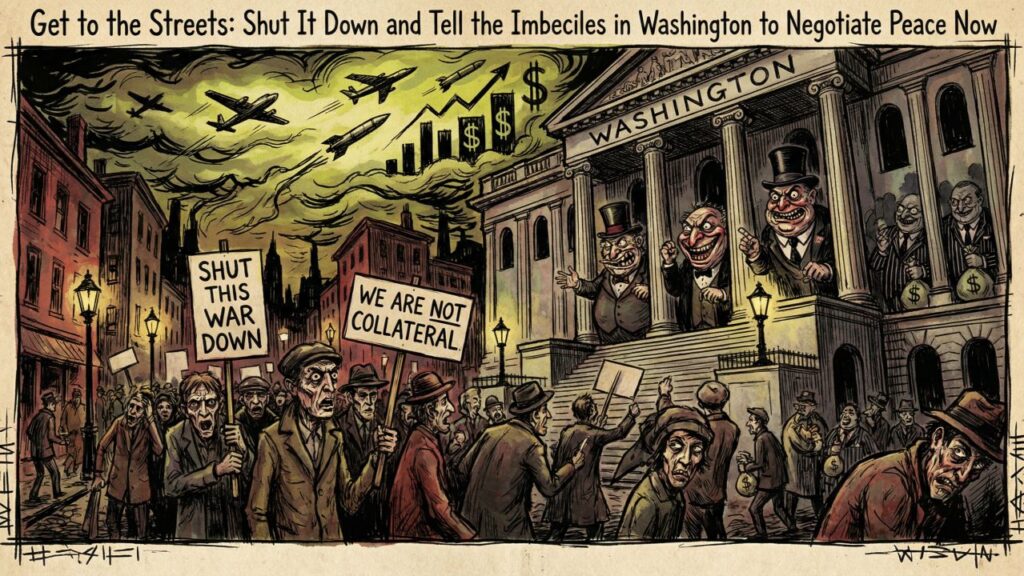
The US and Israel started this war without provocation; now the US needs to apologize to our allies and Iran, negotiate peace immediately, and correct the mistake that is our elected politicians and the MONEY at the midterms.
A note to my readers
In this trilogy, the MONEY is not a metaphor and not a conspiracy theory. It is the alignment of capital that literally owns both parties, occupies the key offices, places its trades before the events it engineers, and sends the bill to you. It does not have an ideology. It has a balance sheet. It does not prefer Republicans or Democrats. It prefers returns.
The first article traced how the MONEY wagered on bombing Iran while Clown-King Trump was still warming up his speechwriters. Members of Congress from both parties positioned themselves in Exxon, Raytheon, Lockheed, and tanker insurance in the weeks before the strikes. Scott Bessent, Secretary of the Treasury, the global macro hedge fund manager who spent thirty years betting on sovereign decisions before they were made and then became the sovereign decision, pushed out John Hurley, the Under Secretary for Terrorism and Financial Intelligence, whose insistence on enforcing sanctions was interfering with the trade. Hurley was gone by February 15. Thirteen days later, the bombs fell, the waivers were drafted, and the 20-billion-dollar federal reinsurance facility for Hormuz tanker traffic appeared overnight, because no private insurer on earth would touch it at any viable premium. Royko would have called it what it is: the MONEY sent Hurley to Berlin so it could do business without him watching the till. The bombs fell. You paid. You’ll be paying more, much more.
The second article showed how the machinery that made that arbitrage machine possible was built over decades. The Uniparty, funded by the same dark-money pipelines on both sides of the Congressional aisle, practices economic statecraft not through elections or legislation, but through bank compliance departments, Treasury guidance, OFAC sanctions lists, and asset-management term sheets. Clown-King Trump theatrically signs the orders, acting like he’s in charge. The bipartisan Uniparty congressional jesters clap, acting as if they control the King. The MONEY has already moved on to the next trade, wagering without risk.
This third article is the $10 trillion-plus bill that will come due to the US taxpayer. Not the puny 50-billion-dollar cover charge the imbeciles we elected read from the teleprompter, but the real, comprehensive, multi-dimensional invoice that arrives when you start a war of choice against a country of ninety-two million people sitting astride the Strait of Hormuz, in a world already stretched to its structural limits, at precisely the moment when your ability to pay for your own future depends on advantages you are simultaneously destroying. I have been too cautious in prior drafts. The situation does not warrant caution. It warrants clarity and illumination.
Here it is.
Iraq Was the Rehearsal. Iran Is the Show.
Before we count what this war will cost, we have to establish one foundational fact that the entire political class is conspiring to suppress: this is not “another Iraq.” Iraq was the rehearsal. Iran is the show.
In 2003, the “serious” people in Washington told the public with a straight face that the Iraq War would cost perhaps 50 to 60 billion dollars, with pessimistic scenarios running as high as 200 billion. Those numbers were treated as sober, responsible estimates by our ever-so-vigilant media and congressional watchdogs. When scholars later did what Congress and the White House refused to do, they came back with a bill for Iraq alone of roughly 3 trillion dollars, and a bill for the broader post-9/11 project of roughly 8 trillion dollars, along with close to a million people killed directly by violence. The original projections were not off by 10 percent. They were off by a factor of 80 to 120, once you count the full tail.
That was for Iraq: a country of about 25 million people, already hollowed out by sanctions and previous wars, with no control over a global energy chokepoint, no serious external patron willing to step in at scale, and no ability to reach beyond its own borders and reshape the world economy in retaliation.
Iran is something else entirely. Iran has roughly 92 million people, more than three times Iraq’s wartime population, with a diversified industrial base, deep state institutions, and decades of hard-won experience at absorbing sanctions, building workarounds, and waiting out adversaries. It has a regional network of partners and proxies, from Hezbollah to allied militias in Iraq and Syria, that can cause pain from the Red Sea to the Levant. It has dense ties to Russia and China. As of 2024, it is a full member of BRICS. And it sits, quite literally, with its hand on the valve through which roughly one barrel of every five traded globally must pass.
When you attack Iran, you do not merely strike a country. You strike the artery through which industrial civilization moves its blood. Iraq’s oil mattered regionally. Iran’s strategic position matters to every economy on earth that moves energy and goods by sea, which is all of them.
Any honest assessment of this war must begin here. Iran is not “Iraq plus.” Iran is Iraq times X, with X comfortably greater than 1 and every cost dimension scaled accordingly. The Iraq and post-9/11 wars cost somewhere between 3 and 8 trillion dollars, against a far weaker target in a far more stable world. Those numbers are the floor for Iran, not the ceiling. The 50-billion-dollar opening ante is not a budget estimate. It is a lie constructed for people without calculators.
The Five Dimensions of Ruin
A war is not a line item. It is a system of consequences, each one feeding the next. This war has five distinct dimensions of economic damage that interact and amplify one another, collectively threatening not just the American fiscal position but the global economic order itself. To discuss the “cost” of the Iran war and touch only one or two of these is to describe a house fire by noting that it melted a candle.
The first dimension is the energy valve.
The Strait of Hormuz is not a geography lesson. It is the narrowest point in the chain that keeps industrial civilization supplied with energy. Roughly fifteen million barrels of crude oil per day, and a large share of the world’s traded liquefied natural gas, pass through it. Qatar, the world’s largest LNG exporter, has suspended shipments. The Gulf states pump a significant fraction of the world’s oil from within what is now a war zone. War-risk insurance for tankers exploded by 300 to 500 percent within the first weeks. Brent crude surged past 100 dollars on the first day and is heading higher. Iraq’s own deputy prime minister has cited the possibility of 300-dollar oil in a prolonged conflict. Capital Economics puts Brent at 130 dollars in the second quarter of 2026 alone, in an “extended conflict” scenario that is now the base case, not the tail.
Japan imports approximately 90 percent of its crude oil through the Strait of Hormuz. South Korea is nearly as dependent. India sources the majority of its oil from the region. Europe, barely having weaned itself off Russian gas, now faces another energy crisis from a different direction. The Gulf Cooperation Council states, which recycle petrodollars into US Treasuries and backstop Washington’s ability to borrow cheaply, are watching their own export revenues evaporate while their import routes for food and manufactured goods run through a warzone. Qatar’s energy minister did not overstate when he warned of the “collapse of world economies.” He was describing the mechanical logic of what happens when you turn the world’s main energy artery into a sustained combat zone and leave it there.
Sustained triple-digit oil does not produce “market volatility.” It produces a permanently higher cost baseline for everything that depends on energy, which is everything. Transport, fertilizer, food, heating, electricity, manufacturing, construction, and shipping all reprice upward at once and stay there. In wealthy countries, that is a brutal, sustained cost-of-living crisis layered on top of households already strained by the previous inflationary wave. In the Global South, it is not “food insecurity.” It is rationing. It is famine. It is the kind of hunger that produces governments falling and millions of people moving.
This is not a tail risk. This is what happens when you keep Hormuz hot for years, which is the conservatively probable trajectory of a war against 92 million people who have not consented to surrender.
The second dimension is the petrodollar’s last days.
The petrodollar system, the arrangement by which global oil is priced and settled in US dollars and those dollars are recycled into American Treasury bonds, is not just a financial convention. It is the structural foundation of American global power. It is what allows the United States to run perpetual deficits, borrow at relatively low rates regardless of fiscal discipline, and impose its will on the global financial system through sanctions without immediately bearing the full cost of that coercion. Destroy the petrodollar, and you do not merely weaken America financially. You remove the mechanism by which America gets to punch above its weight in every other domain.
That mechanism was already under pressure before this war. The dollar’s share of global foreign exchange reserves has fallen from 71 percent in 1999 to roughly 57 percent by late 2025, its lowest level in three decades. The direction of travel is not ambiguous. It is a structural, multi-decade decline that accelerated sharply after the United States froze 300 billion dollars in Russian central bank reserves in 2022, sending the same message to every central bank on earth: your reserves are safe until Washington decides they are not.
Now add this war. Iran is a full BRICS member as of 2024. BRICS now includes Iran, Russia, China, India, Brazil, South Africa, the UAE, Egypt, Ethiopia, Indonesia, and Saudi Arabia in the process of accession, forming a bloc that controls roughly 40 percent of global crude oil production. China was already buying an estimated 1.5 million barrels of Iranian oil per day, settled not in dollars but in yuan, through closed channels that bypass SWIFT entirely. BRICS Pay, a cross-border payment system designed to route global trade around SWIFT and the dollar, is scheduled for full launch at the 2026 BRICS summit. Russia-China bilateral trade now settles in non-dollar currencies at 85 percent, up from 26 percent two years ago. Yuan-denominated crude oil deals now account for roughly a fifth of daily Brent volume.
Saudi Arabia, the linchpin of the petrodollar arrangement, is joining BRICS, has participated in Project mBridge, and has made increasingly direct noises about reviewing dollar-denominated oil contracts. And Iran, the country we just bombed, sitting on the valve that controls roughly one-fifth of global oil, has floated the idea of permitting tanker passage only for transactions settled in Chinese yuan.
Read that carefully. The country we attacked without provocation, which controls who gets oil through the world’s most important energy chokepoint, is considering making the price of reopening that valve the formal abandonment of the petrodollar for the oil that flows through it. That is not a negotiating posture. That is the logical response of a nation that has been handed extraordinary leverage by the country that attacked it and has been practicing how to use it for forty years.
If that happens, even partially, we are not watching the dollar lose a few more percentage points of reserve share. We are watching the structural foundation of American financial hegemony be renegotiated at gunpoint, by the country we put in that position, with the active support of a coalition controlling nearly half the world’s oil.
The third dimension is allied defection.
A war of choice only works at a remotely acceptable cost if your allies absorb part of the burden. This one has already driven away the very allies whose navies, logistics, and economies should have been in the coalition.
Japan and South Korea, whose economies would collapse without oil from the Strait of Hormuz, have declined to join Trump’s “Hormuz coalition.” Germany has publicly declared the war “not our war.” Trump is now publicly begging the same allies he spent years insulting to send warships to help reopen a strait we militarized, and they are declining or remaining pointedly “cautious.” France and the UK have offered no serious military commitment. The rest of NATO is watching from a safe distance.
The effects compound. The United States bears the full military cost alone, with no burden-sharing, no coalition logistics, and no allied funding, for a war that directly damages allied economies. Those same allies are now accelerating long-term energy diversification strategies that do not rely on American guarantees, which means their future Treasury purchases and dollar holdings are under review. And the global audience has watched the United States start a war without immediate provocation, damage its partners’ economies severely, demand that those partners share the consequences, and receive a public rebuff. Every foreign ministry on earth has filed that lesson. American commitments are conditional. American wars are dangerous to join. American leadership is not what the post-war order advertised.
This is how you spend down the exorbitant privilege in more than just the monetary sense. You spend down the trust and credibility and the network of alliances that was the real foundation of American power and the real reason the dollar became the world’s reserve currency in the first place.
The fourth dimension is BRICS getting even.
This is the dimension the American press refuses to look at directly, because it requires admitting that we handed our adversaries a gift worth more than anything they could have purchased or engineered on their own.
By bombing Iran, a BRICS member, and keeping Hormuz dangerous for years, the United States gave the BRICS bloc the one thing it needed most: a real-world crisis that makes using its alternative financial infrastructure not just ideologically preferable but practically necessary for a large part of the world. China cannot reliably receive Iranian oil through dollar channels now, so it uses yuan channels, thereby normalizing them at scale. Russia, already removed from SWIFT, is now the only major alternative energy supplier for states scrambling to replace the disrupted Gulf supply, and every deal it makes is in rubles, yuan, or bilateral currency swaps. China’s CIPS settlement system, the Shanghai crude oil exchange, and BRICS Pay all undergo a massive stress test and see a massive influx of new users, driven not by ideology but by necessity. Saudi Arabia, watching the United States demand that it bear the costs of a war it did not choose, accelerates its internal review of the petrodollar arrangement.
Every transaction completed outside the dollar system during this war will not return. Every workaround normalized under crisis becomes permanent infrastructure after the crisis. The world is learning, in real time and at American expense, that it can function without SWIFT. That lesson does not unlearn itself when the war eventually ends.
We did not destroy BRICS. We became its most effective fundraising mechanism. We stress-tested its alternative architecture, paid for its expansion, and demonstrated to every undecided country on earth that building a financial lifeboat is not paranoia but prudence.
The fifth dimension is the fiscal impossibility trap.
Here is where the bill becomes not just enormous but structurally catastrophic, because this war arrives precisely when the United States faces competing capital demands it cannot afford to lose.
The United States is simultaneously trying to fund a multi-trillion-dollar war against a country that controls its most important energy chokepoint; an AI reindustrialization campaign requiring hundreds of billions to trillions in infrastructure, chip manufacturing, power generation, and workforce development just to remain competitive with China; a re-industrialization of its manufacturing base in semiconductors, pharmaceuticals, batteries, and defense production, after decades of offshoring that left it structurally dependent on adversaries; and the servicing of a national debt already exceeding 36 trillion dollars.
And it is trying to do all four of those things while simultaneously destroying the financial privilege that made doing multiple expensive things at once even theoretically possible.
The petrodollar system allowed the United States to run persistent deficits and borrow cheaply to finance its ambitions. Destroy it, and the cost of capital for American government borrowing rises. Every dollar of war spending now competes not just against domestic needs but against a higher cost of money in a world less willing to fund American adventures on generous terms. The AI race against China, which the United States can only win by maintaining a sustained capital advantage, becomes harder and more expensive. The re-industrialization agenda, which requires enormous front-end investment in factories, grids, and supply chains, is becoming more expensive. The debt service on 36 trillion dollars becomes more expensive.
You cannot simultaneously start a multi-trillion-dollar war of choice, destroy the financial architecture that lets you borrow cheaply, lose the allies whose partnership reduces your costs, hand your main rival a geopolitical windfall, and still expect to win the AI race, rebuild your industrial base, and service your existing debt. No country can do all of those things at once. The MONEY, which made its short-term trade and will be long gone when the consequences arrive, did not care about that arithmetic. The American public, which has no short position to cover and no private jet to board, should care about nothing else.
The Bill, with No Sedatives
The five dimensions above are not separate stories. They are a system. The energy shock raises costs globally and permanently. The petrodollar erosion raises the cost of financing the war and everything else the country needs to do. Allied defection leaves the United States bearing the full burden alone. BRICS acceleration compounds the dollar’s decline. The fiscal trap makes it all harder to survive and slower to recover from.
Now the numbers, stated plainly and without apology.
The Iraq and post-9/11 wars, against far weaker targets in a far more stable world, cost between 3 and 8 trillion dollars when scholars finally counted everything that mattered. Those numbers are the floor for Iran, the minimum plausible reference point, not the expectation. Iran is three times larger than Iraq, controls a chokepoint that wires its war into every economy on earth, is embedded in a BRICS network actively building an alternative to the financial system Washington uses as a weapon, and has driven away the allies who might have shared the cost. Every multiplier points upward.
A realistic ten-year estimate for Iran does not start where Iraq started. It starts where Iraq ended, and it goes from there. Direct war spending in a sustained multi-year campaign against a country of this size and strategic position runs into the multiple trillions, not the hundreds of billions. Add veterans’ care and disability obligations that accrue from the moment troops deploy and run for decades after. Add interest on the war debt in a world of higher rates and declining dollar privilege. Add the American share of global trade and output losses from years of Hormuz instability, which early models already put at hundreds of billions to over two trillion dollars in the first year alone. Add whatever passes for reconstruction when we finally stop. The ten-year bill for the United States, built from these components and scaled honestly to Iran’s strategic position, runs into the tens of trillions, not the tidy 2-to-8-trillion band we derived from Iraq. That band is what Iraq cost. Iran is Iraq times X, and X is not close to one.
Extend the horizon to twenty years, and you are not adding line items to a budget. You are describing a new shape of the world. Veterans’ care compounds through mid-century. Interest on the war debt crowds out domestic investment for a generation. The structural damage from years of instability in the Gulf of Hormuz, financial fragmentation, and accelerated de-dollarization is not a one-time subtraction but a permanently lower growth baseline that compounds downward every year. The loss of petrodollar privilege, at exactly the moment the United States needs cheap capital to fund an AI revolution and a manufacturing reindustrialization, is not a financial inconvenience. It is a strategic defeat that gets more expensive every year it remains unreversed.
At that scale, we are no longer debating whether a depression is possible. We are debating whether it can be avoided. A multi-year Hormuz war layered onto record global debt, combined with the erosion of dollar privilege and the acceleration of competing financial architectures, produces the conditions for a systemic break: rolling crises in energy, banking, sovereign debt, and trade, arriving too fast and too interconnected for the standard toolkit to address. Central banks are trapped between inflation that cannot be beaten with interest rates and deflation that cannot be beaten by cutting them. Governments that cannot borrow cheaply and cannot cut spending. Political systems whose legitimacy rests entirely on delivering growth and stability, and which are delivering neither. That is not volatility. That is depression, the only kind the twenty-first century will produce: a grinding, compounding, systemic failure that arrives not as a single crash but as a new permanent condition.
Qatar’s energy minister said it directly: a prolonged conflict risks the “collapse of world economies.” He was not being rhetorical. He was reading the same logic laid out above, from a shorter distance. The MONEY has already hedged this scenario. It is in yuan-denominated instruments, defense contracts, energy holdings, and BRICS-adjacent infrastructure. You have not hedged it. Your pension has not hedged it. Your mortgage has not hedged it. Your kids’ tuition has not hedged it.
The King, the Jesters, and the Missing Zeros
Look at who sold you this.
The same jesters who timed their purchases of Exxon and Raytheon in the precise weeks before the strikes on Iran are now chairing the committees that review war spending. The same Clown-King who cannot find Iran on a map is signing supplemental after supplemental, calling it strength, while the structural foundations of American power crumble underneath him. The same Treasury man who spent his career turning sovereign decisions into trading positions is now making the sovereign decisions, and his professional network positioned itself months before the public knew there was a decision to make.
They are handing you an invoice that runs into the tens of trillions, calling it 50 billion, and counting on your exhaustion and their media dominance to prevent you from noticing the missing zeros.
Meanwhile, China is not bombing anyone. China is building chip fabs, training foundation models, signing infrastructure deals across three continents, expanding its naval reach in the Pacific, and quietly offering every country the United States just alienated a financial alternative that requires nothing in return except participation. Every American misstep is a Chinese opportunity. Every ally we drive away is a partner Beijing gains. Every dollar of petrodollar recycling that stops flowing into US Treasuries is a yuan-denominated deal that flows into Chinese infrastructure instead.
We are not just losing a war. We are funding our competitor’s victory with the proceeds of our own decline.
Shut This War Down Now
“Shut this war down now” is not a left-wing slogan or a right-wing slogan. It is the only rational response to the evidence available to any American with a calculator and a conscience.
It means demanding an immediate end to offensive operations and a public, binding mandate for negotiation with Iran, with the explicit acknowledgment that this war was not launched in response to an imminent threat to the American homeland. No aggressor state gets to attack a country unprovoked and then dictate the terms of the resulting negotiations. We apologize. To Iran. To the allies whose economies we damaged by turning their energy supply route into our private shooting range. To every trading partner who relied on Hormuz and now pays for our choice at the pump, at the grocery store, in their national budgets. We sit down. We do the work.
It means demanding that every future war-funding vote be preceded by a comprehensive ten- and twenty-year cost projection, built on the methods scholars used to count Iraq and the post-9/11 wars, published in full, before a single additional dollar is authorized. The public has the right to see the real invoice before the check is signed in their name. Not the cover charge. The bill.
It means redirecting the existing war budget, including the 50-billion-dollar supplemental and the 20-billion-dollar tanker backstop, toward reparations and reconstruction: humanitarian aid for Iranian civilians, rebuilding of the civilian infrastructure we have already destroyed, and economic stabilization for the neighboring populations whose livelihoods we disrupted by turning the world’s main energy artery into a warzone. Call it reconstruction. Call it stabilization. Call it whatever does not offend the sensibilities of people who can watch a country of 92 million people bombed without provocation and worry mainly about the right word for what comes next. The MONEY spends the same.
And it means treating the midterm elections as the referendum they must become. Every member of Congress who voted for this war, voted to fund its escalation, sat on a committee and repeated the 50-billion lie, refused to disclose the full bill, or collected capital gains on positions timed to the strikes while their constituents paid for it at the gas pump, is a mistake to be corrected. Not a Democratic mistake. Not a Republican mistake. A Uniparty mistake, funded by the same MONEY, wearing different costumes, signing the same checks, and cashing the same profits.
Get to the Streets
The fate of the global economy and the future of American power are not abstractions to be discussed in think tanks and policy journals. They are being decided right now, in real time, by people who have already run their version of the numbers and chosen the MONEY’s side. They chose the short-term trade over the long-term future. They chose to spend the petrodollar privilege, the allied trust, the dollar’s reserve status, and the fiscal capacity needed to fund the AI revolution and the re-industrialization of the American economy, on a war of choice against a country that was not threatening the American homeland, to benefit a class of insiders already positioned before the first bomb fell.
That is not a tragedy. It is a choice. And choices can be reversed if the people on the other end of the invoice show up and demand it loudly enough to be impossible to ignore.
Get to the streets with the numbers in your hands. Not just “no more war,” though that too, but the specific, sourced, quantified indictment: that this war is Iraq times X and X is large; that the bill runs into the tens of trillions over a decade and beyond double digits over twenty years; that a global depression is the conservatively probable outcome of a multi-year Hormuz war in the most leveraged global economy in modern history; that the petrodollar arrangement we are destroying is the precise financial foundation we need to fund the AI race and the re-industrialization we keep promising ourselves; and that the people who made this decision have already been paid and have no intention of sharing the consequences with the rest of us.
Shut this war down now. Demand peace. Apologize to Iran and to every ally and trading partner we damaged with this American mistake. Apply the war budget to reparations and to rebuilding, abroad and at home. And at the midterms, correct the mistake that is them and the MONEY, before they finish spending down the foundations of a country they were never asked to mortgage and a future they were never authorized to sell.
Related reading
- American Empire in Ruins: The Unprovoked, Unconstitutional, and Catastrophic US-Israeli War on Iran
- A Bill of Indictment for Murder and Genocide Against the American Military and Trump, as its Commander and Chief
- Delusional Dispatches From Trump, Who Cannot Understand an Intelligence Report
- Trump Prices, Trump Lies