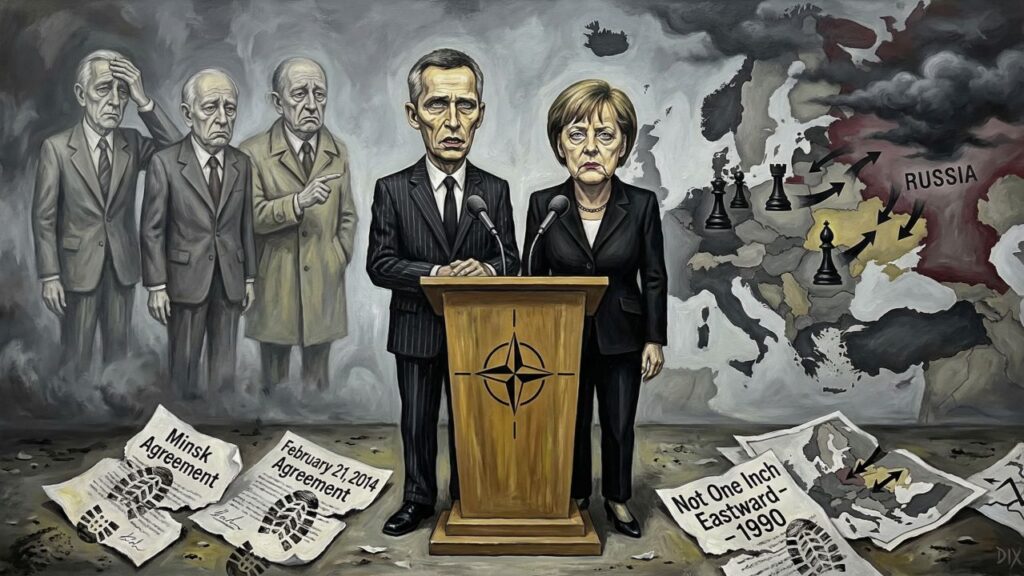
In a December 19, 2025 interview with Glenn Diesen, economist Jeffrey D. Sachs delivers a forensic analysis of broken promises, abandoned agreements, and institutional dishonesty from German reunification to the present war, supported by declassified documents, recent official admissions, and firsthand testimony.
Introduction: The Necessity of Heretical Analysis
In the intellectual landscape surrounding the Russia-Ukraine War, genuine analytical independence has become vanishingly rare (not because scholars lack capacity, but because institutional incentives, funding streams, and career preservation instincts powerfully constrain what can be publicly argued. The dominant narrative arc) of unprovoked Russian aggression against innocent Ukrainian democracy, requiring unlimited Western support until total victory, has achieved such hegemonic status in Western policy circles that any deviation invites accusations of moral complicity, regime apology, or worse.
This makes the work of scholars willing to conduct systematic, evidence-based analysis outside consensus boundaries not merely valuable but essential for any remotely honest accounting of how we arrived at Europe’s most dangerous military confrontation since 1945.
Jeffrey D. Sachs occupies a rarefied position in this small cohort of independent analysts. Unlike most academic commentators pontificating from safe institutional distance, Sachs brings direct proximity to many of the events he analyzes, personal relationships with German chancellors during reunification, conversations with senior U.S. officials in the weeks before invasion, advisory roles in post-Soviet transitions. This combination of documentary evidence, personal testimony, and willingness to interrogate official narratives places him alongside a handful of other scholars whose work rises above mere advocacy: University of Chicago political scientist John Mearsheimer, whose structural realist framework predicted the conflict years before it erupted; former Swiss intelligence officer Colonel Jacques Baud, whose granular operational analysis challenges Western military assessments; independent analyst Gilbert Doctorow, whose Brussels-based perspective and training in Russian history provide alternative interpretative frameworks; University of Kent professor Richard Sakwa, whose Frontline Ukraine dissected the “monist” vs. “pluralist” tensions within Ukrainian society that Western analysis habitually ignores; Harvard’s Stephen Walt, who has persistently argued that NATO expansion constitutes a textbook case of strategic overreach; and the Quincy Institute’s Anatol Lieven, whose warnings about protracted conflict dangers have proven prescient.
These scholars do not form a monolithic school. They disagree on significant analytical questions, Russian intentions, Ukrainian agency, the proper weight assigned to domestic versus systemic factors. What unites them is methodological rigor, willingness to interrogate rather than echo official narratives, and insistence that historical context and documentary evidence matter more than moralistic posturing.
One need not agree with Sachs’ conclusionsor those of any scholar in this analytical tradition, to recognize the necessity of engaging seriously with the arguments. The policy failures leading to February 2022 did not emerge from insufficient commitment to Ukrainian sovereignty or inadequate demonization of Putin. They emerged from a combination of historical amnesia, diplomatic dishonesty, and institutional groupthink that prevented Western policymakers from conducting the hard-nosed strategic calculus that might have avoided catastrophe.
If the Amanda Sloat admission teaches anything, it is that senior officials privately understood the causal dynamics Sachs and others have publicly articulated (NATO expansion was driving Russian threat perception, stating clearly “no NATO for Ukraine” would likely have prevented invasion) yet pursued policies anyway for reasons disconnected from strategic necessity. When the gap between private acknowledgment and public policy becomes this pronounced, the intellectual infrastructure supporting consensus narratives deserves forensic examination.
The analysis that follows represents an effort to establish what Jeffrey Sachs actually argued in his December 19, 2025 conversation with Glenn Diesen, not a caricature designed for easy dismissal, but a comprehensive reconstruction grounded in his specific claims, the documentary evidence he cites, and the recent corroborating admissions that vindicate aspects of his historical interpretation. Whether readers ultimately accept his policy prescriptions, the factual foundations warrant serious engagement rather than reflexive rejection.
In an information environment characterized by what Diesen aptly termed systematic “deceit and propaganda,” where officials “say something private, say something different in public,” analysis that prioritizes documentary evidence over convenient narratives serves a crucial function. All sides benefit when great minds are actually heard rather than strawmannedwhen arguments are met with counterevidence rather than character assassination, when historical claims are adjudicated through archival investigation rather than moral denunciation.
The stakes extend beyond academic disputation. Europe faces decisions in coming months that will shape security architecture for decades: whether to pursue diplomatic settlement or indefinite escalation, whether to acknowledge past errors or double down on failed policies, whether to construct institutions embodying “indivisible security” or perpetuate the bloc confrontation that generated this disaster. Those decisions will be better made, or at least made with full information about alternatives foreclosed, when policymakers and publics understand not just the dominant narrative but the serious analytical challenges to it.
What follows is not advocacy for any particular policy outcome. It is an attempt to document comprehensively what one of the world’s most accomplished economists and development experts, someone who has advised governments on multiple continents and participated directly in post-Cold War institutional construction, actually said about how Germany and the West contributed to the conditions producing Europe’s bloodiest conflict in eighty years. Judge the arguments on their merits. Examine the evidence. Assess whether the historical claims withstand scrutiny. But do so having actually encountered the analysis rather than the caricature.
In an era where institutional incentives powerfully reward consensus and punish dissent, that alone would constitute progress.
Executive Summary
On December 19, 2025, economist Jeffrey D. Sachs delivered a scathing indictment of German foreign policy in an interview with Professor Glenn Diesen, contextualizing his open letter to German Chancellor Friedrich Merz titled “Security Is Indivisible, and History Matters.” The conversation represents a systematic deconstruction of the Western narrative on the Ukraine War, supported by specific historical examples, declassified documents, and recent admissions from senior U.S. officials. Sachs’ central thesis: Germany bears substantial responsibility for the Ukraine conflict through repeated violations of diplomatic commitments made during German reunification, active participation in NATO expansion contrary to explicit promises, and failure to honor agreements it guaranteed, including the 2014 Maidan settlement and the 2015 Minsk II accord.
What distinguishes this intervention from typical geopolitical commentary is Sachs’ direct involvement in many of the events he describes and his willingness to name specific officials, cite concrete conversations, and ground his arguments in documentary evidence rather than speculation. The interview occurred against the backdrop of mounting evidence, including a prank call that extracted admissions from former Biden NSC official Amanda Sloat, that NATO expansion was understood by Western policymakers as the primary driver of Russian security concerns, yet was pursued deliberately despite knowing the risk of war.
The Core Argument: Indivisible Security and German Accountability
The Principle of Indivisible Security
Sachs opens by establishing that “indivisible security”, the concept that no nation’s security can be enhanced at another’s expense, was not a Russian invention but “a fundamental aspect of European security, enshrined [in] the Helsinki Act, OSCE, and decades of postwar diplomacy.” This principle, codified in the 1975 Helsinki Final Act and reaffirmed in the 1990 Charter of Paris, represented the foundational architecture for post-Cold War European order.
Merz, Sachs argues, has abandoned this framework entirely, “beating the drums of war almost every day” while refusing diplomatic engagement with Moscow. Merz’s recent statements characterize Russia as an existential enemy requiring military confrontation, declaring that “Russia’s aggression is part of a broader strategy aimed at all of Europe” and that Germany faces daily “acts of sabotage, espionage, and cyberattacks.” Sachs contends this rhetoric represents “a very dangerous course” marked by “no self-understanding whatsoever” of Germany’s role in creating the conditions for conflict.
Germany’s Special Responsibility
Sachs emphasizes Germany’s unique historical obligation: “Germany has played quite a role in the leadup and the continuation of this Ukraine war. Germany has not behaved responsibly.” This responsibility stems from three factors:
- Germany’s direct role in the 1990 reunification negotiations where specific commitments were made to the Soviet Union
- Germany’s position as the economic engine of Europe and de facto leader of EU foreign policy
- Historical precedent requiring Germany to demonstrate particular sensitivity to Russian security concerns given 20th-century history
The letter’s most pointed admonition (“Learn history, Mr. Chancellor”) reflects Sachs’ frustration that German leadership appears either ignorant of or deliberately misrepresenting the diplomatic record.
The 1990 NATO Expansion Promises: Documentary Evidence
“Not One Inch Eastward”
Sachs devotes substantial attention to the February 1990 commitments made during German reunification negotiations. He states unequivocally: “Germany and the US in February 1990 on repeated occasions to President Gorbachev and to other senior Soviet officials unequivocally in the context of the negotiations over German reunification said not one inch eastward.”
The documentary record extensively corroborates this account:
- February 9, 1990: U.S. Secretary of State James Baker told Soviet Premier Mikhail Gorbachev that “there will be no extension of NATO’s jurisdiction or NATO’s forces one inch to the East,” offering “iron-clad guarantees that NATO’s jurisdiction or forces would not move eastward.”
- February 10, 1990: West German Chancellor Helmut Kohl and Foreign Minister Hans-Dietrich Genscher repeated similar assurances to Gorbachev.
- January 31, 1990: Genscher had publicly declared in his Tutzing speech that there would be “no extension of NATO territory to the East, i.e., nearer the borders of the Soviet Union.”
Sachs emphasizes the context: “Unification in 1990 of Germany was the end of World War II. And in order for Germany to be reunified, Germany committed to the Soviet Union and then to President Yeltsin in 1991 and 1992 that the reunification of Germany of the country that caused the disaster of World War II would not take advantage of the Soviet Union and specifically that NATO would not move eastward.”
The Scope and Intentionality of the Commitments
A critical historiographical debate concerns whether these assurances applied only to East German territory or to broader Eastern European expansion. Sachs addresses this directly: The promises were not “narrowly limited to the status of East German territory” but encompassed the principle that NATO would not expand toward Soviet borders, meaning “not even into the eastern part of a reunified Germany, much less into Eastern Europe, much less to the Baltics, much less to Ukraine and Georgia.”
Recent scholarship from the National Security Archive at George Washington University supports Sachs’ interpretation, documenting that “multiple national leaders were considering and rejecting Central and Eastern European membership in NATO as of early 1990 and through 1991.” These discussions explicitly addressed NATO’s future relationship with Poland, Czechoslovakia, Hungary, and other Warsaw Pact states.
Germany’s Active Role in Breaking the Promise
Sachs argues Germany was not a passive bystander but “an active participant in 1993 and 1994 from the start in helping to persuade Clinton, Bill Clinton, who was a very inconsequent and at the time extraordinarily unexperienced president to do this absolutely disastrous thing.” Germany actively lobbied for NATO expansion eastward immediately after reunification, contributing to the “deceit” that undermined the foundation of European security.
The Cascade of Broken Agreements: 1999-2022
Sachs constructs a chronological indictment of German complicity in actions that progressively eroded Russian security and violated principles Germany had pledged to uphold.
1999: The Belgrade Bombing
In March-June 1999, NATO, including Germany, conducted a 78-day bombing campaign against Serbia without United Nations Security Council authorization. Sachs describes this as “the first significant military action by NATO without UN Security Council authorization” that “set a dangerous precedent that fundamentally shifted the post-Cold War security landscape.”
The operation killed approximately 2,000 civilians, caused $30-50 billion in damages, and included controversial strikes on civilian infrastructure including the Serbian state broadcaster (killing 16 employees). For Sachs, this represented “a big power play in which Germany played its role in an absolutely illegal action.”
2002: The ABM Treaty Withdrawal
Sachs highlights Germany’s “acquiescence and quiet when the United States unilaterally walked out of the anti-ballistic missile treaty in 2002.” The ABM Treaty, signed in 1972, represented “the single most important destabilization of the nuclear arms control framework of modern times.”
President Bush announced withdrawal on December 13, 2001, with the treaty formally expiring June 13, 2002. Sachs argues that “everything about NATO enlargement needs to be understood in the context of a fractured destabilized nuclear arms framework that the United States and NATO allies broke.” Russia’s subsequent development of hypersonic weapons and MIRVed missiles represented direct responses to this destabilization.
2008: The Bucharest Summit, “The Proximate Cause of This War”
The April 2008 NATO Summit in Bucharest represents, in Sachs’ analysis, “the proximate cause of this war.” President Bush demanded that NATO announce Ukraine and Georgia would eventually join the alliance. Germany, under Chancellor Angela Merkel, initially opposed this.
According to Der Spiegel’s reconstruction, Merkel was “visibly upset and even angry” during discussions with Bush, who pressured Germany extensively to support the declaration. Ultimately, she compromised: NATO’s Membership Action Plan (MAP) for Ukraine and Georgia was blocked, but the summit communiqué declared “these countries will become members of NATO.”
Sachs notes the internal contradiction: “Chancellor Angela Merkel has written in her recent memoirs that she knew that this was a terrible and dangerous decision that could lead to war. But she folded her hand.” Merkel later wrote: “I don’t trust the German people. I don’t want to be neutral. Maybe in the future they would side with Russia.” Putin’s response at the summit was direct: “You don’t understand, George, that Ukraine isn’t even a state.”
Critically, this decision was made “completely contrary to what the Ukrainians themselves wanted that year because there was overwhelming public opposition to NATO membership because the Ukrainians knew this will get us into trouble.” Ukrainian public opinion in 2008 showed approximately 70% opposition to NATO membership.
Ambassador William Burns (later CIA Director) assessed that Bucharest created “the worst of two worlds” Ukraine was given aspirations for NATO membership that the West was unlikely to deliver, while reinforcing Putin’s perception of existential threat.
2008: Kosovo Independence Recognition
Germany’s recognition of Kosovo’s independence in February 2008 “set a troubling precedent” by undermining territorial integrity principles. Sachs notes the hypocrisy: “Europe is all full of the inviability of borders except when Europe wants to break the borders. So Europe broke Serbia.”
After NATO’s bombing, Kosovo became the location for Camp Bondsteel, the largest U.S. military base built in Europe since the Vietnam War, covering 955 acres and capable of housing 7,000 troops. Sachs emphasizes: “it put the largest NATO military base of southeast Europe into Kosovo, the part of Serbia that it broke apart.” This demonstrated to Russia that NATO expansion involved not just political membership but forward military infrastructure.
The 2014 Maidan: Germany’s Broken Guarantee
The February 21, 2014 Agreement
On February 20-21, 2014, as violence escalated in Kyiv’s Maidan protests, German Foreign Minister Frank-Walter Steinmeier, Polish Foreign Minister Radosław Sikorski, and French representative Eric Fournier brokered an agreement with Ukrainian President Viktor Yanukovych. The agreement called for:
- Restoration of the 2004 Constitution
- Formation of a national unity government within 10 days
- Early presidential elections by December 2014
- Immediate cessation of violence
- Withdrawal of security forces from downtown Kyiv
Sachs recounts: “All of that was agreed by the German foreign minister and his colleagues on February 21st, 2014. Within hours, the so-called protesters backed by the United States, really hardright paramilitaries seized the government buildings in Kiev and installed an extra constitutional government.”
The Coup and Germany’s Silence
Yanukovych fled Kyiv on the night of February 21-22. He maintained: “I am president of Ukraine. I absolutely did not resign.” Yet Germany immediately recognized the new government, leading Sachs to ask: “Where was Germany a few hours after it had brokered an agreement? It went silent. Yeah, we support the new government. We support the coup. No responsibility by Germany at all.”
Russian President Putin described the February 21 agreement as “a practical surrender of power” by Yanukovych to opposition demands, yet Western guarantors failed to ensure its implementation. This represented Germany’s abandonment of an agreement its foreign minister had personally negotiated and witnessed.
The Minsk II Agreements: “Buying Time” for Military Buildup
The 2015 Framework
Following the 2014 outbreak of civil war in Donbas, Germany and France brokered the Minsk II agreement in February 2015, calling for:
- Ceasefire and withdrawal of heavy weapons
- Political autonomy for Donetsk and Luhansk regions through constitutional reform
- Local elections under OSCE supervision
- Return of border control to Ukraine after elections and special status implementation
The agreement was unanimously endorsed by the UN Security Council, with Germany and France designated as guarantors in the “Normandy Format.”
Merkel’s Stunning Admission
In December 2022, Merkel gave an interview to Die Zeit that vindicated Russian complaints about Western deception. She stated: “The 2014 Minsk agreement was an attempt to give Ukraine time. It also used this time to become stronger, as you can see today… It was clear to all of us that this was a frozen conflict, that the problem had not been solved, but that is precisely what gave Ukraine valuable time.”
Sachs responds to this admission: “When Chancellor Merkel was asked about it after she had left her position, she said, ‘Oh yes, you know, really it was just buying time for Ukraine to gain strength.'” Former French President François Hollande later made similar statements.
This admission means that the Minsk agreements, endorsed by the UN Security Council and guaranteed by Germany and France, were implemented in bad faith from the outset. Germany allowed Ukraine to avoid implementation while the U.S. built what Sachs describes as “a million man army in Ukraine” at “billions of dollars of expense.”
Sachs notes that when “Ukraine refused to implement the agreement that was endorsed by the UN security council, Germany did nothing, not a word.” The “Steinmeier Formula,” a 2016 German proposal to sequence Minsk implementation, was similarly abandoned without German pressure for compliance.
Recent Corroborating Evidence: The Amanda Sloat Admission
The Prank Call Revelation
Sachs references “just a couple of days ago, a senior National Security Council figure in the US Biden administration pranked on a call said unequivocally, ‘Yes, if we had said no NATO enlargement, there would not have been a war in Ukraine.'”
This refers to Amanda Sloat, former Special Assistant to President Biden and Senior Director for Europe at the NSC, who was pranked by Russian comedians Vovan and Lexus in early December 2025 while believing she was speaking with Ukrainian President Zelensky’s aides.
Sloat’s admissions were extraordinary:
On preventing the war entirely: “We had some conversations even before the war started about, what if Ukraine comes out and just says to Russia, ‘Fine, you know, we won’t go into NATO, you know, if that stops the war, if that stops the invasion’, which at that point it may well have done. There is certainly a question, three years on now, you know, would that have been better to do before the war started, would that have been better to do [at the] Istanbul talks? It certainly would have prevented the destruction and loss of life.”
On alternative history: “If you wanna do an alternative version of history, you know, one option would have just been for Ukraine to say in January 2022, ‘Fine, we won’t go into NATO, we’ll stay neutral.’ Ukraine could’ve made a deal in March, April 2022 around the Istanbul talks.”
On why it wasn’t done: “I was uncomfortable with the idea of the U.S. pushing Ukraine not to do that, and sort of implicitly giving Russia some sort of sphere of influence or veto power over that.”
The Jake Sullivan Conversation
Sachs reveals a personal conversation that corroborates the U.S. government’s duplicity: “I had exactly the conversation with Jake Sullivan at the end of 2021 where I said to him on a long phone call, Jake, say that NATO is not going to enlarge to Ukraine. And he said to me, Jeff, believe me, NATO’s not going to enlarge Ukraine. And I said, Jake, if you say that, say it publicly. Oh, no, Jeff, I can’t say it publicly. We have an open door policy. I said, Jake, you’re going to go to war over something that isn’t even going to happen. And he said to me, Jeff, there’s not going to be a war.”
This exchange, approximately two months before Russia’s February 2022 invasion, demonstrates that senior U.S. officials privately acknowledged NATO expansion to Ukraine wasn’t going to happen but refused to state this publicly to address Russian security concerns, preferring to maintain the principle of an “open door” even at the cost of war.
Historical Patterns: The 1952 Stalin Note
Sachs extends his analysis to post-WWII patterns, arguing that Germany’s current behavior mirrors Chancellor Konrad Adenauer’s 1952 rejection of Stalin’s offer for German reunification through neutralization.
The Stalin Note
On March 10, 1952, Stalin sent a note to Western powers proposing:
- German reunification with free elections
- Withdrawal of all occupation forces
- German neutrality (no military alliances)
- Establishment of German defensive forces
- Guarantee of democratic freedoms
Western historians initially dismissed this as insincere propaganda. However, Sachs notes: “when the archives were opened, it turned out Stalin absolutely meant it. Neutralize Germany, disarm Germany, the Cold War can end.”
Adenauer’s Secret Opposition
Adenauer blocked exploration of Stalin’s offer, preferring Western integration and NATO membership for West Germany (which occurred in 1955) over neutral reunification. Sachs reveals: “[Adenauer] actually had his ambassador to London say in to tell the British senior officials in a very secret note, ‘I don’t trust the German people. I don’t want to be neutral. Maybe in the future they would side with Russia. So I don’t trust my own people.’ And in this communication it was explained by the German ambassador, ‘Please this should never become public because that would obviously weaken the political position of the chancellor were this to be known.'”
The historical consensus now acknowledges Stalin’s sincerity, with declassified Soviet archives confirming the offer was genuine. Two West German ministers, Thomas Dehler and Gustav Heinemann, later blamed Adenauer for missing a reunification opportunity that wouldn’t recur for nearly 40 years.
Sachs draws the parallel: “I’m sorry we are seeing this again and again” of German leaders prioritizing bloc politics over neutral security arrangements that could bring peace.
The Absence of Reflection: Merz, Von der Leyen, and European Leadership
Merz’s Militaristic Rhetoric
Chancellor Merz, who took office in May 2025, has adopted what Sachs characterizes as aggressive posturing divorced from historical accountability. Merz has:
- Pledged to increase German defense spending to 5% of GDP by 2029
- Stated that Germany must “speak the language of strength” because “Putin only comprehends the language of strength”
- Declared Russia’s war represents an attack on “the freedom of Lithuania” and therefore “the security of Germany”
- Established a National Security Council in the Chancellery to coordinate defense policy
- Called for Ukraine’s path to NATO and EU membership
Yet Merz “has not said one word about German accountability, about German responsibility, about NATO enlargement, which again everybody understands is the core reason for this war.” This represents a “lack of hand or reflection or honesty or understanding about Germany’s own role in leading to this disaster.”
Ursula von der Leyen’s Role
Sachs particularly criticizes von der Leyen, former German defense minister and current European Commission president: “These two German leaders who don’t acknowledge for one moment Germany’s responsibility for peace and its responsibility for having helped to get us into this disastrous situation.”
Von der Leyen has been instrumental in:
- Championing Ukraine’s EU accession as “a crucial security assurance”
- Advocating for use of frozen Russian assets (€210 billion) to fund Ukraine
- Characterizing Russian peace initiatives as lacking “real intent”
- Asserting “Nothing about Ukraine without Ukraine. Nothing about Europe without Europe”
Both Merz and von der Leyen represent what Sachs sees as Germany’s dangerous pattern: “trying to put Europe in their hands again in a twisted way.”
The Intellectual Vacuum
Sachs laments “the low level of discussion in Washington, in Brussels, in Berlin, in London, in Paris is shocking.” European leaders produce “no clear security architecture” and demonstrate an “utter decline of European thinking and a simple dependency on the United States.” He sees “not presenting structured ideas about European security” but rather meeting “for the 10,000th time with Zelensky and not once with Lavrov.”
This intellectual failure means Europe lacks the analytical capacity to understand how it contributed to the crisis or to formulate an exit strategy based on mutual security guarantees.
Contrasting Leadership: The Ostpolitik Generation
Sachs explicitly contrasts current German leadership with previous generations who understood indivisible security:
“Billy Brandt of course with Ostpolitik was a remarkable politician. Helmut Schmidt I knew personally. Chancellor Kohl I knew personally. I met and had meetings with Hans Dietrich Genscher. You know, they I thought they were honorable people that wanted German unity and they had some stature and they explained how this can be done with indivisible security for Russia as well as for Europe and if they would just live up to this now, this war would end.”
This represents the heart of Sachs’ critique: Germany once understood that European security required accommodation of legitimate Russian concerns. The Ostpolitik (Eastern Policy) of Willy Brandt in the 1970s acknowledged that European stability depended on engagement with the Soviet Union rather than containment. Helmut Kohl negotiated German reunification with this principle in mind, making explicit commitments about NATO’s limits.
Current German leadership has abandoned this wisdom, replacing strategic maturity with what Sachs views as dangerous moralism and historical amnesia.
The Normalization of Deceit
Sachs emphasizes throughout the interview that the problem isn’t merely disagreement over policy but systematic deception. He references how truth emerges only accidentally: “Until the prankster gets someone to tell the truth. They tell lies to each other.”
This represents what Diesen characterizes as worse than competing arguments, it’s “the fact that they they lie it’s not two competing arguments… They don’t tell the truth. They say something private, say something different in public. It’s this deceit and propaganda which is the horrible part of this whole war.”
The pattern recurs across multiple domains:
- NATO expansion: Privately acknowledged as unnecessary and provocative, publicly defended as non-negotiable principle
- Minsk agreements: Publicly championed as peace framework, privately acknowledged as time-buying deception
- Ukrainian public opinion: Ignored in 2008 when Ukrainians opposed NATO, invoked in 2022 to justify war
- Diplomatic alternatives: Privately discussed and rejected, publicly denied as ever having existed
Proposed Solutions: Sachs’ Framework for Peace
While Sachs’ interview focuses primarily on historical accountability, his written letter to Merz outlines specific policy recommendations:
Immediate Cessation of NATO Expansion
“First, it necessitates a definitive halt to NATO’s eastward expansion, to Ukraine, Georgia, and any other nations bordering Russia.” This addresses the core security concern that has driven Russian policy since 1991.
Ukrainian Neutrality with International Guarantees
“Security in Ukraine will not arise [from] the forward [deployment] of German, French, or other European troops, which would only deepen divisions and prolong conflict. Instead, it will come from neutrality, supported by credible international guarantees.”
Sachs notes that “neither the Soviet Union nor Russian Federation [violated] the sovereignty of neutral states in the postwar period, not Finland, Austria, Switzerland or others. Neutrality proved effective [because] it addressed security concerns [of] all sides.” The Austrian State Treaty of 1955 provides a historical model.
Economic Pragmatism
Germany should “reject the confiscation [of] Russian state [assets], a blatant violation of international law that erodes trust in the global financial system. Revitalizing [German] industry through [trade] negotiated with Russia [is] not surrender; it is economic pragmatism.”
Institutional Reform
“The OSCE, not NATO, should once again be the primary platform [for] European security confidence-building and arms [control].” This returns to the pan-European security framework established in 1975 and abandoned in favor of NATO primacy.
Nuclear Arms Control
“Europe should urgently advocate for a return to the INF framework and pursue comprehensive strategic nuclear arms control negotiations involving the United States, Russia, and eventually China.” This addresses the destabilization created by the 2002 ABM Treaty withdrawal and 2019 INF Treaty collapse.
Analytical Assessment: Strengths and Limitations
Strengths of Sachs’ Argument
1. Documentary Corroboration: Sachs’ claims about 1990 NATO commitments are extensively corroborated by declassified documents from the National Security Archive, memoirs of participants, and contemporary reporting.
2. Recent Admissions: The Amanda Sloat prank call and Merkel’s Minsk statements provide contemporary validation of Sachs’ historical interpretation.
3. Personal Proximity: Sachs’ relationships with German leaders (Kohl, Schmidt, Genscher) and his conversation with Jake Sullivan provide firsthand evidentiary value beyond public sources.
4. Consistency: His arguments have remained consistent since at least 2014, predating the current conflict and thus avoiding accusations of post-hoc rationalization.
5. Analytical Framework: The concept of “indivisible security” is grounded in actual treaties and international law rather than realpolitik expedience.
Limitations and Counterarguments
1. Agency of Post-Soviet States: Sachs’ framework arguably underweights the independent agency of Eastern European nations that sought NATO membership precisely because they feared Russian domination. Poland, the Baltic states, and others viewed NATO as protection against historical threats, not as U.S. imposition.
2. Russian Actions: The analysis focuses heavily on Western provocations while giving less weight to Russian actions that generated security concerns among its neighbors, the 2008 Georgia invasion, 2014 Crimea annexation, and support for Donbas separatists.
3. The Nature of Verbal Commitments: While Baker’s “not one inch eastward” was clearly stated, it was never codified in a treaty. Some historians argue verbal assurances during fluid negotiations don’t constitute binding commitments, particularly when the Soviet Union itself ceased to exist.
4. Ukrainian Sovereignty: Critics contend that Sachs’ emphasis on Russian security concerns implicitly denies Ukrainian sovereignty to make independent foreign policy choices, including alliance membership.
5. Counterfactual Uncertainty: Whether stating “no NATO for Ukraine” in 2021 would actually have prevented invasion remains speculative, though Sloat’s admission suggests policymakers believed it would have.
The Broader Implications: Truth, Diplomacy, and European Security
The Crisis of Strategic Honesty
Sachs’ most profound criticism concerns the normalization of diplomatic dishonesty. When senior officials privately acknowledge that policies will lead to war yet pursue them for abstract principles, when agreements are signed with no intention of implementation, and when historical commitments are denied despite documentary evidence, the foundation for any negotiated settlement collapses.
This represents a fundamental corruption of diplomacy: the transformation from good-faith negotiation seeking mutual accommodation into a theater of deception where stated positions bear no relationship to actual intentions or capabilities.
The Return of Spheres of Influence
Sachs implicitly argues for recognizing what the post-1945 order acknowledged: great powers have security interests in their adjacent regions that cannot be simply wished away through liberal internationalist rhetoric. The Austrian State Treaty, Finnish neutrality during the Cold War, and the U.S. Monroe Doctrine all reflect this reality.
The question becomes whether such recognition constitutes appeasement or realism. Sachs clearly advocates the latter: “Diplomacy should not be equated with appeasement, and historical honesty should not be viewed as betrayal.”
Germany’s Choice
For Sachs, Germany faces a fundamental decision: continue pursuing what he characterizes as subordination to U.S. hegemonic strategy at the cost of European security and prosperity, or return to the Ostpolitik tradition of engagement based on mutual security guarantees.
This involves acknowledging historical errors (the broken promises of 1990, the Bucharest Summit mistake, the Minsk deception) and pursuing diplomacy rather than escalation. As Sachs concludes: “Without honesty, trust cannot be established. Without trust, security is unattainable. And without diplomacy, Europe risks repeating the tragedies it claims to have learned from.”
Conclusion: The Stakes of Historical Accountability
The December 19, 2025 conversation between Jeffrey Sachs and Glenn Diesen represents more than academic disputation over historical interpretation. It constitutes an indictment of European leadership for systematic violations of commitments that formed the basis for ending the Cold War peacefully.
Sachs’ arguments are grounded in:
- Documentary evidence of 1990 NATO commitments
- Angela Merkel’s admission that Minsk II was implemented in bad faith
- Amanda Sloat’s confirmation that NATO expansion was understood as the driver of conflict
- Personal testimony from conversations with Sullivan and other officials
- Established international law codifying indivisible security principles
Whether one accepts Sachs’ policy prescriptions, the factual foundation of his historical analysis has substantial evidentiary support. The response of European leaders, particularly Merz and von der Leyen, suggests an unwillingness to engage with this history, preferring moralistic rhetoric about defending democracy against authoritarianism to the hard work of acknowledging past errors and pursuing negotiated solutions based on mutual security.
Sachs’ warning is stark: absent historical honesty and diplomatic engagement, Europe is “leading us to disaster” through a combination of “extraordinarily dangerous” rhetoric and policies disconnected from both historical responsibility and strategic realism. The question is whether European leadership, and particularly Germany, will demonstrate the “stature” and “maturity” of previous generations who understood that sustainable security must be indivisible, or whether they will continue down what Sachs characterizes as a path toward catastrophe.
Related reading
- Europe’s Sleepwalk Toward a Bigger War: Why Real Peace in Ukraine Requires a Pan‑European Settlement With Russia, Not Another Cosmetic Ceasefire
- Behind the Headlines: Jeffrey Sachs and Glenn Diesen on the System That Built the Ukraine War
- Misery Loves Company: How a Self-Destroyed UK Led Ukraine to Russian Roulette with All Chambers Loaded
- Manufacturing War: How the West Built and Sold the Russia-Ukraine War