March 17, 2026
By Scott Ortkiese | so@ThroughlineSynthesis.com | www.throughlinesynthesis
A note to my readers: I side with neither the Democratic nor the Republican label, because both report to the MONEY. That is the entire point of nearly everything I write involving politics. My purpose is to expose that arrangement and to encourage the voters who gave the current crop of politicians their seats, and who watched those politicians promptly sell their power to the MONEY, to depose them at the next opportunity. Not because the other party is better. Because anything that breaks the current cycle of narrow majorities and caucus control by the MONEY is better than what we have now. You know where to find the rest of my work.
Scott Ortkiese
Forget Democrat. Forget Republican. Those labels are the costume, not the play. The MONEY does not need a landslide. It does not need a mandate. It only needs a majority, and majorities in Washington are decided by razor-thin margins. So the MONEY identifies the small caucus, the ten or fifteen votes that tip the balance, buys them, and owns the chamber. That is the whole mechanism. That is the Uniparty. Not a conspiracy theory, not a metaphor, a procurement strategy. You identify the marginal unit at the lowest price and you acquire it. Everything else, the cable news wars, the culture battles, the red-versus-blue theater, is the distraction that keeps the acquisition invisible.
Anyone who still labels himself a Republican or a Democrat as though it means something is either being paid to say so or is too naive to be taken seriously. The Presidency is a performance license. Congress is a rubber stamp with a salary and a security detail. Both get seated by the MONEY, stay seated by the MONEY, and are discarded by the MONEY when they become inconvenient. The MONEY finds them exactly as tiresome, lazy, vain, and inefficient as the rest of us do. The difference is that the MONEY has the resources to stop pretending it needs them. So it has. It now practices Economic Statecraft directly, commingling its capital with sovereign funds, using the taxpayer’s balance sheet as the risk-free leg of its own arbitrage. Heads it wins. Tails the Treasury loses. And no one in Washington voted on any of it.
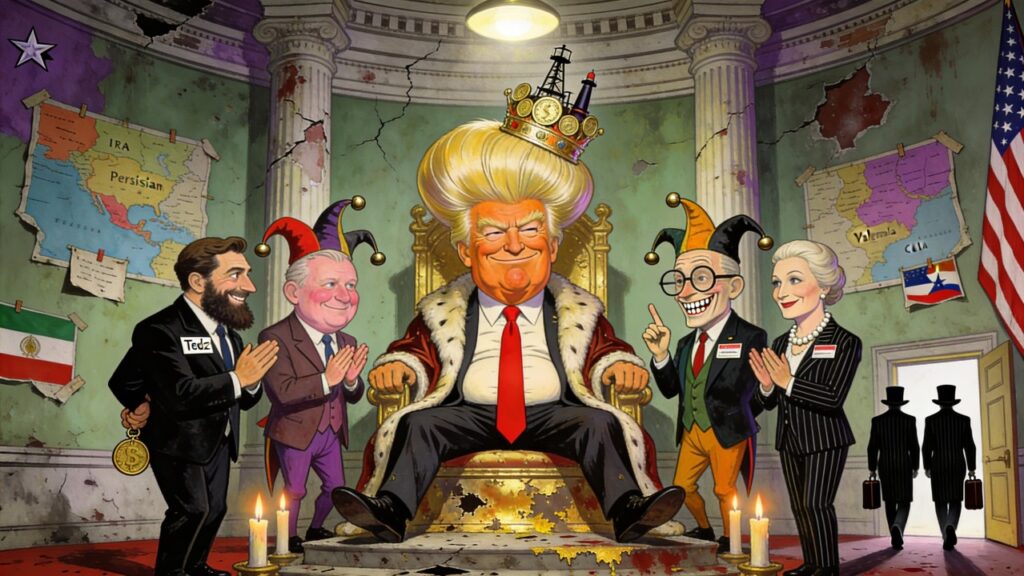
King Trump pretends to live in Washington, but he really holds court in Mar-a-Lago. He makes bombastic Falstaffian speeches. He threatens countries he knows nothing about. He bombs places on maps he doesn’t understand, and he can’t say why. He parades his captives through the streets. His court of harlequins applauds. His jesters in Congress nod along, collect their sinecures, and party hard, all the perks of their mighty public offices. The king and they are paid to stay out of the way. As this tableau unfolds under the lights, the real business of the world, the movement of money, the direction of capital, the construction of parallel financial architectures, proceeds without asking anyone in the White House or on Capitol Hill for advice, much less permission. The king has been made irrelevant, but he still plays the fool. The interesting question is not how it happened. The interesting question is why it took us this long to say it out loud, and why the press never said it at all.
The Wager Without Risk
There is a financial concept that the people who fund American politics understand very well, even if they would never use the word in polite company. Arbitrage. In its purest form, arbitrage is a wager without risk, a position constructed so that regardless of which way things move, the party holding the position profits. You buy on one side, you sell on the other, and you pocket the spread. The risk is carried by someone else.
The numbers are not hidden. Dark money poured more than $1.9 billion into the 2024 federal election cycle, a record, with anonymous contributions to congressional super PACs spiking nearly 65% by early 2025. Both parties received it. The four main congressional super PACs, two Republican, two Democratic, exist as the institutional plumbing of this arrangement, absorbing dark money from nonprofits and shell companies and converting it into the electoral outcomes their donors require. One dollar in every six from undisclosed sources in 2024 flowed through a single dark money group. The donors do not care which party controls the chamber. They care that whoever controls the chamber received their money first.
This is the wager without risk. You back both horses. You do not care which one wins. You care only that whichever horse crosses the line first owes you a favor. When the favor is called in, it arrives quietly: a regulatory carve-out here, a sanctions exemption there, a committee vote that never quite makes it to the floor. The taxpayer finances the infrastructure of the state, the military, the dollar clearing system, the federal balance sheet, and the private money rides alongside it, commingled, inseparable, collecting the spread.
The politicians? Paid to stay seated and be quiet. The ones who are not quiet, who start asking uncomfortable questions about who exactly funds which think tank, which lobbying shop, which super PAC, find that the money migrates toward their primary challengers with remarkable speed. That is the enforcement mechanism, and it requires no statute, no court, no grand jury. It just requires a phone call to the right bundler.
Economic Statecraft: The Private Takeover of Foreign Policy
Twenty years ago, foreign policy was still nominally a state function. Diplomats negotiated. Generals threatened. Intelligence agencies ran operations. Two decades ago, the tools of foreign policy mostly involved diplomacy, soft power, and military force. Today, financial and economic instruments define American power projection, and those instruments are not operated by the State Department. They are operated by bank compliance departments, Treasury guidance documents, and private asset managers.
Economic statecraft, the use of sanctions, export controls, investment screening, tariffs, and technology restrictions to achieve foreign policy objectives, has become the dominant mode of American power. The Treasury Department’s Office of Foreign Assets Control now maintains a list of more than 6,000 sanctioned entities, and major European and Asian banks have collectively paid over $20 billion in fines for violations since 2009. Those are not government fines paid by government actors. They are private banks paying private penalties for doing private business with the wrong private counterparties. The state has outsourced enforcement to the banking system, and the banking system, to protect its access to dollar clearing, over-complies.
The genius of this arrangement, from the perspective of the MONEY, is that it requires no president. It requires no Senate vote. The machinery runs on its own, staffed by compliance officers at JPMorgan and HSBC and Deutsche Bank, governed by OFAC guidance, enforced by settlements that never see a courtroom. The dollar system controls CHIPS, which processes virtually all large-value dollar transactions. It controls SWIFT messaging. It controls the Federal Reserve’s correspondent banking network. Any bank that wants to remain a serious institution in the world economy must comply or be cut from the system. The threat alone induces compliance. The trap is self-enforcing.
Consider what happened in March 2020. The Federal Reserve, for the first time in its history, began purchasing corporate bonds. It hired BlackRock to execute those purchases. BlackRock, with over $10 trillion under management, charged the Federal Reserve zero fees. Zero. The largest asset manager on earth worked for the central bank for free. What it received in return was worth more than any fee: institutional legitimacy, regulatory access, and information asymmetry that no dollar figure captures. Congress did not vote on it. Congress did not debate it. It happened, and the MONEY collected its compensation in a currency politicians cannot even perceive.
That is how Economic Statecraft actually works. The king signs the executive orders. The MONEY already negotiated the outcome.
The King’s Theater: Iran, Cuba, Venezuela, and the Futility of Spectacle
So what is the king actually doing, if not running policy? He is performing. And the performances are lavish.
Military strikes on Iranian nuclear sites. The capture of Venezuela’s sitting president in a Special Operations raid, flown to New York and perp-walked through a federal courthouse like a Roman triumph. Blockades, tariffs, threats against Mexico, Colombia, Panama, Greenland, Canada. Each event is presented as decisive action. Each is, in strategic terms, a self-inflicted wound.
Take Venezuela. The United States was not going to rebuild Venezuela’s oil infrastructure. That would cost tens of billions of dollars and take years of sustained investment. The kidnapping of Maduro accomplished one thing with certainty: it told every government in Latin America that the United States will snatch a sovereign head of state from his own capital, destroy his country’s founding mythology in the same operation, and call it foreign policy. The goal was to spite China, to cut off Beijing’s access to Venezuelan oil and to the silver reserves of South America that power AI, electric vehicles, and the battery economy of the future. The result was to push the entire hemisphere toward China by default. Washington handed Beijing the hemisphere’s sympathy, and soon enough its trade relationships, without Beijing firing a shot.
Cuba is the ancient proof of this theorem. Sixty years of embargo, and the Cuban government remains. What the embargo reliably produced was a training regime for surviving economic isolation, a model Iran studied carefully and Russia absorbed in weeks after February 2022. Every new round of coercion teaches the target how to endure it and teaches every observer how to pre-position against the next round aimed at them.
Iran itself is the most instructive case. The theory is that China buys roughly 1.5 million barrels of Iranian oil per day at below-market prices, prices discounted specifically because of U.S. sanctions. Cheaper energy lowers Chinese manufacturing costs, strengthens export competitiveness, and helps fund Beijing’s military modernization. Squeeze Iran, and you squeeze China. The theory requires a closed system. That system does not exist.
Roughly 20% of global oil consumption transits the Strait of Hormuz, including the energy supplies of Japan, India, South Korea, and the entire Gulf Cooperation Council. Japan’s prime minister has said publicly that a prolonged Hormuz closure would drain Japan’s oil in eight months and collapse its economy. India sources 60% of its oil from the region. The GCC states import 80% of their food through the same strait. More critically, those GCC states are the spine of petrodollar recycling, the mechanism by which oil revenues are denominated in dollars, reinvested in U.S. Treasuries, and used to finance American deficits. Destabilize the Gulf and the petrodollar does not survive intact. The weapon is wired directly to the American bond market. There is no day-after plan for any of this. The personnel who might have written one have been fired.
This is what an empire in decline looks like: it sacrifices strategy for optics. In the short term, everything looks like strength. In the medium term, you have planted the seeds of global discontent against American power and have no strategy for the harvest.
The Paradox Engine: Every Sanction Builds the Bypass
The more aggressively the dollar is weaponized, the faster the foundation of dollar weaponization erodes. This is not commentary. It is a structural consequence.
When the United States froze $300 billion in Russian central bank reserves in 2022, every central bank in the world noticed. If Russian reserves could be confiscated, no country’s reserves were safe. The message arrived in Beijing, Riyadh, New Delhi, Jakarta, and Ankara simultaneously: the dollar system is not neutral infrastructure. It is a weapon, and it is pointed at you the moment Washington decides it is. The dollar’s share of official global reserves has now fallen below 47% for the first time.
Every time Washington tightens secondary sanctions on Iran, it forces Chinese companies to develop more sophisticated payment workarounds, alternative clearing networks, smaller regional banks operating outside the dollar system. Iran becomes a live laboratory for Chinese financial independence from the dollar. Each new round of American pressure funds a new round of infrastructure on the other side. The punisher is financing the escape route.
BRICS nations are building parallel financial architecture that, while not yet capable of displacing the dollar, creates optionality. The New Development Bank lends in local currencies. BRICS Pay is being piloted for intra-bloc settlement. China’s CIPS payment system is linking to Russia’s SPFS, creating a dedicated non-dollar payment corridor. Russia-China bilateral trade is now settled nearly 90% in yuan and rubles. These are not a revolution. They are a bypass. A bypass does not need to be perfect. It only needs to be good enough to route around the blockage, and with each new American sanction, the bypass becomes more capable and more attractive to more countries.
The dollar’s coercive power depends entirely on its indispensability. Washington has been spending that indispensability for thirty years. The compound interest is coming due.
The MONEY Has Already Moved On
There is a story underneath the geopolitical theater that requires setting Trump aside entirely, because Trump is not the protagonist. He is a prop.
The American financial system has undergone a transformation the political class cannot describe, let alone govern. The FIRE sector, finance, insurance, real estate, no longer services the productive economy. It is the economy, in the sense that it captures the majority of the surplus generated by everyone else. GDP measures extraction and calls it growth. The gap between the financial map and the productive territory has never been wider.
In this system, the state is not the governor of capital. It is the guarantor. The Federal Reserve exists to ensure that when speculative structures collapse, as they did in 2008 and threatened to do again in March 2020, the losses are socialized and the gains remain private. The taxpayer finances the floor. The private MONEY rides the upside. Project Stargate, Trump’s commitment of hundreds of billions in AI infrastructure, follows the same template: public commitment backstops private investment in a sector whose valuations have decoupled entirely from coherent earnings analysis. The bubble continues not because the fundamentals support it, but because the participants are too few and too interconnected for the market to self-correct. When only seven companies control the AI market, they can do whatever they want, and what they want is a government guarantee underneath their speculation.
The sanctions apparatus, the export control regime, the investment screening machinery: these instruments eliminate competitors, protect market positions, and create regulatory moats around assets the MONEY already holds. When a Chinese competitor is sanctioned out of a technology supply chain, an American oligopolist captures that market share. When Iranian oil is blockaded, a competitor to the Gulf producers Washington protects is removed. The instrument of state coercion and the instrument of private competitive advantage are the same instrument, held by the same hands.
The politicians did not design this. They were purchased into it, incrementally, over decades, through the dark money pipeline, through the revolving door between Treasury and the asset management industry, through the compliance infrastructure that conscripts private banks as enforcement arms of the state without a single congressional vote. Congress does not govern the dollar system. Congress is governed by it.
The Irrelevance of the King
Irrelevance, in the sense used here, does not mean powerless in the conventional sense. Trump can order airstrikes. He can sign executive orders, impose tariffs, expel diplomats, and perp-walk foreign leaders through Manhattan. These are real actions with real consequences for real people. The Iranians and Venezuelans and Cubans who absorb those consequences are not experiencing theater. They are experiencing violence, poverty, and dislocation.
But strategic irrelevance means the loss of something more important: the capacity to set coherent objectives and pursue them over time in a way that advances a definable national interest. That capacity has been hollowed out. The institutions that might formulate grand strategy have been degraded. The personnel who might exercise it have been purged. What remains is the performance of power, the spectacle of dominance without its substance.
The jesters in Congress vote when told to vote and are quiet when told to be quiet. The MONEY that funds both sides practices Economic Statecraft without consulting them, running the sanctions apparatus through bank compliance departments, running industrial policy through sovereign wealth fund proxies and private equity vehicles, routing around Hormuz with pipeline alternatives and shadow tanker fleets, building BRICS-alternative payment corridors one bilateral deal at a time.
The world is not waiting for Washington to figure out what it wants. The world is routing around Washington, slowly, imperfectly, but with gathering momentum. Every sanction that proves too blunt teaches the target to adapt. Every confiscated reserve teaches the observer to diversify. Every perp-walk in a Manhattan courthouse tells the Global South something it will not forget, and files it away for the next infrastructure deal it signs with Beijing instead of Washington.
The king is still on his throne. He still has his crown. He still makes his speeches and waves his scepter and tells his rallies that he alone can fix it. But the MONEY, which put him there and keeps him there and will one day discard him, has already moved on. It is building the next system. It is hedging the current one. It is collecting the spread between what the state believes it controls and what it actually controls, which is, increasingly, the distance between the map and the territory.
The Democrat-Republican binary is the last illusion they sell you before they take your wallet. The MONEY bought both parties, owns the margins that make the majorities, and has long since stopped pretending that Washington is where the decisions get made.
The press won’t say it. So we will.
Scott Ortkiese is the founder of Throughline Synthesis Group, a geopolitical and economic analysis consultancy based in Houston, Texas.
Related reading
- Entering Losing Wars We Can’t Fund: Congress and Trump Do What They’re Told, How High and Which Way, Sirs?
- Does He Really Think They Don't Have Options? How Trump’s Lack of Strategy Is Driving Nations Away
- Does He Really Think Nobody Has Options? Trump’s Imperial Arrogance and the Countries He Screwed
- The Trump Protection Racket: How a Declining US Empire Extorts Friends and Enemies Alike