Why This Article Exists
In my first article, “The Petrodollar Trap: How the Iran War Threatens to Collapse the Financial Architecture of the American Empire,” I laid out the mechanics of the petrodollar system step by step: the 1974 Nixon-Kissinger deal with Riyadh, the secret Treasury back-door arrangement, the recycling loop from oil sales through GCC sovereign wealth funds back into US Treasuries and AI data centers, and the seven-phase chain reaction from Hormuz closure through GCC collapse, AI bubble burst, dollar credibility crisis, RMB ascent, regional reordering, and global restructuring.
In my second article, “Five Damned Good Reasons the Loss of the Petrodollar Means the Death of the American Empire,” I distilled the structural argument into five pillars: the petrodollar finances the US military without taxation, permits unlimited borrowing, masks the consequences of de-industrialization, weaponizes the global financial system through sanctions, and is the only thing preventing a depression worse than the 1930s.
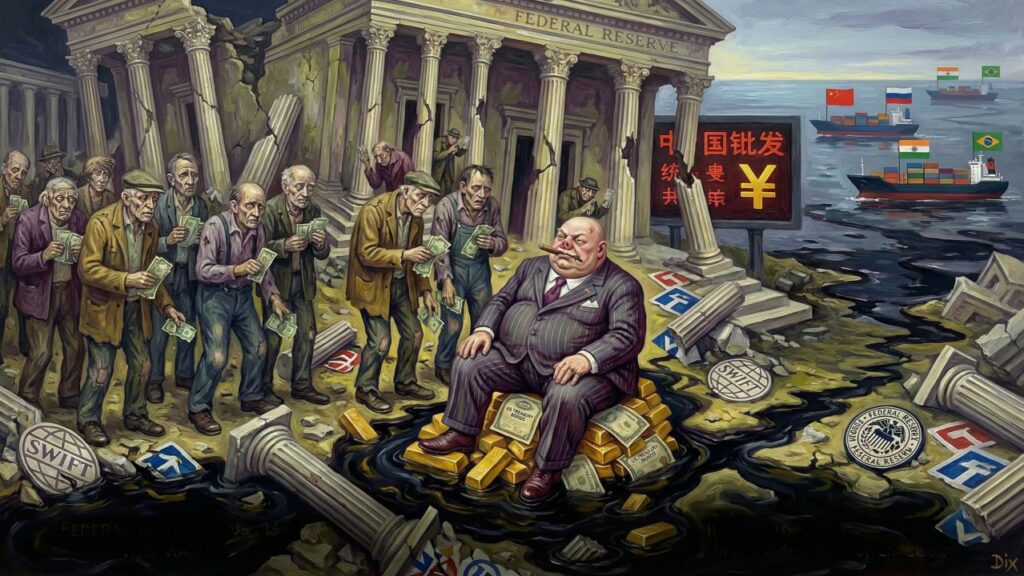
Those two articles answered the questions “how does the system collapse?” and “why is the collapse terminal?” This companion piece covers the ground neither of them touched. Because while Americans debate whether the petrodollar is really in danger, the rest of the world has stopped debating and started building. The replacement infrastructure is not theoretical. It is not a white paper. It is not a BRICS press release. It is operational, processing tens of billions of dollars in transactions, and scaling faster than any Western analyst predicted. And the consequences of that replacement for ordinary Americans, for their pensions, their mortgages, their grocery bills, and their retirement accounts, are the part of this story that no one is writing about.
This is not an article about saving the petrodollar. The petrodollar is a rigged game that has allowed America to live beyond its means for half a century by exporting its inflation to the rest of the world and forcing captive nations to finance its wars. Its death is overdue. The question is not whether it should be preserved. The question is what happens to 330 million Americans who have been living inside a system they never understood, when that system ceases to function.
Part One: The Plumbing They Built While You Weren’t Looking
mBridge: $55 Billion and Counting
The most important financial infrastructure project in the world is one most Americans have never heard of. Project mBridge is a cross-border digital currency platform that allows central banks to settle international payments directly using their own digital currencies, without routing transactions through correspondent banks, without passing through the SWIFT messaging network, and without touching the US dollar.
The platform has now processed over $55.5 billion in cumulative transactions and completed more than 4,000 cross-border settlements. That figure represents a 2,500-fold increase since the project’s early pilot phase in 2022. The participating central banks include China, Hong Kong, Thailand, the United Arab Emirates, and Saudi Arabia.
China’s digital yuan accounts for approximately 95% of total settlement volume on mBridge. The People’s Bank of China reports that the digital yuan has processed more than 3.4 billion transactions worth around 16.7 trillion yuan ($2.4 trillion), an increase of over 800% compared with 2023.
The Bank for International Settlements, which originally oversaw the project, exited mBridge in October 2024. BIS General Manager Agustin Carstens was blunt about the reason: “We cannot directly support any project for the BRICS because we cannot operate with countries that are subject to sanctions”. The BIS departure did not slow the project. If anything, it clarified the geopolitical alignment: the West is on one side, and the nations building the replacement are on the other. Josh Lipsky of the Atlantic Council warned that the BIS withdrawal signals “a division in CBDC development, with payment networks increasingly reflecting geopolitical divides”.
The UAE Ministry of Finance executed its first government transaction using wholesale digital dirhams on mBridge in November 2025. Saudi Arabia, the linchpin of the original petrodollar arrangement, is an active participant in the platform that is designed to make that arrangement obsolete.
BRICS Pay: Launching in 2026
BRICS Pay is a decentralized messaging and payment system designed to connect the national payment infrastructures that BRICS members have already built: India’s Unified Payments Interface, China’s CIPS, Russia’s SPFS, Brazil’s Pix, and South Africa’s SAMOS. The prototype was demonstrated in Moscow in October 2024 at the Kazan Summit. The system uses a Decentralized Messaging System (DCMS) for secure communications and a DAO governance model that gives all members equal participation.
BRICS announced in January 2026 that full operational implementation is planned for the 2026 BRICS summit in India, with technical coordination led by India’s central bank. The system may later incorporate central bank digital currencies and connect with existing networks like Visa and Mastercard as a parallel option.
Vladimir Putin confirmed at the 2025 BRICS summit in Rio de Janeiro that 90% of all transactions between Russia and other BRICS member states are now settled in national currencies, primarily rubles and partner currencies. That figure was 26% just two years earlier. The speed of that shift, from one quarter to nine tenths in 24 months, should alarm anyone who believes de-dollarization is a slow, theoretical process.
CIPS and SPFS: The SWIFT Alternatives
China’s Cross-Border Interbank Payment System (CIPS) now connects participants across 119 countries. Roughly 100 banks in the ASEAN region alone have joined CIPS. CIPS functions as a direct alternative to SWIFT for yuan-denominated trade, allowing banks to process payments without routing through the dollar-centric correspondent banking network.
Russia’s System for Transfer of Financial Messages (SPFS), built after the 2014 sanctions threatened to cut Russian banks off from SWIFT, has expanded to include 160 foreign banks in over 20 countries. Russia has also issued co-badged Mir and UnionPay cards, giving Russian consumers access to UnionPay’s network in 180 countries.
These are not protest gestures. These are production systems processing real money for real economies. Trade between China and Russia hit a record $244.8 billion in 2024, nearly all of it settled in yuan and rubles. Brazil and China have eliminated the dollar from their bilateral trade through a yuan-real settlement agreement. India completed its first crude oil purchase from the UAE in rupees in August 2023. Indian refiners, including Reliance Industries and Bharat Petroleum, now routinely purchase Russian crude in UAE dirhams, bypassing the dollar entirely.
The infrastructure for dollar-free trade is being built, as one analysis put it, “transaction by transaction, contract by contract”.
Part Two: The Gold Signal
Central banks are not just building alternative payment rails. They are also telling you, in the clearest possible language, what they think the future looks like.
In 2025, central banks around the world purchased 863 tonnes of gold, the fourth-largest annual expansion of central bank gold reserves on record. Of 24 central banks surveyed, 22 increased their gold holdings. Total global gold demand crossed 5,000 tonnes for the first time in history, driven by a 45% price rally and 53 new all-time highs that created an estimated $555 billion in wealth gains for gold holders.
The milestone that matters most: gold overtook US Treasuries as the largest reserve asset held by central banks on a mark-to-market basis, the first time this has happened since 1996. Central banks simultaneously sold $48 billion in Treasuries in the first half of 2025 alone. This is not noise. This is a directional signal from the institutions that manage the world’s monetary reserves. They are rotating out of the dollar’s debt instruments and into the asset that has served as money for five thousand years.
The buyers are not limited to US adversaries. Poland, Turkey, India, Kazakhstan, and Brazil led reported purchases. Poland and Turkey are NATO allies. India is a Quad partner. These are nations hedging against the system they are nominally part of, because they can read the same data everyone else can.
Part Three: The Vassal Rebellion
ASEAN’s Five-Year Exit Plan
At the 46th ASEAN Summit in Kuala Lumpur in May 2025, the ten-nation bloc formally adopted its Economic Community Strategic Plan 2026 to 2030, which embeds the goal of reducing dependence on the US dollar and maximizing local currency usage for all cross-border transactions. The plan commits ASEAN to “expand and strengthen regional payment connectivity and promote local currency settlement”.
This is not aspirational language. ASEAN has already operationalized cross-border payments in local currencies through standardized QR codes across eight member states. While BRICS debates symbolic currencies, ASEAN is processing real transactions. Malaysian investors can pay in ringgit across Southeast Asia and China without converting to dollars, eliminating double conversion fees and reducing transaction costs.
Saudi Arabia’s Hedge
The most consequential defection is the quietest. Saudi Arabia, the country whose 1974 agreement with the United States created the petrodollar system, is now an active participant in mBridge, has signed a $7 billion currency swap agreement with China allowing direct yuan-riyal settlement, and its finance minister has publicly declared openness to non-dollar oil contracts. Xi Jinping explicitly asked Saudi leaders to accept RMB settlement for oil during his December 2022 visit to Riyadh, and the Shanghai Petroleum and Natural Gas Exchange is being positioned as the platform for yuan-denominated energy trade.
China surpassed the United States as Saudi Arabia’s largest trading partner in 2011. The logic is straightforward: Saudi Arabia’s biggest customer wants to pay in its own currency, and the technology to facilitate that payment now exists.
Treasury Divestitures
The numbers tell the story. China’s Treasury holdings ended 2025 at $683.5 billion, the lowest level since 2008, after offloading $208.6 billion in long-term US financial assets during the year. In December 2025 alone, total foreign holdings of Treasuries dropped by $88.4 billion to $9.27 trillion, the lowest level since October. Japan, the largest overseas holder of US government debt, saw its position decline by $17.2 billion. Britain’s holdings fell by $23 billion.
BRICS nations are moving in the same direction. Brazil’s Treasury holdings fell from $229 billion in November 2024 to $168 billion a year later. India’s dropped from $234 billion to $186.5 billion over the same period. Beijing’s regulators have advised Chinese financial institutions to rein in their holdings of US Treasuries, citing concentration risks and market volatility.
This is not a run on the bank. It is something more dangerous for the United States: a slow, steady, coordinated withdrawal by the institutions that have been financing American deficits for decades.
Part Four: What This Means at Your Kitchen Table
Everything described above is macro. It is central banks and sovereign wealth funds and cross-border payment platforms. For most Americans, these are abstractions. What follows is the translation.
Your Pension and Social Security
Social Security’s combined trust fund is now projected to be depleted by 2034, one year sooner than previously forecast. When that happens, beneficiaries face an immediate 19 to 23% cut to their monthly payments. The current average Social Security benefit for a retiree is $1,976 per month. A 19% reduction takes that down to roughly $1,600. For the approximately 20% of Americans aged 65 and older who rely on Social Security for more than 75% of their income, that cut is the difference between getting by and poverty.
A petrodollar collapse accelerates every element of this crisis. If foreign demand for Treasuries continues to decline (and it is declining right now, as documented above), the government must offer higher yields to attract buyers. Higher yields mean higher borrowing costs for the government. Higher borrowing costs mean the deficit widens. A wider deficit means either benefit cuts come sooner or the Federal Reserve prints money to cover the gap, which means inflation, which erodes the purchasing power of the benefits that remain.
This is not hypothetical. The dollar has already fallen 11% over the past year, hitting a four-year low. Gold has soared above $5,500 per ounce, nearly doubling in a year, as investors move out of dollar-denominated assets. Investopedia noted that “for individuals, a weakened dollar translates into more expensive imports, increased fuel costs, and potentially higher interest rates on mortgages, auto loans, and credit cards”.
Your 401(k) and Retirement Savings
Every dollar-denominated retirement account in America, every 401(k), IRA, and pension fund invested in Treasuries, US equities, or dollar-denominated bonds, is a bet that the dollar will hold its value. The British precedent shows what happens when that bet goes wrong. British expat pensioners saw the purchasing power of their retirement income fall by 15 to 26% depending on where they lived, just from the pound’s decline after Brexit. That was a single political event in a country that had already lost its reserve currency status decades earlier.
The pound’s decline from global reserve currency to regional currency took roughly 30 years of grinding losses punctuated by sudden crises: the 1931 devaluation that forced Britain off the gold standard, the 1949 devaluation of 30.5% that came just 14 days after the Chancellor told Parliament he had “not the slightest intention of devaluing the pound,” and the 1967 devaluation that Harold Wilson famously tried to spin as not affecting “the pound in your pocket”. Sterling’s share of global reserves collapsed from 81% in 1945 to 11% by 1970. American savers should study this timeline carefully, because the indicators that preceded each British crisis, denial by officials, accelerating foreign sell-offs of government debt, and desperate attempts to maintain confidence through rhetoric while the structural foundations erode, are precisely the indicators visible in the United States right now.
Your Grocery Bill
American consumers in January 2026 paid prices that were higher for coffee, tea and cocoa (12%), fish and seafood (8%), fruits (7%), and meat (5%) compared with pre-tariff trends. Beef prices rose 15.5% year-over-year and coffee surged nearly 20% in 2025. These increases are partly tariff-driven and partly supply-chain driven, but a weakening dollar compounds every one of them because America imports much of what it eats, wears, and drives. The USDA projects food-at-home prices will rise another 2.5% in 2026, but that projection does not account for a sustained petrodollar fracture that would make every imported good substantially more expensive.
The mechanism is simple. When the dollar weakens, it takes more dollars to buy the same quantity of imported goods. When the nations selling those goods no longer need to hold dollars because they can trade oil in yuan, rubles, rupees, or dirhams, the artificial demand that has propped up the dollar’s value for 50 years disappears. The purchasing power that Americans have taken for granted since 1974, the ability to import the world’s goods and pay for them with a currency that costs nothing to produce because the world had to hold it anyway, ends.
Your Mortgage and Your City’s Budget
If foreign governments continue reducing their Treasury holdings (and the data shows they are), the US government must offer higher yields to attract domestic buyers. Treasury yields set the floor for mortgage rates, auto loan rates, and corporate borrowing costs. Higher government borrowing costs ripple through every credit market in the economy. State and local governments, which depend on municipal bond markets that are ultimately backstopped by the dollar’s reserve status, face higher borrowing costs for every school, bridge, highway, and water system they need to finance.
President Trump told the press in January 2026 that he is “not concerned” about the dollar’s depreciation. This is precisely the kind of official denial that preceded every British devaluation crisis. The Chancellor was not concerned in 1949 either. Fourteen days later, the pound lost 30.5% of its value overnight.
Part Five: The Energy Transition Wild Card
There is a final dimension to this story that none of the petrodollar commentary, including my own previous articles, has addressed. The petrodollar system requires global oil dependence to function. If the world does not need oil, it does not need dollars to buy oil. And the world is moving past oil faster than the petrodollar’s defenders want to admit.
Over 90% of all new power generation capacity added in 2024 came from renewable sources, with 2025 showing similar trends. Global electric vehicle sales climbed 25% in 2024 to over 17 million units, with another 35% surge in the first quarter of 2025. The International Energy Agency projects oil demand will plateau near 105 million barrels per day before 2030, with post-2027 growth slowing to just 0.4 million barrels per day.
China, the world’s largest energy importer, has been building what my first article described as “an astonishing growth in supply of cheap energy,” particularly solar, wind, and nuclear. This is not altruism. It is the most rational possible response to a system that forces you to earn or borrow American dollars to keep your economy running. Every solar panel China installs is a panel that does not require a dollar transaction. Every electric vehicle that replaces an internal combustion engine is a vehicle that does not generate petrodollar demand.
The paradox is devastating for Washington. The United States is fighting a war in the Middle East to control the world’s oil supply at the precise historical moment when the world is beginning to not need that oil. The petrodollar’s death may come not from a financial crisis or a military defeat but from the simple technological fact that the commodity it depends on is being made obsolete. The war to preserve the petrodollar may be the last war of the oil age, fought by an empire that did not notice the age had ended.
The Through-Line
My first article showed that the Iran war has triggered a chain reaction that threatens to collapse the petrodollar system. My second article showed that the loss of the petrodollar means the loss of every structural advantage that allows the United States to function as an empire despite being a de-industrialized debtor nation. This article has shown two things those pieces did not cover.
First, the replacement is already here. mBridge has processed $55.5 billion. CIPS connects 119 countries. SPFS links 160 foreign banks. BRICS Pay launches this year. Ninety percent of Russia-BRICS trade already bypasses the dollar. ASEAN has a five-year plan to follow suit. Saudi Arabia is hedging with yuan swaps and mBridge participation. Central banks are buying gold and selling Treasuries. The infrastructure for a post-dollar world is not being planned. It is being used.
Second, the cost will be borne by ordinary Americans who have never heard the word “petrodollar” and have no idea that their pensions, their retirement accounts, their grocery bills, their mortgage rates, and their city budgets all depend on a system that was negotiated in a Riyadh palace in 1974 and is now being dismantled in Beijing, Moscow, New Delhi, Brasilia, and Kuala Lumpur. The British went through this. Their pensioners lost 15 to 26% of their purchasing power from currency depreciation alone. Their Chancellor denied it was happening 14 days before the crash.
America’s leaders are not concerned. That is exactly what the British said.
Related reading
- How the Tehran and Delhi Settlements Expose a Petrodollar Already Gone, Gone, Gone, Taking the Bellicose American Empire With It.
- Five Damned Good Reasons the Loss of the Petrodollar Means the Death of the American Empire
- The Petrodollar Trap: How the Iran War Threatens to Collapse the Financial Architecture of the American Empire
- Never Is Hope So Pure As In The Certainty Of Loss: UAE's OPEC Exit and the Structural Dissolution of the Petrodollar