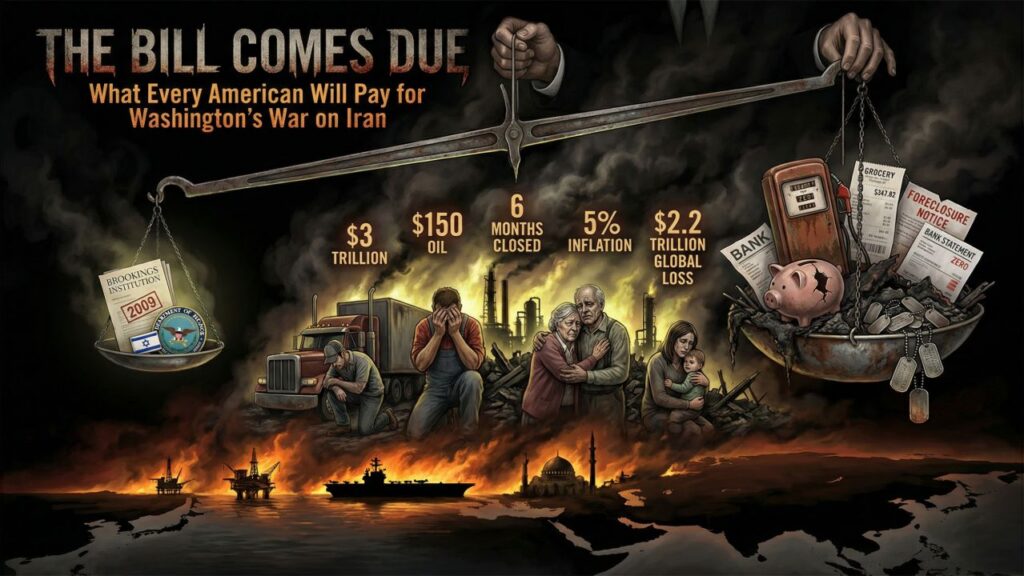
Washington and Tel Aviv did not just start a war. They wrote a bill and handed it to you. Every American who buys gas, groceries, or a plane ticket. Every parent who holds a mortgage. Every retiree watching a pension erode. Every small business owner whose supply chain just broke. This is not a distant conflict with abstract consequences. The meter is running, the Strait of Hormuz is sealed, the Strategic Petroleum Reserve is being burned through in real time, and the invoice, measured not in billions but in trillions, is already in the mail.
Part Two of the Throughline Iran War Series. Read Part One: “Famine is Not Coming. It is Here.”
What You Are Already Paying: The 19-Day Ledger
Washington and Tel Aviv sold this war on a single premise: Iran was on the verge of building a nuclear weapon. IAEA chief Rafael Grossi stated publicly, on camera and in writing, that there is “no evidence of a structured plan by Iran to build nuclear weapons”. Director of National Intelligence Tulsi Gabbard told the Senate Intelligence Committee in her written March 2025 assessment, one year before the bombs dropped, that Iran “is not building a nuclear weapon and Supreme Leader Khamenei has not authorized the nuclear weapons program he suspended in 2003”. She then told the same committee on March 18, 2026, three weeks into the current war, that Iran’s nuclear program had been “obliterated” in the June 2025 strikes, and that there had been no effort to rebuild it since. The United States launched a war to prevent an imminent nuclear threat from a country whose nuclear program its own intelligence chief confirmed had already been destroyed. You are paying for that decision. Here is the ledger.
Gasoline. The national average for a gallon of regular has jumped from $2.98 before the war to $3.84 as of March 16, the highest level since September 2023. Diesel is near $5 per gallon, a $1.34 increase from pre-war levels. Diesel is not merely a trucking fuel. It is the fuel of the entire physical economy. Every product that moves by truck in America, which is nearly all of them, carries a diesel surcharge now being priced into what you pay at the store. The pipeline from diesel price to grocery receipt runs approximately six to eight weeks. Those increases have not hit your receipt yet.
Groceries. Food prices were already elevated, having risen 29.4 percent between March 2020 and December 2025. The war adds simultaneous pressure through three channels: diesel costs raise transportation expenses for every product on every shelf; oil prices raise packaging and manufacturing costs; fertilizer prices, already at crisis levels as documented in Part One of this series, raise production costs for American farmers. Wholesale prices in February surged 0.7 percent, more than double the consensus forecast, with year-over-year wholesale inflation running at 3.4 percent, the highest in a year. The February Producer Price Index came in “way hotter than expected, exceeding consensus expectations by nearly double”. PPI foreshadows consumer inflation by two to three months. What is in your grocery cart in May was priced in this PPI.
Mortgages. On the day before the war started, the 30-year fixed mortgage rate had just dipped below 6 percent for the first time since 2022. The war erased that in one week. The 10-year Treasury yield climbed back above 4 percent as oil-driven inflation fears drove bond investors to sell. The 30-year fixed is now at 6.11 percent, its largest weekly increase since April 2025. The Federal Reserve, facing simultaneous inflation pressure and growth risk, cannot cut rates to rescue the housing market without feeding the inflation the war is generating. The spring home-buying season, on which the housing sector depends for its annual economic velocity, has been poisoned at its source.
Air travel. Jet fuel has risen from $2.50 per gallon to $3.99, a 60 percent increase in three weeks. Fuel constitutes 20 to 25 percent of airline operating costs. The four major U.S. carriers face a collective increase of $5.8 billion in fuel expenses if these prices hold through the year. Airlines no longer hedge fuel costs. They have no buffer. United Airlines CEO Scott Kirby has warned that fare increases “will probably start quick”. More than 20,000 flights have already been cancelled due to airspace disruptions.
Stocks and recession odds. The S&P 500 is down for the year. JPMorgan has adopted a “tactically bearish” stance. Kalshi prediction markets place recession odds at 35 percent, up from approximately 20 percent before the military buildup in the Middle East. Goldman Sachs has raised its recession probability to 25 percent and climbing. A former White House energy adviser stated on CNBC that a prolonged Hormuz shutdown is “a guaranteed global recession”.
The Cost Clock: Not Billions. Trillions.
The early institutional estimates of this war’s cost were built for a short-conflict scenario and are already obsolete. The Penn Wharton Budget Model’s $65 billion baseline was a first-week press release, not a forecast. It requires comparison to the only relevant precedent.
The Iraq War (against a country with a fraction of Iran’s military capability, no navy, and an air force already destroyed by a decade of no-fly zones) cost the United States $3 trillion in its “conservative scenario,” as calculated by Nobel laureate economist Joseph Stiglitz and Harvard professor Linda Bilmes. Brown University’s Watson Institute put the full long-term cost of Iraq and Afghanistan combined at more than $6 trillion when veteran medical costs through 2051, interest on war debt, and macroeconomic drag are included. The Bush administration’s 2003 projection for Iraq was $50 billion to $60 billion. They were off by a factor of 100.
Iran has three times Iraq’s population. It has a functioning navy that has already forced the shutdown of the world’s most critical oil transit chokepoint. It has demonstrated the ability to damage a U.S. carrier strike group and destroy THAAD radar installations. Its Revolutionary Guard has publicly stated it can sustain the current conflict for six months. The $65 billion figure is not a floor. It is a fiction. The realistic range for a six-month war against Iran, incorporating operational costs, munitions replacement, strategic petroleum reserve depletion, and the macroeconomic damage now compounding daily, runs into the multiple trillions of dollars, unbudgeted, unpassed by Congress, and added to a national debt that is already costing $1 trillion per year in interest payments alone.
The operational burn rate is running at approximately $1 billion to $1.43 billion per day. The Department of Defense reported the first six days at $11.3 billion and day twelve at $16.5 billion. At that trajectory, thirty days of this war exceeds the entire annual budget of the Department of Homeland Security. Sixty days matches peak annual Afghanistan spending. Six months approaches half a trillion dollars in direct military costs alone, before a single barrel of depleted Strategic Petroleum Reserve oil is replenished, before a single veteran files a disability claim, before the interest on the borrowed war debt is calculated.
The Emergency Reserve: Already Gone
The Strategic Petroleum Reserve was designed for exactly this scenario. It no longer has the capacity to cover it.
On March 11, the Trump administration announced it would release 172 million barrels from the SPR to dampen prices. The current SPR holds approximately 415 million barrels, already at 58 percent capacity following Biden-era drawdowns that were never fully replenished. The coordinated IEA release involves 32 countries releasing a combined 400 million barrels, the largest emergency reserve release in history. That sounds substantial. It is not. The 400 million barrel global release covers approximately 20 days of the supply gap created by Hormuz’s closure. The U.S. SPR release alone, covering 172 million barrels over 120 days, covers approximately four months of partial mitigation at a delivery rate of roughly 1.4 million barrels per day into a market short by nearly 15 million barrels per day. Once the 172 million barrels are released, the SPR will be at its lowest level in over 40 years. Energy Secretary Chris Wright says Trump plans to refill it. To refill 172 million barrels at 4 million barrels per month takes until 2031. If the war runs six months as Iran has projected, the SPR cushion will be largely spent before the conflict ends, and will then need to be rebuilt in a higher-price environment, at taxpayer expense, on a five-year timeline.
30 Days: The April Thresholds
Multiple economic thresholds converge in April that do not yield to politics or press releases.
RSM chief U.S. economist Joe Brusuelas has identified the recession trigger points: oil at $125 per barrel, gasoline at $4.25 per gallon, and inflation at 4 percent annually. Oil was above $100 and rising as of March 16. Gasoline was at $3.84 and rising. CPI was at 2.4 percent before the war began, but the PPI data already in the pipeline projects consumer price acceleration through May and June. All three recession thresholds are reachable by mid-April if the Strait remains closed.
The shipping cost transmission is direct and accelerating. Maersk CEO Vincent Clerc has stated that the war’s transport cost increases “will be passed to our customers and will pass on to the consumers”. War-risk insurance premiums for Gulf vessels have increased by 300 to 500 percent. European LNG prices (TTF) have surged 180 percent since the onset of the conflict. A composite index tracking global container-shipping spot prices was up 12 percent since the start of the conflict by March 12. Those increases are currently arriving in U.S. retail prices with a six-to-eight-week lag. April and May prices will carry the full freight cost of this war’s opening weeks, while June and July prices will carry the costs accumulating right now.
Inflation has already been running above the Federal Reserve’s 2 percent target for approximately five years. Many Fed officials believed 2026 would finally be the year it returned to target. A sustained energy shock eliminates that possibility. Goldman Sachs projects U.S. CPI hitting 3 percent or higher by year-end under a protracted war scenario. That is the optimistic projection. It assumes the war ends within months. If it does not, the compounding is far more severe.
90 Days: The Price Nobody Has Ever Seen
Capital Economics has modeled the three-month scenario with direct precision: a loss of 8 to 9 percent of world oil and LNG exports, Brent crude at $150 per barrel, European natural gas at 120 euros per megawatt hour, and global inflation rising by 2.5 percentage points. SolAbility’s economic analysis projects global GDP loss reaching approximately $2.2 trillion under a three-to-six-month conflict, with Gulf GDP declining 22 percent, levels that “could trigger global stagflation akin to the Arab oil [shock] of 1973”.
American consumers have not experienced $150 oil. The highest ever recorded Brent price was approximately $147 in July 2008. At $150, gasoline at the U.S. pump approaches $5.50 to $6 per gallon in a country where the car is not merely transportation but economic participation. Rural Americans, who drive longer distances with no public transit alternatives, face effective income cuts measured in thousands of dollars annually. Small businesses across transportation, manufacturing, agriculture, chemicals, and logistics face simultaneous margin compression that produces layoffs, closures, and price increases in overlapping waves.
Goldman Sachs projects Qatar and Kuwait face GDP contractions of 14 percent if the conflict extends through April, while the UAE faces 5 percent and Saudi Arabia 3 percent. Capital Economics warns the entire Gulf region could lose 10 to 15 percent of GDP under a three-month scenario with lasting infrastructure damage. These are not peripheral economies. Saudi Arabia, Kuwait, Qatar, and the UAE collectively hold trillions of dollars in U.S. Treasury bonds and dollar-denominated assets. Gulf sovereign wealth funds under existential fiscal pressure are not passive holders of American debt instruments. They sell.
The ICIS global scenario analysis is blunt on the ninety-day outcome: “A global recession is the central outcome, driven by high energy prices, supply chain breakdowns, and collapsing consumer spending”. This is not a worst-case framing from a fringe source. ICIS is the world’s leading chemical and energy market intelligence firm. Their baseline scenario for a three-month conflict is global recession. Not risk of recession. Not elevated recession probability. Global recession as the central outcome.
The Stagflation Trap: No Exit
Stagflation is the combination of rising inflation and stagnating or contracting growth. It was last seen in the United States in the 1970s and is the one economic condition monetary policy cannot address without making the other component worse. Lower interest rates to fight unemployment feeds inflation. Higher rates to fight inflation kills growth. The Federal Reserve is running between two fires with one bucket.
The 1973 Arab oil embargo affected approximately 7 percent of global oil consumption. The current Hormuz disruption affects 20 percent of global petroleum liquids consumption simultaneously, nearly three times the 1973 scale, along with one of the world’s largest LNG export hubs. The U.S. labor market was already weakening before the first bomb fell, having shed 92,000 jobs in February prior to the conflict. A senior BMO Capital Markets economist stated: “The U.S. economy is now confronting its second stagflation-like shock within a year. Following the trade war, the Iran conflict will elevate prices, disrupt supply chains, undermine investor and business confidence, and dampen global demand”.
The IMF has warned that a prolonged trade war alone could slice global GDP by up to 7 percent. That assessment preceded the Iran war. The tariff shock and the energy shock are now compounding simultaneously. The Fed cannot address both. A former White House energy adviser told CNBC this combination produces “a guaranteed global recession”. The word “guaranteed” is unusual in economic forecasting. It reflects the structural nature of what a multi-month Hormuz closure does to an already-stressed global economy carrying pre-existing tariff wounds and pre-existing inflationary pressure.
One Year: The Structural Catastrophe
The one-year scenario requires the acknowledgment of what is already irreversibly in motion, regardless of when the guns fall silent.
South Pars and Ras Laffan have suffered production facility damage that carries a five-to-seven-year reconstruction timeline. QatarEnergy’s North Field East expansion, which would have brought 32 million tonnes per year of new LNG capacity to market, has been pushed to at least 2027 under optimistic assumptions. Qatar and Kuwait’s LNG and crude exports are almost entirely Hormuz-dependent, neither country has pipeline bypass capacity. Even a ceasefire tomorrow does not restore what has already been destroyed. The IEA has described this conflict as producing “the largest supply disruption in the history of the global oil market”. That title was earned by damage already done, not by future projections.
Europe, which pivoted from Russian gas to Qatari and American LNG after 2022, now faces a structural supply gap on a multi-year timeline. European LNG prices have already surged 180 percent. Germany’s anticipated economic growth for 2026 has been effectively halved. Japan, which imports nearly 90 percent of its energy and whose strategic petroleum reserve covers approximately 4.5 months of consumption, faces economic shock of a severity not seen since the 2011 earthquake. South Korea’s reserve covers approximately 3.2 months. China’s covers approximately 2.8 months. If the war runs past the reserves of America’s most critical Asian allies, Washington faces alliance-fracturing economic pressures in the Pacific at precisely the moment it is most dependent on allied cohesion.
The dollar’s dominance is under direct attack for the first time since Bretton Woods. Iran has explicitly demanded that ships wishing to transit the Strait price their oil in Chinese yuan, not dollars. The petrodollar system, under which virtually all oil is priced in dollars, creates artificial global demand for the American currency, enabling the United States to borrow at a scale no other country could sustain. CNN’s own reporting on the yuan-oil proposal noted that it represents “the most significant challenge to American financial dominance since 1974”. Dollar reserves have already declined from 71 percent of global foreign exchange reserves in 2000 to approximately 58 to 60 percent today. Every day of this war provides additional incentive for countries watching their food supplies collapse and energy bills spike because of a U.S.-initiated conflict to accelerate the transition to alternative settlement currencies. The dollar’s reserve status does not collapse in a single day. It corrodes in the accumulation of moments when the cost of holding dollars exceeds the benefit, and this war is generating those moments at an extraordinary rate.
The U.S. national debt will absorb a war cost that, on the Iraq precedent scaled to Iran’s size and stated duration, runs to several trillion dollars, unbudgeted, layered on existing deficits, raising Treasury financing requirements at precisely the moment when inflationary conditions are already pushing bond yields higher. Higher yields on a larger debt load produce exactly the debt-service dynamics that are the endgame of unsustainable fiscal trajectories. The United States currently pays approximately $1 trillion per year in interest on its national debt. A multi-trillion dollar war, financed entirely by borrowing, into a bond market skittish about inflation, is a self-reinforcing spiral: the war generates inflation, inflation raises yields, higher yields raise the cost of the war debt, the more expensive war debt requires more borrowing, which raises inflation expectations further.
The Historical Mirror: Why Every Precedent Understates This
The 1973 Arab oil embargo affected 7 percent of global supply for approximately six months. It produced a 40 percent gasoline price spike, rationing, a deep recession, and a decade of economic stagnation. It also produced the petrodollar architecture now under direct attack.
The 1979 Iranian Revolution removed approximately 7 percent of world oil supply and drove oil from $13 to $34 per barrel, pushing inflation to double digits across the developed world. It produced the Volcker shock, 20 percent interest rates, a second deep recession, and the political conditions that elected Ronald Reagan.
The 2022 Russia-Ukraine war disrupted Russian and Belarusian fertilizer and energy exports but left global shipping routes open. Russian product could be rerouted, expensively, slowly, but physically. It produced 27.2 million additional people in poverty and 22.3 million in acute hunger. It was partially absorbed through market adaptation over eighteen months.
The current Hormuz disruption affects 20 million barrels per day of oil and the world’s most concentrated LNG export hub, simultaneously, through a geographic chokepoint that has no bypass for most of the affected nations. Unlike 1973, the product cannot be rerouted. Unlike 1979, this is not one producer going offline but the entire Gulf’s output locked behind a single military theater. Unlike 2022, there is no alternative route because the commodity is physically trapped behind the world’s most contested 33-kilometer waterway. CRU Group analyst Chris Lawson stated: “While there are many parallels to 2022, the supply and demand implications of the conflict in the Middle East have the potential to be much more severe and wide ranging”. The IEA called it the largest supply disruption in history. ICIS’s central scenario for three months is global recession. SolAbility projects $2.2 trillion in global GDP loss. These are not fringe projections. They are the assessments of the institutions that run the global commodity and energy system, using superlatives that have no prior referent.
What Americans Bought With This War
A Reuters/Ipsos poll found only 29 percent of Americans approve of the strikes, 64 percent believe Trump has not sufficiently explained the military objectives, and 67 percent expect gas prices to continue rising. The president promised to control inflation and avoid foreign wars. He has delivered the largest oil supply disruption in recorded history and a war whose daily cost runs $1 billion to $1.43 billion, against an adversary whose own intelligence chief confirmed posed no nuclear threat when the bombs dropped.
The receipts are arriving. Gas is at $3.84 and rising toward the $4.25 recession trigger. Diesel is near $5. Mortgages reversed a long-awaited affordability recovery. Airline fares are increasing. Groceries are primed to spike on a two-to-three-month lag from PPI data already in the pipeline. The S&P 500 is down for the year. Recession odds range from 25 to 35 percent and climbing. The Strategic Petroleum Reserve is being burned through at a rate that leaves it at a 40-year low once the current release is complete. The dollar’s reserve architecture is under the most direct challenge since 1974. And the IAEA chief confirmed on camera that there was never any evidence of the nuclear weapons program cited to justify it all.
Every American household that drives, flies, eats, borrows, or saves is now enrolled in this conflict whether they voted for it or not.
The question that the economic ledger cannot answer is the one that demands to be asked. The people who designed this are on the public record. They worked at the CIA. They published their plan at the Brookings Institution. One of them served twice as U.S. Ambassador to Israel. The plan was written in 2009. If the stated justification was false, the intelligence community knew it was false, and the war was launched anyway, then who designed it, when, and why?
That is the subject of the next article.
Related reading
- Wagering Without Risk: How Washington and Tel Aviv Insiders Bombed Iran on the American Taxpayer's Dime
- The Iran War’s Hidden Toll on Asia-Pacific: A War of Choice, a Region in Collapse, and a Bill Every American Will Pay
- The Molecules of War: How Washington's Persian Gulf Gamble Is Coming for Your Grocery Bill, Your Smartphone, and Your Economy
- The Inflation Reckoning: How an Unlawful War on Iran Is Detonating Every US Price Indicator