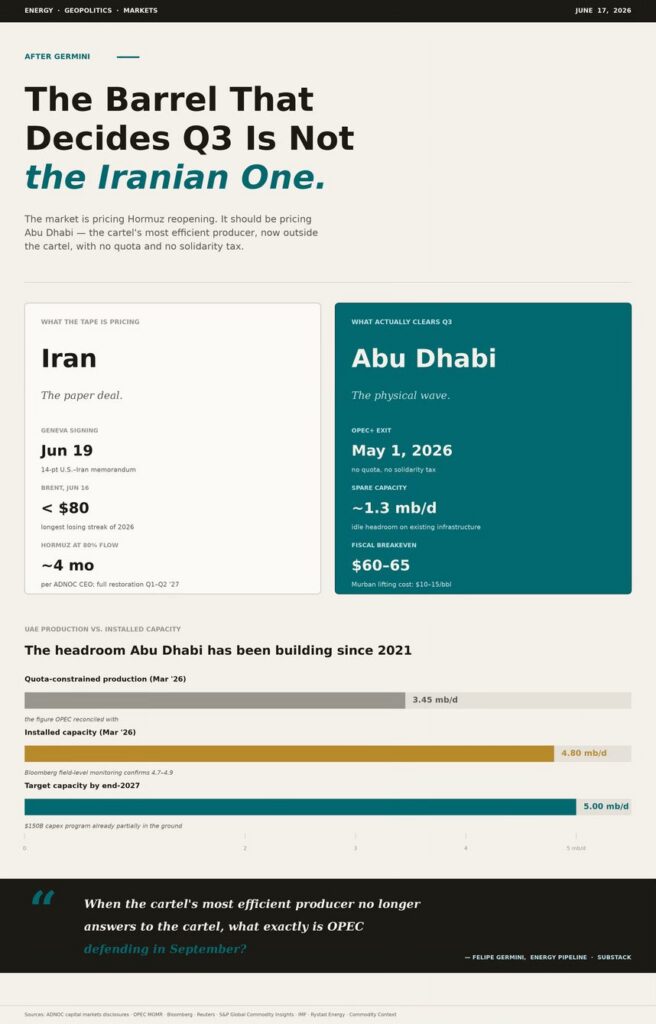
A note of acknowledgment, first. Felipe Germini, a Brazilian energy executive with 25 years across the rig floor, the trading desk, and the boardroom, former Country Managing Director at Schlumberger, and founder of GerminiEnergy, writes the ENERGY Pipeline Substack. His June 16 note is one of the few public pieces of analysis circulating this week that correctly identifies which barrel actually clears the third quarter. The mainstream desks are pricing the Iranian return. Germini is pricing the Emirati return. The distinction is the entire trade. What follows extends his argument with the underlying physical, fiscal, and logistical data, addressed to a readership that does not need the words “spare capacity” defined.
The Tape: A War Premium Bleeding Out in Real Time
Germini’s price snapshot is correct and, by Tuesday’s close, slightly understated to the downside. WTI traded at $77.22/bbl in early Tuesday dealing and broke below $76 intraday; Brent fell as much as 4% to print below $80 for the first time since March 2 (Bloomberg via WorldOil; AEGIS Hedging). Both benchmarks have now logged their longest losing streak of the year, four consecutive sessions, with Brent in technically oversold territory longer than at any point since October 2025 (Reuters via Fidelity). Goldman Sachs cut its Q4 2026 Brent call from $90 to $80 and now expects Persian Gulf exports back to pre-war levels by end-July, a full month earlier than its prior model; Morgan Stanley cut its Q3 Dated Brent forecast from $100 to $90 (Bloomberg).
The catalyst is the 14-point U.S.-Iran memorandum to be signed in Geneva on June 19, mediated by Pakistan and Qatar. Beyond the ceasefire and 60-day nuclear track, the operative provisions for the barrel are three: immediate U.S. authorization for Iran to resume oil and fuel sales, the lifting of the U.S. naval blockade on Iranian ports, and the reopening of the Strait of Hormuz, which Tehran has effectively closed since late February (Al Jazeera; Bloomberg).
This is the trade the desks are running. It is the obvious trade. It is also the wrong trade if your horizon extends past the signing ceremony.
The Calendar Gap Germini Identifies, and Why It Matters
The signing date and the physical reopening of Hormuz are not the same date. This is Germini’s central operational insight and it deserves emphasis because it is being collapsed in the price action.
Sultan Al Jaber, ADNOC CEO and UAE Minister of Industry, has stated on the record that flows through the strait will require approximately four months to return to 80% of pre-conflict levels, with full restoration deferred to Q1 or Q2 of 2027 (Gulf Daily News). The constraints are physical and unsentimental: marine mine clearance from the February interdiction, war-risk premiums on hull-and-cargo insurance that have not yet repriced, Iranian port replenishment, and the staged restart of Saudi and Iraqi southern loadings that were taking shelter in onshore storage. Rory Johnston of Commodity Context, whose June 2026 OPEC+ Data Deck documents that Iranian production collapsed roughly 28% from February to May under the blockade, has been explicit that even on a best-case clearance schedule, the realized supply response trails the paper deal by quarters, not weeks. Amrita Sen at Energy Aspects, speaking at the FT Commodities Summit in April, put it in inventory terms: “You’ve already at this point lost a billion barrels, even if this resolves tomorrow… by the time things get moving again, it takes some time to put all of that back” (Reuters via Sahm).
That gap, between the signing on June 19 and Hormuz running at design throughput sometime in early 2027, is the window in which the Emirati barrel matters far more than the Iranian one. The market is conflating the two.
The Emirati Barrel: No Quota, No Solidarity Tax, and Already Selling
One factual refinement to Germini’s framing. The UAE’s withdrawal from OPEC and OPEC+ took formal effect on May 1, 2026, as he states (Reuters; CNBC). His characterization of “north of a million barrels a day” of usable spare capacity is correct and, by the most rigorous independent estimates, conservative. The accounting matters here:
-
Installed capacity (March 2026): approximately 4.8 million b/d, cross-checked by Bloomberg field-level monitoring at 4.7 to 4.9 million b/d (Middle East Insider).
-
Quota-constrained production (March 2026): 3.45 million b/d, the figure reconciled with OPEC member-state submissions in the Monthly Oil Market Report.
-
Idle headroom on existing infrastructure: approximately 1.3 million b/d that capex had already built but quota discipline kept off the water.
-
Published capacity trajectory: 5.0 million b/d by end-2027, 5.5 million b/d by 2030, underwritten by a $150 billion capex program now partially in the ground (Middle East Insider; Ahram Online on ADNOC’s $55bn additional commitment).
Rystad Energy’s Jorge León captured the cartel-arithmetic implication: “Losing a member with 4.8 million barrels per day of capacity, and the ambition to produce more, takes a real tool out of the group’s hands… Saudi Arabia is now left doing more of the heavy lifting on price stability, and the market loses one of the few shock absorbers it had left” (subsurfaceops).
The fiscal picture is what makes the quota-relief unlock structurally durable rather than tactical. Murban lifting costs are in the $10 to $15/bbl range, among the lowest globally. The UAE’s consolidated fiscal breakeven sits between $60 and $65/bbl by Fitch and IMF measures, with Abu Dhabi’s federal contribution skewing the effective breakeven lower still. Non-oil GDP now accounts for 67% of UAE output, and ADNOC paid $23 billion in dividends to the Abu Dhabi government in 2025 with 2026 tracking higher (Middle East Insider fiscal breakeven analysis; OilPrice citing Fitch). Translation: Abu Dhabi can carry Brent in the high $60s indefinitely while running a fiscal surplus. Riyadh cannot.
The behavior is already in the tape. ADNOC has sold at least 30 million barrels of Das, Upper Zakum, and Umm Lulu on the spot market in the first half of June alone (Tankterminals/Reuters; Lenta). Two earlier tenders cleared 14 million barrels on CFR terms to Asian refiners, with ADNOC absorbing the war-risk freight premium, a structural concession that no Saudi or Iraqi seller is currently matching (energynews.pro; Bloomberg). The June Official Selling Price was set at $104.44/bbl with a zero differential across all four main grades, eliminating the historical Murban premium over Upper Zakum. That is a tell: ADNOC is competing for share against the entire Gulf complex, not pricing off it (energynews.pro).
The Hormuz Bypass: Why the UAE Is Not Quite Strait-Captive
There is a wrinkle in Germini’s “week Hormuz physically clears” framing that strengthens rather than weakens his thesis. Unlike every other Gulf producer, the UAE possesses a functional Hormuz workaround: the Abu Dhabi Crude Oil Pipeline (ADCOP), running 1.5 million b/d of nameplate capacity from Habshan to Fujairah on the Gulf of Oman side of the strait. ADCOP has reportedly been running at 1.7 to 1.8 million b/d, above design, since February. Abu Dhabi is accelerating a 48-inch West-East pipeline targeting 3.3 million b/d of evacuation capacity by 2027, with Fujairah terminal capacity scaling to 4 million b/d (energynews.pro on ADCOP; Enterprise AM; Logistics).
Murban, the flagship onshore grade, evacuates through Fujairah and has been moving throughout the war. The offshore grades, Das, Upper Zakum, and Umm Lulu, remain Hormuz-dependent for the moment because their loading terminals sit at Das Island and Zirku Island inside the Gulf. The implication is asymmetric: every other Gulf producer needs Hormuz fully cleared before they can ramp; Abu Dhabi has been monetizing the war on Murban and will add the offshore grades to the wave the moment the strait reopens. Germini’s “water through a broken levee” metaphor is technically apt. The levee is partial, the pressure behind it has been building since 2021, and ADNOC has already opened the spillway.
The Russian Reprieve in Reverse: Germini’s Strongest Subsidiary Point
Germini’s Russian analysis is the most factually robust section of his note, and it deserves expansion because it reframes what the Hormuz reopening actually does to Moscow.
The Urals price points he cites are correct. In February 2026, Urals at Primorsk traded at $42 to $44/bbl on FOB basis, the discount to Brent widening to $28 to $30/bbl, the deepest spread in nearly three years, set in motion by the January 10, 2025 OFAC package that designated 183 vessels, blocked Sovcomflot’s entire 69-tanker complex, and named two Russian majors (BOE Report citing Argus; Treasury; Moneycontrol).
The Hormuz closure inverted that picture. By March, Urals delivered to India had traded at a $4 to $6/bbl premium to Dated Brent, the first time since records began in 2023, as Indian refiners scrambled to replace lost Saudi and Iraqi medium-sour barrels (S&P Global; Reuters). The European Commission’s June 9 sanctions proposal cites the same data point Germini does: Urals at $87/bbl during the closure versus $58/bbl in February, a $29/bbl windfall that the Kremlin’s tax formula was already pre-discounting against (Euronews). Bessent’s March 12 temporary lifting of restrictions on sale of Russian oil from detained shadow-fleet tankers, justified for “stability in global energy markets” and held in place until April 11, was the U.S. acknowledgement that Urals had become a swing-supply input during the crisis (Wikipedia).
That windfall now evaporates on a one-for-one basis with Gulf medium-sour returning to Asian refineries. By Monday’s close, Urals had already fallen to $67.80/bbl, down 6.55% in a single session (Trading Economics).
Germini’s “shadow fleet down close to half its usable hulls after January’s OFAC list” requires one calibration. The most rigorous public count comes from the Kyiv School of Economics January 2026 Oil Tracker: approximately 178 tankers actually loaded Russian cargoes that month (105 crude, 73 products), with combined lift capacity exceeding 100 million deadweight tonnes, roughly 17% of the global tanker fleet (EU Perspectives). The EU has now placed 632 tankers on its sanctions list under the 20th package adopted in April 2026 (SWP Berlin; Eagle Ocean Marine). The Council on Foreign Relations puts OFAC’s share at roughly one-third of the active shadow fleet, with Indian refiners refusing OFAC-designated cargoes outright (CFR). Craig Kennedy’s foundational analysis at Navigating Russia, required reading on this subject, documented earlier that upward of 50% of Moscow’s active shadow tankers could be in violation of price-cap rules through U.S.-based flagging and P&I exposure. The functional capacity loss is therefore not “half the hulls” in a literal sense but closer to one-third confirmed and another fifteen-plus percent operating under elevated interdiction risk, with productivity on the surviving fleet down 30 to 70% from re-routing, longer ballast legs, and at-sea idling (Ukraine MEV Sanctions Monitoring Report).
Germini’s structural point is unchanged and, if anything, sharper for the correction: the discount comes back, the logistics damage is permanent. Russia exits the Hormuz crisis with a more brittle shipping apparatus than it entered with, and with revenues that the EU’s draft 20th package, the UK’s new boarding authority (used on the Smyrtos in the English Channel on June 16, hours before this writing, per Al Jazeera), and OFAC’s third-country secondary regime are actively compressing.
The Question Germini Leaves on the Table
Germini closes with the operative question: “When the cartel’s most efficient producer no longer answers to the cartel, what exactly is OPEC defending in September?” The answer, on the data, is uncomfortable for Riyadh.
OPEC without the UAE is OPEC without its lowest-cost incremental barrel and its most credible spare-capacity holder. Saudi Arabia inherits the price-defense burden alone, against a producer that has every fiscal incentive to take share and the pipeline infrastructure to bypass the chokepoint that constrains Saudi exports. Iraq, the next-largest member, has chronic compliance problems and Kurdish export disputes. Kuwait is structurally a price-taker. The Africans cannot move the needle. The “OPEC+” half of the equation, Russia, is a discounted, sanctioned exporter whose pricing power inside the bloc has collapsed.
What Saudi Arabia is defending in September is therefore not a price floor in the traditional sense. It is the legitimacy of a quota framework whose largest non-Saudi enforcer has just walked out the door, while the U.S. shale complex remains profitable in the high $60s and Abu Dhabi is selling Murban at a zero-differential OSP. The Guardian, the Atlantic Council, and JINSA have each independently reached the same operational conclusion that Germini reaches by inference: a price war is the rational equilibrium, not a tail risk (Guardian; Atlantic Council; JINSA; House of Saud).
Closing Note
Germini’s framework is the right one and it sits within a small group of analysts who are reading the post-Hormuz market through physical and logistical fundamentals rather than headline tape. Readers who find his approach valuable should be reading him alongside Rory Johnston at Commodity Context, Anas Alhajji at Energy Outlook Advisors, Amrita Sen at Energy Aspects, Helima Croft at RBC Capital Markets, Javier Blas at Bloomberg Opinion, Leslie Palti-Guzman at Energy Vista, Craig Kennedy at Navigating Russia, Giacomo Prandelli at The Merchant’s News, and Blue Water Strategy for the maritime-intelligence overlay. The signing in Geneva on Friday closes the war premium. It opens, on the same day, the structural question Germini has correctly identified: the cartel’s most efficient producer no longer answers to the cartel, and the September meeting will be the first one in fifty years where Riyadh sits across from Abu Dhabi rather than next to it.
The barrel that decides Q3 is, as he says, the Emirati one. The market will figure that out. It is not figuring it out today.
Related reading
- How the Tehran and Delhi Settlements Expose a Petrodollar Already Gone, Gone, Gone, Taking the Bellicose American Empire With It.
- Brute Force Is Not Progress: The Trillion Dollar AI Bill Everyone Else Is Paying
- Not Stagflation. A Just Depression
- The Calm Before the Spike: What the WSJ Purposely Got it Wrong About Oil Prices and What’s Coming. Why?