US enemies are better off than US allies
By Scott Ortkiese | so@throughlinesynthesis.com | www.throughlinesynthesis.com April 28, 2026
Prologue: The Loyal Ally
Bahrain made every bet Washington asked it to make.
In 1971, it offered its soil as the permanent headquarters of the U.S. Fifth Fleet, the naval force whose presence in the Persian Gulf is the physical expression of American military dominance over the world’s most critical energy corridor. It accepted being a military target for every Iranian weapons system aimed at American power projection. It maintained the dollar peg that anchors Gulf monetary architecture to U.S. monetary policy. It kept its borders and its airspace open to American military operations for fifty years without interruption. It absorbed the full political and security cost of being Washington’s most visible footprint in a strategically volatile region.
In exchange, Bahrain received an implicit guarantee: American power would deter Iranian aggression, Saudi Arabia would backstop the dynasty’s fiscal gaps under the GCC security umbrella, and Bahrain’s function as the dollar system’s Gulf node would be protected in perpetuity.
Every element of that guarantee has been simultaneously revoked in 2026, not by accident, not by the fog of war, but by the deliberate sequencing of principals who had already positioned themselves inside the architecture that replaces Bahrain’s function before the first missile was fired.
That is not a theory. It is a documented sequence of transactions, legislative acts, and strategic exits that the mainstream financial press has individually reported and never assembled into a coherent picture. This article assembles it.
What the War Did to the Ally
Before the first missile was fired on February 28, 2026, Bahrain’s government carried debt equal to 134% of its annual GDP, was running an 11% fiscal deficit, and needed oil above $130 per barrel to balance its budget, the highest breakeven in the entire GCC. These numbers were known. The IMF had been publishing them for five consecutive years with the same urgent recommendation: implement fiscal reforms or face unsustainable debt. The U.S. government, which depends on Bahrain’s political stability to maintain Fifth Fleet operations, said nothing publicly about the fiscal trajectory of the ally on whose soil it stations its most important regional military asset.
Then the Trump administration initiated the military campaign against Iran that made Bahrain a primary strike target.
Iranian missiles and drones hit Bahraini refineries, manufacturing plants, and critical infrastructure directly. The base itself sustained damage. The fleet that was supposed to deter Iranian military action could not prevent Iranian weapons from hitting the island that hosts it. The Strait of Hormuz closure that followed severed the trade and export channels through which Bahrain earns the foreign currency it needs to service its debt. Since the war began, the price of bread and cereals in Bahrain has risen 140%, cooking oil 219%, dairy products 116.8%, and red meat 135%. Bahrain’s Foreign Minister himself warned in April that the Hormuz war is “pushing millions into poverty.”
The Fifth Fleet, housed on Bahraini soil at Bahraini strategic expense, was the reason Iranian missiles targeted Bahraini infrastructure. The Bahraini people are paying the cost of hosting an alliance partner that started a war on their doorstep and whose principals had already arranged their exit from the monetary architecture that made Bahrain strategically relevant.
The Exit Was Arranged Before the War Began
Four days before Trump’s inauguration in January 2025, two lieutenants of Sheikh Tahnoon bin Zayed Al Nahyan, the UAE’s national security adviser and brother of its president, signed a contract to invest $500 million into World Liberty Financial, acquiring a 49% equity stake in the Trump family’s stablecoin company. The deal paid $187 million to Trump family entities and $31 million to Witkoff family entities, the family of Steve Witkoff, simultaneously named Trump’s Middle East envoy responsible for managing the Iran war’s diplomatic resolution.
Two months after the inauguration, the Trump administration reversed Biden-era chip export restrictions and granted the UAE access to 500,000 advanced Nvidia AI chips per year, with one-fifth allocated directly to Tahnoon’s G42 AI company. In May 2025, Tahnoon’s MGX vehicle used USD1, the Trump family stablecoin, to execute a $2 billion investment in Binance, the world’s largest crypto exchange, while Binance’s founder was simultaneously seeking a presidential pardon from Trump.
The structure of these transactions is not incidental to the Iran war and its consequences for Bahrain. It is their explanation. The Trump family’s stablecoin revenue depends on USD1 circulation volume. Tahnoon owns 49% of that revenue stream. The Middle East envoy managing the war’s diplomatic resolution has a family that collected $31 million from the UAE’s national security adviser. The timeline of ceasefire negotiations, the terms under which the Strait reopens, and the pace at which the old petrodollar architecture is allowed to deteriorate before the new stablecoin architecture is sufficiently scaled to replace it, all of these are decisions being made by principals with direct financial interests in managing the transition on a specific timeline.
Bahrain has no seat at that table. It is not a principal in the transition. It is a cost of the transition, a legacy node in a system being deliberately replaced, whose fiscal distress, infrastructure damage, and strategic obsolescence are the externalities that the transition’s principals have decided to manage rather than prevent.
The Replacement Architecture: How the Petrodollar Dies and What Replaces It
To understand why Bahrain’s situation is not recoverable under the current geopolitical arrangement, you have to understand precisely what is being built to replace the system Bahrain was built to serve.
The petrodollar recycling mechanism has underwritten the global monetary order since the Nixon-Kissinger-Faisal agreement of 1974. Gulf sovereigns sell oil denominated in dollars, accumulate dollar surpluses, and recycle those surpluses into U.S. Treasury markets. That recycling keeps U.S. borrowing costs low, funds the military infrastructure that protects the Gulf monarchies, and closes the loop: oil demand creates dollar demand, dollar demand creates Treasury demand, Treasury demand funds American power, American power protects Gulf oil. Bahrain’s entire strategic function, as the site of the Fifth Fleet, as the dollar peg anchor, as the financial intermediary for Gulf-dollar flows, has been a node in that loop.
The loop is breaking. Gulf sovereigns facing fiscal stress, Iranian missile damage, and Strait disruption are not recycling surpluses into Treasuries. They are drawing down reserves, seeking yuan swap lines, and redirecting capital toward Asian infrastructure. The recycling mechanism that funded American deficits for fifty years is losing its primary input at the precise moment the U.S. faces $9 trillion in maturing debt by 2027.
The GENIUS Act, signed by Trump in July 2025, replaces that input mechanically, legally, and permanently, in three phases that are already in motion.
Phase One is complete. Every dollar of stablecoin in circulation must by law be backed one-to-one by a U.S. Treasury bill, cash, or overnight repurchase agreement. This is not voluntary. It is the legal condition of issuance. Tether alone already holds $122 billion in T-bills, more than Germany or Israel, and is on track to become a top-ten T-bill purchaser in 2026. The stablecoin market stood at $313 billion in March 2026, almost entirely dollar-denominated, every dollar of it a legally mandated, structurally persistent Treasury buyer. Unlike Gulf sovereign recyclers, stablecoin issuers cannot sell their T-bills for geopolitical reasons, divert them to yuan assets, or reduce their holdings in response to a military conflict. As long as the tokens are in circulation, the bills must be held.
Phase Two is the scaling event. The Federal Reserve projects the stablecoin market reaching $3 trillion within five years. Wharton economists confirmed the substitution explicitly: “$3 trillion in stablecoin backing would support Treasury issuance and bring down yields, and provide a source of demand as China and Japan back away from buying Treasuries.” At $3 trillion, stablecoin issuers hold more U.S. Treasury debt than any sovereign nation on earth, without diplomatic negotiation, without security guarantees, and without the geopolitical dependencies that the Iran war has just demonstrated are structurally unreliable. Treasury Secretary Scott Bessent stated the outcome plainly: the GENIUS Act gives “the dollar an internet-native payment rail that is fast, frictionless, and free of middlemen” while producing “a surge in demand for US Treasuries.”
Phase Three is the settlement rail displacement. Every dollar of global energy and trade that settles through a dollar-stablecoin system rather than through SWIFT generates demand for the stablecoins that settle it, which generates demand for the T-bills that back them, which closes the loop that petrodollar recycling used to close. The GENIUS Act does not merely replace the Treasury demand function of petrodollar recycling. It replaces the settlement function itself, the dollar’s role as the currency in which global trade is denominated and cleared, with a blockchain-native infrastructure that operates without the Gulf, without SWIFT, and without the geopolitical dependencies that the Iran war has just proven are unreliable.
Tahnoon paid $500 million for 49% of the yield stream generated by the T-bills backing those stablecoins. As the market scales from $313 billion toward $3 trillion, the revenue flowing to World Liberty Financial and thus to both the Trump family and Tahnoon scales proportionally. He bought that position four days before Trump’s inauguration, before the Iran war began, and seven months before the GENIUS Act was signed. The UAE’s OPEC exit today is the capstone of that repositioning: Abu Dhabi no longer needs cartel discipline to support dollar oil pricing because it already co-owns the infrastructure that replaces dollar oil pricing with dollar stablecoin settlement.
This transition makes Bahrain’s petrodollar function not merely economically painful but architecturally obsolete. The Fifth Fleet’s presence is the reason Bahrain is a target. The stablecoin architecture is the reason Bahrain’s function as a dollar recycling node has been made redundant. Both of those outcomes were engineered by the same alliance that Bahrain spent fifty years serving faithfully.
The UAE’s lifeline to Bahrain is a swap, not a grant, because you do not invest in the indefinite survival of what is being replaced when you have already purchased 49% of what replaces it.
Who Owns the Agencies Rating Bahrain’s Ruin
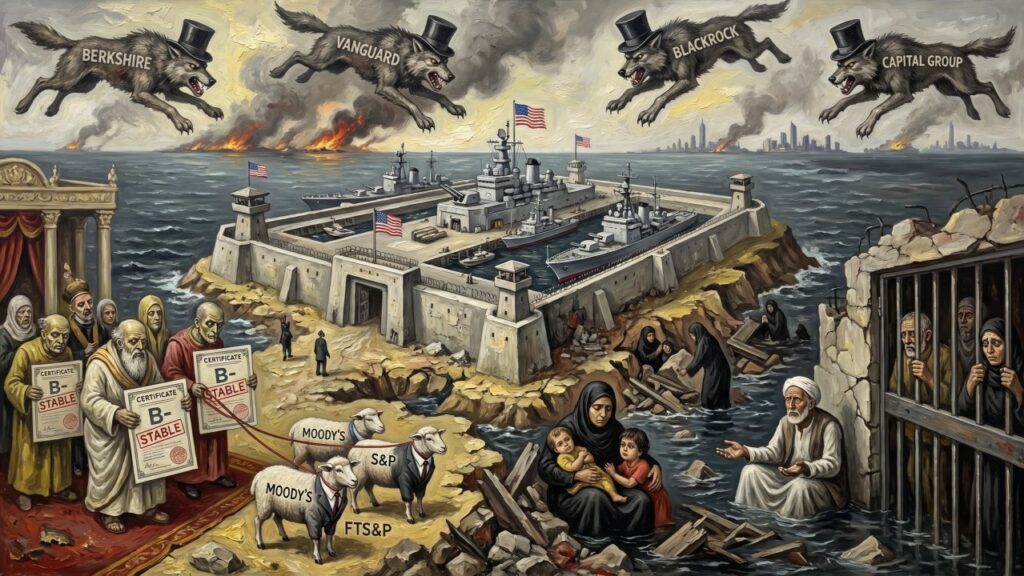
The rating agencies holding Bahrain at B stable while its food prices rise 219% and its infrastructure burns are not independent analytical institutions. They are profit centers owned by the rentier capital complex whose portfolio valuations depend on the managed transition remaining invisible for as long as possible.
Berkshire Hathaway holds 13.7% of Moody’s, worth approximately $11 billion, earning $93 million in dividends in 2025 alone. Berkshire simultaneously holds massive dollar-denominated equity positions whose valuations rest on dollar stability and orderly capital markets. A downgrade cascade that reprices dollar-denominated assets impairs Berkshire’s balance sheet directly.
Vanguard holds 9.99% of S&P Global worth $14.73 billion and manages $9.3 trillion in predominantly dollar-denominated assets. BlackRock holds 7.6% of S&P Global and is the single largest holder of U.S. Treasury debt through its iShares ETF complex, managing $10.5 trillion. A sovereign downgrade cascade that reprices the dollar’s reserve currency status threatens the value of every asset under their management and every fee those assets generate.
Fitch is 100% privately held by Hearst Corporation, whose financial positions are entirely opaque and entirely unaccountable to any public interest standard.
The NRSRO designation that gives all three firms their commercial monopoly was created by the SEC in 1975 and left intact after both Moody’s and S&P paid combined settlements of over $2 billion for documented rating fraud. The same model that produced 45,000 triple-A ratings on mortgage paper that was 83% junk is the model rating Bahrain’s sovereign debt today.
These agencies are not running behind the physical reality of Bahrain’s deterioration because their analysts lack information. They are running behind it because Berkshire’s balance sheet, BlackRock’s AUM fees, Vanguard’s index fund valuations, and the Trump-Tahnoon stablecoin revenue all require the transition to remain invisible for as long as possible. The rating agencies are not the wolves in this story. They are the guard dogs the wolves own.
The Sequence of What Comes Next for Bahrain
Bahrain will not announce its failure. It will manage it until it cannot, and then the failure will be announced by events.
The UAE currency swap buys two to three quarters of fiscal breathing room. After that, the government faces a choice between cutting the subsidies that make food and fuel affordable for its population and missing the debt service payments that maintain its access to international capital markets. There is no third option. The IMF has been saying so for five years.
When the fiscal adjustment comes, it will be imposed on a population whose food costs have already risen 140 to 219% since the war began, whose export revenues have been severed by the Strait closure, and whose infrastructure has been damaged by missiles fired at the American fleet it hosts. The fertilizer scarcity flowing from the Hormuz disruption will add further food price pressure over the next nine to eighteen months. The UAE OPEC exit puts downward pressure on oil prices at precisely the moment Bahrain needs them elevated to narrow its deficit. These pressures compound. They do not offset.
Bahrain’s sovereign default probability, assessed at 10 to 20% by financial analysts in March, rises with every month the Strait remains disrupted and every month fiscal adjustment is deferred. When the default arrives, the people who pay the heaviest cost are not the London and New York bondholders who will receive their negotiated haircut. They are the Bahraini citizens who staked their economic lives on the promise that hosting the world’s most powerful naval fleet on their island would purchase them a measure of security and stability. That promise has been broken by the power that made it, in service of a transition whose architects are already on the other side.
The Trump administration will say nothing. The Middle East envoy whose family collected $31 million from the UAE’s national security adviser will manage the diplomatic process on a timeline that serves the stablecoin transition’s scaling requirements. The rating agencies will issue a Negative Outlook, then a Rating Watch, then a downgrade, each action arriving six months after the market already knows, each one filed with the precision of paperwork submitted after the fact by institutions paid not to notice until noticing becomes unavoidable.
What Bahrain Teaches the Seven
The seven nations addressed in this article are not Bahrain. Their fiscal positions, reserve levels, and institutional depth vary significantly. But each of them has made strategic bets on the permanence of an architecture that is being deliberately replaced, and the Bahrain story is what those bets look like when the external conditions that sustain them are removed by the very parties that built them.
Japan imports 93% of its crude oil through the Strait of Hormuz, holds a constitution that prevents it from deploying naval forces to protect that chokepoint, and is building the world’s largest semiconductor complex on energy that transits a Strait functionally closed for sixty days. Japan began releasing 80 million barrels from its 254-day reserves thirteen days after the war began because spot market premiums were already untenable. Japan’s Bahrain is the gap between its strategic dependency on a maritime chokepoint it cannot protect and the institutional confidence that the alliance that controls that chokepoint will always keep it open on terms that do not require Japan to sacrifice every other foreign policy interest.
South Korea routes 70% of its crude oil through the Strait, suffered an 18% stock market decline in four trading days, and sources helium and bromine, both critical semiconductor fabrication inputs, primarily from a Gulf now subject to force majeure declarations with five-year restoration timelines. South Korea’s Bahrain is a decision made across decades to allow the world’s most strategically irreplaceable industrial sector to become dependent on inputs transiting a chokepoint whose security was subcontracted to an alliance partner whose principals are simultaneously managing the war that closed it.
Singapore generates 95% of its electricity from imported natural gas and functions as the primary refined product supplier for its entire sub-region. Deputy Prime Minister Gan told Parliament on April 7 that the Iran war will hurt growth and drive inflation higher. Gan’s statement was honest about the symptoms and silent on the architecture. Singapore’s dollar-denominated energy settlement function depends on the dollar remaining the settlement currency of regional energy trade. The stablecoin bifurcation and the yuan-CIPS alternative are restructuring that assumption in real time, and Singapore’s government has not yet told its citizens what that means for the institutional role that has underwritten its prosperity.
Indonesia was identified by S&P as the sovereign rating most at risk in Southeast Asia if the conflict is prolonged, its constitutional 3% fiscal ceiling threatened by the combined pressure of energy subsidy costs and rising borrowing rates. Indonesia’s Bahrain is the subsidy trap: politically entrenched spending commitments that accumulate fiscal pressure faster than growth absorbs it, in a country that has been warned about the trajectory and found it politically impossible to act on those warnings before an external shock removes the choice.
Malaysia is the region’s net energy exporter and the exception that proves the rule, its CDS spreads tighter since February 28 while every neighbor’s have widened. Malaysia’s Bahrain is not its balance sheet but its settlement architecture: Petronas prices exports in dollars and routes trade finance through dollar-denominated systems whose replacement is underway. The choice between dollar-stablecoin rails and yuan-CIPS rails is a present operational question that neither Petronas nor the government has addressed publicly.
Vietnam faces 70% diesel price increases and 50% gasoline price increases since February 28, directly threatening the 10% average annual GDP growth target that General Secretary To Lam has staked his government’s legitimacy on achieving. Vietnam’s Bahrain is the export manufacturing model’s exposure to freight cost increases, energy input cost increases, and the dollar-denominated trade finance architecture whose bifurcation Vietnam has not yet factored into its growth projections.
Thailand has experienced material CDS spread widening as higher oil import costs compress corporate margins, raise transport costs, inflate the subsidy burden, and suppress tourism, which accounts for roughly 9% of GDP. Thailand’s Bahrain is the compound erosion of multiple revenue streams simultaneously, none of them individually a rating event, together producing a fiscal trajectory that the agencies will describe as weakening, then deteriorating, then requiring action, each label arriving long after the market already knows.
The Architecture Connects Everything
Every nation in this article shares a condition that their individual credit ratings do not capture. They are embedded in a dollar-denominated energy settlement system whose architecture is undergoing the most consequential transition since 1974, at the precise moment its physical infrastructure is functionally closed, and the institutional architecture meant to measure and communicate that transition is owned by the parties that need the transition to remain invisible.
The GENIUS Act manufactures a captive Treasury buyer that replaces Gulf sovereign recycling. Tahnoon co-owns the stablecoin company that anchors the new architecture. The Trump family holds equity in that company. The Middle East envoy managing the war’s diplomatic resolution has a family that collected $31 million from Tahnoon before the war began. The UAE has exited OPEC to maximize production volume unconstrained by cartel discipline designed to maintain dollar oil pricing, because Abu Dhabi no longer needs dollar oil pricing when it co-owns dollar stablecoin pricing. Berkshire, Vanguard, and BlackRock own the rating agencies that are certifying stability on sovereigns whose physical and fiscal foundations are actively disintegrating.
This is not a set of independent institutional failures. It is the operating signature of a transition being managed by its principals at the expense of the legacy nodes, the loyal allies, the structurally dependent partners who made the old system work and are now being left to absorb the costs of its replacement.
Bahrain made every bet Washington asked it to make. It hosted the fleet. It absorbed the missiles. It maintained the peg. It kept the dollar flows moving. What it received in return was a war started on its doorstep, an architecture built to render its function obsolete, and a rating agency system certifying stability on its ruin while the wolves who own those agencies position themselves for the world that comes next.
The governments of South Korea, Japan, Singapore, Indonesia, Malaysia, Vietnam, and Thailand should read that sentence carefully. The guard dogs will not bark until the wolves have already eaten. By the time the rating agencies say what the physical reality already shows, it will be too late to do anything except manage the consequences of a transition you were never told was already underway.
Throughline Synthesis Group | April 28, 2026