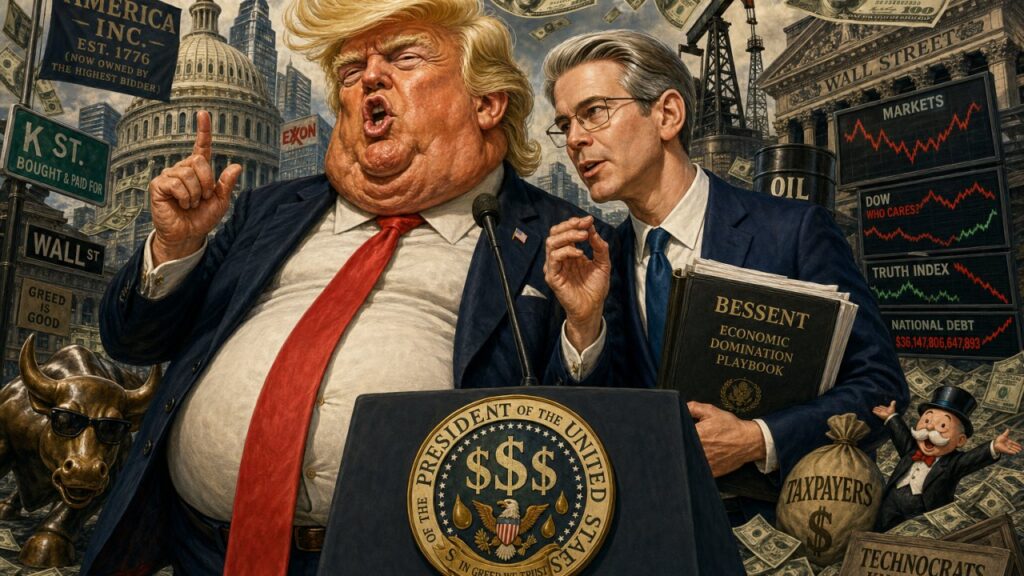
Because their vanity and greed eclipse any loyalty to people, they treat America as a disposable casino, not a republic. Dumb and dumber.
By Scott Ortkiese | Throughline Synthesis | May 19, 2026 Petrodollar Series, Article IV, additive to “The Petrodollar Trap,” “Five Damned Good Reasons,” “The Replacement Is Already Here,” and “Bibi and The Donald Played War Games.”
Why I Wrote This Article
The first three articles in this series traced the petrodollar’s mechanics, named the five structural pillars whose loss is terminal, and inventoried the replacement plumbing that is already processing money. The fourth, Global Depression, named the institutional capture and the physical irreversibility that lock the outcome in. This article does something the prior four did not. It performs the dissection.
In the last ten days the actual ledgers of the post-dollar order surfaced in public view. Treasury named the vessels. China named the refineries. The Reserve Bank of India named the accounts. The OFAC general licenses confirmed the volumes. Lloyd’s confirmed the war-risk premiums. The shadow-fleet trackers, TankerTrackers, Kpler, Windward, Vortexa, confirmed the routings down to the IMO number. The CFR confirmed the Beijing summit produced no agreement on Hormuz. And the bond market, the only entity in this story that does not lie, settled the policy debate on Washington’s behalf by making the next sanctions decision for it.
What follows is not commentary. It is the trial exhibit. The framework is the one the realists, Mearsheimer, Diesen, Sachs, Doctorow, Hudson, Escobar, Crooke, Korybko, Norton, have been writing in plain English for two years while the Atlantic foreign-policy establishment screamed past them. The empire whose terminal phase is documented below is the empire that started this war, and the multipolar architecture documented alongside it is not a threat. It is the rational answer to a hegemon that has spent a decade demonstrating to every solvent counterparty on earth that the price of using its rails is being held hostage on them.
Part One: The Two Loops Are Not a Theory. They Have Names, Numbers, IMO Codes, and Owners.
A pair of Indian analysts, Navroop Singh and Himja Parekh, published a useful piece on May 18 labeling two operational settlement architectures the Tehran Loop and the Delhi Loop. The labels are good. The diagnosis is incomplete and, in places, written for a New Delhi audience in a register I will not adopt. What they describe as two parallel rebellions against the dollar is, in fact, the public visible portion of a single systemic event: the petrodollar’s recycling loop has been replaced, transaction by transaction, by recycling loops that do not route through New York, do not require Treasuries, and do not need American permission. The American response, sanctions, tariffs, kinetic action, is not strategy. It is the noise a system makes when its plumbing fails.
Here is what each loop actually contains, in the present tense, with named entities and routing data.
The Tehran Loop: Operational Receipts
On April 24, 2026, OFAC issued Treasury press release SB0472. The release sanctioned Hengli Petrochemical (Dalian) Refinery Co., Ltd., China’s second-largest teapot refinery, identified by Treasury as having “purchased billions of dollars’ worth of Iranian petroleum and petrochemicals” (U.S. Treasury, April 24, 2026). It named Sepehr Energy Jahan Nama Pars Company, the oil sales arm of Iran’s Armed Forces General Staff, as the counterparty. It then listed nineteen vessels by IMO number, with named registered owners domiciled in Hong Kong, the Marshall Islands, Panama, the British Virgin Islands, the Cayman Islands, the UAE, Vietnam, China, and Liberia. The COVENIO (IMO 9263227, Hong Kong-owned Extensive Shipping Limited) alone has moved more than six million barrels of Iranian oil to China since early 2025. The SEEKER 8 (IMO 9294329, Marshall Islands-owned Reayou Company Limited) moved over four million barrels in a single two-month window in early 2026. The ANSHUN II (IMO 9253117, Cayman Islands-owned Laurel Shipping Ltd) has moved millions of barrels since 2024 (U.S. Treasury, April 24, 2026).
This is the OFAC frame. The fuller frame, from the commercial intelligence side, is more devastating. Windward.ai‘s February-March 2026 shadow-fleet analytics identify 430 active tankers in the Iranian trade, of which 62% sail under falsely declared flags and 87% are already sanctioned, with Marshall Islands, Hong Kong, China, and Panama the top four ownership jurisdictions (Windward, February 26, 2026). TankerTrackers’ Dark Fleet data confirms Iran-to-China flow at 1,643,331 barrels per day, Russia-to-China at 972,699 bpd, Russia-to-India at 931,744 bpd, and Venezuela-to-China at 476,134 bpd (TankerTrackers, Dark Fleet Report). Kpler estimates the shadow fleet now moves 6 to 7% of global crude flows, roughly 3,733 million barrels per year (Kpler Insights). Windward’s most striking finding: 161 million barrels of Iranian crude were on water at the time of measurement, of which 79% was destined for China, 13% for Syria, 8% for the UAE. Treasury’s 1,000-plus sanctioned persons are sanctioning roughly a fifth of an architecture that is bigger than the architecture it is trying to suppress.
Eight days after SB0472, on May 2, 2026, not “late April,” as Singh and Parekh stated, China’s Ministry of Commerce issued its first-ever prohibition order under the 2021 Blocking Rules, citing the National Security Law, the Foreign Relations Law, and the Anti-Foreign Sanctions Law, and ruling that the U.S. designations of Hengli and four other teapot refineries “shall not be recognised, enforced or complied with” by Chinese entities (Stephenson Harwood, May 5, 2026). Five years after Beijing built the statute, this is the first time it has been used. OFAC’s accommodation was to issue a 22-day wind-down license expiring May 24, 2026, with the unusual condition that any payment to Hengli must be parked in a blocked, interest-bearing U.S. account, an arrangement that exists only because Treasury knows it cannot actually stop the flow.
The Chinese move is the more important of the two. Beijing did not retaliate in dollars or in tariffs. It rewrote the legal status of compliance itself, making it actionable under Chinese law for Chinese entities to honor American secondary sanctions. That is not escalation. That is the construction of an alternative legal regime for international commerce in which extraterritorial American jurisdiction is the prohibited behavior. This is precisely the kind of normative substitution Glenn Diesen has been describing for years: the Eurasian transition is built not by louder ideology but by the patient replacement of the institutional substrate Washington took for granted (Diesen, BraveNewEurope, November 2024).
The Tehran Loop is also, importantly, not paralyzed by the strait it is supposedly trapped behind. Argus Media’s May 14, 2026 reporting confirms Kharg Island was still loading crude on May 8, directly contradicting the Bessent line that Iranian storage was “full” and that the regime was on the verge of physical asphyxiation (Argus Media, May 14, 2026). The same Argus reporting documents that the IRGC has expanded its operational footprint from the strait proper into a “vast operational area” extending from the port of Jask on the Iranian coast out to Siri Island in the central Persian Gulf, a defended seaboard, not a chokepoint Washington can pry open with a single carrier strike. Alastair Crooke’s reading of this posture is the operative one: Iran’s defensive doctrine is dispersed and autonomous, with command authority pre-delegated to multiple regional centers, designed to remain operational even after decapitation strikes against any single command node (Crooke, Iran Sets Conditions for Access to the Strait of Hormuz, March 21, 2026; Crooke, This Is an Asymmetric War Iran Has Already Won, April 2, 2026).
Pepe Escobar, writing with Larry Johnson, has named what Iran is actually operating: an “invisible toll gate” in the strait, selective passage granted to tankers serving China, India, and the Eurasian coalition, denial of passage to U.S., Israeli, and NATO-affiliated cargoes (Greanville Post, March 16, 2026). The 25-year China-Iran Comprehensive Strategic Partnership and the joint China-Iran SIPS payment system give the gate its political and financial backstop. The South China Morning Post’s March 26 reporting confirms the corollary: the war has strengthened the petroyuan, with the Shanghai International Energy Exchange seeing accelerated yuan-denominated crude futures activity precisely because the dollar-denominated alternative is now politically risk-loaded (SCMP, March 26, 2026).
The American side of the chokepoint is the other half of the picture, and it has been reported with greater honesty in The New York Times’ own interactive than in any State Department briefing. Since April 13, 2026, the U.S. Navy has been operating a maritime blockade in the Gulf of Oman and approaches to the Strait of Hormuz, intercepting more than seventy vessels in the first five weeks. The bulk carrier Majestic X was captured in the Indian Ocean. Other shadow-fleet vessels, Huge, Salute Legend, have shifted to ship-to-ship transfers outside the blockade zone to keep the flow moving (The New York Times, May 15, 2026). Press TV’s late-April coverage records Iran’s response: no retreat, with the IRGC and the Iranian Navy publicly invoking sovereign right over the strait and adjacent waters as the legal frame for refusing American passage demands (Press TV, April 25, 2026; Press TV, April 27, 2026). What is in fact unfolding is a two-sided maritime interdiction regime, with the U.S. trying to enforce sanctions east of Hormuz and Iran enforcing its toll gate inside it. Both sides are intercepting tankers. The flow is continuing through the gaps in both nets.
Treasury has now sanctioned over 1,000 Iran-related persons, vessels, and aircraft since February 2025 (U.S. Treasury, April 24, 2026). The shadow fleet keeps loading. The teapots keep refining. The receipts keep landing where receipts land: in offshore vehicles registered in jurisdictions whose corporate law is written, in practice, in London, Hong Kong, BVI, Cayman, Marshall Islands, Panama. These are not Iranian or Chinese sovereignties. They are Anglo-financial administrative facades. The Tehran Loop is, in its terminal node, a European loop with a Persian source. Which is why Lloyd’s of London raised Strait of Hormuz transit premiums to 7.5 to 10% of hull value in March 2026, a tenfold increase from pre-war levels (Lloyd’s List, March 11, 2026), and why NATO members declined to assist American Hormuz operations. The European financial system is long this trade, and a closed strait is, for its own purposes, more profitable than an open one.
The Delhi Loop: Operational Receipts
The Reserve Bank of India did two specific things in August 2025 that converted the rupee-rouble experiment into permanent monetary infrastructure. On August 5, 2025, the RBI eliminated the prior-approval requirement for Authorized Dealer banks to open Special Rupee Vostro Accounts (Reserve Bank of India, FAQ). On August 12, 2025, the RBI permitted non-resident SRVA holders to invest their entire surplus rupee balances into Indian Government Securities and Treasury Bills (Reuters, August 12, 2025).
Read that second sentence again. It is the entire ballgame. Sberbank, VTB, and Gazprombank can now hold rupee balances from oil sales to Indian Oil, Bharat Petroleum, and Reliance, and reinvest those balances directly into yield-bearing Indian sovereign debt. That is, definitionally, recycling. It is the petrodollar architecture replicated in rupees, with Russian oil exporters in the role American Treasury holders used to occupy and the Government of India in the role the U.S. Treasury used to occupy. The dollar has been removed from a critical Eurasian energy-finance loop and the rupee has been put in its place, not as a global reserve currency, but as a bilateral settlement and reinvestment currency that does the same work for the participants without requiring American permission to do it.
The volumes confirm the mechanism is working. India’s Russian crude imports collapsed from 69 million barrels in August 2025 to 29 million in February 2026 under tariff pressure, then rebounded to a record 2.3 million barrels per day in mid-May 2026, roughly 69 million barrels per month, a fifty-percent jump from the February floor (OilPrice.com, May 14, 2026). On May 18, 2026, India’s Joint Secretary at the Ministry of Petroleum stated categorically that India will continue sourcing Russian crude “regardless of a U.S. sanctions waiver.” That is not a negotiating position. That is a sovereign declaration that the Delhi Loop is no longer a U.S. policy variable.
It is also worth recording, because the Atlantic press tried for months to manufacture the opposite story, that Prime Minister Modi never confirmed any commitment to halt Russian oil purchases. The “Modi pledged to stop” narrative was a State Department fabrication recycled through Washington-aligned outlets; the actual Indian position, as Andrew Korybko documented in February, was that Indian refiners would respond to “market conditions, not ideology,” and the August dip was a price-arbitrage response to tariff-induced uncertainty, not a strategic concession (Korybko, AzerNews, February 7, 2026; Pressenza, February 25, 2026). The May rebound to a record level is what the actual policy looks like once the price signal corrects.
I note one Singh-Parekh framing I am not adopting: the casual triumphalism around Operation Sindoor and the broad-brush hostility toward Pakistan. The Indian general staff drew operational conclusions about the Russian arms stack, S-400, Su-30, Brahmos, Akash integrated into IACCS, that are real and that reinforce the Delhi Loop’s stickiness, and the Trump administration’s tilt toward Rawalpindi (Trump-family crypto entanglement, Balochistan rare-earth deals, the Pentagon and CIA overruling State on the realignment) is real and is structurally telling. But the underlying lesson is not that Russian weapons beat American weapons in a 22-minute strike package against a regional rival; it is that conditional, slow, politically reversible U.S. arms relationships are no longer competitive against suppliers willing to transfer technology and respect sovereignty. That is a systemic indictment of the American arms-export model, not a sectarian scorecard.
So India holds Russian oil, Russian arms, rupee-rouble settlement, and SRVA Treasury recycling as a single integrated posture. The Singh-Parekh piece, written from New Delhi, treats this as strategic autonomy. From the realist vantage it looks like something more structural: a Quad partner whose entire purpose in U.S. grand strategy was to balance China has fully exited the dollar-arms-energy stack that defined American Asian primacy, while not in fact balancing China. The Quad is now a press release. The substance has moved elsewhere.
Part Two: The Bond Market Settled the Argument on May 18, and the “Foreign Demand” Story Is Not What Bessent Says It Is
Here is the part of the story the foreign-policy commentariat does not want to look at directly, because looking at it directly ends most of their careers.
On May 15, 2026, the U.S. 10-year Treasury yield closed at 4.59% and the 30-year closed at 5.12% (FRED DGS10, FRED DGS30). The Japan 30-year JGB hit an all-time high of 3.89% in January 2026 (Trading Economics), a historic level for a market whose entire post-1990 architecture depended on suppressed long-end yields, and a warning that even the closest, most institutionally aligned American creditor is repricing duration. Brent crude traded at $111.04 per barrel on May 15, 2026 (Fortune, May 15, 2026) with the Strait of Hormuz effectively closed. Gold, which hit $5,589/oz on January 28, 2026, sits near $4,694/oz, off its highs but still effectively double its 2024 level (GoldSilver, May 12, 2026).
Three days later, on May 18, 2026, Treasury Secretary Scott Bessent announced a new 30-day general license, the third in a sequence after OFAC General License 133 (March) and General License 134/134B, authorizing “the most vulnerable nations” to access Russian crude cargoes already loaded on vessels (gCaptain, May 18, 2026). The administration had let the previous waiver lapse two days earlier. The bond and energy markets gave Washington forty-eight hours of clarity, and the waiver was reissued.
Bessent’s framing in his X post was the tell within the tell: the new license, he wrote, would “help reroute existing supply to countries most in need by reducing China’s ability to stockpile discounted oil.” That sentence is propaganda packaging applied to a capitulation. The substance is that Washington is permitting Russian crude to move; the marketing is that doing so somehow hurts China. China is not the target of this waiver and Bessent knows it. China holds direct yuan-settled supply contracts with Iran and Russia, runs CIPS clearance for the proceeds, and bought down its Treasury exposure to $682.6 billion by November 2025 (Anadolu, February 24, 2026) precisely so that decisions of this kind would not affect it. The “stockpiling” line is rhetorical chaff for a domestic American audience that needs an enemy to receive the news of a sanctions retreat.
Here is the harder truth about the bond market, the one I owe to readers because it is genuinely not what the standard de-dollarization brief asserts, and because intellectual honesty requires saying so. Foreign holdings of U.S. Treasury securities hit an all-time record $9.49 trillion in February 2026, up substantially over twelve months (Wolf Street, April 15, 2026). On the surface this looks like a refutation of the de-dollarization story. Read the composition table and it is the opposite, it is the story’s confirmation.
China and Hong Kong combined sold $96 billion of Treasuries over the trailing twelve months, dropping to $962 billion. The Euro Area added $164 billion to reach $2.0 trillion. Japan held at $1.24 trillion, the largest single foreign holder. The Cayman Islands held $443 billion, of which the Federal Reserve’s own analysis attributes roughly $2 trillion in aggregate Cayman positions to hedge-fund basis-trade activity rather than to long-only sovereign holders. Belgium held $455 billion, almost entirely via Euroclear, the offshore clearing facility through which non-US institutional buyers transit positions for tax and custody reasons. The United Kingdom added significantly. Ireland and Luxembourg, both pure financial-domicile jurisdictions, registered material increases (Wolf Street, April 15, 2026).
Translate the composition. The marginal buyer of U.S. Treasuries in 2026 is not a foreign central bank. It is a Cayman-domiciled hedge fund running a basis trade, long the cash bond, short the future, levered fifty to one, whose entire P&L depends on the spread holding and the repo facility staying open. It is a Belgium-via-Euroclear or Ireland-via-Dublin custody position belonging to European insurance companies and pension funds whose mandates still require dollar duration. It is a UK or Luxembourg vehicle warehousing positions for institutional clients of City of London asset managers. These are the buyers absorbing the supply that China and Hong Kong (and, before them, Saudi Arabia and the GCC sovereign wealth funds, who have rotated mBridge-ward) are no longer absorbing.
That is not “foreign demand for dollar reserve assets.” That is plumbing. It is the offshore Eurodollar system and the leveraged basis trade doing the work that real sovereigns used to do, and it is doing that work under conditions, long-end yields above 5%, repo funding stress, weekly basis-trade unwind scares, that the Federal Reserve’s own Office of Financial Research has warned, since 2024, are systemically fragile. The “record foreign holdings” headline is what the Wolf Street analysis calls the basis-trade composition update; it should be read the way one reads a credit binge in the final innings of a cycle, not the way one reads a vote of sovereign confidence. The actual sovereign vote is the one Saudi Arabia, China, India, Turkey, and Poland are casting in tonnes of gold, in mBridge participant slots, and in SRVA balances.
The operative principle, stated cleanly: the U.S. government no longer enjoys the discretion to enforce its own sanctions architecture against a major energy supplier without triggering a long-end Treasury auction failure and a domestic fuel-price spike that arrives at the gas pump before the policy memo arrives in the West Wing. The 30-year crossing 5% with Brent at $111 is not a warning. It is a veto. The waiver is what the veto looks like in policy form. And the marginal bid that is “keeping” the Treasury market afloat is itself the most fragile bid in the structure.
John Mearsheimer put the strategic version of this in plain English on April 3, on Al-Jazeera: the United States’ primary “font of power is not military or population, it is the petro/pedo dollar because it decouples economic power from population size. Absent that fiat luxury, the US military cannot exist at its current magnitude and absolute US power is diminished significantly” (Mearsheimer, Power Politics & The Iran War, April 6, 2026). His March 27 framing on the operational reality is more direct: Iran “holds all the cards” because only 5% of pre-war Hormuz throughput is now moving, the U.S. has had to lift sanctions on both Iran and Russia to keep crude flowing, “and that means the Iranians have huge leverage over us. And the longer this goes on, when you think about the consequences for the world’s food supply of all these fertilizers not making it,” the worse it gets (Mearsheimer/YouTube, March 27, 2026). Singh and Parekh dance around this and call it “tactical policy pivot.” Mearsheimer calls it what it is: defeat.
This is not the petrodollar under pressure. This is the petrodollar in receivership, with Bessent as the court-appointed administrator, the bond market as the bankruptcy judge, and a leveraged offshore basis trade as the bridge financing that determines how loud the eventual restructuring is going to be.
Part Three: The Replacement Architecture Is Not “Building.” It Is Live, and the East Asian and ASEAN States Are Its Backbone.
Singh and Parekh assert that “BRICS Pay settlement system is near completion and ready to be deployed.” That is the present-tense reality only halfway. The full picture, in May 2026, foregrounds an architecture in which East Asia and ASEAN are not bystanders but the load-bearing structure:
· mBridge has processed over $55.5 billion in cumulative cross-border CBDC settlements through more than 4,000 transactions, a 2,500-fold increase since the 2022 pilot phase. The digital yuan accounts for approximately 95% of platform volume. Participating central banks: People’s Bank of China, Hong Kong Monetary Authority, Bank of Thailand, Central Bank of the UAE, and Saudi Central Bank (Reuters, January 16, 2026). The Bank for International Settlements quietly exited the project in October 2024 after General Manager Agustín Carstens stated, on the record, that the BIS “cannot operate with countries that are subject to sanctions.” That sentence is the operational definition of a financial cold war and the institutional moment the Western settlement establishment ceded the technology frontier.
· ASEAN’s local-currency settlement framework is not aspirational; it is processing transactions today. At the 46th ASEAN Summit in Kuala Lumpur in May 2025 the bloc adopted the Economic Community Strategic Plan 2026 to 2030, with explicit commitments to reduce dollar dependence and maximize local-currency usage in cross-border transactions. Indonesia, Malaysia, Thailand, Singapore, the Philippines, and Vietnam have operationalized cross-border QR-code payments in local currencies across eight member states; Malaysian investors transact in ringgit across Southeast Asia and into China without converting to dollars (ASEAN Briefing, 2023; Asia News Network, July 2025; IMF Selected Issues, 2026; AMRO Policy Paper, December 2023). Indonesia’s de-dollarization task force, Bank Negara Malaysia’s bilateral local-currency settlement frameworks, Vietnam’s dong-renminbi clearing arrangements with Chinese provincial counterparties, and Bank of Thailand’s role on mBridge are the connective tissue. ASEAN+3 (the ten ASEAN members plus China, Japan, and South Korea) has been building this through the Chiang Mai Initiative, the Asian Bond Market Initiative, and the Asian Bond Fund for two decades. The post-1997 lesson, never again let the IMF and the U.S. Treasury triage your currency under duress, has been institutionalized into a working regional financial commons that 2026 is finally letting it use.
· BRICS Pay is scheduled for full operational deployment at the 18th BRICS Summit, September 12 to 13, 2026, in New Delhi (Rio Times, April 12, 2026), with technical coordination led by the Reserve Bank of India. The system links India’s UPI, China’s CIPS, Russia’s SPFS, Brazil’s Pix, and South Africa’s SAMOS into a decentralized messaging system with DAO governance, a design that makes it institutionally impossible to seize or sanction the system as a whole, because there is no central operator to coerce.
· CIPS now reaches participants in 119 countries. SPFS links 160 foreign banks in over 20 countries. Russia-China bilateral trade hit $244.8 billion in 2024, settled almost entirely in yuan and roubles. Putin confirmed at the 2025 Rio summit that 90% of Russia-BRICS trade is now settled in national currencies, up from 26% two years prior. Ben Norton’s Geopolitical Economy Report has been tracking these flows since 2022, in the format the Western financial press has refused to publish: aggregated central-bank-by-central-bank de-dollarization reporting.
· The Saudi defection is no longer plausible deniability. Saudi Arabia is a participating central bank on mBridge. The Saudi Central Bank has signed a 50-billion-yuan currency swap with the PBoC. Saudi Aramco has, since 2023, accepted yuan settlement for incremental volumes through the Shanghai International Energy Exchange’s RMB-denominated crude futures. S&P Global’s own analysis, normally a defender of dollar primacy, concedes that “deepening bilateral ties could help facilitate more use of the renminbi in Saudi-China oil trade in the decades to come” (S&P Global). “Decades” is the institutional way of saying “this has already happened and we are not going to be the ones to say so first.”
· Central bank gold accumulation continued at near-record pace in 2025: 863 tonnes, the fourth-largest annual addition on record, with 22 of 24 surveyed central banks expanding holdings (World Gold Council, January 29, 2026). The buyers driving 2025 gold purchases included Poland and Turkey, both NATO members. A NATO member that is net-rotating from Treasuries into gold is not a NATO member that believes the dollar’s reserve role survives the decade.
The replacement is not building. It is built. The deployment schedule of the last unbuilt component, BRICS Pay at full launch, is now public, dated, and four months away. After September 12, 2026, the technical bridge between Indian retail payments, Chinese wholesale settlement, Russian interbank messaging, Brazilian instant payments, and (through ASEAN+3 interoperability) Southeast Asian local-currency rails is operational without dollar dependency. The international monetary architecture of the post-American era does not require American consent to function. That is the news.
What this architecture means for the East Asian and ASEAN states I have spent years arguing should be its protagonists: Japan is being forced, by the 30-year JGB at 3.89%, to confront the cost of three decades of acting as a duty-bound buyer of last resort for American debt. South Korea, structurally aligned to U.S. semiconductor and security policy, is watching Beijing build the trade and payment infrastructure its actual economy runs on. Vietnam, Malaysia, and Indonesia, three countries with no interest in being subordinated to either Washington or Beijing, have chosen ASEAN+3 local-currency settlement as the institutional answer to coercion from either direction. Thailand sits on the mBridge governance group. The Philippines, even under its current security posture, transacts in pesos through the ASEAN QR framework. The multipolar architecture is being underwritten by the productive economies of Asia. Washington has nothing to offer them except threats it can no longer afford to execute.
Part Four: What the Trump-Xi Summit Confirmed by Not Concluding Anything, and What Xinhua Said the Day Putin Landed
The Trump-Xi summit in Beijing on May 13 to 14, 2026, produced no joint statement. Both sides issued separate, divergent readouts. The Council on Foreign Relations, in its summit post-mortem, found a “decent peace” in the absence of escalation but conceded there were no Chinese concessions on Iran, on Hormuz, on Taiwan, on rare earths, on semiconductor exports, or on tariffs, the entire substantive agenda (CFR, May 15, 2026). Xi explicitly warned of the “Thucydides Trap” and drew a hard line on Taiwan. The White House readout claimed a “mutual understanding” that Iran cannot have a nuclear weapon and that Hormuz “must remain open,” paired with vague Chinese commitments to buy Boeing aircraft, soybeans, and unspecified U.S. energy.
Translate that into the language of negotiation: the Chinese side gave Trump optical wins (Boeing orders, soybean purchases) and refused every substantive demand. Xi then announced, via the Kremlin readout published May 16, that Vladimir Putin would conduct an official state visit to Beijing on May 19 to 20, 2026 (Kremlin.ru, May 16, 2026), that is, today and tomorrow, the days immediately after Trump’s plane left Chinese airspace.
The Chinese state press has not been subtle about what the visit is for. Xinhua’s May 18 and May 19 dispatches frame the Putin trip as the operational consolidation of the Sino-Russian strategic partnership at the moment the global energy order is being recomposed (Xinhua, May 18, 2026; Xinhua, May 19, 2026). The Chinese framing is the deliberate inverse of the Atlantic media’s “Russia isolated” line, it is Russia centered, with the United States and its European clients positioned as the actors whose policy choices the Eurasian bloc is now coordinating to absorb and outlast. The diplomatic message is not subtle. Beijing is hosting Moscow on the eve of the BRICS Pay deployment cycle, in the middle of the Iran war, three days after a Treasury sanctions waiver renewal that publicly conceded American enforcement limits.
This is what serious statecraft looks like. Beijing is operating with the strategic patience of a civilization-state on a multi-decade time horizon, executing a coalition foreign policy in coordination with Moscow, Tehran, New Delhi, Brasília, and the ASEAN+3 architecture. Washington is operating on a Truth Social posting schedule, under a chief executive whose tactical attention span is shorter than a single news cycle and whose strategic guidance is filtered through a donor class that mistakes leverage for strategy. There is no symmetry between these two operating modes. The contest’s outcome is already implicit in the contest’s design.
Part Five: The Three Pillars Burning Simultaneously
The petrodollar’s structural decomposition is not happening through a single failure point. It is happening through three simultaneous structural fires, each of which my prior articles named and each of which is now visibly worse:
Pillar One, The Energy Recycling Loop. Saudi Arabia, the UAE, and Bahrain, the original GCC petrodollar anchors, are now hosting AI hyperscaler infrastructure (OpenAI’s Stargate UAE 5-GW campus with G42, Oracle, Nvidia, Cisco; Microsoft’s $15 billion UAE commitment through 2029; Saudi Humain’s domestic AI buildout) that has itself become a target. Iranian retaliatory strikes in March 2026 hit AWS facilities in the UAE and Bahrain, producing measurable outages in banking, payment processing, and enterprise services (CNBC, March 11, 2026). The petrodollar’s recycling sink (GCC sovereign wealth funds → U.S. Treasuries and U.S. AI equities) and the AI bubble’s energy substrate (GCC subsidized power → Middle East data centers) are the same physical infrastructure. Iran understands this. Targeting it strikes the AI equity bubble and the petrodollar recycling loop in the same kinetic motion. This was the predictable consequence of basing the next great American asset bubble on top of someone else’s energy infrastructure inside an active war theater Washington itself opened.
Pillar Two, The Helium and Semiconductor Stack. Middle Eastern helium liquefaction infrastructure, critical to MRI machines, fiber-optic production, and advanced semiconductor fabrication, has been degraded. Companies globally have implemented helium rationing protocols. Replacement infrastructure takes years to construct (DW, March 18, 2026; Asia Pacific Foundation, April 17, 2026). This is where the East Asian semiconductor supply chain, TSMC, Samsung, SK Hynix, the entire Japanese specialty-chemical and lithography ecosystem, bears the cost of an American war it did not sanction. Tokyo, Seoul, and Taipei are being asked to absorb input-cost shocks and capacity disruptions to support a strategic objective whose strategic logic Washington itself can no longer articulate.
Pillar Three, The Fertilizer-to-Food Pipeline. Three of the world’s top ten urea exporters ship through the Strait of Hormuz. China has signaled it will not export urea until August 2026, removing millions of tons from the global market. European nitrogen production has been running at ~75% of normal since 2022 because of natural gas costs. As of early March 2026, the Strait of Hormuz is blockaded (CME Group, March 13, 2026). Urea barge prices at New Orleans hit $450/ton in early 2026, up from $389 a year earlier. The planting window for the Global South cannot be reopened in arrears. The famine consequences of missed 2026 applications will arrive at harvest. They are now mathematically committed, regardless of any subsequent ceasefire. Mearsheimer’s March warning that the second-order fertilizer crisis is in many ways worse than the oil crisis is, on the present numbers, correct.
Each of these is independently catastrophic. Their simultaneity is the structural event. And each of them runs through, or near, the same maritime chokepoint whose closure the Trump administration has just confirmed it does not have the financial capacity to forcibly reopen.
Part Six: The European Loop Inside the Other Two Loops
Now the part Singh and Parekh almost wrote and then flinched away from.
The terminal beneficiary of the Tehran Loop’s recycled crude proceeds is not Iran. It is the City of London law-firm, real-estate, and asset-management complex that processes the offshore entities, and, per the Wolf Street basis-trade analysis above, the Belgium/Euroclear, Ireland, Luxembourg, and UK custody-and-leverage complex that absorbs the Treasury duration that Asian sovereigns are no longer absorbing. Look again at the registered owners of the nineteen vessels sanctioned by OFAC on April 24: Hong Kong, Marshall Islands, Panama, British Virgin Islands, Cayman Islands. These are not financial sovereignties. They are administrative facades whose corporate registries, escrow agents, and fiduciary trustees are, in commercial substance, downstream of London magic-circle law firms and the British dependent-territory legal apparatus. The same complex that warehouses the Iranian crude proceeds in the upstream node warehouses the leveraged basis trade on the downstream node. It is one architecture.
The terminal beneficiary of the Delhi Loop’s refined Russian crude is European industrial and retail energy demand. Indian refiners, Reliance, Indian Oil, BPCL, purchase Russian crude in rupees, refine it on the Gujarat coast, and export the resulting diesel, jet fuel, and naphtha to Europe at full market prices in euros and dollars. Europe maintains the legal fiction that it does not import Russian energy while in fact importing it through one Indian washing cycle. This arrangement was always public, always known, and always exempted from sanctions because the alternative was European industrial collapse, which has happened anyway, more slowly, in Germany.
This is why Lloyd’s of London priced Strait of Hormuz transits at 7.5 to 10% of hull value rather than withdrawing capacity. This is why NATO allies declined to assist American Hormuz operations. This is why the EU has not implemented secondary sanctions on Indian refined-product exports despite Washington’s increasingly public irritation. Europe is structurally long both loops and long the basis trade that is absorbing American duration supply. The “transatlantic alliance” cannot move against either loop because doing so would crash European energy supply, European banking fee income, European real-estate inflows, and European insurance-and-pension dollar duration positions in the same week.
When Singh and Parekh write, in their conclusion, that “the Americans by targeting these parallel loops outside the Dollar system are also in effect targeting their European allies”, they are correct, and the implication is one they leave unspoken. The alliance system that built and enforced the petrodollar is now operating against the petrodollar’s continuation. The Atlanticist architecture is functionally aligned with the BRICS architecture against the United States Treasury, for the simple and devastating reason that the United States Treasury is the only counterparty in this arrangement that no longer has the financial bandwidth to pay for its preferences.
The British went through this in 1949 and again in 1967. The Chancellor was “not concerned” in 1949, fourteen days before sterling devalued 30.5%. President Trump told the press in January 2026 that he is “not concerned” about dollar depreciation. The reflex is identical and so is the trajectory.
Part Seven: Hudson’s Petrodollar Rule and the Long Pattern
The realist case on Iran is not complicated and Mearsheimer, Sachs, Diesen, Doctorow, and Hudson have stated it clearly since March 2026. The war was not provoked by Iran. Iran was at a peace table in Geneva under Omani mediation when the strikes began on February 28, 2026. The nuclear pretext was false; the IAEA had no evidence of a weapons program; the actual American demands, zero enrichment, zero ballistic missiles, no partnership with regional allies, were terms of capitulation, not a negotiating position. Mearsheimer’s read is the operative one: Trump put forward demands “essentially full capitulation” and the Iranians “are simply saying they’re not even talking to the US at the moment” (Mearsheimer/YouTube, March 27, 2026).
What this war is actually about, and what it has always actually been about, is the petrodollar. Michael Hudson has named the pattern as the “Petrodollar Rule”: Washington uses energy as a weapon against any state that prices its hydrocarbons outside the dollar or proposes to settle them in a non-dollar instrument. The pattern is documented across 1953 (Mossadegh’s Iran, nationalization of Anglo-Iranian Oil), 2003 (Iraq, oil-for-euros pricing under Saddam), 2011 (Libya, Gaddafi’s gold dinar proposal), 2022 (Russia, post-SWIFT rouble-for-gas decree), 2024 (escalating sanctions against Venezuela and Iran), and 2026 (the present strikes) (Hudson, BraveNewEurope, January 13, 2026). Iran was the last major energy exporter whose proceeds did not cycle through GCC sovereign wealth funds into U.S. Treasuries and Silicon Valley equities. Iraq was taken for the same reason in 2003. Libya was taken for the same reason in 2011. Syria was attempted for the same reason. Venezuela was attacked in the same weeks as Iran in 2026, not coincidentally, with its president kidnapped and Venezuelan oil placed under U.S. operational control. The Petrodollar Rule does not deviate. Only the targets change.
The political authorship of this war is also not in doubt. Netanyahu needed a war to extend his domestic legal survival amid criminal proceedings he could not otherwise outrun. Trump operates with paper-thin congressional majorities in which twenty House votes, sometimes five, determine whether any legislation passes, and a donor consortium with the capacity to move twenty seats through targeted primary spending effectively dictates legislative behavior. AIPAC spent over $100 million in the 2024 cycle alone through its connected PAC network (OpenSecrets, 2024 Pro-Israel PAC contributions). Miriam Adelson delivered $100 million to Trump-aligned political operations in October 2024 alone (Times of Israel, October 17, 2024). The Jared Kushner Saudi sovereign-wealth investment fund is a matter of public record. The institutional pathway from donor capital to neoconservative strategic intent to Oval Office authorization for an unprovoked first strike is not speculative. It is documented in election filings.
This is the empire George Kennan warned about in his late writing and Andrew Bacevich documented for thirty years before passing. It is the empire Doctorow described, from Brussels, as no longer capable of distinguishing its own interest from the interest of its most parasitic clients. It is the empire that Mearsheimer’s offensive-realism framework has predicted, with precision, would overreach and crack itself on Eurasia. The crack is happening. The receiver has been appointed. The bond market is doing the math the State Department cannot.
Part Eight: The Crash, Not the Decline, Restated With Today’s Numbers
Hudson’s framing remains the only one that fits the evidence. A decline is gradual, cyclical, manageable, eventually recoverable. A crash is structural, abrupt, and definitionally not the ascent’s mirror image. American power did not decline. Three concentrated decisions, to sanction Russia in 2022, to attack Iran in February 2026, to flip Pakistan against India, converged with three structural realities (a $40-trillion-plus debt pyramid built atop fifteen years of suppressed interest rates, an industrial base hollowed out by financialization, a reserve role contingent on energy-flow control Washington no longer holds) and produced a crash.
The replacement system is operational. mBridge is processing yuan. SRVAs are recycling rupees into Indian sovereign debt. CIPS spans 119 countries. ASEAN’s local-currency QR framework processes daily retail flow across eight member states. BRICS Pay launches in 119 days. Central banks are net long gold and net short Treasuries, even when the headline foreign holdings number prints a record, because that record is a leveraged basis-trade and Euroclear-warehoused composition that does not represent sovereign confidence. Two NATO members are participating in the gold-accumulation pattern. The April 24 Treasury sanctions hit 1,000-plus Iran-related entities and produced China’s first-ever Blocking Order eight days later. The May 18 sanctions waiver is the third consecutive admission, in OFAC general-license form, that Washington cannot prosecute its own war financially without crashing its own bond market.
What does not exist is the institutional bridge. Hudson is correct on this point. There is no replacement architecture for the IMF, the World Bank, the UN Security Council, the World Court, the BIS, or the SWIFT messaging system at global scale. mBridge replaces SWIFT for a coalition. CIPS replaces correspondent banking for a coalition. BRICS Pay replaces retail rails for a coalition. ASEAN+3 frameworks replace IMF triage for a region. None of these things replace the global settlement, dispute-resolution, and reserve-management infrastructure that the dollar system provided, however coercively. The world is transitioning between a collapsing global architecture and coalition-scale replacements, and the gap between the two is where the depression already taking shape, in fertilizer prices, in helium rationing, in Russian crude waivers, in Brent at $111, in Treasury yields at 4.59% and 5.12%, in the basis trade’s repo facility, actually lives.
There is no off-ramp because there is no destination. The institutions that would have negotiated the transition are themselves the institutions being replaced. The actors capable of constructing the bridge are concentrated in the same political class, donor-captured, electorally fragile, ideologically committed to a sanctions regime the bond market has just declared unaffordable, that authorized the strike that broke the system.
Part Nine: What This Means at My Kitchen Table
I have written before about the consequences for ordinary American households: Social Security depletion accelerated by one year to 2034, with a 19 to 23% benefit cut at depletion; 401(k) accounts exposed to a dollar that has lost 11% in the past year while gold doubled; grocery prices already 5 to 15% higher year-over-year on protein and beverages; mortgage rates climbing alongside a Treasury market whose largest sovereign foreign buyers (China, Saudi Arabia) have rotated out and whose marginal buyer is a leveraged hedge fund in the Cayman Islands. The numbers since I last wrote those words are worse.
The 30-year Treasury is at 5.12%. The 10-year is at 4.59%. Foreign central banks added 863 tonnes of gold in 2025. China is at the lowest Treasury position since 2008. Brent is at $111. The Strait of Hormuz is blockaded, by the U.S. Navy on the Gulf of Oman side, by the IRGC’s “vast operational area” on the Iranian side. Treasury is on its third Russian crude waiver in nine weeks. Saudi Arabia is on the mBridge participant list. India is at a record 2.3 million barrels per day of Russian imports paid for in rupees that come right back as G-Sec purchases. The 18th BRICS summit is in 119 days and it is the launch event for BRICS Pay. The May 13 to 14 Trump-Xi summit produced no Chinese concessions on any substantive item. Putin landed in Beijing today.
The American consumer is the residual claimant on every one of those facts. The pension fund holding Treasuries faces a marginal-buyer base that is itself a leveraged repo position one funding stress away from forced liquidation. The retiree on a fixed Social Security benefit faces dollar depreciation against a goods basket that an economy still importing $700 billion more than it exports has to buy at a weaker exchange rate. The homeowner faces mortgage rates anchored to a 10-year yield that just printed 4.59% while equity valuations have to digest the AI sector’s exposure to physical infrastructure inside an active war zone. The municipal-bond issuer faces borrowing costs that compound off the same long-end curve.
None of this is hypothetical. None of it is forward-looking. All of it is in the May 2026 print. And all of it is the price ordinary Americans are paying for a war their political class authorized on behalf of a foreign government and a donor consortium, with no consultation of the public interest and no honest accounting of the cost.
Part Ten: What Singh and Parekh Got Right, What They Got Wrong, and What They Could Not Say
They got the labels right. Tehran Loop and Delhi Loop are useful taxonomy. They got the legal mechanics of the RBI’s August 2025 SRVA reforms exactly right. They got the volume swings on Indian Russian crude imports exactly right. They got Operation Sindoor’s significance to Indian procurement logic mostly right, though their framing of it as a sectarian victory I will not adopt. They got Hengli right (though they got the China blocking-order date wrong by approximately a week, it was May 2, not “late April”). They got the May 18 waiver renewal right. They identified the European-terminal-node dynamic and chose not to develop it. They identified the bond-market-as-arbiter dynamic and chose not to follow it where it leads.
What they got wrong is the cadence. They wrote a New Delhi policy brief that ends on “pragmatic retreat” and “tactical policy pivot” because, for an Indian audience, that is the operational conclusion: India should keep doing what India is doing, hedge with marginal U.S. LNG and arms purchases to keep Washington from doing further damage, and let the structural drift do the rest. That is a sound prescription for Indian policy. It is not a sound description of where the system is.
The system is not pivoting. It is failing. The waiver is not “tactical.” It is the third in a sequence and the sequence has no terminus that does not include either a forced restoration of bond-market discipline through a recession deeper than 2008 or a forced abandonment of the sanctions regime that has been the primary instrument of American post-1991 statecraft. There is no third option. The Trump administration is publicly choosing the second one, license by license, while loudly claiming the first.
What Singh and Parekh could not say, because their position does not permit it, is that the United States is not losing this contest to China, to Russia, to India, or to BRICS. The United States is losing this contest to its own bond market and its own basis trade, which together have correctly priced the impossibility of simultaneously running 6.5%-of-GDP deficits, financing two open-ended wars, sustaining global secondary-sanctions enforcement against the suppliers of $111 Brent, and maintaining the suppressed long-end yields the post-2008 asset-price economy requires to remain solvent. The fact that the headline foreign holdings number reads “record $9.49 trillion” while the composition reads “Cayman basis trade, Euroclear custody, City of London leverage” is not a counterargument to that thesis. It is its most damning evidence. The bid that is “supporting” the Treasury market is the bid most likely to disappear in a single bad afternoon at the repo desk.
The petrodollar dies when the marginal foreign buyer of a U.S. Treasury demands a yield the U.S. fiscal trajectory cannot support without monetization, or when the leveraged offshore bid that is currently masquerading as foreign demand experiences a single basis-trade unwind, and the monetization in turn collapses the dollar’s purchasing power against the goods basket the petrodollar arrangement allowed Americans to consume in the first place. We are at that yield. We are at that fiscal trajectory. We are one repo stress event away from that unwind. The monetization decision is the next decision.
The Through-Line, Continued
In Article I I named the seven-phase chain reaction. In Article II I named the five structural pillars. In Article III I named the replacement plumbing. In Article IV I named the institutional capture and the irreversible physical damage. In this article I have named the present-tense ledger entries: the vessels, the refineries, the SRVA notifications, the waiver license numbers, the yield prints, the basis-trade composition, the gold tonnage, the IMO codes, the IRGC operational footprint, the U.S. Navy blockade tally, the summit non-readouts, the dates.
A petrodollar in good standing does not require the State Department to issue three sanctions-waiver licenses on the principal sanctioned counterparty in the space of nine weeks. A petrodollar in good standing does not require the second-largest teapot refinery on Earth to be sanctioned and then granted a wind-down license with a frozen-account workaround. A petrodollar in good standing does not require a U.S. Navy interdiction operation in the Gulf of Oman to intercept seventy ships and still see Iran-to-China flow holding at 1.64 million barrels per day on Windward and TankerTrackers monitors. A petrodollar in good standing does not depend on a Cayman-domiciled, fifty-to-one-levered basis trade for its marginal duration bid. A petrodollar in good standing is not what is happening on the Treasury Department’s own press-release page.
What is happening on the Treasury Department’s own press-release page is a forced public disclosure schedule of the petrodollar’s receivership. SB0472 named the vessels. The May 2 Chinese Blocking Order named the political price of naming them. The May 18 license confirmed the price will be paid. The Trump-Xi non-readout confirmed Beijing knows it. The May 19 Putin landing in Beijing confirmed Moscow knows it. The IRGC’s expansion from Hormuz to a Jask-to-Siri-Island operational area confirmed Tehran has institutionalized its toll gate. The rupee invested into G-Secs confirms Delhi knows it. The euros and dollars Indian refiners earn on refined Russian product confirm Brussels and London know it. The ASEAN+3 local-currency framework confirms Jakarta, Kuala Lumpur, Hanoi, Bangkok, Seoul, and Tokyo know it. The 30-year Treasury at 5.12% confirms the bond market priced it. The Wolf Street composition table confirms the bid that remains is not a real bid.
The only constituency that does not yet know it is the one with the most to lose: the American household, whose Social Security, 401(k), mortgage, and grocery basket are about to absorb the difference between a system that worked because the rest of the world had no choice and a system in which the rest of the world has, very obviously and very publicly, chosen.
This is not a tragedy. It is an audit. The empire is being told, in the language it cannot ignore, the long-end yield curve and the basis-trade repo facility, that it cannot afford its own pretensions. The productive economies of Eurasia, from the Pacific littoral to the Persian Gulf, are building the institutional infrastructure of the next order. The realists were right. The neoconservatives were wrong. The bond market is the only honest broker left in the room, and on May 18, 2026, it issued its ruling.
The receivership filing is on the Treasury’s website. The bond market is the trustee. The basis trade is the unsecured bridge loan. And the American household is the unsecured creditor of an empire whose own donor class wrote the bankruptcy plan.
Scott Ortkiese is President and CEO of Faulkner Capital Holdings and publishes Throughline Synthesis. This article extends the petrodollar analytical framework first developed in “The Petrodollar Trap” (February 2026), “Five Damned Good Reasons” (February 2026), “The Replacement Is Already Here” (March 2026), and “Bibi and The Donald Played War Games” (April 2026). It draws on primary U.S. Treasury and OFAC documents; Reserve Bank of India notifications; World Gold Council data; FRED Treasury yield series; Lloyd’s List underwriting reports; the Stephenson Harwood legal analysis of China’s May 2 Blocking Order; IMF and AMRO documentation of the ASEAN+3 local-currency settlement framework; Wolf Street’s April 15, 2026 composition analysis of foreign Treasury holdings and the basis trade; Windward.ai, TankerTrackers, and Kpler shadow-fleet monitoring; Argus Media reporting on Iranian loading patterns and IRGC operational expansion; The New York Times’ May 15 documentation of the U.S. Navy blockade in the Gulf of Oman; Press TV and Xinhua reporting on Iranian and Sino-Russian framing of the crisis; the South China Morning Post on petroyuan strengthening; and the Council on Foreign Relations and Kremlin readouts of the May 13 to 14 Trump-Xi summit and the May 19 to 20 Putin state visit to Beijing. The realist framing is indebted to John Mearsheimer, Glenn Diesen, Michael Hudson, Jeffrey Sachs, G.L. Doctorow, Pepe Escobar, Alastair Crooke, Andrew Korybko, and Ben Norton, whose published work has been describing this trajectory in plain English while the Atlantic establishment denied it was occurring. The author thanks Navroop Singh and Himja Parekh for the operational taxonomy of the Tehran and Delhi Loops, which provides useful labels for the underlying architecture even where the present article diverges from their conclusions.
Related reading
- Five Damned Good Reasons the Loss of the Petrodollar Means the Death of the American Empire
- The Petrodollar Trap: How the Iran War Threatens to Collapse the Financial Architecture of the American Empire
- The Replacement Is Already Here: What the Petrodollar's Successor Means for Every American
- The Glasshouse Empire War, Debt, and the Petrodollar’s Last Stand