The Iran War Is Not About Nukes or Regime Change. It’s About Who Controls the Trade Arteries Between Russia, China, India and the Middle East, We’d Rather Do Anything Than Compete Fairly
APR 16, 2026
By Scott Ortkiese · so@throughlinesynthesis.com · www.throughlinesynthesis.com
* * *
Part 1 established the core argument: Bordachev’s demolition of the Great Game myth, the three geopolitical maps (Mackinder, Mahan, Spykman) that still govern Western strategy, Bordachev’s connectivity thesis that supersedes all three, and the civilizational depth of the Central Asian Five as the reason they cannot be converted into Western projects. Part 2 examines what the new order is actually being built from, and what the journey will cost.
* * *
PART FOUR: THE ARCHITECTURE OF LEADERLESS MULTILATERALISM
The French Journalist and the Idea She Could Not Understand
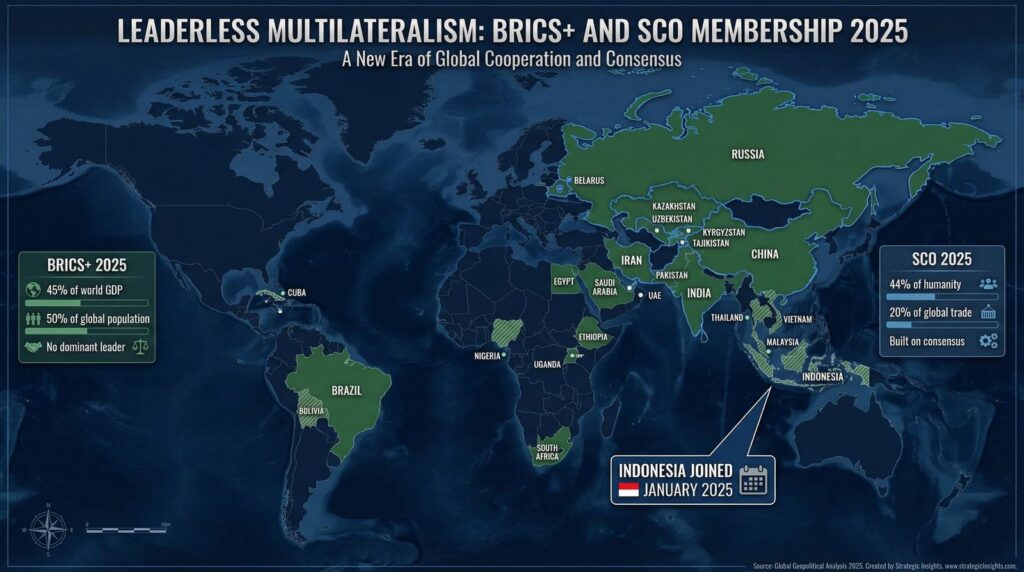
MAP 4BRICS+ Full Members (forest green), SCO Members (steel blue), and BRICS Partner Countries (sage green).
The most intellectually significant exchange in the conversation is Bordachev’s anecdote about a French journalist who asked him what the main advantage of the SCO was. He told her: it has no leader. She was stunned. Bordachev’s observation about her incomprehension is the key to understanding the entire geopolitical divide: she had grown up in a NATO-American world in which any institution must have a leader to function. The absence of a hegemon meant, to her, institutional failure.
Western multilateral institutions are all designed on the assumption that collective action requires a single dominant power to structure cooperation from above. Remove the hegemon, and these institutions become dysfunctional, as the UN has demonstrated repeatedly whenever a crisis does not serve American strategic interests. SCO and BRICS operate on the opposite premise: that sovereignty cannot be subordinated without generating the resistance that ultimately destroys the arrangement.
As the 2025 BRICS Rio Summit Declaration explicitly affirmed, the bloc is built on “mutual respect and understanding, sovereign equality, solidarity, democracy, openness, inclusiveness, collaboration and consensus.” Indonesia became a full member in January 2025. The partner country roster expanded to include Kazakhstan, Uzbekistan, Malaysia, Thailand, Vietnam, Belarus, Bolivia, Cuba, Nigeria, and Uganda. The 2025 summit produced a Leaders’ Framework on Global AI Governance and a Partnership for the Elimination of Socially Determined Diseases, substantive agreements reached without a dominant power imposing terms.
Zero-Sum Thinking as European Philosophy
Bordachev refuses to condemn zero-sum thinking as a strategic error, comparing it instead to a predator’s instinct for meat: not a mistake, but a nature. By contextualizing zero-sum thinking as a feature of European political philosophy rather than a universal law of strategic rationality, he opens an entirely different lens for reading the history of Western grand strategy.
The SCO and BRICS are not weak because they lack hegemonic leadership. They are optimizing for objectives different from those Western analysts assume. The Central Asian states are not fence-sitters exercising unstable ambiguity. They are practicing a tradition of deliberate balance, refined over millennia at the crossroads of competing civilizations. BRICS was not designed to coordinate against the West. It was designed to create optionality, to preserve the freedom of choice for each member state, and to gradually build the financial capacity that reduces dependence on US-controlled institutions.
* * *
PART FIVE: THE IRAN WAR AND ITS EURASIAN CONSEQUENCES
Infrastructure Warfare: The China-Iran Railway as Primary Target
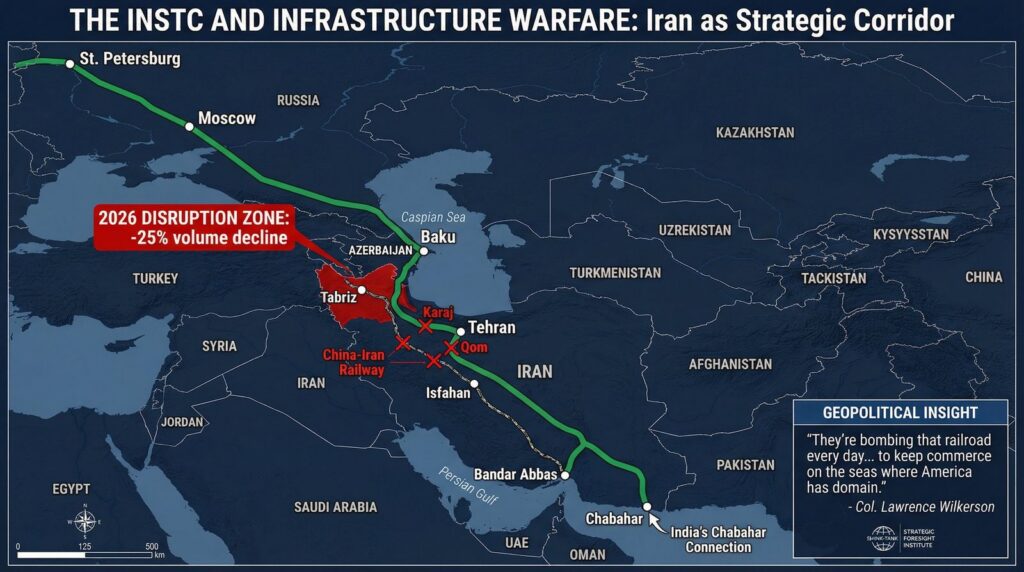
MAP 5The INSTC from St. Petersburg to Bandar Abbas, the 2026 disruption point near Tabriz, Iran’s three strategic functions, and India’s Chabahar connection.
To understand what is actually being destroyed in the Iran war, the testimony of Colonel Lawrence Wilkerson, former Chief of Staff to US Secretary of State Colin Powell, is essential. Speaking with Glenn Diesen in April 2026, Wilkerson identified the primary military objective of the US-Israeli bombing campaign with unusual candor:
“We’re bombing the hell out of that railroad that China had finished, all the way to the Persian Gulf… They’re bombing it. They’re bombing the bejeezus out of it. Every day they’re bombing that railroad… That railroad will take 60% of the commerce that China now generates, which is probably about 40% of the world’s commerce, off the seas, where America has domain, and put it on land. We don’t want that. We don’t want that at all.”
Col. Lawrence Wilkerson, former Chief of Staff to Secretary of State Colin Powell, April 2026
The railroad Wilkerson describes is the China-Iran Railway, a 10,400-kilometer overland freight corridor that opened in June 2025, just ten months before the war began. It was designed to carry freight from Xi’an to the Aprin dry port near Tehran, cutting 15 to 20 days off sea shipping times while bypassing both the Strait of Hormuz and the Malacca Strait simultaneously. Between late February and April 2026, US and Israeli airstrikes hit 8 to 10 railway bridges and line segments specifically along this corridor.
This is not collateral damage. It is the deliberate destruction of the infrastructure that Bordachev identifies as the decisive variable in 21st-century great power competition. The war against Iran is simultaneously a war against the BRI’s most critical land corridor. Wilkerson’s testimony is the clearest possible confirmation of Bordachev’s connectivity thesis, and it comes not from a Russian source but from a former senior US official.
Why Iran’s Collapse Would Hurt the Whole Region
Bordachev’s claim is precise: Central Asians do not want Iran to collapse. The reasoning is not sentimental. A collapsed Iran would not become a stable Western-aligned state. The pattern from Afghanistan to Libya to Syria shows that the US and European powers would attempt to exploit Iranian chaos against Russia and China.
The International North-South Transport Corridor (the 7,200-kilometer route running from Russia through Azerbaijan and Iran to the port of Bandar Abbas on the Persian Gulf) has already seen projected volume declines of 25% or more in 2026 as the conflict continues, with disruption concentrated in Iran’s northwest between Tabriz and the Caspian port of Bandar Anzali beginning in late February 2026. The corridor that was supposed to give Russia, Central Asia, and India a viable alternative to the Suez Canal has been effectively cut at its most critical point.
The Trans-Afghan Corridor: From Aspiration to Urgency
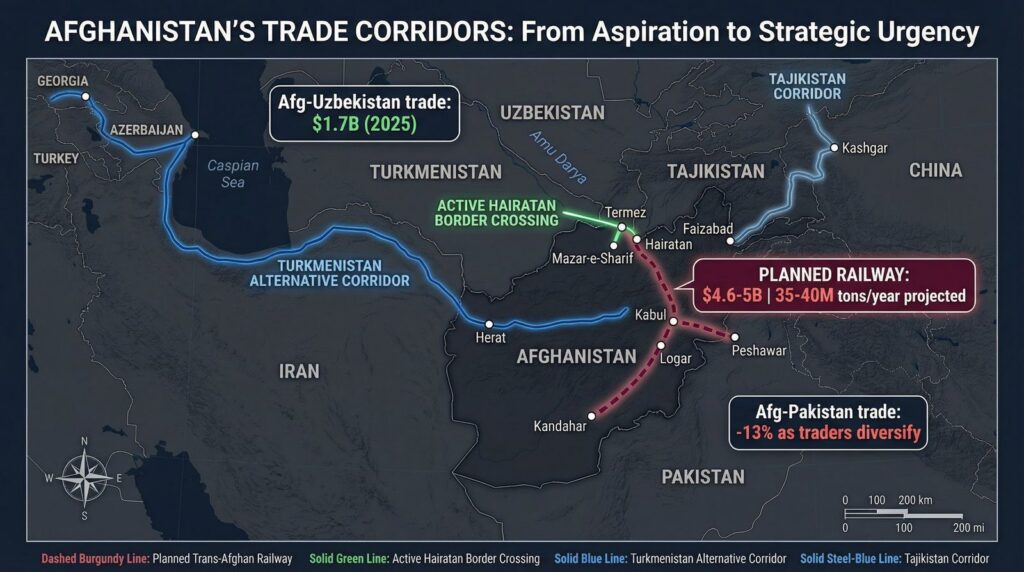
MAP 6Afghanistan’s trade corridors, the planned Trans-Afghan Railway (Termez to Peshawar), the active Hairatan crossing, and Turkmenistan and Tajikistan alternatives.
The planned railway from Termez through Mazar-e-Sharif and Logar in Afghanistan to Peshawar is estimated at $4.6 to $5 billion and would reduce shipping times from 35 days by truck to approximately 5 days by rail. Projected freight volumes upon completion are estimated at 35 to 40 million tons per year. Trade between Afghanistan and Uzbekistan reached $1.7 billion in 2025, up sharply from $1.1 billion in 2024.
The Taliban’s active diversification away from dependence on Pakistan has accelerated the development of three parallel routes: through Uzbekistan via Hairatan, through Turkmenistan connecting to the Caspian Sea and Turkey, and through Tajikistan to western China. Afghanistan-Pakistan trade fell 13% year-on-year as traders diversified. These obstacles (lack of international recognition, high tariff structures, underdeveloped logistics infrastructure) are not fatal barriers. They are the precise conditions under which sophisticated private capital structuring becomes indispensable.
Disruption Creates Opportunity: Where the Capital Is Going
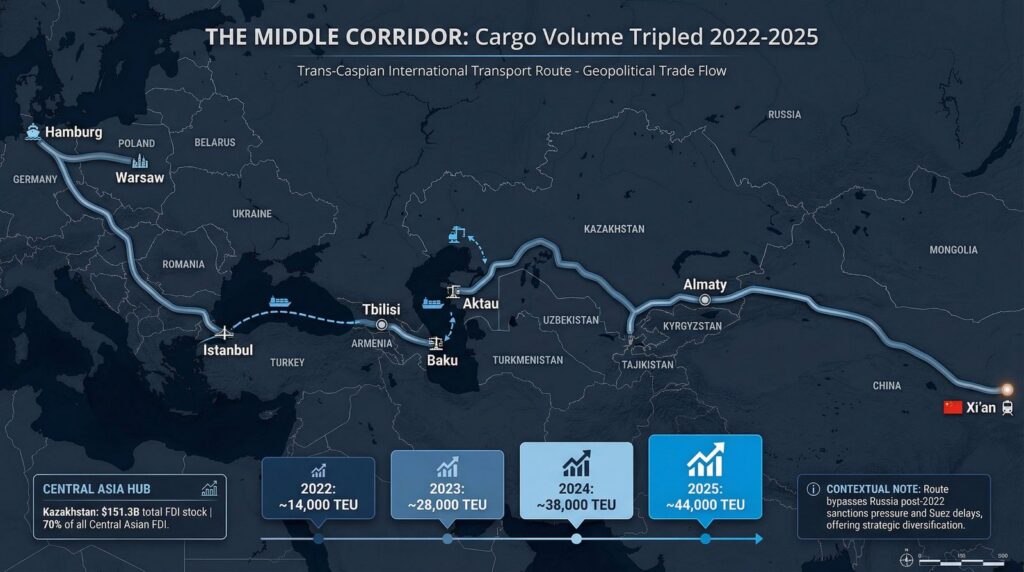
MAP 7The Middle Corridor from China through Kazakhstan, across the Caspian, through Azerbaijan and Georgia to Europe, cargo volume tripled 2022-2025.
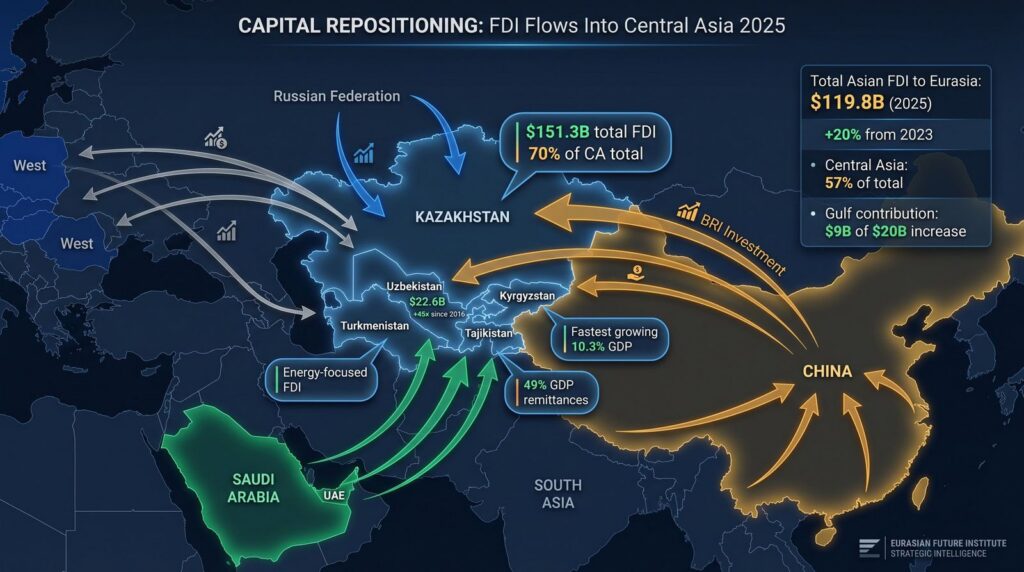
MAP 8Foreign Direct Investment flows into Central Asia. Total Asian FDI: $119.8 billion, up 20% from 2023. Central Asia = 57% of total.
Total Asian foreign direct investment into the Eurasian region reached $119.8 billion by mid-2025, a 20% increase from 2023. Central Asia accounted for 57% of that total. Gulf state investment provided $9 billion of the $20 billion increase in 2024-2025. Uzbekistan’s investment stock from Asian sources grew more than 45-fold from 2016 levels, doubling in 2024-2025 alone from $11 billion to $22.6 billion. Kazakhstan attracted nearly 70% of all FDI in the region with a total stock of $151.3 billion. These are not marginal flows.
* * *
PART FIVE-B: WHY THE DEMOLITION WILL BE VIOLENT, THE KRAINER PERSPECTIVE
Bordachev’s analysis is fundamentally optimistic: the new architecture is already being built, the World Majority has demonstrated its behavioral pattern, and the structural foundations of the post-American order are already in place. Alex Krainer, writing on the same day as this article, reaches the same destination by a different route, and his near-term prognosis is far darker. Where Bordachev describes where things end, Krainer describes what the journey looks like.
Krainer’s argument is structural rather than geopolitical. The Western financial system requires the continuous conquest of new collateral, resource wealth pledged against the debt the system creates from nothing, to refinance its own inflation. Iran holds an estimated $35 trillion in natural resource wealth. Gaining political control over Tehran would re-inflate a system that is, in Krainer’s assessment, already imploding. This means the war is not a policy choice that could be reversed by a different administration or a different set of diplomats. It is a systemic imperative.
“For the bankers, it’s either bringing new collateral into the system or it’s their whole system imploding. They don’t know how to do anything else… And they will sacrifice every nation that they occupy (like the United States, Great Britain, France and so forth) completely, in order for their system to survive.”
Alex Krainer, April 10, 2026
The relationship between Bordachev and Krainer is not contradiction. It is complementarity across time horizons. Bordachev is right about where things end: the new architecture is being built, the World Majority’s behavioral pattern is irreversible, and the five load-bearing claims are already operational realities. Krainer is right about what the journey looks like: sustained infrastructure destruction, manufactured crises, financial system fractures, and a transitional period far more violent and disruptive than any optimistic reading of the structural data would suggest. The new order is not arriving peacefully. It is arriving through the wreckage of the old one.
* * *
PART SIX: THE WORLD MAJORITY CONCEPT
What It Is and What It Is Not
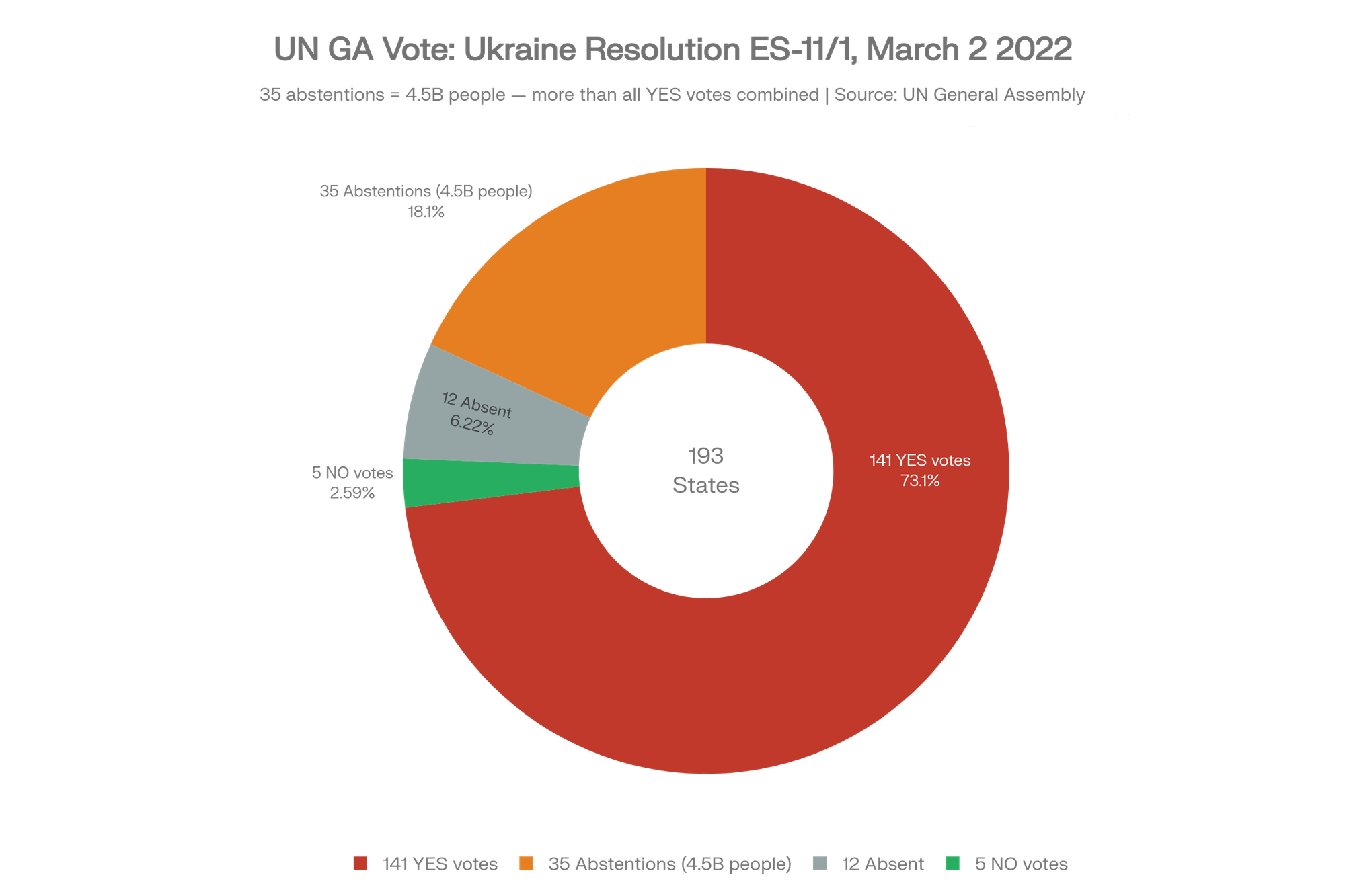
INFOGRAPHIC 1UN General Assembly Resolution ES-11/1, March 2, 2022 to 141 yes, 35 abstentions representing 4.5 billion people, 5 no votes, 12 absent.
The “World Majority” concept, which Bordachev formally introduced in his October 2024 Valdai report, must be carefully distinguished from earlier concepts it resembles but transcends. The Non-Aligned Movement (1961) was defined by refusal to align with either Cold War bloc, a political stance organized around a specific bipolar structure that ceased to exist when the Soviet Union collapsed. The “Global South” concept is geographic and developmental. Neither captures what Bordachev is describing.
The World Majority is defined by a specific pattern of behavior revealed in 2022: the refusal, by a majority of the world’s states representing the majority of the world’s population, to join Western sanctions against Russia. This refusal was not coordinated. It was not the product of a shared ideology. It was the independent behavior of states that have each calculated that the freedom to make their own choices has greater sovereign value than the compliance demanded by the United States and its allies.
The Financial Architecture Being Built
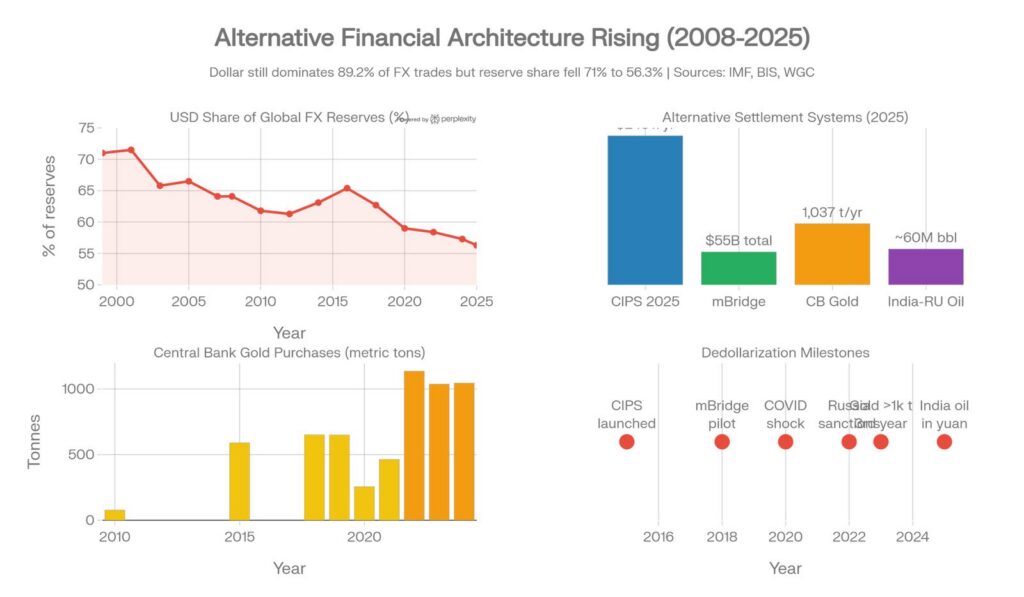
INFOGRAPHIC 2Alternative financial architecture: CIPS $245T settled, mBridge $55B processed, dollar reserve share at 56.3%, 1,000+ tons annual central bank gold purchases.
The mBridge platform has processed approximately $55 billion in transactions, 95% in digital yuan, with 26 central banks participating. China’s CIPS settled the equivalent of $245 trillion in 2025, up 43% year over year. The dollar’s share of global foreign exchange reserves has fallen from 71% in 2008 to 56.3% in 2025. Central banks have bought over 1,000 metric tons of gold annually for three consecutive years. In March 2026, Indian refiners settled a significant portion of roughly 60 million barrels of Russian crude in yuan, the largest single month of non-dollar oil settlement in India’s history.
The honest caveats matter. The dollar still sits on one side of 89.2% of all global foreign exchange transactions. China’s capital controls still limit yuan internationalization. BRICS has explicitly ruled out a common currency. ING projects the transition will take a decade or more. This is not a revolution. It is a slow rebalancing measured in decades, not years. What matters is the direction.
* * *
PART SEVEN: RUSSIA’S MOST UNDERAPPRECIATED STRATEGIC ASSET
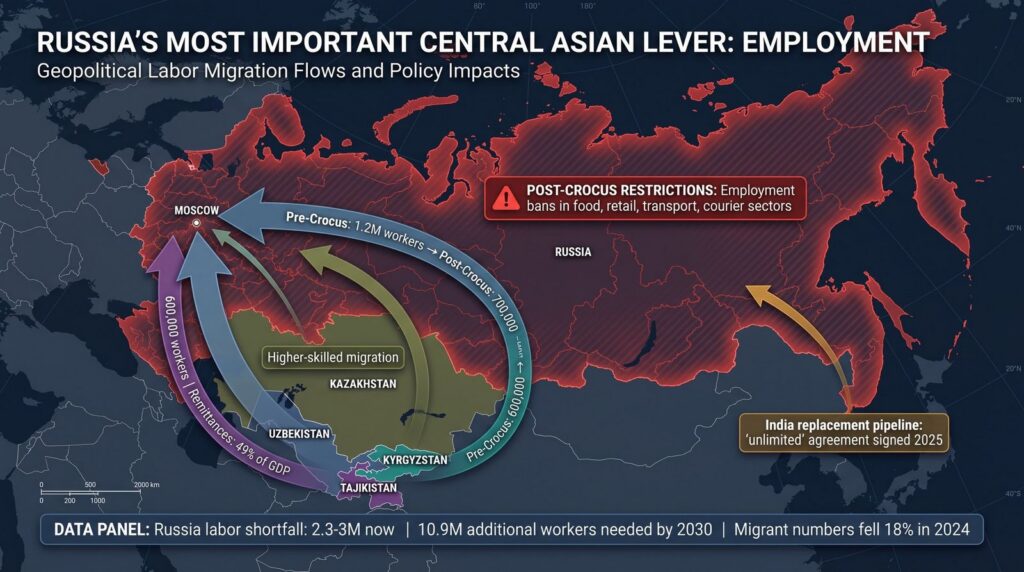
MAP 9Central Asian labor migration to Russia, flow arrows, pre/post-Crocus migrant numbers, and remittance percentages of GDP for each republic.
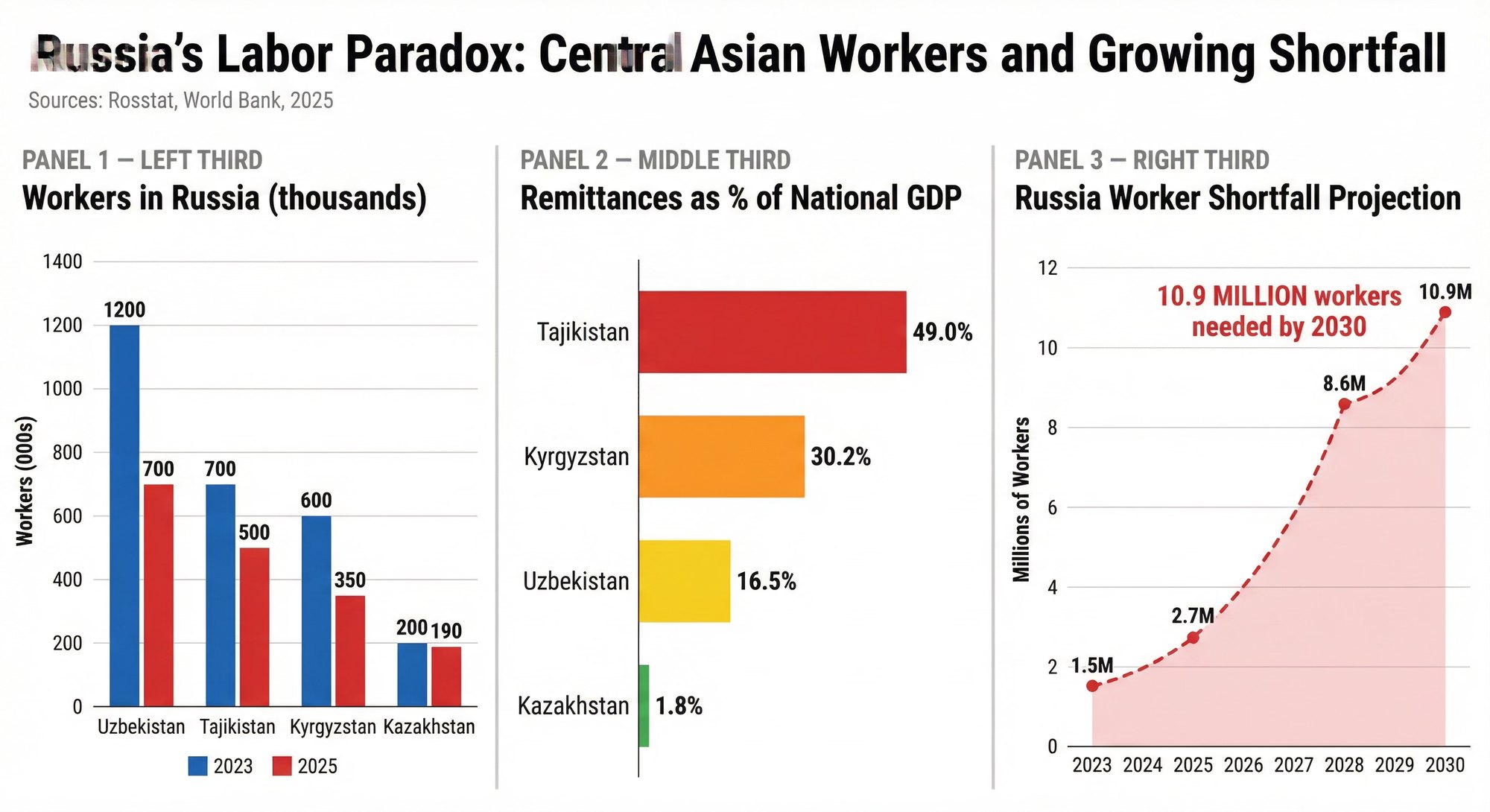
INFOGRAPHIC 3Russia’s labor arithmetic, the 2.3-3M worker shortfall, the 10.9M demand by 2030, the post-Crocus migrant collapse, and the India replacement pipeline.
Employment: The Foundation That Is Cracking
Russia’s most important source of influence in Central Asia is not military, political, or ideological. It is employment. Seven to ten million Central Asians work in the Russian economy at any given time, and the remittances they send home are not peripheral income. In Tajikistan they amount to roughly 49% of GDP. In Kyrgyzstan, over 30%. Russia makes jobs. That simple fact, more than any military base or political lever, is the foundation of Russian influence in the region.
Following the March 2024 ISIS-K attack on Crocus City Hall, Russian public opinion turned sharply hostile toward Central Asian workers. Authorities introduced employment bans in food service, retail, transport, and courier work, and expanded police powers to deport workers without court orders. Central Asian migrant numbers fell 18% in 2024. Kyrgyz migrants dropped from 600,000 to 350,000 by 2025. Uzbek workers fell from 1.2 million to around 700,000. Russia is now recruiting replacement labor from India, signing agreements in late 2025 for what its Deputy Prime Minister called an ‘unlimited’ number of Indian workers.
Russia’s Labor Minister told Putin in 2025 that the economy would need 10.9 million additional workers by 2030 to meet wartime production targets. If the trend holds, Russia will have damaged the one instrument of influence in Central Asia that no military alliance or political agreement could replicate.
* * *
SYNTHESIS: WHAT BORDACHEV IS ACTUALLY SAYING
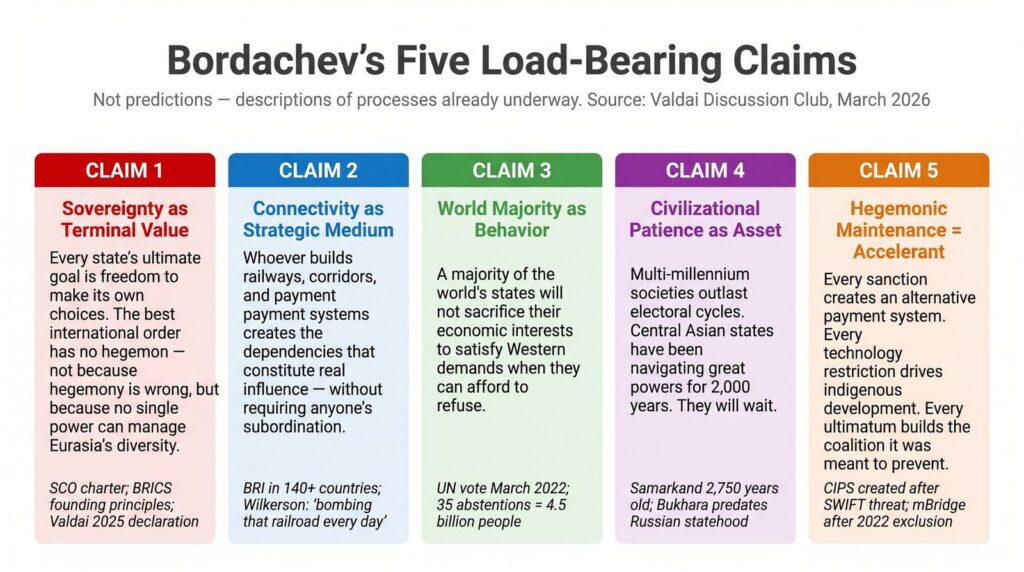
INFOGRAPHIC 4Five load-bearing claims: sovereignty as terminal value, connectivity as strategic medium, the World Majority as behavior, civilizational patience as asset, and hegemonic maintenance as accelerant.
Across his article and the conversation with Diesen, Bordachev advances five load-bearing claims about the world that is arriving.
First: every state’s ultimate strategic objective is the freedom to make its own choices. The best international order for achieving this is one without a hegemon, not because hegemony is morally wrong, but because Eurasia’s civilizational, geographic, and economic diversity exceeds any single power’s capacity to manage it from above.
Second: the real competition of the 21st century is not for territory but for connectivity. Whoever builds the railways, corridors, payment systems, and energy networks creates the dependencies that constitute real influence without requiring anyone’s subordination. This is why the China-Iran Railway, not the Strait of Hormuz, is the primary military target of the 2026 Iran campaign. Colonel Wilkerson’s testimony makes this explicit: what is being bombed is not Iranian military capacity. What is being bombed is the infrastructure that would make American sea-lane dominance obsolete.
Third: the World Majority is not an alliance. It is a pattern of behavior. A majority of the world’s states have demonstrated, in practice, that they will not sacrifice their own economic interests to satisfy Western demands when they can afford to refuse.
Fourth: civilizational patience is a strategic asset. The Central Asian states, Afghanistan, Iran, and the broader World Majority are societies with multi-millennium traditions of navigating between great powers, absorbing invasion, and reconstituting themselves with their cultural cores intact. Western strategy, driven by electoral cycles and media attention spans, consistently underestimates how long non-Western actors are willing to wait.
Fifth: every American effort to prevent multipolarity accelerates it. Every sanctions regime produces alternative payment systems. Every technology restriction produces indigenous development. Every demand for political alignment produces deliberate multi-sided foreign policy as the rational response. The tools of American hegemony are simultaneously the tools of World Majority construction.
These five claims are not predictions. They are descriptions of processes already underway, visible in trade data, payment system volumes, infrastructure contracts, and the blast walls coming down in Kabul.
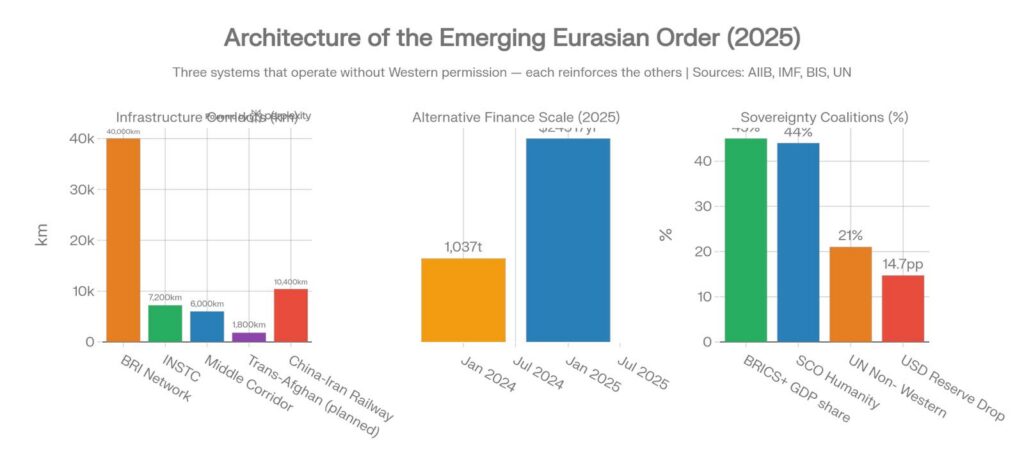
INFOGRAPHIC 5The Architecture of the Emerging Eurasian Order: infrastructure corridors, alternative payment systems, and sovereignty coalitions, three systems that do not require Western permission to function.
* * *
AUTHOR’S NOTE: THE WORLD MAJORITY’S COMMUNICATION PROBLEM
Every country in the World Majority faces the same problem that Bordachev identifies but does not address: it needs to explain its strategic choices to its own public, to institutional investors, to credit rating agencies, and to international counterparties in language that is technically credible, politically defensible, and calibrated for audiences with widely varying levels of sophistication.
The West solves this problem through a vast ecosystem of think tanks, media institutions, academic networks, and public diplomacy infrastructure that continuously produces accessible analysis presenting Western strategic choices in the most favorable light to target audiences. The World Majority has almost none of this. The Valdai Club serves Russia. Chatham House serves Britain. Carnegie serves Washington. None of them serves the multi-sovereign, multi-audience communication needs of the World Majority as a whole.
Connecting Gulf capital to Eurasian infrastructure requires structured capital formation, forward liability tools, tax credit architectures, and liability management instruments that allow governments to make the case to their own publics and to global asset managers simultaneously.
* * *
Scott Ortkiese is the founder of Throughline Synthesis Group, which produces geopolitical and financial analysis for institutional clients navigating the transition to a multipolar order.
so@throughlinesynthesis.com · www.throughlinesynthesis.com
Related reading
- The Iran War’s Hidden Toll on Asia-Pacific: A War of Choice, a Region in Collapse, and a Bill Every American Will Pay
- The Aluminum Pearl Harbor: Trump and Netanyahu Sank America’s Industrial Fleet
- America’s Suicidal Empire: The Iran War, the Death Spiral of a Failing Hegemon, and the World We Are Destroying
- Trump Is Gambling America’s Power on a Losing Hand