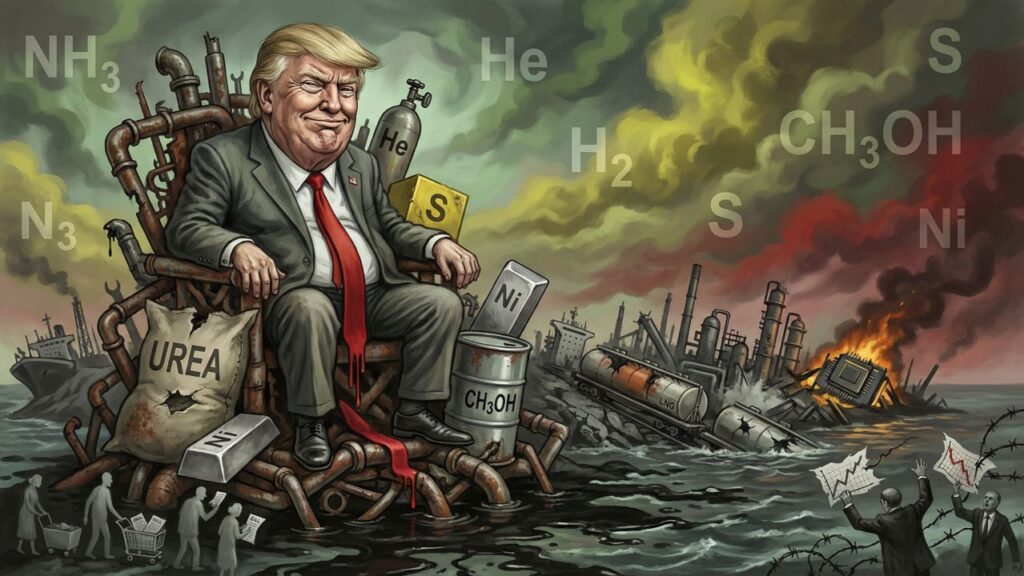
Most Americans think of supply chain disruptions in terms of port delays and empty shelves. This is a different kind of disruption. This one starts at the atomic level, with the molecules and elements whose names you likely haven’t spoken since high school chemistry. And because of what the United States and Israel chose to do on February 28, 2026, those molecules are now geopolitical weapons. Their absence will arrive quietly, indirectly, and with an inflationary persistence that Washington has neither acknowledged nor begun to address.
I. The Gas That Holds the Economy Together, And You’ve Never Heard of It
Start with a balloon.
Not the kind filled with hot air, the kind floated at a birthday party, the Mylar kind that drifts toward the ceiling and stays there. The gas inside that balloon is helium. You know that. What you may not know is that helium is also the molecule that stands between civilization’s most advanced technology and catastrophic dysfunction.
Helium is not manufactured. It cannot be synthesized. It is produced, slowly and irreversibly, through the radioactive decay of uranium and thorium deep within the Earth’s crust, a process measured in geological time, not industrial quarters. Alpha particles shed by decaying uranium nuclei are, in fact, helium-4 nuclei. Over millions of years, those particles accumulate in the same underground formations that trap natural gas, sealed by impermeable caprock. Pump the natural gas and you capture the helium with it. Release the helium to open air and it rises, reaches escape velocity, and bleeds into space, gone forever, irretrievably. It is, by physical law, a non-renewable resource that humanity is currently burning through at a rate several geologists have estimated will exhaust the planet’s accessible supply within twenty-five to thirty years at current consumption rates.
Now consider what helium actually does in the modern industrial economy.
In semiconductor fabrication facilities (the immaculate, hyper-controlled clean rooms where memory chips and logic chips are made) helium performs two irreplaceable functions. It is used to purge and cool the internal environments of the equipment that deposits thin films of material onto silicon wafers. It maintains the cryogenic temperatures required for precision cooling at certain process steps. Because helium is chemically inert (it reacts with nothing), it can be used without fear of contamination. Because of its extraordinarily high thermal conductivity for a gas its size, it transfers heat with unmatched efficiency. There is no substitute. No other gas replicates both its inertness and its thermal properties at the temperatures semiconductor fabrication requires. When helium supply tightens, fab yields fall, more defective chips per wafer, higher cost per good die, lower output volume.
Qatar produces roughly thirty to thirty-eight percent of the world’s helium supply (extracted as a byproduct of processing the North Field’s natural gas at the Ras Laffan Industrial City, the single largest LNG complex on Earth. South Korea, home to Samsung and SK Hynix) which together produce approximately two-thirds of the world’s memory chips, including the High Bandwidth Memory (HBM) modules that power every AI data center on the planet, sources 64.7 percent of its helium imports from Qatar.
On February 28, 2026, the United States and Israel launched coordinated strikes on Iran. Iran retaliated. On March 19, Iranian forces struck Ras Laffan. QatarEnergy declared force majeure. The world’s dominant helium production node went offline.
Samsung and SK Hynix have approximately six months of helium in inventory. Their executives have said so, publicly. A South Korean ruling party lawmaker, Kim Young-bae, warned after meeting with industry leaders that “officials have indicated that the production of semiconductors might be compromised if we are unable to procure certain essential materials from the Middle East.” South Korean chipmakers are now conducting emergency procurement outreach to American suppliers and Russian suppliers simultaneously, the latter of which ought to generate some interesting conversations in Washington about the downstream logic of its own foreign policy.
Think about what downstream from Samsung and SK Hynix means. It means AI data centers, the servers running every large language model, every cloud computing product, every digital transaction platform in the world. It means automotive electronics. It means medical devices. Consumer electronics. Defense systems. Telecommunications infrastructure. All of it sits downstream from a gas molecule that forms over millions of years underground in Qatar and that Washington helped knock offline without apparently considering whether this might be relevant.
The United States Congress authorized fifty-two billion dollars under the CHIPS Act to secure domestic semiconductor supply chains. The war that the administration launched is now threatening the primary fabrication input for its closest allied chip producers. The irony is so complete it is almost structurally beautiful, a policy monument to strategic incoherence at a scale rarely achieved in modern governance.
Helium is the opening case. The logic that makes helium a crisis extends, in different forms, to dozens of industrial molecules and elements that are only now revealing their Persian Gulf dependencies to an American public that was never told they existed.
II. Nitrogen, Hydrogen, and the Molecule That Feeds Half of Humanity
In 1909, German chemist Fritz Haber demonstrated in his laboratory that nitrogen gas from the atmosphere could be combined with hydrogen gas under extreme heat and pressure to produce ammonia. Carl Bosch industrialized the process by 1913. Both men eventually received the Nobel Prize, Haber in 1918, Bosch in 1931. The process they built, known as Haber-Bosch, is arguably the most consequential industrial achievement in human history. It directly enabled the global population to grow from 1.6 billion in 1900 to 8 billion today. Remove it, and roughly half the nitrogen atoms currently inside human bodies, fixed into the crops that were eaten, would not exist in a biologically available form.
To understand why the Strait of Hormuz is a global food security chokepoint, you need to understand this process at the molecular level.
Step One: Where the hydrogen comes from.
The Haber-Bosch process requires hydrogen gas (H₂) in enormous quantities. Today, approximately 72 percent of the world’s ammonia is produced using natural gas as the hydrogen source, specifically through a process called Steam Methane Reforming (SMR). In the SMR reactor, methane (CH₄) and steam (H₂O) are passed over a nickel catalyst at high temperature. The reaction breaks the carbon-hydrogen bonds in methane and the oxygen-hydrogen bonds in water, yielding carbon monoxide and hydrogen gas: CH₄ + H₂O → CO + 3H₂. This “syngas” then passes through a second reactor where the water-gas shift reaction converts the remaining carbon monoxide: CO + H₂O → CO₂ + H₂. The carbon dioxide is removed by chemical scrubbing, leaving a high-purity hydrogen stream. Approximately sixty percent of the natural gas input to an ammonia plant is used as chemical feedstock, the molecular raw material from which the hydrogen atoms in ammonia are ultimately derived. The remaining forty percent is burned as fuel to generate the heat and compression energy the process requires.
There is no cheap way to make hydrogen at industrial scale without natural gas. Alternative hydrogen production methods, electrolysis using renewable electricity, exist and are growing, but they currently represent a tiny fraction of global ammonia production capacity. The Gulf’s industrial dominance in ammonia production is not accidental. It exists precisely because the Gulf sits on vast reserves of cheap, abundant natural gas. The feedstock cost advantage is structural.
Step Two: Where the nitrogen comes from, and the industrial gases that come with it.
Nitrogen is not scarce. It constitutes approximately 78 percent of every breath of air on Earth. The challenge is not scarcity, it is energy. Atmospheric nitrogen (N₂) is an extraordinarily stable molecule. The triple bond between its two nitrogen atoms is one of the strongest in all of chemistry, requiring enormous energy inputs to break. Making that nitrogen chemically available, “fixing” it, requires the Haber-Bosch reactor’s combination of high temperature (300 to 500°C), extreme pressure (150 to 300 atmospheres), and an iron-based catalyst.
The nitrogen itself is produced in large air separation units (ASUs) adjacent to ammonia plants. The cryogenic air separation process works by exploiting the different boiling points of air’s components. Atmospheric air is drawn in, filtered, compressed to roughly six to eight bar, and pre-cooled to remove moisture and carbon dioxide using molecular sieve adsorbers. The purified air is then routed through a multi-stream heat exchanger, a “cold box”, and cooled to approximately, 185°C, at which point it partially liquefies. The liquid air enters a high-pressure distillation column, where components separate according to their boiling points: nitrogen boils at, 196°C, argon at, 185.8°C, and oxygen at, 183°C. Because nitrogen is the most volatile, it rises to the top of the column as a pure vapor. Oxygen-rich liquid collects at the bottom and passes to a second low-pressure column for further purification. The result: streams of high-purity nitrogen (typically >99.99%), oxygen, and, in facilities designed to capture it, liquid argon.
This air separation process is also the origin of the industrial gases that the entire advanced manufacturing economy depends upon: the oxygen used in steelmaking and medical settings; the argon used as an inert shield gas in precision welding; the nitrogen used for inerting pipelines, preventing oxidation in food packaging, and in countless industrial applications. The same infrastructure that produces nitrogen for ammonia synthesis produces the invisible molecular scaffolding of modern industry. The Gulf’s dominance in this sector is a function of the same cheap natural gas advantage that powers everything else.
Step Three: Ammonia, and what it becomes.
The pure hydrogen stream from the SMR unit and the nitrogen stream from the ASU are blended in a three-to-one ratio (H₂:N₂) and fed into the synthesis reactor under Haber’s conditions: 300 to 500°C, 150 (300 atmospheres, iron catalyst with potassium and aluminum oxide promoters. The ammonia yield per pass is relatively low) typically 15 to 25 percent, because the reaction is an equilibrium. Unreacted gases are separated and recycled back. The ammonia (NH₃) is condensed to liquid at approximately, 20°C for storage and transport.
From ammonia, the entire portfolio of nitrogen-based fertilizers is derived:
Ureathe world’s most widely traded nitrogen fertilizer, is produced by reacting ammonia with carbon dioxide: 2NH₃ + CO₂ → (NH₂)₂CO + H₂O. The resulting granules contain 46 percent nitrogen by weight and are the standard currency of agricultural nitrogen markets. Iran and Qatar are among the world’s largest urea exporters.
Ammonium Nitrate (AN) is produced by reacting ammonia with nitric acid (itself made from ammonia). It contains approximately 34 percent nitrogen and is the basis of European nitrogen fertilizer use and American UAN (urea-ammonium-nitrate) solutions used on corn and wheat.
Phosphate fertilizersspecifically DAP and MAP, are produced by reacting ammonia with phosphoric acid derived by treating mined phosphate rock with sulfuric acid. This is where sulfur enters the fertilizer equation: without sulfur to produce sulfuric acid, phosphate rock cannot be converted to plant-available fertilizer. Morocco’s OCP, the world’s largest phosphate producer, imports 3.7 million metric tonnes of Gulf sulfur annually. It is facing its own supply crisis.
Potash (potassium chloride, the third major fertilizer nutrient) is mined from underground deposits (primarily in Canada, Russia, and Belarus) and is not directly dependent on Gulf gas. However, potash is almost always applied in combination with nitrogen and phosphate. Disrupting nitrogen availability simultaneously undermines the agronomic logic of applying potash at all.
The Gulf’s five major exporters (Iran, Qatar, Saudi Arabia, the UAE, and Bahrain) account for 34 percent of global urea trade. The International Fertilizer Association estimates the wider Middle East supplies nearly 50 percent of globally traded urea. UNCTAD calculates approximately one million tonnes per month of nitrogen, ammonia, phosphates, and sulfur transit through the Strait of Hormuz.
The Strait of Hormuz is not primarily an oil chokepoint. It is a calorie chokepoint.
Before the first bomb fell, urea was already elevated at $450 to 475 per ton at the U.S. Gulf. Within days of the opening strikes, bids reached $520 to 550. Within a week, dealers were quoting $700 as spring planting panic swept markets. S&P Global’s granular urea benchmark rose 38.8 percent by March 13. Argus Media documents Middle East export benchmarks approximately 60 percent above year-ago levels. Wolfe Research estimates the fertilizer disruption alone could raise food-at-home inflation for American consumers by roughly two percentage points.
The northern hemisphere spring planting window runs from late March through May. It is open now. Nitrogen fertilizer not reaching fields by mid-May does not reduce yields, it eliminates them, entirely, for the current season. University of Illinois crop scientists estimate the corn yield penalty at up to 1.75 bushels per acre per day of planting delay past the end of April. There is no diplomatic exception to the agronomic calendar.
This is what a molecule looks like when it becomes a weapon.
III. Sulfur, Nickel, and the Steel That the World Must Now Build
The third cascade begins with a yellow element most people associate with the smell of rotten eggs. Sulfur is, in fact, one of the most industrially critical elements on the periodic table, and one of the least visible in public discourse about this war.
In the modern electric vehicle supply chain, the path from raw nickel ore to battery-grade nickel passes through one of the most chemically aggressive industrial processes in existence: High-Pressure Acid Leach, or HPAL. Nickel-bearing laterite ores are dissolved in concentrated sulfuric acid at temperatures of 250 to 270°C and pressures of 40 to 50 bar, releasing the nickel (and cobalt) into an aqueous solution from which they can be selectively recovered and purified into the Mixed Hydroxide Precipitate (MHP) that battery manufacturers use for cathode material in lithium-ion cells.
Sulfuric acid (H₂SO₄) is made by burning sulfur and reacting the resulting sulfur dioxide with oxygen and water. The sulfur input is the critical variable. Indonesia (the world’s largest nickel producer, accounting for more than 50 percent of global output) imports approximately 75 percent of its sulfur from the Middle East, the majority transiting through the Strait of Hormuz. HPAL facilities in Indonesia typically hold only one to two months of sulfur inventory.
The math is unambiguous. Before the conflict, sulfur already constituted approximately fifty percent of HPAL operating costs. S&P Global Market Intelligence documented that Indonesia imported over 5.2 million metric tonnes of sulfur in 2025, a 44 percent year-on-year increase driven by HPAL expansion. That expansion has made Indonesia simultaneously more critical to global battery supply chains and more structurally dependent on Gulf sulfur, at the precise moment the Gulf is burning.
Should HPAL operations curtail, which the Indonesian Nickel Industry Forum has warned is the direct consequence of a prolonged Hormuz disruption, the effects ripple through every industry that depends on stainless steel and battery-grade nickel. Every major automobile manufacturer on Earth. Stainless steel for food processing, pharmaceuticals, medical devices, water treatment, and chemical plants. And, critically, the cryogenic pipeline steel used in LNG infrastructure.
Which brings us to the reconstruction demand crisis that almost nobody is discussing.
LNG trains are not simple structures. They are immense cryogenic processing facilities that cool natural gas to approximately, 162°C, below the boiling point of methane, converting it to liquid form for transport. The materials required are not standard construction commodities. LNG storage tanks and processing infrastructure require 9% nickel steela specific alloy developed in the 1940s following the catastrophic Cleveland LNG explosion of 1944, which resulted from the brittle fracture failure of a tank made with insufficient nickel. At cryogenic temperatures, standard carbon steel undergoes a ductile-to-brittle transition: it shatters under stress. Nickel at the 9% level suppresses this transition by stabilizing a fine-grained microstructure that remains tough even at, 196°C. The Type 304 and Type 316 austenitic stainless steels, used across petrochemical, food, and pharmaceutical infrastructure, contain 8 and 11 percent nickel respectively. Approximately 65 percent of all global nickel production flows into stainless steel production. There is no substitute for nickel in these cryogenic and corrosion-resistance applications.
QatarEnergy has confirmed the Iranian attacks damaged two of its fourteen LNG trains, with three-to-five-year repair timelines. The Financial Times described Ras Laffan as “a massive industrial site three times the size of Paris, constructed over 30 years at a cost of hundreds of billions of dollars.” South Pars (struck by Israeli jets, representing 80 percent of Iran’s domestic gas supply) is a potential candidate for total destruction at American hands if Trump’s threats are executed.
The reconstruction mathematics are staggering. Each destroyed LNG train requires thousands of tonnes of 9% nickel steel plate, precision-fabricated cryogenic pipeline, high-alloy pressure vessels, heat exchanger bundles, and instrumentation. Multiply that by the infrastructure damage across South Pars, Ras Laffan, and the other Gulf installations struck in this conflict. Add the pipeline and refinery reconstruction that Iran itself will require at war’s end. Add the hardened military infrastructure being rebuilt across the region.
You get a commodity pincer of near-mathematical certainty: nickel supply constrainedby the HPAL sulfur feedstock crisis on the supply side, and nickel demand spiking from Gulf reconstruction requirements on the demand side, for years. This intersection has received almost zero attention in mainstream commodity analysis. It represents one of the most consequential structural dynamics in global materials markets in a generation.
Sulfur is simultaneously being rationed across three competing user categories: Indonesia’s HPAL nickel processors, Africa’s copper miners (the DRC imported 1.3 to 1.4 million tonnes of Middle East sulfur last year), and global phosphate fertilizer producers. The Middle East accounts for approximately 24 percent of the world’s sulfur production. Replacing that volume from North American or Russian sources is a multi-year infrastructure project, not a logistics problem. Conflict surcharges, rerouting delays around the Cape of Good Hope (adding two weeks to transit), and war-risk insurance premia compound costs on every alternative supply path.
IV. Methanol: The Invisible Chemical Economy
There is a fourth molecule that has received almost no coverage in the American press, despite the fact that it underlies a staggering range of products Americans buy every week.
Methanol (CH₃OH, the simplest alcohol) is not a consumer product. It is a chemical precursor and feedstock for a vast range of industrial products: formaldehyde (building materials, adhesives, resins), acetic acid (plastics, textiles), MTBE and DME (fuel additives), olefins (the building blocks of polyethylene and polypropylene plastics), and direct fuel use. It is also a primary feedstock for biodiesel and an increasingly important marine fuel.
The Strait of Hormuz controls an estimated 35 to 45 percent of global seaborne methanol exports, a share that surpasses even its proportional importance for crude oil. Iran is among the world’s largest methanol producers, with annual output exceeding 7 million metric tonnes, using the country’s vast natural gas reserves as feedstock. Saudi Arabia’s Ar-Razi facility (a joint venture that includes Japan’s Mitsubishi Gas Chemical, with annual capacity exceeding 4 million metric tonnes) has suspended supply under force majeure since the opening strikes.
Iranian methanol exports have come to a complete standstill. Military strikes have damaged portions of Iran’s natural gas infrastructure, which serves simultaneously as feedstock for methanol synthesis and fuel for production facilities. Even intact facilities cannot export while the Strait is functionally closed to commercial shipping.
The downstream consequences flow into plastics manufacturing, adhesives, construction materials, packaging, and fuel markets across Asia. China, the world’s largest methanol consumer, faces supply pressure that filters directly into the cost structure of every product its factories make, and therefore into the price of every imported good on American shelves. There is no “Made in China” label that is unaffected by what has happened to methanol prices in the Persian Gulf.
The American Economic Association has a term for what is building across these four cascades: stagflation. Rising input costs across the entire productive economy (energy, food, chemicals, metals) combined with demand weakness from consumer uncertainty and policy chaos. The Federal Reserve entered this conflict already wrestling with inflation above its 2 percent target and signs of labor market softening. Fed Chair Powell has described effectively zero net private-sector job creation over the preceding six months. The standard central bank response to commodity-driven inflation, raise rates, simultaneously deepens the demand-side recession. The standard response to a weakening economy, cut rates, pours fuel on inflationary pressure. There is no clean exit from that trap. The CFR describes the risk precisely: “elevated rates against a backdrop of labor market weakness and a financially stretched consumer raise the specter of stagflation.”
V. The Domestic Inflation Feedback Loop, Why Helping Allies Costs Americans More
There is a mechanism that Washington’s economic communicators have consistently obscured: when the United States steps in to supply energy-desperate allies with its own natural gas, as LNG exports, it directly raises the price Americans pay for gas at home.
This is not an accusation. It is basic market economics.
The United States enters 2026 with an unprecedented ramp-up in LNG export capacity. New facilities (Plaquemines LNG, Corpus Christi Stage 3, Golden Pass Train 1, Port Arthur) are adding an estimated 6 to 8 billion cubic feet per day of incremental feedgas demand by year end. Each LNG cargo departing a U.S. Gulf Coast terminal is a precise quantity of natural gas removed from the domestic supply balance. More exports mean a tighter domestic market. A tighter domestic market means a higher floor under the Henry Hub benchmark price.
The mechanism that transmits Gulf disruption into American utility bills runs as follows: Ras Laffan and South Pars damage removes LNG supply from global markets. European buyers, who have been competing for LNG since the 2022 Nord Stream sabotage cut Russian gas, now face acute shortfall. Asian buyers (Japan, South Korea, China, Taiwan, Vietnam) simultaneously face the same shortfall because Hormuz is closed to their Gulf deliveries. Both regions intensify competition for every available cargo. European TTF natural gas prices surged nearly 30 percent following the Ras Laffan attacks. Asian JKM benchmark prices track in parallel. This global price spike creates enormous arbitrage profit for US LNG exporters, incentivizing them to maximize export volumes and leaving domestic consumers competing for a smaller supply.
A pre-war analysis of U.S. LNG economics stated the dynamic with clinical precision: “Increased exports connect the U.S. domestic natural gas market to higher global prices, driving higher electricity and heating bills for U.S. households.” The same analysis estimated rising LNG exports could impose up to $125 billion in added costs on U.S. industry by 2050. That estimate was made in peacetime, before Ras Laffan was burning.
The administration’s response (encouraging allies to buy more American LNG, pushing to repeal the Jones Act, temporarily lifting sanctions on certain tanker routes) is not a strategy. It is a pressure valve. It reduces immediate geopolitical friction by selling American gas at globally elevated prices to desperate buyers, while simultaneously tightening the domestic supply balance and raising the floor on what American consumers pay to heat their homes and power their factories.
Wolfe Research estimates that fertilizer disruption alone will add roughly 2 percentage points to U.S. food-at-home inflation, on top of an estimated 0.40 percentage point direct contribution from the energy price spike. Those estimates are conservative. They predate the Ras Laffan attacks and do not model a multi-year reconstruction timeline.
The Cato Institute stated it plainly: “The Iran war has again shown that U.S. tariffs and trade barriers don’t insulate Americans from global disruptions and, by adding costs or restrictions on imports, can make them worse.” This is the logical endpoint of America First applied without knowledge of supply chain interdependence: a policy that declares the global economy irrelevant and ends by making Americans pay premium prices for its destruction.
VI. The Preamble: How the Tariff Catastrophe Prepared the Ground
The Iran war did not arrive in an economy at equilibrium. It arrived in one already under extraordinary structural stress, and Washington contributed to that stress at every stage.
Trump’s tariff campaign, launched in early 2025, was premised on the theory that unilateral trade barriers could force manufacturing back to the United States without consequences for supply chains or consumer prices. The premise was false on its face to anyone with knowledge of global industrial logistics. Supply chains built over decades to exploit comparative advantage (electronics assembled in East Asia, chemicals processed in the Gulf, minerals extracted in Africa and South America) do not respond to tariffs by instantly reshoring. They respond by disrupting, delaying, raising prices, and triggering retaliatory measures that close off export markets for American producers.
By early 2026, wholesale prices were already rising sharply, before the first bomb fell on Iran. The Federal Reserve’s preferred inflation measure had not returned to target in five years. The promised manufacturing renaissance had not materialized. Then came the 25-percent secondary tariff on nations trading with Iran, a measure announced in January 2026 that threatened to force an impossible binary choice on every major Asian and European economy: abandon Tehran or face a devastating tax on all exports to the United States. The yen and rupee came under immediate pressure. Supply chains already stressed by COVID and previous tariff rounds began another round of panicked adjustment.
And then, before that adjustment could resolve itself, the bombs fell on February 28.
The supply chain expert community described what followed with one word: accelerant.“Global supply chains have been experiencing years of strain, initially due to the COVID-19 pandemic, followed by the imposition of tariffs and various trade restrictions,” wrote Axios. “The turmoil in the Middle East introduces an additional layer of tension.” A senior supply chain economist described the accumulated shock as “a perfect storm for stagflation.” The Iran war is not a supply chain disruption that arrived from outside the policy framework. It is the policy framework’s natural endpoint: an administration that treated global economic interdependence as irrelevant when it launched its trade wars discovered that the global economy is deeply relevant, and that it has few tools left that do not make things worse.
The day before the Iran strikes, the Pentagon sent an emergency solicitation to mining companies requesting help boosting domestic supplies of thirteen critical minerals (nickel, graphite, germanium, tungsten among others) needed for semiconductors and weapons systems. Proposals were due March 20. The day before the war, the US military was asking the mining industry to find the minerals it needed to fight the war. It had launched the war without ensuring it had those minerals. This is the operational definition of strategic incoherence.
VII. What the World Will Do Now, The Great Decoupling Accelerates
Washington’s most dangerous miscalculation may not be the military one. It may be the assumption that nations absorbing these economic shocks will continue organizing their industrial strategies around American preferences.
They will not.
China’s response is the most consequential. Beijing’s most recent Five Year Plan, delivered by Premier Li Qiang on March 5, 2026, commits explicitly to “economic resilience and technological self-reliance” as long-term strategic choices. Chatham House’s assessment is direct: “The turmoil in the Gulf will only reinforce Beijing’s conviction” that dependence on external conditions beyond its control is an existential liability. China’s mBridge digital currency platform has processed over $55.5 billion in cumulative settlements outside the SWIFT dollar architecture. CIPS connects 119 countries. The Five Year Plan now explicitly accelerates investment in domestic semiconductor production, advanced manufacturing, and 6G connectivity. China is reducing dollar-denominated energy dependencies with each solar panel installed and each EV sold. “It is unlikely that Beijing fails to recognise that the war with Iran serves as a rehearsal for a conflict with China,” notes the BRICS Council’s geopolitical analysis.
Japan is being forced to revisit alignments it has maintained for eighty years. Prime Minister Takaichi’s government is releasing strategic reserves, lifting caps on coal-fired generation, accelerating nuclear capacity expansion, and actively contemplating the resumption of Russian crude oil and naphtha imports, which were restricted under American pressure after 2022. Iran’s IRGC commander told NHK that Japanese tankers would receive free passage through the Strait if Japan distanced itself from Washington’s war. That offer is sitting on the table. With every month the Strait remains disrupted, its political cost in Tokyo declines. Japan holds $1.23 trillion in U.S. Treasury bonds. It does not need to sell them in an afternoon. Natural attrition, reduced rollover, and reallocation of new reserve accumulation into gold and yuan assets constitutes a quiet revolution whose effects on U.S. borrowing costs will be structural and lasting.
India is accelerating the trajectory it was already on. It had twenty-five days of oil reserves when the Strait closed. Washington’s response was a thirty-day sanctions waiver to continue buying Russian crude, a bureaucratic permission slip to do what India was going to do regardless. Reliance Industries and Bharat Petroleum have been settling Russian crude purchases in UAE dirhams, bypassing the dollar, for two years. India is a founding BRICS member, with 1.4 billion people whose cooperation Washington needs for every strategic objective in Asia. The waiver is not generosity. It is an admission that Washington cannot enforce its own sanctions regime on the world’s most populous country. India’s alignment is being repriced in real time.
South Korea is drawing conclusions in silence. It sources 60 (70 percent of its crude through Hormuz and received no advance warning of the Iran strikes. It has watched its primary helium supplier go offline, its chip industry scramble, and its petrochemical production curtail) because of a war Washington launched without a phone call to Seoul. South Korean chipmakers are now conducting emergency helium procurement from US and Russian suppliers simultaneously. That single sentence contains its own geopolitical logic.
Indonesia is building alternatives. Its sulfur crisis is accelerating a pivot toward domestic energy self-sufficiency that explicitly reduces dependence on Gulf supply chains and the dollar-denominated architecture those chains represent. ASEAN adopted a formal five-year plan at the May 2025 Kuala Lumpur summit to reduce dollar dependence and maximize local currency settlement across the bloc.
Germany has now lost both of its primary energy relationships in four years (Russian gas severed in 2022 at American instigation, Gulf LNG disrupted in 2026 by American military action. Michael Hudson’s description of Germany’s competitive genius) buy cheap Russian energy, make excellent industrial goods, sell expensive products to China, has been systematically dismantled by Washington while Berlin stood at attention. Chancellor Merz has not called Putin. He is spending 500 billion euros on defense instead. That trajectory ends only one way: German industrial decline, political radicalization, and eventually strategic autonomy, a phone call to Moscow that Washington will no longer have the credibility to prevent.
Russia is not a victim of this war. It is its principal economic beneficiary. Bilateral trade with China hit a record $244.8 billion in 2024, nearly all settled in yuan and rubles. Russia is now the marginal energy supplier to every Asian economy scrambling to replace Gulf crude. It is the marginal fertilizer supplier to countries locked out of Gulf urea. It is the marginal helium supplier to South Korean chipmakers who find themselves calling Moscow for the components required to manufacture AI infrastructure that American tech companies depend upon. The sanctions are a Western performance for a Western audience. The audience that matters stopped watching years ago.
VIII. The Industrial Policy Surge, A New World Order Built on American Wreckage
There is a dimension to this war’s consequences that has received almost no analysis in Western financial media: the industrial policy response that the war will trigger globally, and what it will mean for American competitiveness over the next decade.
Every nation blindsided by this conflict is drawing the same strategic conclusion: supply chain dependency on a single chokepoint, in a region controlled by a great power that acts without consultation, is an existential risk. The policy response to that conclusion is industrial self-sufficiency at a scale the world has not attempted since the Second World War.
China’s Five Year Plan is the leading indicator, but not the only one. India is accelerating domestic fertilizer production capacity and renewable energy installation. Japan is fast-tracking nuclear restarts and a domestic offshore wind buildout that would have seemed politically impossible twelve months ago. South Korea is investing in domestic helium recycling technology and alternative gas supply infrastructure. Indonesia is building domestic processing capacity to reduce its dependence on imported Gulf sulfur by investing in pyrometallurgical nickel processing alternatives. Brazil is restructuring its entire agricultural input supply strategy toward regional and domestic alternatives after watching Iran simultaneously become unavailable as both its primary urea source and its largest corn buyer.
BRICS, in this context, is not primarily an ideological project. It is an insurance policy. The countries building settlement infrastructure outside SWIFT (mBridge, CIPS, national currency swap lines, the BRICS Pay system launching at the 2026 India summit) are not doing so because they hate the dollar. They are doing so because they have watched the dollar-mediated global order produce a war that burned their food supply chains without asking their permission. The infrastructure being built is a hedge against a repetition of this moment, denominated in self-preservation.
The United States is not building that infrastructure. It is the reason others are.
The irony is precise: Washington’s stated motivation for the tariff campaign was to restore American industrial self-sufficiency. The supply chain analysis required to execute that goal would have mapped every critical input dependency, exactly the kind of analysis that would have revealed the helium, sulfur, nickel, ammonia, and methanol vulnerabilities described in this article. The day before the war, the Pentagon was asking the mining industry to help it find the minerals it needed to fight the war. It had launched the war without ensuring it had those minerals.
IX. The Reckoning at Home
Americans have been told that this war’s costs are abstract: rising gasoline prices, some disruption to allies, a temporary squeeze on energy markets that will resolve when the fighting stops.
This is false on every dimension.
The costs are molecular. They are baked into the agricultural calendar that cannot be reset, nitrogen fertilizer not in the ground by mid-May does not grow a 2026 crop, no matter what is signed in any ceasefire. They are structural in LNG markets that will be disrupted for three to five years by Ras Laffan damage alone. They are cascading through the industrial gas supply chains that no one told Americans existed. They are compounding through the nickel and sulfur markets that will not rebalance until replacement infrastructure is built, in years. They are accelerating the de-dollarization process that every central bank on earth except the Federal Reserve is now actively executing.
The grocery bill, the utility bill, the car payment, the cost of the medical device, the price of the smartphone, all of these will carry embedded costs from this war for years. Not because of oil prices alone. Because of molecules: helium, ammonia, urea, sulfur, nickel, methanol. Because of a war launched without asking whether these molecules mattered. Because of a foreign policy that confused military dominance with supply chain security, and discovered the difference at the worst possible moment.
The planting window is closing. The gas fields are burning. The LNG trains at Ras Laffan are under battle damage. The helium reserves in South Korean chip fabs are six months deep and counting down. The sulfur stockpiles at HPAL nickel plants in Indonesia are one to two months deep.
The molecules don’t care about press releases. They don’t respond to Truth Social. They obey physical laws: boiling points, stoichiometric ratios, geological formation timelines measured in millions of years. Those physical laws are now in direct conflict with the foreign policy of the United States of America.
The consequences are only beginning.
Scott Ortkiese is the founder and principal of Throughline Synthesis Group. He writes atthroughlinesynthesis.com and on LinkedIn and Substack. This article draws on data from Reuters, S&P Global Market Intelligence, LSEG, ING Think, TrendForce, the Korea International Trade Association (KITA), the Indonesian Nickel Industry Forum (FINI), Fertilizers Europe, the American Chemical Society, Chatham House, the Council on Foreign Relations, the Cato Institute, Wolfe Research, Forbes, Bloomberg, the New York Times, Fortune, AP, and extensive technical literature on Haber-Bosch chemistry, cryogenic air separation, and nickel metallurgy.
Related reading
- THE BILL COMES DUE: What Every American Will Pay for Washington's War on Iran
- Wagering Without Risk: How Washington and Tel Aviv Insiders Bombed Iran on the American Taxpayer's Dime
- A Illegal & Unnecessary War Turned A Shaky Economy Into A Shipwreck
- How An Unnecessary Iran War Turned A Shaky Economy Into A Crash Test