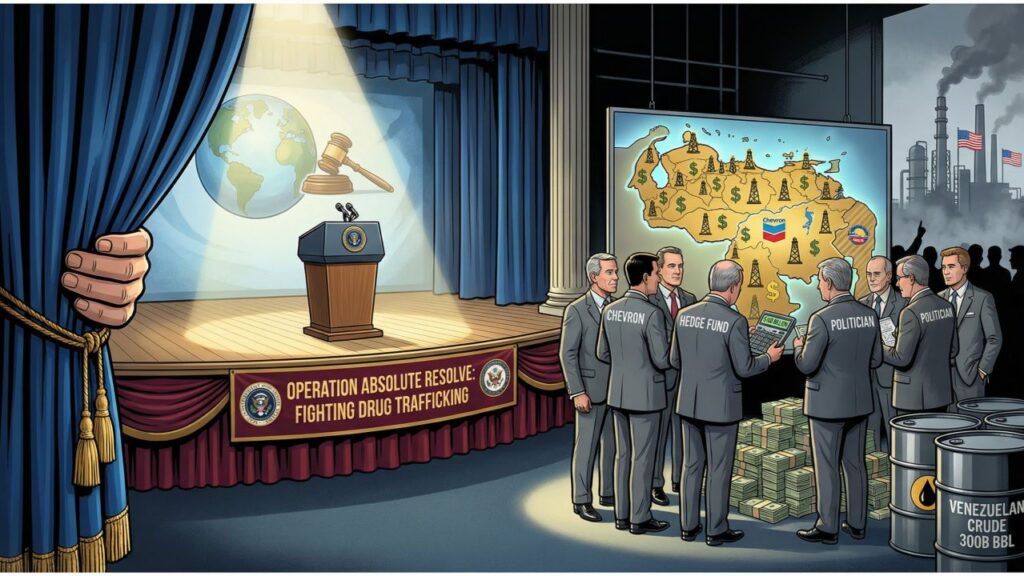
On November 7, 2025, exactly eight weeks before President Trump ordered Operation Absolute Resolve, hedge fund billionaire Paul Singer’s Elliott Investment Management acquired Citgo Petroleum Corporation for $5.9 billion.
Analysts valued Citgo at $11-13 billion. Singer, notorious for “vulture” investing in distressed assets, bought Venezuela’s crown jewel refinery network at a 50 percent discount while Nicolás Maduro remained in power and U.S. sanctions strangled Venezuelan oil production.
On January 3, 2026, Delta Force extracted Maduro from Caracas in less than 48 hours. Zero U.S. casualties. Mission accomplished.
Singer’s Citgo acquisition instantly appreciated by $5-7 billion. Within 24 hours, Chevron surged 5-7 percent, Gulf Coast refiner stocks jumped 5-16 percent, and oilfield services companies gained 9 percent. ExxonMobil and ConocoPhillips gained leverage to collect over $10 billion in arbitration awards from Venezuela.
Coincidence?
Singer is a major Trump donor. Chevron CEO Mike Wirth spent months lobbying Trump, who nearly revoked their Venezuela license in February 2025 before reversing course after “multiple discussions”. Energy Secretary Chris Wright coordinated with oil executives before the operation. Ali Moshiri, the former Chevron executive who negotiated staying in Venezuela, told the Financial Times within 24 hours that he was raising $2 billion for Venezuelan projects and “interest in Venezuela has gone from zero to 99 percent”.
This wasn’t a humanitarian intervention. This was a $100 billion economic rescue operation for stranded Gulf Coast refinery assets, coordinated with the beneficiaries months in advance, executed with overwhelming military force, and delivered with precision timing that made billionaires richer while the foreign policy establishment shrieked about international law.
Let’s examine who made fortunes this week, why Obama and Biden failed for eight years while Trump succeeded in 48 hours, and why the usual suspects condemning Trump’s operation are the same people who’ve presided over two decades of catastrophic failures.
The Operation: 48 Hours to Success vs. 8 Years of Failure
On January 3, 2026, Trump deployed 150 aircraft and Delta Force to Venezuela. Maduro was in federal custody within hours. Venezuelan military units didn’t resist. Russia and China couldn’t intervene. Zero U.S. casualties.
Trump stated his objective explicitly hours after Maduro’s capture: “We will have our very large United States oil companies…go in, spend billions of dollars, fix the badly broken infrastructure, and start making money for the country”. No plausible deniability. No diplomatic euphemisms. Just overwhelming force and clear economic objectives.
Contrast this with Obama and Biden’s eight-year failure:
Obama (2009-2017): Maintained sanctions while Venezuelan production collapsed from 2.5 million barrels per day to 2 million. Watched Maduro consolidate power after Chávez’s death in 2013. Pursued “engagement” that accomplished nothing while 3 million Venezuelans fled. Drew “red lines” in Syria he wouldn’t enforce, signaling to dictators worldwide that American threats were empty.
Trump’s First Attempt (2019): Recognized Juan Guaidó as Venezuela’s legitimate president and pressured the military to defect. Nothing happened. The armed forces stayed loyal to Maduro. By 2021, Guaidó was a failed puppet president with no power. Trump learned: half-measures don’t work.
Biden (2021-2025): Continued the Guaidó charade until it became too embarrassing. Maintained sanctions while Gulf Coast refineries faced a stranded asset crisis. Delegated Venezuela policy to State Department bureaucrats who achieved nothing. His presidency’s defining foreign policy moment was the disastrous Afghanistan withdrawal that killed 13 Americans and humiliated the nation.
For eight years under Obama and Biden, the foreign policy establishment pursued their preferred methods: sanctions, diplomatic pressure, multilateral engagement, support for opposition figures, gradual escalation. For eight years, Maduro remained in power while Venezuelan oil production collapsed 75 percent and 8 million people fled.
Trump tried their methods in 2019. They failed. In 2026, he deployed overwhelming force. It succeeded in 48 hours.
The difference wasn’t just execution, it was incentive structures. And that brings us to who made money this week.
The Money: Who Got Rich When Maduro Fell
Within 24 hours of Maduro’s capture, the market priced in what the Trump administration had coordinated months in advance: Venezuela’s 300 billion barrels of oil reserves were accessible, Gulf Coast refineries’ stranded assets were rescued, and a feeding frenzy was about to begin.
Paul Singer: $5-7 Billion in 48 Hours
Singer’s Elliott Investment Management acquired Citgo for $5.9 billion on November 7, 2025, eight weeks before Maduro’s capture. Citgo owns three refineries in Texas, Louisiana, and Illinois with 807,000 barrels per day of capacity. Analysts valued the company at $11-13 billion.
Singer is known for “vulture” investing, buying distressed assets at steep discounts, then profiting when situations resolve. He bought Argentine debt for pennies on the dollar in 2001, then spent 15 years in litigation before collecting $2.4 billion. He bought Citgo while Maduro remained in power and sanctions prevented Venezuelan crude from flowing.
The day Maduro was captured, Singer’s acquisition appreciated by $5-7 billion. His timing was perfect. His political connections were impeccable. Singer is a major Republican donor who gave millions to Trump-aligned super PACs.
Did Singer know Trump was planning military action? The timing suggests he did. You don’t buy distressed Venezuelan assets at a 50 percent discount eight weeks before regime change unless you have extraordinary confidence the regime is about to change.
Chevron: Positioned for Hemispheric Dominance
Chevron CEO Mike Wirth spent months lobbying Trump after the president nearly revoked their Venezuela license in February 2025. By November, Trump had reversed course after “multiple discussions”.
When Maduro fell, Chevron had 140,000-220,000 barrels per day of production in Venezuela minus 23 percent of the country’s output. They were positioned to scale faster than any competitor because they’d maintained operations throughout the sanctions period while ExxonMobil and ConocoPhillips had been expropriated.
Chevron stock surged 5-7 percent within 24 hours. The company’s Venezuela position, which had been a political liability for years, suddenly became the most valuable oil asset in the Western Hemisphere.
Gulf Coast Refiners: Stranded Assets Rescued
Gulf Coast refineries had invested tens of billions in coking units and hydrocrackers specifically designed to process Venezuelan heavy crude. When sanctions cut off Venezuelan imports, these refineries faced a stranded asset crisis. Domestic shale oil is too light. Canadian tar sands can’t supply enough volume. Mexican heavy crude production is declining.
Within 24 hours of Maduro’s capture, Gulf Coast refiner stocks exploded:
- Valero: +5-7%
- Phillips 66: +8-10%
- Marathon Petroleum: +6-8%
- PBF Energy: +12-16%
These aren’t minor gains. These are institutional investors pricing in the rescue of tens of billions in infrastructure that was becoming worthless under Biden’s do-nothing Venezuela policy.
ExxonMobil and ConocoPhillips: $10+ Billion in Arbitration Awards
ExxonMobil and ConocoPhillips were expropriated by Hugo Chávez in 2007. They’ve spent 18 years in international arbitration. ExxonMobil won a $1.6 billion award but hasn’t collected. ConocoPhillips won $8.7 billion but hasn’t collected.
With Maduro gone and a new Venezuelan government desperate for Western investment, both companies suddenly have leverage to collect. That’s over $10 billion in arbitration awards that were theoretical under Maduro and likely to be paid under a new government.
Both stocks gained 3-5 percent within 24 hours, not as much as Chevron, but institutional investors understand the arbitration windfall is coming.
Hedge Funds and Private Equity: The Feeding Frenzy Begins
Ali Moshiri, the former Chevron executive who negotiated staying in Venezuela in 2006, told the Financial Times within 24 hours that he was raising $2 billion for Venezuelan oil projects through Amos Global Energy. “Interest in Venezuela has gone from zero to 99 percent,” Moshiri said. “I’ve had a dozen calls over the past 24 hours from potential investors”.
Charles Myers of Signum Global Advisors had planned a March 2026 trip to Venezuela with approximately 20 hedge funds and asset managers from finance, energy, and defense sectors, before Maduro was even captured. These funds had positioned capital betting on regime change.
Schlumberger, Halliburton, and Weatherford, the oilfield services giants, surged 9 percent within 24 hours. These companies provide drilling, completion, and production services. Venezuela’s oil infrastructure is devastated after decades of underinvestment. Rebuilding it will generate billions in contracts.
Texas and Louisiana Congressional Delegations: Regional Economic Rescue
Senators Rick Scott, Ted Cruz, and Bill Cassidy introduced legislation raising Maduro’s bounty to $100 million using seized Venezuelan assets weeks before the operation. These aren’t humanitarian gestures. These are regional economic interests demanding action.
Gulf Coast refineries employ hundreds of thousands in Texas and Louisiana. Congressional delegations representing these states backed Trump’s operation because their constituents’ jobs depend on Venezuelan heavy crude access. When Maduro fell, they celebrated because their regional economies were rescued.
This is what coordinated economic policy looks like: identify American interests, position beneficiaries, deploy overwhelming force, achieve objectives, unlock economic value.
Obama and Biden never did this because their foreign policy was controlled by State Department bureaucrats who viewed economic interests as vulgar and preferred multilateral engagement that accomplished nothing.
Trump did this because he understands American power exists to advance American interests, and he doesn’t apologize for it.
The Meltdown: Why The Establishment Is Shrieking
The critics condemning Trump’s Venezuela operation, Jeffrey Sachs, The New York Times, EU officials, progressive Democrats, legacy academia, all share a common trait: they’ve presided over catastrophic failures while opposing anyone who actually achieves results.
Their preferred methods (sanctions, diplomacy, gradual pressure, multilateralism, rules-based order) failed for two decades. Trump’s decisive action succeeded in 48 hours. And that success exposes their expertise as worthless.
Jeffrey Sachs: From Russian Collapse to UN Meltdown
Jeffrey Sachs called Trump’s operation “flagrantly vulgar, thuggish, and illegal” in testimony before the UN Security Council on January 4, 2026.
The irony is rich. Sachs advised Russia on “shock therapy” economic reforms from 1991-1994 that resulted in GDP collapsing 40-50 percent, hyperinflation reaching 2,500 percent, and the wholesale looting of state assets by oligarchs. His Poland reforms in 1989-1990 saw unemployment spike from 0.3 percent to 6.5 percent and GDP drop 9.78 percent in the first year.
While Sachs defends himself by claiming his full recommendations weren’t followed, the fact remains that the policies he advised on contributed to catastrophic economic collapses. Now Sachs lectures Trump about international law violations at the UN Security Council while offering no viable alternative for removing a narco-trafficking dictator who tortured 198 children and refused to step down after losing an election.
Sachs’ UN testimony focused entirely on procedural violations of the UN Charter while ignoring that his preferred method, sanctions and diplomatic pressure, failed to remove Maduro for two decades. Venezuelan oil production collapsed 75 percent under Sachs’ preferred approach. Eight million people fled.
Trump’s “vulgar, thuggish” approach removed Maduro in 48 hours with zero U.S. casualties and is already restarting oil production. Sachs offers lectures about international law. Trump offers results.
The New York Times: Endorsing Failed Coups, Condemning Successful Ones
The New York Times condemned Trump’s Venezuela operation as dangerous precedent and potential illegality.
This is the same New York Times that praised Bush’s failed 2002 Venezuela coup against democratically elected Hugo Chávez, writing on April 13, 2002: “Venezuelan democracy is no longer threatened by a would-be dictator”. When that coup collapsed in 47 hours, The Timesquietly moved on with no apology.
The pattern is clear: The Times supports interventions when they fail or when Democrats order them. They condemn Trump’s successful operations regardless of outcome.
A study titled “Your Complete Guide to the N.Y. Times’ Support of U.S.-Backed Coups in Latin America” found the Times editorial board “has supported 10 out of 12 American-backed coups in Latin America”. But when Trump acts decisively and succeeds, The Times discovers principles about international law they’ve ignored for decades.
This isn’t journalism. It’s partisan hackery.
EU Officials: Selective Application of International Law
EU foreign policy chief Kaja Kallas and European Commission President Ursula von der Leyen condemned Trump’s Venezuela operation as a violation of sovereignty and international law.
These are the same officials who:
- Condemned Russia’s Ukraine invasion in the strongest terms and imposed sweeping sanctions
- Supported NATO’s 78-day bombing campaign in Serbia (1999) without UN authorization
- Backed the U.S.-led coalition that destroyed Libya (2011), creating slave markets and permanent chaos
- Offered only mild criticism when Turkey invaded northern Syria (2019)
Their position is transparent: international law applies to adversaries like Russia and must be enforced with sanctions and military aid. When America invades Venezuela to secure oil interests, they offer mild statements and move on.
The “rules-based international order” isn’t a system of law. It’s a fiction that great powers invoke against adversaries and ignore when convenient. Trump’s honesty about this threatens EU officials who profit from maintaining the fiction.
Progressive Democrats: Opposing Republican Success, Supporting Democratic Failure
Senators Chuck Schumer and progressive Democrats like Adam Schiff condemned Trump’s Venezuela operation as reckless and potentially illegal.
These are the same Democrats who:
- Supported Obama’s Libya intervention that killed thousands and created slave markets
- Defended Biden’s Afghanistan withdrawal that killed 13 Americans
- Backed Obama’s Syria policy that drew red lines he wouldn’t enforce, emboldening dictators worldwide
They’re not principled anti-interventionists. They’re partisan hacks who oppose Republican military action while supporting identical Democratic operations that fail catastrophically.
When Obama bombed Libya without Congressional authorization, Schumer praised it as necessary intervention. When Trump removes Maduro with overwhelming force and achieves stated objectives, Schumer discovers constitutional concerns he ignored under Obama.
Legacy Academia: Expertise Exposed as Worthless
The foreign policy establishment (think tank scholars, university professors, former State Department officials) oppose Trump because he ignores their advice, bypasses their institutions, and achieves objectives they claimed were impossible.
They said Maduro couldn’t be removed without triggering regional war and Russian/Chinese intervention. Trump removed him in hours with zero U.S. casualties. Russia and China did nothing.
They said military intervention would create a humanitarian disaster worse than the current crisis. Trump’s operation was so precise that Venezuelan civilian casualties appear minimal while Maduro, who tortured children and ran narco-trafficking operations, is in federal custody.
They said diplomatic engagement and sanctions would eventually work given enough time and patience. After 20 years of sanctions and engagement, Maduro remained in power while Venezuelan oil production collapsed 75 percent and 8 million people fled.
Trump proved their expertise was worthless. Their preferred methods failed for two decades. His decisive action succeeded in 48 hours. And that success threatens their relevance because it reveals they’ve been managing intractable problems rather than solving them, because chaos justifies their continued employment.
The Pattern: Handlers Who Profit From Chaos vs. Results-Driven Leadership
This pattern isn’t new. The Obama/Biden Venezuela failures and establishment meltdown fit a broader American problem: weak presidents who delegate to unaccountable advisors create incentive structures where handlers profit from perpetual chaos rather than resolved situations.
George W. Bush’s 2002 Venezuela coup, which The New York Times praised before it collapsed in 47 hours, demonstrates the pattern perfectly.
Bush was a disengaged executive who delegated extensively to Vice President Dick Cheney, Defense Secretary Donald Rumsfeld, and Deputy Defense Secretary Paul Wolfowitz. These weren’t public servants. They were operators who leveraged Bush’s disengagement into personal fortunes while engineering catastrophic wars.
Dick Cheney left office worth $150 million after serving as Halliburton CEO from 1995-2000. Halliburton’s subsidiary KBR received $39.5 billion in Iraq contracts over the decade following the 2003 invasion. Cheney maintained 433,333 unexercised stock options as VP and received deferred compensation payments up to $205,298 annually while his former company received billions in no-bid Pentagon contracts.
Donald Rumsfeld’s net worth reached $200 million. His connections to the Carlyle Group, a private equity firm specializing in defense contractors, generated $9.3 billion in Pentagon contracts for Carlyle-controlled companies between 1998-2003.
Paul Wolfowitz created the Office of Special Plans, a Pentagon intelligence unit that bypassed the CIA to feed raw intelligence supporting the Iraq War directly to Bush. The war killed between 150,000 and 460,000 people and cost $6 trillion.
These handlers made hundreds of millions from perpetual chaos. The longer the wars dragged on, the more contracts flowed, the richer they became. A half-assed Venezuela coup that collapsed in 47 hours fit their model perfectly: maintain the problem, justify continued intelligence operations, create perpetual “management” of threats rather than decisive resolution.
Bush’s 2002 coup wasn’t designed to succeed. It was designed to create justifiable chaos.
Obama and Biden followed the same model: delegate Venezuela policy to State Department bureaucrats, pursue gradual pressure that accomplishes nothing, maintain the problem for decades while claiming they’re “managing” it responsibly.
Trump’s model is opposite: coordinate with economic beneficiaries, deploy overwhelming force, achieve objectives, unlock value. His coalition (Chevron, Gulf Coast refiners, Paul Singer, Congressional delegations) only profits from success. Half-measures weren’t an option because half-measures don’t unlock stranded assets or deliver arbitration awards.
This explains why the establishment is melting down. Trump’s success exposes their business model: profit from problems, never solve them, and demonize anyone who achieves results that would eliminate the problems justifying your existence.
Why It Matters: Decisive Presidents Deliver Results
For eight years under Obama and Biden, Venezuela policy followed the foreign policy establishment’s playbook: sanctions, diplomatic pressure, support for opposition figures, multilateral engagement, gradual escalation. For eight years, Maduro remained in power while oil production collapsed and millions fled.
Trump tried their methods in 2019 with Guaidó. They failed. In 2026, he deployed overwhelming force. It succeeded in 48 hours.
The results speak for themselves:
Within 48 hours of Maduro’s capture:
- Paul Singer’s Citgo acquisition appreciated $5-7 billion
- Chevron stock surged 5-7%
- Gulf Coast refiners jumped 5-16%
- ExxonMobil and ConocoPhillips gained leverage for $10+ billion in arbitration awards
- Hedge funds positioned for regime change began raising billions for Venezuelan projects
- Venezuelan oil production can restart, rescuing Gulf Coast refinery assets worth tens of billions
- Cuba’s economy faces collapse without Venezuelan oil subsidies
American casualties: Zero
Regional destabilization: Minimal, Venezuelan military didn’t resist, Russia and China didn’t intervene
International law violations: Condemned by the same establishment that ignored identical violations when Obama bombed Libya and created slave markets
Trump stated his objective explicitly: get American oil companies into Venezuela to fix infrastructure and make money. He coordinated with beneficiaries before the operation. He deployed overwhelming force. He achieved the objective with precision execution.
That’s decisive presidential leadership that delivers results for American economic interests.
The establishment prefers Obama and Biden’s model because perpetual problems justify their continued employment as “experts” managing intractable situations. Trump’s model threatens their relevance by proving decisive action achieves results that actually benefit American interests.
Jeffrey Sachs lectures at the UN about procedural violations while offering no alternative that works. The New York Times condemns Trump’s success after praising Bush’s failure. EU officials selectively apply international law based on whether America or Russia is acting. Progressive Democrats oppose Republican interventions that succeed while supporting Democratic interventions that create disasters.
All of them share one thing: they’ve presided over failures while opposing anyone who achieves results.
Paul Singer made $5 billion in 48 hours by positioning capital for regime change and coordinating with an administration that actually follows through. Jeffrey Sachs melted down at the UN because Trump’s success exposes 30 years of Sachs’ advice as catastrophic.
One made a fortune betting on American success. The other built a career managing American failure.
The foreign policy establishment is shrieking because Trump proved that decisive action, overwhelming force, and clear economic objectives achieve results in 48 hours that their preferred methods couldn’t accomplish in 20 years.
America needs presidents who lead decisively and deliver results that benefit American interests, not presidents who delegate to advisors managing perpetual problems that justify their employment.
Trump is many things. But he’s decisive. He achieves objectives. And he doesn’t apologize for using American power to advance American interests.
The New York Times, Jeffrey Sachs, EU officials, and progressive Democrats can shriek about international law all they want. Paul Singer made $5 billion. Chevron rescued tens of billions in stranded assets. Gulf Coast refineries are hiring. And Maduro is in federal custody.
Results matter more than lectures.
Related reading
- Does He Really Think They Don't Have Options? How Trump’s Lack of Strategy Is Driving Nations Away
- Does He Really Think Nobody Has Options? Trump’s Imperial Arrogance and the Countries He Screwed
- The Irrelevance of King Trump and His Uniparty Jesters in Congress
- Entering Losing Wars We Can’t Fund: Congress and Trump Do What They’re Told, How High and Which Way, Sirs?