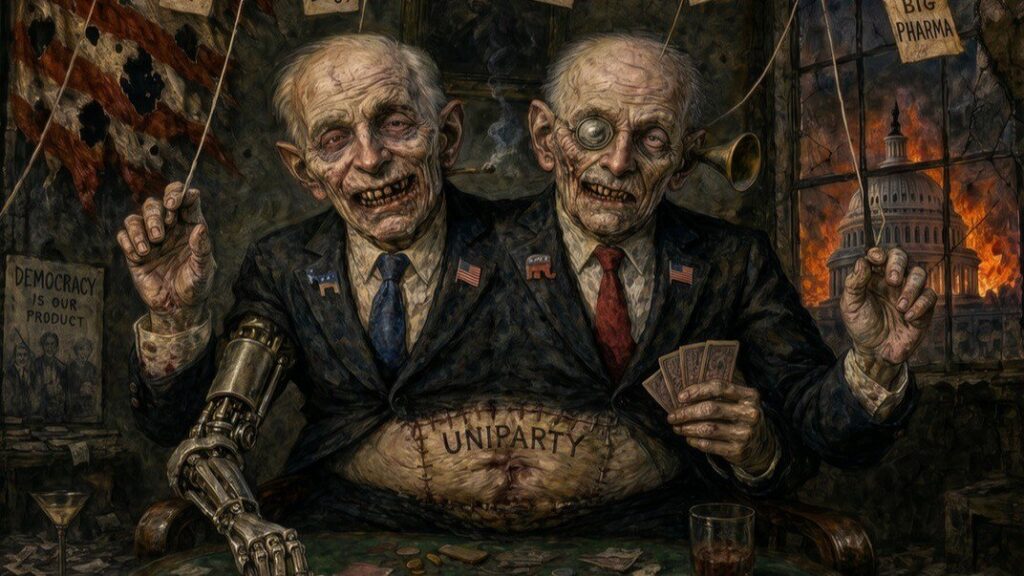
Tucker, come out, come out, wherever you are and bring some independent candidates for the House and Senate.
By Scott Ortkiese | June 24, 2026 | sortkiese@throughlinesynthesis.com
I. When Tucker Carlson Walks, the Building Is on Fire
On June 18, on the “Can’t Be Censored” podcast, Tucker Carlson, for thirty-five years the loudest amplifier the Republican Party ever had on cable, announced he was done with it. “There’s no chance I would support the Republican Party. Not going to support the Democratic Party. I don’t know what I’m going to do,” he said, calling the GOP’s posture in the Iran war “treasonous” and “immoral” and accusing party leaders of putting the interests of a foreign country above those of American citizens (Washington Times). His closing line is the one to mark in red: “If I’m out, then I think a lot of other people are out” (HuffPost).
The trigger was Operation Epic Fury, the joint U.S.-Israeli strikes on Iran, and what Carlson described as a Trump administration “making decisions based on other criteria: what’s best for this company, what’s best for Israel, what’s best for our donors” (WND). Strip the names away and that sentence is the definition of the Uniparty: a permanent governing class whose loyalties are to capital pools, foreign clients, and incumbency itself, not to the country whose flag it salutes for the cameras.
Carlson is not an aberration. He is a symptom. The symptoms are now everywhere.
II. The Numbers Do Not Lie
The political class wants Americans to believe the country is bitterly polarized between two coherent ideological camps. The polling says something else entirely: Americans are bitterly unified in their contempt for both.
Congressional approval has collapsed to 10 percent, tying a record low, against disapproval of 86 percent (Gallup). A record 45 to 47 percent of Americans now identify as independent, the largest bloc in the country (Independent Center; Behind the Numbers). A New York Times/Siena poll finds 43 percent of voters dissatisfied with both parties simultaneously, and only 4 percent satisfied with both (NYT/Siena; KTRH). Among independents specifically, the Democratic Party is viewed favorably by 24 percent and the Republican Party by 20 percent, both deeply underwater with the very voters who decide elections (Washington Times / Economist-YouGov). Half of Americans trust the federal government “little or not at all”; 58 percent say the same about Congress (Seoul Economic Daily / NBC). A recent Harvard survey puts trust in Congress below 10 percent (Harvard Gazette).
Against that backdrop, 95 percent of incumbents who ran in 2024 were re-elected, and for U.S. House and Senate incumbents specifically the rate hovered between 95 and 98 percent (GovFacts). An institution 86 percent of the country despises sends back nearly everyone it sent the last time. That is not democracy. That is a cartel with election-year branding.
III. What “Uniparty” Actually Means
The word is not a slogan. It is an observable behavior pattern, and once one watches for it the pattern is unmistakable.
The two parties fund the same wars. A House panel just advanced a $1.15 trillion defense bill after marathon debate, with bipartisan blessing (Strickland). Senator Angus King, an actual independent, warned that the off-ramp process around defense spending is creating “a very dangerous precedent” (YouTube/King). The Cambridge journalPS: Political Sciencethis month published an essay titled “Not With a Bang But a Whimper: Congressional Silence Amid an Historic Assault on the Power of the Purse” (Cambridge). Congress has stopped doing the one job the Constitution gave it exclusively, and members of both parties signed the death certificate.
The two parties serve the same donors. The American Israel Public Affairs Committee has constructed a parallel donation portal architecture, the “Pro-Israel Network” and the “Better Blue Fund,” explicitly designed to “erase AIPAC’s fingerprints in public data” while routing money to incumbents across both parties (The Forward; Jacobin; ScheerPost). AIPAC’s affiliated AIEF has funded lavish trips to Israel for dozens of members of Congress since October 7 (Guardian). OpenSecrets records $37.8 million in AIPAC independent expenditures this cycle alone (OpenSecrets). Representative Ro Khanna just became the first member of Congress to sign a pledge refusing AIPAC money, the first, after decades (Epoch Times).
The two parties serve the same industries. An Axios review of FEC data found that eight of the twelve top outside spenders in 2026 House primaries are PACs tied to cryptocurrency, artificial intelligence, or pro-Israel groups, with more than $300 million spent so far this cycle to defeat candidates of either party who will not play ball (Axios; Daily Kos). The supposed ideological fight between R and D evaporates the moment one of those three industries opens its checkbook.
The two parties write the rules to keep themselves in power. Texas requires statewide independent candidates to gather 81,030 valid signatures in 30 days, only from voters who skipped both primaries. No independent has ever cleared that bar in a Texas statewide race that had a primary runoff (Texas Tribune; Forward Party). New Mexico demands more than five times the signatures required of major-party candidates (Organ Mountain News). Illinois demands 25,000 from independents versus 5,000 from R/D candidates (Northern Public Radio). North Carolina’s HB 958 would make it a Class 2 misdemeanor to pay petition circulators by the signature and would ban ranked choice voting outright (EIN Presswire). New Jersey’s Secretary of State just overruled an administrative law judge to remove an independent from the ballot on a paperwork technicality (Ballot Access News).
These are not safety mechanisms. They are moats, dug by the two parties for the two parties. As one Oregon independent candidate put it, the ballot-access system “is not designed to let outsiders through” (The Fulcrum).
IV. The Independent Insurgency Already on the 2026 Ballot
The Beltway press is undercounting what has already happened. Between thirty and forty independents are currently running for the U.S. House, alongside credible statewide independents in red and purple states, and several of them are out-raising the incumbents they intend to displace (Independent Center).
The Senate vanguard
Dan Osborn, of Nebraska, is a Navy veteran, a steamfitter, and the former union leader who led the 2021 Kellogg’s strike in Omaha. He lost the 2024 race to Senator Deb Fischer by seven points in a state Trump carried by twenty. In the first quarter of 2026 he out-raised the incumbent, Senator Pete Ricketts, by roughly $200,000 (Senate Pickup Watch). On June 11 he submitted approximately 12,500 petition signatures, more than triple the requirement, locking in ballot access (Nebraska Public Media). He has committed to refuse a caucus with either party, instead building what he calls a coalition of “Democrats, Republicans, Libertarians, Independents, Legal Marijuana NOW under one umbrella” (WNYC / New Yorker Radio Hour).
Seth Bodnar, of Montana, is a former Army Green Beret and the former president of the University of Montana. He submitted nearly 30,000 signatures for an independent Senate bid, more than twice the 13,327 required, and has out-raised the entire field in the state (PBS; Ballot Access News). His campaign line is unambiguous: “When I swore an oath, it wasn’t to a political party” (How to Fix It).
Todd Achilles, of Idaho, is a former Army tank commander and former Democratic state representative now running as an independent against Senator Jim Risch in one of the deepest-red states in the country (IVN).
The House and the governorships
Representative Kevin Kiley, of California, is a sitting member of Congress who left the Republican Party and is running for re-election as an independent in California’s nonpartisan top-two primary (Politico; IVN).
Bill Hill in Alaska, Michael Bridgford in Iowa’s first district, and a parallel candidate in Iowa’s second are the first independents ever to qualify for the ballot in those Iowa districts (Independent Center).
Rick Bennett, a state senator and former chairman of the Maine Republican Party, is running for governor as an independent and has cleared the 4,000-signature threshold (IVN). In Idaho, the independent gubernatorial candidate John Stegner is out-raising the Democratic nominee and every other challenger to Governor Brad Little (Independent Center). In Illinois, the former Republican strategist Collin Corbett has filed petitions to run for governor as an independent (Northern Public Radio). In Indiana, the former mayor of Indianapolis Greg Ballard is closing in on his signature threshold (Independent Center). In Texas, Mike Collier is suing in federal court to break the state’s 81,030-signature trap for lieutenant governor (Texas Tribune). In New Mexico, the longest-serving former mayor of Las Cruces, Ken Miyagishima, is suing the Secretary of State over discriminatory signature thresholds (Organ Mountain News). In Maine, the sitting police chief and Republican nominee Eric Small withdrew and re-registered as unenrolled, saying the party platform no longer matched his values (Independent Center).
The Forward Party has endorsed four independent Senate candidates across four states, the most overt third-party coordination of an independent slate in a generation (Forward Party).
Carlson, Yang, and the 2028 horizon
Andrew Yang is openly entertaining a 2028 run on Forward Party and independent infrastructure, with the explicit theory that the two-party duopoly is structurally incapable of governing an AI-disrupted economy (Apple Podcasts / Equity; YouTube). Carlson’s break with the Republican Party, framed as “if I’m out, then a lot of other people are out,” is being read across the right-populist ecosystem as the opening move toward an independent presidential vehicle (Washington Post). Whether Carlson runs himself or simply endorses, the cultural permission slip he has just issued, that a lifelong Republican can publicly disown both parties without becoming politically homeless, may matter more than any individual candidacy.
V. The Counter-Arguments, Taken Seriously
Honest argument requires engaging the strongest objections.
The first objection is the spoiler argument: independents merely siphon votes and elect the side a voter dislikes most. This is the Ross Perot ghost story, and it is increasingly false. In a top-two primary state such as California, in a nonpartisan top-four system such as Alaska’s, or in a state where one major party has stood aside (Nebraska Democrats have already cleared the field for Osborn), the spoiler logic collapses (Nebraska Public Media). The structural cure exists: ranked-choice voting, nonpartisan primaries, fusion voting. The spoiler objection is a circular defense of the duopoly by the duopoly.
The second objection is that independents cannot govern without a caucus. Senators Angus King of Maine and Bernie Sanders of Vermont, the two sitting independents in the Senate, have demonstrated otherwise for decades. Osborn’s pitch is explicit: refuse to caucus, and force both parties to negotiate (WNYC). In a chamber where margins are routinely 50-50 or 51-49, a single independent willing to walk away from both leaderships transforms majority control from coronation to negotiation (Independent Center). That is not weakness. That is leverage.
The third objection is that some “independents” are merely party plants in disguise. This deserves to be tested case by case. CNN has reported that Osborn’s campaign has received significant flows from Soros-connected dark-money vehicles, and Townhall has flagged his scheduled appearance at a progressive-coded Open Markets conference (Townhall; CNN). Voters should scrutinize donor disclosures, not labels. But the existence of a handful of faux-independents does not invalidate the structural argument. It strengthens it: the parties are now so weak that they must launder candidates through independent branding to remain competitive. That is collapse, not strength.
The fourth objection is that the system cannot be reformed. Yet three states, Louisiana, Tennessee, and Virginia, have just eased ballot access for the U.S. House for 2026 (Ballot Access News). Federal lawsuits in Texas and New Mexico are now testing the constitutionality of the signature traps directly (Texas Tribune; Organ Mountain News). The wall is real, but the wall is cracking.
VI. The Affirmative Case for Mass Incumbent Eviction
The strategic argument for a maximum-eviction posture in 2026 is not nihilism. The opposite. Functional government requires accountability, and accountability has been engineered out of both parties. The cure is to break the moat.
First, the electoral price signal must be restored. A 95 to 98 percent re-election rate in an era of 10 percent congressional approval is proof that the feedback loop between governed and governing has been severed (Gallup; GovFacts). Mass incumbent eviction across both parties, in the same cycle, is the only signal loud enough to penetrate gerrymandered safety.
Second, the war power must be reclaimed. Carlson is correct about the substance even where his rhetoric is incendiary: a constitutional republic in which Congress is silent during a foreign war is no longer a republic (Cambridge). The Senate’s recent bipartisan war-powers rebuke and Representative Marcy Kaptur’s bipartisan coalition vote to end the Iran war choice demonstrate that the votes exist across parties when they are forced (South Florida Reporter; Kaptur). Independents force them.
Third, donor capture must be severed. When eight of the twelve top House primary spenders are crypto, AI, or AIPAC-aligned PACs, the only candidates who can credibly refuse those checks are the ones not running for a nomination those PACs already own (Axios).
Fourth, dissent must once again carry a price inside the parties themselves. If a credible independent threat exists in every cycle, both parties must compete for the median voter on substance, rather than competing for the median primary voter on tribal signaling. The mere existence of viable independents disciplines the duopoly. That alone is worth the campaign.
Fifth, 2026 resets the 2028 board. A November result that produces five to ten new independents in the House, one or two in the Senate, and an independent governor in a red or purple state changes what is thinkable two years later. As the Independent Center observed, the forward read is that 2026 may be a preview rather than a peak (Independent Center).
VII. Closing Argument
The two national parties no longer serve the country. They serve themselves. The evidence is not contested. It is bipartisan in the worst possible sense.
The same defense contractors are paid under both flags. The same lobbyists draft the same bills for the same staff who rotate to the same K Street firms. The same donor portals route the same money to candidates of both parties, designed in their own internal language to “erase fingerprints in public data” (The Forward). The same ballot-access traps, gerrymanders, and procedural moats are dug in concert by Republicans in red states and Democrats in blue ones. And when 86 percent of the country disapproves of the institution they jointly run, 95 percent of its members are sent back to run it again.
That is a Uniparty. Not a slur, a description. The only force in American politics capable of breaking it is the very force the system was deliberately engineered to suppress: viable, well-funded, locally credible independents, running in enough races simultaneously that the duopoly cannot triage them all.
Tucker Carlson said the quiet part aloud: “If I’m out, then I think a lot of other people are out.” Osborn, Bodnar, Achilles, Kiley, Bennett, Stegner, Collier, Miyagishima, Bridgford, Hill, Ballard, Corbett, Small, they are already out. Roughly forty more are gathering signatures while this is being read.
The independents are not coming. They are here. The only question left is whether enough voters in November are willing to do what 86 percent of the country already says it wants done: throw out the people running the machine, in both parties, in the same election, on the same night.
Break the moat. The republic on the other side is the one Americans were promised.
Sources
All claims are sourced inline. Principal reporting drawn from the Washington Times, Washington Post, HuffPost, WND, Gallup, the NYT/Siena poll, the Independent Center, Independent Voter News, the Texas Tribune, The Forward, Jacobin, the Guardian, Axios, the Daily Kos roundup, Ballot Access News, Nebraska Public Media, Montana Free Press, The Fulcrum, the Cambridge journal PS: Political Science, GovFacts, the Harvard Gazette, and OpenSecrets.
Related reading
- Kneecapping the Two-Party Uniparty After Trump’s Versailles Moment
- An Open Letter to Every Incumbent Republican and Democrat: A Call to Arms for Every American Who Is Sick of the War Uniparty; We Want a Third Party!
- Get to the Streets: Shut the Iran War Down and Tell Trump and the Uniparty Imbeciles We Elected in Washington to Negotiate Peace Now
- The Irrelevance of King Trump and His Uniparty Jesters in Congress