Executive Summary
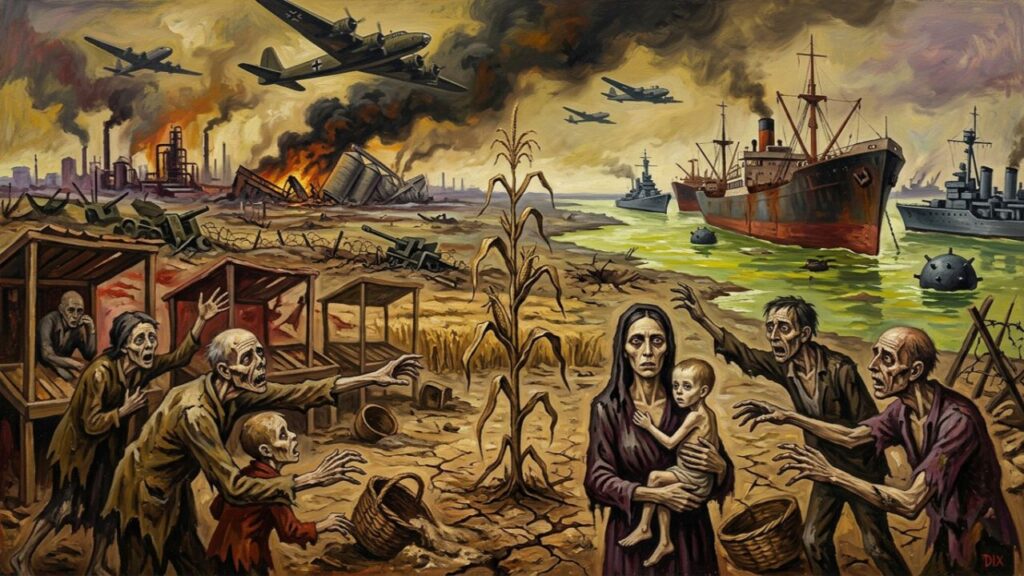
On February 28, 2026, the United States and Israel launched “Operation Epic Fury,” a joint strike campaign targeting Iranian nuclear and military infrastructure that killed Supreme Leader Ali Khamenei and ignited a regional war. The attack was launched while diplomatic negotiations were actively underway in Geneva, just two days after both parties agreed to continue talks. It was unprovoked, unauthorized, and almost certainly illegal under international law. And its most devastating long-term consequence may not be the bombs themselves. It may be the food that can no longer reach the fields, and the harvests that will fail to materialize in 2026 and 2027.
The Strait of Hormuz, through which roughly one-third of the world’s traded fertilizers transit, has been effectively closed since the conflict began. Urea prices have surged more than 50% year-over-year. QatarEnergy, which accounts for approximately 14% of global urea supply, has halted all production and declared force majeure. Nearly one million metric tons of fertilizer cargo are physically stranded in the Gulf. The global sulfur supply chain, which underpins phosphate fertilizer production worldwide, is fracturing.
The FAO’s chief economist warns of “gradual deterioration in food security within one or two agricultural cycles.” The CEO of Yara, the world’s largest fertilizer company, has called a prolonged closure “catastrophic.” The Council on Foreign Relations warns that this confluence of conditions “has the potential to convert a regional military conflict into a global humanitarian crisis.” These warnings are not speculative. They are backed by data, supply chain tracking, and the living memory of what happened when Russia’s invasion of Ukraine disrupted the same markets four years ago, driving 27.2 million more people into poverty and 22.3 million more into hunger.
The difference this time is scale, timing, and the complete absence of legal or strategic justification.
The Illegal and Unprovoked Nature of the Attack
Before examining the economic and humanitarian wreckage of Operation Epic Fury, the legal and ethical foundations of the attack must be confronted directly. They are indefensible.
The coordinated US-Israeli strikes were launched while Iranian and American diplomats were actively negotiating in Geneva, with both parties having agreed just two days prior to continue talks. President Trump had publicly signaled his willingness to extend the negotiating timeline. Then the airstrikes began. International law experts are unambiguous in their assessment.
Ben Saul, the UN Special Rapporteur on human rights and counterterrorism, stated flatly: “This is not lawful self-defense, there was no armed attack by Iran and the Security Council has not authorized it.” The Conversation described the strikes as “neither preemptive nor legal,” concluding that “the international legal order is now in free-fall.” The Military Law Task Force of the National Lawyers Guild called the attack “a grotesque violation of international law and the U.S. Constitution,” noting that aggression of this kind is a crime when a country attacks another that is not threatening it and is not carried out in self-defense.
Under Article 8 of the Rome Statute, the crime of aggression covers the planning, preparation, initiation, or execution of an act of aggression against the sovereignty and territorial integrity of another state. Under Article 2(4) of the UN Charter, the use of force against another state without Security Council authorization is prohibited. The Trump administration sought no authorization from the UN Security Council and bypassed Congress entirely. Israel invoked the concept of “preventive war,” but this doctrine has no legal foundation under international statutes, and Iran had not launched an imminent attack.
The conclusion of international law experts is consistent: President Trump and Prime Minister Netanyahu committed an act of aggression, a war crime under international law, against a sovereign member state of the United Nations, while its diplomats sat at a negotiating table in good faith.
The Strait of Hormuz as a Global Food Chokepoint
The Strait of Hormuz is best known to the public as an oil chokepoint. That framing dramatically understates its importance to the global food system. The strait is, in every material sense, the world’s fertilizer chokepoint, and no infrastructure workaround exists.
Approximately one-third of all globally traded fertilizers transit the strait. This includes:
- 35% of global urea exportsthe world’s most widely used solid nitrogen fertilizer, essential for corn, wheat, and rice production
- ~30% of global ammonia exportsthe fundamental building block of all nitrogen fertilizers
- 20 to 30% of all global fertilizer exports including urea, ammonia, phosphates, and sulfur
- 44% of global sulfur productiona less-discussed but equally critical input for phosphate fertilizers
- 20% of global LNG exportsthe natural gas feedstock that fertilizer plants worldwide depend upon
The Gulf region dominates this market because it sits atop cheap natural gas reserves, the primary feedstock for nitrogen-based fertilizers. Countries affected by the conflict, including Iran, Saudi Arabia, Qatar, Egypt, and the UAE, account for nearly 49% of the world’s urea exports and about 30% of ammonia exports. Qatar alone contributes roughly 14% of the world’s urea supply.
The NDSU Agricultural Trade Monitor notes that the 2026 shock differs fundamentally from the 2022 fertilizer crisis in one key dimension: the simultaneous disruption of nitrogen, phosphate, and sulfur supply chains, with no pipeline alternatives for any of them. Saudi Arabia built an oil bypass pipeline to route crude around the Strait of Hormuz. No equivalent exists for ammonia or sulfur. Ships cannot be easily rerouted because the fertilizer simply does not exist in sufficient quantities elsewhere.
The Immediate Supply Collapse
The chain reaction from Operation Epic Fury to fertilizer supply collapse was rapid and cascading.
On March 2, 2026, just two days after the first strikes, QatarEnergy halted LNG production at its Mesaieed and Ras Laffan plants after Iranian drone strikes on its infrastructure. By March 4, the world’s largest urea production facility, QAFCO’s 5.6 million tonne-per-year Mesaieed plant, had shut down. QatarEnergy subsequently declared force majeure to buyers including India’s Petronet LNG. All sulfur production, representing 8% of global seaborne sulfur trade, ceased.
On March 11, a drone strike suspended all operations at the Port of Salalah in Oman, the last active ammonia export route from the Middle East, responsible for 24% of global ammonia exports. The market reaction, as measured by S&P Global Platts, was immediate:
According to S&P Global Platts data, granular urea FOB Egypt surged from $485/mt on February 27 to $695/mt by March 12, a gain of 43.3% in under two weeks. US Gulf ammonia prices rose 14.2% over the same period, while Baltic and North African urea climbed 32 to 37%. At the New Orleans import hub, urea jumped from $516/mt to $683/mt in a single week, a 32% spike. Year-over-year, urea is now up 52% and Middle East ammonia has more than doubled, up 92% compared to a year ago.
By March 11, the price ratio of urea to corn at the New Orleans import hub reached near-record levels: one ton of urea now costs the equivalent of 126 bushels of corn, up from 75 bushels in December 2025. Fertilizer suppliers in the United States are facing a 25 to 35% shortfall compared to typical spring supplies.
The sulfur disruption is particularly alarming and receives almost no attention in mainstream coverage. The Gulf produces roughly 44% of global sulfur, almost twice its share of the hydrocarbon business. China imports roughly four million metric tons of sulfur annually from the Gulf; Morocco’s OCP Group, the world’s largest phosphate exporter, depends on approximately 3.7 million metric tons. When Gulf sulfur stops flowing, phosphate fertilizer production cascades into constraint worldwide.
Beyond Qatar, the damage spread rapidly to South Asian production:
- In India, which relies on Qatar for approximately 44% of its total imported LNG, multiple domestic fertilizer producers have halted operations, including IFFCO, Chambal Fertilisers, Kribhco, and GNFC
- In Pakistan, Agritech (capacity: 470,000 t/y) and Fatima Fertilizer (500,000 t/y) halted production after gas supply interruptions
- In Bangladesh, production shutdowns are underway
- In Egypt, the loss of Israeli gas imports is forcing reliance on the now-volatile LNG spot market
Nearly one million metric tons of fertilizer cargo sits physically stranded in the Gulf, unable to move.
The Harvest That Won’t Come: Modeling the Food Security Impact
The FAO’s chief economist, Maximo Torero, is precise in his assessment: “The main risk identified is not an immediate global shortage of food, but rather a gradual deterioration in food security driven by rising prices, reduced access to agricultural inputs, and increased production costs. These effects would likely become visible within one or two agricultural cycles.”
This framing is important. It means the full humanitarian damage from Operation Epic Fury will not be visible in 2026, much of it will materialize in the 2026 to 2027 harvest cycle. The inflationary tail of the current disruption could persist well into 2027. The NDSU Agricultural Trade Monitor notes that because fertilizer application decisions are made months before harvest, the price shock now reverberating through global markets will register in reduced yields and higher food prices throughout the second half of 2026 and beyond.
Yara CEO Svein Tore Holsether told The Guardian that if the Strait remains closed for a year, “significant declines in farm yields would be inevitable,” warning that certain crops, particularly European summer varieties like early potatoes, could see yield reductions of up to 50% without adequate fertilizer. Oxford Economics has raised its Q2 2026 fertilizer price forecast by roughly 20%. Wolfe Research estimates the disruption could elevate “food-at-home” inflation by approximately 2 percentage points in the United States.
The IMF estimates that the world economy could withstand a 10% increase in energy prices, but global growth could slow from approximately 3.2% to 3%, and that estimate does not fully account for the fertilizer channel. CFR researcher estimates that fertilizer accounts for up to 25% of agricultural commodity production costs, meaning a 40 to 50% fertilizer price spike translates into a roughly 10 to 12% production cost increase for staple crops, before fuel, transport, and insurance costs are factored in.
The precedent from Russia’s 2022 invasion of Ukraine is sobering. That disruption drove 27.2 million more people into poverty and 22.3 million more into hunger in the two years following the invasion. It restructured global fertilizer trade, kept prices structurally elevated well above prewar levels, and exposed the extreme concentration risk of a market where a small number of geopolitically volatile nations hold outsized control over critical agricultural inputs. The 2026 disruption hits a market that never fully recovered from 2022, while simultaneously triggering oil, gas, and sulfur supply shocks in addition to nitrogen.
Who Suffers Most: A Geography of Famine Risk
The humanitarian burden of this conflict will not fall on the nations that caused it. It will fall, with brutal predictability, on the world’s most vulnerable populations.
Sub-Saharan Africa: The Most Exposed Region
Sub-Saharan Africa is, by nearly every metric, the most food-insecure region on Earth entering this crisis, and also the most dependent on Gulf fertilizer imports. Research from the University of Texas at Austin shows that over 90% of fertilizers used in Sub-Saharan Africa are imported, predominantly from outside the continent. The region already applies a woefully inadequate average of less than 20 kilograms of fertilizer per hectare, any further reduction will directly devastate yields of maize and other nitrogen-intensive staples.
The UNCTAD data is stark: 54% of Sudan’s fertilizer is obtained through Gulf maritime routes; Somalia and Kenya rely on imports for 30% and 26% of their fertilizer needs respectively. Somalia already has 6.5 million people in acute food insecurity, nearly double the population classified as Crisis or worse in August 2025. Kenya’s food insecurity has risen 52% compared to early 2025. West and Central Africa could see over 50 million people facing severe hunger by August 2026.
The fiscal trap is particularly cruel. Sub-Saharan Africa faces a roughly $90 billion sovereign debt wall in 2026, with borrowing rates exceeding 10%. There is negligible fiscal space for emergency commodity procurement. These governments cannot simply bid for alternative fertilizer supplies on the spot market when prices have surged 40 to 50%. They will simply go without, and their harvests will reflect it.
South and Southeast Asia: Scale and Speed of Impact
India, with a population of 1.4 billion, is absorbing the shock from multiple directions simultaneously. The country buys more than 40% of its urea from the Gulf region and relied on Qatar for approximately 44% of its imported LNG, meaning not only its fertilizer imports but also its domestic fertilizer production are disrupted. India’s agreement to import 1.3 million tons of urea faces deep uncertainty. Its basmati rice exports to Iran, one of its largest rice markets, have halted entirely since the conflict began.
Bangladesh, Pakistan, Thailand, and Indonesia are similarly exposed. Bangladesh and Pakistan are facing shutdowns of domestic fertilizer production due to LNG supply interruptions. A farmer in Thailand who relies on imported Gulf urea purchased in strengthening dollars “faces a cost shock on every front,” Rabobank’s Ruben Mera noted. Indonesia and Bangladesh have been specifically highlighted as likely among the most adversely affected countries globally.
Gulf Countries: Import-Dependent and Under Fire
The Gulf states themselves face a compound crisis: their energy infrastructure is under attack, their agricultural import supply chains are disrupted, and they are almost entirely dependent on food imports. These countries import 77% of their rice, 89% of their corn, 95% of their soybeans, and 91% of their vegetable oils. Wealthier Gulf nations (Qatar, Bahrain, Saudi Arabia, Kuwait) have the financial reserves to source food via air or land transport if necessary. Iraq and Iran, however, face severe supply challenges with far fewer financial resources to absorb the shock.
Brazil and Latin America: The Cascading Downstream
Brazil, the world’s largest exporter of soybeans and a major corn producer, imports more than 80% of its fertilizers. A sustained disruption removes a key supply source while simultaneously constraining alternatives. Because fertilizer availability influences agricultural production with a time lag, the full impact on Brazil’s harvests may not materialize until late 2026 or early 2027. Since Brazil is also a critical supplier to China, which needs Brazilian soybeans to feed its livestock, the disruption creates a cascading effect through global protein markets.
The United States: Farmers Already on the Edge
Even in the United States, the country whose government launched this attack, American farmers are among the immediate casualties. The conflict struck at the worst possible moment: March and April are the primary months for urea imports ahead of spring planting. A vessel leaving the Gulf today cannot reach US ports until mid-April, the last possible window for spring planting. The Fertilizer Institute reports the US is currently experiencing a 25% deficit in typical spring supplies. There is a risk that suppliers will redirect US-bound shipments to higher-paying buyers in Asia and Europe.
The National Corn Growers Association warned that US farmers are facing “the second most expensive corn crop on record,” having already navigated four years of elevated input costs. A Farm Journal survey conducted before the conflict found that nearly 75% of farmers believed the crop sector was already in a recession. American Farm Bureau president has written directly to President Trump warning that the “production shock threatens national security.” Farmers are now actively considering abandoning corn acreage in favor of soybeans, but China’s trade war-driven reduction in soybean purchases removes that exit option.
Europe: Energy Costs and Fertilizer Squeeze
European gas prices surged approximately 67% in the first week of the conflict as Qatar’s LNG exports halted. European fertilizer producers, already operating near break-even margins on pre-war gas prices, face severe margin pressure. Egypt, a major urea exporter to Europe, lost its Israeli gas imports and must now compete in the volatile LNG spot market. Oxford Economics predicts that if the conflict continues, the UK and eurozone could see economic growth fall to 1% or less. The EU’s foreign policy chief stated plainly: “If there is a lack of fertilisers this year, there is going to be food deprivation next year.”
The Stagflation Trap: Economic Damage Without Borders
The fertilizer and food crisis sits inside a broader macroeconomic catastrophe that Operation Epic Fury has triggered. Brent crude reached approximately $105.66 per barrel by March 15, the highest since mid-2022. European natural gas prices surged 67% in the conflict’s first week. Japan’s Nikkei dropped more than 6% and South Korea’s Kospi fell over 7% in the immediate aftermath.
Global financial markets are now pricing what economists are calling “stagflation”, a combination of slowing economic growth and rising inflation, driven by energy and commodity price shocks. This is the nightmare scenario for central banks. Interest rates and other monetary policy tools are largely ineffective against a contracting economy experiencing higher prices simultaneously.
In the United States, 30-year Treasury yields have jumped nearly a quarter of a percentage point since the bombing began, raising mortgage rates, credit card rates, and borrowing costs across the consumer economy. The Bureau of Labor Statistics had already recorded food inflation at 2.4% year-over-year in February, before the conflict’s effects registered in the CPI data. Fertilizer costs contribute directly to prices at US supermarkets, and a 2-percentage-point rise in food-at-home inflation is now being modeled.
The IMF estimates that a 10% increase in energy prices, already exceeded, slows global growth from approximately 3.2% to 3%. Energy costs represent roughly half of total retail food bills, meaning the energy pass-through into consumer food prices amplifies the fertilizer shock significantly. This is not a regional or temporary disruption. It is a structural repricing of the global food system.
The Duration Question: How Long Does the Damage Last?
The honest answer, supported by the evidence, is that the damage will last longer than anyone in the Trump administration appears to have planned for.
The original article notes that clearing mines after the 1991 Gulf War took 51 days, and that required minefield maps provided by the defeated Iraqis and a post-ceasefire environment. Today’s Hormuz is contested, mined, and subject to continued Iranian retaliation. Even if a ceasefire materialized tomorrow, the legal and logistical reopening of commercial shipping through the strait would take weeks. Shipping firms would require updated maritime insurance terms, war-risk assessments, and naval escort guarantees before risking billion-dollar vessels.
The full effects of the fertilizer disruption are expected to play out over 6 to 18 months. The “inflationary tail” from fertilizer price decisions made during this spring planting window could last well into 2027. Historical precedent from the 2022 Ukraine-induced fertilizer crisis is unambiguous: these disruptions restructure global trade relationships, keep prices structurally elevated above pre-crisis levels, and expose the concentrated fragility of markets where a handful of geopolitically unstable producers control inputs feeding billions of people.
There is no pipeline alternative for ammonia or sulfur. Alternative fertilizer supply from North Africa and the US exists, but not at sufficient volume to replace Gulf exports without competitive bidding, a bidding war that will, by definition, price out the poorest importers first. CSIS analysts note that the strain on global fertilizer supplies will persist ahead of critical planting seasons even under optimistic scenarios about conflict duration.
The Accountability Gap: Who Bears the Cost?
The United States government will attempt to frame this crisis as a consequence of Iranian retaliation, of Iran “weaponizing” the Strait of Hormuz. This framing inverts the causal chain. Iran did not attack the United States or Israel. The United States and Israel attacked Iran while Iran’s diplomats were negotiating in Geneva, and Iran’s closure of the Strait of Hormuz is, under international law, an act of self-defense against an ongoing illegal assault on its sovereignty.
The UN Charter does not grant powerful states the right to launch “preventive” wars against nations with whom they are actively negotiating. The Rome Statute’s definition of the crime of aggression applies regardless of the aggressor’s military capability or stated intent. The Trump administration did not seek a UN Security Council resolution, did not invoke an imminent threat, and did not present credible evidence of Iranian aggression that would trigger Article 51 self-defense rights.
What followed was a foreseeable consequence of an illegal act of aggression: soaring food prices, stranded fertilizer shipments, shuttered production plants from Qatar to India to Pakistan, rising famine risk in Sub-Saharan Africa, and a stagflationary shock to every economy on Earth. The American Farm Bureau has told President Trump that the “production shock threatens national security.” Farmers in Thailand, Bangladesh, Pakistan, Somalia, and Kenya had no voice in that decision. They will bear its consequences regardless.
The EU’s foreign policy chief has warned of not just food deprivation but a new migration crisis as food insecurity metastasizes across Africa and Asia. The WFP’s Global Outlook entering 2026 already counted 318 million people facing acute hunger, double pre-pandemic levels, with 41 million at Emergency levels or worse. Two famines had already been confirmed in Gaza and Sudan. Operation Epic Fury added a fertilizer shock to a food system already at its breaking point.
No country on Earth is fully insulated from what was set in motion on February 28, 2026. Not the United States, not the European Union, not China, not Brazil. There is not a single economy on earth that will not suffer the consequences of this decision.
Conclusion: A Foreseeable Catastrophe
The fertilizer crisis generated by the US-Israeli attack on Iran is not a side effect. It is a predictable consequence of attacking the country that controls the only chokepoint through which one-third of the world’s fertilizer trade flows, during the spring planting season, without a plan for what happens next.
The scale of the damage reflects the catastrophic mismatch between the apparent strategic intent of the operation and any reasonable consideration of its consequences. Urea prices are up 52% year-over-year. Nearly one million metric tons of fertilizer are stranded. QatarEnergy’s entire production complex is offline. Indian and Pakistani fertilizer plants are shuttered. Fifty million Africans face severe hunger by August 2026. A global stagflation risk now shadows every central bank on the planet.
Yara’s CEO calls it “catastrophic.” The Council on Foreign Relations calls it a potential conversion of “a regional military conflict into a global humanitarian crisis.” The FAO warns of deterioration “within one or two agricultural cycles.” The EU warns of “food deprivation next year.”
The 2022 Ukraine fertilizer shock, widely considered one of the most severe food security disruptions in recent history, drove 27.2 million people into poverty and 22.3 million into hunger. That conflict involved a regional power invading a neighboring state. The 2026 Iran shock involves the world’s largest military power attacking a country it was negotiating with, at a chokepoint through which far more of the global fertilizer supply flows, during a spring planting season that cannot be repeated. The downstream consequences, measured in lower yields, higher food prices, cascading hunger, and structural economic damage, will accumulate over the next 12 to 24 months. The damage has only begun.
Related reading
- US-Israeli Attack on Iran Will Trigger Global Starvation
- American Empire in Ruins: The Unprovoked, Unconstitutional, and Catastrophic US-Israeli War on Iran
- Analysis: The World’s Critical Supply Architecture Disrupted by the U.S. Attack on Iran
- The Last Blunder: How the US-Israel Attack on Iran Killed the American Empire's Operating System