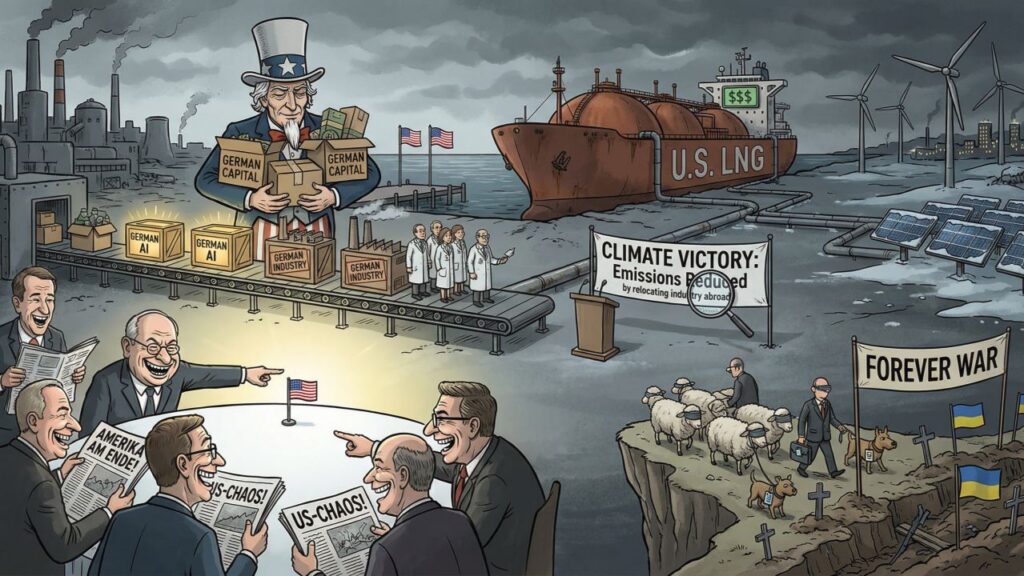
NATURAL GAS EDITION (Gulf Coast LNG and Haynesville’s Position)
Author’s note: Schadenfreude is a peculiarly German word, the pleasure derived from others’ misfortune. The German press wields it liberally against America and anyone else who dares exhibit common sense, self-preservation, or even the most modest notion of national honor. Yet the joke, as always, is on those who laugh too soon.
The Forever War grinds on in Ukraine, and what flows westward across the Atlantic is not merely German capital but the very sinews of German power: industry, artificial intelligence, and the intellectual corpus that once made Germany an industrial titan. Meanwhile, Germany cannot even generate electricity reliably. Wind turbines stand idle, solar panels darken, and the lights flicker, all while German officials virtue signal about climate victory, conveniently claiming credit for emissions reductions achieved by offshoring the industries that produced them.
Three butcher’s bills will come due: one paid by the German economy, stripped and hollowed; one paid in Ukrainian blood on the killing fields of Donbas; and one paid by the German people themselves, sheep led willingly to slaughter by their leaders and the subservient lapdogs of the legacy press who herd them forward with manufactured consent and imperious condescension toward anyone who questions the march toward the cliff.
Schadenfreude, indeed, you smug, arrogant, and sanctimonious controllers and your oh-so-receptive sheep.
SAO
THE FOREVER WAR
By Scott Ortkiese
Executive Summary for the Natural Gas Market: Gulf Coast LNG and Haynesville’s Position
For natural gas producers, LNG dealmakers, and energy investors, the central fact is that European policy since February 2022 has turned what many still frame as a temporary geopolitical shock into an economic driver of American LNG demand. The decisions to sever Russian pipeline supplies, to allow or enable the destruction of Nord Stream, and to construct a financial and diplomatic architecture that prevents normalization with Moscow have collectively locked Europe into long‑term dependence on expensive liquefied gas, with the United States as the primary beneficiary.
Before the war, Europe’s industrial model rested on a foundation of cheap Russian pipeline gas. In 2021, Russian flows to the European Union totaled around 155 billion cubic meters per year, accounting for roughly 45 percent of EU gas imports and about 40 percent of total European gas consumption once domestic production is included. Germany, the industrial core of the continent, sourced about 55 percent of its gas from Russia at delivered prices on the order of 200 dollars per thousand cubic meters. That energy platform underwrote the competitiveness of German chemicals, autos, steel, and a broad range of European industry that relied on predictable, low‑cost baseload gas.
By 2024, that world was gone. Russian pipeline volumes to the EU collapsed to roughly 54 billion cubic meters, a loss of more than 100 bcm that had to be replaced by some mix of demand destruction, alternative supply, and efficiency. U.S. LNG exports to Europe surged from around 10 bcm in 2021 to well over 60 bcm, a six‑fold increase in three years. Spot LNG prices in Europe spiked toward 700 dollars per thousand cubic meters during the panic phase and have since eased into the 500 to 600 dollar range as terminal capacity and shipping caught up. Even after that normalization, European industrial buyers are still paying roughly three times what they once paid for Russian pipeline gas, and there is no credible path back to the old parity.
The destruction of Nord Stream in September 2022 set the physical parameters of this new reality. Explosions at depths of roughly 70 to 100 meters in the Baltic removed around 110 bcm per year of pipeline capacity in one stroke. Investigations by Swedish and Danish authorities established that this was deliberate sabotage using substantial explosive charges rather than any kind of accident. German investigators have identified a group of suspects with Ukrainian links, pointing toward a state‑linked operation.
Presumably, Ukraine’s motivation was to eliminate Europe’s exit option: as long as Nord Stream existed, European leaders facing economic pain could rationalize normalizing with Russia to restore cheap gas, potentially pressuring Ukraine into territorial concessions or an unfavorable peace. By destroying the pipelines, Ukraine ensured Europe had no choice but to continue supporting Ukraine indefinitely, because the physical infrastructure enabling a Russia-Europe energy reconciliation was permanently removed.
For LNG dealmakers, who destroyed Nord Stream doesn’t matter, the pipelines themselves no longer exist. Recreating that system would require five to ten years of engineering, environmental review, permitting, and construction, tens of billions of euros in capital, and, above all, Russian cooperation to rebuild infrastructure in precisely the waters where it was just destroyed. Moscow has indicated it has no intention of doing so, preferring instead to redirect volumes to China through Power of Siberia and to India and others through Arctic routes on terms that match or exceed its old European margins.
Even if every sanctions package vanished tomorrow, the asset freezes were reversed, and the political class in Brussels suddenly rediscovered the virtues of realism, none of that would re‑materialize pipelines on the seabed. Europe would still face a 5 to 10-year hurdle during which it is functionally one hundred percent dependent on LNG for the volumes that Nord Stream used to carry, and by the time any replacement system could theoretically come online, a significant share of Europe’s energy‑intensive industry will already have migrated to jurisdictions with lower input costs or simply shut down.
The December 2025 decision on Russian central bank reserves hardened the financial architecture around this energy break. Until then, roughly 210 billion euros of Russian reserves held in European institutions were formally frozen but subject to a six‑month rollover process. In theory, that created a lever: asset unfreezing could be part of any negotiated settlement. By scrapping the periodic review and explicitly conditioning any return of those reserves on Russia paying war reparations to Ukraine, the European Union converted a temporary pressure tool into a permanent confiscation regime with an unlock code that cannot be entered. Reparations are payments imposed on defeated nations after unconditional surrender, the kind dictated to Germany after World War I or Iraq after the 1991 Gulf War. They are not negotiated; they are imposed on states that have lost the ability to resist. Russia has not been defeated and will not be defeated. It remains a nuclear-armed power with four times Ukraine’s population, Chinese economic backing, and a UN Security Council veto. The military trajectory is one of grinding Russian advance through attrition, not imminent collapse. A demand for reparations therefore presupposes total Russian military defeat and regime change, an outcome that is not occurring under any realistic scenario. From Moscow’s perspective, this decision removes any incentive to negotiate. Whether Russia compromises tomorrow or fights for another decade, the financial outcome is identical: permanent loss of reserves. Meanwhile, Russia has successfully redirected energy exports eastward (Power of Siberia pipelines to China, Arctic LNG to India, discounted crude to Asian refiners) at prices exceeding former European margins. Europe’s asset seizure accelerated Russia’s pivot to Asia while locking Europe into American LNG at three to four times the cost, with no path back to competitive energy prices. For LNG dealmakers, the consequence is clear: European demand has no expiration date tied to peace talks or diplomatic breakthroughs, because the EU structured its freeze to guarantee Russia will never voluntarily return to European energy markets.
This choice removed the EU’s most obvious piece of negotiating leverage and simultaneously tied its own hands. Any future leadership that wished to treat assets as a bargaining chip would have to climb down from a publicly declared position that money returns only alongside Russian capitulation. The immediate consequence for LNG is that demand no longer has an “expiration date” attached to ceasefires or peace talks. A settlement that leaves the frozen‑asset machinery largely intact changes very little about Europe’s need to secure non‑Russian gas at any price.
Three mechanisms now anchor Europe’s LNG dependency: the physical destruction of pipeline infrastructure, the permanent frozen‑asset regime, and the decision‑making structure and personnel choices inside the EU. The first mechanism is simply Nord Stream’s absence. Pipelines are not sanctions; they cannot be lifted with a signature. The system that once delivered cheap Russian gas to Germany and the broader EU does not exist on the seabed anymore, and the sovereign that controlled the molecules has already redirected them to Asia. The second mechanism is the asset architecture. By tying reserve release to reparations, Brussels removed any rational incentive for Russia to treat those funds as negotiable and made it politically excruciating for future European leaders to reverse course. The third mechanism is institutional and personal. Under EU rules, sanctions and asset decisions require unanimity among twenty‑seven member states. That gives small, historically traumatized states like Estonia, Latvia, Lithuania, and Poland an effective veto over any softening of policy, regardless of what Berlin or Paris might prefer. On top of that unanimity requirement, the Union has installed as its key foreign‑policy actors Kaja Kallas and Ursula von der Leyen, leaders whose biographies and financial entanglements strongly predispose them toward confrontation rather than compromise. When veto power is concentrated in the most hard‑line capitals and the top diplomatic posts are held by figures structurally incapable of selling a deal at home, policy lock‑in ceases to be an accident.
For LNG market participants, the implication is straightforward. Europe’s dependence on imported liquefied gas is not a transient function of a particular front line around Kharkiv or Kherson. It is the consequence of infrastructure that has been physically removed, financial instruments that have been weaponized in ways that are hard to unwind, and an institutional design that makes policy reversal nearly impossible without a political revolution in Brussels and several national capitals. That is the commercial reason why demand from Europe looks less like a weather trade and more like a new base load.
Gulf Coast LNG and Haynesville’s Position
On the other side of this European debacle sits the Gulf Coast, where liquefaction capacity is being built out at a pace and scale that would have been unimaginable without the structural break in Europe’s energy relationship with Russia. Existing plants such as Sabine Pass and Corpus Christi are being joined by Golden Pass, Plaquemines, and a fleet of other projects that collectively push projected Gulf Coast capacity beyond 30 billion cubic feet per day by 2030, more than double current throughput. At the same time, midstream projects like the Louisiana Energy Gateway pipeline, with roughly 1.8 Bcf per day of capacity, are being laid down for the explicit purpose of moving Haynesville molecules to those export terminals. This is not generic infrastructure; it is a purpose‑built LNG feeder system linking a specific dry‑gas basin to a specific export corridor.
In practice, the incremental feedgas for this expansion does not come proportionally from every U.S. basin. Geography and pipe determine who wins. Haynesville’s location within two to three hundred miles of the key Louisiana terminals, combined with dedicated infrastructure like LEG, means that roughly half to sixty percent of new liquefaction capacity is expected to be backed by Haynesville gas. Another twenty to twenty‑five percent is likely to come from associated gas in the Permian, pushed toward Corpus Christi and other Texas facilities along new lines, with the remaining volumes supplied by Eagle Ford, Mid‑Continent, and Appalachian gas that must overcome longer distances and infrastructure constraints. For Haynesville producers, that translates into a disproportionate share of the growth barrel.
On the demand side of the Gulf Coast ledger, European counterparties dominate the book of business for new trains. By 2029, roughly seventy percent of incremental U.S. LNG export capacity is spoken for by European utilities and industrial buyers, via long‑term sale and purchase agreements and associated feedgas contracts that typically run fifteen to twenty years. These contracts are often indexed to crude or use hybrid pricing formulas rather than pure Henry Hub spot exposure, and they incorporate escalation mechanisms that preserve real returns for upstream suppliers. European buyers accept these terms because they no longer inhabit a world of optionality. With Russian pipeline gas politically and physically off the table, indigenous production declining, and the intermittency of renewables requiring dispatchable backup, security of supply is now more important than shaving a dollar off the MMBtu.
This is why capital from Tokyo Gas, JERA, and Citadel has flowed into Haynesville assets at valuations notably richer than comparable U.S. dry‑gas properties that lack LNG linkage. Tokyo Gas paid roughly 2.7 billion dollars in 2024 to secure Haynesville volumes that can be steered toward Japanese power and industrial demand. JERA followed with a 1.5 billion dollar acquisition of Haynesville properties at thirty to fifty percent premiums over peers without export connectivity. Citadel’s acquisition of Paloma Resources for around 1.2 billion dollars reflected a similar thesis from a financial buyer’s perspective: feedgas streams pointed at European LNG contracts offer downside protection and cash‑flow visibility that pure domestic gas producers cannot match in a cyclical market. These are not bets on maximum volumetric growth; they are purchases of optionality and security in a world where Europe has, by design, made itself a captive buyer.
Scenario Analysis: Why Every Path Preserves LNG Demand
The easiest way to visualize the durability of this demand is to walk through the main political and military scenarios and ask what each does to the call on U.S. LNG. The base case, and by far the most plausible trajectory, is a frozen conflict that drags on for five to ten years or longer without a formal peace treaty. In such a world, sanctions remain, the asset freeze architecture tied to reparations stays in place, Nord Stream is not rebuilt, and Europe continues to treat Russian gas as untouchable. Under those conditions, European LNG imports hover around seventy percent of EU gas supply well into the mid‑2030s. Industrial demand erodes but does not vanish, and the portion that remains is structurally tied to LNG. For Haynesville‑linked exporters, this is a world of elevated but stable baseload demand stretching through at least the 2035 to 2040 planning window.
A Russian military victory does not unwind this structure; it intensifies it. If Ukrainian defenses eventually crack under manpower shortages and matériel exhaustion, and Russia either takes more territory or imposes regime change in Kyiv, the political reaction in Europe will be an energy‑security panic. States that already mistrust Moscow will scramble to over‑contract non‑Russian supply, seeking to insulate themselves from the risk of becoming the next target. That behavior pushes European LNG demand higher than in the frozen‑conflict base case and widens premia (i.e., price markups that sellers can charge above baseline market prices) for firm capacity. From the vantage point of Gulf Coast liquefaction projects, the main difference is not direction but magnitude.
Even a negotiated settlement, the scenario that on the surface appears most bearish for LNG, does less damage to the demand story than many assume. Suppose Turkey, China, or another acceptable mediator brokers a deal that freezes the front line in some form of territorial compromise and codifies Ukrainian neutrality. The December 2025 asset architecture does not automatically dissolve on signing day. Any reversal would require unanimous EU agreement and a political elite willing to eat a very public humiliation. In parallel, any attempt to reconstruct large‑scale pipeline infrastructure from Russia to Europe would still face the same five‑to‑ten‑year engineering and permitting cycle that exists today. In the meantime, Europe will have spent years paying LNG prices while deindustrialization and relocation run their course. In such a “good news” scenario, European LNG imports may fall from seventy percent of supply to somewhere in the forty to fifty percent range, but that is still roughly double the pre‑2022 status quo in which U.S. LNG was a marginal swing supplier rather than an anchor of the system.
The final scenario, EU fragmentation, is a tail risk but one worth considering. Under this path, prolonged economic strain, energy costs, and political backlash cause certain states to drift away from Brussels and seek their own arrangements with Russia, while others cling to the existing line. Aggregate LNG demand does not disappear; it becomes more chaotic. Procurement shifts to a patchwork of national strategies, credit profiles diverge, and contract structures become messier. Yet individual mid‑size states lack either the capital or the time horizon to recreate pipeline infrastructure at the scale that Nord Stream once represented. They remain buyers in the LNG market even if their relationship to EU institutions changes.
The common thread across these scenarios is that none produces a rapid reversion to the pre‑war configuration in which Russian pipeline gas supplied the bulk of Europe’s needs and American LNG served as occasional top‑up. The range of plausible futures runs from elevated demand that persists, to elevated demand that increases, to elevated demand that moderates only slightly from its peak. For anyone sitting on Haynesville acreage with pipe to the Gulf, that is the strategic backdrop against which to evaluate every drilling program, midstream commitment, and contract negotiation for the next two decades.
The Leadership Problem: Trauma and Corruption
The two people who now shape the European Union’s posture toward Russia more than any others are Kaja Kallas, as High Representative for Foreign Affairs, and Ursula von der Leyen, as President of the European Commission. Both come to their roles with personal histories and incentive structures that make genuine compromise with Moscow psychologically and materially impossible, and that fact matters as much for LNG demand as any pipeline map.
Kaja Kallas’s worldview was forged in a family that lived through the worst of Soviet rule in the Baltics. Born in Soviet‑occupied Estonia in 1977, she grew up in a household marked by deportation and imprisonment. In March 1949 her mother, grandmother, and great‑grandmother were loaded by Stalin’s security apparatus into cattle cars and shipped to Siberia, where they endured winters that fell to minus forty degrees Celsius (Nerdly interesting, but -40°C = -40°F, the only point where the Celsius and Fahrenheit scales intersect, but I digress) and nearly a decade of exile before they were allowed to return. Her grandfather spent years in Siberian labor camps where thousands of Estonians died from disease, starvation, and forced labor.
When Kallas says, as she has in numerous public interviews, that “Russia hasn’t changed” and that the “same evil” still lives there, she is not making a dispassionate analytical claim. She is speaking from a diplomacy crippling inherited trauma that sees history repeating itself along the Estonian border. This renders her fundamentally unsuited for any role in EU-Russia policy, yet she remains at the table as a hardliner. Diplomatic negotiations require the ability to separate personal grievance from strategic calculus, to assess adversaries without viewing them through the lens of ancestral suffering, and to identify compromise positions that serve broader European interests rather than the psychological needs of a single traumatized state. Kallas possesses none of these capacities. Her family history (deportations, labor camps, decades of Soviet occupation) makes her incapable of the emotional distance necessary to represent a twenty-seven-member union with divergent threat perceptions, economic dependencies, and historical relationships with Moscow. She has no business negotiating with Russia or shaping policy toward it, yet she holds the EU’s most senior foreign-policy position precisely because leaders like Macron, Scholz, and Tusk wanted someone who would never seek an off-ramp. They installed trauma as policy. Estonia’s geography amplifies that trauma. It is a country of around 1.3 million people, smaller than the city of San Diego, sharing a 294‑kilometer border with Russia and sitting within artillery range of St. Petersburg. Soviet occupation ended only in 1991; many Estonians in positions of influence remember it directly. The state now spends more than five percent of GDP on defense, a higher share than any NATO member including the United States, and has approved billions more in new defense outlays in recent years. Within that context, Kallas does not see Russia as a difficult neighbor to be managed; she sees an existential predator whose defeat must be pursued at almost any cost.
Her elevation to the EU’s top diplomatic post was not an accident of meritocratic competition but a deliberate choice by core European leaders who wanted the hardest possible line on Russia. Emmanuel Macron, Donald Tusk, Olaf Scholz, and Mark Rutte pushed through her appointment over the objections or abstentions of Viktor Orbán, Giorgia Meloni, and Robert Fico, who either opposed her selection or criticized it immediately. The point was to install a warrior, not a conciliator. Kallas herself has boasted in semi‑private settings that she has persuaded other countries not to meet with Vladimir Putin and has described her job as one of constantly leaning on “third countries” with the argument that Europe pays them more than Russia does. This is not the language of someone looking for off‑ramps. It is the language of someone building a coalition for permanent isolation.
Her repeated insistence that the European Union does not negotiate with “war criminals” closes the last remaining conceptual space for a negotiated settlement. The International Criminal Court’s 2023 warrant for Putin over the deportation of Ukrainian children provides the legal pretext, but the underlying stance is categorical: if the other side is criminal by definition, any contact is contamination. The historical record of conflict resolution, from Korea to Vietnam to the Balkans, shows that wars usually end with ugly, morally compromised bargains struck between men who have presided over atrocities. Kallas’s logic forbids that. When the EU organizes highly publicized “peace summits” that exclude Russia and then issues communiqués about what Moscow must do, it is performing theater, not diplomacy. The structure is not designed to reach a settlement; it is designed to show resolve.
If Kallas embodies a trauma that blinds her to peace and the EU’s best interests, Ursula von der Leyen embodies nonstop corruption. Born into Brussels elite power structures, she has spent her career steering lucrative contracts to firms employing her family members, destroying evidence when investigations threaten, and facing zero consequences because her malignant manipulative caste protects its own. Born in Brussels in 1958 while her father worked for the European Economic Community, von der Leyen grew up inside the structures that later became the EU. Ernst Albrecht, her father, served as Minister‑President of Lower Saxony and was a major figure in Germany’s Christian Democratic Union. Ursula attended elite schools, studied in London and at Stanford, married into a wealthy medical family, and moved through politics as part of a European caste rather than an outsider clawing her way up from obscurity.
As Germany’s Defense Minister between 2013 and 2019 she presided over a consulting scandal that would have ended most political careers. The ministry spent around 100 million euros on external consultants in 2015 and over 150 million in 2016, while officially reporting only a tiny fraction of those sums to the Bundestag. A large share of the contracts went to McKinsey & Company, where von der Leyen’s son David was employed, and many were awarded without proper competitive tender. Her state secretary Katrin Suder was herself a former McKinsey partner and channeled work to former colleagues, a textbook case of revolving‑door contracting that the German Federal Court of Auditors denounced as inadmissible.
When parliament finally launched an inquiry and designated specific text messages and phone records as evidence, the devices in question were wiped. Messages that had been formally placed under evidentiary protection in July 2019 were deleted in August. The ministry offered boilerplate about security protocols; the practical effect was obstruction. Instead of ending her career, this record became the prelude to a promotion. In July 2019 von der Leyen left German jurisdiction to become President of the European Commission.
In Brussels she reprised the same pattern with vastly larger sums. During the pandemic she negotiated by text message with Pfizer CEO Albert Bourla over a contract for 1.8 billion additional vaccine doses worth tens of billions of euros, commitments on the scale of a small country’s annual GDP. When journalists and watchdogs attempted to obtain those messages under EU transparency law, her staff claimed they were “short‑lived” communications that did not need to be archived. Subsequent legal efforts to force disclosure ran into the same void: the messages had been wiped. The European Ombudsman concluded that her handling of the matter violated transparency obligations, yet she faced no real consequences and was re‑elected Commission President in 2024.
Against that backdrop, her son’s position at McKinsey and the consultancy’s role advising European defense firms are not incidental details. McKinsey is deeply embedded with contractors such as Rheinmetall and BAE that have enjoyed extraordinary order growth and stock price appreciation since 2022. As Commission President, von der Leyen has championed policies that funnel tens of billions of euros into rearmament, EU-Ukraine defense industrial integration, and long‑term munitions spending. The same ecosystem of firms that benefits from those decisions employs her son and has previously benefited from her willingness to steer contracts their way. The incentives are obvious: a de‑escalation that seriously deflates Europe’s defense budgets is not in her personal or familial interest.
Von der Leyen’s rhetorical project has been to rebrand the EU as a “geopolitical Europe,” explicitly shifting its raison d’être from economic integration and peace to strategic confrontation with Russia. In public documents and speeches she has spelled out conditions for Ukraine that amount to terms of victory rather than compromise: full restoration of 1991 borders, no limits on Ukrainian force posture, eventual EU accession, and a settlement in which Europe’s institutional “centrality” is explicitly recognized. These are not bargaining positions designed to be traded. They are markers of total success. When placed alongside the asset freeze architecture that conditions Russian reserve release on reparations, they define a posture in which anything short of Russian capitulation is treated as unacceptable.
Taken together, Kallas and von der Leyen form a pincer that closes off both the psychological and material avenues for compromise. One cannot, for internal emotional reasons, contemplate any engagement with Moscow that does not end in humiliation and punishment. The other cannot, for embedded financial and reputational reasons, afford a peace that would shrink defense budgets, expose the folly of Europe’s energy decisions, and force a reckoning with her own record. Both are operating inside an institutional system that gives small, hard‑line states veto power over sanctions policy and that has already locked in asset seizure rules premised on an impossible Russian defeat. Under those conditions, calling for “diplomatic solutions” is an empty ritual. The architecture is built for a long war, and the people running it are among the least likely Europeans to dismantle it.
The Defense Industry Bonanza
If Kallas and von der Leyen explain why policy cannot change, Europe’s defense contractors explain why there is constant pressure to ensure that it does not. Since 2022, the European arms industry has enjoyed the kind of upside that Wall Street usually associates with once‑in‑a‑generation technology shifts, not artillery wars in the Donbas. Rheinmetall, Germany’s flagship defense manufacturer, is the emblem. Its share price moved from roughly ninety euros before the invasion to over six hundred euros by late 2025, lifting market capitalization from a low single‑digit billions figure into the mid‑sixties. In less than four years, shareholders who bought before the war saw fifteen‑fold returns. Profit margins rose from around ten percent into the mid‑teens. Order backlogs doubled, and the company committed capital to new munitions plants, including facilities on Ukrainian soil that bind Kyiv’s warfighting capacity directly to Rheinmetall’s future revenues.
The pattern repeats across Europe. BAE Systems in the United Kingdom, Thales in France, Saab in Sweden, and a constellation of smaller firms have all booked record orders and enjoyed re‑ratings as governments scrambled to refill depots, backfill donated stocks, and build out new production lines for everything from artillery shells to air defense systems. By mid‑2025 Europe had allocated more than thirty‑five billion euros in military aid to Ukraine through various vehicles, including the so‑called European Peace Facility, which has been quietly repurposed from supporting peacekeeping in Africa to underwriting lethal aid on the continent’s eastern edge. The European Union now openly describes itself as the largest foreign public investor in Ukraine’s defense industry, a phrase that would have been unthinkable in Brussels a decade ago.
This torrent of money does not arrive in a vacuum. Defense firms spend heavily on lobbying in Brussels, Berlin, Paris, and other capitals. They hire former officials, sponsor conferences, fund think tanks, and cultivate the kind of social and professional overlap with policymakers that makes their preferences feel like common sense. The same consulting houses that advise ministries on “capability gaps” and “readiness” also advise the companies bidding to fill those gaps. In that environment, a war that sustains high levels of ammunition consumption and constant calls for new capabilities is not a crisis to be ended; it is a business model to be maintained.
When von der Leyen champions EU‑Ukraine defense industrial integration or calls for multi‑year ammunition procurement programs, she is not doing so in a vacuum of technocratic neutrality. She operates in a network where her son’s employer helps defense firms position for those contracts and where her own political story is tied to an image of resolute leadership against Russian aggression. A genuine peace that produced a sharp contraction in defense budgets would not merely lower revenues for arms manufacturers. It would also expose the scale of Europe’s energy and industrial self‑harm and raise uncomfortable questions about why so many decision‑makers, consultants, and lobbyists prospered as their societies absorbed the costs.
The Economic Catastrophe: Energy Colonization
Europe’s military commitment to Ukraine is not the only arena where its policy choices have produced winners and losers. The energy dimension has quietly done even more to reshape the balance of power between Europe, the United States, Russia, and China. Before the war, the European industrial project was inseparable from cheap Russian hydrocarbons. German heavy industry in particular was built on a simple equation: Russian pipeline gas in at roughly 200 dollars per thousand cubic meters, high‑value exports out. That pricing allowed firms like BASF, the world’s largest chemical company, to run complex sites such as Ludwigshafen, whose gas consumption rivals that of entire mid‑sized countries, as both energy hubs and feedstock centers for global supply chains.
The destruction of Nord Stream and the subsequent decision to replace Russian pipeline gas with LNG fundamentally broke that equation. European industrial users now face gas prices that, even after the worst of the crisis has passed, are several multiples of their pre‑war levels. In relative terms, they pay far more for energy than competitors in the United States, who benefit from domestic shale production and shorter, cheaper logistics chains. The result has been a steady trickle of relocation announcements that, taken together, amount to a re‑drawing of the global industrial map. BASF has closed or shrunk operations at legacy German sites and shifted investment to China and the U.S. Volkswagen has begun closing plants in Germany for the first time in its history. Other manufacturers quietly mothball capacity, delay projects, or choose new sites abroad where electricity and gas do not carry a European premium.
This is not simply a story of cyclical pain or a bad couple of winters. Once supply chains move and capital equipment is installed in Texas, Louisiana, Shanghai, or Nanjing, the friction of reversing those decisions is immense. Europe’s choice to treat Russian gas as permanently taboo, combined with the physical destruction of its main pipeline corridor and the sunk costs of regasification terminals and long‑term LNG contracts, effectively hands a portion of Europe’s industrial base to its competitors. The United States captures that value through cheap gas at home and high‑margin LNG sales abroad. China captures it through discounted Russian energy and the relocation of European plant and expertise onto Chinese soil. Russia, after an initial shock, has reoriented its hydrocarbons toward Asia and is no longer structurally dependent on European markets at all.
From the vantage point of Houston or Lake Charles, what Brussels presents as moral resolve looks like something closer to energy colonization. A continent that once prided itself on being a co‑equal economic pole has chosen to blow up its own low‑cost energy foundation, then replace it with imported molecules priced at a premium and paid for in a currency it does not control. In doing so it has made itself dependent on U.S. gas producers, U.S. shipping and terminal capacity, and U.S. policy whims in a way that would have horrified earlier generations of European strategists. At the same time it has strengthened the hand of the one actor it meant to weaken most: China, which now enjoys cheaper Russian energy, rising industrial capacity, and a Europe too distracted and weakened to compete effectively.
The human cost of this experiment shows up not only in industrial balance sheets but in household budgets. European consumers face higher heating and electricity bills, taxes diverted into subsidies and price caps, and the gradual erosion of the social model that depended on a robust manufacturing base. Politicians in Berlin and Brussels talk about “strategic autonomy,” but the reality is an energy dependency that has merely changed address. Where Europe once depended on Russia for cheap pipeline gas, it now depends on the United States for expensive liquefied gas, with a new layer of mediation by traders, shipping companies, and financiers who all take a cut.
From an LNG dealmaker’s perspective, this is precisely what underwrites the structural demand story. Europe cannot easily walk away from the contracts it has signed or the terminals it has built; it cannot un‑blow Nord Stream; it cannot instantaneously rebuild a competitive industrial energy platform at home. The logical consequence is a multi‑decade flow of European money across the Atlantic in exchange for American molecules, a flow that will continue long after the current front line in Ukraine has shifted or frozen. The tragedy for Europe is that in trying to punish Russia it has punished itself more severely. The opportunity for U.S. gas producers is that this self‑inflicted wound is, in practical terms, permanent.
The Military Reality: Attrition Warfare
On the battlefield, the war in Ukraine increasingly resembles a modernized version of the First World War more than any clean, maneuver‑centric campaign from the history books. Both sides have dug into extensive trench systems, layered minefields, and overlapping artillery zones, and the strategic question is no longer who can execute the perfect offensive, but who can endure a grinding contest of attrition longer. In that kind of war, the decisive variables are population, industrial capacity, external support, and political tolerance for losses, not clever operational plans or isolated tactical victories.
Russia enters this contest with structural advantages that no amount of Western rhetoric can erase. It has a population roughly four times that of pre‑war Ukraine, and even after accounting for emigration and demographic problems, it retains a larger pool of men who can be mobilized. Its defense industry, scarred but not destroyed by the post‑Soviet collapse, has been re‑tooled for wartime production, running factories on three shifts to turn out artillery shells, armored vehicles, drones, and missiles. It has access to external support from countries like Iran and North Korea, which supply drones and ammunition, and it enjoys China’s economic backing in the form of continued trade and technology transfer. Perhaps most importantly, it operates under an authoritarian political system that can suppress dissent and absorb casualties at levels that would topple many democratically elected governments.
Ukraine, by contrast, is fighting with a shrinking manpower base and an economy that would have collapsed outright without external aid. Millions of working‑age Ukrainians have left the country as refugees. Reports from the front describe units whose average age continues to rise into the forties because younger men either remain abroad, evade conscription, or are already casualties. Desertion cases, while politically sensitive, have grown more common in military court statistics, reflecting the strain of long rotations, inadequate rest, and the sense that promised breakthroughs have not materialized. Equipment losses have been partly offset by Western deliveries, but ammunition consumption rates still outpace Western production capacity, particularly in artillery, where Russia has been able to fire more shells per day than Ukraine despite sanctions. Air defense systems are depleted faster than they can be replaced, and industrial targets across Ukraine remain vulnerable to missile and drone attacks that undermine the home front.
The cumulative effect is slow but real deterioration. Offensive operations that Western officials once advertised as game‑changing have yielded modest territorial gains at high cost. The 2023 counteroffensive, widely hyped in advance, failed to crack Russia’s prepared defensive belts and consumed a significant portion of Ukraine’s best trained units and Western armor. Subsequent efforts have been more limited in ambition. None of this means Ukraine collapses tomorrow. Attrition wars can drag on for years after the strategic balance has tilted. But it does mean that, absent a dramatic shift in the external environment, the side with the larger population, deeper industrial base, and more reliable external backing will continue to grind forward at a pace that only looks slow if you forget the calendar.
Europe’s Impossible Trap
Against this military backdrop, Europe finds itself in a position where every path forward looks untenable in a different way. Strategically, it has boxed itself into a triangle of impossibilities: it cannot win outright, it cannot negotiate honestly, and it cannot admit defeat. Each of these constraints is a direct consequence of the structural and leadership choices already examined, and together they explain why policy has drifted into a de facto commitment to a Forever War.
Militarily, Europe cannot defeat Russia in Ukraine without a level of direct involvement that its publics will not accept and its arsenals cannot support. European armies have atrophied under three decades of peace dividends; their force structures are sized for modest expeditionary operations and alliance contributions, not for high-intensity, long-duration combat against a peer adversary. Artillery production plans that are presented in Brussels as ambitious still fall short of Ukraine’s current annual consumption, while Russia, aided by imports from North Korea, can manufacture or acquire shells in the millions. The few European states that maintain relatively large forces, such as Poland, prioritize their own territorial defense rather than risking confrontation with a nuclear power. Even the politicians most hawkish on Russia shrink from proposing direct intervention, because they know that voters who support abstract “solidarity” are far less enthusiastic about sending their own sons and daughters into the trenches.
Diplomatically, Europe has made genuine negotiation almost impossible. The asset freeze regime, as already described, conditions any return of Russian reserves on reparations that presuppose total Russian defeat. The rhetorical framing of the conflict as a civilizational struggle between democracy and autocracy turns any territorial compromise into a moral betrayal. Leaders like Kallas and von der Leyen have so thoroughly tied their identities to maximalist positions that they cannot back down without detonating their own careers. Institutional rules that require unanimity give the most hard‑line states veto power over any attempt to explore de‑escalation. Under those conditions, “peace initiatives” tend to be events where like‑minded governments gather to draft statements about what Russia must accept, without ever inviting Russia to the table or offering anything in return.
Politically, Europe cannot admit that the strategy it has pursued since 2014 has failed. To do so would be to concede that NATO’s open‑door policy was pursued without an honest assessment of Russian red lines; that Minsk was used as a delaying tactic rather than a good‑faith effort at settlement; that the sabotage of serious talks in early 2022 condemned Ukraine to years of additional destruction; and that Europe’s own sanctions and energy decisions have damaged its economies more severely than Russia’s. Such admissions would not merely be embarrassing. They would delegitimize entire parties, media ecosystems, and bureaucratic cohorts that have portrayed themselves as stewards of European security and morality. For politicians facing re‑election, for editors who have spent years policing the discourse, and for officials whose budgets and prestige have grown with the crisis, that kind of reckoning is unthinkable.
The result is paralysis masquerading as resolve. Europe continues to fund Ukrainian defense at levels sufficient to prevent rapid collapse but not enough to reverse the strategic balance. It continues to pass new sanctions packages that make less and less marginal difference. It continues to speak in the language of victory while quietly preparing for stalemate. Meanwhile, its own industrial base erodes under the weight of higher energy costs and defense outlays, and its dependence on U.S. LNG and U.S. security guarantees deepens at precisely the moment when Washington is signaling a long‑term pivot toward confronting China.
The Forever War Verdict
Put together, the military attrition logic, the leadership constraints, the institutional vetoes, the asset architecture, and the economic re‑wiring of Europe’s energy system all point in the same direction. Without a shock large enough to overthrow the current political class in key capitals, Europe is not on a path toward a clean victory or a negotiated peace. It is on a path toward a managed, normalized state of low‑intensity war that drags on for years, punctuated by occasional escalations and pauses, while the underlying structural realities (Russia’s demographic and industrial advantages, Europe’s energy dependency, Ukraine’s exhaustion) grind away in the background.
From the perspective of LNG markets, this “Forever War” is less a metaphor than a demand forecast. As long as Europe remains locked into confrontation with Russia, both politically and in the language of reparations and war crimes, the restoration of cheap Russian pipeline gas is off the table. As long as Nord Stream remains a twisted wreck on the seabed, the physical option to change course is missing even if the political will were to appear. As long as the same leaders who created this situation continue to present themselves as its solution, the incentive structure in Brussels and Tallinn and Berlin will favor more of the same. The war can freeze, flare, or shift location, but the energy architecture and the financial commitments that grew out of it will stay in place.
That is why, for Haynesville producers and Gulf Coast LNG projects, the key distinction is not between “war” and “peace” in Ukraine. It is between a Europe that is structurally separated from Russian energy and one that is not. The decisions that matter on that axis have already been taken and, barring regime‑level change, are not going to be reversed within any reasonable investment horizon. The Forever War is therefore not just a geopolitical diagnosis; it is the commercial backdrop that turns long‑dated LNG contracts with European counterparties from speculative punts into something closer to infrastructure‑like cash flows anchored in the self‑inflicted constraints of an entire continent.
Strategic Implications for LNG Dealmakers
For the people sitting on acreage, midstream commitments, and offtake negotiations, the question is not whether Europe’s Ukraine policy is wise or foolish in the abstract. It is what that policy, and the structures built around it, imply about cash flows and risk over the next twenty years. On that score, the picture that emerges from Europe’s choices is remarkably consistent. The continent has deliberately severed itself from its cheapest historical source of gas, overseen the physical destruction of the main infrastructure that carried that gas, written its own financial position into an asset regime that precludes easy reconciliation, empowered leadership that treats compromise as betrayal, and locked decision‑making into a unanimity rule that gives hard‑line states veto power over course corrections. Each of those factors alone would tilt the odds in favor of sustained LNG demand. Taken together, they amount to a high‑confidence environment for long‑term exposure.
That does not mean the future is risk‑free; it never is. Demand will ebb and flow with recessions, efficiency gains, and the slow diffusion of alternative technologies. Political shocks could accelerate deindustrialization and shrink the European market further than baseline assumptions. A truly radical political turnover in Brussels and key capitals could, over time, alter the asset regime or reopen energy channels that seem closed today. But any such reversal would require a scale of change that is hard to imagine within the investment horizon of most LNG projects. It would mean admitting that the signature decisions of the past decade, from NATO’s handling of Ukraine to the treatment of Russian reserves to the sabotage or acquiescence over Nord Stream, were catastrophic errors. It would mean displacing the very people whose careers and reputations are built on insisting that those decisions were necessary and righteous. As long as that reckoning does not occur, the structures now in place will continue to operate.
For Haynesville‑linked producers, this environment supports a playbook that is much closer to infrastructure investment than to the traditional boom‑and‑bust gas cycle. Long‑dated contracts indexed to oil or hybrid formulas, backed by European utilities and industrials that have no easy substitute, become the backbone for capital planning. Upstream development can be sized around pipeline and terminal capacity rather than the latest Henry Hub print. Balance sheets can be structured with the expectation that European buyers will still be in the market, not because they love paying a premium, but because their own leaders have made the alternatives politically and physically unavailable. The irony is that a war Europeans justified in the language of values has produced, for U.S. gas producers, one of the clearest examples in recent history of demand underwritten by someone else’s irreversible strategic mistakes.
Europe’s Forever War is not a slogan or a prediction; it is the logical endpoint of decisions already taken. The cheap gas pipelines that underwrote its industrial model have been blown up, the reserves that once gave it leverage have been locked behind a reparations demand that precludes compromise, and the leaders who might theoretically reverse course are those whose personal histories, financial ties, and public narratives bind them most tightly to escalation. The system as constructed does not contain an internal mechanism for backing down; it only knows how to fund another Ukrainian budget tranche, sign another munitions contract, announce another package of sanctions that Russia will route around, and then explain to its own citizens why their energy bills and tax burdens keep rising.
For the United States, and particularly for producers tied into Gulf Coast liquefaction, this represents an extraordinary, if morally ambiguous, windfall. Europe’s self‑destruction as a low‑cost manufacturing platform and its conversion into a premium LNG customer amount to a long‑term transfer of industrial capacity, investment, and strategic leverage across the Atlantic and toward Asia. Russia has learned that it can survive and even adapt without European customers. China has positioned itself as the main beneficiary of discounted Russian hydrocarbons and relocated European plant. It is Europe alone that finds itself paying three times its old gas price to sustain a war it cannot win, cannot end, and cannot admit was a mistake.
The Institutional Mission Shift
The European Union was built, over seventy years, as a mechanism for preventing war through economic integration. The European Coal and Steel Community, founded in 1951, had a simple premise: if French and German heavy industry were so intertwined that neither could function without the other, then another Franco-German war would be impossible. The Maastricht Treaty of 1992 formalized the Union around monetary union, single market rules, and shared regulatory standards. Defense and foreign policy remained stubbornly national, reflecting the reality that most member states viewed the EU as an economic convenience, not a collective actor on the global stage. That mission lasted until roughly 2022.
Ursula von der Leyen’s explicit rebranding of the Union as “geopolitical Europe” marks the formal abandonment of that founding logic. In speeches, policy documents, and budget allocations, the EU now defines itself primarily in terms of its confrontation with Russia rather than its capacity to promote trade, harmonize standards, or raise living standards. This is not a subtle shift in emphasis; it is a wholesale redefinition of purpose. An institution created to make war unthinkable now exists to prosecute one.
The mechanism through which this transformation has been executed is the European Peace Facility, a name so Orwellian that it deserves its own footnote in the history of institutional cynicism. Originally established to fund peacekeeping operations in Africa and other missions consistent with the EU’s self-image as a soft-power actor, the Facility has been quietly repurposed as the primary vehicle for financing Ukraine’s war effort. By mid-2025 the fund had grown from an initial capitalization of roughly 5.7 billion euros to over twelve billion, with the overwhelming majority now directed toward lethal military aid rather than peacekeeping. The bureaucrats in Brussels did not bother changing the name. They simply redirected the money from conflict resolution in Africa to ammunition procurement in Eastern Europe and continued calling it a “peace” facility.
Josep Borrell, who served as the EU’s High Representative for Foreign Affairs before Kallas took over, made the logic explicit in December 2022 when he announced that the Ukraine conflict “will be resolved on the battlefield” rather than through diplomacy. This was not an off-the-cuff remark or a negotiating posture; it was a formal articulation of EU policy. The Union that spent decades positioning itself as the alternative to American military unilateralism had explicitly rejected diplomatic resolution in favor of a military verdict. Borrell’s statement effectively closed the door on any serious European effort to broker or support negotiations, a position that Kallas has since hardened into absolute doctrine.
This mission drift occurred with virtually no democratic consultation. European citizens were never asked in referendums whether they wanted their Union transformed from an economic project into a party to a land war in Eastern Europe. National parliaments debated funding packages but not the underlying question of whether the EU should redefine itself around permanent confrontation. The shift happened incrementally through executive decisions, budget reallocations, and rhetorical repositioning by unelected officials in Brussels who treated the question of the Union’s purpose as a technocratic matter rather than a civilizational choice. By the time publics began to notice, the architecture was already in place and the momentum irreversible.
The irony is that this transformation undermines the very legitimacy the EU claims. If the Union’s purpose is now military confrontation with Russia, then it is competing on terrain where it has no comparative advantage and where national sovereignty questions become unavoidable. France and Poland do not agree on threat assessments, risk tolerance, or the acceptable price of confrontation. Germany’s industrial lobbies have radically different interests than Estonia’s strategic planners. Forcing these divergent preferences into a single “geopolitical Europe” posture produces lowest-common-denominator policy that satisfies no one and creates constant friction. The result is an institution that has lost its original economic rationale without gaining the coherence or capability necessary to function as a genuine security actor.

The American Abandonment
For most of the post-war period, the strategic bargain underpinning the transatlantic relationship was straightforward. The United States guaranteed European security through NATO, maintained tens of thousands of troops on the continent, and provided nuclear deterrence. In exchange, Europe accepted American leadership on major security questions, hosted U.S. bases, and aligned its foreign policy with Washington’s preferences on issues that mattered to American strategists. That bargain allowed European governments to run defense budgets far below what independent security would require, freeing resources for generous social programs and industrial subsidies. It was not a relationship of equals, but it worked for both sides as long as Europe remained the primary theater of U.S. strategic concern.
That era is ending, and the December 2025 release of the Trump administration’s National Security Strategy makes the break explicit in language that European officials found shocking. The document opens with a blunt assessment: “Stark strategic realities prevent the United States from being primarily focused on the security of Europe.” For seventy-five years, every American administration from Truman through Biden treated European security as a vital U.S. interest enshrined in NATO’s Article Five commitment. The 2025 strategy effectively repudiates that premise, replacing it with an Asia-first doctrine that treats Europe as a secondary theater where American resources and attention will decline over time.
The specific commitments outlined in the strategy amount to a roadmap for American disengagement. The document announces an end to further NATO expansion, reversing decades of policy that treated the Alliance’s “open door” as a sacred principle. It demands that European states increase defense spending to five percent of GDP by 2035, roughly double the current average and well above the three-and-a-half percent that the United States itself spends. For context, hitting that target would require European governments to find an additional five hundred billion euros per year in defense outlays at a time when their economies are already strained by energy costs and industrial decline. The strategy explicitly states that the United States will reduce its contributions to European conventional deterrence, meaning that the roughly one hundred thousand U.S. troops currently stationed in Europe will be drawn down as forces are redeployed to the Indo-Pacific.
Most remarkably, the document goes beyond security policy to attack the European Union itself, stating that Europe faces “civilizational erasure” due to current EU policies and that the United States will “cultivate opposition within the EU” to “save European civilization” from those policies. This is unprecedented language. For the United States to announce that it views the EU’s own leadership as part of the problem, and that it intends to work with individual member states against Brussels, represents a fundamental break with the post-war transatlantic order. It suggests that Washington no longer sees a strong, unified Europe as a strategic asset but rather as a dysfunctional impediment that must be bypassed or undermined.
The logic driving this shift is straightforward and has been telegraphed for over a decade. In November 2011, President Barack Obama announced the “pivot to Asia,” a strategic rebalancing toward the Indo-Pacific to counter China’s rise. That policy continued under Trump’s first term and was reaffirmed by Biden before the Ukraine war temporarily pulled American focus back to Europe. The bipartisan consensus in Washington is clear: China, not Russia, is the long-term peer competitor that will determine whether the United States remains the dominant global power in the twenty-first century. Russia is a declining power with a shrinking population, an economy smaller than Italy’s, and no plausible path to challenging American primacy outside its immediate periphery. China is a rising power with four times the U.S. population, an industrial base that dwarfs America’s, and global ambitions that directly threaten U.S. interests in the Pacific and beyond.
For American strategists, the implication is obvious: resources are finite, and the United States must prioritize. Every division stationed in Germany, every bomber wing in the U.K., every missile defense battery in Poland is a capability not available for deterrence in the South China Sea or the defense of Taiwan. European officials spent the last three years assuring their publics that Ukraine’s victory was certain because the combined weight of Europe and America could overwhelm Russia. Now America is explicitly saying it will not sustain European security commitments because its attention and resources must go elsewhere. Europe is being told to handle Russia on its own while America pivots to the theater that actually matters.
The timing of this strategic abandonment could hardly be crueler from a European perspective. Brussels committed itself to confrontation with Russia, imposed sanctions that hurt Europe more than their target, allowed or enabled the destruction of critical energy infrastructure, and tied up tens of billions in military and financial aid to Ukraine. It did so with the assumption that American backing was reliable and that transatlantic unity would endure. Now, at the moment when the costs of that strategy are becoming clear and the military situation in Ukraine is deteriorating, Washington is announcing that Europe is on its own. The United States under the Biden Administration effectively encouraged European escalation, provided just enough support to ensure the conflict drags on, and is now stepping back to let Europe deal with the consequences while American planners focus on encircling China.
For European strategic planners, this is a nightmare scenario. European militaries cannot quickly replace American capabilities in intelligence, logistics, long-range strike, missile defense, or nuclear deterrence. European defense industries cannot scale production to replace American munitions and equipment flows within any reasonable timeframe. European political systems are not structured for the kind of sustained mobilization and sacrifice that independent deterrence would require. And European publics, contrary to elite rhetoric, show little appetite for higher taxes, conscription, or the other burdens that would come with genuine strategic autonomy. The gap between Europe’s self-image as a “geopolitical” actor and its actual capacity to project power or defend itself without American help is about to become painfully apparent.
The ultimate irony is that Europe’s attempt to demonstrate resolve and unity through its Ukraine policy has exposed precisely the opposite. It has shown that Europe cannot win wars on its own periphery, cannot sustain its industrial base without cheap external energy, cannot maintain policy coherence when member states have divergent interests, and cannot count on the bottomless no-cost American security guarantees that have underwritten its prosperity for three-quarters of a century. The Forever War that Europe has locked itself into is unfolding just as its principal ally is headed for the exit.
Who Bears Responsibility
The question of how Europe arrived at this self-destructive position requires looking beyond the structural factors and institutional dynamics to the specific decisions and individuals that set the current trajectory in motion. Glenn Diesen, the Norwegian professor of international relations whose analysis helped frame parts of this report, is correct in his central thesis: a negotiated peace was entirely achievable in early 2022, and it was deliberately prevented by Western intervention that prioritized long-term Russian exhaustion over Ukrainian survival.
The evidence for this claim comes not from Russian propaganda or conspiracy theories but from the direct testimony of mediators who were present during the negotiations. Naftali Bennett, who served as Israel’s Prime Minister in early 2022, has stated in multiple interviews that serious talks were underway in Istanbul during March and April of that year. According to Bennett, both sides had moved toward a framework deal in which Ukraine would accept neutrality and limits on NATO membership in exchange for security guarantees and territorial arrangements that, while painful, would have ended the war within weeks of its start. Bennett has explicitly confirmed that Western officials, particularly from the United States and United Kingdom, intervened to kill the deal. Turkish Foreign Minister Mevlut Cavusoglu has corroborated this account, stating publicly that certain Western countries told Ukraine not to sign.
Victoria Nuland, who served as Under Secretary of State for Political Affairs in the Biden administration, admitted in a 2024 interview that “us and the Brits” advised Ukraine against accepting the terms on offer in Istanbul. Her phrasing was matter-of-fact, as if the decision to extend the war was an obvious choice that required no moral justification. Amanda Sloat, Biden’s Senior Director for Europe at the National Security Council, went further in her own 2024 remarks, acknowledging that the administration had floated the idea of Ukrainian neutrality before the invasion as a potential way to avoid conflict altogether. She then posed the question that now haunts Western policy: “There is certainly a question almost three years on now…would that have been better to do before the war started, would that have been better to do in Istanbul talks. It certainly would have prevented the destruction and the loss of life.”
The answer to Sloat’s question is obvious to anyone not invested in justifying the current disaster. A deal in Istanbul would have spared Ukraine two additional years of artillery bombardment, prevented the destruction of much of its energy infrastructure, saved tens of thousands of Ukrainian and Russian lives, and avoided the deindustrialization of Europe that followed from the decision to sever Russian energy ties. But accepting that deal would have required Washington and London to give up the opportunity to bleed Russia through a long war of attrition, and it would have meant admitting that NATO expansion into Ukraine was never worth the cost. So the talks were sabotaged, Ukraine was told to fight on, and the war that could have ended in April 2022 instead ground forward into the meat-grinder attrition phase that continues today.
The deeper roots of the crisis go back even further, to decisions made during the Bush and Obama administrations that crossed Russian red lines without any serious plan for managing the consequences. At the April 2008 NATO summit in Bucharest, President George W. Bush insisted on a declaration promising eventual NATO membership to Ukraine and Georgia over the objections of France, Germany, and others who understood the provocations involved. William Burns, who at the time served as U.S. Ambassador to Moscow and now runs the CIA under Biden, sent a prescient cable in February 2008 titled “Nyet Means Nyet: Russia’s NATO Enlargement Redlines.” In that cable Burns warned explicitly that Ukrainian membership in NATO was Russia’s reddest of red lines, that it would produce a strong Russian reaction, and that Russia’s leadership viewed NATO expansion into Ukraine as an existential threat that would be met with force if necessary.
Burns’s warnings were ignored. The Bucharest declaration went forward, setting in motion the chain of events that led to Russia’s 2014 annexation of Crimea and its 2022 full-scale invasion. The tragedy is that Burns’s analysis was exactly correct. Russia did precisely what he predicted it would do, at precisely the moment when the West’s actions made inaction intolerable from Moscow’s perspective. Yet the same officials who ignored his warnings in 2008 spent the next decade doubling down, culminating in the decisions of 2022 to sabotage peace talks and commit Europe to indefinite confrontation.
The Minsk agreements of 2014 and 2015, which were supposed to provide a framework for resolving the Donbas conflict, have since been revealed as a deliberate deception. Angela Merkel, who brokered Minsk alongside France’s François Hollande, admitted in a December 2022 interview that the agreements were never intended as a genuine path to peace. Instead, they were designed to buy time for Ukraine to build up its military with Western support in preparation for an eventual showdown with Russia. Hollande later confirmed Merkel’s account. This means that for eight years, the West was publicly committed to a peace process while privately using it as cover to prepare for war. From Russia’s perspective, this makes any future Western peace proposal inherently suspect. Why would Moscow trust European guarantees or American mediation when the last set of agreements was explicitly designed as a delaying tactic?
The American officials most directly responsible for the current trajectory include President Joe Biden, Secretary of State Antony Blinken, National Security Advisor Jake Sullivan, and Victoria Nuland. These are the individuals who made the call to encourage Ukrainian resistance rather than accept neutrality, who coordinated with Boris Johnson to sabotage the Istanbul talks, and who have overseen the policy of open-ended military and financial support without any clearly defined endpoint or success criteria. Their strategy appears to have been based on the assumption that sanctions would cripple Russia’s economy, that Russian military capacity would collapse under the weight of equipment losses, and that sustained Western support would allow Ukraine to reclaim lost territory and negotiate from a position of strength. Every one of those assumptions has proven wrong.
Strategic Failure Assessment
Measured against its own stated objectives, Western policy toward Russia and Ukraine since 2022 represents a comprehensive failure on nearly every dimension. The strategy was supposed to isolate Russia, cripple its economy, weaken its military, strengthen Western unity, and produce Ukrainian victory. None of those things has happened.
Russia was supposed to be isolated diplomatically and economically, cut off from global markets and reduced to pariah status. Instead, Russia has deepened ties with China, India, and much of the Global South. Trade with China reached record levels as Russia redirected energy exports eastward. India became a major buyer of discounted Russian oil, which it refines and resells to Europe at a markup, allowing European countries to claim they have stopped buying Russian energy while actually funding Moscow through an extra step. Russia has expanded its role in multilateral institutions like BRICS and the Shanghai Cooperation Organization, which together represent a larger share of global GDP than the G7. Far from being isolated, Russia has demonstrated that it can function and even thrive in a world where Western markets are closed, because the non-Western world represents the majority of humanity and increasingly the majority of economic growth.
The ruble was supposed to collapse under the weight of sanctions, producing hyperinflation and domestic unrest that would force Putin to back down. In the initial days after the invasion, the ruble did plunge, and Western officials triumphantly announced they had turned it into “rubble.” Then it recovered, stabilized, and has since traded within a relatively normal range. Russia’s central bank, led by Elvira Nabiullina, managed the crisis competently through capital controls, interest rate adjustments, and the requirement that energy buyers pay in rubles or convert through Russian banks. The ruble’s resilience became an early indicator that the sanctions regime would not produce the swift economic collapse that Western policymakers had promised.
The Russian economy was supposed to implode, unable to sustain a war effort while cut off from Western technology, finance, and markets. Instead, Russia’s economy contracted modestly in 2022, then returned to growth in 2023 and 2024. The IMF projects Russian GDP growth in line with or above many Western European economies. Unemployment remains low. Industrial production, particularly in defense sectors, has expanded dramatically. Russia has proven adept at sourcing sanctioned goods through third countries, developing domestic substitutes for Western technology, and reorienting supply chains toward Asia. This does not mean sanctions have had no effect; they have imposed costs and inefficiencies. But they have not produced anything close to the economic collapse that was supposed to make continuing the war impossible.
European unity was supposed to be strengthened by the shared sense of threat from Russia and the moral clarity of supporting Ukraine. Instead, cracks are widening. Hungary under Viktor Orbán has blocked or watered down multiple sanctions packages and maintains open channels to Moscow. Slovakia under Robert Fico has questioned the sustainability of military aid. Italy, despite supporting the EU consensus publicly, has significant business constituencies that want sanctions relief. Germany’s industrial lobbies are increasingly vocal about the damage that energy costs and lost Russian markets have inflicted. Public opinion polls across Europe show declining enthusiasm for open-ended support to Ukraine as energy bills rise and economic growth stalls. The longer the war drags on, the more these fractures will widen.
Ukraine was supposed to win, reclaiming territory and negotiating from a position of strength that would allow it to dictate terms. Instead, Ukraine is slowly losing a war of attrition. The 2023 counteroffensive, which Western officials presented as a potential turning point, failed to achieve meaningful territorial gains. Russian forces have gradually advanced in the Donbas, taking Bakhmut, Avdiivka, and other contested cities at enormous cost. Ukrainian casualties are unsustainable, manpower shortages are acute, and Western ammunition supplies remain inadequate. The trajectory is not toward Ukrainian victory but toward frozen conflict or worse.
NATO credibility was supposed to be affirmed by the Alliance’s unified response and commitment to collective defense. Instead, the war has revealed that NATO cannot project power in a sustained ground conflict against a peer adversary, that European members lack the industrial capacity to sustain Ukraine without American help, and that American security guarantees are now explicitly conditional and temporary as Washington pivots to Asia. If the purpose of expanding NATO toward Russia was to enhance security, the result has been to provoke a war that NATO is unwilling to fight directly and unable to win through proxies.
Every major assumption underpinning Western strategy has been falsified by events. Russia did not collapse economically, Ukraine did not win militarily, Europe did not emerge stronger or more united, and the United States did not successfully pivot to Asia while maintaining European commitments. What has been achieved is the destruction of Europe’s industrial competitiveness, the entrenchment of a Forever War that serves narrow defense and energy interests, and the exposure of Western military and diplomatic limits for the entire world to observe. That is not strategy; it is civilizational self-harm dressed up as moral leadership.
What Needs to Change
For European policymakers willing to confront reality rather than continue performing resolve, several shifts would be necessary to extract the continent from its current trap. None of these changes appear likely given current political dynamics, but spelling them out clarifies just how far Europe has drifted from rational strategy and what course correction would actually require.
The first necessary step is accepting the energy reality that no amount of political willpower can reverse. Nord Stream is destroyed and will not be rebuilt within any investment horizon relevant to current industrial planning. Cheap Russian pipeline gas is not returning to Europe at pre-war volumes and prices, regardless of how the conflict in Ukraine ultimately resolves. That means Europe faces a binary choice: either adapt its industrial model to permanently higher energy costs, or accept that energy-intensive manufacturing will continue migrating to regions where gas is cheaper. Adaptation would require a genuine ten-to-fifteen-year mobilization around nuclear power, a renewable build-out at scales never attempted, and massive investment in industrial efficiency and electrification. It would mean treating energy infrastructure with the seriousness that previous generations devoted to post-war reconstruction, not as a line item in a climate ministry’s five-year plan.
Alternatively, Europe could consciously choose to de-industrialize, shifting its economic model away from heavy manufacturing and toward services, high-value niche production, and sectors less sensitive to energy input costs. This would be a wrenching transformation with profound implications for employment, trade balances, and geopolitical weight, but it would at least be an honest acknowledgment of the consequences of decisions already taken. What Europe cannot do is continue pretending that it can maintain its industrial base while paying three times what competitors pay for energy. The laws of economics do not care about moral posturing.
The second requirement is creating diplomatic off-ramps that allow current leaders to pivot toward negotiation without confessing total failure. This is admittedly difficult when the leaders in question have spent years ruling out any engagement with Moscow and conditioning their political survival on maximalist outcomes. One possible mechanism would be to frame any shift in policy as a response to American demands rather than a European choice. The Trump administration’s December 2025 National Security Strategy, with its explicit call for Europe to handle its own security and its criticism of current EU leadership, provides potential cover. European officials could present a turn toward realism as reluctant compliance with American pressure rather than an admission that their own strategy was wrong from the beginning. This is face-saving theater, but face-saving theater is often what allows failed policies to be abandoned without triggering wholesale political collapse.
Alternatively, Europe could facilitate leadership changes that bring in figures not personally committed to the current course. Kallas and von der Leyen are structurally incapable of pursuing compromise for the reasons already detailed. New leadership without the same biographical baggage or financial entanglements could more credibly explore settlement options. This would require acknowledging that their appointments were themselves strategic errors, an uncomfortable admission but a necessary precondition for policy flexibility.
The third essential reform is rebuilding some mechanism for graduated sanctions relief tied to specific, achievable Russian actions rather than requiring unconditional surrender. The current frozen-asset architecture, which conditions release on reparations that will never be paid, eliminates all leverage and all incentive for Russian compromise. A more sophisticated approach would identify incremental steps (ceasefire observance, prisoner exchanges, partial withdrawals, infrastructure security guarantees) and match them with proportional sanctions relief. This is basic negotiation hygiene. Demanding everything up front while offering nothing ensures that negotiations never happen. If Europe’s goal is actually to end the war rather than to perform virtue, it needs to give Russia some reason to believe that concessions will be reciprocated.
The fourth requirement, and perhaps the most psychologically difficult, is public acknowledgment of past strategic failures. Admitting that Minsk was a deception, that NATO expansion was pursued recklessly without planning for the consequences, that the Istanbul talks were sabotaged, and that Europe’s energy suicide was a catastrophic error would be politically painful for every party and official that supported these policies. But honesty about failure is the prerequisite for rebuilding any diplomatic credibility with Russia or with the significant portions of the global population that watched this sequence unfold and concluded that Western guarantees are worthless. Trust, once destroyed, can only be rebuilt through costly signaling. Admitting error is costly, which is precisely why it might be believed.
None of these steps appears imminent. European political culture currently rewards doubling down over reassessment. Officials who built careers on confronting Russia have no personal incentive to acknowledge that the confrontation has failed. Media ecosystems that spent years championing Ukrainian victory cannot admit they were selling illusions without destroying their own credibility. Defense contractors and energy exporters who profit from the current arrangement will fight any course correction. The institutional structures that require unanimity give hardline states veto power over change. And the publics, while increasingly skeptical, have not yet experienced enough pain to demand wholesale policy reversals.
The more probable outcome is that Europe continues on its current trajectory until external forces impose change. That could come through Ukrainian military collapse that makes continued resistance impossible. It could come through a fiscal crisis that forces austerity and makes open-ended aid unsustainable. It could come through political upheaval as populist parties exploit economic stagnation and energy costs to unseat the establishment consensus. Or it could come through American decisions that leave Europe with no choice but to seek accommodation with Russia because the alternative is indefinite confrontation without the means to prevail.
From the perspective of LNG dealmakers, this paralysis is the entire opportunity. As long as Europe remains trapped in current policy, unable to reverse course and unwilling to admit failure, the structural demand for U.S. gas remains intact. Every year that passes without pipeline reconstruction, without asset unfreezing, without leadership change, is another year in which European buyers have no alternative to American molecules at American prices.

Conclusion: The Forever War as Commercial Reality
Europe’s Forever War is not a metaphor deployed for rhetorical effect. It is an accurate description of a policy architecture that has eliminated the normal mechanisms through which wars end: military victory, negotiated settlement, or one side’s collapse. Europe cannot achieve military victory because it lacks the capacity. It cannot pursue negotiated settlement because it has installed leadership psychologically and financially committed to confrontation, tied its own hands through an asset-freeze mechanism that demands the impossible, and created institutional veto points that allow the most hardline members to block any diplomatic flexibility. And it cannot admit collapse or defeat because doing so would delegitimize the entire political class that prosecuted this strategy.
The result is stalemate by design, a grinding, low-intensity conflict that continues indefinitely because all the incentives and structures point toward its continuation. Defense contractors profit from sustained ammunition consumption. American LNG exporters profit from Europe’s permanent need for expensive gas. Consultancies like McKinsey profit from advising both sides of these transactions. Politicians maintain relevance by presenting themselves as stalwart defenders against Russian aggression. Bureaucrats expand budgets and authority under the cover of crisis. The only actors who suffer are the Ukrainian and Russian soldiers dying in trenches, the European workers losing jobs as factories close, and the ordinary citizens on all sides who pay higher costs for energy, food, and everything else while their leaders profit from or ideologically require the conflict’s continuation.
For Haynesville producers, Gulf Coast liquefaction projects, and the broader universe of investors positioned around U.S. natural gas exports, this analysis translates into a simple commercial thesis. The decisions that matter for long-term LNG demand have already been made and cannot be easily reversed. The pipelines have been blown up. The assets have been frozen under conditions that cannot be met. The leadership has been selected for its inability to compromise. The institutional rules have been written to prevent flexibility. The industrial base has begun its migration. The contracts have been signed.
What remains is execution, the physical buildout of liquefaction trains and feedgas infrastructure, the drilling programs and midstream commitments that will supply them, and the fifteen-to-twenty-year contractual relationships that will govern molecule flows and revenue streams. All of this can be underwritten with unusual confidence because the demand is not cyclical or speculative. It is structural, locked in by decisions that European leaders would have to repudiate their entire political identities to reverse.
The tragedy is that none of this was necessary. A deal was available in Istanbul that would have spared Ukraine, preserved European industry, and allowed Russia to redirect its belligerence elsewhere. That deal was killed because Western strategists preferred the mirage of Russian exhaustion to the messy reality of compromise. The result is a Europe that has destroyed its own industrial competitiveness to prosecute a war it cannot win, while enriching American gas producers and Chinese manufacturers who stand on the sidelines and collect the gains from European self-immolation.
Future historians will study this period as a case study in how advanced democracies can lock themselves into catastrophic policies through a combination of moral posturing, institutional dysfunction, leadership capture, and the gap between public rhetoric and private incentives. They will note that all the information necessary to avoid this disaster was available in real time, from William Burns’s warnings in 2008, to the mediation attempts in 2022, to the economic analyses showing that sanctions would hurt Europe more than Russia. They will puzzle over why a civilization that prided itself on rationality and learning chose instead to double down on failure, to promote the officials responsible for disasters, and to treat acknowledging error as a greater sin than persisting in catastrophe.
For those operating in energy markets, the lesson is simpler. When an entire continent deliberately destroys the foundations of its own prosperity and then installs leadership structurally incapable of reversing course, the correct response is not to hope for their enlightenment. It is to position for the long-term consequences of their decisions. Europe has built itself a Forever War. The LNG market has built itself a forever customer. The rest is accounting.
Related reading
- Russia and Ukraine: The Forever War
- Blood Profits: How the Uni‑Party Turned Ukraine into Its Latest Forever War
- Manufacturing War: How the West Built and Sold the Russia-Ukraine War
- Europe’s Sleepwalk Toward a Bigger War: Why Real Peace in Ukraine Requires a Pan‑European Settlement With Russia, Not Another Cosmetic Ceasefire