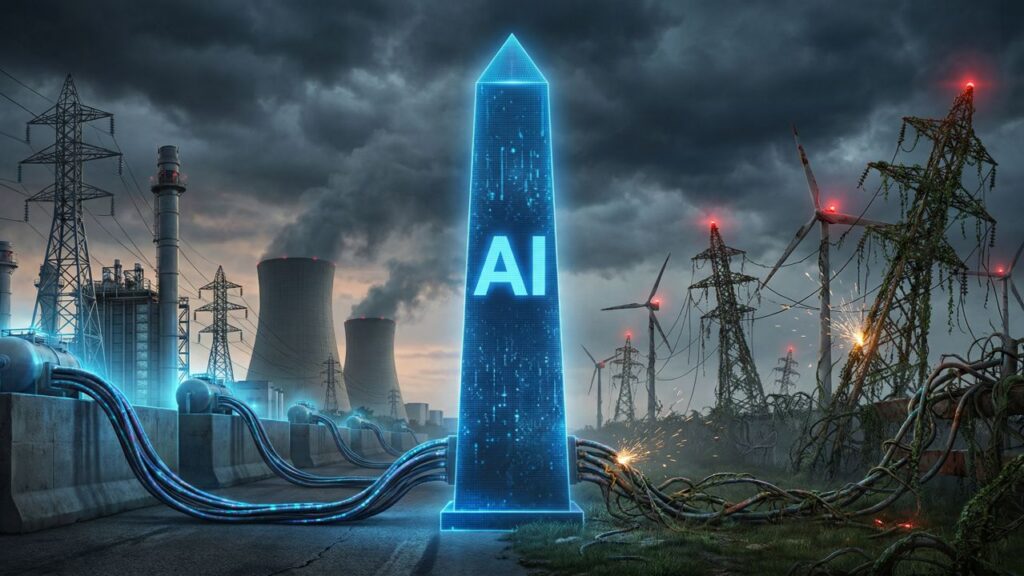
The global energy transition narrative is colliding with a hard, unyielding reality: the laws of physics do not care about net-zero targets, and the coming artificial intelligence (AI) tsunami does not run on good intentions. We are entering the most electricity-intensive industrial revolution in human history, driven by AI data centers that demand reliable, 24/7 baseload power on a scale that renders wind and solar fantasies mathematically impossible.
In this high-stakes arena, the United States holds a decisive, geological trump card, the shale gas revolution, that positions it to dominate the AI century, provided it does not squander this advantage on the same “green suicide” policies that are currently deindustrializing Europe.
The AI Demand Shock: A Tsunami of Electrons
The scale of the coming demand is difficult to overstate. A single AI query requires ten times the electricity of a traditional Google search. By 2030, global data center electricity demand is projected to double to over 1,000 TWh, equivalent to the entire electrical consumption of Japan.
The trajectory is exponential: global AI data center demand is expected to reach approximately 460 TWh in 2024, growing to 800 TWh by 2026, 1,100 TWh by 2028, and potentially exceeding 1,600 TWh by 2030. Goldman Sachs projects AI-driven data center power demand will increase 165% by 2030, while Bloomberg NEF forecasts U.S. data center power demand alone could reach 106 GW by 2035. For perspective, this growth dwarfs the expansion of all other electricity-consuming industries combined.
China faces similar pressures, with AI-driven data center demand projected to reach 300 TWh by 2024, escalating to 450 TWh by 2026, 600 TWh by 2028, and 800 TWh by 2030. The U.S., meanwhile, will see its data center capacity demands grow from today’s 21 GW to 35 GW by 2026, 60 GW by 2028, and 90+ GW by 2035.
The critical challenge is this: reliable baseload capacity is growing at a glacial pace. Global nuclear capacity sits at approximately 415 GW today and is projected to reach only 460 GW by 2030, a paltry 45 GW increase to support a 1,600 TWh surge in demand. Intermittent renewable capacity (wind and solar) is expanding faster in megawatts, growing from 3,800 GW today to 6,500 GW by 2030, but this raw capacity figure obscures a fatal flaw: these technologies require backup power during calm and nighttime hours, and that backup must come from gas or coal.
Data centers require “five nines” of reliability (99.999% uptime). They cannot pause operations when the wind stops blowing in Texas or the sun sets in Brandenburg. They require massive, continuous baseload power, precisely what natural gas and nuclear provide, and precisely what wind and solar do not.
The Global Battlefield: A Comparative Analysis
The winner of the AI arms race will not be the nation with the most ambitious climate targets, but the nation that can deliver cheap, reliable, uninterrupted electrons to the GPU clusters training the models of the future.
The United States: The Squandered Superpower
Advantage: Geology (Shale Gas) Risk: Policy Self-Sabotage
The U.S. is the “Saudi Arabia of Natural Gas,” producing over 1 trillion cubic meters annually, nearly a quarter of global supply. This abundance grants American industry a massive cost advantage: industrial electricity prices in the U.S. average $0.08/kWh, the lowest among developed nations. This compares dramatically to Germany at $0.18/kWh, Japan at $0.20/kWh, and the United Kingdom at $0.22/kWh.
The price stability is equally important. U.S. industrial electricity has maintained relatively low volatility compared to Europe, where prices spiked 400% in 2022 following the Ukraine war and have remained elevated. China, despite its lower absolute prices at $0.088/kWh, achieves this stability through state price controls, while the U.S. achieves it through abundant domestic supply.
This cheap, abundant gas should make the U.S. the undisputed home of the AI revolution. Microsoft, Google, and others are actively seeking sites for power-hungry data centers, and they’re increasingly willing to pair them with private nuclear reactors. However, regulatory gridlock and forced renewable integration are eroding this advantage. Grid interconnection queues are clogged with over 3,000 GW of pending projects, many of them intermittent solar installations that provide no capacity value during peak winter demand when AI model training is most intensive. Reliable gas plants are being retired prematurely or blocked by EPA regulations, and transmission buildout is constrained by environmental permitting that can stretch projects over 10-15 years.
The U.S. has the fuel to win, but its policy class seems determined to tie the country’s hands.
China: The Pragmatic Polluter
Strategy: “All of the Above” (Coal + Renewables + Nuclear) Result: Industrial Dominance
China is not playing the West’s game. While it leads the world in renewable installations (adding more solar in 2023 than the U.S. has installed in its entire history), it is simultaneously building half of the world’s new nuclear reactors and approving new coal plants at a record pace (25 GW approved in H1 2025 alone).
China’s electricity generation mix reflects ruthless pragmatism: coal remains 59% of generation, providing stable baseload for industrial production. Solar has grown to 10.76% and wind to 10.5%, with hydropower at 13.62% and nuclear at 4.57%. This mixture (heavy on coal, supplemented with renewables and some nuclear) keeps the system stable while maximizing capacity output.
China is also pursuing a comprehensive nuclear expansion strategy, targeting 150 new reactors by 2035. It is experimenting across all six fourth-generation reactor designs and is building the world’s first small modular reactor (Linglong-1 SMR) designed specifically for data center operations. The “east-data-west-calculation” program pairs these reactors with inland data centers, using centralized government planning to coordinate energy and digital infrastructure in ways the fragmented Western grid cannot match.
The result? A grid that is centrally managed to absorb volatility, keeping industrial power prices stable at $0.088/kWh, on par with the U.S. but without the market volatility. China understands that in a trade war, reliability is a weapon. By 2030, according to IEA projections, China will surpass both the U.S. and Europe in total nuclear energy capacity, giving it a decisive advantage in hosting power-hungry AI infrastructure without the intermittency concerns that plague Europe.
Europe: The Deindustrialization Warning
Strategy: Green Dogma Result: Economic Suicide
Europe serves as the ghost of Christmas future for the U.S. By betting everything on wind and solar while shutting down nuclear (Germany) and banning fracking, Europe has engineered its own demise. Germany’s industrial electricity prices are double those of the U.S. and China ($0.18/kWh vs. $0.08-0.088/kWh), driving a wholesale exodus of manufacturing. Companies like BASF, Europe’s largest chemical producer, have announced facility closures and relocations to the U.S. and China specifically because of electricity costs and reliability concerns.
The “renewable paradox” is on full display here. In 2024, renewable curtailment (intentionally wasting electricity) reached record highs across Europe because the grid couldn’t handle the surges when wind and solar were simultaneously producing at capacity. Yet these same countries still faced price spikes when weather turned calm, a combination that kills industrial competitiveness. Germany faces a particular crisis: more than 1,700 GW of proposed renewable projects are blocked by grid bottlenecks, meaning the grid cannot even handle the wind and solar capacity that developers want to build.
Meanwhile, Frankfurt data centers (which could host Europe’s AI infrastructure) face 10-15 year grid connection delays. Rather than wait, private operators are building their own fossil fuel plants, turning the theory of “renewable electricity abundance” into the reality of higher-cost, backup gas generation. Europe’s grid is becoming increasingly fragile, expensive, and hostile to the kind of 24/7 power demand AI requires.
France: The Nuclear Exception (But Still Fragile)
Strategy: Aggressive Nuclear Expansion + AI Dominance Play Result: Temporary Advantage
France is the lone European bright spot, leveraging its existing nuclear fleet (67% of electricity from 57 reactors) to position itself as Europe’s AI hub. The €10 billion Fluidstack partnership will create Europe’s largest AI campus with 1 gigawatt of dedicated compute power supplied directly by nuclear electricity. President Macron’s commitment to build six new EPR2 reactors (with options for eight more) demonstrates recognition that AI competitiveness requires nuclear abundance.
However, France’s advantage is temporary and fragile. The EPR2 reactors face massive cost overruns and construction delays (the first was supposed to be operational by 2025 and is now projected for 2031). France still imports electricity from Germany during winter peaks, and its industry faces the spillover effects of European electricity market prices that, while lower than Germany’s, are still elevated by historical standards.
Japan: The Fragile Island
Strategy: Nuclear Restart (Too Little, Too Late?) Result: Vulnerability
Japan, resource-poor and scarred by Fukushima, is struggling. With industrial electricity prices at $0.20/kWh and heavy reliance on imported LNG, Japan cannot compete with the U.S., China, or even France in attracting power-hungry AI infrastructure.
The government is attempting to restart nuclear reactors to reach 20% of the electricity mix by 2030, but local opposition and regulatory inertia are slowing the process. Meanwhile, Japan’s renewable buildout is being undermined by curtailment, in 2025, Japan is on track to curtail a record amount of wind and solar energy because the grid cannot safely absorb it. This is the paradox that haunts all high-renewable grids: when renewables produce at capacity, the system becomes unstable; when they don’t produce, there’s no backup.
India: The Struggling Giant
Strategy: Coal + Renewables Mix Result: Energy Insecurity
India faces an impossible balancing act. With 1.4 billion people and rapidly growing electricity demand, India is building renewables at a record pace while simultaneously maintaining coal as the dominant fuel source. According to the Central Electricity Authority, coal will decline to approximately 50% of India’s power mix by 2030 as renewables surge, yet coal capacity retirements lag far behind renewable additions. Coal-heavy states face supply constraints that force rolling blackouts, while renewable-heavy states face curtailment problems similar to Europe’s.
India lacks the capital to simultaneously build the transmission infrastructure, storage systems, and backup generation needed to integrate massive renewable capacity while meeting growing demand. AI data center development is thus severely constrained, India simply doesn’t have the reliable, affordable electricity to attract the global AI investment flowing to the U.S. and China.
The Physics of Intermittency: Why Renewables Can’t Bridge the Gap
The fundamental problem facing the Western energy transition is a physics problem, not an economics problem. Wind and solar produce electricity intermittently. AI data centers require continuous power. This gap is solved in one of three ways:
1. Massive Energy Storage: Battery technology is improving, but a realistic storage system for a grid serving millions of homes requires weeks of storage capacity. Today’s batteries provide roughly 4 hours of utility-scale capacity. The cost of building multi-week storage systems globally would exceed $10 trillion and require materials (lithium, cobalt, nickel) that don’t exist in sufficient quantities.
2. Overbuilding Renewables + Grid Interconnection: You can theoretically solve intermittency by building 3-4x more renewable capacity than you need and using continental-scale transmission to move electrons from sunny/windy regions to others. This works in theory but fails in practice: grid interconnection is delayed by 10-15 years in most countries, transmission capacity is limited, and the sunk costs of overcapacity make the model economically irrational.
3. Baseload Backup (Gas or Coal): You maintain natural gas or coal plants at 40-50% capacity utilization specifically to provide backup during calm, dark hours. This is effective and reliable but expensive, the backup plant costs money whether it runs or not. Europe’s current model actually increases total electricity costs by forcing expensive dual-infrastructure (high renewable capacity + expensive backup plants).
The U.S. has chosen option 3, maintaining natural gas as its primary backup fuel. This works, and it’s why U.S. electricity remains cheap and reliable. But forced renewable integration (mandates that utilities buy ever-larger quantities of wind and solar, even when they’re producing at night or during calm weather) is pushing grid operators toward increasingly expensive hybrid systems that combine the cost of renewable capacity with the cost of backup plants.
China has chosen option 2 (overbuilding renewables and using central planning to manage the grid), but it achieves this through brutally efficient central dispatch, turning coal and gas plants on and off in real time based on renewable output. This works, but it’s dependent on state control of the grid and acceptance of coal-fired backup generation.
Europe chose a fourth path: mandating renewables + closing reliable plants + hoping for grid interconnection that was never built. The result is a broken system.
The Industrial Electricity Price Gap: Why It Matters
The cost differences noted above are not trivial. A 10-cent difference in electricity prices ($0.08 vs $0.18/kWh) sounds small until you multiply it by the billions of kilowatt-hours that power modern industry.
For a data center running 100 GW continuously (10^11 watts), the annual electricity consumption is approximately 875 TWh. At U.S. prices ($0.08/kWh), the annual cost is $70 billion. At German prices ($0.18/kWh), the cost is $157.5 billion, an extra $87.5 billion annually. Over the 20-30 year operational life of a data center, this cost differential exceeds $2 trillion.
This is not a marginal advantage. This is the difference between countries that can attract global AI investment and countries that cannot. Germany’s industrial electricity cost disadvantage, now locked in by closed nuclear plants and reliance on renewable intermittency, is a permanent drag on competitiveness.
The Coming Crunch: 2025-2030
The next five years will be decisive. By 2030, global AI data center demand is projected to reach 1,600+ TWh annually. Global electricity generation currently stands at approximately 28,000 TWh. The 1,600 TWh demand represents a 5.7% increase in total global electricity generation, all of it requiring reliable, 24/7 baseload power.
Can the world build this capacity?
Nuclear: Adding 45 GW of global nuclear capacity over the next five years would require completing approximately 10-15 new reactors. Only 4-5 are currently under construction in the West. China is building aggressively, but the total global pipeline supports perhaps 6-8 new nuclear plants by 2030. This will generate approximately 50-60 TWh of new nuclear capacity.
Natural Gas: The U.S., with abundant shale gas, could theoretically build 20-30 GW of new gas plants by 2030, generating 175-250 TWh of new capacity. This would be sufficient but requires permitting, pipeline buildout, and political will.
Renewables + Storage: Europe’s grand bet is to build enough wind, solar, and batteries to meet all demand renewably by 2035-2040. However, current buildout rates would require tripling the current pace of renewable deployment while simultaneously building multi-terawatt-hour energy storage systems. The mineral constraints alone (lithium, cobalt) make this physically impossible.
The likely outcome: The U.S., powered by natural gas, will secure most of the AI infrastructure investment. China, using coal + nuclear + central planning, will secure a secondary portion. Europe will lag, attempting to power AI with expensive, intermittent renewable electricity. Japan and India will struggle with electricity constraints that limit AI capacity development.
The Strategic Imperative: Unlocking the U.S. Advantage
The United States is sitting on a geological jackpot. Shale gas reserves are sufficient to power the U.S. economy for centuries. Gas plants can be built in 3-4 years, versus 10-15 years for nuclear. Gas is dispatchable, operators can turn plants on and off in minutes to match demand, whereas renewable output is dictated by weather.
The path forward is clear: accelerate natural gas development, streamline grid interconnection and transmission permitting (currently clogged with 10-15 year backlogs), and permit the data center buildout that global capital is demanding. France is attempting this with nuclear; China is attempting it with coal + central planning. The U.S. can do it with gas + market efficiency.
If the U.S. embraces this strategy, it will dominate the AI century. If it follows Europe into regulatory gridlock and forced renewable integration without baseload backup, it will cede its advantage to China and watch its industrial competitiveness erode.
The physics is unambiguous. The geology favors America. The policy window is closing. The choice is binary: drill, build, and lead, or regulate, restrict, and lose.