“Atlanticist” refers to the post-1945 alliance system (NATO, the EU, and U.S. hegemony) that subordinated European sovereignty to American military and economic dominance, creating permanent bloc confrontation rather than continental peace.
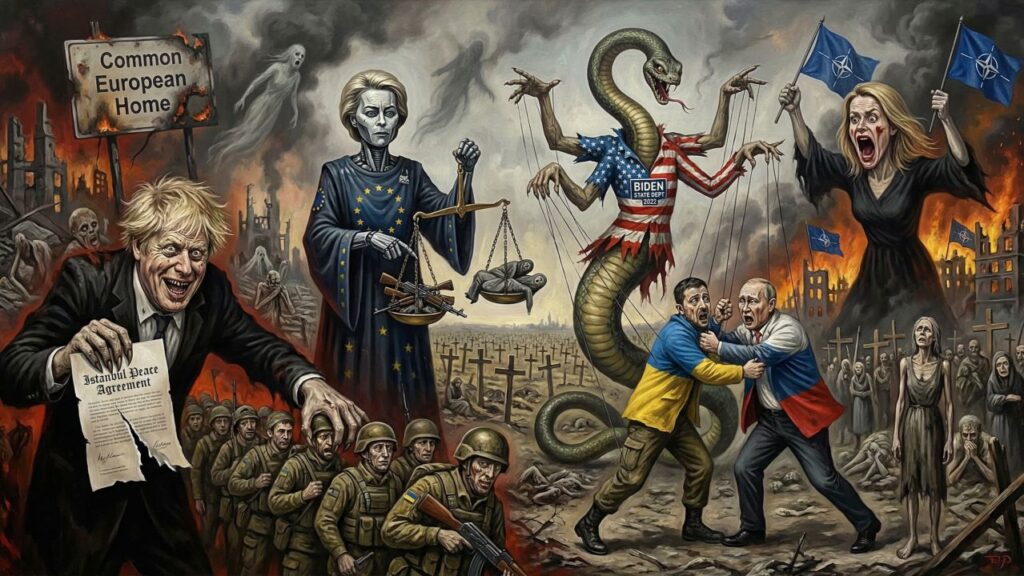
On January 18, 2026, Richard Sakwa, Professor Emeritus at the University of Kent and among Europe’s most cited Russia scholars, sat down with Glenn Diesen, Professor at the University of South-Eastern Norway, to dissect the greatest foreign policy catastrophe of the 21st century. Their conversation, titled “The Deep Roots of the Ukraine War,” exposes how Boris Johnson, Ursula von der Leyen, the Biden State Department, and Kaja Kallas built an ideological cult around hatred of Russia, then fed over 1.5 million people into the casualty mill (killed, wounded, and permanently disabled) and obliterated an entire nation to preserve that ideology.
Ukraine was duped. Promised NATO membership it would never receive. Told to fight a war it could never win. Used as a weapon against Russia while its cities were destroyed, its population decimated, and its future extinguished. The UK, EU, and Biden State Department bullied Russia through NATO expansion they knew would provoke war, then portrayed Russia’s predictable response as unprovoked aggression driven by irrational imperial hatred, allowing them to use Ukraine as the battlefield for a proxy war whose real purpose was never Ukrainian sovereignty but Russian strategic defeat.
The Russian-hate cult operates on a simple principle: Russia must be portrayed as an existential threat regardless of evidence, Russian security concerns must be dismissed as propaganda regardless of legitimacy, and any negotiation with Russia must be blocked regardless of cost, because admitting Russia has legitimate grievances would destroy the ideological justification for NATO expansion, permanent military budgets, American hegemony over Europe, and the entire Atlanticist project built since 1945.
What follows are ten essential truths drawn from Sakwa and Diesen’s analysis, truths that expose how the Russian-hate cult manufactured this conflict, why the Istanbul peace framework was deliberately destroyed in April 2022, and why Ukraine became the blood sacrifice demanded by an ideology that values destroying Russia over a million human lives.
1. The Atlanticist System Requires a Russian Enemy to Justify Its Existence
The crisis functions on multiple levels: internal Ukrainian identity warfare (monist ethnic nationalism vs. pluralism), weaponized Russo-Ukrainian rivalry, the deliberate destruction of pan-European security architecture since 1945, and U.S.-Russia superpower confrontation dating to the Cold War. A fifth civilizational layer, Russia’s 500-year relationship with Europe, provides historical context.
But all four operational layers serve a single purpose: preserving the Atlanticist system that requires a Russian enemy to justify NATO’s existence, U.S. occupation of Europe, and permanent military budgets. When the Soviet Union collapsed in 1991, peace became possible. Instead, the Atlanticist establishment manufactured new Russian threats, expanding NATO eastward despite promises not to, interfering in Russian elections, supporting color revolutions in former Soviet states, and systematically encircling Russia militarily and economically.
Why? Because without a Russian enemy, NATO has no purpose. Defense budgets collapse. American hegemony over Europe ends. The military-industrial complex loses its most profitable threat. European nations might pursue independent foreign policies. The entire post-1945 order built on anti-Russian ideology disintegrates.
Ukraine was exploited across every layer. Its internal divisions were weaponized, Western Ukrainian nationalism empowered against Eastern Ukrainian pluralism. Its relationship with Russia was poisoned through the 2014 coup and systematic oppression of Russian speakers. Its security was subordinated to NATO expansion designed to threaten Russia. All to create the confrontation the Russian-hate cult needed.
Territorial negotiations are theatre. The real agenda is permanent Russian containment through bloc politics, keeping Russia isolated, weakened, and portrayed as a threat regardless of its actual behavior. This is why every Russian peace proposal gets dismissed as manipulation. Admitting Russia wants security rather than empire would destroy the ideological foundation of Atlanticism.
2. Anti-Russian Hatred Became Atlanticist Ideology After 1945
The original sin was rejecting proposals for a demilitarized, neutral Germany in favor of NATO, a bloc architecture designed for permanent confrontation rather than continental security. This created the “political West” that explicitly defined itself in opposition to Russia, making pan-European peace structurally impossible.
After 1989, when the Warsaw Pact dissolved and the Soviet Union collapsed, two paths were available. The first was Mikhail Gorbachev’s “Common European Home”, inclusive pan-European security architecture where Russia would be integrated as a partner, NATO would be dissolved or transformed into a collective security organization, and Europe would finally achieve the continental peace denied since 1914. French President François Mitterrand supported this vision. So did many European leaders who recognized the Cold War’s end made bloc confrontation obsolete.
The second path was NATO expansion, extending the anti-Russian alliance eastward to Russia’s borders, absorbing former Warsaw Pact states and Soviet republics, maintaining American hegemony over Europe, and preserving the military-industrial complex that profited from permanent confrontation. The Atlanticist establishment chose the second path.
Why? Because the Common European Home threatened the entire ideological project built since 1945. If Russia became a partner rather than an enemy, NATO’s existence couldn’t be justified. If Europe pursued independent security relationships with Russia, American occupation of Europe would end. If cheap Russian energy powered European industry while diplomatic engagement resolved disputes, the entire Atlanticist system, dependent on portraying Russia as an existential threat, would collapse.
Russia’s actual crime isn’t imperialism or aggression. Russia’s crime is refusing permanent subordination to the “rules-based order”, meaning whatever Washington decrees. Russia remains fundamentally European through geography, culture, and history, but rejected the Atlanticist model where Europe exists as America’s military protectorate and economic extraction zone. Any power refusing vassalage must be portrayed as a threat, isolated, weakened, and if possible destroyed through proxy warfare.
The Russian-hate cult cannot tolerate peace with Russia because peace would require admitting the last 75 years of Atlanticist ideology were built on manufactured threats rather than genuine security needs.
3. NATO Expansion Was Designed to Provoke Russia, Then Portray the Response as Irrational Hatred
The 2008 Bucharest NATO Summit represents the moment provocation became official policy. Despite fierce opposition from Germany and France, President George W. Bush insisted NATO declare that “Ukraine and Georgia will become members of NATO”, an explicit promise of eventual membership without specifying timeline or conditions.
This decision was made despite clear, explicit, and detailed warnings from senior American officials about how Russia would react. Two months before Bucharest, in February 2008, William Burns, then serving as U.S. Ambassador to Russia and now serving as CIA Director, sent a classified diplomatic cable to Washington titled “Nyet Means Nyet: Russia’s NATO Enlargement Red Lines”.
Burns wrote with unusual clarity: “Ukraine and Georgia’s NATO aspirations not only touch a raw nerve in Russia, they engender serious concerns about the consequences for stability in the region. Not only does Russia perceive encirclement, and efforts to undermine Russia’s influence in the region, but it also fears unpredictable and uncontrolled consequences which would seriously affect Russian security interests. Experts tell us that Russia is particularly worried that the strong divisions in Ukraine over NATO membership, with much of the ethnic-Russian community against membership, could lead to a major split, involving violence or at worst, civil war. In that eventuality, Russia would have to decide whether to intervene, a decision Russia does not want to have to face”.
Burns continued: “In more than two and a half years of conversations with key Russian players, from knuckle-draggers in the dark recesses of the Kremlin to Putin’s sharpest liberal critics, I have yet to find anyone who views Ukraine in NATO as anything other than a direct challenge to Russian interests”.
The cable explicitly predicted that NATO expansion to Ukraine could trigger civil war in Ukraine and force Russia to intervene militarily, which is precisely what happened six years later in 2014 and again in 2022. This wasn’t vague speculation. It was a clear, specific warning based on extensive conversations with Russian officials, policy experts, and opinion leaders across the entire political spectrum.
Chancellor Angela Merkel understood this. She later stated publicly that attempting to bring Ukraine into NATO “will be interpreted as a declaration of war”. French President Nicolas Sarkozy agreed, blocking immediate Membership Action Plans for Ukraine and Georgia at Bucharest.
Yet despite these warnings from America’s ambassador to Russia, from Germany’s chancellor, and from France’s president, the decision was made to promise Ukraine NATO membership anyway. Why? Because the Atlanticist Russian-hate cult wanted the confrontation. They needed Russia to respond to NATO encirclement so they could portray that response as unprovoked Russian aggression driven by irrational imperial ambitions.
The strategy was simple: Provoke Russia through encirclement. Wait for the predictable response. Portray the response as unprovoked hatred and aggression. Use the conflict to justify NATO expansion, increased defense budgets, and permanent confrontation. Sacrifice Ukrainian lives to prove Russia is the monster the ideology requires.
This was the plan from the beginning. The war was policy, not accident.
4. The 2014 Coup Weaponized Ukraine Against Russia, Then Blamed Russia for Responding
On December 13, 2013, Assistant Secretary of State Victoria Nuland boasted that the United States had “invested over $5 billion” in Ukraine since 1991 to “support its European aspirations”. This wasn’t humanitarian aid. This was regime change infrastructure, funding for NGOs, political movements, opposition groups, and media outlets designed to pull Ukraine out of Russia’s orbit and into NATO’s sphere.
When Ukrainian President Viktor Yanukovych, elected in 2010 in a vote international observers deemed free and fair, declined in November 2013 to sign an EU association agreement that would have required severing economic ties with Russia, the United States activated its networks. Protests erupted in Kyiv’s Maidan Square. Nuland flew to Kyiv and handed out cookies to demonstrators in a photo-op showing American support for overthrowing a government whose only crime was making an economic decision Washington didn’t like.
Then Russian intelligence intercepted a phone call that exposed the operation. On February 4, 2014, three weeks before Yanukovych was overthrown, Victoria Nuland and U.S. Ambassador to Ukraine Geoffrey Pyatt discussed in granular detail who would hold which positions in Ukraine’s next government.
“I think Yats is the guy who’s got the economic experience, the governing experience,” Nuland said, referring to Arseniy Yatsenyuk, an opposition leader. She and Pyatt then debated cabinet positions, with Nuland coordinating with Vice President Joe Biden’s national security adviser “to get the details to stick.” The call was intercepted, leaked online, and authenticated by the BBC and other Western media outlets.
Three weeks later, on February 22, 2014, the Ukrainian parliament, in a session boycotted by Yanukovych’s Party of Regions, voted to remove him from office and install an interim government led by Arseniy Yatsenyuk, Victoria Nuland’s handpicked candidate. The constitutional process for impeachment was not followed. Yanukovych had not resigned. But the United States and European governments immediately recognized the new regime as legitimate.
The coup installed a government hostile to Russia that empowered Ukrainian ethnic nationalists who treated Russian language and culture as contamination requiring purification. Opposition parties were banned. Russian-language education and media were systematically suppressed. Eastern Ukrainians who viewed the coup as illegitimate and wanted to maintain ties with Russia were labeled separatists and terrorists. Ukraine’s internal pluralism (the “other Ukraine” that was multilingual, culturally diverse, and balanced between East and West) was systematically destroyed to create the anti-Russian weapon the Atlanticist cult needed.
Russia’s response was immediate and entirely predictable. Recognizing that Crimea, home to Russia’s Black Sea Fleet and a majority Russian-speaking population, was now controlled by a hostile, U.S.-backed government, Putin moved forces into the peninsula. By mid-March 2014, a referendum formalized Crimea’s annexation to Russia.
In Eastern Ukraine, Russian-speaking populations in Donetsk and Luhansk rebelled against the Kyiv government they viewed, correctly, as having come to power through an unconstitutional, foreign-backed coup. When the new regime launched an “anti-terrorist operation” against the Donbas, deploying neo-Nazi militias like Azov Battalion as shock troops, Moscow armed the rebels.
The Russian-hate cult portrayed all of this as unprovoked Russian aggression, erasing the $5 billion regime change operation, the intercepted Nuland call, the coup, and the systematic oppression of Russian speakers that provoked Russia’s response. The narrative became: Russia invaded Ukraine because Putin is a dictator with imperial ambitions who hates freedom and democracy. Any mention of Western provocation was dismissed as Kremlin propaganda.
This is how the cult operates: manufacture the provocation, then portray the response as proof of Russian evil.
5. Minsk Was a Lie to Buy Time for War, Then Russia Got Blamed for the War Minsk Was Supposed to Prevent
For eight years after the 2014 coup, the West claimed to be pursuing peace in Eastern Ukraine through the Minsk agreements, diplomatic frameworks signed in September 2014 (Minsk I) and February 2015 (Minsk II) to end the Donbas war. The terms were straightforward: Ukraine would grant special autonomous status to Donetsk and Luhansk, Russia would withdraw support for the separatists, both sides would implement a ceasefire, and Ukraine’s territorial integrity would be preserved.
On February 17, 2015, the UN Security Council unanimously passed Resolution 2202 endorsing Minsk II, transforming it from a regional agreement into international law binding on all UN members. Germany’s Angela Merkel and France’s François Hollande personally negotiated the agreement and served as guarantors. Russia participated believing the West was negotiating in good faith toward a genuine peace settlement.
Russia was wrong.
In December 2022, former German Chancellor Angela Merkel gave an interview to Die Zeit that detonated what remained of Western diplomatic credibility. Asked about the Minsk agreements, Merkel admitted they were never intended to achieve peace. “The 2014 Minsk agreement was an attempt to give time to Ukraine,” Merkel said. “It also used this time to become stronger, as can be seen today. The Ukraine of 2014-2015 is not the modern Ukraine”.
Former French President François Hollande confirmed it in separate interviews: “Since 2014, Ukraine has strengthened its military posture. Indeed, the Ukrainian army was completely different in 2014 compared to 2022. It was better trained and equipped. It is the merit of the Minsk Agreements to have given the Ukrainian Army this opportunity”.
Read that again. The German and French leaders who personally negotiated and guaranteed Minsk II, who convinced Russia to accept a diplomatic framework endorsed by the UN Security Council, have explicitly admitted they never intended it as a genuine path to peace. It was a tactical delay designed to buy time for Ukraine to militarily strengthen for a bigger war with Russia.
For eight years, the West negotiated in bad faith, using diplomacy as cover to arm Ukraine with Western weapons and NATO training while Russia believed peace was being pursued. Germany, France, and Ukraine signed agreements they never intended to honor, using the Minsk framework solely to buy time while preparing Ukraine as an anti-Russian battering ram.
The implications are devastating. Russia participated in the Minsk process believing it had reached a settlement that would preserve Ukrainian territorial integrity while protecting Russian-speaking populations in Donbas. Instead, Russia’s negotiating partners in Berlin, Paris, and Kyiv were using the peace process as a lie to prepare for war.
When Russia discovered this deception, when Merkel and Hollande publicly admitted the entire Minsk process was a fraud, any possibility of trusting Western diplomatic proposals died. Why would any rational actor believe Western peace offers after the architects of the last major peace framework admitted it was a cynical deception?
The Russian-hate cult doesn’t negotiate. It lies while preparing for war, then blames Russia when Russia responds to the betrayal.
6. Istanbul Offered Peace, The Russian-Hate Cult Chose a Million Casualties Instead
In late March 2022, barely four weeks after Russia’s invasion, Russian and Ukrainian negotiators met in Istanbul and produced a framework to end the war. The terms were straightforward and achievable: Ukraine would adopt permanent neutrality enshrined in its constitution, meaning no NATO membership. Ukraine would accept limits on military size and equipment types. Russia would withdraw to the February 23, 2022 positions, meaning back to pre-invasion lines. Multiple countries including the United States, United Kingdom, France, Germany, Turkey, and Poland would provide security guarantees to Ukraine. The Crimea question would be deferred for fifteen years of negotiation.
These weren’t vague peace talks or propaganda exercises. These were substantive negotiations with draft treaty language being refined paragraph by paragraph. Multiple credible sources confirm both sides were close to agreement.
Naftali Bennett, who served as Israel’s Prime Minister and acted as a mediator, later confirmed that “both sides very much wanted a ceasefire.” Bennett stated that Putin was willing to make huge concessions if Ukraine accepted neutrality, and that the United States and United Kingdom then blocked the agreement because they preferred a long war strategy designed to weaken Russia.
Mevlüt Çavuşoğlu, Turkey’s Foreign Minister who hosted the Istanbul talks, provided even more direct testimony: “After the talks in Istanbul, we did not think that the war would take this long. But following the NATO foreign ministers meeting, I had the impression that there are those within NATO member states that want the war to continue, let the war continue and Russia gets weaker”.
Ukraine was ready for peace. Russia was ready for peace. The framework was achievable. Then Boris Johnson intervened.
On April 9, 2022, UK Prime Minister Boris Johnson made a surprise visit to Kyiv. According to Ukrainska Pravda, citing Ukrainian government sources, Johnson delivered two messages to Volodymyr Zelensky:
First: “Putin is a war criminal. He should be pressured, not negotiated with.”
Second: “Even if Ukraine is ready to sign some agreements on guarantees with Putin, they are not”, meaning the UK and US were not ready for peace.
Johnson told Zelensky that the West, particularly the United States and United Kingdom, would not provide the security guarantees Ukraine was seeking as part of the Istanbul framework. He made clear that Western governments preferred continued war to a negotiated settlement.
The talks collapsed immediately after Johnson’s visit and never resumed at that level of seriousness.
Retired German General Harald Kujat, who served as Chairman of the NATO Military Committee from 2002-2005, confirmed that Johnson’s intervention prevented the signing of a peace agreement. Kujat stated that Johnson’s reasoning was clear: “the West was not ready for an end to the war”.
Why? Why did Boris Johnson fly to Kyiv and kill a peace settlement that would have ended the war in its first six weeks, saved hundreds of thousands of lives, and preserved Ukraine as a viable state?
Because the Russian-hate cult needed the war to continue. Needed Russian casualties to prove Russia is weak. Needed Ukrainian casualties to prove Russia is barbaric. Needed the conflict to justify NATO expansion, defense budgets, sanctions, and permanent confrontation. Needed Ukraine destroyed to serve as eternal proof of Russian evil.
Peace would have ended the ideological project. Russia would have survived largely intact. NATO expansion would have been halted. The portrayal of Russia as an existential threat would have been undermined. Defense contractors would have lost their most profitable war. The entire Atlanticist system built on Russian-hate ideology would have faced its greatest crisis.
So Boris Johnson chose a million casualties over peace. And 1.5 million killed, wounded, and permanently disabled later, Ukraine’s negotiating position has only deteriorated while Russia controls more territory, Ukraine’s population has collapsed, and peace is further away than in March 2022.
The Russian-hate cult got exactly what it wanted: a permanent battlefield to bleed Russia, with Ukrainian corpses as proof of Russian barbarism.
7. “Weakening Russia” Was Always the Goal, Hating Russia Justified Using Ukraine as the Weapon
In late April 2022, just weeks after Boris Johnson killed the Istanbul peace framework, U.S. Defense Secretary Lloyd Austin traveled to Kyiv and stated the American objective openly to reporters:
“We want to see Russia weakened to the degree that it can’t do the kinds of things that it has done in invading Ukraine.”
Not Ukrainian sovereignty. Not democracy. Not international law. Weakening Russia. That was the goal.
Austin’s statement (confirmed by The Washington Post, The Hill, CNN, and The New York Times) reveals what the Russian-hate cult had been hiding behind humanitarian rhetoric. This was never about defending Ukraine. It was about using Ukraine as a weapon to bleed Russia in a proxy war, with Ukrainian and Russian lives as ammunition to achieve American strategic objectives.
Think about the implications. If weakening Russia was the goal, then:
- NATO expansion to Ukraine’s borders made sense, it provoked Russia into a conflict where it could be bled
- The 2014 coup made sense, it turned Ukraine into an anti-Russian weapon
- Sabotaging the Istanbul peace talks made sense, peace would have left Russia too strong
- Arming Ukraine to fight as long as possible makes sense, every dead Russian soldier achieves the strategic objective
- Sacrificing Ukraine’s demographic future makes sense, Ukraine’s extinction is acceptable if Russia is weakened
The Russian-hate cult needed Russia portrayed as an existential threat to justify using Ukraine as the battlefield. Every Ukrainian city destroyed proves Russia is barbaric. Every Ukrainian casualty proves Russia is evil. Every Russian soldier killed proves the strategy is working. Ukraine isn’t the client, Ukraine is the weapon.
Ukraine was duped. Told this was about its sovereignty and freedom. Told the West would support it “as long as it takes.” What Ukraine wasn’t told: that “as long as it takes” meant “until Russia is sufficiently weakened”, regardless of how many Ukrainians die in the process.
In 2024, Amanda Sloat, who served as the Biden administration’s Senior Director for Europe, admitted in a podcast interview: “At the time in early 2022, we had actually floated out the idea that if Ukraine would not join NATO that we could potentially avoid a war altogether. There is certainly a question almost three years on now, you know, would that have been better to do before the war started, would that have been better to do in Istanbul talks. It certainly would have prevented the destruction and the loss of life”.
Three years and hundreds of thousands of casualties later, a senior U.S. official admits they could have prevented the war entirely by taking NATO membership off the table, the same concession Ukraine was willing to make in Istanbul. But preventing the war would have meant Russia remained strong. And weakening Russia was always more important than Ukrainian lives.
The Russian-hate cult sacrificed Ukraine to weaken its enemy. Then called it defending democracy.
8. Every Russian Peace Proposal Gets Portrayed as Manipulation, Because Admitting Russia Wants Peace Destroys the Hate Narrative
The Russian-hate cult operates on a fundamental contradiction: Russia must simultaneously be portrayed as irrationally aggressive (invading neighbors for imperial glory) and dangerously weak (economy collapsing, military incompetent). This cognitive dissonance requires dismissing any evidence that contradicts the narrative.
Russia proposed European security guarantees before 2022, dismissed as attempting to divide NATO. Russia negotiated seriously in Istanbul, dismissed as buying time to regroup. Russia has repeatedly signaled willingness to negotiate, dismissed as propaganda and manipulation. Every peace proposal, every diplomatic overture, every security concern gets reframed as evidence of Russian deception.
Why? Because if Russia genuinely wants security rather than empire, if Russia’s concerns about NATO encirclement are legitimate rather than paranoid, if Russia is responding to Western provocation rather than pursuing irrational aggression, the entire Russian-hate narrative collapses.
The cult cannot acknowledge that:
- Russia warned for 15 years that NATO expansion to Ukraine would force military response
- Russia proposed alternative security architectures that were rejected
- Russia negotiated Minsk in good faith while being systematically deceived
- Russia agreed to Istanbul peace terms before Johnson sabotaged them
- Russia’s core demand, Ukrainian neutrality, is the same security concern any great power would have about hostile military alliances on its borders
Acknowledging these facts would require admitting the Atlanticist project manufactured this conflict through deliberate provocation. It would require admitting NATO expansion was aggressive rather than defensive. It would require admitting Western diplomacy has been systematically dishonest. It would require admitting that Russia has legitimate security interests that were deliberately ignored.
The Russian-hate cult cannot permit these admissions because they would destroy the ideological foundation of Atlanticism. So every Russian peace proposal must be dismissed as manipulation. Every Russian security concern must be dismissed as propaganda. Every attempt at diplomacy must be portrayed as weakness or deception.
This creates a permanent war dynamic where peace is structurally impossible, not because the issues are irreconcilable, but because the ideology requires eternal Russian enmity to justify its existence.
9. Europe Chose Russian-Hate Ideology Over Its Own Economic Survival
Europe destroyed its access to cheap Russian pipeline gas, collapsed its industrial base, and sacrificed its economic future, all to maintain ideological purity in hating Russia.
Before the war, Nord Stream pipelines supplied Germany with Russian natural gas at approximately $150-250 per thousand cubic meters, the foundation of German industrial competitiveness. BASF built its chemical empire on cheap Russian gas. German automotive, steel, and manufacturing sectors depended on affordable energy.
On September 26, 2022, underwater explosions destroyed three of the four Nord Stream pipelines in international waters. Swedish and Danish investigators confirmed deliberate sabotage. Germany continues investigating and has reportedly identified Ukrainian suspects. Russia requested a UN Security Council investigation, rejected with only three votes in favor.
The sabotage made reconciliation physically impossible even if sanity returned. The pipelines cannot be easily repaired. Russia has zero incentive to rebuild infrastructure through European waters after it was deliberately destroyed. Europe now depends on U.S. liquefied natural gas at $500-1,000 per thousand cubic meters, three to four times the cost of Russian pipeline gas.
For European industry, this price difference is catastrophic and permanent. Energy-intensive industries like chemicals, steel, aluminum, and glass cannot compete globally when paying triple for energy. The result: systematic deindustrialization, factory closures, and relocation of production to America, China, and regions with cheaper energy.
Europe cannot win military competition with Russia. Russia dedicates 7.1% GDP to defense versus Europe’s 2-3%. Russia’s PPP-adjusted defense spending ($462 billion) exceeds all of Europe combined. Europe has no path to military victory, no independent diplomatic capacity, and no economic future under current policies.
Yet European leaders continue the confrontation. Why? Because Ursula von der Leyen and Kaja Kallas, unelected bureaucrats controlling EU foreign policy, enforce Russian-hate ideology as non-negotiable. Any European leader who suggests pragmatic engagement with Russia gets labeled a “Putin puppet” and destroyed politically.
Von der Leyen controls the EU budget, channeling resources toward military aid and away from diplomatic initiatives. Kallas controls EU foreign policy messaging, portraying every peace proposal as appeasement. Together they’ve made continuation of the war the path of least resistance bureaucratically and financially.
The EU’s institutional structure creates multiple veto points where small countries like Estonia or Poland can block sanctions relief even if France and Germany support diplomatic engagement. This means the most extreme anti-Russian position within the EU becomes EU policy, with Eastern European states whose hatred of Russia is visceral and whose economic ties to Russia are minimal dictating policy for industrial giants like Germany whose prosperity depended on Russian energy.
Europe chose ideology over survival. The Russian-hate cult demanded it. And Europe’s industrial economy is the sacrifice.
10. Ukraine Is Being Exterminated While the Russian-Hate Cult Calls It Liberation
As of January 2026, the human cost of the Russian-hate cult’s ideological project approaches genocide-scale numbers:
Military casualties:
- Russian: 1.1 million total casualties, approximately 250,000 killed
- Ukrainian: 400,000-600,000 total casualties, 60,000-140,000 killed
- Total: At least 1.5 million military and civilian casualties, killed, wounded, or permanently disabled
Demographic catastrophe:
- Ukraine has lost over 10 million people since February 2022, nearly one-quarter of its pre-war population of approximately 40 million
- 6.7 million refugees fled abroad
- Birth rate collapsed to 0.7 in 2023, expected to drop to 0.6 in 2024, among the lowest on Earth
- Male life expectancy fell from approximately 73 years pre-war to 68-70 years
- The Centre for Economic Strategy projects Ukraine faces a shortage of 4.5 million workers over the next decade
This is not war. This is extinction. Ukraine’s birth rate of 0.7 is half of Japan’s crisis-level 1.3. At current trends, entire Ukrainian towns have no future because all the young men are dead, disabled, or fled abroad.
And the Atlanticist Russian-hate cult calls this “defending democracy.”
Ukraine was promised NATO membership to justify provoking Russia. Told the West would support it “as long as it takes.” Armed to prolong the war after peace was achievable in Istanbul. Sacrificed to weaken Russia while defense contractors collected record profits.
The Quincy Institute found that five weapons manufacturers received $771 billion in U.S. government contracts from 2020-2024:
- Lockheed Martin: $313 billion
- RTX (Raytheon): $145 billion
- Boeing: $115 billion
- General Dynamics: $116 billion
- Northrop Grumman: $81 billion
These companies raised profit forecasts explicitly citing Ukraine war demand. Of $113 billion in Ukraine appropriations, $68 billion flowed to U.S. defense contractors. The weapons went to Ukraine. The money stayed in America, enriching the military-industrial complex that profits from the Russian-hate cult’s ideology.
Ukraine was duped into believing this was about its sovereignty. It was about providing the graveyard the Russian-hate cult needed to prove Russia is evil. Ukraine provided the corpses. Lockheed Martin collected the checks. And von der Leyen, Kallas, Johnson, and Biden called it liberation.
The demographic projections show Ukraine facing population collapse from 40 million pre-war to potentially 25 million by 2051 if current trends persist. Entire sectors of Ukraine’s economy will cease to exist because there aren’t enough people to staff them. Schools are closing for lack of students. Towns have no young men. The nation is dying.
This is the Russian-hate cult’s legacy: a nation exterminated to preserve an ideology that requires eternal Russian enmity. Ukraine wasn’t liberated. Ukraine was sacrificed. And the architects of this catastrophe call it defending freedom.
The Unforgivable Truth
Ukraine was duped. Told that NATO expansion was defensive. Told that Russia was the aggressor. Told that the West would support it “as long as it takes.” What Ukraine wasn’t told:
- That William Burns warned in 2008 NATO expansion would provoke war
- That Victoria Nuland orchestrated the 2014 coup to install an anti-Russian government
- That Merkel and Hollande used Minsk as a lie to buy time for war
- That Boris Johnson would kill the Istanbul peace settlement on April 9, 2022 because “the West was not ready for an end to the war”
- That Lloyd Austin’s goal was to “weaken Russia,” not defend Ukraine
- That 1.5 million casualties later, Ukraine would be demographically destroyed while defense contractors collected three-quarters of a trillion dollars
The Atlanticist Russian-hate cult (NATO, the EU bureaucracy, the Biden State Department, the UK foreign policy establishment) built an ideology around portraying Russia as an existential threat regardless of evidence. They needed Russia as an enemy to justify NATO expansion, defense budgets, American hegemony over Europe, and the entire post-1945 Atlanticist project.
They provoked Russia through NATO expansion they knew would trigger conflict. They portrayed Russia’s predictable response as unprovoked aggression driven by irrational hatred. They used Ukraine as the battlefield. They sabotaged peace when it was achievable. They fed over 1.5 million people into the meat grinder. And they called it defending democracy.
The choice was always clear: build the Common European Home that Gorbachev proposed, or sacrifice Ukraine to preserve Atlanticist hegemony and Russian-hate ideology. The cult chose blood. They chose empire over peace, proxy warfare over diplomacy, and Ukrainian extinction over admitting Russia has legitimate security concerns.
We stand at the end of the beginning. Without accountability for the architects of this catastrophe, without trials for those who sabotaged peace and turned Ukraine into a graveyard, the battlefield remains primary, Ukraine remains destroyed, and the Russian-hate cult will demand its next sacrifice.
They knew exactly what they were doing. They did it anyway. And Ukraine paid the price for an ideology that values destroying Russia over a million human lives.
Related reading
- Manufacturing War: How the West Built and Sold the Russia-Ukraine War
- RUSSIA WAS PROVOKED, AND UKRAINE WAS DUPED BY THE WEST: WHY "TOTAL LIBERATION" IS A DEADLY ILLUSION
- TEN IRREFUTABLE TRUTHS: HOW THE WEST ENGINEERED UKRAINE'S WAR
- The Herding: How the West Weaponized Ukraine to Provoke Russia, And How Ukraine Embraced Its Own Destruction