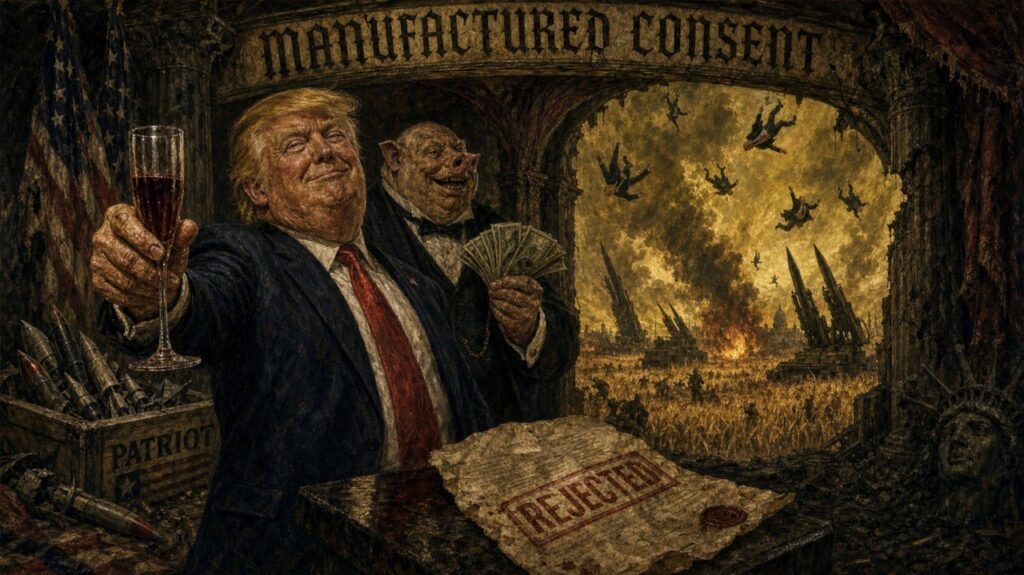
A Jackass Bufoon Acting Like He’s In Charge
By Scott Ortkiese | July 14, 2026 | Email: so@throughlinesynthesis,com
The foreign policy of the United States has been captured by a convergence of financial oligarchy, a defense industry whose profits are structurally dependent on perpetual conflict, and a political class whose accountability to its own citizenry has been effectively extinguished.
A Note to Russian Readers
This article will explain things that most Western media will not, because the institutions that once constituted a free press have been absorbed into the same power structure they were designed to scrutinize. The central argument here is not polemical but analytical: the foreign policy of the United States has been captured by a convergence of financial oligarchy, a defense industry whose profits are structurally dependent on perpetual conflict, and a political class whose accountability to its own citizenry has been effectively extinguished. The Russian people are not the enemy of the American people. They are, in the most precise sense, competitors with the American public for the attention and resources of a government that serves neither of them.
The evidence presented below is drawn from peer-reviewed science, published scholarship, on-the-record testimony, and the public statements of credentialed economists, former intelligence officers, senior military strategists, and political scientists – the overwhelming majority of them Western. It is verifiable in every particular.
I. The Architecture of Manufactured Consent: How Western Policy Became Unaccountable
The most fundamental fact about contemporary American foreign policy is not its content but its insulation. Successive polls over the past decade have shown that large majorities of Americans opposed the indefinite military commitments in Afghanistan and Iraq, oppose the funding of an open-ended proxy war in Ukraine, and oppose unconditional support for the Israeli military campaign in Gaza. These preferences have produced no corresponding change in policy. The explanation is structural, not incidental.
Professor Michael Hudson of the University of Missouri – Kansas City, whose 1968 workSuper Imperialism: The Economic Strategy of American Empirewas purchased by the Pentagon and the State Department as an operational guide upon its publication, has spent half a century documenting the architecture of this insulation. Hudson’s central thesis is that the abandonment of the gold standard in 1971 created a unique system in which the U.S. dollar’s status as the global reserve currency converts foreign central bank holdings of U.S. Treasury securities into involuntary financing of the American military budget. “The international monetary system is a dollar system based on America’s war spending,” Hudson has stated. “When it spends money abroad on the military, other countries pay for this expense, because other countries hold their international reserves in the form of Treasury bonds to finance the American budget deficit, which is mainly a military deficit.”
This is not a minor observation. It means that the dollar-based international financial system – the IMF, the World Bank, the SWIFT payments architecture, the Bretton Woods institutions – constitutes a mechanism by which the rest of the world involuntarily subsidizes American military primacy. Sanctions, financial exclusion, and dollar weaponization are not departures from this system. They are its enforcement mechanism. Every nation that holds dollar reserves is, in Hudson’s formulation, providing tribute to a military empire – whether it consents to that arrangement or not.
Professor Richard Wolff, Professor of Economics Emeritus at the University of Massachusetts Amherst, approaches the same structure from the Marxian tradition and arrives at the same destination: the Ukraine war, like the wars in Iraq, Afghanistan, Libya, and Syria before it, is not primarily a geopolitical event but an economic one. “Ukraine, per se, is not the issue,” Wolff has written. “It is tragically a war-ravaged pawn in a much larger conflict.” Wolff situates the conflict within the contradictions of late-stage capitalism: a system that, unable to resolve its domestic crises of inequality and political delegitimation, turns outward to military expansion as a mechanism of capital accumulation and political distraction. His most recent analysis frames the European dimension directly: the conflict between Western-aligned Europe and Russia is increasingly taking on the character of “soft warfare,” driven not by genuine security interests but by the class interests of elites in both regions who benefit from militarization and the suppression of labor’s political power.
The financial evidence for this diagnosis is not abstract. Defense contractor revenues and backlogs rose dramatically from the moment the Ukrainian conflict escalated. BAE Systems shares rose 32 percent; Thales, 35 percent; AeroVironment, 63 percent. Lockheed Martin, Raytheon (RTX), and Northrop Grumman – corporations documented as having profited from every major American military engagement since Korea – received hundreds of billions in replenishment and new contracts. The political mechanism connecting these financial interests to policy formation is the revolving door: over 380 senior Pentagon officials joined defense contractors within two years of leaving government service during the 2000 – 2020 period alone. The contractors fund the politicians; the politicians authorize the weapons; the weapons are consumed; the consumption funds replenishment contracts; the replenishment contracts fund the next election cycle. This is not a conspiracy. It is a system, and it operates in plain sight.
II. Pax Silica: The PayPal Mafia and the Tech Oligarchic Capture of the American State
The traditional analysis of American oligarchic capture – defense contractors, fossil fuel companies, financial institutions – has been rendered incomplete by a development that accelerated between 2016 and 2025 and reached its fullest expression in the second Trump administration: the systematic takeover of executive branch power by a network of Silicon Valley billionaires whose origins trace to a single company, PayPal, founded at the turn of the millennium.
The term “PayPal Mafia” was not coined by critics. It was first used approvingly byFortunemagazine in 2007, accompanying a now-iconic photograph of its members dressed in mafia-style attire. The network’s political significance, once marginal, is now total. Three of the most powerful figures in the current American government – Vice President JD Vance, White House AI and Crypto Czar David Sacks, and the head of the Department of Government Efficiency (DOGE), Elon Musk – are products of a single mentorship and investment network organized around Peter Thiel, PayPal’s co-founder and ideological architect.
Peter Thiel is not an ordinary political donor. He is a political entrepreneur of a distinct and historically unprecedented type: a billionaire who has explicitly stated that “freedom and democracy are not compatible,” who funded a secret legal campaign to destroy an independent media outlet (Gawker) as a demonstration of what concentrated private wealth can do to institutional journalism, and who has spent two decades systematically building the ideological and political infrastructure of what scholars have begun calling post-democratic techno-libertarianism. His company Palantir Technologies – co-founded with early CIA seed money, built on surveillance data analytics, and now the primary data infrastructure contractor for U.S. immigration enforcement, Department of Defense AI programs, and DOGE – received $970.5 million in federal contracts in 2025 alone, nearly double the prior year’s figure, and projects revenue of over $3 billion in U.S. government contracts in 2026. The trajectory is not incidental. It is the return on a political investment.
The architecture of Thiel’s political project is precise and documented. In 2011, Thiel gave a speech at Yale Law School that a young JD Vance later described as “pivotal” in reshaping his worldview. Thiel subsequently hired Vance at Mithril Capital, backed the launch of Vance’s own venture fund, Narya Capital (which Founders Fund – Thiel’s vehicle – still lists as an affiliate in regulatory filings), personally introduced Vance to Trump at Mar-a-Lago in 2021 (brokering the transformation of a vocal Trump critic into his most loyal political ally), and donated $15 million to Vance’s 2022 Ohio Senate campaign – the largest individual donation to a single Senate candidate in American history. When Trump was selecting his running mate in 2024, it was Thiel, Sacks, and Palantir consultant Jacob Helberg who made the coordinated private case for Vance. The Vice President of the United States is, in the most direct and documented sense, a Thiel creation.
Elon Musk’s role is structurally different but complementary. Musk contributed over $250 million to Trump’s 2024 reelection effort – the single largest individual campaign contribution in American political history – and was rewarded with appointment to lead DOGE, which is technically classified as an advisory body external to the government, thereby exempting Musk from standard financial disclosure requirements. Only six of approximately 82 publicly identified DOGE employees filed the required financial disclosure statements. DOGE staff communicated primarily through Signal encrypted messaging. The arrangement, asJacobinnoted in a peer-reviewed analysis, represents “a new phase of American oligarchy” – not the old model of corporate lobbying and campaign contributions, but the direct, unmediated installation of a major federal contractor as the administrator of the federal budget.
The conflicts of interest are not subtle. SpaceX holds a monopoly on American crewed spaceflight – the sole provider for International Space Station missions. Starlink provides communications infrastructure for Pentagon and intelligence operations. Tesla has been positioned at the center of federal EV charging infrastructure while benefiting from regulatory credits worth billions. In 2025, when Trump threatened to cancel federal contracts with Musk’s companies during their public falling-out, Musk retaliated by threatening to withdraw SpaceX’s Dragon spacecraft – the only vehicle capable of retrieving American astronauts from the International Space Station. The exchange was, asJacobinobserved, a revelation: “Musk’s business interests had become with basic government functions.” The captured agency was the entire executive branch.
David Sacks – PayPal’s first Chief Operating Officer, born in apartheid South Africa, a Stanford alumnus whose investment portfolio spans Airbnb, Facebook, Palantir, SpaceX, Rumble, and Uber – now holds the title of White House AI and Crypto Czar, with responsibility for “the AI arms race with China.” His appointment was unopposed and unconfirmed by the Senate, as befits an administration that has progressively eliminated the distinction between government and private interest.
Palantir’s role in this new order deserves separate and sustained analysis. Founded by Thiel with early investment from the CIA’s In-Q-Tel venture arm, Palantir has since its inception occupied the precise intersection of private capital and state surveillance that defines the Thiel political project. Its products, in the words of CEO Alex Karp, are designed to “scare enemies and on occasion kill them.” Its contract with ICE to develop “ImmigrationOS” – a real-time tracking system for undocumented immigrants, processing external data sources alongside government databases – is the most visible expression of a broader ambition: the creation of a unified data infrastructure for the American state, operated by a private company, accountable to its shareholders rather than to the Constitution. Former Palantir employees published an open letter in 2025 accusing the company of “straying from its foundational principles of democracy and ethical data usage.” The letter was ignored. Federal contracts nearly doubled.
The political theorist Sheldon Wolin identified, in his 2008 workDemocracy Incorporated, a phenomenon he called “inverted totalitarianism”: a system in which corporate power has achieved the political dominance that in classical totalitarianism is exercised by the state, while maintaining the forms of democratic legitimacy – elections, constitutions, a nominally free press – as its ideological cover. The Trump-Musk-Thiel complex is the fullest realization of Wolin’s diagnosis to date. Karl Marx and Friedrich Engels wrote that “the executive of the modern state is but a committee for managing the common affairs of the whole bourgeoisie.” The second Trump administration has dispensed with the committee. The bourgeoisie sits at the desk.
What is Pax Silica? It is the order that emerges when the state is no longer captured by oligarchic interest but replaced by it: when the Vice President is the creation of a single venture capitalist, when the federal budget is administered by the world’s richest man acting outside disclosure requirements, when the data infrastructure of immigration enforcement is owned by the company that helped build the surveillance state, and when the political philosophy animating the whole construction is the explicit belief that freedom and democracy are incompatible. It is not fascism in the classical sense. It is something new: a post-democratic managerial oligarchy, wearing the skin of a populist revolt, operating in plain sight, and perfectly willing to explain itself – because it no longer believes it needs to hide.
III. The Long Road to Ukraine: NATO Expansion as Strategic Provocation
The academic literature on the origins of the Ukraine conflict is, among serious scholars outside the Western government information apparatus, essentially unanimous. The war is not an expression of Russian imperial ambition suddenly awakened in 2022. It is the terminal consequence of a thirty-year Western policy of strategic encirclement that was warned against by some of the most distinguished figures in American diplomatic and strategic history.
Professor Jeffrey Sachs of Columbia University – Special Adviser to three UN Secretaries-General, former Director of the UN Millennium Development Goals, and one of the most cited economists in the world – has documented the origins with precision. When NATO Secretary-General Jens Stoltenberg testified before the European Parliament, he inadvertently confirmed the fundamental Russian grievance: “He wanted us to sign that promise, never to enlarge NATO. He went to war to prevent NATO, more NATO, close to his borders.” Sachs observes that the U.S. decision to pursue NATO enlargement to Ukraine was not an organic response to Russian aggression but a deliberate policy choice adopted in 1994 under the Clinton administration – contravening the verbal assurances given to Soviet leader Mikhail Gorbachev in 1990 that NATO would not expand “one inch eastward” beyond a reunified Germany.
The warnings against this course were clear, credentialed, and ignored. George Kennan – the architect of Cold War containment strategy and arguably the most distinguished American foreign policy thinker of the twentieth century – described NATO expansion in 1997 as “a tragic mistake.” William Burns, then U.S. Ambassador to Russia (now CIA Director), wrote a cable to Secretary of State Condoleezza Rice in 2008 entitled “Nyet Means Nyet,” in which he explained that the entire Russian political class – not merely Vladimir Putin – was unequivocally opposed to NATO membership for Ukraine, and that pursuing it risked precisely the outcome that has since occurred. Ambassador Jack Matlock, John Mearsheimer of the University of Chicago, and many others issued the same warnings in public, and were dismissed or attacked as Putin apologists.
The Bucharest Summit of April 2008 – at which NATO declared that Ukraine and Georgia “will become members of NATO” – was, in Sachs’s assessment, the decisive turning point. German Chancellor Angela Merkel and French President Nicolas Sarkozy opposed the declaration, understanding that it was a provocation Russia could not accept. The United States overrode them. Sachs has stated that had Germany, France, and Italy held firm, “there would not be a war in Ukraine. Ukraine would not have lost a million people.”
From the Russian analytical perspective, Timofei Bordachev – Programme Director of the Valdai Discussion Club and Academic Supervisor of the Centre for Comprehensive European and International Studies at the Higher School of Economics in Moscow – has articulated the Russian position with the precision of a scholar who understands the international relations theory underlying it. In Bordachev’s framework, Russia is not a revisionist power seeking to overturn the international order but a conservative one seeking to preserve the Westphalian principle that major powers retain the right to shape the security environment on their borders – a principle every great power has historically asserted and the United States has always asserted most vigorously of all. Russia has “absolutely no place for messianism” in its foreign policy culture, Bordachev writes; what it requires is mutual recognition of sovereignty and security interests, not subordination. The United States, Bordachev argues, is “a power digging itself deeper and deeper into the vicious cycle of hegemonic decline, clinging to its position as an exceptional state in an international system that has long been ready to move on.”
Professor Richard Sakwa of the University of Kent, author ofFrontline Ukraine: Crisis in the Borderlands, identifies what he calls a “fateful geographical paradox” at the heart of European security: “NATO exists to manage the risks created by its own existence.” Sakwa argues that the post-Cold War Atlantic system was structured around a fundamental asymmetry: it offered Russia partnership without membership, integration without equality, and cooperation without security guarantees. The EU, in Sakwa’s analysis, “has allowed itself to become an auxiliary of NATO’s expansion,” transforming what was originally a peace project into an instrument of geopolitical pressure. His most recent analysis – published in July 2026 – argues that Russophobia, far from being a rational response to Russian behavior, is a deep-seated civilizational pathology in Atlanticist political culture that has systematically prevented the construction of a viable pan-European security architecture.
Glenn Diesen, Professor of International Relations at the University of South-Eastern Norway and author ofThe Ukraine War and the Eurasian World Order, synthesizes these arguments into a structural theory of hegemonic decline. The key passage of Diesen’s analysis is this: “The proxy war, unprecedented sanctions, and efforts to isolate Russia in the wider world contributed to the demise of liberal hegemony as opposed to its revival. Much of the world responded to the war by intensifying their transition to a Eurasian world order that rejects hegemony and liberal universalism. The economic architecture is being reorganised as the world diversifies away from excessive reliance on Western technologies, industries, transportation corridors, banks, payment systems, insurance systems, and currencies.” The world order Diesen describes is one in which Western liberal hegemony asserted “full sovereignty for the liberal West, and limited sovereignty for the rest” – a formulation that the Global South, Russia, China, and Iran have all, in different registers, refused.
IV. The Istanbul Betrayal: Documented Evidence of Sabotaged Peace
The most consequential single fact of the Ukraine conflict – one almost entirely absent from Western mainstream media – is that a negotiated settlement was within reach in late March and early April of 2022, and that it was actively undermined by Western governments who preferred the continuation of the war to a diplomatic resolution.
The evidence for this proposition is not speculative. It comes from the parties who were in the room.
David Arakhamia, the head of Ukraine’s negotiating team in Istanbul, stated in a November 2023 interview that Russia had been “prepared to end the war” on the condition that Ukraine agreed to formal neutrality and committed not to join NATO. He described the draft agreement as substantively concluded when Boris Johnson arrived in Kyiv and told the Ukrainian leadership that they should “not sign anything with them at all, and let’s just fight.”
Naftali Bennett, who served as Israeli Prime Minister at the time and as a direct intermediary between Moscow and Kyiv, stated publicly that the deal had approximately a 50 percent chance of success, and that the United States, the United Kingdom, and their allies “blocked it.” Former German Chancellor Gerhard Schroeder confirmed: “The Ukrainians did not agree on peace because they were not allowed to.” Turkish President Recep Tayyip Erdogan confirmed that the potential deal collapsed after Johnson “withdrew his hand from the peace efforts.” Czech Prime Minister Andrej Babis became, as of early 2026, the latest sitting Western leader to confirm publicly that a peace agreement had been “actually already concluded in April 2022” before Britain intervened to prevent it.
Former U.S. Under Secretary of State Victoria Nuland acknowledged in testimony that Western governments had counselled Kyiv against the proposed agreement. The Wall Street Journal published a detailed reconstruction in 2023 confirming the broad outlines of these accounts.
Jeffrey Sachs has placed these events in their proper historical context: they represent the continuation of a policy pattern in which the United States has consistently chosen escalation over diplomacy when the alternative would have reduced NATO’s strategic footprint. “By recognizing that the question of NATO enlargement is at the center of this war,” Sachs writes, “we understand why U.S. weaponry will not end this war. Russia will escalate as necessary to prevent NATO enlargement to Ukraine. The key to peace in Ukraine is through negotiations based on Ukraine’s neutrality and NATO non-enlargement.”
Ray McGovern, who served as a CIA analyst for 27 years and delivered presidential intelligence briefings to seven presidents from John F. Kennedy through George H.W. Bush, has situated the sabotage of the Istanbul talks within the broader neoconservative strategic agenda. In McGovern’s analysis, the figures driving the continuation of the Ukraine war are not pursuing American national interests but the interests of a permanent foreign policy and defense establishment that has operated with increasing independence from democratic accountability since the end of the Cold War.
V. The Patriot Deception: Thirty Years of Falsified Performance Data
The conversation between Professor Theodore Postol of MIT and Glenn Diesen – the analytical catalyst for this article – is more than a technical assessment of one weapons system. It is a controlled experiment in the relationship between military-industrial financial interest and the management of public truth.
Postol is Professor of Science, Technology, and National Security Policy at MIT, a former scientific adviser to the Chief of Naval Operations, and the author of the only detailed peer-reviewed technical assessment of the Patriot missile system’s performance during the 1991 Gulf War – a body of work validated by a panel of the American Physical Society.
His 1993 paper, co-authored with George Lewis and published inScience and Global Security, demonstrated through video analysis and applied physics that the Patriot PAC-2’s celebrated Gulf War performance – initially claimed by the Army and endorsed by President George H.W. Bush as a 41-out-of-42 intercept success rate, approximately 96 percent – was, in reality, a rate of zero in terms of the actual destruction of Scud warheads. The intercept claims were not a matter of honest measurement error. The Army’s own program executive officer, testifying before Congress with Postol present, was asked what the military meant by “intercept.” His answer – delivered, in Postol’s account, “to a lot of laughter” – was: “What we mean by an intercept is a Patriot and a Scud passed in the sky.”
The consequences for Postol were severe. Raytheon and the Army mounted what he describes as a ferocious campaign against him – pressuring MIT’s administration to discipline him, mounting financial pressure, and generating personal threats. The American Physical Society vindicated him six years later, finding his methodology “scientifically sound” and confirming the “absolute contradiction” between Army claims and the video evidence.
In 2026, Postol applied the same validated methodology to video footage from the Iranian strikes on Israel and U.S. military bases in the Middle East – the most extensive live-fire test of Western air defense systems in a generation. His findings constitute a strategic watershed.
The Patriot PAC-3 – costing $4 million per interceptor, with operational doctrine calling for two interceptors fired at each incoming ballistic missile – demonstrated an effective intercept rate against ballistic missiles of approximately 2 to 3 percent. The arithmetic is unsparing: at a 2 percent success rate, roughly 100 Patriot interceptors must be expended to stop a single ballistic missile – a cost of approximately $400 million per destroyed incoming warhead. Lockheed Martin and Raytheon continued to claim, in marketing materials and congressional testimony, an intercept rate exceeding 90 percent.
The video evidence is forensically clear. In mass-attack scenarios involving dozens of incoming warheads, a genuine 90 percent intercept rate would produce – in Postol’s phrase – a sky that “looks like a July 4th fireworks display.” The actual footage shows missiles arriving and detonating on the ground, with isolated intercepts scattered among the many failures. The Iron Dome system, celebrated in Western media as a near-perfect shield, displays the same pattern of near-zero effectiveness against ballistic missiles.
Within the first day of the Iran-Israel-U.S. theater conflict, Iranian forces destroyed all long-range ballistic missile defense radars – THAAD systems – using precision drone strikes. Postol’s conclusion is stark: “Between the drones and the ballistic missiles, air defenses are going to play no role in the future.” The era of American and Israeli conventional military dominance – backed by the perception of invulnerable air defense – has ended. The contractors are, in Postol’s direct words, “getting hundreds of billions of dollars by falsely claiming that these intercept systems are working.” This finding has direct strategic relevance to Europe: Trump approved, at the 2026 NATO summit, licensing rights for Ukraine to produce Patriot interceptors, and European force planning assumes a level of ballistic missile protection that the empirical record does not support.
Retired Royal Navy Commodore Steve Jermy – a combat veteran of the Falklands War who commanded warships in the 5th Destroyer Squadron and served as Commandant of Britain’s Fleet Air Arm – brings independent military-strategic confirmation from a different analytical direction. Jermy has argued that the West has suffered a consistent pattern of strategic defeat – Afghanistan, Iraq, Libya, Syria, and now Ukraine – attributable to what he calls “a poverty of strategic thinking” and a structural institutional tendency to tell political leaders what they want to hear rather than what the evidence shows. He has described NATO’s industrial capacity as hollowed out by decades of financialization, fundamentally incapable of outproducing Russia in the material systems required to sustain a conventional war. “Only fantasists believe NATO can defeat Russia militarily,” Jermy has stated.
VI. The Neoconservative Project: From Clean Break to Strategic Collapse
The intellectual genealogy of the foreign policy establishment that produced the Ukraine war and the Iran conflict runs through a small and remarkably consistent network of strategic thinkers whose ideas have had consequences entirely disproportionate to their democratic mandate.
Alastair Crooke – a former senior officer of the British Secret Intelligence Service (MI6), a former EU Special Adviser for the Middle East, and the founder of Conflicts Forum in Beirut – has tracked the neoconservative strategic program since its explicit articulation in the 1990s. The 1996 “Clean Break” document, prepared for then-Israeli Prime Minister Benjamin Netanyahu by a team that included Richard Perle, Douglas Feith, and David Wurmser – all of whom would later hold senior positions in the George W. Bush administration – called for the elimination of Israel’s strategic adversaries through regime change: first Iraq, then Syria, then Lebanon through Hezbollah’s destruction, and finally Iran. The neutralization of Russian influence in the Middle East was a parallel objective. What is remarkable is not that this program was conceived but that it was executed, largely as planned, across four successive U.S. administrations – at a cost of trillions of dollars, hundreds of thousands of lives, and the comprehensive destruction of the regional order.
Crooke argues that the program has now produced its own strategic defeat. The Iranian strikes on Israel and U.S. bases demonstrated a ballistic missile capability that overwhelmed the air defense systems at the core of the Western security proposition in the region, marking the end of the Pax Americana in the Middle East as a practical military reality. The perception of American and Israeli invincibility – always partly a construct of media management – has been shattered by events that Patriot intercept rate data can now quantify with precision.
Professor Seyed Mohammad Marandi of the University of Tehran – Iran’s most internationally visible academic voice and an adviser who has participated in nuclear negotiations – has explained what Crooke describes from the outside. Iran’s military posture is not aggressive but deterrent: the product of decades of preparation for a scenario the neoconservative program made inevitable. Iran spent those decades burying critical infrastructure underground, developing precision ballistic missile capabilities, and building strategic relationships with Russia, China, and the broader Global South – because it understood, from the experiences of Iraq, Libya, and Syria, that regimes which abandon their deterrent capabilities invite the fate that Western regime change policy intends for them. Marandi has noted that Iran has been preparing for this type of scenario “for decades,” and that the depth of its underground military infrastructure reflects the seriousness with which it has taken the American and Israeli threat.
Max Blumenthal, founder and editor of The Grayzone and one of the most rigorous investigative journalists covering the intersection of U.S. foreign policy and the Israel lobby, has documented in extensive empirical detail how the Gaza genocide has exposed the structural capture of both American political parties and their media institutions. The Grayzone’s reporting has traced the financial and institutional networks through which organized pro-Israel lobbying converted campaign contributions into reliable congressional support for Israeli military operations, regardless of their documented civilian casualty rates. The U.S.-backed destruction of Gaza is not a policy anomaly or a failure of oversight. It is the expression of a political economy in which a foreign government’s strategic interests have been successfully embedded in American domestic political incentive structures.
Brian Berletic, a former United States Marine and the host of The New Atlas, has brought military-analytical framework to the strategic architecture that Crooke identifies and Blumenthal documents at the domestic level. Berletic argues that the United States has pursued a doctrine of “strategic sequencing” – attempting to isolate and defeat adversaries one at a time while maintaining a division of labor among client states – and that Europe is currently being positioned as the next instrument in this sequence, prepared for “war with Russia” through escalating military commitments and the progressive erosion of European strategic autonomy.
VII. The Financial Architecture of Dollar Hegemony and Its Challengers
The economic underpinning of American military primacy is the dollar system that Hudson anatomized inSuper Imperialism, and the challenge to that system is now the central structural fact of international political economy.
Hudson’s model is precise: when the United States spends abroad on military operations, the dollars created by that spending flow into the reserve holdings of foreign central banks, which recycle them by purchasing U.S. Treasury securities, thereby financing the very deficit that the military spending created. The Pentagon and the State Department understood this immediately: when Hudson’s book was published, its largest purchasers were government agencies, who recognized in it a description of an unprecedented mechanism of imperial extraction – what Hudson calls “the biggest ripoff in human history.”
The sanctions imposed on Russia in 2022 – the freezing of approximately $300 billion in Russian central bank reserves held in Western financial institutions – were intended as a demonstration of the dollar system’s coercive power. Their unintended consequence has been precisely the opposite: a global acceleration of de-dollarization, as states across the Global South concluded that dollar-denominated reserves are not assets but hostages. Jim O’Neill – the Goldman Sachs economist who coined the BRIC acronym in 2001 – stated in July 2026 that BRICS alternatives to the dollar are “no longer a fantasy,” crediting advances in payment technologies and the demonstration effect of the Russian sanctions. By 2025, 90 percent of intra-BRICS trade was being conducted in local currencies, up from 65 percent in 2023. The BRICS Pay platform – building on China’s CIPS, India’s UPI, and Brazil’s PIX – is in advanced operational development.
Warwick Powell, Professor at Queensland University of Technology and a leading analyst of China’s economic statecraft, has argued that the Belt and Road Initiative embodies a model of international engagement fundamentally different from the Washington Consensus. In a Keynesian framework Powell has developed across multiple publications, the BRI is not a debt trap but a demand-creation mechanism: an attempt to build the infrastructure of a non-Western economic order capable of sustaining development outside the dollar system, on terms determined by the participants themselves rather than by IMF conditionality.
Diesen’s contribution to this literature is his argument that the economic and geopolitical dimensions of the multipolar transition are inseparable. The weaponization of the dollar, the SWIFT exclusion of Russia, and the confiscation of Russian central bank reserves demonstrated to states across the world that participation in the Western economic order is not a neutral technical arrangement but a political commitment that can be terminated unilaterally by Washington without legal process. The response of the Global South – eighty percent of the world’s population – has not been to align with Western sanctions but to accelerate the construction of alternative institutions. This is documented in IMF data, SWIFT statistics, BRICS summit declarations, and the trade figures of every major economy outside the NATO bloc.
Alex Krainer, author ofThe Grand Deceptionand a former hedge fund manager with deep expertise in commodity markets and financial intelligence, has independently traced the same architecture from the perspective of a practitioner: the dollar system is not merely an economic arrangement but a coercion mechanism, and the sanctions program is not foreign policy but financial warfare – one that is now producing strategic blowback precisely because it has overreached.
VIII. The Epistemological Dimension: The End of Manufactured Consent
Glenn Diesen’s most important contribution to this literature – beyond his institutional and historical analysis – is his argument that multipolarity is not merely geopolitical but epistemological. The information environment has fragmented irreversibly. There is no longer a single “truth pipeline” controlled by Western media and Western-funded think tanks, and the fragmenting of that pipeline is among the most consequential developments of the current era.
For decades, the maintenance of Western liberal hegemony depended not only on military and financial power but on the management of how events were understood. The Gulf War intercept fraud that Postol documented was containable in 1993 because there were limited channels through which his findings could reach a mass audience; the pressure on MIT’s administration, the Raytheon legal campaign, and the media’s indifference were together sufficient to quarantine the knowledge. That containment is no longer possible. In 2026, the video evidence of Patriot failures circulates globally within hours of its capture. The testimony of Arakhamia, Bennett, Schroeder, and Erdogan on the Istanbul sabotage reaches hundreds of millions of viewers through platforms that no single institutional gatekeeper controls.
The scholars cited in this article have paid professional and sometimes personal costs for saying these things in public. Postol endured a career-threatening institutional assault from the Army and Raytheon. McGovern has been physically assaulted at public events. Sachs has been systematically excluded from mainstream American media despite being one of the world’s most credentialed economists. Marandi operates under the existential sanctions regime that seeks to isolate Iran’s intellectual class from international discourse. Gilbert Doctorow, whoseWar Diariesprovide the most rigorous contemporaneous English-language account of the Ukraine conflict, has been effectively blacklisted from the mainstream outlets that once published him. That all of these figures continue to publish, speak, and document is a testament to the resilience of honest scholarship under institutional pressure.
Alexander Mercouris of The Duran has provided, in the English-language analytical space, what amounts to a running institutional history of the Western policy failure – tracking, in real time, the consistent gap between what Western official sources claimed and what was actually occurring on the ground in Ukraine, in the diplomatic corridors, and in the financial markets. His analysis has been more consistently accurate than that of outlets with vastly larger resources, precisely because it is grounded in primary sources and strategic logic rather than institutional loyalty.
IX. The Emerging World Order: Sovereignty, Development, and the Westphalian Alternative
Against the disintegration of Western liberal hegemony that this analysis documents, a different order is taking shape – one with deep roots in the history of international relations and that represents, for the majority of humanity, a more sustainable and equitable alternative.
Diesen’s theoretical framework draws on the Westphalian tradition: a system of sovereign states whose interactions are governed by balance of power, mutual recognition, and non-interference in internal affairs – as opposed to the liberal hegemonic system, which claimed the right to override sovereignty in the name of universal values and applied that claim selectively in its own strategic interest. “New centres of power have emerged that strive to restore multipolarity and reject liberal universalism,” Diesen writes. The transition is not ideological in the sense of being organized around a competing universalism: it is structural, driven by the emergence of new economic and political centers of gravity that no longer need Western permission to constitute a viable international system.
Bordachev’s Valdai analyses provide the Russian intellectual framework for this transition. Russia’s strategy has “always been aimed at ensuring its own freedom of choice, but not at including other nations in the orbit of its own value concepts.” Russia does not seek to export its model or build an ideological alliance; it seeks a world in which states can organize their domestic affairs according to their own traditions and circumstances, without external interference – the Westphalian compact that the liberal hegemonic order systematically violated. Bordachev argues that the American position is that of a power in hegemonic decline that is making the classic error of the declining hegemon: intensifying coercion precisely when it should be accommodating, thereby accelerating the formation of the coalitions it most fears.
Powell’s work on the BRI and the emerging multipolar economic architecture emphasizes that the alternative to dollar hegemony is not a new hegemony organized around a different currency, but a genuinely pluralistic financial system in which multiple reserve currencies, multiple payment architectures, and multiple development institutions coexist. This is precisely the international monetary reform agenda that Keynes originally proposed at Bretton Woods in 1944 – and that the United States rejected precisely because the dollar-based alternative served its own hegemonic interests more effectively.
X. The American Public and the Russian People: What Is Actually True
The American public does not hate Russia. This proposition is demonstrable and important. Polling consistently shows that large majorities of Americans regard the U.S. commitment to the Ukraine conflict as excessive, support a negotiated settlement over continued military escalation, and are deeply skeptical of the foreign policy establishment’s account of the conflict’s origins and objectives. These views do not translate into policy because the institutions through which they might translate – the electoral system, the legislature, the executive – have been captured by the convergence of oligarchic finance, military-industrial lobbying, and media consolidation this analysis documents.
This is not a new finding. It was the central conclusion of Gilens and Page’s 2014 Princeton study, which analyzed 1,779 policy outcomes and found that “economic elites and organized groups representing business interests have substantial independent impacts on U.S. government policy, while average citizens and mass-based interest groups have little or no independent influence.”
The Postol-Diesen conversation demonstrates at the technical level what the broader analysis documents at the structural level: a political economy that will lie about the kinetics of a missile intercept in congressional testimony will lie about the provocations that produced a war, the sabotage of a peace process, the civilian casualty count of a military campaign, and the structural interests that animate all of it. The PayPal Mafia will lie about the public interest rationale for dismantling the regulatory state while doubling Palantir’s surveillance contracts. Peter Thiel will declare democracy incompatible with freedom while his protege occupies the Vice Presidency. Elon Musk will declare himself a servant of efficiency while his companies monopolize the infrastructure on which government now depends.
Lindsey Graham was not an aberration. He was a symptom – and the disease, as this analysis has documented from Hudson to Postol to Sachs to Diesen to Bordachev, is structural. The cure, if it comes, will also have to be structural: a multipolarity that is not merely geopolitical but institutional, financial, epistemological, and democratic – a genuine restoration of the Westphalian principle that sovereignty belongs to peoples, not to the networks of billionaires who have learned to purchase it.
This article draws on the published work and public statements of Professors Theodore Postol (MIT), Glenn Diesen (University of South-Eastern Norway), Jeffrey Sachs (Columbia University), Michael Hudson (University of Missouri – Kansas City), Richard Wolff (University of Massachusetts Amherst), Richard Sakwa (University of Kent), Timofei Bordachev (Valdai Discussion Club / Higher School of Economics), Seyed Mohammad Marandi (University of Tehran), Warwick Powell (Queensland University of Technology), and the public commentary of Ray McGovern (former CIA), Alastair Crooke (Conflicts Forum), Gilbert Doctorow, Alex Krainer, Steve Jermy (Royal Navy, ret.), Alexander Mercouris (The Duran), Brian Berletic (The New Atlas), and Max Blumenthal (The Grayzone). Sections on the PayPal Mafia and Pax Silica draw on reporting by Bloomberg, Fortune, The Washington Post, Liberation News, Jacobin, The Guardian, The Hill, Reuters, and Wikipedia’s documented record of PayPal Mafia political appointments. All claims are drawn from public record.
Related reading
- How the Tech Billionaires’ Cold War on China and Iran Is Consuming the American Empire
- The Parasite Class: How Neocons Morphed into the Uni-Party, Hijacked Foreign Policy, and Are Now Driving Us Toward Global Extinction
- Американский пузырь искусственного интеллекта лишён смысла. Каждый его участник это знает. И тем не менее он раздувается. Почему?
- The American AI Bubble Makes No Sense. Every Party to It Knows. It Is Happening Anyway. Why?