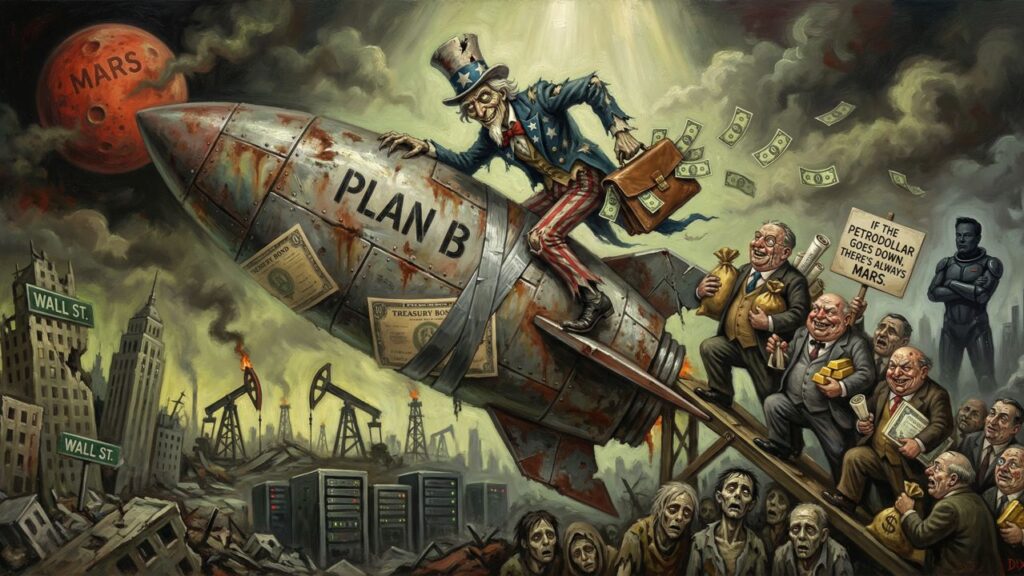
Why the Petrodollar Is Not Just a Currency Arrangement but the Operating System of US Global Power
The petrodollar is not merely a financial convenience. It is the single mechanism that allows the United States to simultaneously run the world’s largest military, sustain a de-industrialized consumer economy, service $40 trillion in debt, project power across 800 overseas bases, and live beyond its means without consequence. Every other empire in history that lost its currency privilege collapsed. The American version of this privilege is the petrodollar, and its loss would be terminal. Here are five reasons why.
Reason One: The Petrodollar Finances the US Military Without Taxation
The United States spends more on its military than the next ten nations combined. The 2023 defense budget was $816 billion, constituting roughly 40 percent of all global military spending, and it is projected to climb to $922 billion by 2038. This level of expenditure would be fiscally impossible for any nation that had to fund it through domestic taxation alone. The petrodollar makes it possible because it creates a closed loop of artificial demand for US government debt.
The mechanism works as follows. When Saudi Arabia or the UAE or Qatar sells oil, the transaction must be denominated in US dollars. The buyer, say Japan or South Korea, must first acquire dollars on the foreign exchange market. The GCC states then accumulate vast dollar surpluses because they sell enormous volumes of crude at a profit and their domestic economies, being small populations in a desert, cannot absorb the revenues. So the surplus dollars get “recycled” back into the United States by purchasing Treasury bonds, equities, real estate, and increasingly, AI data center investments. As Professor Jiang explained on the March 9 broadcast with Diesen, “the Gulf States sell the oil, get petrodollars, and then they recycle it back into the American economy mainly by investing into AI, into data centers, which is now the main engine of growth for the American economy”.
This recycling is what finances America’s permanent war footing. The New York Federal Reserve confirmed that roughly half of the petrodollar windfall historically went to purchase foreign goods, while the remainder was invested in foreign assets, with “the bulk ending up, directly or indirectly, in the United States”. A Federal Reserve research paper put it more bluntly: “dominant reserve currency likely gives the U.S. government access to a much larger investor base, enabling them to borrow more than they would be able to if the U.S. dollar was not a reserve currency. This economic advantage allows the U.S. to finance a large and powerful military more easily”.
Without petrodollar recycling, the United States would have to either tax its own citizens to fund 800 overseas bases and eleven carrier strike groups, or it would have to print the money outright and face immediate inflationary consequences. Neither is politically viable. The petrodollar allows Washington to do what Columbia Business School’s Pierre Yared described as a self-reinforcing loop: “military strength often confers financial advantages, which in turn enable greater military spending”. Break the loop and the empire cannot sustain itself.
Reason Two: The Petrodollar Allows the US to Borrow Without Consequence
The concept the French called the “exorbitant privilege” is not abstract. It means the United States can borrow at lower interest rates than any other nation because there is permanent, artificial, global demand for dollar-denominated assets. Every oil-importing nation on earth must hold dollar reserves just to keep its economy running. Central banks must stockpile Treasuries as insurance against economic shocks. The dollar-denominated securities composing approximately 57 percent of global foreign exchange reserves as of early 2026 are not held because the world loves America. They are held because the petrodollar system leaves no alternative.
This is why the US national debt has reached $40 trillion without triggering a sovereign debt crisis. As Jiang told Diesen, “America has 40 trillion in debt. This debt is a Ponzi scheme. The American economy is sustained by a Ponzi scheme”. He is describing the structural reality that the US borrows to cover its deficits, and the lenders are not making voluntary investment decisions. They are captive participants in a system that requires them to hold dollars in order to buy energy.
The petrodollar system effectively exports American inflation to the rest of the world. When the Federal Reserve prints money to cover deficits, the inflation does not stay domestic because the new dollars are absorbed by global demand for dollar reserves. As the Counterpunch analysis noted, this system “allowed America to run ‘guns and butter’ policies, funding warfare and domestic programs simultaneously, without bankrupting itself”. Peter Schiff, on his March 6 appearance with Diesen, described the inevitable outcome of losing this privilege: “The deficits are going to be in the stratosphere. And so we’re going to be cranking up the printing presses like never before to pay for it. And I think the world’s going to recognize that and move even faster to de-dollarize”.
If the petrodollar collapses, the US would face what every over-indebted nation faces when foreign creditors stop lending: skyrocketing interest rates, currency devaluation, austerity, and the inability to roll over existing debt. The Ponzi scheme Jiang describes only works as long as new money keeps flowing in. The moment GCC petrodollar recycling stops, the music stops.
Reason Three: The Petrodollar Masks the Consequences of De-industrialization
The United States has not been a manufacturing economy for decades. It offshored its industrial base to China and Southeast Asia in pursuit of financial returns, and the petrodollar system is what allowed this to happen without immediate consequences. As Michael Hudson explained in his March 6 conversation with Diesen, “the United States is no longer industrialized. It’s de-industrialized. All this growth of wealth since 2008 has been in the stock, bond, and real estate markets. It’s financial wealth. It’s not the wealth of real production. Living standards have not risen for more than half of Americans since 2008”.
In a normal economy, a nation that stopped making things would see its currency collapse, its trade deficits become unsustainable, and its standard of living plummet. The petrodollar prevents this reckoning. Because every nation must acquire dollars to buy oil, there is permanent demand for the currency regardless of whether America actually produces anything the world wants to buy. The US can import Chinese goods, German cars, Japanese electronics, and Vietnamese textiles, and pay for all of it with dollars that cost nothing to produce because the world has to hold them anyway.
Lyn Alden, the financial analyst, described this as the Triffin Dilemma applied to the petrodollar: “The global accumulation of dollar reserves requires the United States to run a current account deficit. Since desired reserves rise with world nominal GDP, which is growing faster than US nominal GDP, the growth of dollar reserves will raise US external indebtedness unsustainably”. The US runs persistent trade deficits not because of bad policy but because it has to. Dollars must leave the US and enter global circulation for the system to function. Those dollars are earned by foreign exporters who then recycle them into Treasuries, closing the loop.
Remove the petrodollar and the US trade deficit becomes a genuine crisis rather than a structural feature. American consumers would discover what it actually costs to import goods when the world no longer needs to subsidize dollar demand. The Stanford Review put it starkly: “A nation can lose its currency’s supremacy simply by drowning in debt. The US dollar began supplanting the British pound as the world’s premier currency after World War I, not because Britain lost the war, but because it left the war bankrupt”. The US is already $40 trillion in debt. Without the petrodollar’s artificial demand propping up the currency, the debt becomes the anchor that drags the ship down.
Reason Four: The Petrodollar Is the Sanctions Weapon
The ability to weaponize the global financial system is not a side benefit of dollar hegemony. It is perhaps the most potent instrument of American imperial power, more consequential on a day-to-day basis than aircraft carriers. Because virtually all oil transactions pass through dollar-clearing systems, and because the SWIFT messaging network and correspondent banking system are dominated by US institutions, Washington can effectively cut any nation, bank, company, or individual off from the global economy with the stroke of a pen.
This is why Iran was under maximum pressure before the war. This is why Russia faced asset freezes after 2022. This is why Venezuela’s government was strangled economically. This is why Cuba has endured sanctions since 1961. The dollar’s centrality in oil markets gives the US government what the Counterpunch analysis called “a powerful economic weapon: control of dollar-based transactions to reward allies and punish adversaries”.
Hudson, in his March 6 conversation, described how the US deploys this against its own allies. The demand to Japan and Korea to invest $350 billion each in US-directed funds, with the threat of tariffs if they refuse, is only possible because these nations are captive to the dollar system. If Japan could buy its oil in yen or yuan, it would have no reason to hold massive dollar reserves and no vulnerability to US financial coercion. The petrodollar is the chain. Remove it and the US loses not just an economic tool but its primary means of disciplining both enemies and allies without firing a shot.
If the petrodollar collapses, the sanctions weapon becomes a water pistol. Nations that can trade oil in yuan, rubles, rupees, or gold have no reason to clear transactions through New York. They have no reason to hold Treasuries. They have no reason to obey US secondary sanctions. The entire architecture of American economic coercion dissolves. As Jiang observed, the BRICS nations and Iran are already moving toward exactly this outcome, and the Iran war is accelerating the timeline.
Reason Five: The Petrodollar Is the Only Thing Preventing a Depression Worse Than the 1930s
This is Jiang’s most provocative claim, and it is supported by the structural analysis. The American economy in 2026 is built on a financial bubble, not on productive capacity. The stock market is propped up by AI investments. The AI investments are funded significantly by GCC petrodollar recycling. The GCC petrodollar recycling depends on Gulf states being able to sell oil and on the continued existence of the dollar-denominated oil trade. The Iran war threatens all of it simultaneously.
Jiang stated it flatly: “If the Gulf States were to stop investing in America, the AI financial bubble would burst and with it the entire American economy. America would suffer a much greater depression than the 1930s. That’s how dire the situation is for America right now”. The logic chain is direct. The Strait of Hormuz is closed. GCC oil production has shut down. The GCC states cannot sell oil. They cannot generate petrodollars. They cannot recycle those dollars into US Treasuries and tech stocks. The AI bubble, which is the “main engine of growth for the American economy,” loses its funding. An Amazon data center in the UAE has already been hit.
Peter Schiff, from the perspective of a money manager, arrived at the same conclusion from a different angle: “We already had inflationary pressures building. Now, they’re going to build even more. Oil is now almost $90 a barrel. It’s up more than 60 percent so far in 2026. Consumers are going to get hit with the worst of everything. A weakening economy, job losses, a rising cost of living”. Three of the last five monthly job reports showed net job losses even before the war. The war accelerates every negative trend.
Richard Wolff, on his February 27 appearance, described the disintegrating political coalition that would need to manage this crisis: the Republican party fracturing over tariffs, the Epstein scandal eroding trust, the Supreme Court striking down tariffs as unconstitutional, and the impossibility of funding the war, the deficit, and the defense budget simultaneously. His assessment: “He promised to get rid of the deficit, but he also promised to increase the defense budget by 600 billion dollars. And now that the tariffs are gone, he has absolutely no way to pay for any of this. And he’s going to make an expensive war in Iran any minute”.
The convergence is what makes this existential. It is not one variable. It is every variable going negative at the same time: the oil supply disruption, the petrodollar recycling freeze, the AI bubble deflation, the bond market stress, the manufacturing incapacity to fight a long war, the political dysfunction at home, and the accelerating de-dollarization abroad. As the GoldCore analysis summarized it: the petrodollar system “created an artificial, insatiable demand for US paper, allowing Washington to run up tabs that would make a Roman emperor blush. They called it an ‘exorbitant privilege.’ I call it building a financial empire on IOUs, a gilded cage trapping the world in dollar dependency”. When the cage opens, the empire has no clothes.
The Bottom Line
The petrodollar is not one benefit among many. It is the single structural mechanism that allows the United States to be a global empire despite being a de-industrialized debtor nation with $40 trillion in obligations, a hollowed-out manufacturing base, crumbling infrastructure, and profound political dysfunction. It finances the military without taxation. It permits unlimited borrowing without consequence. It masks de-industrialization. It weaponizes the financial system. And it prevents the financial reckoning that would otherwise have arrived decades ago.
Every analyst Scott Ortkiese trusts is saying the same thing from a different angle. Jiang says the GCC states are the Achilles’ heel. Schiff says the dollar will collapse and gold will explode. Hudson says the US is extracting tribute from vassals because it can no longer sustain itself domestically. Wolff says the political system is disintegrating. Armstrong’s cycles point to systemic rupture. The Iran war did not create these vulnerabilities. But by closing the Strait of Hormuz, destroying GCC infrastructure, and accelerating the flight from dollar-denominated assets, it may have lit the fuse on every one of them simultaneously.
Related reading
- How the Tehran and Delhi Settlements Expose a Petrodollar Already Gone, Gone, Gone, Taking the Bellicose American Empire With It.
- The Petrodollar Trap: How the Iran War Threatens to Collapse the Financial Architecture of the American Empire
- The Replacement Is Already Here: What the Petrodollar's Successor Means for Every American
- Never Is Hope So Pure As In The Certainty Of Loss: UAE's OPEC Exit and the Structural Dissolution of the Petrodollar