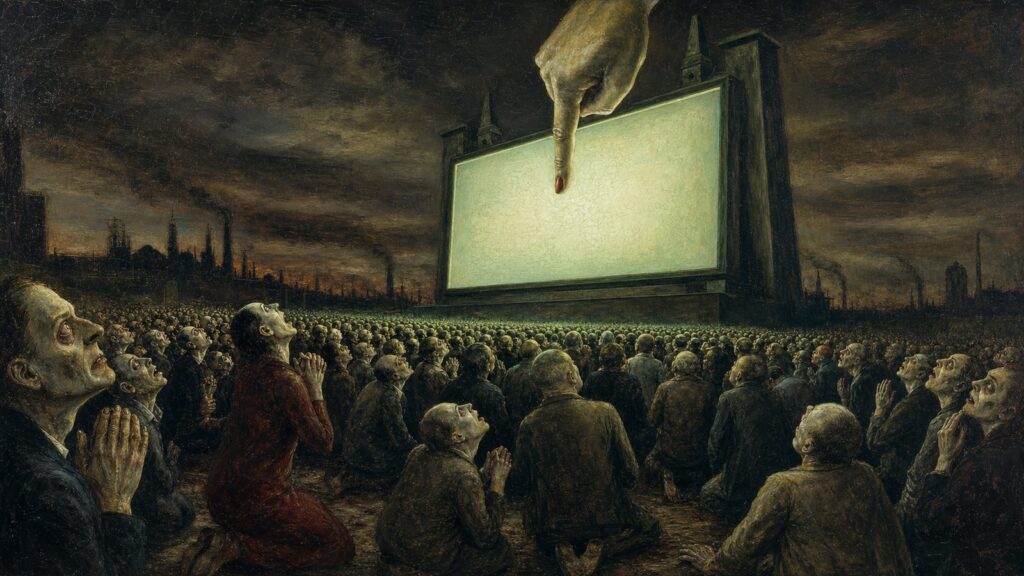
A President Threatening to Erase 90 Million People. A Congress That Won’t Stop Him. A Working Class Footing the Bill.
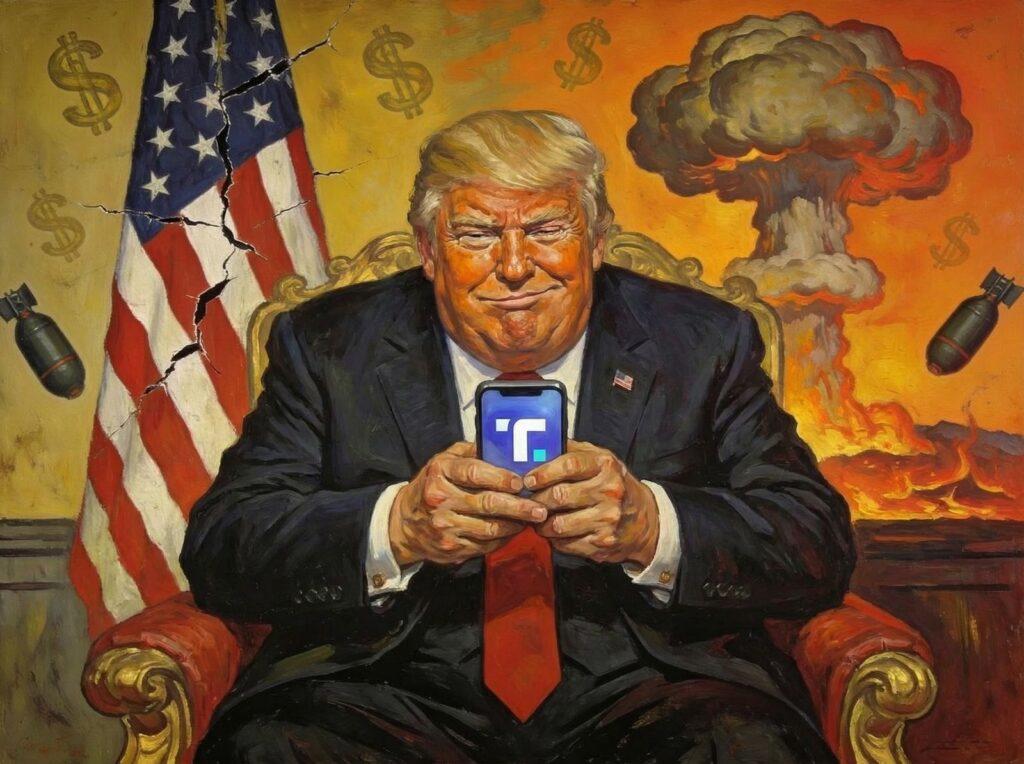
By Scott Ortkiese | so@throughlinesynthesis.com | www.throughlinesynthesis.com
When the American empire finally collapses, historians won’t be stunned by the greed of the elite. They’ll be stunned by the loyalty of the poor.
April 7, 2026. The national average for a gallon of regular gasoline is $4.14 today, up from $3.06 a year ago. The Strait of Hormuz has been effectively closed since February 28, when the United States launched a war against Iran that is now in its sixth week. Iran rejected a U.S. ceasefire proposal yesterday. Trump’s deadline for Iran expires tonight at 8 p.m. Eastern. This morning, the President of the United States posted the following on Truth Social:
“A whole civilization will die tonight, never to be brought back again. I don’t want that to happen, but it probably will.”
Read that sentence again. The President of the United States is threatening, in writing, to erase an entire civilization of 90 million people. He is doing it in your name. He is spending your money. He is burning your gas. And the working-class voters who gave him his majority are paying $4.14 at the pump to fund a war that has killed at least 7,300 people in its first 34 days, including 890 confirmed civilians, with tonight’s escalation not yet counted.
Kevin Barron, former vice president of the Pentagon Press Association, said on air this morning that he has never been more nervous for a night like this in his career. Professor John Mearsheimer, a West Point graduate and one of America’s most cited strategic scholars, said today that what Trump is threatening constitutes genocidal intent, and that if the order comes to destroy Iran as a functioning society, “it is possible there would be a revolt of the generals.” Congress is silent. The mainstream media is performing its customary theater of alarm. And the people who will pay the price in blood, treasure, and gasoline are the same people who cheered the loudest.
Nobody asked them. That is the whole story.
Act I: The Mechanism
One of the most consequential puzzles of modern American politics is not how the wealthy captured the political system. That was entirely predictable. The deeper mystery is how tens of millions of working-class Americans were persuaded to cheer for it. Over the past half-century, a working class that once formed the bedrock of the New Deal coalition has been systematically redirected away from its own economic interests and toward a politics of cultural grievance, tribal identity, and manufactured resentment. The mechanism was not fraud, not voter suppression, and not any single conspiracy. It was something more durable and more insidious: the replacement of economic solidarity with emotional reward. And the price of that substitution is now being paid in gas prices, gutted healthcare, and a war that tonight threatens to become a genocide.
The political realignment of the American working class did not happen overnight. White working-class voters were the electoral foundation of the Democratic Party from the New Deal era through the 1960s. That alignment began to fracture with the Civil Rights Act of 1964, when President Lyndon Johnson reportedly told an aide that Democrats had “lost the South for a generation.”
What followed was one of the most deliberate political engineering projects in American history. Nixon’s Southern Strategy, articulated most explicitly by campaign advisor Kevin Phillips and RNC Chairman Lee Atwater, married the corporate elite’s hostility to taxation and regulation with the cultural conservative’s hostility to civil rights, women’s rights, and social inclusion. The genius of the formula was its adaptability: coded language like “law and order,” “states’ rights,” and “welfare dependency” activated racial resentment among one constituency while remaining deniable to moderate voters. Race was the original wedge, but it established the template for every subsequent culture war: abortion, gay marriage, immigration, and now, in its most fully realized and most dangerous form, the performative nationalism that tonight is threatening to burn a civilization to the ground.
Thomas Frank diagnosed this dynamic with devastating clarity in What’s the Matter with Kansas? (2004), documenting how the conservative movement shifted American political discourse from economic equality to explosive cultural issues that redirected working-class anger toward “liberal elites” rather than toward the corporations systematically dismantling their livelihoods. Frank warned in 2004 that Kansas’s political realignment would go national. It did. Most fully in 2016, when Trump won 62 percent of the white working-class vote. Most catastrophically in 2024, when that same coalition handed him a second term and a war with no exit.
The key insight is this: the working class was not simply deceived about the facts. Working-class voters consistently tell pollsters they support higher taxes on the wealthy, stronger unions, expanded healthcare, and higher minimum wages. In 2024, 63 percent of working-class voters supported raising tax rates on incomes above $400,000. They were not confused about their economic interests. They were offered something more emotionally immediate: the satisfaction of punishing someone they had been told to resent. They voted against their interests not because it helped them, but because they were told it would hurt someone else.
That realignment is now being stress-tested in real time. A CNN/SSRS poll conducted March 26 through 30, 2026, found that white working-class voters have turned net-negative on Trump for the first time in his second term. His net approval among white non-college graduates now stands at minus one. Twelve months ago it was plus eleven. The mechanism Frank described is intact. The emotional transaction is collapsing under the weight of $4 gas and a president threatening genocide on Easter week.
Act II: The Ledger
The historical record of what working-class voters actually received from the political movement they sustained is not ambiguous. It is a ledger written in cuts, closures, and casualties.
Reagan’s tax cuts delivered an average reduction of $695 for middle-class households while delivering $47,147 to households in the top 1 percent, a ratio of 68 to 1. For the bottom half of American income earners, average income actually declined during Reagan’s presidency, falling from $16,371 in 1980 to $16,268 by 1988, after adjusting for inflation. The promised trickle-down never trickled. Four decades of tax cuts fueled the most dramatic concentration of wealth in American history.
The pattern repeated. Trump’s 2017 Tax Cuts and Jobs Act disproportionately benefited corporations and the wealthiest households. His signature domestic achievement of the second term, the One Big Beautiful Bill Act, signed July 4, 2025, is not a future threat. It is current law. It contains $863 billion in Medicaid cuts and $186 billion in SNAP reductions, the largest cut to food assistance in the program’s 60-year history, a 20 percent reduction. The Congressional Budget Office projects 5.3 million people will lose Medicaid coverage through new work requirements alone, with broader projections reaching 7.8 million. The Commonwealth Fund estimates the combined cuts will reduce state GDPs by $154 billion in 2029, eliminate 1.22 million jobs, and raise the national unemployment rate by 0.8 percentage points. The cuts cost the country more in economic activity than they save the federal government in outlays.
A majority of Trump’s own voters, according to polling by his own 2024 campaign pollster Tony Fabrizio, opposed the Medicaid cuts. Two-thirds of swing voters disapproved of slashing the program to finance tax cuts for the wealthy. They got the cuts anyway. They will continue to support the party that delivered them, because the emotional transaction that drives their loyalty has nothing to do with policy outcomes.
And then there are the tariffs. Trump promised to lower prices on Day One. One year after Liberation Day, American households paid an average of $1,000 more in 2025 for the same goods they purchased the year before. Congressional analysts project the 2026 household cost at $2,512. Lower-income families, who spend a larger share of their income on food, clothing, and transportation, absorb the greatest burden. The Yale Budget Lab estimates peak tariff pressure on consumer prices will arrive between April and October 2026, precisely midterm election season. One year after Liberation Day, 89,000 manufacturing jobs have been eliminated and 124,000 transportation and warehousing jobs have vanished, the exact sectors Trump promised to revive. The working class voted for lower prices and more jobs. It is receiving the opposite on both counts.
This is the ledger before the war. The war has its own accounting.
Act III: The Iran Connection
The war against Iran, launched February 28, 2026, was not demanded by the American working class. It was not started to protect working-class jobs, lower energy costs, or expand healthcare. It was driven in significant part by Israeli lobby pressure, Netanyahu’s regional ambitions, and an administration that, as John Mearsheimer has argued for years and confirmed on air this morning, believed incorrectly that shock and awe would produce a quick Iranian capitulation. The American working class was not consulted. It was handed the bill.
Within weeks of the war’s start, Brent crude surged 50 percent, from $67 to over $100 per barrel. Gas prices climbed from $2.98 to $4.14 nationally, the largest month-to-month spike since October 1990. Diesel reached $5.62 per gallon, a 49 percent increase. JPMorgan warns prices could top $5 nationally if the Strait remains closed through mid-April. California is approaching $6 per gallon. The 52-year-old woman at a California gas station who told Al Jazeera “the prices have a big impact because I’m not working right now” was not an abstraction. She was the constituency that handed Trump his 2024 majority, and she is now absorbing the economic consequence of a war fought for goals she was never asked to endorse.
Here is the fact that should end the debate about who this war serves. Alastair Crooke, former senior British diplomat and director of the Conflict Forum, reported this morning that in the first month of the war, Iran earned double its previous monthly oil revenues, approximately $850 million in a single day. Every nation that wants its energy supply intact must now negotiate with Tehran. The war that is bankrupting working-class Americans at the pump is simultaneously making Iran richer than it has been in recent memory. The enemy is not suffering. The enemy is profiting. The working class is paying.
The human cost compounds daily. At least 7,300 people have been killed in the war’s first 34 days, including at least 890 confirmed civilians. Human rights organizations report over 1,400 civilian deaths in the first three weeks alone. These are not military targets. They are people. They are being killed in the name of the American working class, which was not asked, and which is now too busy worrying about its mortgage to protest.
U.S. mortgage rates have climbed for a fifth straight week. Home purchase applications have fallen 3 percent. Refinance applications have dropped 17 percent. Analysts warn that if the Federal Reserve is forced to raise rates in response to war-driven inflation, major U.S. indices, already down 5 to 8 percent, could fall into bear-market territory, taking the retirement savings of working families with them.
Mearsheimer stated plainly this morning: “Trump has not accomplished any of the goals he set out to achieve.” Regime change: no. Seizure of enriched uranium: no. Degrading of ballistic missiles: no. Reopening of the Strait of Hormuz: no. Six weeks in, American military planners have run out of military targets of consequence. What the administration is now contemplating is a punishment campaign aimed at civilian infrastructure: power plants, bridges, hospitals, universities. Colonel Jack Jacobs, Medal of Honor recipient, put it directly: when an attitude that “it doesn’t matter what you do” filters down through the chain of command, “it is very, very dangerous.” Firas Maksad of the Eurasia Group warned that threatening to annihilate a civilization is counterproductive precisely because it unifies Iranian patriotism behind the regime, handing the mullahs exactly the internal solidarity the war was supposed to deny them.
U.S. intelligence assessed as recently as April 3 that Iran is unlikely to reopen the Strait any time soon, viewing its control of the chokepoint as its primary strategic leverage. Tehran is deliberately weaponizing American gas prices as its principal instrument. The enemy in Trump’s war has made the working-class American voter its most effective weapon.
The political reckoning is underway. Among adults earning below $50,000, Trump’s approval has collapsed to 29 percent, with disapproval at 70 percent, a net of minus 41. The UMass Amherst poll released March 29 puts his overall approval at 33 percent, his lowest of the second term, down 11 points in a year. Sixty-three percent of Americans disapprove of his handling of Iran. Independents have reached a record net approval of minus 43. The voters who cheered loudest are paying the most, and for perhaps the first time in this cycle, the economic pain is too immediate and too personal to be redirected through cultural grievance toward an imaginary enemy.
Act IV: The Consequences
What happens when a democracy wages an unjust, unprovoked war of aggression? What happens when its president publicly orders the destruction of a civilization? The answer is not theoretical. It is unfolding right now across six distinct and compounding categories of consequence.
Economic. Goldman Sachs has raised the probability of a U.S. recession within the next twelve months to 30 percent. EY-Parthenon puts it at 40 percent. If oil reaches $150 a barrel, PNC’s chief economist says the odds of recession top 50 percent. Goldman projects unemployment climbing to 4.6 percent by year end. Food prices are rising, driven in part by disrupted fertilizer supply chains from the Gulf. Airlines are adding fuel surcharges. The U.S. Postal Service has imposed an emergency 8 percent postage surcharge. Economic models project global GDP losses ranging from $330 billion in a short conflict to $2.2 trillion if the war drags on. The working class, which has no financial buffer, absorbs the first and deepest shock of every one of these ripples.
Financial and Structural. Bloomberg reported this week that the Iran war has broken the petrodollar. The 52-year arrangement under which Gulf states priced oil in dollars and recycled surpluses into U.S. Treasuries, the financial architecture that allowed America to run permanent deficits and project global power, is fracturing. Gulf states are spending down reserves on air defense and reconsidering their investment commitments to the United States. The dollar’s share of global foreign exchange reserves has already fallen to 56.9 percent, its lowest level since 1995 and down from 72 percent in 2001. The U.S. national debt stands at $39 trillion. Annual interest payments are approaching $1 trillion. Iran is demanding yuan for oil. The petrodollar system that underwrote American prosperity and working-class living standards for half a century is being dismantled, not by China’s patient strategy, but by Trump’s reckless war.
Geopolitical. The NATO alliance is fracturing in real time. Spain has closed its airspace to U.S. military aircraft. Italy has denied landing rights. France has blocked weapons shipments. Poland has refused to redeploy its Patriot batteries. Trump has threatened trade retaliation against Spain and told allies to “go get your own oil.” Secretary of State Rubio has said NATO requires “re-examination.” Trump has told The Telegraph he is “seriously contemplating” withdrawing from NATO. Iran had not attacked the United States before February 28. Article 5 of the NATO treaty was never triggered. Allies had no obligation to join. They were simply asked to clean up a mess they had no part in making. Russia and China, watching from the sidelines, have not had to lift a finger. The United States has lost more soft power in six weeks than it accumulated in a decade.
Legal. The Nuremberg Tribunal, established by the United States, defined the crime of aggression as “the supreme international crime, differing only from other war crimes in that it contains within itself the accumulated evil of the whole.” Nuremberg Principle III states explicitly that the fact that a person acted as Head of State does not relieve them from responsibility under international law. Iran has filed 16 formal letters with the International Criminal Court demanding condemnation of what it calls an unprovoked war of aggression. The Iranian Red Crescent has formally petitioned the ICC to investigate documented attacks on water facilities, electricity infrastructure, civilian industrial facilities, and transportation networks, all prohibited under Article 54 of Additional Protocol I of the Geneva Conventions. Luis Moreno Ocampo, founding chief prosecutor of the ICC, said this week that Trump’s threats to destroy Iranian infrastructure could constitute war crimes under the same legal framework used to indict Vladimir Putin for destroying Ukraine’s civilian electricity system. The Guardian’s legal correspondent wrote today: “There is no question that Trump’s threats, if carried out, would amount to war crimes.” The President of the United States is, as of this morning, openly threatening to commit acts for which American prosecutors once sent German leaders to the gallows at Nuremberg.
Societal. The war is doing to American civil society what all unjust wars do: it is demanding that citizens become complicit in atrocities they were never asked to authorize. At least 890 confirmed civilians are dead. Iranian civilians are forming human chains around power plants tonight, not because they love the regime that has oppressed them for 47 years, but because a foreign president has threatened to erase them and they have nowhere else to stand. Every American who pays taxes, buys gas, or deposits a paycheck into a bank that holds U.S. Treasuries is financing this. The moral cost of that complicity is not abstract. It is the specific, named weight of 890 civilian deaths and counting, laid at the feet of a working class that was never consulted and never consented. A democracy that cannot stop its own president from threatening genocide has ceased to function as a democracy.
Historical. Robert H. Jackson, America’s chief prosecutor at Nuremberg, said: “The ultimate step in avoiding periodic wars, which are inevitable in a system of international lawlessness, is to make statesmen responsible to law.” Tonight, a sitting American president is threatening to do what the Nuremberg Tribunal was designed to prevent. If he carries out that threat, the United States will have not merely violated international law. It will have destroyed the legal architecture it built at the cost of 400,000 American lives in World War II, and done so in six weeks, on Truth Social, while working-class Americans paid $4.14 for the gas to drive to jobs that may not exist by the time the recession arrives.
Act V: The 25th Amendment and the Historians’ Verdict
Let us use the correct word.
The United Nations Convention on the Prevention and Punishment of the Crime of Genocide defines genocide as acts committed with intent to destroy, in whole or in part, a national, ethnic, racial, or religious group. This morning, the President of the United States posted that “a whole civilization will die tonight, never to be brought back again.” He followed it by writing: “God bless the great people of Iran.” In one post he announced their annihilation and offered them his blessing. He has done this in your name, with your taxes, using your military, while you pay $4.14 to put gas in your car.
Professor Mearsheimer said this morning: “He’s talking about wiping the entire civilization of Iran off the face of the earth. If this isn’t genocidal intent, I don’t know what is. This is the kind of rhetoric you expect from Adolf Hitler, not from President Trump. It just shows you that something is fundamentally wrong here.” He added: “What he’s doing is being done in our name, and it appears that nobody’s willing to stand up to him.”
Nobody is standing up to him. That is the second half of the story.
The 25th Amendment, Section 4, provides that the Vice President and a majority of the Cabinet may declare the President unable to discharge the powers of his office. It has never been invoked. This week, Iran’s embassies around the world posted the same message: “Seriously think about the 25th Amendment, Section 4.” Democratic members of Congress have issued formal calls for the Cabinet to act. Judge Andrew Napolitano, a former federal judge, opened his broadcast this morning quoting Jefferson: “What if sometimes to love your country you had to alter or abolish the government? What if Jefferson was right?”
Mearsheimer, asked directly what Americans can do if the president is “crazy,” answered without comfort: “We have the 25th Amendment, and it’s up to people inside the administration at its highest levels to try to remove him from power if they think that’s necessary. But I don’t see any evidence that people at the highest levels of the administration think that he’s crazy.” The linchpin is JD Vance. This is the same man who was reportedly up all night before Easter attempting to broker a ceasefire through Pakistan. He is not invoking the 25th Amendment. He told reporters this morning that the Iranians “are not the fastest negotiators.” He is waiting to see what happens at 8 p.m.
There is one more thing that must be said. President Trump publicly instructed his followers to watch a Mark Levin broadcast on Easter weekend. In that broadcast, Levin used the Battle of Okinawa as his frame to argue that nuclear weapons represent “an act of peace” and urged the President to consider their use against Iran. Tucker Carlson, on air, called it “an argument being test-driven.” Mearsheimer’s response was exact: “The comparisons with Okinawa are laughable. Thirteen Americans have died. It’s regrettable, but to compare this to Okinawa is absurd.” The man whispering nuclear options into the President’s ear is not a general. He is a Fox News host. And the President of the United States told his voters to watch.
No law was broken. Elections were held. Votes were counted. The consent of the governed was formally obtained. What was subverted was not the mechanism of democracy but its premise: that citizens vote in pursuit of their own interests and the common good. When that premise is successfully replaced with tribal identity and the emotional reward of punishing designated enemies, the formal machinery of democracy becomes a vehicle for its own subversion. The billionaires get richer. The healthcare gets cut. The tariffs raise prices. The war gets started. The civilization gets threatened. And the working class, having been told that someone else is to blame, lines up to vote for it again.
Mearsheimer said this morning: “It’s just horrible where we are.”
Historians will not be stunned by the greed of the elite. The elite behaved exactly as elites always behave. They will be stunned that the machinery of democracy was turned into a weapon against the very people it was designed to protect. They will be stunned that the legal principles the United States wrote in the ruins of World War II were discarded by an American president threatening genocide on Truth Social, while a Fox News host lobbied for nuclear weapons and a compliant Congress looked the other way. They will be stunned that every constitutional safeguard designed to prevent this moment is sitting unused, because the one man who could activate it is watching the clock.
The question that remains is whether the pain has finally become too immediate, too personal, and too undeniable to be redirected one more time before November 3rd.
Or whether tonight changes everything.
Related reading
- A Bill of Indictment for Murder and Genocide Against the American Military and Trump, as its Commander and Chief
- A Lying Bastard’s Ledger: A Hundred Days of Donald Trump, Convicted by His Own Truth Social Account
- Trump’s Truth Social: The Unfiltered Record, An Objective Analysis
- American Empire in Ruins: The Unprovoked, Unconstitutional, and Catastrophic US-Israeli War on Iran